Montage Residences and Pendry Residences Report Benchmark Year in 2020

ORANGE COUNTY, Calif., Jan. 27, 2021 /PRNewswire-PRWeb/ — Today, Montage Residences and Pendry Residences,…

ORANGE COUNTY, Calif., Jan. 27, 2021 /PRNewswire-PRWeb/ — Today, Montage Residences and Pendry Residences, a distinct portfolio of exclusive private residences in storied settings across the U.S., Mexico, and Bahamas, announce a strong benchmark year in 2020, with over $275 million in branded residential sales, multiple development announcements, and the introduction of innovative technologies during an ever-changing residential market. With unique locales, incomparable amenities and gracious and attentive service, Montage and Pendry Residences experienced strong demand throughout the year from discerning buyers and demonstrated impressive growth across a $4.5 billion portfolio in branded residential real estate.

In 2020, technology changed the way people live and work around the world. Montage International quickly and strategically adapted, virtually connecting with owners and potential buyers by conducting virtual home tours, selling numerous residences sight unseen. Through a collaboration with the world’s leading wellness real estate technology company, DelosTM, Montage Residences and Pendry Residences continue to respond to the needs of today’s luxury buyers, introducing new residential amenities and technologies that provide access to homeowners across its portfolio. Certain residences will feature Delos’ DARWINTM Premier offering, a combination of products, features, technologies, and services to create and maintain indoor environmental conditions that are designed to enhance health, well-being, and performance.

Highlights of residential success from 2020 include:

Unique developments announced within the portfolio, seeing immediate, strong sales interest

  • Pendry Residences Park City experienced continued impressive demand ahead of the community’s Winter 2021 opening with over 90% of the residences sold, marking over $200 million in total real estate sales and exceeding $100 million in sales in 2020 alone. Currently, less than 15 residences remain available for purchase within this luxury mountainside development.
  • The Residences at Montage Cay, the brand’s first ever private island and Caribbean development debuting in 2023 in The Abacos, Bahamas, was announced and commenced a Founding Owner sales program unveiling a select collection of residences.
  • Montage Residences Big Sky, where Montana life awaits and scheduled to open in November 2021. More than half of its residences currently available are under contract through a private real estate offering.

New properties prepare to welcome residents in celebrated settings

  • Pendry Residences West Hollywood by Montage Hotels & Resorts will begin welcoming owners in Spring 2021. Along the famed Sunset Boulevard, this property offers a resident-only arrival, private rooftop pool, lounge, garden deck and more. In partnership with McLaren, a custom showroom garage is also available for one Pendry resident.
  • Montage Residences Healdsburg, the brand’s first wine country destination, unveiled a collection of 25 turn-key Harvest homes and 15 build-ready Estate homesites. The residential designs blend seamlessly into the contours of the land, emphasizing privacy and indoor-outdoor living for those seeking a comfortable, yet refined retreat.

Technology changes the way we live and work

  • Pendry Residences Natirar, located one hour outside of New York City in Somerset County, N. J., debuted Delos’ DARWIN Premier technology in each Farm Villa residence to help optimize well-being through cleaner air and water and circadian lighting and by creating purposeful spaces to promote mindful living.
  • Montage Residences Kapalua Bay offers buyers a final opportunity for turn-key living on Maui with a select number of move-in ready residences remaining for sale. A number of buyers who purchased in 2020 engaged virtually as sight unseen buyers familiar with the brand and destination confidently moved forward with purchasing their second home to enjoy for years to come.

«In the current climate, it’s never been more important to create a home that provides effortless experiences, world-class hospitality, and ultimately benefits owners’ well-being» said Tina Necrason, executive vice president of residential, Montage International. «In 2020, we saw people putting a greater emphasis on family and spending time together, in addition to their health, appreciating the natural beauty of destinations such as Park City, Big Sky, Los Cabos and The Abacos. This is the true essence of the lifestyle we provide, and when our homeowners aren’t with us on property, they rest assured knowing their homes are taken care of and their community awaits. As a brand, we are excited to continue to pivot to the needs of the buyer, whatever they may be, and offer a multi-faceted and evolving collection with an array of wellness and technology capabilities.»

Blending amenities and services of the world-class hotels and resorts with the comforts of home, each Montage and Pendry Residence provides owners a lifestyle that is refined and relaxed, with dedicated places to gather and create new memories together. The distinct collection presents buyers with turn-key ownership, meeting every need whether in residence or from afar with a personalized suite of residential services. Asset preservation, property management, and the flexibility of optional rental management programs are delivered by the award-winning Montage and Pendry staff. The privileges of ownership extend beyond the home through a thoughtful array of benefits and services, from travel excursions and special-occasion planning, as well as other bespoke offerings to provide effortless second home living.

Furthering the company’s dedication to ensuring the well-being of its guests, associates and residents, Montage International implemented its Peace of Mind Commitment in 2020, an enhanced prescriptive health and safety protocol program throughout the entire portfolio including a partnership with One Medical.

For additional information on residential opportunities, please visit http://www.distinctlivinghome.com. To learn more about Montage Hotels & Resorts, please visit http://www.montagehotels.com. To learn more about Pendry Hotels & Resorts, please visit http://www.pendryhotels.com.

###

About Montage Residences
Montage Residences is the esteemed collection of residential communities within Montage Hotels & Resorts, the ultra-luxury hospitality management company founded by Alan J. Fuerstman in 2002. Designed to serve affluent and discerning homeowners, Montage Residences offers a distinctive lifestyle that embodies the authenticity of each coveted destination paired with sophisticated touches tailored to each resident’s personal desires and individual tastes. Living spaces reflect distinguishing characteristics captured through stunning locations and genuine sense of place, while signature services and amenities are seamlessly delivered to provide the most carefree lifestyle for every resident. The Montage Residences portfolio includes: Laguna Beach, Deer Valley, Kapalua Bay, Palmetto Bluff, and Los Cabos. A future collection of Montage Residences is planned for La Quinta, California; Healdsburg, California; Big Sky, Montana; and Bahamas, The Caribbean. For additional information on residential opportunities, please visit http://www.montageresidences.com.

About Pendry Residences
Pendry Residences is a bespoke collection of private, whole ownership residential offerings at select Pendry Hotels & Resorts, a new luxury hospitality brand from Montage International. Pendry combines inspired design with a celebration of culture and authentic service. Created for cultured and discerning homeowners, each residential offering infuses a unique perspective on contemporary style that blends with the arts and local community. The Pendry Residences portfolio under development includes: West Hollywood, California; Natirar, New Jersey; La Quinta, California; and Park City, Utah. For additional information on residential opportunities, please visit https://www.pendry.com/residences/.

About Montage International
Montage International, the ultra-luxury hospitality management company founded by Alan J. Fuerstman, features a distinctive collection of hospitality brands. Montage International encompasses the ultra-luxury brand Montage Hotels & Resorts, the new luxury hospitality brand Pendry Hotels & Resorts, Montage Residences, Pendry Residences and the management of some of the country’s premiere golf courses and clubs. Founded in 2002, Montage Hotels & Resorts is an artistic collection of distinctive hotels, resorts and residences including: Montage Laguna Beach, Montage Deer Valley, Montage Kapalua Bay, Montage Palmetto Bluff, Montage Los Cabos and Montage Healdsburg. Opening in 2021 is Montage Big Sky, opening in 2022 is Montage La Quinta, and opening in 2023 is Montage Cay. Pendry Hotels & Resorts, founded in 2014, is a collection of new luxury hotels for today’s cultured world traveler located in taste making destinations including Pendry San Diego and Sagamore Pendry Baltimore. Opening in 2021 is Pendry West Hollywood, Pendry Manhattan West, Pendry Park City, and Pendry Chicago. Opening in 2022 is Pendry La Quinta, Pendry Natirar, and Pendry Washington D.C. – The Wharf. Montage International also manages and operates Spanish Peaks Mountain Club in Big Sky, Montana and The May River Golf Club in Bluffton, South Carolina. For more information, please visit http://www.montage.com.

Media Contact

Chrissy Bruchey, C&R, +1 310.664.8888, chrissy@candrpr.com


SOURCE Montage Residences and Pendry Residences

Los Angeles Area Chamber of Commerce Charts a Bold Path Ahead Toward Economic Recovery & Installation of New Board Chair During 2021 Inaugural Awards Program

LOS ANGELES, Jan. 27, 2021 /PRNewswire/ — The Los Angeles Area Chamber of Commerce hosts its 133rd annual Inaugural Awards, a celebration of bold leadership and hope for our region. The event themed, «Together for Tomorrow,» also marks the Chambers’ vision for regional economic recovery for the year ahead.

«The last year has been difficult on many levels. Not only did the pandemic disrupt business and decimate small businesses, but it also shed light on the deep inequities in our communities…

LOS ANGELES, Jan. 27, 2021 /PRNewswire/ — The Los Angeles Area Chamber of Commerce hosts its 133rd annual Inaugural Awards, a celebration of bold leadership and hope for our region. The event themed, «Together for Tomorrow,» also marks the Chambers’ vision for regional economic recovery for the year ahead.

«The last year has been difficult on many levels. Not only did the pandemic disrupt business and decimate small businesses, but it also shed light on the deep inequities in our communities of color. This annual awards program is an opportunity to focus on the critical work in the coming year for recovery and to celebrate those whose work inspire us. Our event theme, Together for Tomorrow, is a signal of hope, we still believe that together, our region can create a better tomorrow,» said Maria S. Salinas, President & CEO of the L.A. Area Chamber. 

The Inaugural Awards also marks the installation of the incoming 2021 Chamber Board Chair, Raul A. Anaya, President of Business Banking at Bank of America and Market President for Greater Los Angeles where he oversees the bank’s local corporate and social responsibility activities, including philanthropic giving, community development lending and investing, as well as support for the bank’s 8,000 employees in the Greater Los Angeles area. During a time when economic recovery will be a top priority, Raul joins a long line of Chamber leadership dedicated to the Los Angeles region.

Local and statewide civic leaders, business thought leaders and philanthropists will be in attendance. The event will recognize extraordinary leadership with the presentation of the Civic Medal of Honor, Corporate Leadership, and Beacon of Light Award.

Awards Presented:

  • Corporate Leadership Award will be presented to Ralphs, the Southern California supermarket chain, inspired us with their response to the pandemic, dedicated to feeding the human spirit through their Zero Hunger Zero Waste program. Their work in feeding communities in need during the pandemic, providing rapid antibody tests to customers and as essential workers during the pandemic provided a safety net our communities could rely upon.
  • Civic Medal of Honor will be presented to Constance L. Rice, for her incomparable work as a civil rights activist, author, lawyer, advocate and leader, known and respected for fighting systemic injustice, equity and advancing democracy.
  • Beacon of Light Awards will be presented to our championship teams who have given us hope of a brighter tomorrow, the LA Dodgers and the LA Lakers. As champions, on and off the field, they inspire, support our communities, provide entertainment and hope, not only to sports fans but to all of us.

The event is virtual this year, open to the public and free to attend. We encourage everyone to join us as we celebrate the bright road ahead of the Los Angeles region in 2021. Additional information may be found at https://lachamber.com/inaugural-dinner/.

About Los Angeles Area Chamber of Commerce
The Los Angeles Area Chamber of Commerce represents the interests of business in the Los Angeles region. The Chamber’s mission is to design and advance opportunities and solutions for a thriving regional economy that is inclusive and globally competitive. Founded in 1888, the Chamber is the oldest and largest business association in the region. Its member companies work together to promote a prosperous economy and quality of life in the Los Angeles region.

For more information, visit www.lachamber.com 

CONTACT: Shannon Smith, 213-580-7532, ssmith@lachamber.com


Cision View original content:http://www.prnewswire.com/news-releases/los-angeles-area-chamber-of-commerce-charts-a-bold-path-ahead-toward-economic-recovery–installation-of-new-board-chair-during-2021-inaugural-awards-program-301216682.html

SOURCE Los Angeles Area Chamber of Commerce

The Vertex Companies, Inc. Acquires Lockwood, Kessler & Bartlett, Inc. to Expand Design & Other AEC work in New York

WEYMOUTH, Mass., Jan. 27, 2021 /PRNewswire-PRWeb/ — LKB has exciting infrastructure projects underway, bringing their engineering design, construction administration, environmental, and energy consulting services together on projects around the state. LKB’s clients in the public sector include: the NYS Office of Parks, Recreation & Historic Preservation; the New York State Thruway Authority; the New York State Department of…

WEYMOUTH, Mass., Jan. 27, 2021 /PRNewswire-PRWeb/ — LKB has exciting infrastructure projects underway, bringing their engineering design, construction administration, environmental, and energy consulting services together on projects around the state. LKB’s clients in the public sector include: the NYS Office of Parks, Recreation & Historic Preservation; the New York State Thruway Authority; the New York State Department of Transportation; and several county Public Works Departments. Their projects include overpasses, bridges, roadways and state parks among others. Some notable projects include the award-winning NYS Route 347 Design-Build project, for which LKB served as the lead designer. This $36 million fast-track highway improvement project was completed in under 18 months, and received the highest sustainable design rating under the GreenLITES program, as well as the 2018 Outstanding Engineering Achievement Award from the New York State Society of Professional Engineers (NYSSPE), Long Island Chapter. LKB has also been involved in construction administration for numerous high profile highway and bridge projects, such as the complex $40 million replacement of the historic Crane Road Bridge in Scarsdale, NY. This multi-span concrete «mushroom bridge» was originally constructed in 1925 and required significant improvements. In addition, they have managed the construction of approximately 15 miles of a High Occupancy Vehicle (HOV) lane along the Long Island Expressway (LIE), under four separate construction contracts totaling over $200 million. This work included widening the mainline of the LIE, upgrading services roads, as well as reconstruction, replacement, and removal of bridges.

LKB also includes a broad team of mechanical, electrical and environmental engineers and technical professionals who support the public and private sector on real estate development and renovations such as: medical buildings, industrial properties, museums, marinas, airports, offices, and higher education campuses to list a few.

For Vertex, this acquisition augments its East Coast presence and expands its services in engineering and construction administration. «We could not be more excited about the acquisition of LKB. Founded in 1889 and in operation for over 130 years, LKB is a piece of engineering history. We are honored to have them as part of our team» said Jeffrey Picard President of Vertex. «Since my first meeting with LKB’s owners and executives, it was abundantly clear that our corporate cultures were in alignment, and LKB’s various practices would complement and expand Vertex’s core services, particularly in New York. Our mutual dedication to our clients, our teammates, and our ever-commitment to deliver first-class professional services will allow us to continue our growth journey into the future.»

For LKB, Vertex provides the right fit, as it is an employee-owned company that offers the expanded resources of a multi-disciplinary firm throughout its North American presence. Andre Haddad, President and CEO of LKB said, «Vertex offers LKB a tremendous geographical presence and breadth of resources enabling us to provide an expanded array of services to our clients. Together, the combination of our distinctive resources and areas of expertise give us a great advantage to provide unparalleled service to the industry.»

Steve Hanuszek, Executive Vice President of LKB said, «The complimentary nature of the specialized services offered by each firm generates an excellent environment for collaborative development. I truly believe this venture will benefit each organization and will provide tremendous opportunities, not only for the growth of both companies, but also for the professional advancement of our employees.»

Andrew Chagnon, managing director of Vertex said of the acquisition, «Being growth focused has shown Vertex that with growth comes opportunity. We see the addition of LKB to the Vertex team not only as a great opportunity for both organizations, but more importantly for the people that truly are the organizations. In addition, we have a deep respect for the Lockwood Kessler & Bartlett legacy, and we look forward to working together to extend this legacy for decades to come.»

Vertex is an employee-owned AEC firm that offers forensic consulting, design engineering, environmental services, construction services, and digital solutions throughout the globe. Vertex is value driven and cares about its clients and employee-owners. Since incorporation in 1995, Vertex has maintained an annual growth rate of over 20 percent and is routinely ranked by ENR as a top construction, environmental, and engineering design firm. Also, for the past five years, industry benchmarks based on employee surveys have ranked Vertex one of the best firms to work for.

VERTEX is pleased to have worked with The Environmental Financial Consulting Group (EFCG), which initiated this transaction and served as VERTEX’s financial advisor.

Media Contact

Lisa Dehner, The Vertex Companies, Inc., +1 978-618-5853, ldehner@vertexeng.com

Bill McConnell, The Vertex Companies, Inc., 303-623-9116, wmcconnell@vertexeng.com

Twitter, Facebook


SOURCE The Vertex Companies, Inc.

Illinois Sportsbooks Reach $450 Million In November, Hitting Yet Another Rare Milestone, According to PlayIllinois

LAS VEGAS, Jan. 27, 2021 /PRNewswire/ — Illinois online and retail sportsbooks collected more than $450 million in wagers in November, setting a fresh record for monthly handle to place fourth among legal sports betting markets in the U.S. It’s a remarkable ascent for a fledgling market that has become the fourth state in history to enjoy a month with more than $450 million in bets, according to <a target="_blank"…

LAS VEGAS, Jan. 27, 2021 /PRNewswire/ — Illinois online and retail sportsbooks collected more than $450 million in wagers in November, setting a fresh record for monthly handle to place fourth among legal sports betting markets in the U.S. It’s a remarkable ascent for a fledgling market that has become the fourth state in history to enjoy a month with more than $450 million in bets, according to PlayIllinois, which offers news and analysis of the state’s gaming industry.

«Illinois’ success is more than just a large population fueling impressive numbers that dwarf smaller states,» said Jessica Welman, analyst for PlayIllinois.com. «Illinois is rivaling markets such as Pennsylvania that are far more mature and just as large, and it’s doing it because the top online sportsbooks in the country are investing heavily in the market and Illinois bettors are responding with an unprecedented fervor.»

Illinois bettors placed a record $451 million in wagers in November, according to «approximate» data released Wednesday by the Illinois Gaming Board. That is up nearly 4% from $434.6 million in October. Only New Jersey ($931.6 million) and Nevada ($609.4 million) — the two oldest legal sports betting markets in the U.S. — and Pennsylvania ($491.9 million) generated more in bets during November 2020.

November’s bets produced $41 million in adjusted gross revenue for the operators, down slightly from the state record $42.2 million in revenue generated in October. Those gains yielded $6 million in state taxes.

Despite a relative leveling from October to November, Illinois’ ascent remains unprecedented. New Jersey did not surpass $450 million in monthly handle until its 17th month after launch. It took Pennsylvania even longer, reaching the mark with $462.8 million in September 2020, 23 months after launch.

Aside from the suspension of the state’s in-person registration requirements, much of what has fueled the market is interest in regional sports, particularly the Chicago Bears and Notre Dame. But the Bears went 0-4 in the month, and without baseball and the NBA Finals, November offered less to bet on than in October. In addition, retail sportsbooks were shuttered in mid-November because of Covid-related restrictions.

«At this point, it makes sense to adjust our expectations up for the market,» said Joe Boozell, analyst for PlayIllinois.com. «The retail market was shut down in November, and this was the first month since the market really heated up in July that the sports schedule was slower than the month before, and yet sportsbooks still made gains. Such resilience shows that Illinois is maturing more quickly than anyone imagined.»

With retail sportsbooks shuttered for the second half of the month, online sports betting accounted for the vast majority of all bets. Specific operator data was not immediately released.

With only five online operators, Illinois is still home to a relatively short roster of sportsbooks. But Penn National’s Barstool-branded app, BetMGM, and Unibet are among those that are expected to launch in Illinois in the coming months, which should give the state a boost.

«Remarkably, Illinois has done all this with just a handful of operators and without some of the best-known brands in the industry,» Boozell said. «The gains will continue to attract operators, and could have Illinois poised to challenge even the largest market in the U.S., so long as the state’s in-person registration requirement remains suspended.»

For more information, visit PlayIllinois.com/news.

About the PlayUSA.com Network:
The PlayUSA.com Network and its state-focused branches is a leading source for news, analysis, and research related to the market for regulated online gaming in the U.S. 

Contacts:
Zack Hall, DVA Advertising & PR, 541-389-2411, 290209@email4pr.com 


Cision View original content to download multimedia:http://www.prnewswire.com/news-releases/illinois-sportsbooks-reach-450-million-in-november-hitting-yet-another-rare-milestone-according-to-playillinois-301216695.html

SOURCE PlayIllinois.com

Worldwide Commercial Aircraft Carbon Brakes Industry to 205 – Featuring Airbus SE, Crane Company & Honeywell International Among Others

DUBLIN, Jan. 27, 2021 /PRNewswire/ — The «Commercial Aircraft Carbon Brakes Market: Global Industry Trends, Share, Size, Growth, Opportunity and Forecast 2020-2025» report has been added to ResearchAndMarkets.com’s offering.

Research and Markets Logo

The global commercial aircraft carbon brakes market grew at a CAGR of around 9% during 2014-2019. Carbon brakes help stop a moving aircraft by exploiting friction between the rotating and stationary discs. These brakes are durable and resistant against high temperature, thermal shock and mechanical fatigue. Consequently, they are widely preferred over steel brakes in commercial aircraft. The retrofitting of these brakes in certain airplanes models can help decrease fuel consumption and reduce carbon dioxide (CO2) emissions. Moreover, improvements in the manufacturing and overhaul procedures have reduced the overall cost of carbon brakes, which is expanding their applications in small, short-haul commercial aircraft.

The rising air passenger traffic on account of inflating disposable incomes, increasing business travels and the easy availability of online travel bookings represents one of the key factors bolstering the market growth. Moreover, the growing international trade, along with the escalating demand for high-performance brakes in commercial aircraft, is also stimulating the market growth. Furthermore, advantages associated with carbon brakes, such as long service intervals, low maintenance costs, high energy absorption and fast cooling rates, are increasing their adoption over conventional brakes.

Apart from this, with the rising environmental concerns, governing agencies of various countries are imposing stringent standards on greenhouse gas (GHG) emission from the aviation industry, which is influencing the market positively. However, a decline in travel and tourism activities due to the spread of the coronavirus disease (COVID-19) and suspension of various domestic and international airline services is negatively impacting the market growth. It is anticipated to experience growth once lockdown restrictions are relaxed. Looking forward, the publisher expects the global commercial aircraft carbon brakes market to continue its moderate growth during the next five years.

Competitive Landscape:

The report has also analysed the competitive landscape of the market with some of the key players being Airbus SE, Crane Company, Honeywell International Inc., Meggitt Plc, Mersen, Mitsubishi Heavy Industries Ltd., Parker-Hannifin Corporation, Raytheon Technologies Corporation, Safran S.A. and SGL Carbon SE.

Key Questions Answered in This Report:

  • How has the global commercial aircraft carbon brakes market performed so far and how will it perform in the coming years?
  • What has been the impact of COVID-19 on the global commercial aircraft carbon brakes market?
  • What are the key regional markets?
  • What is the breakup of the market based on the aircraft type?
  • What is the breakup of the market based on the material?
  • What is the breakup of the market based on the manufacturing process?
  • What is the breakup of the market based on the end user?
  • What are the various stages in the value chain of the industry?
  • What are the key driving factors and challenges in the industry?
  • What is the structure of the global commercial aircraft carbon brakes market and who are the key players?
  • What is the degree of competition in the industry?

Key Topics Covered:

1 Preface

2 Scope and Methodology
2.1 Objectives of the Study
2.2 Stakeholders
2.3 Data Sources
2.3.1 Primary Sources
2.3.2 Secondary Sources
2.4 Market Estimation
2.4.1 Bottom-Up Approach
2.4.2 Top-Down Approach
2.5 Forecasting Methodology

3 Executive Summary

4 Introduction
4.1 Overview
4.2 Key Industry Trends

5 Global Commercial Aircraft Carbon Brakes Market
5.1 Market Overview
5.2 Market Performance
5.3 Impact of COVID-19
5.4 Market Forecast

6 Market Breakup by Aircraft Type
6.1 Narrow-body Aircraft
6.1.1 Market Trends
6.1.2 Market Forecast
6.2 Wide-body Aircraft
6.2.1 Market Trends
6.2.2 Market Forecast
6.3 Others
6.3.1 Market Trends
6.3.2 Market Forecast

7 Market Breakup by Material
7.1 Petroleum Pitch
7.1.1 Market Trends
7.1.2 Market Forecast
7.2 Polyacrylonitrile
7.2.1 Market Trends
7.2.2 Market Forecast

8 Market Breakup by Manufacturing Process
8.1 Chemical Vapor Infiltration
8.1.1 Market Trends
8.1.2 Market Forecast
8.2 Liquid Phase Infiltration
8.2.1 Market Trends
8.2.2 Market Forecast

9 Market Breakup by End User
9.1 OEM
9.1.1 Market Trends
9.1.2 Market Forecast
9.2 Aftermarket
9.2.1 Market Trends
9.2.2 Market Forecast

10 Market Breakup by Region
10.1 North America
10.1.1 United States
10.1.1.1 Market Trends
10.1.1.2 Market Forecast
10.1.2 Canada
10.1.2.1 Market Trends
10.1.2.2 Market Forecast
10.2 Asia Pacific
10.2.1 China
10.2.1.1 Market Trends
10.2.1.2 Market Forecast
10.2.2 Japan
10.2.2.1 Market Trends
10.2.2.2 Market Forecast
10.2.3 India
10.2.3.1 Market Trends
10.2.3.2 Market Forecast
10.2.4 South Korea
10.2.4.1 Market Trends
10.2.4.2 Market Forecast
10.2.5 Australia
10.2.5.1 Market Trends
10.2.5.2 Market Forecast
10.2.6 Indonesia
10.2.6.1 Market Trends
10.2.6.2 Market Forecast
10.2.7 Others
10.2.7.1 Market Trends
10.2.7.2 Market Forecast
10.3 Europe
10.3.1 Germany
10.3.1.1 Market Trends
10.3.1.2 Market Forecast
10.3.2 France
10.3.2.1 Market Trends
10.3.2.2 Market Forecast
10.3.3 United Kingdom
10.3.3.1 Market Trends
10.3.3.2 Market Forecast
10.3.4 Italy
10.3.4.1 Market Trends
10.3.4.2 Market Forecast
10.3.5 Spain
10.3.5.1 Market Trends
10.3.5.2 Market Forecast
10.3.6 Russia
10.3.6.1 Market Trends
10.3.6.2 Market Forecast
10.3.7 Others
10.3.7.1 Market Trends
10.3.7.2 Market Forecast
10.4 Latin America
10.4.1 Brazil
10.4.1.1 Market Trends
10.4.1.2 Market Forecast
10.4.2 Mexico
10.4.2.1 Market Trends
10.4.2.2 Market Forecast
10.4.3 Others
10.4.3.1 Market Trends
10.4.3.2 Market Forecast
10.5 Middle East and Africa
10.5.1 Market Trends
10.5.2 Market Breakup by Country
10.5.3 Market Forecast

11 SWOT Analysis
11.1 Overview
11.2 Strengths
11.3 Weaknesses
11.4 Opportunities
11.5 Threats

12 Value Chain Analysis

13 Porters Five Forces Analysis
13.1 Overview
13.2 Bargaining Power of Buyers
13.3 Bargaining Power of Suppliers
13.4 Degree of Competition
13.5 Threat of New Entrants
13.6 Threat of Substitutes

14 Price Analysis

15 Competitive Landscape
15.1 Market Structure
15.2 Key Players
15.3 Profiles of Key Players
15.3.1 Airbus SE
15.3.1.1 Company Overview
15.3.1.2 Product Portfolio
15.3.1.3 Financials
15.3.1.4 SWOT Analysis
15.3.2 Crane Co.
15.3.2.1 Company Overview
15.3.2.2 Product Portfolio
15.3.2.3 Financials
15.3.2.4 SWOT Analysis
15.3.3 Honeywell International Inc.
15.3.3.1 Company Overview
15.3.3.2 Product Portfolio
15.3.3.3 Financials
15.3.3.4 SWOT Analysis
15.3.4 Meggitt plc
15.3.4.1 Company Overview
15.3.4.2 Product Portfolio
15.3.4.3 Financials
15.3.4.4 SWOT Analysis
15.3.5 Mersen
15.3.5.1 Company Overview
15.3.5.2 Product Portfolio
15.3.5.3 Financials
15.3.5.4 SWOT Analysis
15.3.6 Mitsubishi Heavy Industries Ltd
15.3.6.1 Company Overview
15.3.6.2 Product Portfolio
15.3.6.3 Financials
15.3.6.4 SWOT Analysis
15.3.7 Parker-Hannifin Corporation
15.3.7.1 Company Overview
15.3.7.2 Product Portfolio
15.3.7.3 Financials
15.3.7.4 SWOT Analysis
15.3.8 Raytheon Technologies Corporation
15.3.8.1 Company Overview
15.3.8.2 Product Portfolio
15.3.8.3 Financials
15.3.8.4 SWOT Analysis
15.3.9 Safran S.A.
15.3.9.1 Company Overview
15.3.9.2 Product Portfolio
15.3.9.3 Financials
15.3.9.4 SWOT Analysis
15.3.10 SGL Carbon SE
15.3.10.1 Company Overview
15.3.10.2 Product Portfolio
15.3.10.3 Financials
15.3.10.4 SWOT Analysis

For more information about this report visit https://www.researchandmarkets.com/r/l8eea1

Media Contact:

Research and Markets
Laura Wood, Senior Manager
press@researchandmarkets.com   

For E.S.T Office Hours Call +1-917-300-0470
For U.S./CAN Toll Free Call +1-800-526-8630
For GMT Office Hours Call +353-1-416-8900

U.S. Fax: 646-607-1904
Fax (outside U.S.): +353-1-481-1716

Cision View original content:http://www.prnewswire.com/news-releases/worldwide-commercial-aircraft-carbon-brakes-industry-to-205—featuring-airbus-se-crane-company–honeywell-international-among-others-301216315.html

SOURCE Research and Markets

Unifi Announces Significantly Improved Second Quarter Fiscal 2021 Results

GREENSBORO, N.C., Jan. 27, 2021 /PRNewswire/ — Unifi, Inc. (NYSE: UFI), one of the world’s leading innovators in recycled and synthetic yarns, today released operating results for the second quarter of fiscal 2021, which ended December 27, 2020.

Second Quarter Fiscal 2021 Overview

  • Net sales were $162.8 million, a decrease of 4.0% year-over-year, but an increase of 15.0% sequentially from…

GREENSBORO, N.C., Jan. 27, 2021 /PRNewswire/ — Unifi, Inc. (NYSE: UFI), one of the world’s leading innovators in recycled and synthetic yarns, today released operating results for the second quarter of fiscal 2021, which ended December 27, 2020.

Second Quarter Fiscal 2021 Overview

  • Net sales were $162.8 million, a decrease of 4.0% year-over-year, but an increase of 15.0% sequentially from the first quarter of fiscal 2021.
  • Revenues from REPREVE® Fiber products represented 37% of consolidated net sales, a new quarterly record.
  • Gross profit was $25.9 million, a 66% increase year-over-year, while gross margin was 15.9% of net sales, an increase of 670 basis points year-over-year, despite the year-over-year decline in sales, influenced by the strong performance from the Brazil Segment.
  • Net income was $7.5 million, or $0.40 of diluted earnings per share («EPS»), and reflected the best quarterly earnings performance since June 2018, up from net income of $0.4 million and EPS of $0.02 year-over-year.
  • Adjusted EBITDA1 was $19.2 million, the highest quarterly achievement since June 2016 and the best fiscal second quarter in more than ten years.
  • Operating cash flows were $11.8 million, improving sequentially from $7.9 million generated in the first quarter of fiscal 2021.
  • On December 27, 2020, debt principal was $92.9 million while cash and cash equivalents were $83.3 million, resulting in Net Debt1 of $9.6 million, the lowest level for the Company in more than 20 years.
  • After the close of the fiscal second quarter, the Company completed a strategic acquisition of the nylon assets of Fiber and Yarn Products, Inc. («FNY»); financial terms were not disclosed and did not impact second quarter fiscal 2021.

1 Adjusted EBITDA and Net Debt are non-GAAP financial measures. The schedules included in this press release reconcile each non-GAAP financial measure to its most directly comparable GAAP financial measure.

Eddie Ingle, Chief Executive Officer of Unifi, said, «Second quarter fiscal 2021 results reflected stronger than expected performance across each of our key geographies and reinforced the resilience of our global business model. We delivered significant sequential net sales improvement in each of our segments. Most impressive is the year-over-year improvement in our gross margin, especially with the record set by the Brazil Segment. The team has been diligently positioning our business to capitalize on industry recovery as we near normal demand levels. Additionally, we have been able to sustain many of the efficiencies implemented during the beginning of the pandemic, which have begun to positively impact our long-term profitability and inventory levels as sales volumes returned. The demand for sustainable solutions continues to grow, and we remain intently focused on leveraging our strong global operations and solid financial position to drive momentum for sustainable, long-term growth.» 

Second Quarter Fiscal 2021 Compared to Second Quarter Fiscal 2020

Net sales were $162.8 million, compared to $169.5 million, while consolidated sales volumes increased by 1.0% due to agility and responsiveness during demand recovery in Brazil. The net sales decline resulted from lower selling prices in connection with lower raw material costs and unfavorable foreign currency translation.

Gross profit increased to $25.9 million from $15.7 million in the second quarter of fiscal 2020, primarily due to an improvement in sales mix, raw material and pricing stability, and recent manufacturing efficiency gains. Each segment achieved higher-than-anticipated performance, led by a 32.9% gross margin for the Brazil Segment.

Operating income for the second quarter of fiscal 2021 was $13.1 million, compared to $2.6 million, primarily due to the $10.2 million, or 65.6%, increase in gross profit. Operating income for the second quarter of fiscal 2021 includes certain benefits: (i) the record profitability performance for the Brazil Segment; (ii) raw material and pricing stability; and (iii) lack of discretionary spending due to continued travel restrictions and limitations.

Net income was $7.5 million, or $0.40 per share compared to $0.4 million, or $0.02 per share.

Debt principal was $92.9 million on December 27, 2020, compared to $129.3 million on December 29, 2019. Cash and cash equivalents increased to $83.3 million on December 27, 2020, up from $37.2 million on December 29, 2019, resulting in Net Debt of $9.6 million compared to $92.1 million, respectively. The favorable cash and liquidity positions on December 27, 2020 benefited from the $60.0 million of proceeds from the April 2020 sale of the Company’s minority interest in Parkdale America, LLC («PAL»), while generating operating cash flows during the COVID-19 pandemic.

Year-To-Date Fiscal 2021 Compared to Year-To-Date Fiscal 2020

Net sales were $304.3 million for the first six months of fiscal 2021, compared to $349.5 million. Gross margin was 13.3% for the first six months of fiscal 2021, compared to 9.5%. Operating income was $16.0 million for the first six months of fiscal 2021, compared to $8.9 million. Net income was $10.9 million for the first six months of fiscal 2021, compared to $4.1 million.

After the close of the fiscal second quarter, the Company acquired certain nylon assets of FNY to enhance and expand the Company’s existing nylon yarn portfolio. Financial terms were not disclosed and did not impact second quarter fiscal 2021.

Outlook

Because of the continued global economic impact and uncertainty associated with the COVID-19 pandemic, the Company’s outlook for the third quarter of fiscal 2021 is limited to the following expectations:

  • Net sales trends continue to improve sequentially, including sales of REPREVE® Fiber, with net sales returning to the pre-pandemic level of the March 2020 quarter; and
  • Adjusted EBITDA improves by a low double-digit percentage from the pre-pandemic level of the March 2020 quarter by maintaining the underlying business momentum that has occurred in fiscal 2021, with consideration for the following factors that are expected to differ from the December 2020 quarter:
    • Continued strong performance by the Brazil Segment, albeit tempered from the record setting December 2020 quarter;
    • Unfavorable seasonal domestic shutdown impacts to gross profit for the Polyester and Nylon Segments;
    • Unfavorable impact of the Chinese New Year holiday for the Asia Segment; and
    • Raw material cost pressures due to recent increases in petroleum prices.

For full year fiscal 2021, the Company expects $22.0 to $24.0 million of capital expenditures, excluding acquisition-related amounts.

Update on Recent Trade Developments

Following antidumping and countervailing duties applied to imports of polyester textured yarn from China and India in January 2020, similar imports from Indonesia, Malaysia, Thailand, and Vietnam surged in calendar 2020, replacing the subject imports from China and India.

In December 2020, the United States International Trade Commission («USITC») determined that there is a reasonable indication of material injury from imports of polyester textured yarn from Indonesia, Malaysia, Thailand, and Vietnam, which are allegedly sold in the U.S. at less than fair value.

As a result of the USITC’s affirmative determinations, the U.S. Department of Commerce will continue its investigations of imports of polyester textured yarn from Indonesia, Malaysia, Thailand, and Vietnam, with its preliminary antidumping duty determinations expected in the second quarter of calendar 2021.

Second Quarter Fiscal 2021 Earnings Conference Call

The Company will provide additional commentary regarding its second quarter fiscal 2021 results and other developments during its earnings conference call on January 28, 2021, at 8:30 a.m., Eastern Time. The call can be accessed via a live audio webcast on the Company’s website at http://investor.unifi.com. Additional supporting materials and information related to the call will also be available on the Company’s website.

About Unifi

Unifi, Inc. (NYSE: UFI) is a global textile solutions provider and one of the world’s leading innovators in manufacturing synthetic and recycled performance fibers. Through REPREVE®, one of Unifi’s proprietary technologies and the global leader in branded recycled performance fibers, Unifi has transformed more than 23 billion plastic bottles into recycled fiber for new apparel, footwear, home goods and other consumer products. The Company’s proprietary PROFIBER™ technologies offer increased performance, comfort, and style advantages, enabling customers to develop products that perform, look, and feel better. Unifi continually innovates technologies to meet consumer needs in moisture management, thermal regulation, antimicrobial protection, UV protection, stretch, water resistance, and enhanced softness. Unifi collaborates with many of the world’s most influential brands in the sports apparel, fashion, home, automotive, and other industries. For more information about Unifi, visit www.Unifi.com.

Financial Statements, Business Segment Information and Reconciliations of Reported Results to Adjusted Results to Follow

CONDENSED CONSOLIDATED STATEMENTS OF INCOME
(Unaudited)
(In thousands, except per share amounts)

For the Three Months Ended

For the Six Months Ended

December 27, 2020

December 29, 2019

December 27, 2020

December 29, 2019

Net sales

$

162,776

$

169,511

$

304,281

$

349,460

Cost of sales

136,842

153,846

263,786

316,352

Gross profit

25,934

15,665

40,495

33,108

Selling, general and administrative

  expenses

12,625

12,508

23,989

23,488

Benefit for bad debts

(259)

(258)

(1,146)

(249)

Other operating expense, net

476

854

1,654

962

Operating income

13,092

2,561

15,998

8,907

Interest income

(187)

(212)

(312)

(422)

Interest expense

833

1,101

1,704

2,358

Equity in (earnings) loss of

  unconsolidated affiliates

(130)

756

(223)

1,622

Income before income taxes

12,576

916

14,829

5,349

Provision for income taxes

5,112

507

3,933

1,228

Net income

$

7,464

$

409

$

10,896

$

4,121

Net income per common share:

Basic

$

0.40

$

0.02

$

0.59

$

0.22

Diluted

$

0.40

$

0.02

$

0.58

$

0.22

Weighted average common shares outstanding:

Basic

18,465

18,499

18,456

18,490

Diluted

18,732

18,772

18,729

18,745


CONDENSED CONSOLIDATED BALANCE SHEETS
(Unaudited)
(In thousands)

December 27, 2020

June 28, 2020

ASSETS

Cash and cash equivalents

$

83,321

$

75,267

Receivables, net

83,124

53,726

Inventories

111,489

109,704

Income taxes receivable

9,283

4,033

Other current assets

10,282

11,763

Total current assets

297,499

254,493

Property, plant and equipment, net

199,884

204,246

Operating lease assets

8,082

8,940

Deferred income taxes

2,425

2,352

Other non-current assets

5,108

4,131

Total assets

$

512,998

$

474,162

LIABILITIES AND SHAREHOLDERS EQUITY

Accounts payable

$

38,786

$

25,610

Accrued expenses

20,331

13,689

Income taxes payable

6,467

349

Current operating lease liabilities

1,685

1,783

Current portion of long-term debt

13,683

13,563

Total current liabilities

80,952

54,994

Long-term debt

78,621

84,607

Non-current operating lease liabilities

6,538

7,251

Other long-term liabilities

11,010

8,606

Deferred income taxes

1,004

2,549

Total liabilities

178,125

158,007

Commitments and contingencies

Common stock

1,848

1,845

Capital in excess of par value

63,972

62,392

Retained earnings

326,620

315,724

Accumulated other comprehensive loss

(57,567)

(63,806)

Total shareholders’ equity

334,873

316,155

Total liabilities and shareholders’ equity

$

512,998

$

474,162


CONDENSED CONSOLIDATED STATEMENTS OF CASH FLOWS
(Unaudited)
(In thousands)

For the Six Months Ended

December 27, 2020

December 29, 2019

Cash and cash equivalents at beginning of period

$

75,267

$

22,228

Operating activities:

Net income

10,896

4,121

Adjustments to reconcile net income to net cash

   provided by operating activities:

Equity in (earnings) loss of unconsolidated affiliates

(223)

1,622

Distributions received from unconsolidated affiliates

10,437

Depreciation and amortization expense

12,187

11,610

Non-cash compensation expense

1,816

1,837

Deferred income taxes

(1,700)

(878)

Other, net

(25)

(64)

Changes in assets and liabilities

(3,225)

(50)

Net cash provided by operating activities

19,726

28,635

Investing activities:

Capital expenditures

(6,035)

(8,335)

Other, net

(925)

60

Net cash used by investing activities

(6,960)

(8,275)

Financing activities:

Proceeds from long-term debt

41,100

Payments on long-term debt

(6,725)

(46,085)

Other, net

(64)

(70)

Net cash used by financing activities

(6,789)

(5,055)

Effect of exchange rate changes on cash and cash equivalents

2,077

(323)

Net increase in cash and cash equivalents

8,054

14,982

Cash and cash equivalents at end of period

$

83,321

$

37,210


BUSINESS SEGMENT INFORMATION
(Unaudited)
(In thousands)

Net sales details for each reportable segment of the Company are as follows:

For the Three Months Ended

For the Six Months Ended

December 27, 2020

December 29, 2019

December 27, 2020

December 29, 2019

Polyester

$

76,696

$

82,750

$

145,772

$

171,445

Asia

44,692

47,918

82,415

93,875

Brazil

24,253

20,862

46,859

45,034

Nylon

16,008

17,084

27,037

37,286

All Other

1,127

897

2,198

1,820

Consolidated

$

162,776

$

169,511

$

304,281

$

349,460

Gross profit details for each reportable segment of the Company are as follows:

For the Three Months Ended

For the Six Months Ended

December 27, 2020

December 29, 2019

December 27, 2020

December 29, 2019

Polyester

$

10,895

$

6,660

$

15,527

$

14,455

Asia

6,528

5,517

11,106

9,799

Brazil

7,977

3,430

12,590

7,589

Nylon

395

46

1,060

1,224

All Other

139

12

212

41

Consolidated

$

25,934

$

15,665

$

40,495

$

33,108


RECONCILIATIONS OF REPORTED RESULTS TO ADJUSTED RESULTS
(Unaudited)
(In thousands)

EBITDA and Adjusted EBITDA

The reconciliations of the amounts reported under U.S. generally accepted accounting principles («GAAP») for Net income to EBITDA and
Adjusted EBITDA are as follows:

For the Three Months Ended

For the Six Months Ended

December 27, 2020

December 29, 2019

December 27, 2020

December 29, 2019

Net income

$

7,464

$

409

$

10,896

$

4,121

Interest expense, net

646

889

1,392

1,936

Provision for income taxes

5,112

507

3,933

1,228

Depreciation and amortization expense (1)

6,016

5,863

12,068

11,485

EBITDA

19,238

7,668

28,289

18,770

Equity in loss of PAL

837

2,012

EBITDA excluding PAL

19,238

8,505

28,289

20,782

Severance (2)

383

383

Adjusted EBITDA

$

19,238

$

8,888

$

28,289

$

21,165

(1)

Within this reconciliation, depreciation and amortization expense excludes the amortization of debt issuance costs, which are reflected in interest
expense, net. Within the condensed consolidated statements of cash flows, amortization of debt issuance costs is reflected in depreciation and
amortization expense.

(2)

In the second quarter of fiscal 2020, UNIFI commenced a shutdown plan for its operations in Sri Lanka. The adjustment primarily reflects accrued
severance and exit costs.


Adjusted Net Income and Adjusted EPS

The tables below set forth reconciliations of (i) income before income taxes («Pre-tax Income»), provision for income taxes («Tax Impact») and net income («Net Income») to Adjusted Net Income and (ii) Diluted Earnings Per Share («Diluted EPS») to Adjusted EPS. Rounding may impact certain of the below calculations.

For the Three Months Ended December 27, 2020

For the Three Months Ended December 29, 2019

Pre-tax
Income

Tax
Impact

Net
Income

Diluted
EPS

Pre-tax
Income

Tax
Impact

Net
Income

Diluted
EPS

GAAP results

$

12,576

$

(5,112)

$

7,464

$

0.40

$

916

$

(507)

$

409

$

0.02

Severance (1)

383

(80)

303

0.02

Adjusted results

$

12,576

$

(5,112)

$

7,464

$

0.40

$

1,299

$

(587)

$

712

$

0.04

Weighted average common shares outstanding

18,732

18,772

For the Six Months Ended December 27, 2020

For the Six Months Ended December 29, 2019

Pre-tax
Income

Tax
Impact

Net
Income

Diluted
EPS

Pre-tax
Income

Tax
Impact

Net
Income

Diluted
EPS

GAAP results

$

14,829

$

(3,933)

$

10,896

$

0.58

$

5,349

$

(1,228)

$

4,121

$

0.22

Severance (1)

383

(80)

303

0.02

Adjusted results

$

14,829

$

(3,933)

$

10,896

$

0.58

$

5,732

$

(1,308)

$

4,424

$

0.24

Weighted average common shares outstanding

18,729

18,745

(1)

In the second quarter of fiscal 2020, UNIFI commenced a shutdown plan for its operations in Sri Lanka. The adjustment primarily reflects
accrued severance and exit costs. 

Net Debt

Reconciliations of Net Debt are as follows:

December 27, 2020

June 28, 2020

Long-term debt

$

78,621

$

84,607

Current portion of long-term debt

13,683

13,563

Unamortized debt issuance costs

592

711

Debt principal

92,896

98,881

Less: cash and cash equivalents

83,321

75,267

Net Debt

$

9,575

$

23,614

Cash and cash equivalents

At December 27, 2020 and June 28, 2020, the Company’s domestic operations held approximately 60% and 54% of consolidated cash and cash equivalents, respectively.

Non-GAAP Financial Measures 

Certain non-GAAP financial measures included herein are designed to complement the financial information presented in accordance with GAAP. These non-GAAP financial measures include Earnings Before Interest, Taxes, Depreciation and Amortization («EBITDA»), Adjusted EBITDA, Adjusted Net  Income, Adjusted EPS and Net Debt (together, the «non-GAAP financial measures»).

  • EBITDA represents Net income before net interest expense, income tax expense, and depreciation and amortization expense.
  • Adjusted EBITDA represents EBITDA adjusted to exclude equity in loss of PAL and, from time to time, certain other adjustments necessary to understand and compare the underlying results of UNIFI.
  • Adjusted Net Income represents Net income calculated under GAAP adjusted to exclude certain amounts. Management believes the excluded amounts do not reflect the ongoing operations and performance of UNIFI and/or exclusion may be necessary to understand and compare the underlying results of UNIFI.
  • Adjusted EPS represents Adjusted Net Income divided by UNIFI’s weighted average common shares outstanding.
  • Net Debt represents debt principal less cash and cash equivalents.

The non-GAAP financial measures are not determined in accordance with GAAP and should not be considered a substitute for performance measures determined in accordance with GAAP. The calculations of the non-GAAP financial measures are subjective, based on management’s belief as to which items should be included or excluded in order to provide the most reasonable and comparable view of the underlying operating performance of the business. We may, from time to time, modify the amounts used to determine our non-GAAP financial measures.

We believe that these non-GAAP financial measures better reflect Unifi’s underlying operations and performance and that their use, as operating performance measures, provides investors and analysts with a measure of operating results unaffected by differences in capital structures, capital investment cycles, and ages of related assets, among otherwise comparable companies.

Management uses Adjusted EBITDA (i) as a measurement of operating performance because it assists us in comparing our operating performance on a consistent basis, as it removes the impact of (a) items directly related to our asset base (primarily depreciation and amortization) and (b) items that we would not expect to occur as a part of our normal business on a regular basis; (ii) for planning purposes, including the preparation of our annual operating budget; (iii) as a valuation measure for evaluating our operating performance and our capacity to incur and service debt, fund capital expenditures, and expand our business; and (iv) as one measure in determining the value of other acquisitions and dispositions. Adjusted EBITDA is a key performance metric utilized in the determination of variable compensation. We also believe Adjusted EBITDA is an appropriate supplemental measure of debt service capacity, because it serves as a high-level proxy for cash generated from operations. Equity in loss of PAL is excluded from Adjusted EBITDA because such results do not reflect our operating performance.

Management uses Adjusted Net Income and Adjusted EPS (i) as measurements of net operating performance because they assist us in comparing such performance on a consistent basis, as they remove the impact of (a) items that we would not expect to occur as a part of our normal business on a regular basis and (b) components of the provision for income taxes that we would not expect to occur as a part of our underlying taxable operations; (ii) for planning purposes, including the preparation of our annual operating budget; and (iii) as measures in determining the value of other acquisitions and dispositions.

Management uses Net Debt as a liquidity and leverage metric to determine how much debt would remain if all cash and cash equivalents were used to pay down debt principal.

In evaluating non-GAAP financial measures, investors should be aware that, in the future, we may incur expenses similar to the adjustments included herein. Our presentation of non-GAAP financial measures should not be construed as indicating that our future results will be unaffected by unusual or non-recurring items. Each of our non-GAAP financial measures has limitations as an analytical tool, and investors should not consider it in isolation or as a substitute for analysis of our results or liquidity measures as reported under GAAP. Some of these limitations are (i) it is not adjusted for all non-cash income or expense items that are reflected in our statements of cash flows; (ii) it does not reflect the impact of earnings or charges resulting from matters we consider not indicative of our ongoing operations; (iii) it does not reflect changes in, or cash requirements for, our working capital needs; (iv) it does not reflect the cash requirements necessary to make payments on our debt; (v) it does not reflect our future requirements for capital expenditures or contractual commitments; (vi) it does not reflect limitations on or costs related to transferring earnings from our subsidiaries to us; and (vii) other companies in our industry may calculate this measure differently than we do, limiting its usefulness as a comparative measure.

Because of these limitations, these non-GAAP financial measures should not be considered as a measure of discretionary cash available to us to invest in the growth of our business or as a measure of cash that will be available to us to meet our obligations, including those under our outstanding debt obligations. Investors should compensate for these limitations by relying primarily on our GAAP results and using these measures only as supplemental information.

Cautionary Statement on Forward-Looking Statements

Certain statements included herein contain «forward-looking statements» within the meaning of federal securities laws about the financial condition and results of operations of Unifi that are based on management’s beliefs, assumptions and expectations about our future economic performance, considering the information currently available to management.  An example of such forward-looking statements include, among others, guidance pertaining to our financial outlook. The words «believe,» «may,» «could,» «will,» «should,» «would,» «anticipate,» «plan,» «estimate,» «project,» «expect,» «intend,» «seek,» «strive» and words of similar import, or the negative of such words, identify or signal the presence of forward-looking statements.  These statements are not statements of historical fact, and they involve risks and uncertainties that may cause our actual results, performance or financial condition to differ materially from the expectations of future results, performance or financial condition that we express or imply in any forward-looking statement.

Factors that could contribute to such differences include, but are not limited to: the competitive nature of the textile industry and the impact of global competition; changes in the trade regulatory environment and governmental policies and legislation; the availability, sourcing and pricing of raw materials; general domestic and international economic and industry conditions in markets where Unifi competes, including economic and political factors over which Unifi has no control; changes in consumer spending, customer preferences, fashion trends and end uses for products; the financial condition of Unifi’s customers; the loss of a significant customer or brand partner; natural disasters, industrial accidents, power or water shortages, extreme weather conditions and other disruptions at one of our facilities; the disruption of operations, global demand, or financial performance as a result of catastrophic or extraordinary events, including epidemics or pandemics such as the recent strain of coronavirus; the success of Unifi’s strategic business initiatives; the volatility of financial and credit markets; the ability to service indebtedness and fund capital expenditures and strategic business initiatives; the availability of and access to credit on reasonable terms; changes in foreign currency exchange, interest and inflation rates; fluctuations in production costs; the ability to protect intellectual property; the strength and reputation of our brands; employee relations; the ability to attract, retain and motivate key employees; the impact of environmental, health and safety regulations; the impact of tax laws, the judicial or administrative interpretations of tax laws and/or changes in such laws or interpretations; the operating performance of joint ventures and other equity method investments; and the accurate financial reporting of information from equity method investees.

All such factors are difficult to predict, contain uncertainties that may materially affect actual results and may be beyond our control.  New factors emerge from time to time, and it is not possible for management to predict all such factors or to assess the impact of each such factor on Unifi.  Any forward-looking statement speaks only as of the date on which such statement is made, and we do not undertake any obligation to update any forward-looking statement to reflect events or circumstances after the date on which such statement is made, except as may be required by federal securities laws. The above and other risks and uncertainties are described in Unifi’s most recent Annual Report on Form 10-K, and additional risks or uncertainties may be described from time to time in other reports filed by Unifi with the Securities and Exchange Commission pursuant to the Securities Exchange Act of 1934, as amended.

Cision View original content:http://www.prnewswire.com/news-releases/unifi-announces-significantly-improved-second-quarter-fiscal-2021-results-301216649.html

SOURCE Unifi, Inc.

HEINEKEN México produce 50 toneladas de hielo carbónico para transportar vacunas contra COVID 19 a -70°C

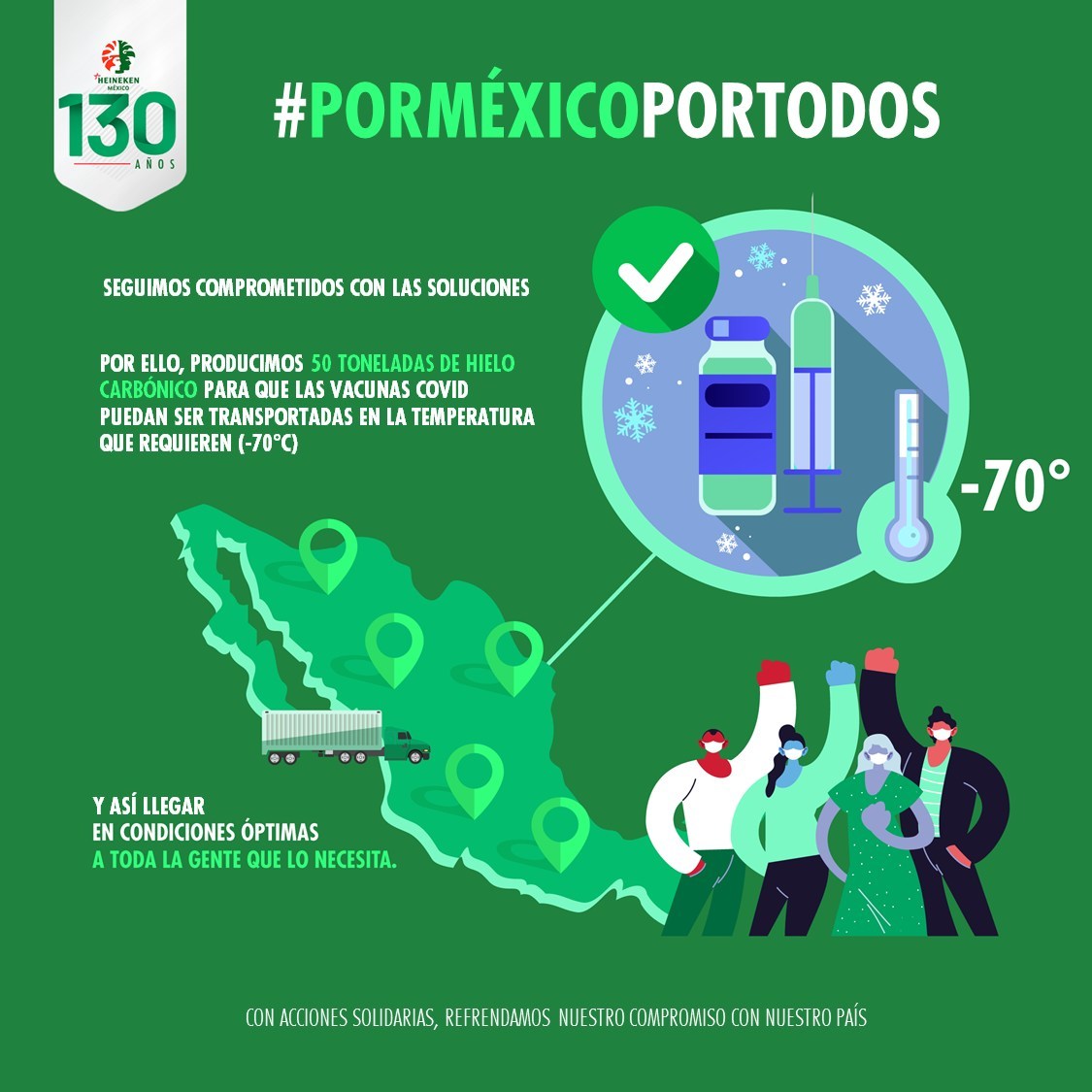
CIUDAD DE MÉXICO, 27 de enero de 2021 /PRNewswire/ — Con el fin de colaborar con las autoridades a que la vacuna contra el COVID 19, que se aplicará a todos los mexicanos, se conserve a la temperatura que marcan los protocolos internacionales a -70°C, HEINEKEN México da a conocer su disposición de producir 50 toneladas de hielo carbónico para proteger el fármaco durante su traslado a todos los rincones del territorio nacional conforme lo requieran las diversas instituciones de salud.

<div class="PRN_ImbeddedAssetReference"…

CIUDAD DE MÉXICO, 27 de enero de 2021 /PRNewswire/ — Con el fin de colaborar con las autoridades a que la vacuna contra el COVID 19, que se aplicará a todos los mexicanos, se conserve a la temperatura que marcan los protocolos internacionales a -70°C, HEINEKEN México da a conocer su disposición de producir 50 toneladas de hielo carbónico para proteger el fármaco durante su traslado a todos los rincones del territorio nacional conforme lo requieran las diversas instituciones de salud.

Las placas de enfriamiento se elaboran a partir de CO2, comúnmente conocido como «hielo seco», que es la forma sólida del dióxido de carbono. Se utiliza principalmente como agente refrigerante. Sus ventajas incluyen una temperatura más baja que el hielo común la que es útil para conservar muestras biológicas y productos biomédicos o farmacológicos sensibles a los cambios térmicos durante su envío.

«Estos momentos difíciles requieren la solidaridad y el esfuerzo de todos. Para nosotros la salud y la vida es lo más importante. Con esta acción nos sumamos a los esfuerzos de nuestras autoridades quienes dieron un gran paso al traer la vacuna e iniciar la aplicación entre los sectores más vulnerables. Ahora nosotros deseamos sumarnos facilitando el insumo que permita que llegue a todo el país en condiciones óptimas, nuestro compromiso permanece vigente POR MÉXICO, POR TODOS afirmó Etienne Strijp, director General de HEINEKEN México.

Cabe destacar que el dióxido de carbono utilizado en la producción de este material, es uno de los elementos más importantes en la elaboración de la cerveza, resultado del proceso de fermentación, se captura y se utiliza en la carbonatación de dicha bebida. Para la producción del hielo carbónico se incorporó maquinaria especializada que garantiza su calidad, de esta forma, se continúa sumando a la visión de economía circular de la organización y compromiso con México, como desde hace 130 años.

Sobre HEINEKEN México
Es una empresa socialmente responsable con más de 130 años en el mercado y en la preferencia de los mexicanos. Fundada en 1890, HEINEKEN México es la cervecera con más tradición en el país y parte del grupo cervecero más internacional al integrarse a HEINEKEN a partir de mayo de 2010.  A través de la estrategia de sustentabilidad «Brindando un Mundo Mejor«, logra impactar positivamente tanto en el medio ambiente como en las comunidades donde operan por medio de acciones continuas y acciones solidarias emergentes como «Por México, Por Todos«, de acuerdo a las necesidades detectadas en diversas circunstancias de carácter humanitario.  Cuenta con 7 plantas productoras de cerveza y una maltera donde se desempeñan más de 16 mil personas comprometidas con la calidad para crear las mejores experiencias. Así mismo, se ha consolidado como una empresa multicategoría al conformar el portafolio más amplio del mercado integrando marcas de cerveza, cerveza sin alcohol, ciders, RTDs y bebidas energizantes, liderados por la cerveza Heineken®️,  y  las marcas: Tecate®️, Tecate Light®️, Tecate Ámbar®, Dos Equis®️, Indio®️, Sol®️, Amstel ULTRA®️, Affligem®️, Bohemia®️, Miller Lite®️, Noche Buena®️, Coors Light®️, Carta Blanca®️, Superior®️, Kloster Light®️, Strongbow Apple Ciders®️, Ladrón de Manzanas®️, Canijilla®️, Heineken® 0.0, Pura Piraña®️ y Solar Power®️.

Info – https://mma.prnewswire.com/media/1428232/HMEX_Hielo_Carbonico_Infographic.jpg

FUENTE HEINEKEN Mexico

HEINEKEN México produce 50 toneladas de hielo carbónico para transportar vacunas contra COVID 19 a -70°C

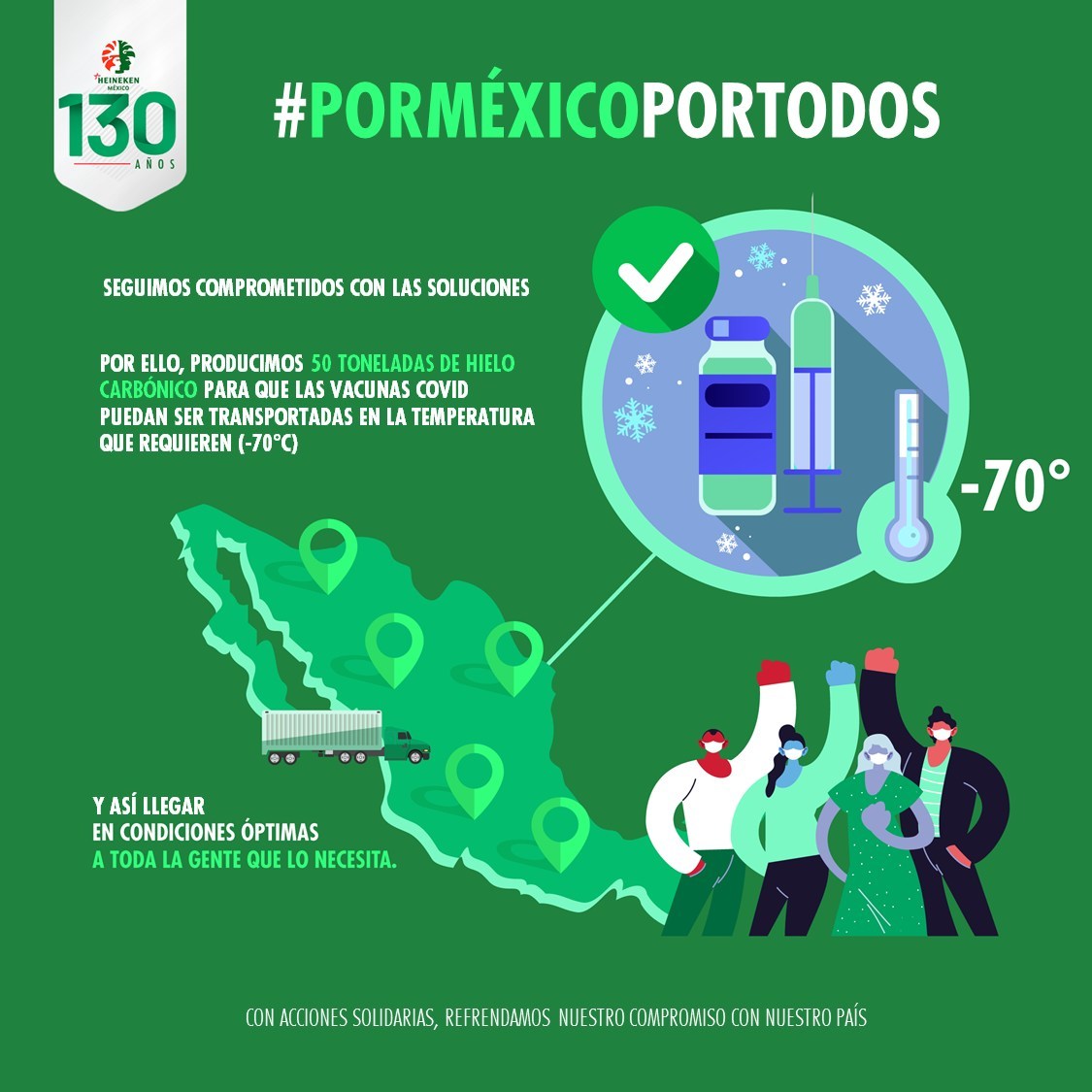
CIUDAD DE MÉXICO, 27 de enero de 2021 /PRNewswire/ — Con el fin de colaborar con las autoridades a que la vacuna contra el COVID 19, que se aplicará a todos los mexicanos, se conserve a la temperatura que marcan los protocolos internacionales a -70°C, HEINEKEN México da a conocer su disposición de producir 50 toneladas de hielo carbónico para proteger el fármaco durante su traslado a todos los rincones del territorio nacional conforme lo requieran las diversas instituciones de salud.

<div class="PRN_ImbeddedAssetReference"…

CIUDAD DE MÉXICO, 27 de enero de 2021 /PRNewswire/ — Con el fin de colaborar con las autoridades a que la vacuna contra el COVID 19, que se aplicará a todos los mexicanos, se conserve a la temperatura que marcan los protocolos internacionales a -70°C, HEINEKEN México da a conocer su disposición de producir 50 toneladas de hielo carbónico para proteger el fármaco durante su traslado a todos los rincones del territorio nacional conforme lo requieran las diversas instituciones de salud.

Las placas de enfriamiento se elaboran a partir de CO2, comúnmente conocido como «hielo seco», que es la forma sólida del dióxido de carbono. Se utiliza principalmente como agente refrigerante. Sus ventajas incluyen una temperatura más baja que el hielo común la que es útil para conservar muestras biológicas y productos biomédicos o farmacológicos sensibles a los cambios térmicos durante su envío.

«Estos momentos difíciles requieren la solidaridad y el esfuerzo de todos. Para nosotros la salud y la vida es lo más importante. Con esta acción nos sumamos a los esfuerzos de nuestras autoridades quienes dieron un gran paso al traer la vacuna e iniciar la aplicación entre los sectores más vulnerables. Ahora nosotros deseamos sumarnos facilitando el insumo que permita que llegue a todo el país en condiciones óptimas, nuestro compromiso permanece vigente POR MÉXICO, POR TODOS afirmó Etienne Strijp, director General de HEINEKEN México.

Cabe destacar que el dióxido de carbono utilizado en la producción de este material, es uno de los elementos más importantes en la elaboración de la cerveza, resultado del proceso de fermentación, se captura y se utiliza en la carbonatación de dicha bebida. Para la producción del hielo carbónico se incorporó maquinaria especializada que garantiza su calidad, de esta forma, se continúa sumando a la visión de economía circular de la organización y compromiso con México, como desde hace 130 años.

Sobre HEINEKEN México
Es una empresa socialmente responsable con más de 130 años en el mercado y en la preferencia de los mexicanos. Fundada en 1890, HEINEKEN México es la cervecera con más tradición en el país y parte del grupo cervecero más internacional al integrarse a HEINEKEN a partir de mayo de 2010.  A través de la estrategia de sustentabilidad «Brindando un Mundo Mejor«, logra impactar positivamente tanto en el medio ambiente como en las comunidades donde operan por medio de acciones continuas y acciones solidarias emergentes como «Por México, Por Todos«, de acuerdo a las necesidades detectadas en diversas circunstancias de carácter humanitario.  Cuenta con 7 plantas productoras de cerveza y una maltera donde se desempeñan más de 16 mil personas comprometidas con la calidad para crear las mejores experiencias. Así mismo, se ha consolidado como una empresa multicategoría al conformar el portafolio más amplio del mercado integrando marcas de cerveza, cerveza sin alcohol, ciders, RTDs y bebidas energizantes, liderados por la cerveza Heineken®️,  y  las marcas: Tecate®️, Tecate Light®️, Tecate Ámbar®, Dos Equis®️, Indio®️, Sol®️, Amstel ULTRA®️, Affligem®️, Bohemia®️, Miller Lite®️, Noche Buena®️, Coors Light®️, Carta Blanca®️, Superior®️, Kloster Light®️, Strongbow Apple Ciders®️, Ladrón de Manzanas®️, Canijilla®️, Heineken® 0.0, Pura Piraña®️ y Solar Power®️.

Info – https://mma.prnewswire.com/media/1428232/HMEX_Hielo_Carbonico_Infographic.jpg

FUENTE HEINEKEN Mexico

Las mentiras durante la pandemia de COVID-19 impulsan el antisemitismo

Las mentiras durante la pandemia de COVID-19 impulsan el antisemitismo

Las mentiras durante la pandemia de COVID-19 impulsan el antisemitismo

PR Newswire


Las mentiras durante la pandemia de COVID-19 impulsan el antisemitismo

Las mentiras durante la pandemia de COVID-19 impulsan el antisemitismo

PR Newswire

NUEVA YORK, 27 January 2021 /PRNewswire Policy/ — Durante la crisis del COVID-19, los supremacistas blancos y los neonazis están resurgiendo, organizándose y reclutando a través de las fronteras, intensificando sus esfuerzos por negar, distorsionar y reescribir la historia, incluido el Holocausto, alertó este martes el Secretario General de la ONU.

António Guterres dijo en un videomensaje para el Día Internacional de Conmemoración del Holocausto, que la pandemia les ha dado una nueva ocasión para atacar a las minorías por motivos de religión, raza, etnia, nacionalidad, orientación sexual, discapacidad y régimen de inmigración.

El Día Internacional honra la memoria de seis millones de judíos y de millones de personas más que los nazis y sus colaboradores asesinaron sistemáticamente durante la Segunda Guerra Mundial.

“Este año el aniversario se celebra bajo la sombra de la pandemia de COVID-19, que ha puesto de manifiesto las fisuras e injusticias que existen desde hace tiempo en nuestras sociedades y ha contribuido al resurgimiento del antisemitismo y la xenofobia», aseguró.

Para el titular de la ONU, el Holocausto fue la culminación de dos milenios durante los cuales los judíos fueron víctimas de discriminación, ataques, expulsiones y matanzas periódicas. Debería haber terminado con el antisemitismo para siempre. Pero no lo ha hecho. El antisemitismo, por desgracia, sigue existiendo.

“Es urgente que aunemos esfuerzos para detenerlo. Al considerar la recuperación de la pandemia de COVID-19, debemos corregir las fragilidades y lagunas expuestas por la misma y fortalecer nuestros lazos mutuos, basados en nuestra humanidad común”, expresó.

Añadió que el 2021 debe ser un año de recuperación y de sanar las sociedades “rotas” en las que el odio se ha arraigado “demasiado fácilmente”.

Al recordar a quienes perdieron la vida en el Holocausto y honrar a quienes sobrevivieron, Guterres aseguró que el mejor homenaje que puede rendirles la humanidad es la creación de un mundo de igualdad, justicia y dignidad para todos.

Mentiras dañinas

Auschwitz-Birkenau, el mayor centro de exterminio nazi, fue liberado un 27 de enero hace 76 años.

“En este día de recuerdo y dolor, se nos recuerda el horror al que pueden conducir el odio y la mentira”, expresó la Alta Comisionada de los Derechos Humanos en un comunicado para la fecha.

Sumándose al mensaje del Secretario General, Michelle Bachelet anunció que El Congreso Judío Mundial ha informado de un aumento del 30% en los insultos antisemitas en las principales redes sociales desde noviembre de 2019.

“Con renovado vigor, quienes difunden teorías de conspiración vinculan cada vez más las ideologías políticas extremas y los delirios antisemitas, tejiendo mentiras elaboradas y falsedades que responsabilizan a los judíos individuales o de la comunidad judía en su conjunto por cada tipo de gobierno que falla”, denunció.

Agregó que, impulsadas por líderes de opinión irresponsables y amplificadas y legitimadas por los motores excepcionalmente poderosos de los medios digitales, estas fabricaciones llenas de odio son profundamente dañinas en sí mismas y pueden representar una amenaza real de violencia.

“Al igual que en la década de 1930, la mentira, el odio, el chivo expiatorio y la deshumanización también están rompiendo nuestra fibra social. Las palabras tienen consecuencias”, recalcó.

Bachelet exhortó a los gobiernos y las plataformas digitales a reevaluar urgentemente su responsabilidad de permitir o participar en tales tendencias.

“Tenemos que rechazar las mentiras. Necesitamos asegurarnos de que el discurso público se base en hechos, que reflejen objetivamente la verdad, incluida la verdad fundamental de nuestra igualdad de derechos y dignidad como seres humanos. Necesitamos invertir en la educación en derechos humanos para contrarrestar la discriminación y las teorías de conspiración tóxicas e infundadas”, pidió.

La Alta Comisionada aseguró que aprender las lecciones del siglo XX significa comprender que es necesario levantarse y defender los derechos humanos, “para que la humanidad pueda sobrevivir».

Iniciativas contra el antisemitismo

En ese contexto, La UNESCO anunció una serie de iniciativas para combatir la negación y el antisemitismo durante la ceremonia virtual de la conmemoración de Día Internacional.

La UNESCO, el Congreso Judío Mundial y Facebook se unieron para garantizar que la negación, distorsión y desinformación sobre el Holocausto no se difunda en la plataforma de redes sociales. A partir de hoy, la plataforma redirigirá a sus usuarios que busquen términos asociados con el Holocausto, al sitio web https://aboutholocaust.org/en, fuera de Facebook.

Organizado por el Congreso y la UNESCO, el sitio web expone los hechos históricos correctos sobre el Holocausto. Esta iniciativa sigue al anuncio de Facebook en octubre de 2020 de que la negación de la tragedia sería prohibida en todas sus plataformas y refleja un compromiso conjunto de las tres organizaciones para contrarrestar el antisemitismo, que ha ido en aumento en los últimos años, especialmente en redes sociales.

“Transmitir la historia del Holocausto es clave para combatir las teorías actuales de negación y conspiración. Es clave para ayudar a las personas a adquirir las habilidades necesarias para rechazar el antisemitismo, el racismo y el odio y para desafiar a quienes buscan explotar la ignorancia. Debemos unir fuerzas para compartir información objetiva y confiable en las plataformas de redes sociales. Esta asociación marca un paso muy significativo en la dirección correcta», dijo la directora general de la UNESCO, Audrey Azoulay.

Para contrarrestar el antisemitismo y la negación del Holocausto, la agencia también ha estado movilizando a los gobiernos. Con una contribución de 1,6 millones de dólares, Canadá se sumó a la lista de países que invierten en el programa mundial de la UNESCO para promover la educación sobre el tema como herramienta para prevenir futuros genocidios, implementado con el Museo Conmemorativo del Holocausto de los Estados Unidos en Washington DC.

«Nos uniremos a la UNESCO para dar prioridad a la lucha contra el antisemitismo y la educación para la prevención del genocidio», dijo Irwin Cotler, enviado especial de Canadá para preservar el recuerdo del Holocausto y combatir el antisemitismo.

La UNESCO también dio la bienvenida a la exposición del fotógrafo Luigi Toscano «No nos olvidemos» en en su sede principal en París, con los retratos de más de 200 sobrevivientes de la persecución. La exposición estará expuesta hasta el 12 de febrero y es la instalación más grande del mundo del proyecto, ya vista por más de un millón de visitantes en todo el mundo.

SOURCE Centro de Noticias ONU

NUEVA YORK, 27 January 2021 /PRNewswire Policy/ — Durante la crisis del COVID-19, los supremacistas blancos y los neonazis están resurgiendo, organizándose y reclutando a través de las fronteras, intensificando sus esfuerzos por negar, distorsionar y reescribir la historia, incluido el Holocausto, alertó este martes el Secretario General de la ONU.

António Guterres dijo en un videomensaje para el Día Internacional de Conmemoración del Holocausto, que la pandemia les ha dado una nueva ocasión para atacar a las minorías por motivos de religión, raza, etnia, nacionalidad, orientación sexual, discapacidad y régimen de inmigración.

El Día Internacional honra la memoria de seis millones de judíos y de millones de personas más que los nazis y sus colaboradores asesinaron sistemáticamente durante la Segunda Guerra Mundial.

“Este año el aniversario se celebra bajo la sombra de la pandemia de COVID-19, que ha puesto de manifiesto las fisuras e injusticias que existen desde hace tiempo en nuestras sociedades y ha contribuido al resurgimiento del antisemitismo y la xenofobia», aseguró.

Para el titular de la ONU, el Holocausto fue la culminación de dos milenios durante los cuales los judíos fueron víctimas de discriminación, ataques, expulsiones y matanzas periódicas. Debería haber terminado con el antisemitismo para siempre. Pero no lo ha hecho. El antisemitismo, por desgracia, sigue existiendo.

“Es urgente que aunemos esfuerzos para detenerlo. Al considerar la recuperación de la pandemia de COVID-19, debemos corregir las fragilidades y lagunas expuestas por la misma y fortalecer nuestros lazos mutuos, basados en nuestra humanidad común”, expresó.

Añadió que el 2021 debe ser un año de recuperación y de sanar las sociedades “rotas” en las que el odio se ha arraigado “demasiado fácilmente”.

Al recordar a quienes perdieron la vida en el Holocausto y honrar a quienes sobrevivieron, Guterres aseguró que el mejor homenaje que puede rendirles la humanidad es la creación de un mundo de igualdad, justicia y dignidad para todos.

Mentiras dañinas

Auschwitz-Birkenau, el mayor centro de exterminio nazi, fue liberado un 27 de enero hace 76 años.

“En este día de recuerdo y dolor, se nos recuerda el horror al que pueden conducir el odio y la mentira”, expresó la Alta Comisionada de los Derechos Humanos en un comunicado para la fecha.

Sumándose al mensaje del Secretario General, Michelle Bachelet anunció que El Congreso Judío Mundial ha informado de un aumento del 30% en los insultos antisemitas en las principales redes sociales desde noviembre de 2019.

“Con renovado vigor, quienes difunden teorías de conspiración vinculan cada vez más las ideologías políticas extremas y los delirios antisemitas, tejiendo mentiras elaboradas y falsedades que responsabilizan a los judíos individuales o de la comunidad judía en su conjunto por cada tipo de gobierno que falla”, denunció.

Agregó que, impulsadas por líderes de opinión irresponsables y amplificadas y legitimadas por los motores excepcionalmente poderosos de los medios digitales, estas fabricaciones llenas de odio son profundamente dañinas en sí mismas y pueden representar una amenaza real de violencia.

“Al igual que en la década de 1930, la mentira, el odio, el chivo expiatorio y la deshumanización también están rompiendo nuestra fibra social. Las palabras tienen consecuencias”, recalcó.

Bachelet exhortó a los gobiernos y las plataformas digitales a reevaluar urgentemente su responsabilidad de permitir o participar en tales tendencias.

“Tenemos que rechazar las mentiras. Necesitamos asegurarnos de que el discurso público se base en hechos, que reflejen objetivamente la verdad, incluida la verdad fundamental de nuestra igualdad de derechos y dignidad como seres humanos. Necesitamos invertir en la educación en derechos humanos para contrarrestar la discriminación y las teorías de conspiración tóxicas e infundadas”, pidió.

La Alta Comisionada aseguró que aprender las lecciones del siglo XX significa comprender que es necesario levantarse y defender los derechos humanos, “para que la humanidad pueda sobrevivir».

Iniciativas contra el antisemitismo

En ese contexto, La UNESCO anunció una serie de iniciativas para combatir la negación y el antisemitismo durante la ceremonia virtual de la conmemoración de Día Internacional.

La UNESCO, el Congreso Judío Mundial y Facebook se unieron para garantizar que la negación, distorsión y desinformación sobre el Holocausto no se difunda en la plataforma de redes sociales. A partir de hoy, la plataforma redirigirá a sus usuarios que busquen términos asociados con el Holocausto, al sitio web https://aboutholocaust.org/en, fuera de Facebook.

Organizado por el Congreso y la UNESCO, el sitio web expone los hechos históricos correctos sobre el Holocausto. Esta iniciativa sigue al anuncio de Facebook en octubre de 2020 de que la negación de la tragedia sería prohibida en todas sus plataformas y refleja un compromiso conjunto de las tres organizaciones para contrarrestar el antisemitismo, que ha ido en aumento en los últimos años, especialmente en redes sociales.

“Transmitir la historia del Holocausto es clave para combatir las teorías actuales de negación y conspiración. Es clave para ayudar a las personas a adquirir las habilidades necesarias para rechazar el antisemitismo, el racismo y el odio y para desafiar a quienes buscan explotar la ignorancia. Debemos unir fuerzas para compartir información objetiva y confiable en las plataformas de redes sociales. Esta asociación marca un paso muy significativo en la dirección correcta», dijo la directora general de la UNESCO, Audrey Azoulay.

Para contrarrestar el antisemitismo y la negación del Holocausto, la agencia también ha estado movilizando a los gobiernos. Con una contribución de 1,6 millones de dólares, Canadá se sumó a la lista de países que invierten en el programa mundial de la UNESCO para promover la educación sobre el tema como herramienta para prevenir futuros genocidios, implementado con el Museo Conmemorativo del Holocausto de los Estados Unidos en Washington DC.

«Nos uniremos a la UNESCO para dar prioridad a la lucha contra el antisemitismo y la educación para la prevención del genocidio», dijo Irwin Cotler, enviado especial de Canadá para preservar el recuerdo del Holocausto y combatir el antisemitismo.

La UNESCO también dio la bienvenida a la exposición del fotógrafo Luigi Toscano «No nos olvidemos» en en su sede principal en París, con los retratos de más de 200 sobrevivientes de la persecución. La exposición estará expuesta hasta el 12 de febrero y es la instalación más grande del mundo del proyecto, ya vista por más de un millón de visitantes en todo el mundo.

SOURCE Centro de Noticias ONU

Más de la mitad de la población mundial reconoce que el cambio climático es una emergencia

Más de la mitad de la población mundial reconoce que el cambio climático es una emergencia

Más de la mitad de la población mundial reconoce que el cambio climático es una emergencia

PR Newswire

<p…


Más de la mitad de la población mundial reconoce que el cambio climático es una emergencia

Más de la mitad de la población mundial reconoce que el cambio climático es una emergencia

PR Newswire

NUEVA YORK, 27 January 2021 /PRNewswire Policy/ — Casi dos tercios de más de 1,2 millones de personas encuestadas en todo el mundo consideran al cambio climático como una emergencia mundial, lo que insta a tomar más medidas para abordar la crisis, asegura una nueva encuesta climática de la ONU revelada este miércoles.

Descrita como la encuesta climática más grande realizada hasta ahora, ya que abarcó 50 países con más de la mitad de la población mundial y 17 lenguajes, «People’s Climate Vote» (el voto de las personas sobre el clima) del Programa de las Naciones Unidas para el Desarrollo (PNUD) también muestra que la gente apoya políticas climáticas más integrales para responder a los desafíos.

“Los resultados ilustran claramente que la acción climática urgente tiene un amplio apoyo entre personas de todo el mundo, de todas las nacionalidades, edad, género y nivel educativo”, dijo en un comunicado de prensa Achim Steiner, administrador del Programa.

La encuesta también explica “cómo” la gente quiere que sus legisladores aborden la crisis climática.

“Desde la agricultura respetuosa con el clima hasta la protección de la naturaleza y la inversión en una recuperación ecológica del COVID-19, la encuesta lleva la voz de la gente al frente del debate climático. Señala formas en las que los países pueden avanzar con el apoyo público mientras trabajamos juntos para abordar este enorme desafío”, agregó Steiner.

Los resultados del ejercicio se compartirán con los legisladores y los gobiernos que buscan promulgar políticas para reconstruir las economías posteriores al COVID y abordar el cambio climático. 2021 es un año crucial para los compromisos de acción climática de los países, con una ronda clave de negociaciones que tendrá lugar en noviembre en Glasgow, Reino Unido durante la 26ª sesión de la Conferencia de las Partes de la Convención Marco de las Naciones Unidas sobre el Cambio Climático (CMNUCC).

Los jóvenes fueron incluidos

La encuesta preguntó a los participantes si el cambio climático era una emergencia global y si apoyaban 18 políticas climáticas clave en seis áreas de acción: economía, energía, transporte, alimentos y granjas, naturaleza y protección de las personas.

Su audiencia objetivo de 1,2 millones incluyó a más de medio millón de personas menores de 18 años, un grupo clave sobre el cambio climático que normalmente no puede votar todavía en las elecciones regulares. Para garantizar llegar a la audiencia más joven, se invitó a las personas a participar a través de juegos móviles. Por ejemplo, cuando una persona jugaba Words with Friends o Angry Birds, la encuesta reemplazó la publicidad tradicional en el juego. Esto produjo una muestra enorme, única y aleatoria de personas de todos los géneros, edades y antecedentes educativos.

Los resultados fueron procesados por los analistas de encuestas de la Universidad de Oxford y reflejan más de la mitad de la población mundial. Con un tamaño de muestra tan grande y una rica información sociodemográfica, el margen de error de los resultados es en promedio +/- 2%.

La gente quiere políticas climáticas amplias

Los resultados mostraron que la gente apoyaba políticas climáticas amplias, más allá de la situación actual, asegura el PNUD:

– Hubo un claro llamamiento a favor de más energías renovables en los países con mayores emisiones

– En países con altas emisiones por deforestación y cambio de uso de la tierra, hubo un fuerte respaldo para la conservación de bosques y tierras

– Nueve de cada diez de los países con las poblaciones más urbanizadas respaldaron un mayor uso de automóviles y autobuses eléctricos o bicicletas

– En siete países de altos ingresos hubo un gran apoyo para que las empresas tuvieran que pagar por la contaminación

Las cuatro políticas climáticas más populares en general fueron: conservación de bosques y tierras (54% de apoyo público), más energía solar, eólica y renovable (53%), adopción de técnicas agrícolas respetuosas con el clima (52%) y más inversión en negocios ecológicos y puestos de trabajo (50%).

El nivel de estudios se vincula a la toma de conciencia

La encuesta también encontró un vínculo directo entre el nivel de educación de una persona y su deseo de acción climática. Hubo un reconocimiento muy alto de la emergencia climática entre quienes habían asistido a la universidad en todos los países, desde naciones de bajos ingresos como Bután (82%) y República Democrática del Congo (82%), hasta países ricos como Francia (87%) y Japón (82%).

Los hallazgos también revelaron que mientras que los más jóvenes (menores de 18 años) eran más propensos a decir que el cambio climático es una emergencia, otros grupos de edad no se quedaron atrás, con un 65% de entre 18 y 35 años; un 66% entre 36 y 59 años; y el 58% de los mayores de 60.

“Esto ilustra cuán ampliamente aceptado se ha vuelto este punto de vista”, expresó la agencia.

Datos de América Latina y el Caribe

En América Latina y el Caribe fueron encuestadas personas de Argentina, Belice, Brasil, Chile, Ecuador, Panamá y Trinidad y Tobago. Un 63% de todas las personas coincidieron en que el cambio climático es una emergencia.

El resultado es mayor entre los niños. Una mayoría sustancial ( 70%) de los menores de 18 años en Trinidad y Tobago dijo que el cambio climático es una emergencia, mientras que una sólida mayoría (entre 63 y 77%) de niños en los otros países de encuestados estuvieron de acuerdo.

El nivel promedio de apoyo público en América Latina y el Caribe para las 18 políticas climáticas fue del 45%.

Hubo cinco políticas climáticas que tuvieron un apoyo mayoritario, lideradas por la conservación de bosques y tierras (59%), seguidas por el uso de más energías renovables (57%) y técnicas agrícolas amigables con el clima (56%). Además, la disposición de más vehículos eléctricos y bicicletas obtuvieron la aprobación del 52% de las personas, mientras que la inversión en negocios y empleos ecológicos atrajo al 51%.

Otros datos importantes de la encuesta

– A medida que los gobiernos planean inversiones para reconstruir las economías que emergen de la crisis de COVID-19, hay un apoyo mayoritario en casi todos los países del G20 encuestados para una mayor inversión en negocios y empleos verdes

– La medida con menos apoyo fueron las dietas a base de plantas (30%)

– Si bien hubo altos niveles de apoyo en muchos países para la mayoría de las políticas climáticas, es posible que se requiera más educación para generar apoyo público para la escala de la transformación requerida para abordar el cambio climático

– Las actitudes hacia el cambio climático varían según el género y el país: Había una creencia mucho más fuerte en la emergencia climática entre las mujeres y las niñas que entre los hombres y los niños (por una brecha de más de 10 puntos porcentuales) en Australia, Canadá y Estados Unidos. Pero fue al revés en otros países como Vietnam y Nigeria donde los hombres y los niños apoyaron más la idea de la emergencia climática

SOURCE Centro de Noticias ONU

NUEVA YORK, 27 January 2021 /PRNewswire Policy/ — Casi dos tercios de más de 1,2 millones de personas encuestadas en todo el mundo consideran al cambio climático como una emergencia mundial, lo que insta a tomar más medidas para abordar la crisis, asegura una nueva encuesta climática de la ONU revelada este miércoles.

Descrita como la encuesta climática más grande realizada hasta ahora, ya que abarcó 50 países con más de la mitad de la población mundial y 17 lenguajes, «People’s Climate Vote» (el voto de las personas sobre el clima) del Programa de las Naciones Unidas para el Desarrollo (PNUD) también muestra que la gente apoya políticas climáticas más integrales para responder a los desafíos.

“Los resultados ilustran claramente que la acción climática urgente tiene un amplio apoyo entre personas de todo el mundo, de todas las nacionalidades, edad, género y nivel educativo”, dijo en un comunicado de prensa Achim Steiner, administrador del Programa.

La encuesta también explica “cómo” la gente quiere que sus legisladores aborden la crisis climática.

“Desde la agricultura respetuosa con el clima hasta la protección de la naturaleza y la inversión en una recuperación ecológica del COVID-19, la encuesta lleva la voz de la gente al frente del debate climático. Señala formas en las que los países pueden avanzar con el apoyo público mientras trabajamos juntos para abordar este enorme desafío”, agregó Steiner.

Los resultados del ejercicio se compartirán con los legisladores y los gobiernos que buscan promulgar políticas para reconstruir las economías posteriores al COVID y abordar el cambio climático. 2021 es un año crucial para los compromisos de acción climática de los países, con una ronda clave de negociaciones que tendrá lugar en noviembre en Glasgow, Reino Unido durante la 26ª sesión de la Conferencia de las Partes de la Convención Marco de las Naciones Unidas sobre el Cambio Climático (CMNUCC).

Los jóvenes fueron incluidos

La encuesta preguntó a los participantes si el cambio climático era una emergencia global y si apoyaban 18 políticas climáticas clave en seis áreas de acción: economía, energía, transporte, alimentos y granjas, naturaleza y protección de las personas.

Su audiencia objetivo de 1,2 millones incluyó a más de medio millón de personas menores de 18 años, un grupo clave sobre el cambio climático que normalmente no puede votar todavía en las elecciones regulares. Para garantizar llegar a la audiencia más joven, se invitó a las personas a participar a través de juegos móviles. Por ejemplo, cuando una persona jugaba Words with Friends o Angry Birds, la encuesta reemplazó la publicidad tradicional en el juego. Esto produjo una muestra enorme, única y aleatoria de personas de todos los géneros, edades y antecedentes educativos.

Los resultados fueron procesados por los analistas de encuestas de la Universidad de Oxford y reflejan más de la mitad de la población mundial. Con un tamaño de muestra tan grande y una rica información sociodemográfica, el margen de error de los resultados es en promedio +/- 2%.

La gente quiere políticas climáticas amplias

Los resultados mostraron que la gente apoyaba políticas climáticas amplias, más allá de la situación actual, asegura el PNUD:

– Hubo un claro llamamiento a favor de más energías renovables en los países con mayores emisiones

– En países con altas emisiones por deforestación y cambio de uso de la tierra, hubo un fuerte respaldo para la conservación de bosques y tierras

– Nueve de cada diez de los países con las poblaciones más urbanizadas respaldaron un mayor uso de automóviles y autobuses eléctricos o bicicletas

– En siete países de altos ingresos hubo un gran apoyo para que las empresas tuvieran que pagar por la contaminación

Las cuatro políticas climáticas más populares en general fueron: conservación de bosques y tierras (54% de apoyo público), más energía solar, eólica y renovable (53%), adopción de técnicas agrícolas respetuosas con el clima (52%) y más inversión en negocios ecológicos y puestos de trabajo (50%).

El nivel de estudios se vincula a la toma de conciencia

La encuesta también encontró un vínculo directo entre el nivel de educación de una persona y su deseo de acción climática. Hubo un reconocimiento muy alto de la emergencia climática entre quienes habían asistido a la universidad en todos los países, desde naciones de bajos ingresos como Bután (82%) y República Democrática del Congo (82%), hasta países ricos como Francia (87%) y Japón (82%).

Los hallazgos también revelaron que mientras que los más jóvenes (menores de 18 años) eran más propensos a decir que el cambio climático es una emergencia, otros grupos de edad no se quedaron atrás, con un 65% de entre 18 y 35 años; un 66% entre 36 y 59 años; y el 58% de los mayores de 60.

“Esto ilustra cuán ampliamente aceptado se ha vuelto este punto de vista”, expresó la agencia.

Datos de América Latina y el Caribe

En América Latina y el Caribe fueron encuestadas personas de Argentina, Belice, Brasil, Chile, Ecuador, Panamá y Trinidad y Tobago. Un 63% de todas las personas coincidieron en que el cambio climático es una emergencia.

El resultado es mayor entre los niños. Una mayoría sustancial ( 70%) de los menores de 18 años en Trinidad y Tobago dijo que el cambio climático es una emergencia, mientras que una sólida mayoría (entre 63 y 77%) de niños en los otros países de encuestados estuvieron de acuerdo.

El nivel promedio de apoyo público en América Latina y el Caribe para las 18 políticas climáticas fue del 45%.

Hubo cinco políticas climáticas que tuvieron un apoyo mayoritario, lideradas por la conservación de bosques y tierras (59%), seguidas por el uso de más energías renovables (57%) y técnicas agrícolas amigables con el clima (56%). Además, la disposición de más vehículos eléctricos y bicicletas obtuvieron la aprobación del 52% de las personas, mientras que la inversión en negocios y empleos ecológicos atrajo al 51%.

Otros datos importantes de la encuesta

– A medida que los gobiernos planean inversiones para reconstruir las economías que emergen de la crisis de COVID-19, hay un apoyo mayoritario en casi todos los países del G20 encuestados para una mayor inversión en negocios y empleos verdes

– La medida con menos apoyo fueron las dietas a base de plantas (30%)

– Si bien hubo altos niveles de apoyo en muchos países para la mayoría de las políticas climáticas, es posible que se requiera más educación para generar apoyo público para la escala de la transformación requerida para abordar el cambio climático

– Las actitudes hacia el cambio climático varían según el género y el país: Había una creencia mucho más fuerte en la emergencia climática entre las mujeres y las niñas que entre los hombres y los niños (por una brecha de más de 10 puntos porcentuales) en Australia, Canadá y Estados Unidos. Pero fue al revés en otros países como Vietnam y Nigeria donde los hombres y los niños apoyaron más la idea de la emergencia climática

SOURCE Centro de Noticias ONU