Pandemic adding to the physical and financial stress facing many Black caregivers

COLUMBUS, Ohio, Feb. 11, 2021 /PRNewswire/ — While the risk of COVID-19 poses the greatest threat to the elderly, it’s also taking a toll on the people they rely on most: their caregivers. This is particularly true in the Black community, where the pandemic presents new sources of stress, both physically and financially.
<a…

COLUMBUS, Ohio, Feb. 11, 2021 /PRNewswire/ — While the risk of COVID-19 poses the greatest threat to the elderly, it’s also taking a toll on the people they rely on most: their caregivers. This is particularly true in the Black community, where the pandemic presents new sources of stress, both physically and financially.

A new Nationwide Retirement Institute® survey of 313 Black caregivers commissioned in September 2020 reveals the toll the pandemic has taken on those providing care. Many current caregivers are worried that they can’t protect their loved one from getting sick (67%) and among all caregivers, more than half feel that they can’t take a day off (54%).

As Black caregivers struggle to balance work and caregiving, many also have concerns about their financial security, with only 58% answering that they are prepared financially for current or potential caregiving responsibilities (vs. 67% of all caregivers).

Among all U.S. adults, there is a surprising gap in financial literacy regarding the cost associated with being a caregiver.  Only about half of Millennials (51%) and Gen Xers (46%) and only about a third of Boomers+ (35%) are knowledgeable about how much it costs to be a caregiver.  

For Black caregivers, these costs average more than $5,000 a year and are an unwelcome sacrifice. More than 8 in 10 Black caregivers (83%) believe they should be able to provide care without dipping into their savings. Despite this, some may find themselves in this position, as around a third are worried they’ll be unable to provide money they had planned for their children (33%) or unable to retire one day (30%) because of caregiving expenses.

«The pandemic has disproportionately impacted the Black community greater than other populations,» said Kristi Rodriguez, senior vice president of the Nationwide Retirement Institute. «Many Black caregivers are struggling to balance work while providing care or have experienced a financial hit due to COVID-19. Despite these obstacles, they continue to provide care for their loved ones every day.»

Fighting through the storm

Many current Black caregivers feel the pandemic has prevented them from providing the care they once did (49%) and has made it nearly impossible to complete their caregiving duties (44%). In addition, half (49%) say the pandemic has impacted their financial ability to provide care. What’s more, two-thirds of current Black caregivers are avoiding everyone so they can stay healthy and keep caregiving (67%) and 57% feel they can’t afford to get sick because no one else can provide care for their loved one.

«Caregiving can be financially, emotionally and physically exhausting, but it also is a rewarding experience that changes you as a person,» said Rodriguez. «The challenges of caregiving are exacerbated by the pandemic; it is an especially stressful time.»

Nearly three-quarters of current Black caregivers (73%) wish they had more help with their caregiving duties because of the increased stress of the pandemic.  In fact, one in six (17%) say they have had to look for additional caregiving help because of the pandemic, but two thirds of Black caregivers (67%) would not be comfortable having an at-home care provider, because of the pandemic.

The pandemic has also disrupted the intimacy between caregivers and the loved ones they look after. More than half of current Black caregivers (52%) say they use video calls some or all of the time now to provide virtual caregiving, and nearly six in ten (59%)  say social distancing makes their job as a caregiver more difficult.

Fear of not being there

Black caregivers are far more likely to say they chose to take on the role of caregiver (71%) and, if given the choice, most (73%) would choose to be a caregiver all over again. In fact, more than two in three Black caregivers (68%) say their biggest fear is not being able to provide care for their loved one.

As a result of being a caregiver, 49% say they have become closer to the person they care for, 34% report being a caregiver brought meaning and purpose into their life, and 29% say caregiving brought their family closer. In addition, more than two in three (69%) current Black caregivers say their family members are helping them with caregiving now that they are home more.

The dual life of a young Black caregiver

More and more, Millennials and Gen Xers are surpassing Boomers+ as the caregivers in their families, typically caring for an aging parent. For younger generations already struggling with work-life balance, this new role amounts to a second job. In the Black community, the workload can be stressful with caregivers spending an average of 32 hours a week providing care. In addition, Millennial Black caregivers spend $6,832 a year in out-of-pocket expenses on caregiving, and Black Gen Xers spend an average of $5,694.

Younger Black caregivers have the added stress of worrying about how their job could impact their caregiving duties. More than one in three Millennials (35%) and Gen Xers (38%) say they are afraid their responsibilities at work could cause them to have to stop providing care to their loved one, and some (32% Millennials, 42% Gen Xers) are even afraid their caregiving duties could cause them to lose their job.

«The pandemic is really bringing a sense of urgency for many Black Americans – especially younger generations – to focus on things such as financial planning, putting your health first and long-term care planning,» said Rodriguez. «One of the greatest gifts you can give your loved ones is having a plan for when you need caregiving.»

Back-up plan for care

Black caregivers who are familiar with long-term care are much more likely than all adults 24+ who are familiar with long-term care to have discussed long-term care with their family (64% vs. 41%) and about two-thirds of Black caregivers (65%) have a back-up plan if they can no longer provide care for their loved one. Most commonly, that plan involves another family member caring for them (50%).

While most Black caregivers say the pandemic has made it more important than ever to have long-term care insurance (92% vs. 81%  adults 24+), not nearly as many Americans have long-term care insurance in place (8%*). Only one in 20 (4%) Black Americans say they have talked to a financial professional about long-term care costs.

«Amid today’s uncertainty, it is more important than ever to work with a financial professional and use online tools to help plan for the unexpected and make long-term goals a reality,» Rodriguez said. «The good news is that nearly half (48%) of all Black caregivers say they are working with a financial professional for the first time as a result of the pandemic.»

To simplify this complicated issue and encourage discussions around health care and long-term costs in retirement, Nationwide’s Health Care/LTC Cost Assessment tool provides a meaningful, personalized cost estimate that will help financial professionals and clients plan for future medical and long-term care expenses.

To learn more about the 2020 Black Caregivers Survey, visit www.nationwide.com/ltcinsights. Financial professionals can learn more at www.nationwidefinancial.com/ltcinsights.

Methodology

The 2020 Nationwide Retirement Institute Black Caregivers survey was conducted online by The Harris Poll on behalf of The Nationwide Retirement Institute within the United States between Aug. 25 and Sept. 16, 2020 among 313 Black adults aged 24 and over who are or have been caregivers. Caregivers are defined as those who have ever or are now providing paid or unpaid long-term care to a friend or family member, not through an agency, business, or non-governmental organization.  Those who care(d) only for a child under 18 or a child over 18 born with a disability did not qualify as a caregiver for this survey.  

The 2020 Nationwide Retirement Institute Long-term Care survey was conducted online within the United States between Aug. 25 and Sept. 16, 2020 among 959 adults aged 24 and over by The Harris Poll on behalf of The Nationwide Retirement Institute. The survey also included 308 adults 24+ who are or have been caregivers.

Respondents for these surveys were selected from among those who have agreed to participate in our surveys. Because the sample is based on those who agreed to participate in the online panel, no estimates of theoretical sampling error can be calculated. Data are weighted where necessary by age by gender, race/ethnicity, region, education, income, marital status, household size, and propensity to be online to bring them in line with their actual proportions in the population.

About The Harris Poll

The Harris Poll is one of the longest running surveys in the U.S. tracking public opinion, motivations and social sentiment since 1963 and is now part of Harris Insights & Analytics, a global consulting and market research firm that delivers social intelligence for transformational times. We work with clients in three primary areas; building twenty-first-century corporate reputation, crafting brand strategy and performance tracking, and earning organic media through public relations research. Our mission is to provide insights and advisory to help leaders make the best decisions possible. To learn more, please visit www.theharrispoll.com

About Nationwide

Nationwide, a Fortune 100 company based in Columbus, Ohio, is one of the largest and strongest diversified insurance and financial services organizations in the United States. Nationwide is rated A+ by both A.M. Best and Standard & Poor’s. An industry leader in driving customer-focused innovation, Nationwide provides a full range of insurance and financial services products including auto, business, homeowners, farm and life insurance; public and private sector retirement plans, annuities and mutual funds; excess & surplus, specialty and surety; pet, motorcycle and boat insurance. For more information, visit www.nationwide.com. Follow us on Facebook and Twitter.

* There are 93 million people age 55 and older (Kaiser Family Foundation – Population Distribution by Age Report for 2018). Only 7.5 million people of any age have LTC coverage. (American Association of Long-Term Care Insurance – AALCTCI, 2020 Report)

This material is not a recommendation to buy, sell, hold, or rollover any asset, adopt an investment strategy, retain a specific investment manager or use a particular account type. It does not take into account the specific investment objectives, tax and financial condition or particular needs of any specific person. Investors should work with their financial professional to discuss their specific situation.

This information is general in nature and is not intended to be tax, legal, accounting or other professional advice. The information provided is based on current laws, which are subject to change at any time, and has not been endorsed by any government agency.

Nationwide and The Harris Poll are separate and non-affiliated companies.

Nationwide Investment Services Corporation (NISC), member FINRA, Columbus, OH. Nationwide Retirement Institute is a division of NISC.

Nationwide, the Nationwide N and Eagle, Nationwide is on your side and Nationwide Retirement Institute are service marks of Nationwide Mutual Insurance Company © Nationwide 2020

NFM-20570AO

Contact:
Charley Gillespie  
charley.gillespie@nationwide.com

Cision View original content to download multimedia:http://www.prnewswire.com/news-releases/pandemic-adding-to-the-physical-and-financial-stress-facing-many-black-caregivers-301226996.html

SOURCE Nationwide

New Leaf Paper Announces Sustainable Green Printing Partnership

WALNUT CREEK, Calif., Feb. 11, 2021 /PRNewswire/ — New Leaf Paper, advancing its mission to provide sustainable-business solutions and combat destructive climate change, has teamed with The Sustainable Green Printing Partnership (SGP) as it brings together different business departments and organizations to support supply-chain sustainability.

<a…

WALNUT CREEK, Calif., Feb. 11, 2021 /PRNewswire/ — New Leaf Paper, advancing its mission to provide sustainable-business solutions and combat destructive climate change, has teamed with The Sustainable Green Printing Partnership (SGP) as it brings together different business departments and organizations to support supply-chain sustainability.

«New Leaf Paper and The Sustainable Green Printing Partnership share environmental commitments,» said Paul Bradshaw, New Leaf Paper COO. «Both organizations support a more sustainable print-supply chain through education and innovation. Together, we can be advocates for changing purchasing behaviors today to manifest a sustainable paper industry tomorrow.»

This partnership brings together printers, purchasing departments, suppliers and educational institutions to support a sustainable print-supply chain. Through SGP, printers, print buyers, suppliers and supporting organizations work together to drive the sustainable business practices that today’s customers demand. Both SGP and New Leaf Paper are committed to helping customers and consumers find sustainable solutions that meet all of their business needs.

This latest partnership is just one of many recent partnerships and success stories from New Leaf Paper and its commitment to its mission. The certified B-Corporation in recent months has announced partnerships with HP’s Sustainable Forest Collaborative and Canopy’s Ancient and Endangered Forest Conservation & Eco Paper Production Policy

New Leaf Paper
New Leaf Paper is the leading national supplier for environmentally responsible paper solutions, focusing on developing and supplying sustainable, superior papers with 100% post-consumer recycled fiber (PCRF). New Leaf Paper is committed to reducing its environmental footprint, capturing and reusing as much waste as possible, and minimizing resources used in the production of printing, writing, publishing and communication papers.  New Leaf Paper is a Certified B-Corporation, Certified Woman-Owned Business, and FSC certified. Our papers are made in the USA, processed chlorine-free, and contain Ancient Forest Friendly certification. For more information or to ORDER PAPER, visit www.NewLeafPaper.com.

SGP
The Sustainable Green Printing Partnership (SGP) is the only certification organization promoting sustainability in all printing processes throughout the United States and Canada. SGP promotes a sustainable print supply chain through best practices, innovation, information sharing and validation. The SGP program encompasses the three pillars of sustainability – people, planet, and profit. SGP partners include 3M, tesa tape North America, FLEXcon, Cooley/Group, Laird Plastics, Piedmont Plastics, Sun Chemical, REI, ANN Inc., BrandKey Graphics, Snowball Print Marketing, major printing organizations, academic institutions, and other leading companies. www.sgppartnership.org.

CONTACT:
Shannon Bone
Shannon@newleafpaper.com
(704) 999-8118


Cision View original content to download multimedia:http://www.prnewswire.com/news-releases/new-leaf-paper-announces-sustainable-green-printing-partnership-301226241.html

SOURCE New Leaf Paper

Sappi’s Ultracast Viva™ Nominated For Green Product Award 2021

BOSTON , Feb. 11, 2021 /PRNewswire/ — Sappi North America, Inc., a leading producer and supplier of diversified paper, packaging products and pulp, today announced that its <a target="_blank"…

BOSTON , Feb. 11, 2021 /PRNewswire/ — Sappi North America, Inc., a leading producer and supplier of diversified paper, packaging products and pulp, today announced that its Ultracast Viva release paper is nominated for the Green Product Award 2021 in the fashion category. Over a thousand applicants from 51 countries were screened for this year’s nomination, which will award companies and start-ups that have distinguished themselves by their sustainable practices and product results.

Ultracast Viva is a textured release paper made specifically for high-fidelity PVC, PU, semi-PU and solvent-free casting systems that are used in the manufacturing of coated fabrics. This first-of-its-kind product embodies Sappi’s forward-looking sustainability practices in alignment with the company’s global goals for environmentally-friendly manufacturing.

«We’re thrilled to have been selected as a nominee for this industry-leading award,» said Mark Hittie, Director of Release Strategy at Sappi North America. «We are committed to pushing the industry forward through sustainable product innovation. Ultracast Viva was designed to further support new production practices in the textile industry, and we’re proud to offer products that allow customers to meet heightened sustainability standards.»

With Sappi’s nearly 80 years of experience creating textures, Ultracast Viva brings to market performance improvements that are more compatible than ever with green chemistry systems, including benefits from its reduced curl, increased reusability and easier handling with expanded temperature limits. The production of this texture is designed for companies who are invested in using sustainable options to create release paper and materials.

«Ultracast Viva release paper is a good example for the level of quality and passion our nominees are contributing to a more sustainable future,» said Nils Bader, Director of the Green Product Award.

Since 2013, the Green Product Award has honored those products and services that promote sustainable innovation. Over 45,000 votes have already been cast for the Green Product Audience Award, where the winner is decided by a public vote. Voting will remain open until Feb. 14. To vote for Ultracast Viva, please visit https://www.gp-award.com/en/produkte/ultracast-viva.

Winners will be announced at the Green Products Award ceremony during the digital show and congress from April 14-16, 2021.

To learn more about Sappi North America, please visit www.sappi.com. For information about the Green Product Award visit www.gp-award.com/en/gpaward.

About the Green Product Award
The international Green Product Award is rewarding products and services, good in design, innovation and sustainability since 2013. The aim of the award is to share good examples for the public and to provide feedback and networking opportunities for the participants.  The Award showcases 11 categories of Architecture & Tiny Houses, Building Components, Circular Materials, Consumer Goods, Fashion, Handicraft, Interior & Lifestyle, Kids, Mobility, Sport and Workspace.

The Green Concept Award – held in cooperation with IKEA-Stiftung – strictly focuses on concepts, materials and prototypes, not on the market yet. The yearly nominees represent the upcoming trends of sustainable innovations.

About Sappi North America, Inc.
Sappi North America, Inc., headquartered in Boston, is a market leader in converting wood fiber into superior products that customers demand worldwide. The success of our three diversified businesses – high-quality graphic papers, pulp, and packaging and speciality papers – is driven by strong customer relationships, best-in-class people and advantaged assets, products and services. Our high-quality graphic papers, including McCoy, Opus, Somerset, and Flo, are the key platform for premium magazines, catalogs, books, direct mail and high-end print advertising. We are a leading manufacturer of dissolving pulp with our Verve brand, a sustainable fiber, which is used in a wide range of products, including textile fibers and household goods. We deliver sustainable packaging and speciality papers for luxury packaging and folding carton applications with our single-ply packaging brands, Spectro and Proto, and for the food and label industries with our specialty papers, LusterPrint and LusterCote. We are also one of the world’s leading suppliers of casting and release papers with our Ultracast, PolyEx and Classics lines for the automotive, fashion and engineered films industries. Customers rely on Sappi for high technical, operational and market expertise; products and services delivered with consistently high quality and reliability; and, state-of-the-art and cost-competitive assets and innovative spirit.


Cision View original content:http://www.prnewswire.com/news-releases/sappis-ultracast-viva-nominated-for-green-product-award-2021-301226832.html

SOURCE Sappi North America, Inc.

ASC Group and Auxano Environmental Merger Creates WBE/DBE Evaluation and Consulting Powerhouse

COLUMBUS, Ohio, Feb. 11, 2021 /PRNewswire-PRWeb/ — Today, ASC Group, Inc. of Columbus, and Auxano Environmental LLC of Lebanon, Ohio, announced they have merged.

The combined companies will operate as ASC/Auxano in the Federal market and will continue to operate as ASC Group, Inc. in all other markets. Both markets will benefit significantly from single-sourcing in a variety of complimentary evaluation and consulting fields. ASC…

COLUMBUS, Ohio, Feb. 11, 2021 /PRNewswire-PRWeb/ — Today, ASC Group, Inc. of Columbus, and Auxano Environmental LLC of Lebanon, Ohio, announced they have merged.

The combined companies will operate as ASC/Auxano in the Federal market and will continue to operate as ASC Group, Inc. in all other markets. Both markets will benefit significantly from single-sourcing in a variety of complimentary evaluation and consulting fields. ASC Group’s acquisition of Auxano will maintain their certifications as a woman-owned business. The expansion positions ASC Group and ASC/Auxano to service the Continental United States (CONUS) for military contracts.

The merger has added Phase I and II ESA (RMR) to the ASC Group, Inc. ODOT Prequalification listings providing a complete list of all Environmental Services. The merger also adds capacity to ASC/Auxano in the Federal market adding cultural resource services to the Federal services line. ASC/Auxano will be positioned exceptionally well to provide unique expertise for Federal contracts as the new administration continues to focus on small business success.

«Auxano is known for tackling some of the hardest remediation evaluation and environmental risk assessments in the business. We’ve been partnered with them often on many of our contracts. We work well together. It makes perfect sense to team up and formalize our relationship. We’ll have unmatched value in the regional market,» said Shaune Skinner, President of ASC Group, Inc.

«We’ve collaborated with ASC Group on numerous projects over the years, and I highly respect their team’s professionalism and depth of scope. I can’t wait to see what we can do,» said Nichole Lashley, founder of Auxano Environmental LLC. Lashley will continue with ASC/Auxano as Director of Federal Projects.

About Auxano
Founded in 2013, Auxano Environmental LLC is a certified small, disadvantaged woman-owned business with unique expertise in Phase II ESA (environmental site assessment) following the American Standard for Testing and Materials (ASTM). Auxano has received the small business environmental award from the SAME (Society of American Military Engineers) Kentuckiana Post in 2020, and Nichole Lashley will serve as the Post’s Board President for 2022.

About ASC Group
ASC Group, Inc. is headquartered in Columbus, Ohio, with regional offices in Cleveland, Ohio, Indianapolis, Indiana, Florence, Kentucky, and Harrisburg, Pennsylvania. The company was founded in 1986 as Archeological Services Consultants, Inc. by Shaune Skinner and Elsie Immel-Blei. ASC are cultural and environmental consultants providing archeological, architectural history, and environmental services for Federal, state, and local clients primarily in an 11-state region of the Midwest. They are SBA (US Small Business Administration), WBENC (Women’s Business Enterprise National Council), and FAA (Federal Aviation Administration) certified.

Media Contact

Michelle Garrett, Sullivan Solutions, +1 6143154037, michelle@sullivansolutions.com


SOURCE ASC/Auxano

Cultural Comfort, Siloes And Stress Impacts Gen Z Trust Circles

FAIRFAX, Va., Feb. 11, 2021 /PRNewswire-HISPANIC PR WIRE/ — According to a study by the Culture Marketing Council: The Voice of Hispanic Marketing (CMC), despite a multicultural majority among the under-18 age segment, most non-Hispanic white (NHW) teens do not experience the MC majority reality in their daily lives—from their schools and neighborhoods to their friendships online and in real life. Regardless of race or background, teen stress levels are high, trust circles are tight and…

FAIRFAX, Va., Feb. 11, 2021 /PRNewswire-HISPANIC PR WIRE/ — According to a study by the Culture Marketing Council: The Voice of Hispanic Marketing (CMC), despite a multicultural majority among the under-18 age segment, most non-Hispanic white (NHW) teens do not experience the MC majority reality in their daily lives—from their schools and neighborhoods to their friendships online and in real life. Regardless of race or background, teen stress levels are high, trust circles are tight and vary among kids and parents, depending on culture, age, and experience with organizations and institutions.

AHAA: The Voice of Hispanic Marketing is rebranding as Culture Marketing Council: The Voice of Hispanic Marketing, which will continue to elevate the quality and effectiveness of U.S. marketing by harnessing the power of cultural expertise and impact to drive business results.

«Trust circles, cultural comfort or discomfort, and stress are all nuances that marketers must understand, as they impact brand relationships and purchase decisions,» said CMC Research Chair Nancy Tellet, founder, brand & consumer navigator at PureClarity LLC. «Trust, plays a huge role not only in the political arena and friendships, but also where we live, how we raise our kids, and in the brands we choose to buy.»

Today, two-thirds of multicultural Gen Zers grow up in families that attempt to retain most of their historical cultural values. They also take cues from modern American society, choosing which values to keep, reject and add.

A Multicultural Majority in Numbers but Not in Daily Life

Racial and ethnic segments tend to self-silo across schools, neighborhoods and friendships, both on social media and in real life. This is mostly prevalent among NHW teens and tweens ages 8-17. While non-Hispanic Blacks (NHB) and Hispanics silo less, the majority of their in real life friends are either their own segment or other persons of color (POC). When it comes to social media, however, friends are slightly more diverse for NHW & NHB but virtually same for Hispanics.

The Majority of Gen Zers and Parents Are Comfortable with All Types of People

Sixty percent of Gen Zers and parents say, «I am truly comfortable with all people.» Among the 40 percent—a sizable minority—who are uncomfortable, all segments regardless of race or ethnicity report most discomfort with «rich people» and «evangelical Christians.» Blacks and Hispanics also say they are most uncomfortable among NHWs, NHWs and Blacks share a discomfort of LGBTQ+ people, and, surprisingly, Hispanics say they are most uncomfortable around «other Hispanics.» In addition, one in five (22 percent) NHWs are uncomfortable hearing Spanish spoken in public.

The Stress is Real for Gen Zers

Across all segments, teens report «being smart and well educated» as a core value for success; however, this ambition and often, fear of failure leaves them feeling stressed and isolated. Stress among Hispanic teens is higher than other groups. The shrinking middle class has added to teen stress for all groups especially NHW teens who feel they need to «protect» their turf. Black and Hispanic teens expressed more resilience with an attitude of «Life is tough, but I am tougher,» since life was never that easy to begin with. Hispanic teen stress actually decreased during COVID, as the negative spotlight shifted from them to the pandemic and other social and political issues.

The Cultural Closet: What’s Kept, What’s Tossed and What’s Being Added

More than two-thirds of POC want to keep most of their historical cultural values. Among Hispanics and NHB, family culture «keeps you safe, sane and happy.» For Hispanics, it’s about sharing knowledge and traditions while instilling a sense of interdependence (we vs me). For NHBs, family connections not only protect and support but also serve to share knowledge and pass down tradition. Hispanics and NHBs ages 13 to 49 keep values of resilience and the importance of their communities in their cultural closet, as it is important to succeed in spite of adversity.

Hispanic and Black teens place a high level of importance on the practice of «respect» including respect for their elders and stronger parental authority, including discipline within the parent/child relationship. Among NHBs, respect is straightforward, stressing the importance of respect for oneself and receiving it from others.  Among Hispanics, «respeto» is complex and more formal than what is typically expected in the U.S—with an emphasis on courtesy,  including helping above and beyond when you are a guest in someone’s house or how you behave with authority figures, such as your doctor or an elder.

More than half of Hispanic and NHB teens agree that traditional gender roles have to go. In addition, six out of 10 Hispanics ages 13 to 49 would like to get rid of socio-economic and racial colorism hierarchies.

Methodology  & Funders:

  • This study builds on more than 20,500 consumer touchpoints to date, the CMC released the third part of a comprehensive study on Gen Z (ages 13 to 17), IT’S TIME: Ready (or Not) for the Multicultural Majority, analyzing social media consumption, streaming video habits and the escalating power of culture in content.
  • The study received financial or operational support from Kantar, ThinkNow, ViacomCBS and Univision.
  • Quantitative research came from 2,418 13-17s (Gen Z) and 25-49 parents of kids 8-12 (65% Millennials/ 35% Xers) with equal sample representation of Hispanics (HISP), non-Hispanic Blacks (NHB) & non-Hispanic Whites (NHW) from January 2020 to February 2020.
  • Qualitative interviews with 54 respondents (36T/18P), in-home pairs (HISP/NHB/NHW) and two Gen Z multicultural workshops (HISP/NHB/NHW/Asian-American/Other)

For more information, visit culturemarketingcouncil.org and follow the CMC on Facebook, Instagram, and Twitter at @cmchispanic.

About CMC: Founded in 1996 as the Association of Hispanic Advertising Agencies, the Culture Marketing Council: The Voice of Hispanic Marketing is the national trade organization of all marketing, communications, and media firms with trusted Hispanic expertise.

«In our landmark study, IT’S TIME: Ready (or Not) for the Multicultural Majority, we learned that Gen Z teens and parents feel a sense of unity with other minority segments and understands that hate and racism are the biggest issues they face together,» said CMC Research Chair Nancy Tellet, founder, brand & consumer navigator at PureClarity LLC. «With more than half of people ages 13 to 49 having quit a culturally illiterate brand, it’s all about what role culture plays in what stays in and what gets thrown out of trust circles.»

Logo – https://mma.prnewswire.com/media/635930/Culture_Marketing_Council_Logo.jpg  

SOURCE Culture Marketing Council: The Voice of Hispanic Marketing

Cultural Comfort, Siloes And Stress Impacts Gen Z Trust Circles

FAIRFAX, Va., Feb. 11, 2021 /PRNewswire/ — According to a study by the Culture Marketing Council: The Voice of Hispanic Marketing (CMC), despite a multicultural majority among the under-18 age segment, most non-Hispanic white (NHW) teens do not experience the MC majority reality in their daily lives—from their schools and neighborhoods to their friendships online and in real life. Regardless of race or background, teen stress levels are high, trust circles are tight and vary among kids and…

FAIRFAX, Va., Feb. 11, 2021 /PRNewswire/ — According to a study by the Culture Marketing Council: The Voice of Hispanic Marketing (CMC), despite a multicultural majority among the under-18 age segment, most non-Hispanic white (NHW) teens do not experience the MC majority reality in their daily lives—from their schools and neighborhoods to their friendships online and in real life. Regardless of race or background, teen stress levels are high, trust circles are tight and vary among kids and parents, depending on culture, age, and experience with organizations and institutions.

«Trust circles, cultural comfort or discomfort, and stress are all nuances that marketers must understand, as they impact brand relationships and purchase decisions,» said CMC Research Chair Nancy Tellet, founder, brand & consumer navigator at PureClarity LLC. «Trust, plays a huge role not only in the political arena and friendships, but also where we live, how we raise our kids, and in the brands we choose to buy.»

Today, two-thirds of multicultural Gen Zers grow up in families that attempt to retain most of their historical cultural values. They also take cues from modern American society, choosing which values to keep, reject and add.

A Multicultural Majority in Numbers but Not in Daily Life

Racial and ethnic segments tend to self-silo across schools, neighborhoods and friendships, both on social media and in real life. This is mostly prevalent among NHW teens and tweens ages 8-17. While non-Hispanic Blacks (NHB) and Hispanics silo less, the majority of their in real life friends are either their own segment or other persons of color (POC). When it comes to social media, however, friends are slightly more diverse for NHW & NHB but virtually same for Hispanics.

The Majority of Gen Zers and Parents Are Comfortable with All Types of People

Sixty percent of Gen Zers and parents say, «I am truly comfortable with all people.» Among the 40 percent—a sizable minority—who are uncomfortable, all segments regardless of race or ethnicity report most discomfort with «rich people» and «evangelical Christians.» Blacks and Hispanics also say they are most uncomfortable among NHWs, NHWs and Blacks share a discomfort of LGBTQ+ people, and, surprisingly, Hispanics say they are most uncomfortable around «other Hispanics.» In addition, one in five (22 percent) NHWs are uncomfortable hearing Spanish spoken in public.

The Stress is Real for Gen Zers

Across all segments, teens report «being smart and well educated» as a core value for success; however, this ambition and often, fear of failure leaves them feeling stressed and isolated. Stress among Hispanic teens is higher than other groups. The shrinking middle class has added to teen stress for all groups especially NHW teens who feel they need to «protect» their turf. Black and Hispanic teens expressed more resilience with an attitude of «Life is tough, but I am tougher,» since life was never that easy to begin with. Hispanic teen stress actually decreased during COVID, as the negative spotlight shifted from them to the pandemic and other social and political issues.

The Cultural Closet: What’s Kept, What’s Tossed and What’s Being Added

More than two-thirds of POC want to keep most of their historical cultural values. Among Hispanics and NHB, family culture «keeps you safe, sane and happy.» For Hispanics, it’s about sharing knowledge and traditions while instilling a sense of interdependence (we vs me). For NHBs, family connections not only protect and support but also serve to share knowledge and pass down tradition. Hispanics and NHBs ages 13 to 49 keep values of resilience and the importance of their communities in their cultural closet, as it is important to succeed in spite of adversity.

Hispanic and Black teens place a high level of importance on the practice of «respect» including respect for their elders and stronger parental authority, including discipline within the parent/child relationship. Among NHBs, respect is straightforward, stressing the importance of respect for oneself and receiving it from others.  Among Hispanics, «respeto» is complex and more formal than what is typically expected in the U.S—with an emphasis on courtesy,  including helping above and beyond when you are a guest in someone’s house or how you behave with authority figures, such as your doctor or an elder.

More than half of Hispanic and NHB teens agree that traditional gender roles have to go. In addition, six out of 10 Hispanics ages 13 to 49 would like to get rid of socio-economic and racial colorism hierarchies.

Methodology  & Funders:

  • This study builds on more than 20,500 consumer touchpoints to date, the CMC released the third part of a comprehensive study on Gen Z (ages 13 to 17), IT’S TIME: Ready (or Not) for the Multicultural Majority, analyzing social media consumption, streaming video habits and the escalating power of culture in content.
  • The study received financial or operational support from Kantar, ThinkNow, ViacomCBS and Univision.
  • Quantitative research came from 2,418 13-17s (Gen Z) and 25-49 parents of kids 8-12 (65% Millennials/ 35% Xers) with equal sample representation of Hispanics (HISP), non-Hispanic Blacks (NHB) & non-Hispanic Whites (NHW) from January 2020 to February 2020.
  • Qualitative interviews with 54 respondents (36T/18P), in-home pairs (HISP/NHB/NHW) and two Gen Z multicultural workshops (HISP/NHB/NHW/Asian-American/Other)

For more information, visit culturemarketingcouncil.org and follow the CMC on Facebook, Instagram, and Twitter at @cmchispanic.

About CMC: Founded in 1996 as the Association of Hispanic Advertising Agencies, the Culture Marketing Council: The Voice of Hispanic Marketing is the national trade organization of all marketing, communications, and media firms with trusted Hispanic expertise.

«In our landmark study, IT’S TIME: Ready (or Not) for the Multicultural Majority, we learned that Gen Z teens and parents feel a sense of unity with other minority segments and understands that hate and racism are the biggest issues they face together,» said CMC Research Chair Nancy Tellet, founder, brand & consumer navigator at PureClarity LLC. «With more than half of people ages 13 to 49 having quit a culturally illiterate brand, it’s all about what role culture plays in what stays in and what gets thrown out of trust circles.»

Cision View original content to download multimedia:http://www.prnewswire.com/news-releases/cultural-comfort-siloes-and-stress-impacts-gen-z-trust-circles-301226573.html

SOURCE Culture Marketing Council: The Voice of Hispanic Marketing

New Data Shows Workers With Lowest Income Suffer Longest Wait Times for Unemployment Insurance

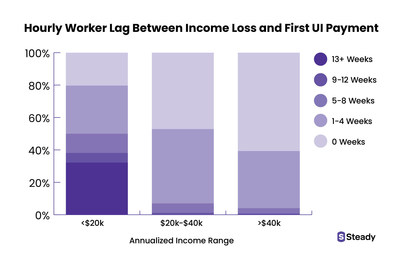
ATLANTA, Feb. 11, 2021 /PRNewswire/ — Steady, an app used by over 2.5 million gig and hourly wage earners, today released findings from a national analysis which suggests that lower income gig workers experience longer delays than their more affluent peers, when it comes to accessing unemployment insurance. 

<div…

ATLANTA, Feb. 11, 2021 /PRNewswire/ — Steady, an app used by over 2.5 million gig and hourly wage earners, today released findings from a national analysis which suggests that lower income gig workers experience longer delays than their more affluent peers, when it comes to accessing unemployment insurance. 

The data reflects the growing disconnect between the unemployment insurance system, and the rise of the 1099 economy workforce which has grown 15% since 2010 and now accounts for more than one-third of the U.S. workforce, according to the Bureau of Labor Statistics.  Unlike full-time employees, which have fewer income sources, 1099 or hourly wage earners often struggle to compile and provide paperwork from multiple income sources, including gig apps like Lyft or Instacart.

«1099 workers often face an insurmountable clerical task of providing documentation of income from multiple streams, and then wait in the balance as the government attempts to verify it, » said Adam Roseman, founder and CEO of Steady. «The data tells us that Americans who need emergency relief the most often face the greatest delays in getting access to benefits.»

Because workers grant Steady access to their actual bank transactions, the app can generate a real time understanding of earnings.  Workers also use the app to generate «income intelligence» to inform job searches and financial decisions. According to an analysis published this year, workers who use the app see average gains of $5,500.

Other findings from Steady’s analysis include:

  • There has been over a 23% drop in gig or hourly workers earning income since six months ago.
  • The industries hit hardest by the pandemic that saw the biggest declines in gig worker income include Entertainment, Hospitality, and Rideshare; those that saw the biggest increase in gig worker income were the three categories of Delivery: Grocery, Other (e.g., FedEx), and Restaurant.

«Steady’s data highlights the harsh reality that our unemployment insurance system is ill-equipped to serve workers hardest hit by the pandemic,» said Andy Stettner, fellow of the Century Foundation. «The requirement that unemployment insurance applicants send in their tax records or other verification may help to prevent rampant fraud, but in doing so, it blocks access to the benefits that American families urgently need.»

To learn more, visit https://steadyapp.com/

About Steady

Steady puts tools into the hands of American workers to help them solve their increasing income challenges caused by wages not keeping up with costs of living, the reduction of available work hours at employers due to their driving efficiencies, and future job loss due to automation. Steady makes it easier than ever for workers to fill their income gaps, gain insights into their income, and improve their overall financial well-being. Steady has over 2.5 million Members.

The Steady app can be downloaded for free from the App Store and Google Play.


Cision View original content to download multimedia:http://www.prnewswire.com/news-releases/new-data-shows-workers-with-lowest-income-suffer-longest-wait-times-for-unemployment-insurance-301226805.html

SOURCE Steady

Brain Corp Extends Leadership Position in Autonomous Mobile Robots with Record 2020 Growth

SAN DIEGO, Feb. 11, 2021 /PRNewswire/ — Brain Corp, an artificial intelligence (AI) software company creating transformative core technology in robotics, today announced record growth in 2020 as global retailers ramped up their adoption of <a target="_blank"…

SAN DIEGO, Feb. 11, 2021 /PRNewswire/ — Brain Corp, an artificial intelligence (AI) software company creating transformative core technology in robotics, today announced record growth in 2020 as global retailers ramped up their adoption of robotic floor scrubbers and other autonomous solutions in the wake of the global pandemic.

Working through its OEM partners, Brain Corp achieved over a 300% increase in robotic deployments during the year as retailers leaned heavily on cleaning automation to help better manage «a constant state of clean» caused by the ongoing health crisis. As of Jan. 31, 2021, the company and its partners had deployed more than 14,500 BrainOS®-powered robots, representing the world’s largest robotic fleet operating in public indoor spaces (retail and grocery stores, malls, airports, schools and healthcare facilities). Brain Corp also recorded more than an 80% y-o-y increase in monthly subscription revenue for its cloud-connected autonomous services that help operators run the robots.

«Given the rapid adoption rates and strong value proposition, robotic solutions are clearly becoming the new commercial cleaning standard,» said Dr. Eugene Izhikevich, CEO at Brain Corp. «In today’s changing world, businesses are rethinking their automation strategies, bringing robots out from behind locked areas and into public spaces where they bring a new level of process automation. We’ve seen how much support robots have provided essential workers through the pandemic, and look forward to continued innovation with our OEM partners.» 

Additional 2020 Brain Corp operational highlights:

  • Surpassed a total of 4 million autonomous hours of global operation to date.
  • Generated an estimated 3.3 million hours of additional productivity for end customers during the year through its BrainOS-powered robotic fleet.
  • Surpassed 54 billion square feet of space covered autonomously to date through its combined robotic applications.
  • Launched a new BrainOS-powered robotic scrubber with Tennant Company, the T380AMR solution, which is adept at handling tighter retail store footprints. Schnucks, a leading Midwest grocery chain, recently deployed the T380AMR robotic scrubbers to help improve in-store customer experiences.
  • Launched a new BrainOS-powered scrubber with Nilfisk, the Liberty SC60, which is ideal for large indoor spaces like retail, airports, malls, warehouses, and light industrial.
  • Announced that Sam’s Club is expanding its investment in BrainOS-powered robotic scrubbers to all of its stores nationwide, while also extending a retail shelf analytics pilot program designed to deliver faster inventory insights and customer experiences. The pilot uses a first-of-its-kind dual function robot design that integrates a data-scanning accessory with a robotic scrubber from Tennant.
  • Announced the initial commercial rollout of the BrainOS-powered autonomous delivery tug, a industry first robotic application that helps retailers bridge the automation gap in moving inventory from the stockroom out to store shelves. Brain Corp announced two new OEM partners for the delivery tug, Dane Technologies and Mitsubishi Logisnext Americas.
  • Launched new user experience (UX) and reporting features that revolutionize the ease of which AMRs can be used and managed by non-technical employees, speeding deployment at scale and enabling commercial businesses to achieve rapid ROI.
  • Recognized as an AMR deployment leader, and a «hot tech innovator,» in two separate reports by ABI Research, a global tech market advisory firm.
  • Named a winner of the San Diego Top Workplaces Award 2020 by The San Diego Union-Tribune.

In a recent white paper, «The Business Value of Autonomous Mobile Robots in the Wake of COVID-19,» author Rian Whitton, a senior analyst with ABI Research, noted that Brain Corp is pioneering a new class of «public-facing» autonomous robots that can operate outside of tightly controlled environments, such as traditional manufacturing and warehouse settings, thanks to advanced navigation and technical features. This brings new automation value to commercial businesses and their employees, helping establish a new operational standard for cleaning.

«We have a burgeoning ecosystem of robotics developers, lots of partnerships with original equipment manufacturers like Tennant and Nilfisk, and sufficient buy-in from grocers and retailers like Kroger, Schnucks, and Walmart,» Whitton said in a recent interview. «All the infrastructure is in place for automated commercial cleaning to be mainstreamed in retail.»

Top OEM partners leverage BrainOS, the company’s robotic AI software platform for building and managing commercial robots at scale, to develop an array of robotic applications, including floor scrubbers, vacuums, delivery tugs, and retail shelf-scanning units. Retailers can use these applications for «automating the aisle,» a new approach that uses multiple, vertically focused robotics applications—bound together by a centralized platform—that enables them to more easily adapt to changing consumer buying habits and shifts to e-commerce and digital fulfillment, while also removing long-standing bottlenecks in the retail supply chain.

About Brain Corp
Brain Corp is an AI software leader that powers the world’s largest fleet of autonomous mobile robots operating in commercial indoor public spaces. The BrainOS platform and its cloud-connected autonomy service are used by global manufacturing partners to successfully build, deploy, and support commercial robots at scale across industries and applications. Through intuitive software and controls, BrainOS also enables end customers to easily leverage the power of robotics to offload repetitive, labor-intensive tasks related to floor care, in-store inventory delivery, and shelf-scanning. This frees employees’ time to focus on higher-value responsibilities. Working with its partners, Brain Corp has deployed over 14,500 robots within retail, grocery, malls, airports, hospitals, warehouses, and other industries. For more information, please visit www.braincorp.com

Media Contact:
Zara Andrabi
zara@bulleitgroup.com

Cision View original content to download multimedia:http://www.prnewswire.com/news-releases/brain-corp-extends-leadership-position-in-autonomous-mobile-robots-with-record-2020-growth-301226418.html

SOURCE Brain Corp

Hospital Association Launches Second Phase of Climate Resiliency Work

WASHINGTON, Feb. 11, 2021 /PRNewswire-PRWeb/ — In a second phase of work to help hospitals build climate resiliency for their communities, America’s Essential Hospitals will educate its members about how climate affects health and health equity and energize them to embrace resiliency and sustainability.

The work, part of a Kresge Foundation–supported project, follows a 2019 climate resiliency report from Essential Hospitals Institute, the association’s research entity. That report, part of…

WASHINGTON, Feb. 11, 2021 /PRNewswire-PRWeb/ — In a second phase of work to help hospitals build climate resiliency for their communities, America’s Essential Hospitals will educate its members about how climate affects health and health equity and energize them to embrace resiliency and sustainability.

The work, part of a Kresge Foundation–supported project, follows a 2019 climate resiliency report from Essential Hospitals Institute, the association’s research entity. That report, part of the project’s first phase, identified a lack of strategic leadership and funding as the main barriers to broader hospital adoption of climate resiliency programs.

In this new project phase, the Institute will convene essential hospital leaders at regional meetings to raise awareness of the relationship of climate change to health equity and essential hospitals’ mission of caring for underrepresented people and underserved communities. It also will develop a framework for an Action Learning Cohort, a network of essential hospitals that will share knowledge, ideas, and experience to put climate resiliency plans into action.

«Environmental factors and other social determinants of health weigh heaviest on the vulnerable people our hospitals serve, and climate change threatens to make matters worse,» said Bruce Siegel, MD, MPH, president and CEO of America’s Essential Hospitals. «This project will activate our members to confront and mitigate this threat.»

The U.S. health care system accounts for 8.5 percent of greenhouse gas emissions, and health care emissions have risen 6 percent from 2010 to 2018. The health impacts of climate change are similar in scope to preventable medical errors and disproportionately affect low-income communities and communities of color. Climate change has sparked a national conversation about how to build climate resilience and sustainability in health care to enhance equity.

Some essential hospitals have taken noteworthy steps toward this goal, and the Institute project seeks to engage more hospitals in climate resiliency work.

«Essential hospitals have extensive experience making the lived environment better in communities that face the greatest environmental threats to good health,» said Kalpana Ramiah, DrPH, MSc, Institute director and the association’s vice president of innovation. «By engaging our members with this project, we will help them not only support patients but also make their communities at large more resilient to climate change.»

# # #

About America’s Essential Hospitals
America’s Essential Hospitals is the leading champion for hospitals and health systems dedicated to high-quality care for all, including the vulnerable. We support our more than 300 members with advocacy, policy development, research, and education. Communities depend on essential hospitals to provide specialized, lifesaving services; train the health care workforce; advance public health and health equity; and coordinate care. Essential hospitals innovate and adapt to lead the way to more effective and efficient care. Learn more at essentialhospitals.org.

About Essential Hospitals Institute
Essential Hospitals Institute is the research, education, dissemination, and leadership development arm of America’s Essential Hospitals. The Institute supports the nation’s essential hospitals as they provide high-quality, equitable, and affordable care to their communities. Working with members of America’s Essential Hospitals, we identify promising practices from the field, conduct research, disseminate innovative strategies, and help our members improve their organizational performance. We do all of this with an eye toward improving individual and population health, especially for vulnerable people.

Media Contact

Carl Graziano, America’s Essential Hospitals, +1 (202) 585-0102, cgraziano@essentialhospitals.org

Twitter, Facebook


SOURCE America’s Essential Hospitals

New Technology to Kill SARS Associated Human Coronavirus in the Air and on Surfaces

CHICAGO, Feb. 11, 2021 /PRNewswire/ — Eco Smart Health today announced that their Sonic Smart Antimicrobial System can effectively reduce virus transmission within schools, gyms, spas, salons, hotels, and dental/medical offices.

The company’s patented all-natural EPA exempt (FIRFA) and FDA (GRAS) recognized formulation Pure Sonic is suspended into the air and on all surfaces by way of the company’s patent pending Sonic Smart Aero Cleaner device. With the…

CHICAGO, Feb. 11, 2021 /PRNewswire/ — Eco Smart Health today announced that their Sonic Smart Antimicrobial System can effectively reduce virus transmission within schools, gyms, spas, salons, hotels, and dental/medical offices.

The company’s patented all-natural EPA exempt (FIRFA) and FDA (GRAS) recognized formulation Pure Sonic is suspended into the air and on all surfaces by way of the company’s patent pending Sonic Smart Aero Cleaner device. With the union of both innovative products, 99.9% of pathogens such as SARS Associated Human Coronavirus, Norovirus; Hepatitis B, Hepatitis C, Herpes Simplex, HIV-1, Streptococcus, E Coli, Salmonella, Staphylococcus, Tuberculosis, Salmonella, Legionella- Influenza Virus Type A, Viral Diarrhea Virus are killed within commercial spaces as large as 3,000 square feet.

The Pure Sonic formulation has been tested by a world-renowned level 3 laboratory and has proven to kill the above pathogens quickly and effectively. Since September 2020, field testing of the Sonic Smart Aero Cleaner device used to suspend the Pure Sonic formulation into the air has validated all company claims.

Vice President and co-founder Mark Hearsh says, «Being a supplier to the hospitality industry for the past 15 years, the impetus to develop the Sonic Smart Antimicrobial System originated from my interest to come up with a solution for hotel housekeeping and maintenance departments to make both the air and surfaces in guest rooms safe to get people back into Hotels.»

Benefits of the Sonic Smart System are:     

  • Easy setup in any indoor space (Plugs into a 120V outlet)
  • Up to 5,000 devices can be WiFi controlled by smart phone or computer
  • Safe to humans, fabrics, furniture
  • Bleach Free, alcohol free, non-corrosive, non-toxic, non-skin/eye irritant non- pathogenic

Eric Rawet, the Director of Technology explains that «Once turned on, the Sonic Smart Aero Cleaner launches the Pure Sonic into the space’s atmosphere activating the formulation to attach itself to airborne viruses and dissolving it’s protein envelope causing it to expire» Rawet also states, «Through molecular diffusion all surfaces within the entire room are protected using the same process. Our website explains all the science behind our system»

Systems range in price between $199.00 to $299.00 depending on size of space to be treated and the cost per treatment is $1.50 to $2.00 depending on size of area. The products will go on sale on the company’s site ecosmarthealth.com in mid-February 2021.

Hearsh and Rawet in 2019 were awarded a patent for a device called the «Med-Wand» that reduces cross contamination within the operating room and emergency rooms and a floor mopping system under the trade name «Spill Master» which is used in businesses and public facilities today to prevent slip and falls.

The Company’s Mission Statement is: Made in America solutions to provide safer and healthier environments. Our team is made of leading engineers, product specialist, marketers and other professionals who have years of experience in their respective specialty and are united with the company’s mission – To Help Solve Modern Day Problems.

For additional information please email 291249@email4pr.com or visit ecosmarthealth.com

Media Contact:
Eric Rawet
Eco Smart Health Corp.
1-888-344-1150
291249@email4pr.com

Cision View original content to download multimedia:http://www.prnewswire.com/news-releases/new-technology-to-kill-sars-associated-human-coronavirus-in-the-air-and-on-surfaces-301226330.html

SOURCE Eco Smart Health