Toyota to Debut Three New Electrified Vehicles for U.S. Market

PLANO, Texas, Feb. 10, 2021 /PRNewswire/ — Toyota Motor North America (TMNA) announced plans to debut in the U.S. market this year, three new electrified models – two BEVs and a PHEV.

PLANO, Texas, Feb. 10, 2021 /PRNewswire/ — Toyota Motor North America (TMNA) announced plans to debut in the U.S. market this year, three new electrified models – two BEVs and a PHEV.

«We continue to be leaders in electrification that began with our pioneering introduction of the Prius nearly 25 years ago,» said Bob Carter, TMNA executive vice president of sales. «Toyota’s new electrified product offerings will give customers multiple choices of powertrain that best suits their needs.»

The new electrified models further expand Toyota’s U.S. leadership in alternative powertrain vehicles. Toyota has over 40% share of the total alternative fuel vehicle market, which includes a 75% share of the fuel cell market and a 64% share of hybrids and plug-ins. By 2025, Toyota’s goal is to have 25% of new vehicle sales be electrified models, and by 2030 expects that to increase to nearly 70%.

Globally, Toyota hybrid vehicles sold have avoided an estimated 139 million tons of greenhouse gas (GHG) into the atmosphere. In the U.S., we have avoided approximately 38 million tons of GHG. This achievement is the result of Toyota’s long-standing commitment to the environment and creating a net positive impact on the planet and society. 

Between now and 2025, Toyota and Lexus models, globally, will have an electrified option. Toyota is also developing a dedicated BEV platform, e-TNGA, that offers flexibility for all drive configurations. These initiatives are further steps toward achieving the Toyota Environmental Challenge 2050, introduced in 2015, the most demanding and most inspiring environmental commitments Toyota has ever made.

«We believe the fastest way to lower greenhouse gases in the transportation sector is to offer drivers lower carbon choices that meet their needs,» said Gill Pratt, chief scientist of Toyota Motor Corporation and CEO of Toyota Research Institute. «At every price point and with multiple powertrains, we can put more people in cleaner automobiles across North America to have the greatest near-term impact on total carbon emissions.»

Toyota shared highlights of new internal research evaluating the environmental impact and cost of ownership between a PHEV and a BEV. For this research, Toyota created a tool that shows the trade-off between GHG Emissions and Total Cost of Ownership. The source code for this tool is publicly available at carghg.org for others to experiment with the various input parameters and see the movement of BEVs and PHEVs on the GHG and cost plot. The research found:

  • GHG of a currently available BEV model and PHEV model are roughly the same in on-road performance when factoring in pollutants created by electricity production for the average U.S. energy grid used to charge batteries.
  • Manufacturing is a component of GHG emissions. Using the «Greenhouse gases, Regulated Emissions, and Energy use in Technologies» (GREET) model, researchers found that the production of a PHEV emits less GHG since it uses a smaller, lighter weight battery.
  • The PHEV is much less expensive to buy and own, compared to the BEV. Without any incentives, the five-year Total Cost of Ownership (TCO) of a long-range BEV is significantly higher than the PHEV. If you include incentives available this year (2020), the TCO of a long-range BEV is much higher.

The key point is that a BEV and PHEV can provide similar environmental benefits. Each has a unique profile and can be an optimal solution in different circumstances. By having a diversified product portfolio with multiple forms of vehicle electrification, Toyota can let consumers choose the model that best suits their usage needs and cost profile while maximizing the total contribution to GHG reduction.

Toyota’s progress on Challenge 2050 in North America is measured across four key areas – reducing carbon emissions, conserving water, fostering a sustainable supply chain including waste reduction, and protecting biodiversity. Sustainability planning, strategies and actions are driven by an annual North American Environmental Action Plan, with a five-year roadmap modeled to achieve targets in Challenge 2050 and also the United Nations Sustainable Development Goals (SDGs).  Toyota is currently targeting:

  • Reduction in CO2 from the company’s operations, products and vehicle lifecycle – including logistics, suppliers and dealers
  • Reduction in overall water use per unit of vehicle production by 3% from a 2020 baseline
  • Reduction of procurement of plastic packaging materials by 25% from a 2018 baseline
  • Development of third party validated onsite habitat management policy by 2021 and begin implementation in 2022.

As proof of its commitment, Toyota recently agreed to purchase power from a future Clearway Energy Group wind farm to reduce its overall carbon footprint from electricity used from the power grid. Toyota also provided an annual update toward having a net positive environmental impact in the 2020 North American Environmental Report.

About Toyota

Toyota (NYSE:TM) has been a part of the cultural fabric in the U.S. for more than 60 years, and is committed to advancing sustainable, next-generation mobility through our Toyota and Lexus brands, plus our nearly 1,500 dealerships. 

Toyota has created a tremendous value chain and directly employs more than 36,000 in the U.S. The company has contributed world-class design, engineering, and assembly of more than 30 million cars and trucks at our 9 manufacturing plants, 10 including our joint venture in Alabama that begins production in 2021. 

To help inspire the next generation for a career in STEM-based fields, including mobility, Toyota launched its virtual education hub at www.TourToyota.com with an immersive experience and chance to visit many of our U.S. manufacturing facilities. The hub also includes a series of free STEM-based lessons and curriculum through Toyota USA Foundation partners, virtual field trips and more. For more information about Toyota, visit www.toyotanewsroom.com.

Media Contact:
Tania Saldana
tania.saldana@toyota.com 
469-292-2418

 

Cision View original content to download multimedia:http://www.prnewswire.com/news-releases/toyota-to-debut-three-new-electrified-vehicles-for-us-market-301226178.html

SOURCE Toyota Motor North America

Salud Pública recomienda cuidar la salud dental desde la infancia

Aún en medio del COVID-19, padres pueden tomar medidas ahora para mejorar la salud dental de sus hijos/as más adelante

LOS ÁNGELES, 10 de febrero de 2021 /PRNewswire-HISPANIC PR WIRE/ — A tiempo para el mes nacional de la salud dental infantil en febrero, el Departamento de Salud Pública (Salud Pública) del Condado de Los Ángeles lanzó una campaña de educación pública para dar consejos a mamás y papás sobre cómo cuidar los dientes de leche con una rutina saludable en casa, para la salud dental de sus hijos/as…

Aún en medio del COVID-19, padres pueden tomar medidas ahora para mejorar la salud dental de sus hijos/as más adelante

LOS ÁNGELES, 10 de febrero de 2021 /PRNewswire-HISPANIC PR WIRE/ — A tiempo para el mes nacional de la salud dental infantil en febrero, el Departamento de Salud Pública (Salud Pública) del Condado de Los Ángeles lanzó una campaña de educación pública para dar consejos a mamás y papás sobre cómo cuidar los dientes de leche con una rutina saludable en casa, para la salud dental de sus hijos/as durante la infancia – y por vida.

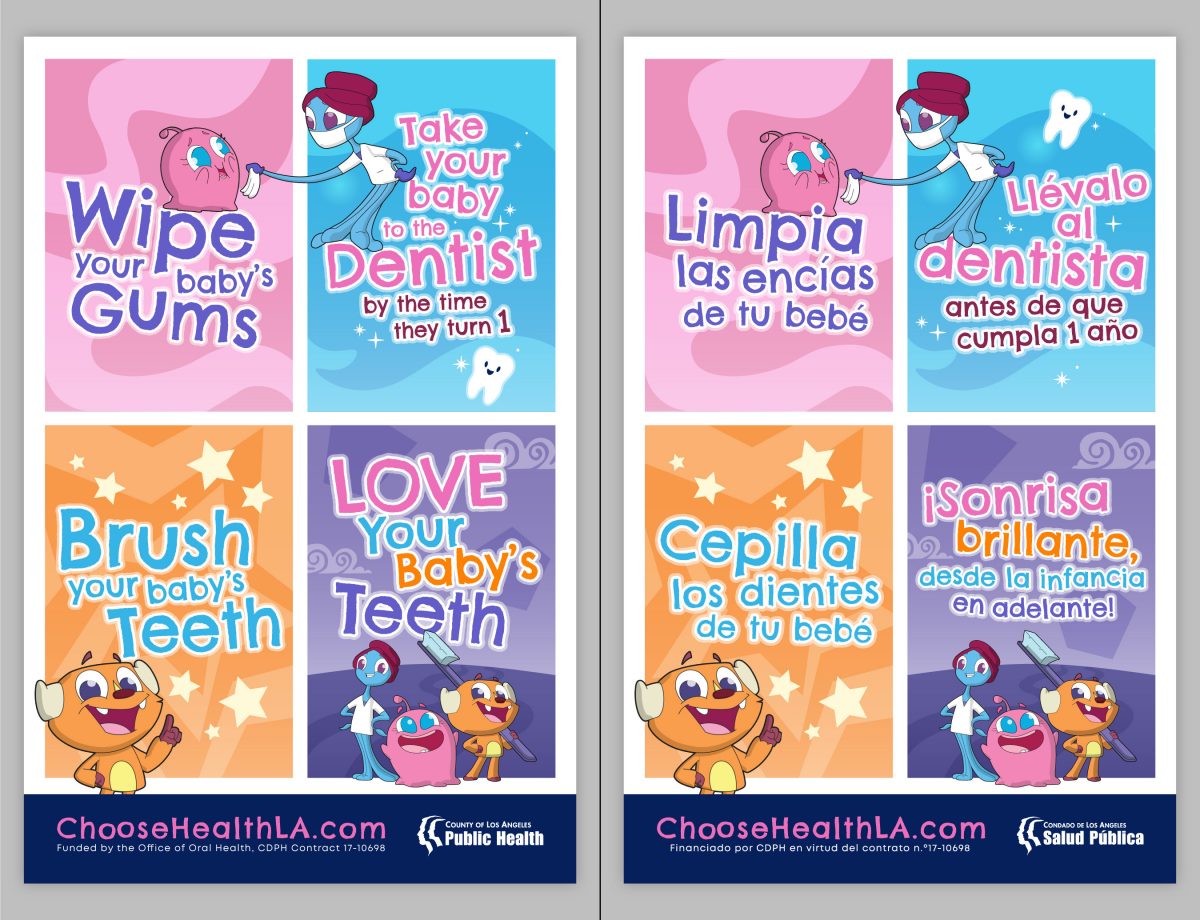
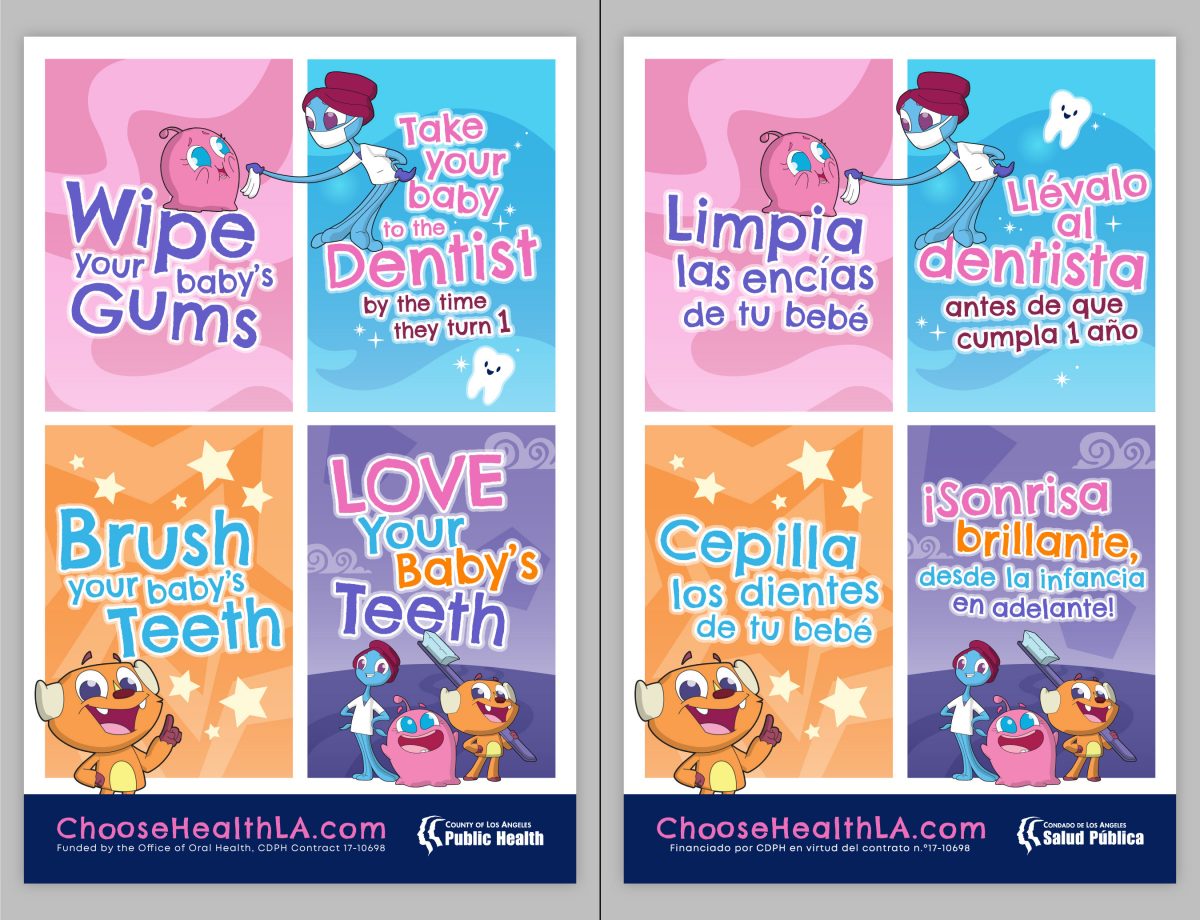
LACDPH Oral Health Campaign Graphic

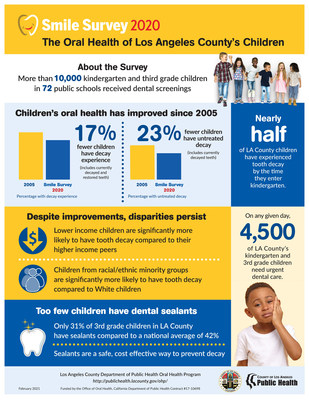
Casi la mitad de los estudiantes del condado de Los Ángeles ya han tenido una caries dental cuando ingresan al kínder y más del 60 por ciento de los estudiantes de tercer grado han tenido enfermedades dentales. La enfermedad dental más común es la caries. La caries dental sigue siendo más común entre niños/as de hogares hispanohablantes o con desventajas socioeconómicas y entre niños/as asiático/a americanos/as, afroamericanos/as y latinos/latinx. Niños/as de familias de bajos ingresos tienen casi el doble de probabilidad de tener caries tratadas y/o no tratadas y sustancialmente más probabilidad de tener caries no tratadas en comparación con los/as que no vienen de familias de bajos ingresos. Casi dos de cada tres niños/as latinos/latinx, aproximadamente la mitad de los/as niños/as afroamericanos/as y casi la mitad de los/las niños/as asiático/a-americanos/as han tenido una caries en algún momento de su vida, en comparación con solo el 32 por ciento de los/as niños/as blancos/as no hispanos/as.

«Vemos disparidades significativas en la salud dental de los/las niños/as del Condado de Los Ángeles. Los/las de familias de bajos ingresos tienen más probabilidad de tener caries y menos probabilidad de tener acceso a cuidado dental,» dijo Barbara Ferrer, PhD, MPH, MEd, directora de Salud Pública. «La salud dental es esencial para la salud en general. Desarrollar hábitos preventivos en casa y tener acceso a un(a) dentista hace posible que nuestro/as hijo/as tengan una vida de sonrisas saludables. Animamos a los padres a visitar ChooseHealthLA.com para consejos y para encontrar un(a) dentista cerca de ti a bajo costo o sin costo.»

Cuando no las trata un(a) dentista, las caries solo empeoran con el tiempo y pueden ser dolorosas, lo que reduce el bienestar y el desarrollo académico de los/las niños/as. Es posible que los estudiantes que tienen dolores de muelas no puedan concentrarse en lecciones, preparase para clases o enfocarse durante exámenes, por ejemplo. Las caries dentales que no se tratan pueden volverse más dolorosos y causar mala nutrición e infecciones que, si no se tratan, podrían poner la vida en peligro. La mala higiene bucal se asocia con problemas de salud como enfermedades cardíacas, diabetes y complicaciones del embarazo en el futuro. También se puede ahorrar dinero si comienza una rutina saludable de visitar un(a) dentista antes de que el bebé cumpla un año. Niños/as cubiertos por el programa dental de Medi-Cal que fueron al dentista a la edad de un año tuvieron costos dentales un 40% más bajos durante los siguientes cuatro años en comparación con niños/as que no vieron al dentista en su primer año de vida. Niños/as que califican para el seguro dental de Medi-Cal tienen la mayoría de los servicios de cuidado dental cubiertos por su seguro, incluyendo limpiezas dentales, rellenos y radiografías.

La campaña de educación pública de Salud Pública anima a los padres a tomar tres acciones sencillas para proteger la salud dental de su hijo/a desde la infancia en adelante:

  • Incluso antes de que salga el primer diente, limpia las encías de su bebé con una toallita después de alimentarlo/a;
  • Cepilla los dientecitos dos veces al día con un cepillo suave y una cantidad de pasta dental con fluoruro del tamaño de un grano de arroz; y,
  • Visita el/la dentista cada 6 meses empezando cuando le salga el primer diente o antes de que cumpla un año.

Salud Pública realizará una campaña publicitaria en inglés y español para alcanzar a los padres y cuidadores/as de niños de 0 a 5 años en comunidades donde niños/as tienen las tasas más altas de caries y el menor acceso al cuidado dental. El esfuerzo incluirá anuncios en televisión, radio, en línea, redes sociales, supermercados, paradas de autobús y consultorios de pediatras. Mira los videos de la campaña aquí: https://www.youtube.com/watch?v=qLztfTADyEU&list=PLlnxlejrhx-SoNF1045bnLhd8-M76HXom

Encuentra un(a) dentista cerca de ti a bajo costo o sin costo y consigue consejos sobre cómo cuidar los dientes de tu hijo/a: ChooseHealthLA.com/dientes

The Department of Public Health is committed to protecting and improving the health of over 10 million residents of Los Angeles County. Through a variety of programs, community partnerships and services, Public Health oversees environmental health, disease control, and community and family health. Nationally accredited by the Public Health Accreditation Board, the Los Angeles County Department of Public Health comprises nearly 4,100 employees and has an annual budget of $1 billion. To learn more about Los Angeles County Public Health, visit PublicHealth.LACounty.gov, and follow LA County Public Health on social media at twitter.com/LAPublicHealth, facebook.com/LAPublicHealth, instagram.com/LApublichealth and youtube.com/LAPublicHealth.

Los Angeles County Department of Public Health works to protect health,
prevent disease, and promote health and well-being.


LACDPH Smile Survey 2020

Foto – https://mma.prnewswire.com/media/1436690/LACDPH_Oral_Health_Campaign_Graphic.jpg
Foto – https://mma.prnewswire.com/media/1436691/SmileSurvey2020_01.jpg

FUENTE Los Angeles County Department of Public Health

Public Health Calls for Dental Care to Start Early in Childhood

Even Amid COVID-19 Parents Can Take Actions Now To Improve Their Child’s Dental Health Later

LOS ANGELES, Feb. 10, 2021 /PRNewswire-HISPANIC PR WIRE/ — In time for National Children’s Dental Health Month, the Los Angeles County Department of Public Health (Public Health) launched a media and public education campaign to give parents advice on how to care for their children’s baby teeth and lay the foundation for their babies’ dental health as they grow with a healthy routine at…

Even Amid COVID-19 Parents Can Take Actions Now To Improve Their Child’s Dental Health Later

LOS ANGELES, Feb. 10, 2021 /PRNewswire-HISPANIC PR WIRE/ — In time for National Children’s Dental Health Month, the Los Angeles County Department of Public Health (Public Health) launched a media and public education campaign to give parents advice on how to care for their children’s baby teeth and lay the foundation for their babies’ dental health as they grow with a healthy routine at home.

LACDPH Oral Health Campaign Graphic

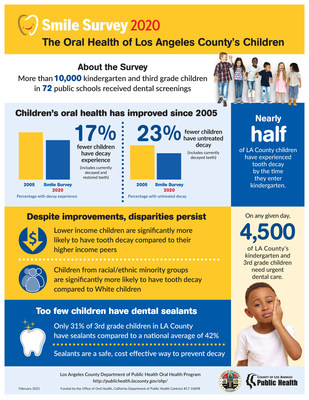
By the time they enter kindergarten, nearly half of children in Los Angeles County have experienced tooth decay and more than 60 percent of third grade children have had dental disease. The most common oral disease is tooth decay. Tooth decay remains more common in children from socioeconomically disadvantaged households, among children from Spanish speaking households, and among Asian, Black/African American and Latino/Latinx children. Children from families with low incomes are almost twice as likely to have treated and/or untreated cavities and are substantially more likely to have untreated cavities compared to those who do not come from families with low incomes. Nearly two-thirds of Latino/Latinx children and more than half of African American/Black children and almost half of Asian children have had a cavity in their lifetime, compared to only 32 percent of non-Hispanic white children.

«We see significant dental health disparities among children in Los Angeles County, with children from families with lower incomes more likely to have cavities and less likely to have access to dental care,» said Barbara Ferrer, PhD, MPH, MEd, Director of Public Health. «Dental health is essential to overall health. Developing preventive habits at home and having access to a dentist puts our children on track for a lifetime of healthy smiles. We encourage parents to visit ChooseHealthLA.com for tips and to find a low or no cost dentist near you.»

When not treated by a dentist, cavities can be painful and only get worse, reducing children’s wellbeing and academic development. Children experiencing toothaches may not be able to concentrate on their daily academic learnings or while taking an exam, for example. They may have a hard time concentrating or preparing for class. Untreated tooth decay can lead to health problems, including increasing pain, poor nutrition, infections which if left untreated could become life-threatening. Poor oral hygiene is associated with health problems such as heart disease, diabetes, and pregnancy complications later in life. It’s also more cost effective to start a healthy routine of going to the dentist by the time a child turns age one. Children covered by the Medi-Cal Dental Program who went to the dentist by age one had 40% lower dental costs over their next four years when compared to children that did not see a dentist in their first year of life. In California, children who qualify for Medi-Cal Dental insurance have most dental care services including teeth cleanings, fillings, and x-rays covered by their insurance.

Public Health’s awareness campaign encourages parents to take three simple actions to safeguard their baby’s dental health from day one:

  • Even before the first tooth comes in, clean your baby’s gums with a washcloth after feeding;
  • Brush your baby’s teeth twice a day with a soft toothbrush and just a smear of fluoride toothpaste, the size of a grain of rice; and,
  • Start visiting the dentist every 6 months by the time your baby turns one or when the first tooth appears.

Public Health will run a public awareness and education campaign in English and Spanish to reach parents and caregivers of children ages 0-5 in communities where children have the highest rates of cavities and the least access to dental care. The effort will include advertisements on television, radio, online, social media, grocery stores, bus shelters, and pediatricians’ offices. Watch the campaign videos here: https://www.youtube.com/watch?v=kbwHJOQtm6Q&list=PLlnxlejrhx-QFxbTObOUFEqO7xCTl389g

Find a low or no cost dentist near you and get tips for taking care of your child’s teeth at every age: ChooseHealthLA.com/Teeth

The Department of Public Health is committed to protecting and improving the health of over 10 million residents of Los Angeles County. Through a variety of programs, community partnerships and services, Public Health oversees environmental health, disease control, and community and family health. Nationally accredited by the Public Health Accreditation Board, the Los Angeles County Department of Public Health comprises nearly 4,100 employees and has an annual budget of $1 billion. To learn more about Los Angeles County Public Health, visit PublicHealth.LACounty.gov, and follow LA County Public Health on social media at twitter.com/LAPublicHealth, facebook.com/LAPublicHealth, instagram.com/LApublichealth and youtube.com/LAPublicHealth.

Los Angeles County Department of Public Health works to protect health,
prevent disease, and promote health and well-being.


LACDPH Smile Survey 2020

Photo – https://mma.prnewswire.com/media/1436354/LACDPH_Oral_Health_Campaign_Graphic.jpg
Photo – https://mma.prnewswire.com/media/1436355/LACDPH_Smile_Survey_2020.jpg


SOURCE Los Angeles County Department of Public Health

Climate Corps, Proven Model for Jobs and Climate Action, Poised to Answer Biden’s Call

SAN RAFAEL, Calif., Feb 10, 2021 /PRNewswire/ — Climate Corps – a fellowship program providing professional development opportunities for U.S. workers through implementation of environmental projects with local governments, nonprofits, and businesses – is well-poised to meet President Biden’s ambitious climate…

SAN RAFAEL, Calif., Feb 10, 2021 /PRNewswire/ — Climate Corps – a fellowship program providing professional development opportunities for U.S. workers through implementation of environmental projects with local governments, nonprofits, and businesses – is well-poised to meet President Biden’s ambitious climate and economic recovery goals.

A national Climate Corps could be the answer to job creation and climate change.

«The program was born out of the Great Recession over a decade ago to address the looming climate crisis and economic recovery. As an inroad to high paying green careers, it has the potential to create a more equitable workforce. It’s more relevant now than ever,» said Cyane Dandridge, Executive Director of SEI (the nonprofit that runs the Climate Corps program).

Emerging professionals are recruited by Climate Corps for placement in 10-month paid fellowships, where they gain real-world skills in environmental leadership by advancing sustainability initiatives within organizations. Since 2010, Climate Corps has placed 800 fellows to lead thousands of environmental projects – from zero waste and clean energy to climate action planning and green transportation.

«The whole workforce development program SEI created essentially opened up opportunities. Without that, I wouldn’t be in the position I’m in,» said David Liebman, former Climate Corps fellow and Sustainability and Energy Programs Manager at Santa Rosa Junior College.

«I view SEI’s Climate Corps model as a proven approach to preparing emerging professionals for real, meaningful jobs while bringing true value to their host organization and contributing to our collective progress towards addressing this climate crisis,» said Debbie Raphael, Director of the San Francisco Department of the Environment and past Climate Corps partner.

Every year, Climate Corps fellows prevent greenhouse gas emissions equal to 3,000+ cars taken off the road for one year, save enough water to serve over one million homes, and divert over 30 million pounds of waste.

In an Executive Order announced one week after inauguration, President Biden called for the establishment of a Civilian Climate Corps to simultaneously conserve and restore natural resources, address climate change, create high-paying jobs, and achieve «justice for communities who have been subjected to environmental harm.»

Similar programs designed to address both workforce and climate goals have been set forth by some states. In September, California’s Gov. Newsom announced the creation of the California Climate Action Corps with a focus on edible food recovery and wildfire protection. Last fall, New York’s Gov. Cuomo announced his plan for the Career Pathway Training Partnerships program to prepare New Yorkers for the growing number of job opportunities in the clean energy industry, training workers from the state’s most underserved and low-income populations.

SEI’s Climate Corps is forging ahead amidst the global pandemic and serving record numbers of fellows and partners. The program has seen a 600% increase in fellowship applications in the last year and is anticipating a significant increase in demand for fellows as cities, states, and organizations across the U.S. strive to achieve ambitious climate goals. The pre-existing, time-tested model could be easily adopted into the new administration’s plan for a Civilian Climate Corps.

About SEI
SEI, the Climate Corps program implementer, is an environmental nonprofit that builds leaders to drive sustainability solutions. For over 20 years, SEI has partnered with schools, communities, and businesses to develop a leadership pathway from elementary school to early career, educating and empowering students and emerging professionals to create thriving, resilient communities.

Cision View original content:http://www.prnewswire.com/news-releases/climate-corps-proven-model-for-jobs-and-climate-action-poised-to-answer-bidens-call-301226164.html

SOURCE SEI

Public Health Calls for Dental Care to Start Early in Childhood

LOS ANGELES, Feb. 10, 2021 /PRNewswire/ — In time for National Children’s Dental Health Month, the Los Angeles County Department of Public Health (Public Health) launched a media and public education campaign to give parents advice on how to care for their children’s baby teeth and lay the foundation for their babies’ dental health as they grow with a healthy routine at home.

<a…

LOS ANGELES, Feb. 10, 2021 /PRNewswire/ — In time for National Children’s Dental Health Month, the Los Angeles County Department of Public Health (Public Health) launched a media and public education campaign to give parents advice on how to care for their children’s baby teeth and lay the foundation for their babies’ dental health as they grow with a healthy routine at home.

By the time they enter kindergarten, nearly half of children in Los Angeles County have experienced tooth decay and more than 60 percent of third grade children have had dental disease. The most common oral disease is tooth decay. Tooth decay remains more common in children from socioeconomically disadvantaged households, among children from Spanish speaking households, and among Asian, Black/African American and Latino/Latinx children. Children from families with low incomes are almost twice as likely to have treated and/or untreated cavities and are substantially more likely to have untreated cavities compared to those who do not come from families with low incomes. Nearly two-thirds of Latino/Latinx children and more than half of African American/Black children and almost half of Asian children have had a cavity in their lifetime, compared to only 32 percent of non-Hispanic white children.

«We see significant dental health disparities among children in Los Angeles County, with children from families with lower incomes more likely to have cavities and less likely to have access to dental care,» said Barbara Ferrer, PhD, MPH, MEd, Director of Public Health. «Dental health is essential to overall health. Developing preventive habits at home and having access to a dentist puts our children on track for a lifetime of healthy smiles. We encourage parents to visit ChooseHealthLA.com for tips and to find a low or no cost dentist near you.»

When not treated by a dentist, cavities can be painful and only get worse, reducing children’s wellbeing and academic development. Children experiencing toothaches may not be able to concentrate on their daily academic learnings or while taking an exam, for example. They may have a hard time concentrating or preparing for class. Untreated tooth decay can lead to health problems, including increasing pain, poor nutrition, infections which if left untreated could become life-threatening. Poor oral hygiene is associated with health problems such as heart disease, diabetes, and pregnancy complications later in life. It’s also more cost effective to start a healthy routine of going to the dentist by the time a child turns age one. Children covered by the Medi-Cal Dental Program who went to the dentist by age one had 40% lower dental costs over their next four years when compared to children that did not see a dentist in their first year of life. In California, children who qualify for Medi-Cal Dental insurance have most dental care services including teeth cleanings, fillings, and x-rays covered by their insurance.

Public Health’s awareness campaign encourages parents to take three simple actions to safeguard their baby’s dental health from day one:

  • Even before the first tooth comes in, clean your baby’s gums with a washcloth after feeding;
  • Brush your baby’s teeth twice a day with a soft toothbrush and just a smear of fluoride toothpaste, the size of a grain of rice; and,
  • Start visiting the dentist every 6 months by the time your baby turns one or when the first tooth appears.

Public Health will run a public awareness and education campaign in English and Spanish to reach parents and caregivers of children ages 0-5 in communities where children have the highest rates of cavities and the least access to dental care. The effort will include advertisements on television, radio, online, social media, grocery stores, bus shelters, and pediatricians’ offices. Watch the campaign videos here: https://www.youtube.com/watch?v=kbwHJOQtm6Q&list=PLlnxlejrhx-QFxbTObOUFEqO7xCTl389g

Find a low or no cost dentist near you and get tips for taking care of your child’s teeth at every age: ChooseHealthLA.com/Teeth

The Department of Public Health is committed to protecting and improving the health of over 10 million residents of Los Angeles County. Through a variety of programs, community partnerships and services, Public Health oversees environmental health, disease control, and community and family health. Nationally accredited by the Public Health Accreditation Board, the Los Angeles County Department of Public Health comprises nearly 4,100 employees and has an annual budget of $1 billion. To learn more about Los Angeles County Public Health, visit PublicHealth.LACounty.gov, and follow LA County Public Health on social media at twitter.com/LAPublicHealth, facebook.com/LAPublicHealth, instagram.com/LApublichealth and youtube.com/LAPublicHealth.

Los Angeles County Department of Public Health works to protect health,
prevent disease, and promote health and well-being.

Cision View original content to download multimedia:http://www.prnewswire.com/news-releases/public-health-calls-for-dental-care-to-start-early-in-childhood-301226156.html

SOURCE Los Angeles County Department of Public Health

CEX.IO LOAN Experiences Massive Institutional Demand With Over $100 Million of Loan Requests

LONDON, Feb. 10, 2021 /PRNewswire/ — Crypto-backed lending service CEX.IO LOAN that launched in October 2020, has been experiencing major demand, receiving over $100M worth of loan requests to date. Most of the requests came from institutional investors, despite the service’s popularity among retail clientele, as well.

According to CEX.IO LOAN, such an increase…

LONDON, Feb. 10, 2021 /PRNewswire/ — Crypto-backed lending service CEX.IO LOAN that launched in October 2020, has been experiencing major demand, receiving over $100M worth of loan requests to date. Most of the requests came from institutional investors, despite the service’s popularity among retail clientele, as well.

According to CEX.IO LOAN, such an increase in demand can be attributed to the institutionalization of the crypto-industry. Institutional investors in possession of cryptocurrencies regard it as collateral for borrowing funds and use it as such.

They prefer the company’s service due to the convenience it offers to users. On the CEX.IO LOAN platform, customers can borrow cash against their cryptoassets in a quick and simple manner, without having to deal with credit checks or any unnecessary paperwork.

CEX.IO LOAN serves various cryptocurrency market participants, from retail investors and traders to startups and large enterprises. Users can borrow any amount between $500 and $100,000 at competitive interest rates starting at 8.75% per year and the loan duration ranging from seven days to one year.

The service has already experienced high demand from VIP clients, with 41% of all CEX.IO LOAN customers borrowing cash against Bitcoin, 53% – against Ethereum, and 6% – against decentralized finance (DeFi) tokens. 

While retail investors borrow $1,400 on average, VIP clients request larger-sized loans, with the typical amount being $1 million or higher. Institutional clients also need the funds for more extended periods (usually, 6-12 months), which indicates a long-term asset management strategy.

«As institutional investors find the digital asset industry increasingly attractive, it’s a pleasure to serve them with our enterprise-grade instant crypto-backed loan platform. Security, convenience, and compliance are key priorities for corporate clients, which are features that we have been providing to all our clients in the rapidly growing CEX.IO ecosystem,» – Anton Chashchin, Commercial Director for the CEX.IO LOAN service, stated.

About CEX.IO LOAN

CEX.IO LOAN is a part of the CEX.IO Group. Founded in 2013, CEX.IO operates one of the largest international exchanges of the cryptocurrency market, which has been featured among Crypto Compare’s ten best exchange services. With offices in the UK, USA, Ukraine, Cyprus, and Gibraltar, CEX.IO serves over 3 million customers worldwide. From entry-level users to professional traders, as well as institutions and businesses, CEX.IO suits the needs of various crypto market participants with a reliable, high-security digital asset service.

Cision View original content:http://www.prnewswire.com/news-releases/cexio-loan-experiences-massive-institutional-demand-with-over-100-million-of-loan-requests-301225779.html

SOURCE CEX.IO

We Are All Human + Hispanic Star Present «We Are Latino At Heart Infographic»

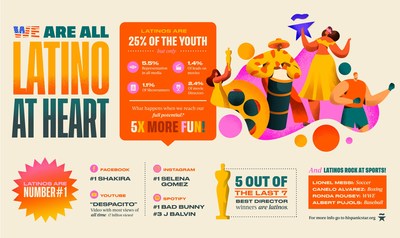
NEW YORK, Feb. 10, 2021 /PRNewswire-HISPANIC PR WIRE/ — Despite the fact that the Hispanic community has increased its representation and influence in the Entertainment industry, there are still too many places where representation is far from being a reality.

<img id="prnejpg71ccleft" title=" " border="0" alt=" " align="middle" imagelabel="General" src="https://mma.prnewswire.com/media/1436659/Latino_At_Heart.jpg…

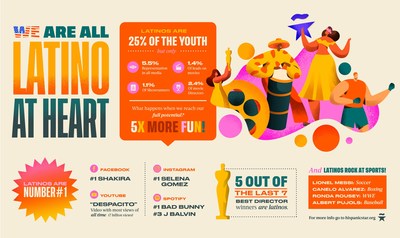
NEW YORK, Feb. 10, 2021 /PRNewswire-HISPANIC PR WIRE/ — Despite the fact that the Hispanic community has increased its representation and influence in the Entertainment industry, there are still too many places where representation is far from being a reality.

About We Are All Human
We Are All Human is a foundation dedicated to advancing the agenda of equity, diversity, and inclusion. Our vision is for every human to value every human. Our mission is to advocate for every human to be respected and empowered by focusing on our common humanity. By focusing on the universal values that make us all human, we can reach common ground, eliminate discrimination and achieve a more equitable society.

Media Contact:
Marisa García de Celis
marisa@weareallhuman.org
+52 3314178702

Photo – https://mma.prnewswire.com/media/1436659/Latino_At_Heart.jpg

SOURCE We Are All Human

We Are All Human + Hispanic Star Present «We Are Latino At Heart Infographic»

NEW YORK, Feb. 10, 2021 /PRNewswire/ — Despite the fact that the Hispanic community has increased its representation and influence in the Entertainment industry, there are still too many places where representation is far from being a reality.

NEW YORK, Feb. 10, 2021 /PRNewswire/ — Despite the fact that the Hispanic community has increased its representation and influence in the Entertainment industry, there are still too many places where representation is far from being a reality.

About We Are All Human
We Are All Human is a foundation dedicated to advancing the agenda of equity, diversity, and inclusion. Our vision is for every human to value every human. Our mission is to advocate for every human to be respected and empowered by focusing on our common humanity. By focusing on the universal values that make us all human, we can reach common ground, eliminate discrimination and achieve a more equitable society.

Media Contact:
Marisa García de Celis
marisa@weareallhuman.org
+52 3314178702

Cision View original content to download multimedia:http://www.prnewswire.com/news-releases/we-are-all-human–hispanic-star-present-we-are-latino-at-heart-infographic-301226113.html

SOURCE We Are All Human

Texas remains second in the nation for relocation activity in 2019

AUSTIN, Texas, Feb. 10, 2021 /PRNewswire-HISPANIC PR WIRE/ — Texas ranked second in the nation for relocation activity in 2019, according to the 2021 edition of the Texas Relocation Report released today by Texas Realtors, which analyzes the latest available migration data from the U.S. Census Bureau and U-Haul.

<img id="prnejpg7caaleft" title="Texas Association of Realtors…

AUSTIN, Texas, Feb. 10, 2021 /PRNewswire-HISPANIC PR WIRE/ — Texas ranked second in the nation for relocation activity in 2019, according to the 2021 edition of the Texas Relocation Report released today by Texas Realtors, which analyzes the latest available migration data from the U.S. Census Bureau and U-Haul.

Texas Association of Realtors logo.

«Once again, Texas welcomed more than half a million new residents from other states,» said Marvin Jolly, 2021 chairman of Texas Realtors. «Some move here for a lower cost of living than where they’re from, a great quality of life, diverse job opportunities, good weather—there are many reasons people continue coming to Texas

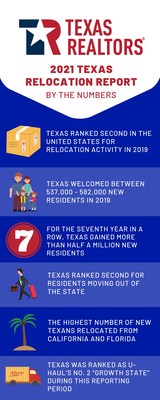
According to the Census estimates, Texas welcomed 537,000 – 582,000 new residents in 2019. This is the seventh year in a row that Texas attracted more than 500,000 new residents from out of state. The Census also estimated 435,000 – 471,000 Texans moved to other states, yielding a net gain of approximately 100,000 people. The Lone Star State also welcomed approximately 192,000 – 222,000 new residents from outside the United States in 2019.  

The highest number of new Texans from other U.S. states relocated from California and Florida, respectively. Other top states for people moving to Texas included Louisiana, Illinois, Oklahoma, New Mexico, Georgia and Arizona.

California ranked first in the United States for the number of residents moving out of state in 2019, with Texas coming in second. The most popular out-of-state relocation destinations for people moving out of Texas included California, Colorado, Oklahoma, Florida and Georgia. While California was the top state new Texans moved from and existing Texans moved to, about double the number of Californians moved to Texas compared to the migration of Texans to California.   

From 2014 to 2018, the top counties for people moving to Texas from out of state included Harris, Dallas, Tarrant, Bexar and Travis. On the metropolitan statistical area (MSA) level, the Dallas-Fort Worth-Arlington MSA and Houston-The Woodlands-Sugar Land MSA recorded the highest number of incoming residents from out-of-state during the same time frame.

«Though we don’t have 2020 relocation statistics yet, increased remote-work opportunities and company relocations continued to fuel moves from other states to Texas during the pandemic,» said Jolly. «No matter what part of the state these new residents are moving to, no one is better positioned to help them realize their real estate dreams than a Texas Realtor,» he said.

About the 2021 edition of the Texas Relocation Report
The 2021 edition of the Texas Relocation Report is based on data from the 2019 American Community Survey 5-Year Estimates by the U.S. Census Bureau as well as the 2020 U-Haul National Migration Trend Report. The report analyzes county relocation data of nine demographic areas in Texas. Texas REALTORS® distributes insights about the Texas housing market each month, including quarterly market statistics, trends among homebuyers and sellers, international trends, and more. To view the Texas Relocation Report in its entirety, visit texasrealestate.com.

About Texas REALTORS®
With more than 140,000 members, Texas REALTORS® is a professional membership organization that represents all aspects of real estate in Texas. We are the advocates for REALTORS® and private property rights in Texas. Visit texasrealestate.com to learn more.

Contact:
Morgan Moritz
mmoritz@piercom.com

Logo – https://mma.prnewswire.com/media/1317682/Texas_Realtors_Logo.jpg

SOURCE Texas REALTORS

Texas remains second in the nation for relocation activity in 2019

AUSTIN, Texas, Feb. 10, 2021 /PRNewswire/ — Texas ranked second in the nation for relocation activity in 2019, according to the 2021 edition of the Texas Relocation Report released today by Texas Realtors, which analyzes the latest available migration data from the U.S. Census Bureau and U-Haul.

<a…

AUSTIN, Texas, Feb. 10, 2021 /PRNewswire/ — Texas ranked second in the nation for relocation activity in 2019, according to the 2021 edition of the Texas Relocation Report released today by Texas Realtors, which analyzes the latest available migration data from the U.S. Census Bureau and U-Haul.

«Once again, Texas welcomed more than half a million new residents from other states,» said Marvin Jolly, 2021 chairman of Texas Realtors. «Some move here for a lower cost of living than where they’re from, a great quality of life, diverse job opportunities, good weather—there are many reasons people continue coming to Texas

According to the Census estimates, Texas welcomed 537,000 – 582,000 new residents in 2019. This is the seventh year in a row that Texas attracted more than 500,000 new residents from out of state. The Census also estimated 435,000 – 471,000 Texans moved to other states, yielding a net gain of approximately 100,000 people. The Lone Star State also welcomed approximately 192,000 – 222,000 new residents from outside the United States in 2019.  

The highest number of new Texans from other U.S. states relocated from California and Florida, respectively. Other top states for people moving to Texas included Louisiana, Illinois, Oklahoma, New Mexico, Georgia and Arizona.

California ranked first in the United States for the number of residents moving out of state in 2019, with Texas coming in second. The most popular out-of-state relocation destinations for people moving out of Texas included California, Colorado, Oklahoma, Florida and Georgia. While California was the top state new Texans moved from and existing Texans moved to, about double the number of Californians moved to Texas compared to the migration of Texans to California.   

From 2014 to 2018, the top counties for people moving to Texas from out of state included Harris, Dallas, Tarrant, Bexar and Travis. On the metropolitan statistical area (MSA) level, the Dallas-Fort Worth-Arlington MSA and Houston-The Woodlands-Sugar Land MSA recorded the highest number of incoming residents from out-of-state during the same time frame.

«Though we don’t have 2020 relocation statistics yet, increased remote-work opportunities and company relocations continued to fuel moves from other states to Texas during the pandemic,» said Jolly. «No matter what part of the state these new residents are moving to, no one is better positioned to help them realize their real estate dreams than a Texas Realtor,» he said.

About the 2021 edition of the Texas Relocation Report
The 2021 edition of the Texas Relocation Report is based on data from the 2019 American Community Survey 5-Year Estimates by the U.S. Census Bureau as well as the 2020 U-Haul National Migration Trend Report. The report analyzes county relocation data of nine demographic areas in Texas. Texas REALTORS® distributes insights about the Texas housing market each month, including quarterly market statistics, trends among homebuyers and sellers, international trends, and more. To view the Texas Relocation Report in its entirety, visit texasrealestate.com.

About Texas REALTORS®
With more than 140,000 members, Texas REALTORS® is a professional membership organization that represents all aspects of real estate in Texas. We are the advocates for REALTORS® and private property rights in Texas. Visit texasrealestate.com to learn more.

Contact:
Morgan Moritz
mmoritz@piercom.com


Cision View original content to download multimedia:http://www.prnewswire.com/news-releases/texas-remains-second-in-the-nation-for-relocation-activity-in-2019-301225369.html

SOURCE Texas REALTORS