Xi calls for multilateralism to fight pandemic, recession

BEIJING, Jan. 26, 2021 /PRNewswire/ — A news report by China Daily:

President Xi Jinping delivered a special speech at the virtual Davos Agenda event of the World Economic Forum in Beijing on Monday. Here are the highlights:

BEIJING, Jan. 26, 2021 /PRNewswire/ — A news report by China Daily:

President Xi Jinping delivered a special speech at the virtual Davos Agenda event of the World Economic Forum in Beijing on Monday. Here are the highlights:

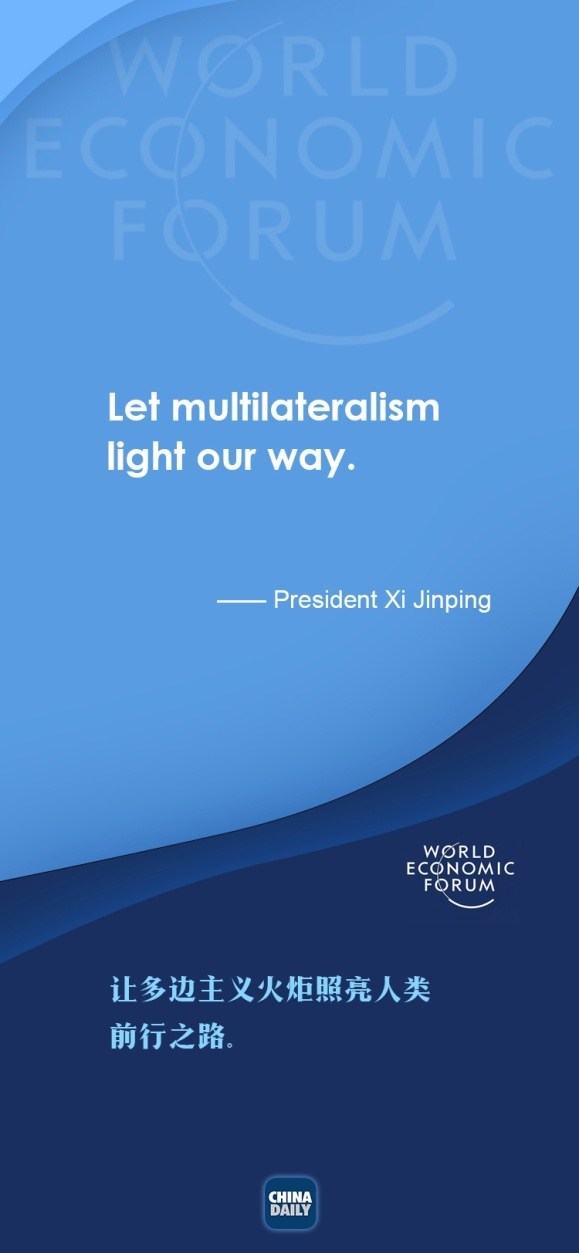
A quote from President Xi Jinping's special speech at the virtual Davos Agenda event of the World Economic Forum in Beijing on Monday.

Four tasks facing the world

1. Macroeconomic policy coordination

We are going through the worst recession since the end of World War II.

Despite the trillions of dollars in relief packages worldwide, global recovery is rather shaky and the outlook remains uncertain.

Macroeconomic policy support should be stepped up to bring the world economy out of the woods as early as possible.

2. Peaceful coexistence

Each country is unique with its own history, culture and social system, and none is superior to the other.

The best criteria are whether a country’s history, culture and social system fit its particular situation, enjoy people’s support, serve to deliver political stability, social progress and better lives, and contribute to human progress.

Difference in itself is no cause for alarm and what does ring the alarm is arrogance, prejudice and hatred.

3. Common prosperity

The international community should keep its eyes on the long run, honor its commitment, and provide necessary support to developing countries and safeguard their legitimate development interests.

Equal rights, equal opportunities and equal rules should be strengthened, so that all countries will benefit from the opportunities and fruits of development.

4. Global action

No global problem can be solved by any one country alone, and there must be global action, global response and global cooperation.

Four initiatives on upholding multilateralism

1. Consultation in intl affairs

Multilateralism is about having international affairs addressed through consultation and the future of the world decided by everyone working together.

To build small circles or start a new Cold War will only push the world into division and even confrontation. We cannot tackle common challenges in a divided world, and confrontation will lead us to a dead end.

We should build an open world economy, uphold the multilateral trading regime, discard discriminatory and exclusionary standards, rules and systems, and take down barriers to trade, investment and technological exchanges.

We should strengthen the G20 as the premier forum for global economic governance, engage in closer macroeconomic policy coordination, and keep the global industrial and supply chains stable and open.

2. Intl governance based on rules

The strong should not bully the weak. A decision should not be made by simply showing off strong muscles or waving a big fist.

Multilateralism should not be used as a pretext for acts of unilateralism. Principles should be preserved and rules, once made, should be followed by all. ‘Selective multilateralism’ should not be our option.

3. Fair competition

History and reality have made it clear that the misguided approach of antagonism and confrontation, be it in the form of cold war, hot war, trade war or tech war, will eventually hurt all countries’ interests and undermine everyone’s well-being.

It is important for the international community to stick to the concept of cooperation based on mutual benefit and guarantee the equal rights to development for all countries.

We should advocate fair competition, like competing with each other for excellence in a racing field, not beating each other on a wrestling arena.

4. Looking to the future

The world is undergoing changes unseen in a century, and now is the time for major development and transformation.

We need to reform and improve the global governance system on the basis of extensive consultation and consensus-building.

China’s plans

1. China will continue to take an active part in international cooperation on COVID-19

China will continue to share its experience with other countries, do its best to assist countries and regions that are less prepared for the pandemic, and work for greater accessibility and affordability of COVID vaccines in developing countries.

2. China will continue to implement a win-win strategy of opening-up

It serves no one’s interest to use the pandemic as an excuse to reverse globalization and go for seclusion and decoupling.

3. China will continue to promote sustainable development

China must step forward, take action, and get the job done when the interests of all humanity are at stake.

China is taking concrete actions to uphold multilateralism and contributing to protecting our shared home and realizing the sustainable development of humanity.

4. China will continue to advance science, technology and innovation

Scientific and technological advances should benefit all humanity rather than be used to curb and contain other countries’ development.

5. China will continue to promote a new type of international relations

The zero-sum game or winner-takes-all is not the guiding philosophy of the Chinese people.

China will get more actively engaged in global economic governance and push for an economic globalization that is more open, inclusive, balanced and beneficial to all.

chinadaily.com.cn

Cision View original content to download multimedia:http://www.prnewswire.com/news-releases/xi-calls-for-multilateralism-to-fight-pandemic-recession-301215345.html

SOURCE China Daily

ZF Launches Series Production for new EV Braking System

LIVONIA, Mich., Jan. 26, 2021 /PRNewswire-HISPANIC PR WIRE/ — ZF confirms its position as a technology and system supplier for electromobility with a new series production order. The latest in ZF brake control solutions will be established as standard in Volkswagen’s ID.3 and ID.4 models as well as in Volkswagen Group’s globally marketed modular e-drive system MEB platform. With its new brake control, ZF can help to meet high comfort and safety requirements. Furthermore, it optimizes the recovery…

LIVONIA, Mich., Jan. 26, 2021 /PRNewswire-HISPANIC PR WIRE/ — ZF confirms its position as a technology and system supplier for electromobility with a new series production order. The latest in ZF brake control solutions will be established as standard in Volkswagen’s ID.3 and ID.4 models as well as in Volkswagen Group’s globally marketed modular e-drive system MEB platform. With its new brake control, ZF can help to meet high comfort and safety requirements. Furthermore, it optimizes the recovery of braking energy – increasing the range and everyday usability of electric vehicles.

Volkswagen Group’s order for the new ZF brake control system covers several million vehicles – starting with the recently introduced ID.3 and ID.4 and continuing with future models based on the manufacturer’s MEB e-drive platform MEB.

With an optimized software interface, ZF’s new braking system can be integrated and networked even more easily into the electronic architecture of the vehicles.

The ZF system also supports driver assistance features such as automatic emergency braking. In addition, ZF’s solution replaces previously necessary mechanical components (such as the parking lock) with software functions, which saves both weight and costs.

«We meet the trend toward electromobility with our entire range of technological solutions – not just in driveline technology,» says Wolf-Henning Scheider, CEO of ZF Group. «This supply order from Volkswagen emphasizes how our competencies for braking systems as well as for networked systems contribute to increasing the range of our customers electric vehicles. To this end, our systems help to meet high comfort and safety requirements.»

On a technical level, ZF brake control is based on a combination of the company’s electronic brake booster (EBB) and its electronic stability control (ESC). The system is part of a software network housed in the stability control unit. It helps meet stringent safety standards set by the European road safety association EuroNCAP. New testing protocols for functions such as automatic emergency braking drive the need for more powerful boost to provide braking force even faster and more dynamically.

ZF Friedrichshafen AG
ZF is a global technology company and supplies systems for passenger cars, commercial vehicles and industrial technology, enabling the next generation of mobility. ZF allows vehicles to see, think and act. In the four technology domains Vehicle Motion Control, Integrated Safety, Automated Driving, and Electric Mobility, ZF offers comprehensive solutions for established vehicle manufacturers and newly emerging transport and mobility service providers. ZF electrifies different kinds of vehicles. With its products, the company contributes to reducing emissions and protecting the climate.

ZF, which acquired WABCO Holdings Inc. on May 29, 2020, now has 160,000 employees worldwide with approximately 260 locations in 41 countries. In 2019, the two then-independent companies achieved sales of €36.5 billion (ZF) and $3.4 billion (WABCO).

For further press information and photos please visit: www.zf.com

SOURCE ZF

Guayaquil, abre inscripciones a proyectos socioambientales de América Latina para los «Oscars Del Medio Ambiente»

GUAYAQUIL, Ecuador, 26 de enero de 2020 /PRNewswire/ — Hasta el 15 de febrero a través de la página web: www.premioslatinoamericaverde.com los proyectos sociales y ambientales de toda América Latina podrán formar parte del Festival de Sostenibilidad más relevante del mundo, PREMIOS LATINOAMÉRICA VERDE (PLV), en 8 CATEGORÍAS Y 19 SUBCATEGORÍAS alineados a los OBJETIVOS  DE DESARROLLO y SOSTENIBLE DE NACIONES…

GUAYAQUIL, Ecuador, 26 de enero de 2020 /PRNewswire/ — Hasta el 15 de febrero a través de la página web: www.premioslatinoamericaverde.com los proyectos sociales y ambientales de toda América Latina podrán formar parte del Festival de Sostenibilidad más relevante del mundo, PREMIOS LATINOAMÉRICA VERDE (PLV), en 8 CATEGORÍAS Y 19 SUBCATEGORÍAS alineados a los OBJETIVOS  DE DESARROLLO y SOSTENIBLE DE NACIONES UNIDAS.

Guayaquil, Ecuador ha sido la sede de PLV desde el 2013 y se ha destacado en la región como una ciudad comprometida con el ecosistema al recibir 12.690 proyectos sociales y ambientales provenientes de 1144 ciudades y 41 países de América Latina y el Caribe, por lo que ha sido reconocido a nivel internacional como los «Oscars del Medio Ambiente«.

«El objetivo en el 2021 es sumar mentes, manos, entidades y gobiernos, ya que sólo con una visión regional y positiva se obtienen soluciones certeras y se contribuye en el compromiso de los 17 Objetivos de la Agenda 2030″, enfatizó Gustavo Manrique, Presidente de Premios Latinoamérica Verde.

Las personas, entidades públicas y privadas, gobiernos y ONG podrán participar de manera GRATUITA en PLV registrando sus proyectos en las siguientes categorías:

  • CATEGORÍA ENERGÍA: Dirigido a proyectos que trabajen en sistemas de producción/gestión energética con eje en la reducción de impacto socioambiental. 
    • SUBCATEGORÍAS: Accesibilidad a la energía y Energía limpia.
  • CATEGORÍA BIODIVERSIDAD: Dirigido a proyectos que tengan como foco el cuidado, la protección y la recuperación de los recursos más importantes para nuestra vida. 
    • SUBCATEGORÍAS: Océanos, Agua, Bosques, Fauna.
  • CATEGORÍA CIUDADES: Dirigido a proyectos que ofrezcan calidad de vida a sus habitantes, cuidando sus recursos, la justicia social para el bienestar actual y futuro. 
    • SUBCATEGORÍAS: Innovación e infraestructura, Movilidad, Comunidad Rural.
  • CATEGORÍA RESIDUOS: Dirigido a proyectos que trabajan en el tratamiento consciente de todo tipo de residuos. Clasificación, separación, tratamiento, reciclaje, entre otros.
    • SUBCATEGORÍAS: Manejo de residuos sólidos, Reciclaje, Productos Reusables.
  • CATEGORÍA ECONOMÍA: Dirigido a proyectos basados en un sistema socioeconómico y financiero tendiente al bienestar social, con empresas respetuosas con el planeta. 
    • SUBCATEGORÍAS: Producción sostenible, Economía Circular, Finanzas.
  • CATEGORÍA DESARROLLO HUMANO: Deberán tener como eje el desarrollo humano y el bienestar de la población, cualquiera sea su formato.
    • SUBCATEGORÍAS: Educación, Comunidad, Igualdad y Salud.
  • CATEGORÍA COMUNICACIÓN: Dirigido a empresas o plataformas tradicionales o digitales que informan, generan conciencia sobre la emergencia climática y sobre los millones de personas que están trabajando para el necesario equilibrio entre el ser humano y la naturaleza.
  • CATEGORÍA POLÍTICAS PÚBLICAS: Dirigido a proyectos enfocados a prácticas innovadoras para la mejora de los procesos de gestión socio ambiental, en el desarrollo de ciudades sostenibles y accesibles. Tales como propuestas e implementación de cambio, medidas regulatorias, leyes, y asignación de recursos o partidas presupuestarias, entre otros.

PLV seleccionarán a 63 finalistas de las ocho categorías y se premiarán a 21 proyectos. Asimismo se entregarán cuatro premios adicionales: Premios a la Escalabilidad, Premio al Público, Premio a la Efectividad y Premio a la Innovación.

Contacto:
Omar Dimitrakis Ruiz
Teléfono; +593987906373

Foto – https://mma.prnewswire.com/media/1427106/Ganadores_1.jpg
Foto – https://mma.prnewswire.com/media/1427105/Ganadores_2.jpg

FUENTE Premios Latinoamérica Verde

On the Heels of President Biden’s Inauguration, International Leaders Provide Roadmap for the Way Forward In China-US Relations

HONG KONG, Jan. 26, 2021 /PRNewswire/ — At a pivotal point in China-US relations, in the midst of COVID-19, and days following the inauguration of President Joe Biden, the United States and China are facing profound changes in their relationship and must work to bring stability back to the world community of which these nations are two of its most important members,…

HONG KONG, Jan. 26, 2021 /PRNewswire/ — At a pivotal point in China-US relations, in the midst of COVID-19, and days following the inauguration of President Joe Biden, the United States and China are facing profound changes in their relationship and must work to bring stability back to the world community of which these nations are two of its most important members, agreed panelists in a session today during the «US-China Relations: The Way Forward» forum hosted by the China-U.S. Exchange Foundation (CUSEF) and the China Center for International Economic Exchanges (CCIEE).

Over 40 past and current major stakeholders and influencers in the China-U.S. relationship including, former Prime Minister of Japan Yasuo Fukuda, CCIEE Chairman and former PRC Vice Premier Zeng Peiyan, former Prime Minister of Italy and former President of the European Commission Romano Prodi, former U.S. Secretary of Commerce Carlos Gutierrez, CPPCC Vice Chairman Tung Chee-hwa, current government officials, senior business leaders and renowned scholars from the United States, China, and other Asia Pacific countries came together virtually in an effort to address the current challenges facing bilateral relations. The discussion focused on how China and the U.S. should move forward in light of the incoming U.S. administration and use the opportunity to identify areas of cooperation between the two countries to tackle global challenges including climate change, the environment, food security, cyber security and COVID-19.

In an opening greeting to the forum, Carrie Lam, Chief Executive of Hong Kong Special Administrative Region, stressed that, «with the incoming 46th President of the U.S. we hope that bilateral relations between the world’s two leading economies will start to improve, providing the impetus of global recovery.» Ms. Lam added that both President Xi Jinping and President Joe Biden echoed their commitment to international cooperation on important issues going forward, specifically in global efforts to eradicate the pandemic. 

Adding to the optimism and hope for progress in both trade and policy negotiations between the U.S. and China, CCIEE Chairman Zeng Peiyan said that in order to seek win-win cooperation, China and the U.S. must first rebuild mutual trust by restarting and improving multi-level engagement mechanisms and ultimately, using that dialogue as the fundamental conduit to address issues and challenges in order to play a leading role in managing relations. He also stressed that the two countries must «reshape and restart economic and trade relations, which have always been the ballast and stabilizer of the overall relationship.»

In addition to this, global governance will be essential during an era of heightened risk. Speakers stressed their optimism of a new American president, but also spoke candidly of the challenges that will remain on both sides due to the innate political frames of both countries. «I don’t think there will be a major change between China and U.S. relations despite the new administration. However, there will be more dialogue,» said Romano Prodi, former Prime Minister of Italy and former President of the European Commission. «The tensions within the U.S. and competition with China are prevalent amongst both the Republicans and Democrats. Thus, there will be a necessity for deeper dialogue and exchange of views.»

Former Prime Minister of Japan Yasuo Fukuda stressed that less division and instability is something all nations are seeking given the risks and problems that need to be resolved immediately, which cannot be solved without the United States and its global leadership, especially in international trade and finance. However, he notes that «the U.S. must first contain the biggest issue – COVID-19, before it can help the rest of the world.»

Emphasizing the detrimental effects of a complete China-U.S. decoupling, former U.S. Secretary of Commerce Carlos Gutierrez firmly believes that this bilateral relationship should not be one based solely on transactions, but rather one that encourages a more strategic partnership, which increases areas of collaboration while eradicating areas of friction. «When you call someone an enemy, they become your enemy. We [U.S.] are not an enemy of China, and I don’t think China is an enemy of us. Words matter.» Former U.S. Trade Representative Carla Hills echoed this same sentiment by predicting that there will be significant changes in how the U.S. handles its international relationships. In her eyes, «the tone in which we deal with all international governments, including China, will be more diplomatic.»

In the closing remarks of today’s session, Tung Chee-hwa, the founder and Chairman of CUSEF, referenced both President Xi Jinping and President Biden in sharing their mutual goals to address global challenges including fighting climate change and COVID-19. He underscored that the world needs assurance that all nations will abide by the same rules-based system and that China will work to protect the rules-based system and maintain global harmony. Addressing areas of cooperation, Mr. Tung explained, «President Biden has said that his four priorities are the pandemic, the economy, climate change, and racial injustice. There is no question that the two countries can work together in at least the first three priorities.» In his opinion, «It is time to turn the page of the negatives of the past few years and start to work with one another again.»

The second day of the forum will host panels on the future of trade and the economy in connection to US-China relations. Keynote speakers will include: Michael Spence, Nobel Laureate in Economics and Philip H. Knight Professor Emeritus of Management in the Graduate School of Business at Stanford University; Zhang Xiaoqiang, Executive Vice Chairman and Chief Executive Officer at CCIEE; Stephen Roach, Senior Fellow at the Jackson Institute of Global Affairs and  Senior Lecturer at Yale; Bi Jingquan, Executive Vice Chairman of CCIEE and Vice Chairman of the Committee on Economic Affairs or the 13th CPPCC National Committee; plus a host of well-known panel speakers from both the U.S. and China. The third day will cover technology and global challenges, and people-to-people exchange, with keynote speakers including Steven Chu, Nobel Laureate in Physics and Former U.S. Secretary of Energy; Xie Zhenhua, Special Adviser on Climate Change Affairs of the Ministry of Ecology and Environment of China; Stephen Orlins, President of the NCUSCR; and Wang Chao, President of the Chinese People’s Institute of Foreign Affairs; also followed by panels of other distinguished speakers.

Note to Editors:

About the China – United States Exchange Foundation 
The China-United States Exchange Foundation (CUSEF)  is an independent, non-profit and non-governmental foundation committed to the belief that a positive and peaceful relationship between the strongest developed nation and the most populous, fast-developing nation is essential for global wellbeing. Founded in Hong Kong in 2008 and privately funded, CUSEF builds platforms to encourage constructive dialogue and diverse exchanges between the people of the U.S. and China. For more information please visit https://www.cusef.org.hk/.

About the China Center for International Economic Exchanges
Founded on March 20th, 2009, China Center for International Economic Exchanges (CCIEE), is a social organization and a new type of think tank, registered with and approved by the relevant authorities of the Chinese government. Guided by the philosophy of «Originality, Objectivity, Rationality and Compatibility», CCIEE aims to serve national development, improve people’s welfare and promote exchanges and cooperation by conducting research on strategic and economic issues both at home and abroad, developing international exchanges and cooperation and providing consulting services and intellectual support to the government and business in decision making. For more information, visit www.cciee.org.cn.

Media contact:
CUSEF
contactus@cusef.org.hk 


Cision View original content:http://www.prnewswire.com/news-releases/on-the-heels-of-president-bidens-inauguration-international-leaders-provide-roadmap-for-the-way-forward-in-china-us-relations-301215339.html

SOURCE China-United States Exchange Foundation

S&P CoreLogic Case-Shiller Index Shows Annual Home Price Gains Climbed To 9.5% In November

NEW YORK, Jan. 26, 2021 /PRNewswire/ — S&P Dow Jones Indices today released the latest results for the S&P CoreLogic Case-Shiller Indices, the leading measure of U.S. home prices. Data released today for November 2020 show that home prices continue to increase across the U.S. More than 27 years of history are available for these data series, and can be accessed in full by going to <a target="_blank"…

NEW YORK, Jan. 26, 2021 /PRNewswire/ — S&P Dow Jones Indices today released the latest results for the S&P CoreLogic Case-Shiller Indices, the leading measure of U.S. home prices. Data released today for November 2020 show that home prices continue to increase across the U.S. More than 27 years of history are available for these data series, and can be accessed in full by going to https://www.spglobal.com/spdji/.

Please note that transaction records for September 2020 for Wayne County, MI are now available. Due to delays at the local recording office caused by the COVID-19 lockdown, S&P Dow Jones Indices and CoreLogic were previously unable to generate a valid September 2020 update of the Detroit S&P CoreLogic Case-Shiller indices.

However, there are not a sufficient number of records for October 2020 and November 2020 for Detroit. Since Wayne is the most populous county in the Detroit metro area, S&P Dow Jones Indices and CoreLogic are unable to generate a valid Detroit index value for the months of October and November. When the sale transactions data fully resume and sufficient data are collected, the Detroit index values for the month(s) with missing updates will be calculated.

YEAR-OVER-YEAR 

The S&P CoreLogic Case-Shiller U.S. National Home Price NSA Index, covering all nine U.S. census divisions, reported a 9.5% annual gain in November, up from 8.4% in the previous month. The 10-City Composite annual increase came in at 8.8%, up from 7.6% in the previous month. The 20-City Composite posted a 9.1% year-over-year gain, up from 8.0% in the previous month.

Phoenix, Seattle and San Diego continued to report the highest year-over-year gains among the 19 cities (excluding Detroit) in November. Phoenix led the way with a 13.8% year-over-year price increase, followed by Seattle with a 12.7% increase and San Diego with a 12.3% increase. All 19 cities reported higher price increases in the year ending November 2020 versus the year ending October 2020. 

MONTH-OVER-MONTH

The U.S. National Index posted a 1.1% month-over-month increase, while the 10-City and 20-City Composites both posted increases of 1.2% and 1.1% respectively, before seasonal adjustment in November. After seasonal adjustment, the U.S. National Index posted a month-over-month increase of 1.4%, while the 10-City and 20-City Composites both posted increases of 1.4%. In November, all 19 cities (excluding Detroit) reported increases before and after seasonal adjustment.

NALYSIS

«The trend of accelerating home prices that began in June 2020 has now reached its sixth month with November’s emphatic report,» says Craig J. Lazzara, Managing Director and Global Head of Index Investment Strategy at S&P Dow Jones Indices. «The National Composite Index gained 9.5% relative to its level a year ago, accelerating from October’s 8.4% increase. The 10- and 20-City Composites (up 8.8% and 9.1%, respectively) also rose more rapidly in November than they had done in October. The housing market’s strength was once again broadly-based: all 19 cities for which we have November data rose, and all 19 gained more in the 12 months ended in November than they had gained in the 12 months ended in October.

«As COVID-related restrictions began to grip the economy last spring, their effect on housing prices was unclear. Price growth decelerated in May and June before beginning a steady climb upward.  November’s report continues that acceleration in a particularly impressive manner. The National Composite last matched this month’s 9.5% growth rate in February 2014, more than six and a half years ago. From the perspective of more than 30 years of S&P CoreLogic Case-Shiller data, November’s 9.5% year-over-year change ranks near the top decile of all monthly reports.

«Recent data are consistent with the view that COVID has encouraged potential buyers to move from urban apartments to suburban homes. This may represent a true secular shift in housing demand, or may simply represent an acceleration of moves that would have taken place over the next several years anyway. Future data will be required to address that question.

«Phoenix’s 13.8% increase led all cities for the 18th consecutive month. Seattle (+12.7%) and San Diego (+12.3%) took the silver and bronze medals once again. Prices were strongest in the West (+10.1%) and Southwest (+9.7%) regions, with the historically lagging Northeast (+9.3%) also turning in an impressive month.»

SUPPORTING DATA 

Table 1 below shows the housing boom/bust peaks and troughs for the three composites along with the current levels and percentage changes from the peaks and troughs.

2006 Peak

2012 Trough

Current

Index

Level

Date

Level

Date

From Peak (%)

Level

From Trough (%)

From Peak (%)

National

184.61

Jul-06

134.00

Feb-12

-27.4%

232.38

73.4%

25.9%

20-City

206.52

Jul-06

134.07

Mar-12

-35.1%

238.48

77.9%

15.5%

10-City

226.29

Jun-06

146.45

Mar-12

-35.3%

251.65

71.8%

11.2%

Table 2 below summarizes the results for November 2020. The S&P CoreLogic Case-Shiller Indices are revised for the prior 24 months, based on the receipt of additional source data.

November 2020

November/October

October/September

1-Year

Metropolitan Area

Level

Change (%)

Change (%)

Change (%)

Atlanta

167.19

1.2%

1.2%

7.9%

Boston

248.19

1.4%

1.5%

10.4%

Charlotte

183.18

1.1%

1.4%

9.4%

Chicago

154.40

0.4%

1.0%

7.5%

Cleveland

140.10

0.1%

1.3%

9.8%

Dallas

207.20

0.8%

1.5%

7.2%

Denver

241.28

1.0%

0.9%

8.1%

Detroit

Las Vegas

208.31

0.7%

0.8%

6.8%

Los Angeles

315.33

0.9%

1.1%

9.1%

Miami

266.58

1.3%

1.5%

7.9%

Minneapolis

196.43

0.7%

1.1%

9.4%

New York

219.53

1.8%

1.9%

8.2%

Phoenix

225.68

1.3%

1.7%

13.8%

Portland

263.13

0.7%

0.7%

9.5%

San Diego

295.64

0.9%

1.7%

12.3%

San Francisco

288.65

0.6%

1.0%

8.3%

Seattle

285.98

0.9%

1.1%

12.7%

Tampa

245.99

1.4%

1.6%

9.5%

Washington

256.00

1.1%

1.2%

9.1%

Composite-10

251.65

1.2%

1.4%

8.8%

Composite-20

238.48

1.1%

1.3%

9.1%

U.S. National

232.38

1.1%

1.4%

9.5%

Sources: S&P Dow Jones Indices and CoreLogic

Data through November 2020

Table 3 below shows a summary of the monthly changes using the seasonally adjusted (SA) and non-seasonally adjusted (NSA) data. Since its launch in early 2006, the S&P CoreLogic Case-Shiller Indices have published, and the markets have followed and reported on, the non-seasonally adjusted data set used in the headline indices. For analytical purposes, S&P Dow Jones Indices publishes a seasonally adjusted data set covered in the headline indices, as well as for the 17 of 20 markets with tiered price indices and the five condo markets that are tracked.

November/October Change (%)

October/September Change (%)

Metropolitan Area

NSA

SA

NSA

SA

Atlanta

1.2%

1.4%

1.2%

1.4%

Boston

1.4%

1.7%

1.5%

2.0%

Charlotte

1.1%

1.3%

1.4%

1.5%

Chicago

0.4%

1.2%

1.0%

1.6%

Cleveland

0.1%

0.7%

1.3%

2.1%

Dallas

0.8%

1.0%

1.5%

1.6%

Denver

1.0%

1.4%

0.9%

1.4%

Detroit

Las Vegas

0.7%

1.0%

0.8%

1.1%

Los Angeles

0.9%

1.2%

1.1%

1.3%

Miami

1.3%

1.3%

1.5%

1.5%

Minneapolis

0.7%

1.4%

1.1%

1.6%

New York

1.8%

2.1%

1.9%

1.8%

Phoenix

1.3%

1.6%

1.7%

1.7%

Portland

0.7%

1.3%

0.7%

1.4%

San Diego

0.9%

1.6%

1.7%

2.1%

San Francisco

0.6%

0.8%

1.0%

1.4%

Seattle

0.9%

1.7%

1.1%

2.1%

Tampa

1.4%

1.3%

1.6%

1.5%

Washington

1.1%

1.3%

1.2%

1.4%

Composite-10

1.2%

1.4%

1.4%

1.6%

Composite-20

1.1%

1.4%

1.3%

1.6%

U.S. National

1.1%

1.4%

1.4%

1.7%

Sources: S&P Dow Jones Indices and CoreLogic

Data through November 2020

For more information about S&P Dow Jones Indices, please visit https://www.spglobal.com/spdji/.

ABOUT S&P DOW JONES INDICES

S&P Dow Jones Indices is the largest global resource for essential index-based concepts, data and research, and home to iconic financial market indicators, such as the S&P 500® and the Dow Jones Industrial Average®. More assets are invested in products based on our indices than products based on indices from any other provider in the world. Since Charles Dow invented the first index in 1884, S&P DJI has been innovating and developing indices across the spectrum of asset classes helping to define the way investors measure and trade the markets.

S&P Dow Jones Indices is a division of S&P Global (NYSE: SPGI), which provides essential intelligence for individuals, companies, and governments to make decisions with confidence. For more information, visit https://www.spglobal.com/spdji/.

FOR MORE INFORMATION:

April Kabahar
Global Head of Communications
New York, USA
(+1) 212 438 7530
april.kabahar@spglobal.com

Raymond McConville
Communications Manager
New York, USA
(+1) 212 438 1678
raymond.mcconville@spglobal.com

S&P Dow Jones Indices’ interactive blog, IndexologyBlog.com, delivers real-time commentary and analysis from industry experts across S&P Global on a wide-range of topics impacting residential home prices, homebuilding and mortgage financing in the United States. Readers and viewers can visit the blog at www.indexologyblog.com, where feedback and commentary are welcomed and encouraged.

The S&P CoreLogic Case-Shiller Indices are published on the last Tuesday of each month at 9:00 am ET. They are constructed to accurately track the price path of typical single-family homes located in each metropolitan area provided. Each index combines matched price pairs for thousands of individual houses from the available universe of arms-length sales data. The S&P CoreLogic Case-Shiller U.S. National Home Price Index tracks the value of single-family housing within the United States. The index is a composite of single-family home price indices for the nine U.S. Census divisions and is calculated quarterly. The S&P CoreLogic Case-Shiller 10-City Composite Home Price Index is a value-weighted average of the 10 original metro area indices. The S&P CoreLogic Case-Shiller 20-City Composite Home Price Index is a value-weighted average of the 20 metro area indices. The indices have a base value of 100 in January 2000; thus, for example, a current index value of 150 translates to a 50% appreciation rate since January 2000 for a typical home located within the subject market.

These indices are generated and published under agreements between S&P Dow Jones Indices and CoreLogic, Inc.

The S&P CoreLogic Case-Shiller Indices are produced by CoreLogic, Inc. In addition to the S&P CoreLogic Case-Shiller Indices, CoreLogic also offers home price index sets covering thousands of zip codes, counties, metro areas, and state markets. The indices, published by S&P Dow Jones Indices, represent just a small subset of the broader data available through CoreLogic.

Case-Shiller® and CoreLogic® are trademarks of CoreLogic Case-Shiller, LLC or its affiliates or subsidiaries («CoreLogic») and have been licensed for use by S&P Dow Jones Indices. None of the financial products based on indices produced by CoreLogic or its predecessors in interest are sponsored, sold, or promoted by CoreLogic, and neither CoreLogic nor any of its affiliates, subsidiaries, or predecessors in interest makes any representation regarding the advisability of investing in such products.


Cision View original content:http://www.prnewswire.com/news-releases/sp-corelogic-case-shiller-index-shows-annual-home-price-gains-climbed-to-9-5-in-november-301215333.html

SOURCE S&P Dow Jones Indices
University of St. Thomas Achieves Top Environmental Rating for New Residence Hall

ST. PAUL, Minn., Jan. 26, 2021 /PRNewswire/ — A group of on-campus students at Minnesota’s largest private university have new bragging rights: They can truly say they live in one of the country’s greenest residence halls.

<div…

ST. PAUL, Minn., Jan. 26, 2021 /PRNewswire/ — A group of on-campus students at Minnesota’s largest private university have new bragging rights: They can truly say they live in one of the country’s greenest residence halls.

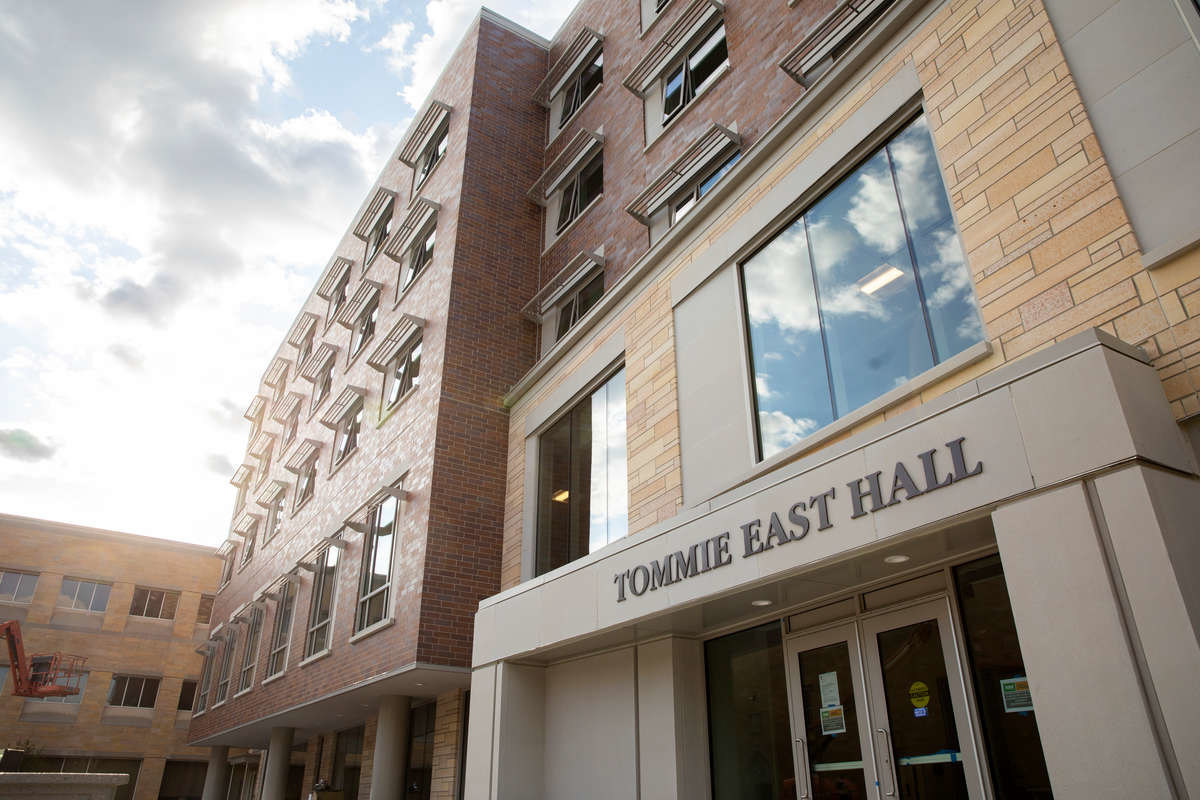
The U.S. Green Building Council (USGBC) has awarded its highest environmental rating – the LEED® (Leadership in Energy and Environmental Design) Platinum certification – to the University of St. Thomas’ Tommie East Residence Hall. The building is the first in the Midwest to certify platinum under the LEED v4 new construction rating system in its category, the sixth in the U.S. and seventh in the world. It marks another step in the university’s larger plan to achieve carbon neutrality by 2035.

LEED is the world’s most widely used green building rating system.

St. Thomas opened the five-story, 139,300-square-foot residence hall – which can house up to 260 students – last fall as part of many transformative upgrades to its St. Paul campus. Designed by ESG Architecture & Design, and constructed by Ryan Companies, it received high marks for several features, including:

  • Energy efficiency above industry standards
  • Electric vehicle charging stations
  • High-efficiency appliances and low-flow water fixtures
  • Green space access
  • Underground rainwater infiltration

«Preparing our students to be sustainability leaders is central to the university’s mission to advance the common good,» said Amir Nadav, assistant director of campus sustainability. «Tommie East reflects the university’s commitment and provides a unique opportunity for students to live in, and learn from, a high-performance building. We hope students’ experiences at St. Thomas will empower and inspire them to champion sustainability in their own lives and future careers.»

Tommie East is certified using LEED’s Building Design and Construction: Multifamily Midrise rating system for new construction.

Over the past decade, St. Thomas has reduced carbon emissions by 37% by implementing energy conservation measures in new and existing buildings. As part of its larger sustainability initiative, the university is designing all new buildings larger than 25,000 square feet to a minimum of LEED Silver standards. It also calls for integrating sustainability into its residence halls by reducing waste, conserving energy and water, and measuring its progress.

St. Thomas also achieved a STARS (Sustainability Tracking, Assessment and Rating System) Silver rating in 2018, is listed on the Princeton Review’s Guide to Green Colleges, and has received three marks of distinction from the Climate Leadership Network.

CONTACT: Vineeta Sawkar, vineeta.sawkar@stthomas.edu

Cision View original content to download multimedia:http://www.prnewswire.com/news-releases/university-of-st-thomas-achieves-top-environmental-rating-for-new-residence-hall-301215329.html

SOURCE University of St. Thomas

New research highlights racial inequities in the workforce and makes actionable recommendations for equitable economic recovery

WASHINGTON, Jan. 26, 2021 /PRNewswire/ — New reports show that there remain deep racial inequities in the labor market that are made worse by the coronavirus pandemic. Coupled with disaggregated data analysis, the reports identify workforce equity strategies that should be implemented across systems to foster broad economic prosperity.

The Advancing Workforce Equity reports, released today by the National Fund for Workforce Solutions, in collaboration with PolicyLink and the <span…

WASHINGTON, Jan. 26, 2021 /PRNewswire/ — New reports show that there remain deep racial inequities in the labor market that are made worse by the coronavirus pandemic. Coupled with disaggregated data analysis, the reports identify workforce equity strategies that should be implemented across systems to foster broad economic prosperity.

The Advancing Workforce Equity reports, released today by the National Fund for Workforce Solutions, in collaboration with PolicyLink and the USC Equity Research Institute, Burning Glass Technologies, and JPMorgan Chase, uncover data that highlights the stark realities for workers in five U.S. metro regions – Boston, Chicago, Dallas, San Francisco, and Seattle. Key observations that emerged across these regions include the following:

  • Racial inequities in income are a drag on regional economic growth. The unrealized GDP ranges from $33 billion in Seattle to $348 billion in the San Francisco Bay Area and will only increase as the workforce diversifies.
  • Occupational segregation, where workers of color are crowded into low-wage jobs, is entrenched and perpetuates inequities. In the Dallas region, Black workers are about 18% of the total workforce but almost half (48%) of healthcare support workers and just 12% of both computer and mathematical jobs and management positions.
  • Black and Latinx workers earn substantially less than their White counterparts at every education level.
  • There are not enough good jobs to go around, and workers of color are overrepresented in low-quality jobs. In all five communities, only 40-50% of workers are in «good jobs.»
  • Workers of color face significant, disproportionate risk of job loss as a result of automation.

«Shared prosperity demands bold solutions that center racial equity and dismantle systems and structures that disadvantage certain groups of people,» said Michael McAfee, president and CEO of PolicyLink. Equity—just and fair inclusion into a society in which everyone can participate and prosper—is the superior growth model. It is not only a matter of social justice or morality: It is an economic necessity.»

Although there are similarities across the reports, the recommended actions emerged from the local data insights and reflect the power of local leadership, design, and influence. Traditional workforce activities — education, training, and job placement — remain a priority, but this research demonstrates that achieving workforce equity will require greater public and private sector coordination, collaboration, and solutions that can cut across multiple systems, including housing, transportation, and childcare.

«The data supports what we’ve seen for a long time. Racial inequities are entrenched in all aspects of the workforce system,» said Amanda Cage, president and CEO of the National Fund for Workforce Solutions. «The time for talk is over. It’s time to get to work, and the strategies outlined in these reports offer a concrete way to get started.»

The following recommendations are among those highlighted in the reports:

  • Focus on improving job quality and/or increasing the number of quality jobs.
  • Use skills-based hiring, retention, and advancement strategies to reduce racial occupational segregation that results from hiring bias and degree inflation.
  • Invest in proven workforce training programs to remove barriers to entry and advancement in the labor market.
  • Invest in solutions that increase worker voice and power, and support worker rights.
  • Connect workforce programs to economic development initiatives with specific equity targets and outcomes.

«As workers across the country, especially in Black and Latinx communities, continue to face barriers to good jobs, it’s critical to work across sectors to address these inequities,» said Monique Baptiste, vice president of global philanthropy at JPMorgan Chase. «With data-driven insights and collaboration, and as part of JPMorgan Chase’s commitment to advancing racial equity and preparing people for the future of work, we can begin to close the gap, grow opportunity, and define a clear path forward to a more inclusive economy.»

The regional reports, data, and analysis can be found at https://nationalfund.org/advancing-workforce-equity-reports/.

The Advancing Workforce Equity reports were developed through a partnership of the National Fund for Workforce Solutions, PolicyLink, USC Equity Research Institute, and Burning Glass Technologies, with support from JPMorgan Chase.


Cision View original content:http://www.prnewswire.com/news-releases/new-research-highlights-racial-inequities-in-the-workforce-and-makes-actionable-recommendations-for-equitable-economic-recovery-301215252.html

SOURCE The National Fund for Workforce Solutions

New research highlights racial inequities in the Boston area workforce and makes actionable recommendations for equitable economic recovery

BOSTON, Jan. 26, 2021 /PRNewswire/ — A new report shows that in the Boston metropolitan region, people of color are overrepresented in the essential jobs that are disproportionately impacted by the ongoing pandemic. The report uses data to identify workforce equity strategies that should be implemented to foster broad economic prosperity.

Advancing Workforce Equity in Boston: A Blueprint for Action, released today by the…

BOSTON, Jan. 26, 2021 /PRNewswire/ — A new report shows that in the Boston metropolitan region, people of color are overrepresented in the essential jobs that are disproportionately impacted by the ongoing pandemic. The report uses data to identify workforce equity strategies that should be implemented to foster broad economic prosperity.

Advancing Workforce Equity in Boston: A Blueprint for Action, released today by the National Equity Atlas (a partnership between PolicyLink and the USC Equity Research Institute) with the National Fund for Workforce Solutions, SkillWorks, Burning Glass Technologies, and JPMorgan Chase, highlights stark realities for workers in the Boston metropolitan region. 

People of color – especially Black and Latinx residents – face systemic and structural barriers to opportunity, and this impact is widespread. According to the data, White workers in Greater Boston with less than a high school diploma earn about the same as workers of color with an associate degree. In fact, deeply entrenched racial inequity cost the region $44 billion in unrealized GDP in 2018 alone. Disparities in the system are felt by the whole region, but workers of color are bearing most of the burden.

«Across our national network of employers, workforce development boards, training providers, and community partners, the situation mirrors what this data reveals: Racial inequities are entrenched in all aspects of the workforce system,» said Amanda Cage, president and CEO of the National Fund for Workforce Solutions. «To ensure the system works for everyone, we need to start fixing these issues now.»

Key recommendations to build a thriving and inclusive economy include the following:

  • Leverage the real estate development boom and industry growth to increase union participation and expand apprenticeship and secure public financing for social programs that support workers of color.
  • Encourage public policy solutions that result in more good jobs and work across systems to expand investments in childcare, housing, and transportation — all with racial equity at the center.
  • Encourage educational institutions and employers to transition to skills-based hiring.
  • Invest in robust data collection and reporting systems to uncover inequities, track progress, and drive change.

«No single solution can reverse the decades of systemic inequity built into our local economy – and made more evident during the pandemic,» said Andre Green, executive director of SkillWorks at the Boston Foundation, the local partner of the National Fund for Workforce Solutions. «It will take a multi-pronged approach that includes policymakers, employers, workforce training programs, and most importantly, workers themselves to better understand and improve job quality and equity.»

As workers across Greater Boston, especially in Black and Latinx communities, continue to face barriers to good jobs, it’s critical to work across sectors to address these inequities,» said Abby Marquand, vice president of global philanthropy at JPMorgan Chase. «With data-driven insights and collaboration, and as part of JPMorgan Chase’s commitment to advancing racial equity and preparing people for the future of work, we can begin to drive a clear path forward to a more inclusive economy.»

The report, data and analysis can be found at https://nationalequityatlas.org/research/workforce-equity-boston.

Advancing Workforce Equity in Boston: A Blueprint for Action was developed through a partnership of the National Fund for Workforce Solutions, SkillWorks: Partners for a Productive Workforce, PolicyLinkUSC Equity Research Institute, and Burning Glass Technologies, with support from JPMorgan Chase.

Cision View original content:http://www.prnewswire.com/news-releases/new-research-highlights-racial-inequities-in-the-boston-area-workforce-and-makes-actionable-recommendations-for-equitable-economic-recovery-301215247.html

SOURCE The National Fund for Workforce Solutions

New research highlights racial disparities in the workforce in Dallas and Collin Counties and makes actionable recommendations for equitable economic recovery

DALLAS, Jan. 26, 2021 /PRNewswire/ — A new report shows that despite its reputation as a beacon of economic vitality, there remain deep racial inequities in the Dallas labor market, made worse by the challenges of the pandemic. Coupled with data analysis, the report identifies workforce equity strategies that should be implemented across systems to foster economic prosperity.

Advancing Workforce Equity in Dallas and Collin

DALLAS, Jan. 26, 2021 /PRNewswire/ — A new report shows that despite its reputation as a beacon of economic vitality, there remain deep racial inequities in the Dallas labor market, made worse by the challenges of the pandemic. Coupled with data analysis, the report identifies workforce equity strategies that should be implemented across systems to foster economic prosperity.

Advancing Workforce Equity in Dallas and Collin Counties: A Blueprint for Action, released today by the National Equity Atlas (a partnership between PolicyLink and the USC Equity Research Institute) with the National Fund for Workforce Solutions, United Way Pathways to Work, Burning Glass Technologies, and JPMorgan Chase, highlights stark realities for workers in the Dallas region.

Occupational segregation is stark and the impact is widespread. Black workers in Dallas and Collin Counties are about 18% of the total workforce but almost half (48%) of healthcare support workers and just 12% of both computer and mathematical jobs and management positions.

In 2018 alone, racial gaps in wages and employment for working-age people cost the region more than $115 billion in lost GDP. Inequities in the system are felt by the whole region, but workers of color are bearing the burden.

«Across our national network of employers, workforce development boards, training providers, and community partners, the situation mirrors what this data reveals: Racial inequities are entrenched in all aspects of the workforce system,» said Amanda Cage, president and CEO of the National Fund for Workforce Solutions. «To ensure the system works for everyone, we need to start fixing these issues now.»

The report offers the following agenda for funders, employers, and community organizations to build a thriving and inclusive regional workforce: 

  • Create good jobs and improve the quality of existing jobs.
  • Use skills-based hiring, retention, and advancement strategies to reduce occupational segregation.
  • Align workforce development and worker rights efforts to improve basic protections and increase opportunities for advancement.
  • Coordinate with the local housing systems to ensure access to good jobs in affordable neighborhoods.

«United Way has set ambitious 10-year community goals to drive transformative change and advance racial equity in education, income and health in North Texas,» said Andrea Glispie, director of United Way Pathways to Work, the local partner of the National Fund for Workforce Solutions. «Increasing the number of young adults who earn a living wage by 20%, with a particular focus on Black and Latinx North Texans, is a top priority. The strategic recommendations in this report provide a roadmap for how to reach this goal.»

«As workers across the country, especially in Black and Latinx communities, continue to face barriers to good jobs, it’s critical to work across sectors to address these inequities,» said Monique Baptiste, vice president of global philanthropy at JPMorgan Chase. «With data-driven insights and collaboration, and as part of JPMorgan Chase’s commitment to advancing racial equity and preparing people for the future of work, we can begin to close the gap, grow opportunity, and define a clear path forward to a more inclusive economy.»

The report, data and analysis can be found at https://nationalequityatlas.org/research/workforce-equity-dallas 

Advancing Workforce Equity in Dallas and Collin Counties was developed through a partnership of the National Fund for Workforce Solutions, United Way Pathways to Work, PolicyLink, USC Equity Research Institute, and Burning Glass Technologies, with support from JPMorgan Chase.


Cision View original content:http://www.prnewswire.com/news-releases/new-research-highlights-racial-disparities-in-the-workforce-in-dallas-and-collin-counties-and-makes-actionable-recommendations-for-equitable-economic-recovery-301215249.html

SOURCE The National Fund for Workforce Solutions

New research highlights racial disparities in the workforce in Seattle and makes actionable recommendations for equitable economic recovery

SEATTLE, Jan. 26, 2021 /PRNewswire/ — A new report shows that despite Seattle’s reputation as a progressive beacon of economic vitality, deep racial inequities remain in the labor market that are made worse by the pandemic. Using disaggregated data analysis, the report identifies workforce equity strategies that should be implemented to foster broad economic prosperity.

Advancing Workforce Equity in Seattle: A Blueprint for…

SEATTLE, Jan. 26, 2021 /PRNewswire/ — A new report shows that despite Seattle’s reputation as a progressive beacon of economic vitality, deep racial inequities remain in the labor market that are made worse by the pandemic. Using disaggregated data analysis, the report identifies workforce equity strategies that should be implemented to foster broad economic prosperity.

Advancing Workforce Equity in Seattle: A Blueprint for Action, released today by the National Equity Atlas (a partnership between PolicyLink and the USC Equity Research Institute) with the National Fund for Workforce Solutions, Workforce Development Council of SeattleKing County, Burning Glass Technologies, and JPMorgan Chase, highlights stark realities for workers in the region.

The impact of racial inequity is widespread. Black and Latinx workers earn substantially less than their White counterparts at every education level. Nearly 90% of White workers are paid at least $15 an hour, compared to just 59% of Latinx immigrants, 64% of Black immigrants, and 68% of Native Americans.

In 2018 alone, racial gaps in wages and employment for working-age people cost Seattle over $33 billion in lost GDP. Disparities in the system are felt by the whole region, and workers of color bear the burden.

«Across our national network of employers, workforce development boards, training providers, and community partners, the situation mirrors what this data reveals: Racial inequities are entrenched in all aspects of the workforce system,» said Amanda Cage, president and CEO of the National Fund for Workforce Solutions. «To ensure the system works for everyone, we need to start fixing these issues now.»

The new report offers a robust agenda for building a thriving and inclusive regional workforce and includes the following recommendations:

  • Partner with employers to implement equitable recovery commitments.
  • Develop and track equity metrics as the economy recovers.
  • Build sustainable community influence and power in the workforce development system.
  • Advance sector-based strategies that prioritize growth sectors like construction, IT, and healthcare.

«As Seattle metro grows more diverse, these racial disparities in the workforce carry a heavy toll, not only for workers and families but also for the regional economy as a whole,» said Marie Kurose, CEO of the Workforce Development Council of SeattleKing County — the local partner of the National Fund for Workforce Solutions.

«It’s critical to work across sectors to address the widespread inequities facing workers of color throughout our region,» said Cat Martin, vice president of global philanthropy at JPMorgan Chase. «With data-driven insights and collaboration, and as part of JPMorgan Chase’s commitment to advancing racial equity and preparing people for the future of work, we can chart a course to a more inclusive recovery and help ensure economic opportunity for all.»

The report, data and analysis can be found at https://nationalequityatlas.org/research/workforce-equity-seattle.

Advancing Workforce Equity in Seattle: A Blueprint for Action was developed through a partnership of the  National Fund for Workforce Solutions, Workforce Development Council of SeattleKing County, PolicyLink, USC Equity Research Institute, and Burning Glass Technologies, with support from JPMorgan Chase.

Cision View original content:http://www.prnewswire.com/news-releases/new-research-highlights-racial-disparities-in-the-workforce-in-seattle-and-makes-actionable-recommendations-for-equitable-economic-recovery-301215251.html

SOURCE The National Fund for Workforce Solutions