Pregnant women in third trimester unlikely to pass SARS-CoV-2 infection to newborns

BETHESDA, Maryland, Dec. 22, 2020 /PRNewswire-HISPANIC PR WIRE/ — Pregnant women who are infected with SARS-CoV-2, the virus that causes COVID-19, during the third trimester are unlikely to pass the infection to their newborns, suggests a study funded by the National Institutes of Health. The study followed 127 pregnant women who were admitted to Boston hospitals during the spring of 2020. Among the 64 pregnant women who tested positive for SARS-CoV-2, no newborns…

BETHESDA, Maryland, Dec. 22, 2020 /PRNewswire-HISPANIC PR WIRE/ — Pregnant women who are infected with SARS-CoV-2, the virus that causes COVID-19, during the third trimester are unlikely to pass the infection to their newborns, suggests a study funded by the National Institutes of Health. The study followed 127 pregnant women who were admitted to Boston hospitals during the spring of 2020. Among the 64 pregnant women who tested positive for SARS-CoV-2, no newborns tested positive for the virus. NIH support was provided by the Eunice Kennedy Shriver National Institute of Child Health and Human Development (NICHD), the National Heart, Lung, and Blood Institute (NHLBI), and the National Institute of Allergy and Infectious Diseases (NIAID).

«This study provides some reassurance that SARS-CoV-2 infections during the third trimester are unlikely to pass through the placenta to the fetus, but more research needs to be done to confirm this finding,» said Diana W. Bianchi, M.D., NICHD Director.

The study, published in the journal JAMA Network Open, was led by Andrea G. Edlow, M.D., M.Sc., of Massachusetts General Hospital and Harvard Medical School.

The researchers studied the occurrence of SARS-CoV-2 infection in the third trimester of pregnancy, evaluating levels of virus in respiratory, blood and placental tissue samples, the development of maternal antibodies, how well those antibodies passed through the placenta to the fetus (an indicator of potential immune protection from the mother) and examined placental tissue. The results reported are limited to women in the third trimester because data on women infected during the first and second trimesters are still being collected and evaluated.

Among those who tested positive for SARS-CoV-2 in the study, 36% (23/64) were asymptomatic, 34% (22/64) had mild disease, 11% (7/64) had moderate disease, 16% (10/64) had severe disease, and 3% (2/64) had critical disease. The study included, as comparators, 63 pregnant women who tested negative for SARS-CoV-2 and 11 reproductive-age women with COVID-19 who were not pregnant.

The team found that pregnant women who were positive for SARS-COV-2 had detectable levels of virus in respiratory fluids like saliva, nasal and throat secretions, but no virus in the bloodstream or the placenta.

The researchers did not find significant differences between levels of SARS-CoV-2 antibodies produced by pregnant and non-pregnant women. However, the study team did observe lower-than-expected levels of protective antibodies in umbilical cord blood. In contrast, they found high levels of influenza-specific antibodies, presumably from maternal flu vaccination, in the cord blood samples of both SARS-CoV-2 positive and negative women. The researchers suggest these findings may indicate that SARS-CoV-2 antibodies do not pass through the placenta as easily as other maternal antibodies.

The researchers believe theirs is one of the first reports of less-than-expected transfer of SARS-CoV-2 antibodies to the fetus. Low transfer of these antibodies was observed regardless of the woman’s severity of COVID-19 or whether she had an underlying health condition, such as obesity, high blood pressure or diabetes. The study authors noted that it will be important to determine why these maternal antibodies are less likely to cross the placenta and whether this reduced antibody transfer renders newborns more vulnerable to SARS-CoV-2 infection, compared to other infections. The authors added that it will be important to determine how lower levels of maternal SARS-CoV-2 antibodies may affect health outcomes of preterm babies because COVID-19 may increase the risk of preterm labor.

The study also found that placentas from infected women were not different from those of uninfected women, though the risk for ischemia (reduced blood flow) in the placenta appeared higher for women with more severe COVID-19. In line with an earlier report, the researchers also found that while the placenta expresses major molecules used by SARS-CoV-2 to cause infection—the ACE2 receptor and the TMPRSS2 enzyme—the two molecules are rarely expressed together in the same location, which may help explain why the virus only rarely affects the placenta.

The researchers suggest their findings could help improve the care of pregnant women with COVID-19 and of their newborns, as well as provide information to assist in the development of new strategies for vaccinating pregnant women.

ARTICLE:
Edlow AG, et al. Assessment of maternal and neonatal SARS-CoV-2 viral load, transplacental antibody transfer, and placental pathology in pregnancies during the COVID-19 pandemic. JAMA Network Open DOI: 10.1001/jamanetworkopen.2020.30455 (2020)

About the Eunice Kennedy Shriver National Institute of Child Health and Human Development (NICHD): NICHD leads research and training to understand human development, improve reproductive health, enhance the lives of children and adolescents, and optimize abilities for all. For more information, visit https://www.nichd.nih.gov.

About the National Institutes of Health (NIH): NIH, the nation’s medical research agency, includes 27 Institutes and Centers and is a component of the U.S. Department of Health and Human Services. NIH is the primary federal agency conducting and supporting basic, clinical, and translational medical research, and is investigating the causes, treatments, and cures for both common and rare diseases. For more information about NIH and its programs, visit https://www.nih.gov.

SOURCE Eunice Kennedy Shriver National Institute of Child Health and Human Development; National Institutes of Health (NIH)


Manulife Investment Management issues inaugural Climate Report for timber and agriculture aligned with recommendations from the Task Force on Climate-related Financial Disclosures

Identifies carbon removal investments as 2021 priority

TSX/NYSE/PSE: MFC SEHK: 945

BOSTON, Dec. 22, 2020 /PRNewswire/ – Hancock Natural Resource Group (HNRG), a Manulife Investment Management Company, recently released its inaugural climate disclosure report. The new report highlights the risks and opportunities climate change presents to timber and agriculture investments and how the firm is assessing and managing climate-related impacts. This focused…

Identifies carbon removal investments as 2021 priority

TSX/NYSE/PSE: MFC SEHK: 945

BOSTON, Dec. 22, 2020 /PRNewswire/ – Hancock Natural Resource Group (HNRG), a Manulife Investment Management Company, recently released its inaugural climate disclosure report. The new report highlights the risks and opportunities climate change presents to timber and agriculture investments and how the firm is assessing and managing climate-related impacts. This focused report is structured following the recommendations of the Task Force on Climate-related Financial Disclosures.

«We believe the biggest climate-related opportunity within timber and agriculture is carbon removal,» said William E. Peressini, CEO, HNRG. «Traditionally we have managed timberland and farmland for our investors in order to achieve market-rate returns, while also generating positive environmental and social outcomes. We are now scaling up our capabilities for «impact-first investments» – investments that optimize and prioritize carbon sequestration – which may also provide the best climate change mitigation option for clients.»

As longtime managers of timber and agriculture, HNRG is aware of the impact climate change has on biological assets and is in a position to mitigate its effects.   

The new report focuses on climate analysis and expands on what is contained in the Manulife Investment Management sustainable and responsible investing report  for the timber and agriculture business. It provides a much deeper understanding of its approach to climate-related governance, strategy, risk management, and metrics and targets for these asset classes.

  • As a thematic investment manager, HNRG identifies areas where social or environmental objectives can offer commercial investment opportunities across timber and agricultural assets. Sustainably managed forests and farms are carbon sinks and are two of the most significant types of natural climate solutions for removing carbon dioxide from the atmosphere. Leveraging this function is a strategic priority for the firm and informs business planning across multiple time horizons. HNRG incorporates the anticipated impacts of climate-related risks and opportunities into its business strategy in five key ways: Economic research, Diversification, High-quality asset management, Value-added services, and Impact-first investments.
  • HNRG’s risk management process for identifying and assessing climate-related risks is grounded in its acquisition due diligence and integrated investment and property management businesses. HNRG conducts comprehensive environmental, biological and social reviews of all targets and requires all reviews to highlight variance from U.S. standards, even when the relevant local standards are less stringent. In addition to investment due diligence, risk is managed though portfolio diversification and property management by HNRG’s forest and farm management teams. HNRG also manages risk through implementation of a uniform set of Stewardship Principles which are developed, reviewed and adhered to on both a regional and global level.
  • The primary metric used by HNRG to measure the success of its climate-related efforts is clients’ risk-adjusted returns. HNRG believes risk-adjusted return provides the most comprehensive measure of success in managing client assets. HNRG also prioritizes and incentivizes climate stewardship. Stewardship performance comprises 20% of annual employee incentive plan compensation, and is based on third-party sustainability certification audits, as well as the integration of ESG considerations into acquisition due diligence.

«The HNRG 2020 Climate Report showcases why it is a business imperative to adapt to and address climate-related impacts,» added Brian J. Kernohan, Head of Sustainability, Private Markets, Manulife Investment Management and Hancock Natural Resource Group. «We look forward to continuing the work necessary to obtain or develop information tailored to achieve fuller results in future iterations of climate-related scenario analysis on behalf of our clients to better understand the journey ahead to a lower carbon and more sustainable world.»

Please click here to download a copy of the 2020 Climate Report.

About Hancock Natural Resource Group
Hancock Natural Resource Group (HNRG) is part of Manulife Investment Management’s comprehensive Private Markets platform, which includes Private Equity and Credit, Infrastructure, Real Estate, Timber and Agriculture. HNRG’s timber division manages approximately 5.4 million acres of timberland across the United States and in Canada, New Zealand, Australia, and Chile. HNRG’s agricultural investment group oversees approximately 470,000 acres of prime farmland in major agricultural regions of the United States and in Canada and Australia.

About Manulife Investment Management
Manulife Investment Management is the global wealth and asset management segment of Manulife Financial Corporation. We draw on more than a century of financial stewardship and the full resources of our parent company to serve individuals, institutions, and retirement plan members worldwide. Headquartered in Toronto, our leading capabilities in public and private markets are strengthened by an investment footprint that spans 17 countries and territories. We complement these capabilities by providing access to a network of unaffiliated asset managers from around the world. We’re committed to investing responsibly across our businesses. We develop innovative global frameworks for sustainable investing, collaboratively engage with companies in our securities portfolios, and maintain a high standard of stewardship where we own and operate assets, and we believe in supporting financial well-being through our workplace retirement plans. Today, plan sponsors around the world rely on our retirement plan administration and investment expertise to help their employees plan for, save for, and live a better retirement. 

As of September 30, 2020, Manulife Investment Management had CAD$923 billion (US$692 billion) in assets under management and administration. Not all offerings are available in all jurisdictions. For additional information, please visit manulifeim.com.

Cision View original content to download multimedia:http://www.prnewswire.com/news-releases/manulife-investment-management-issues-inaugural-climate-report-for-timber-and-agriculture-aligned-with-recommendations-from-the-task-force-on-climate-related-financial-disclosures-301197813.html

SOURCE Manulife Investment Management

California Governor Gavin Newsom Appoints Secretary of State Alex Padilla to Replace Vice President-elect Kamala Harris in US Senate

WASHINGTON, Dec. 22, 2020 /PRNewswire/ — Voto Latino celebrates California Secretary of State Alex Padilla becoming the first Latinx person to represent California in the United States Senate after Governor Gavin Newsom announced his appointment to the seat being vacated by Vice President-elect Kamala Harris….

WASHINGTON, Dec. 22, 2020 /PRNewswire/ — Voto Latino celebrates California Secretary of State Alex Padilla becoming the first Latinx person to represent California in the United States Senate after Governor Gavin Newsom announced his appointment to the seat being vacated by Vice President-elect Kamala Harris. Padilla will serve out the two remaining years in Harris’ term. With a population that is nearly 40% Latinx, California has been significantly out-of-step in its representation of the Latinx community in Washington. Padilla will be only the tenth Latinx person to serve in the United States Senate.

«Congratulations to Senator Padilla for this landmark moment in our community and country’s history,» said María Teresa Kumar, president and CEO of Voto Latino. «A sincere congratulations as well to Governor Newsom for his progressive decision to give voice and representation to California’s Latinx community. Only 26 years removed from Prop 187, tens of millions of Latinxs in California finally have a Senator with an intimate understanding of their lives and struggles.»

Padilla has been a noted leader in California particularly on election security and modernization issues and education reform. During his tenure as Secretary of State, California has registered more than four million new voters through an automatic voter registration program supported and implemented by Padilla. Born to immigrant parents, Padilla was motivated towards public service by the debate around and passage of Prop 187, a 1994 state ballot initiative that threatened to deprive undocumented Americans of their constitutional rights and access to public services.

Voto Latino publicly supported Padilla’s appointment and engaged with the Governor on this critical decision.

Voto Latino is a grassroots political organization focused on educating and empowering a new generation of Latinx voters, as well as creating a more robust and inclusive democracy. Through innovative digital campaigns, culturally relevant programs and authentic voices, we shepherd the Latinx community towards the full realization of its political power. 

Contact: 
Danny Turkel, danny@votolatino.org


Cision View original content to download multimedia:http://www.prnewswire.com/news-releases/california-governor-gavin-newsom-appoints-secretary-of-state-alex-padilla-to-replace-vice-president-elect-kamala-harris-in-us-senate-301197808.html

SOURCE Voto Latino

Amistad Project Files Federal Lawsuit Demanding State Legislatures in Contested States Be Allowed to Certify Electors Prior to Congressional Count

ARLINGTON, Va., Dec. 22, 2020 /PRNewswire/ — The Amistad Project of the non-partisan Thomas More Society has filed a lawsuit in the United States District Court for the District of Columbia demanding that legislatures in Arizona, Georgia, Michigan, Pennsylvania, and Wisconsin be allowed to certify…

ARLINGTON, Va., Dec. 22, 2020 /PRNewswire/ — The Amistad Project of the non-partisan Thomas More Society has filed a lawsuit in the United States District Court for the District of Columbia demanding that legislatures in Arizona, Georgia, Michigan, Pennsylvania, and Wisconsin be allowed to certify electors prior to congressional certification.

«Kings and Queens dissolve parliaments and legislative bodies, not Governors. At least that was the case until this year. Governors in these contested states have declared themselves to be the law due to COVID and are now actively preventing the state legislatures from exercising their constitutional authority to review the election process,» said Phill Kline, Director of the Amistad Project.

«The governor of Pennsylvania is refusing to allow the legislature there to meet, while in Michigan the attorney general is threatening legislators who disagree with certification with criminal investigation, and Gov. Whitmer uses COVID – and later a non-existent threat – as an excuse to prevent Republicans in Michigan legislature from entering the Capitol Building while Democrats were allowed in the building to vote on certification,» Kline continued.

The lawsuit argues that current federal and local statutes interfere with state legislatures’ constitutional right to certify Presidential electors, in a direct violation of separation of powers. It also cites an Amistad Project white paper which illustrates how the Electoral College vote deadline of December 14 is arbitrary and does not apply to the contested states.

Currently, state law and the executive branch refusal have prevented state legislatures from meeting as a body to review, investigate and debate the method in which the election was conducted. «No one person, or small group of persons, should be able to prohibit the state legislature from performing its constitutional responsibilities,» Kline added.

«Unfortunately, current federal and state code has allowed a constitutionally non delegable legislative function and responsibility to become a ministerial process,» said Erick Kaardal, lead attorney for the Amistad Project.

As a remedy, the lawsuit requests that the court declare sections of federal and local law that interfere with state legislatures’ constitutional prerogative to post-election certification of the Presidential electors be declared unconstitutional.

It also seeks to ensure that the Vice President and Congress do not count Presidential elector votes from Arizona, Georgia, Michigan, Pennsylvania, and Wisconsin, until those states’ legislature are able to meet in a joint session to vote to certify their electors. 

«Governors do not have a right to certify election results through fiat,» said Kline. «The Constitution gives state legislatures alone the right to certify Presidential electors.»

Reference: Case number 1:20-cv-03791


Cision View original content:http://www.prnewswire.com/news-releases/amistad-project-files-federal-lawsuit-demanding-state-legislatures-in-contested-states-be-allowed-to-certify-electors-prior-to-congressional-count-301197804.html

SOURCE Amistad Project

Cox Automotive December Forecast: Sales Pace Continues to Slow as 2020 Stumbles Across Finish Line

ATLANTA, Dec. 22, 2020 /PRNewswire/ — Boosted by year-end sales and extra selling days, light vehicle sales in the U.S. for December are expected to finish near 1.54 million, a 1.9% increase over last December. The gain is a bit misleading, however, as there are 28 shopping days this month, three more than last year and five more than last month. With that many extra days for vehicle shoppers to acquire new wheels, a volume increase is more than expected. When volume is viewed on a seasonally…

ATLANTA, Dec. 22, 2020 /PRNewswire/ — Boosted by year-end sales and extra selling days, light vehicle sales in the U.S. for December are expected to finish near 1.54 million, a 1.9% increase over last December. The gain is a bit misleading, however, as there are 28 shopping days this month, three more than last year and five more than last month. With that many extra days for vehicle shoppers to acquire new wheels, a volume increase is more than expected. When volume is viewed on a seasonally adjusted basis, the sales pace is forecast to fall to a 15.5 million seasonally adjusted annual rate (SAAR), down from last month and down nearly 7% from last December’s 16.8 million pace.

According to Charles Chesbrough, senior economist at Cox Automotive: «December new-vehicle sales should show a year-over-year increase thanks to the three additional shopping days. But concerns about the virus, more state-directed lockdowns, and the ongoing economic recession are likely to constrain holiday sales. The passage of more government stimulus this week is good news overall, but we do not expect new government stimulus to impact the new-vehicle market in any noticeable way in December.» 

December 2020 Sales Forecast Highlights

  • New light-vehicle sales are forecast to increase nearly 30,000 units, or 1.9%, compared to December 2019. When compared to last month, sales are expected to rise nearly 350,000 units, or nearly 29%.
  • The SAAR in December 2020 is estimated to be 15.5 million, below last year’s 16.8 million level, and a slight decrease from last month’s 15.6 million pace.

December 2020 Forecast

Sales Forecast1

Market Share

Segment

Dec-20

Dec-19

Nov-20

YOY%

MOM%

Dec-20

Nov-20

MOM

Compact SUV/Crossover

250,000

252,236

194,457

-0.9%

28.6%

16.3%

16.3%

-0.1%

Mid-Size SUV/Crossover

250,000

233,665

201,064

7.0%

24.3%

16.3%

16.9%

-0.6%

Full-Size Pickup Truck

230,000

247,881

179,174

-7.2%

28.4%

15.0%

15.1%

-0.1%

Mid-Size Car

115,000

111,798

92,732

2.9%

24.0%

7.5%

7.8%

-0.3%

Compact Car

110,000

111,378

83,364

-1.2%

32.0%

7.2%

7.0%

0.2%

Grand Total2

1,535,000

1,506,401

1,189,762

1.9%

29.0%

Cox Automotive Industry Insights data 

2 Total includes segments not shown  

All percentages are based in raw volume, not daily selling rate.

2020 Sales Benefit from Strong Retail Demand

Full-year 2020 sales are forecast to end down 15.3% from 2019. After a 34.1% drop in Q2, improvements in Q3 and Q4 salvaged what many in the industry thought would be a far worse year. 2020 will be the first year below 17-million sales since 2014. Still, as Cox Automotive Chief Economist Jonathan Smoke notes, «This year presented the economy and the auto market with incredible challenges. As we close the year, it is remarkable to see how well the industry performed. Retail vehicle sales will end the year down less than 10% despite losing six weeks of the most important time of the year.»

Smoke added, «Supply constraints likely prevented even better volume performance, but most manufacturers and dealers enjoyed improved profitability as a result of limited supply and robust demand. We enter 2021 still battling the COVID-19 pandemic, but the distribution of vaccines gives us confidence that the economy and the auto market will both see continued progress once we get through the winter.»

Full Year 2020 Forecast

Sales Forecast1

Q4 2019

Q4 2020

YOY%

Full Year 2019

Full Year 2020

YOY%

Grand Total2

4,286,255

4,107,320

-4.2%

17,044,014

14,437,000

-15.3%

Cox Automotive Industry Insights data 

2 Total includes segments not shown  

All percentages are based in raw volume, not daily selling rate.

About Cox Automotive
Cox Automotive Inc. makes buying, selling, owning and using cars easier for everyone. The global company’s 27,000-plus team members and family of brands, including Autotrader®, Clutch Technologies, Dealer.com®, Dealertrack®, Kelley Blue Book®, Manheim®, NextGear Capital®, VinSolutions®, vAuto® and Xtime®, are passionate about helping millions of car shoppers, 40,000 auto dealer clients across five continents and many others throughout the automotive industry thrive for generations to come. Cox Automotive is a subsidiary of Cox Enterprises Inc., a privately-owned, Atlanta-based company with annual revenues of $21 billion. www.coxautoinc.com

Cision View original content to download multimedia:http://www.prnewswire.com/news-releases/cox-automotive-december-forecast-sales-pace-continues-to-slow-as-2020-stumbles-across-finish-line-301197791.html

SOURCE Cox Automotive

Report: Companies Should Examine Whether Their Financial Disclosures Adequately Acknowledge Systemic Risks

NEW YORK and LONDON, Dec. 22, 2020 /PRNewswire/ — The events of 2020 brought risks related to public health, climate change, and diversity, equity, and inclusion to the forefront of public consciousness. A new report by The Conference Board and…

NEW YORK and LONDON, Dec. 22, 2020 /PRNewswire/ — The events of 2020 brought risks related to public health, climate change, and diversity, equity, and inclusion to the forefront of public consciousness. A new report by The Conference Board and Datamaran finds that, while corporate disclosures related to these risks have generally increased over the last decade, a significant number of large companies have not included these issues in their financial disclosures.

Released today, the report examines how large public companies reacted to the year’s events in their corporate reporting, and how senior executives can apply this knowledge in addressing external risks. As the report points out, for instance, public health risks were absent from most companies’ risk disclosures in financial reports until the risk materialized with the emergence of COVID-19, signaling a reactive risk management approach.

«Most companies continue to report on ESG topics outside their financial reports. But as ESG issues become increasingly important to investors, some of these issues are expected to make their way into more financial statements,» said Thomas Singer, Principal Researcher at The Conference Board. «Disclosure in financial reports is also a signal of the attention those issues receive in corporate risk management and overall governance processes.» 

The analysis focuses on some of the largest public companies from Europe and the United States, examining the S&P 500 and the S&P Europe 350 using Datamaran’s patented technology. Additional findings from the report include:

Companies should examine whether their financial disclosures adequately acknowledge systemic risks.

  • Risk disclosure needs to be specific to each company, but in light of intense interest from investors, company boards and board committees should take a fresh look at their risk disclosures. Boards may also want to reconsider how committees—beyond the audit committee—are involved in the risk management and disclosure process.

Companies may be increasingly expected to provide more specifics in financial disclosures.

  • While more companies are including ESG risks in their financial disclosures, risks are frequently described in broad terms. For example, climate risk disclosure has become more prominent, but only a small percentage of company disclosures mention specific impacts and opportunities related to climate change.

«External risks – and the pace at which they emerge – have transformed the business landscape in 2020. And yet, while there is a growing corporate awareness of external and emerging risks generally, companies often struggle to incorporate them into their long-term strategies and business model innovations,» said Ian van der Vlugt, Director of Product at Datamaran. «Companies need an ability to monitor the external landscape in a reliable and systematic way, with technology as an enabler to provide credible and real-time data about emerging risks to inform decision-making. This is what investors and regulators not only expect, but demand.»

Companies should consider what other relatively «dormant» risks might be around the corner.

  • The impact of the pandemic on business has highlighted the need for companies to prepare for other emerging risks. Companies may need to ensure their business continuity planning is more dynamic, as seemingly nonmaterial issues can quickly become material.

About The Conference Board

The Conference Board is the member-driven think tank that delivers trusted insights for what’s ahead. Founded in 1916, we are a non-partisan, not-for-profit entity holding 501 (c) (3) tax-exempt status in the United States. www.conference-board.org

About Datamaran

Datamaran is the only software analytics platform in the world that identifies and monitors external risks, including ESG. Trusted by blue-chip companies and top-tier partners, its patented technology brings a data-driven business process for external risk and materiality analysis. In house—at any time. www.datamaran.com


Cision View original content:http://www.prnewswire.com/news-releases/report-companies-should-examine-whether-their-financial-disclosures-adequately-acknowledge-systemic-risks-301197784.html

SOURCE The Conference Board

Argent, San Francisco Bay Area Building Materials Recycler, Transforms Bay Area Work Truck And Equipment Fleet Into Low-Emission Carbon, Green Machines Using Neste MY Renewable Diesel

OAKLAND, Calif., Dec. 22, 2020 /PRNewswire/ — Since forming in 2013, Argent Materials, a regional recycler of concrete and asphalt, and supplier of aggregate materials such as crushed rock, entry, cutback, sand, backfill and base rock for construction projects, has diverted more than a billion pounds of waste from local landfills. As a result, Argent has offset more than 97 million pounds of carbon from the atmosphere and removed a half-million pounds of trash from the streets of <span…

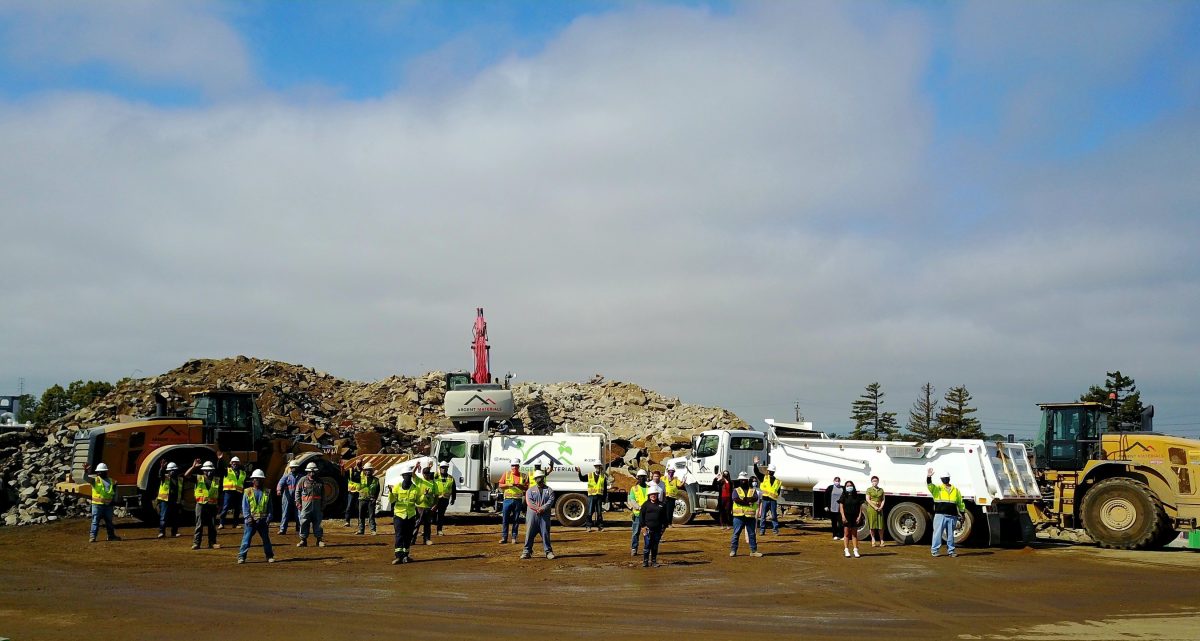
OAKLAND, Calif., Dec. 22, 2020 /PRNewswire/ — Since forming in 2013, Argent Materials, a regional recycler of concrete and asphalt, and supplier of aggregate materials such as crushed rock, entry, cutback, sand, backfill and base rock for construction projects, has diverted more than a billion pounds of waste from local landfills. As a result, Argent has offset more than 97 million pounds of carbon from the atmosphere and removed a half-million pounds of trash from the streets of Oakland, California.

Now, thanks to Argent’s recent switch from petroleum diesel to Neste MY Renewable Diesel™, it can add the elimination of fossil fuels from its vehicle and equipment fleet to its list of environmentally mindful business accomplishments.

Examining electric-driven solutions to the carbon and emissions footprint of Argent’s fleet, it became clear the best fit would be low-carbon, sustainable, bio-based renewable diesel fuel, primarily due to the rugged duty cycles of its trucks and equipment.

«We decided to switch to renewable diesel once our quality and availability concerns were satisfied,» says Bill Crotinger, president of Argent Materials Inc. «Our environmental track record and continual efforts to help our customers build more sustainable communities played a major role in our decision to use renewable diesel in our fleet. It was just another element of our philosophy to not just do the right thing, but make doing the right thing a normal part of doing business.»

Argent has a fleet of about 20 pieces of equipment comprised of wheel loaders, excavators, bobcats and a couple of water trucks.

«Our experience has been positive,» Crotinger says. «There’s no change in engine performance. We absolutely love the renewable nature of this product. We have noticed that the exhaust appears cleaner and seems less toxic.»

All of the renewable products Neste distributes in North America are made from 100% renewable and sustainably sourced waste materials such as used cooking oil, rendered fats and greases. These wastes come from meat processing facilities, hotels, restaurants, sports stadiums and many other venues with industrial kitchens.

Waste and residue materials contain a lot of carbon, one of the main building blocks for renewable diesel. Importantly, this is existing carbon already in the atmosphere, which means Neste MY Renewable diesel emits no new greenhouse gas emissions when used in its 100% pure form – or «neat» – in an engine.

The only new emissions occur during the production operations, which Neste aims to make carbon-neutral by 2035, and supply chain operations. Additionally, Neste is researching and developing a new generation of raw materials that could further enhance renewable diesel’s climate benefits – including municipal solid waste, algae, forestry waste and even converting electric power to liquids.  

«We’re very excited Argent Materials has joined with thousands of other progressive-minded California companies and cities to kick the oil habit and make the switch to Neste MY Renewable Diesel,» says Carrie Song, vice president of sales, Neste US, Inc.

Argent’s move to renewable diesel is in keeping with Neste’s overall approach to environmental sustainability in transportation and other sectors of the economy.

«Renewable diesel is a drop-in fuel that essentially transforms an internal combustion engine into equipment that helps fight climate change and air pollution,» says Song. «As California progresses toward a carbon-neutral future, renewable diesel offers fleet operators an affordable and quick way to stay ahead of emissions standards with no extra costs by turning their medium and heavy-duty road vehicles from fossil fuel to fossil free. Like Neste, Argent is a leader in recycling solutions and proactively taking care of the environment. I’m confident Neste MY Renewable Diesel is not only providing a better fuel solution to Argent’s fleet, but is also delivering a distinct advantage to significantly decreasing its carbon footprint.»

Neste MY Renewable Diesel is available to public and private fleets in California through authorized distributors. Western States Oil, headquartered in San Jose, Calif., is the exclusive distributor of Neste MY Renewable Diesel to Argent Materials. Using exclusive distributors ensures supply chain integrity and guarantees its high quality.

ABOUT NESTE
Neste (NESTE, Nasdaq Helsinki) creates sustainable solutions for transport, business, and consumer needs. Our wide range of renewable products enables our customers to reduce climate emissions. We are the world’s largest renewable diesel producer from waste and residues, introducing renewable solutions to the aviation and plastics industries. We are also a technologically advanced refiner of high-quality oil products. We want to be a reliable partner with widely valued expertise, research, and sustainable operations. In 2019, Neste’s revenue stood at EUR 15.8 billion. In 2020, Neste placed 3rd on the Global 100 list of the world’s most sustainable companies. Read more: neste.com and follow us on Twitter and LinkedIn.

Media Contact:
Helen Deian
helen.deian@neste.com
+1 713 870 5217

Cision View original content to download multimedia:http://www.prnewswire.com/news-releases/argent-san-francisco-bay-area-building-materials-recycler-transforms-bay-area-work-truck-and-equipment-fleet-into-low-emission-carbon-green-machines-using-neste-my-renewable-diesel-301197738.html

SOURCE Neste

2021 Predictions for Elders, Caregiving in Wake of COVID-19

NEW YORK, Dec. 22, 2020 /PRNewswire/ — Aloe Care Health, home to the world’s most advanced voice-activated medical alert and communication service for elder care, invited industry experts to cast…

NEW YORK, Dec. 22, 2020 /PRNewswire/ — Aloe Care Health, home to the world’s most advanced voice-activated medical alert and communication service for elder care, invited industry experts to cast their predictions for 2021.

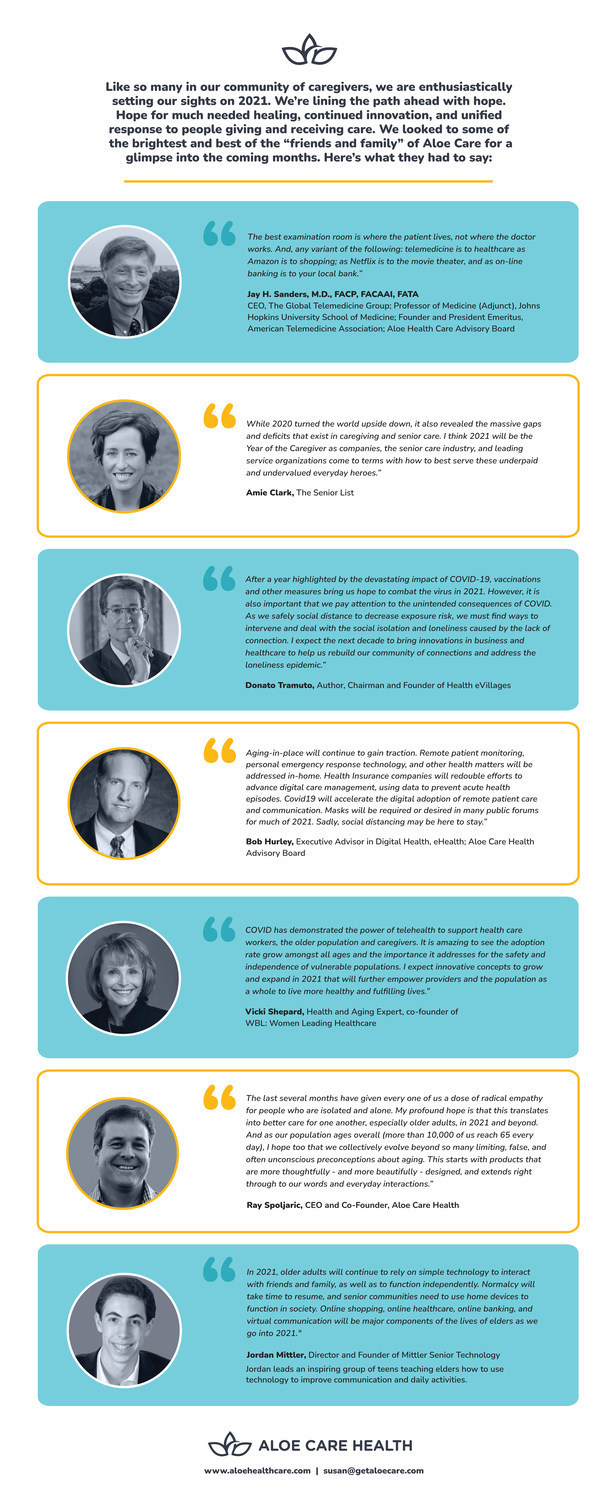
Seven leaders in healthcare, insurtech, caregiving and aging shared their optimistic insights for the path forward:

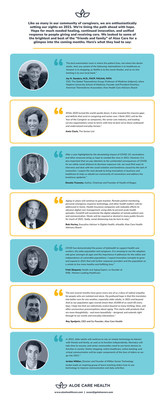
  • «The best examination room is where the patient lives, not where the doctor works. And, any variant of the following: telemedicine is to healthcare as Amazon is to shopping; as Netflix is to the movie theater, and as on-line banking is to your local bank.» Jay H. Sanders, M.D., CEO, The Global Telemedicine Group, member of the Aloe Care Advisory Board
  • «While 2020 turned the world upside down, it also revealed the massive gaps and deficits that exist in caregiving and senior care. I think 2021 will be the ‘Year of the Caregiver’ as companies, the senior care industry, and leading service organizations come to terms with how to best serve these underpaid and undervalued everyday heroes.» Amie Clark, The Senior List
  • «After a year highlighted by the devastating impact of COVID-19, vaccinations and other measures bring us hope to combat the virus in 2021. However, it is also important that we pay attention to the unintended consequences of COVID-19. As we safely social distance to decrease exposure risk, we must find ways to intervene and deal with the social isolation and loneliness caused by the lack of connection. I expect the next decade to bring innovations in business and healthcare to help us rebuild our community of connections and address the loneliness epidemic.» Donato Tramuto, Author, Chairman and Founder of Health eVillages
  • «Aging-in-place will continue to gain traction. Remote patient monitoring, personal emergency response technology, and other health matters will be addressed in-home. Health Insurance companies will redouble efforts to advance digital care management, using data to prevent acute health episodes. Covid19 will accelerate the digital adoption of remote patient care and communication. Masks will be required or desired in many public forums for much of 2021. Sadly, social distancing may be here to stay.» Bob Hurley, Executive Advisor in Digital Health, eHealth; member of the Aloe Care Advisory Board
  • «COVID has demonstrated the power of telehealth to support health care workers, the older population and caregivers. It is amazing to see the adoption rate grow amongst all ages and the importance it addresses for the safety and independence of vulnerable populations. I expect innovative concepts to grow and expand in 2021 that will further empower providers and the population as a whole to live more healthy and fulfilling lives.» Vicki Shepard, Health and Aging Expert, co-founder of WBL: Women Leading Healthcare
  • «The last several months have given every one of us a dose of radical empathy for people who are isolated and alone. My profound hope is that this translates into better care for one another, especially older adults, in 2021 and beyond. And as our population ages overall (more than 10,000 of us reach 65 every day), I hope too that we collectively evolve beyond so many limiting, false, and often unconscious preconceptions about aging. This starts with products that are more thoughtfully, more beautifully designed, and extends right through to our everyday interactions.» Ray Spoljaric, CEO and Co-Founder, Aloe Care Health
  • «In 2021, older adults will continue to rely on simple technology to interact with friends and family, as well as to function independently. Normalcy will take time to resume, and senior communities need to use home devices to function in society. Online shopping, online healthcare, online banking, and virtual communication will be major components of the lives of elders as we go into 2021.» Jordan Mittler, Director and Founder of Mittler Senior Technology. Jordan leads an inspiring group of teens teaching elders how to use technology to improve communication and daily activities.

For more, visit www.aloecare.com. 

About Aloe Care Health 
Aloe Care’s voice-activated system is the world’s most-advanced in-home medical alert and communication system for older adults. Aloe Care offers a comprehensive, proactive approach to remote caregiving and communication and has been widely acclaimed, including Real Simple (December 2020), PCMag, The Senior List, Today’s Caregiver, and MD Tech Review, among others. Aloe Care’s award-winning solution was created by caregivers, for caregivers. More than 70 percent of the team actively supports aging-in-place parents and grandparents. The company is headquartered in New York.


Cision View original content to download multimedia:http://www.prnewswire.com/news-releases/2021-predictions-for-elders-caregiving-in-wake-of-covid-19-301197769.html

SOURCE Aloe Care Health

ESG Pulse Says A Greater Balance-Sheet Recognition Of Climate-Related Liabilities Would Enhance Financial Statements

PARIS, Dec. 22, 2020 /PRNewswire/ — S&P Global Ratings’ latest edition of the ESG Pulse: Reimagining Accounting To Measure Climate Change Risks, published today, looks at how ESG factors have influenced nearly 2,300 rating actions, of which more than 900 rating downgrades, over the last eight months.

In addition, it opines on benefits of greater balance-sheet recognition of actual and potential climate-related liabilities. This would enable users of financial statements to shift…

PARIS, Dec. 22, 2020 /PRNewswire/ — S&P Global Ratings’ latest edition of the ESG Pulse: Reimagining Accounting To Measure Climate Change Risks, published today, looks at how ESG factors have influenced nearly 2,300 rating actions, of which more than 900 rating downgrades, over the last eight months.

In addition, it opines on benefits of greater balance-sheet recognition of actual and potential climate-related liabilities. This would enable users of financial statements to shift qualitative measures of climate exposures to more quantitative assessments.

As a percentage of total ESG and non-ESG rating actions over April-November, ESG-related actions accounted for as much as three-quarters of actions on sovereign/international public finance entities and one-third of U.S. public finance actions. For corporate and infrastructure entities, ESG factors contributed to one in three rating actions; bear in mind that we only treat COVID-19 as an ESG factor if it has direct health and safety effects on an entity’s activities, not as a result of the economic crisis. In structured finance, ESG influenced about one in four rating actions.

This report does not constitute a rating action.

The report is available to subscribers of RatingsDirect at www.capitaliq.com. If you are not a RatingsDirect subscriber, you may purchase a copy of the report by calling (1) 212-438-7280 or sending an e-mail to research_request@spglobal.com. Ratings information can also be found on S&P Global Ratings’ public website by using the Ratings search box located in the left column at www.standardandpoors.com. Alternatively, call one of the following S&P Global Ratings numbers: Client Support Europe (44) 20-7176-7176; London Press Office (44) 20-7176-3605; Paris (33) 1-4420-6708; Frankfurt (49) 69-33-999-225; Stockholm (46) 8-440-5914; or Moscow (7) 495-783-4009.

Copyright © 2020 by Standard & Poor’s Financial Services LLC. All rights reserved.

No content (including ratings, credit-related analyses and data, valuations, model, software or other application or output therefrom) or any part thereof (Content) may be modified, reverse engineered, reproduced or distributed in any form by any means, or stored in a database or retrieval system, without the prior written permission of Standard & Poor’s Financial Services LLC or its affiliates (collectively, S&P). The Content shall not be used for any unlawful or unauthorized purposes. S&P and any third-party providers, as well as their directors, officers, shareholders, employees or agents (collectively S&P Parties) do not guarantee the accuracy, completeness, timeliness or availability of the Content. S&P Parties are not responsible for any errors or omissions (negligent or otherwise), regardless of the cause, for the results obtained from the use of the Content, or for the security or maintenance of any data input by the user. The Content is provided on an «as is» basis. S&P PARTIES DISCLAIM ANY AND ALL EXPRESS OR IMPLIED WARRANTIES, INCLUDING, BUT NOT LIMITED TO, ANY WARRANTIES OF MERCHANTABILITY OR FITNESS FOR A PARTICULAR PURPOSE OR USE, FREEDOM FROM BUGS, SOFTWARE ERRORS OR DEFECTS, THAT THE CONTENT’S FUNCTIONING WILL BE UNINTERRUPTED OR THAT THE CONTENT WILL OPERATE WITH ANY SOFTWARE OR HARDWARE CONFIGURATION. In no event shall S&P Parties be liable to any party for any direct, indirect, incidental, exemplary, compensatory, punitive, special or consequential damages, costs, expenses, legal fees, or losses (including, without limitation, lost income or lost profits and opportunity costs or losses caused by negligence) in connection with any use of the Content even if advised of the possibility of such damages.

Credit-related and other analyses, including ratings, and statements in the Content are statements of opinion as of the date they are expressed and not statements of fact. S&P’s opinions, analyses and rating acknowledgment decisions (described below) are not recommendations to purchase, hold, or sell any securities or to make any investment decisions, and do not address the suitability of any security. S&P assumes no obligation to update the Content following publication in any form or format. The Content should not be relied on and is not a substitute for the skill, judgment and experience of the user, its management, employees, advisors and/or clients when making investment and other business decisions. S&P does not act as a fiduciary or an investment advisor except where registered as such. While S&P has obtained information from sources it believes to be reliable, S&P does not perform an audit and undertakes no duty of due diligence or independent verification of any information it receives. Rating-related publications may be published for a variety of reasons that are not necessarily dependent on action by rating committees, including, but not limited to, the publication of a periodic update on a credit rating and related analyses.

To the extent that regulatory authorities allow a rating agency to acknowledge in one jurisdiction a rating issued in another jurisdiction for certain regulatory purposes, S&P reserves the right to assign, withdraw or suspend such acknowledgment at any time and in its sole discretion. S&P Parties disclaim any duty whatsoever arising out of the assignment, withdrawal or suspension of an acknowledgment as well as any liability for any damage alleged to have been suffered on account thereof.

S&P keeps certain activities of its business units separate from each other in order to preserve the independence and objectivity of their respective activities. As a result, certain business units of S&P may have information that is not available to other S&P business units. S&P has established policies and procedures to maintain the confidentiality of certain non-public information received in connection with each analytical process.

S&P may receive compensation for its ratings and certain analyses, normally from issuers or underwriters of securities or from obligors. S&P reserves the right to disseminate its opinions and analyses. S&P’s public ratings and analyses are made available on its Web sites, www.standardandpoors.com (free of charge), and www.ratingsdirect.com (subscription), and may be distributed through other means, including via S&P publications and third-party redistributors. Additional information about our ratings fees is available at www.standardandpoors.com/usratingsfees.

STANDARD & POOR’S, S&P and RATINGSDIRECT are registered trademarks of Standard & Poor’s Financial Services LLC.

Cision View original content:http://www.prnewswire.com/news-releases/esg-pulse-says-a-greater-balance-sheet-recognition-of-climate-related-liabilities-would-enhance-financial-statements-301197760.html

SOURCE S&P Global Ratings

SoCalGas and LADWP Partner to Deliver 150,000 Energy and Water Efficiency Kits to Help the Environment and Save Customers Money and Energy

LOS ANGELES, Dec. 22, 2020 /PRNewswire/ — The Southern California Gas Co. (SoCalGas) and the <a target="_blank"…

LOS ANGELES, Dec. 22, 2020 /PRNewswire/ — The Southern California Gas Co. (SoCalGas) and the Los Angeles Department of Water and Power (LADWP) have partnered to distribute over 150,000 free energy and water efficiency kits to residents throughout Los Angeles. Each efficiency kit is equipped with simple household devices to help conserve water and natural gas and save money on utility bills. Installing these devices can reduce natural gas usage in Los Angeles by approximately 3.5 million therms and save 46,000 gallons of water per year as a result of this program.

Each kit contains a water-efficient showerhead; two bathroom faucet aerators; and a kitchen faucet aerator. The energy and water efficiency kits will be delivered SoCalGas customers in Los Angeles who have not participated in the program in the last three years throughout the month of December. Customers will also receive information on energy-saving water heaters, smart thermostats, and other appliances that are eligible for SoCalGas rebates. 

«SoCalGas and LADWP continue to help lower our environmental impact and protect our natural resources through the distribution of energy and water efficiency kits,» said Los Angeles Councilmember Joe Buscaino. «These devices are simple and easy to install and have proven to be highly impactful as we make sustainable efforts to promote saving energy and water.»

«Energy efficiency is one of the most cost-effective methods to reduce emissions,» said Brian Prusnek, director of customer programs and assistance at SoCalGas. «Not only do these programs help the environment, they’re actively helping our customers save money on their utility bills while also making a significant environmental impact as well.»

«These simple yet effective kits will help LA residents conserve water while at the same time, save on their utility bills,» said Richard Harasick, LADWP Senior Assistant General Manager of the Water System. «LADWP is proud of its long-standing partnership with SoCalGas to provide efficient, cost-saving solutions to customers’ water and energy needs, especially during these difficult times.

In the City of Los Angeles, water conservation is among the city’s multiple strategies to secure a sustainable water supply for Los Angeles and improve overall water supply reliability. With the help of LADWP’s water conservation rebates and programs, water conservation has become a way of life in Los Angeles. Water use in Los Angeles has steadily declined over the past decades, and recently reached 105 gallons of water per person per day, one of the lowest of any major U.S. city. Read more at www.ladwp.com/waterconservation.

SoCalGas is a leader in researching and developing new technologies that improve energy efficiency, reduce emissions, and keep bills affordable for customers. The utility offers rebate incentive tools and energy savings programs to help customers conserve energy and save money while promoting an environmentally sustainable future. In the past five years, SoCalGas energy efficiency programs have delivered more than 195 million therms in energy savings, enough to power over 390,000 households a year, and reducing greenhouse gas (GHG) by more than 1,000,000 metric tons, the equivalent of removing over 223,000 cars from the road. Overall, these projects have also helped SoCalGas customers save more than $217 million in utility bill costs over the past five years.

Additionally, the utility is also working to increase the production and use of renewable natural gas, which turns waste from dairies, farms, wastewater and landfills, into a source of clean and renewable energy to fuel homes and businesses. The utility recently began field testing a new technology that can simultaneously separate and compress hydrogen from a blend of hydrogen and natural gas to be transported through the natural gas pipeline system to help make a significant contribution towards a cleaner energy future. Learn more on ways to become more energy efficient through our various programs and incentives here.

About SoCalGas

Headquartered in Los Angeles, SoCalGas® is the largest gas distribution utility in the United States. SoCalGas delivers affordable, reliable, clean and increasingly renewable gas service to 21.8 million customers across 24,000 square miles of Central and Southern California, where more than 90 percent of residents use natural gas for heating, hot water, cooking, drying clothes or other uses. Gas delivered through the company’s pipelines also plays a key role in providing electricity to Californians— about 45 percent of electric power generated in the state comes from gas-fired power plants.

SoCalGas’ vision is to be the cleanest gas utility in North America, delivering affordable and increasingly renewable energy to its customers. In support of that vision, SoCalGas is committed to replacing 20 percent of its traditional natural gas supply with renewable natural gas (RNG) by 2030. Renewable natural gas is made from waste created by dairy farms, landfills and wastewater treatment plants. SoCalGas is also committed to investing in its gas delivery infrastructure while keeping bills affordable for our customers. From 2014 through 2018, the company invested nearly $6.5 billion to upgrade and modernize its pipeline system to enhance safety and reliability. SoCalGas is a subsidiary of Sempra Energy (NYSE: SRE), an energy services holding company based in San Diego. For more information visit socalgas.com/newsroom or connect with SoCalGas on Twitter (@SoCalGas), Instagram (@SoCalGas) and Facebook.  

About LADWP

The Los Angeles Department of Water and Power is the nation’s largest municipal utility, with an 8,000 megawatt (MW) electric capacity and serving an average of 436 million gallons of water per day to the more than 4 million residents of the City of Los Angeles, its businesses and visitors. For more than 100 years, LADWP has provided the city with reliable water and power service in a cost effective and environmentally responsible manner.


Cision View original content to download multimedia:http://www.prnewswire.com/news-releases/socalgas-and-ladwp-partner-to-deliver-150-000-energy-and-water-efficiency-kits-to-help-the-environment-and-save-customers-money-and-energy-301197710.html

SOURCE Southern California Gas Company