Toe Wildlife Management Area Receives 62-Acres of Wetland Restoration

MANKATO, Minn., Dec. 22, 2020 /PRNewswire/ — After nearly four years of planning, design, and construction, ISG is proud to report the successful completion of a 62-acre wetland restoration project within the Toe Wildlife Management Area (WMA). Situated in rural Jackson County, an area of southern Minnesota where less than 1% of original wetlands remain, the project is part of a larger initiative of the Heron Lake Watershed District…

MANKATO, Minn., Dec. 22, 2020 /PRNewswire/ — After nearly four years of planning, design, and construction, ISG is proud to report the successful completion of a 62-acre wetland restoration project within the Toe Wildlife Management Area (WMA). Situated in rural Jackson County, an area of southern Minnesota where less than 1% of original wetlands remain, the project is part of a larger initiative of the Heron Lake Watershed District to protect and restore nearly 350-acres of wetlands in the Toe WMA.

ISG’s Water Resource team, led by Vice President Chuck Brandel, PE, worked with the Heron Lake Watershed District and Jackson County to approach the DNR to restore wetlands on the property. With the DNR owning the proposed tract of land, no acreage was taken out of agricultural production, and the surrounding landowners desired to restore the property to provide additional storage in the watershed to reduce flooding downstream. The project was a collaborative effort between the Heron Lake Watershed District (HLWD), Minnesota Department of Natural Resources (DNR), Jackson County Drainage Authority, Jackson County Soil and Water Conservation District, Minnesota Board of Water and Soil Resources (BWSR), landowners in Judicial Ditch 19, and ISG. «This is a great example of partnering with multiple groups and agencies on a project to develop solutions that are a win-win for everyone involved,» said Chuck Brandel.

Funding through the Expedited Conservation Partners Legacy grant was identified by ISG’s Natural Resources team and the firm’s in-house fundraising experts assisted securing the additional dollars to make the project happen. The project was awarded $21,661; covering half of project cost. The remaining expenses were assessed to landowners.

Key planning and design considerations included maintenance of water levels to support improved water quality, enhanced vegetative and wildlife habitat, the reestablishment of native prairie and pollinator buffer habitat, and increased public hunting and other outdoor recreational uses. Additionally, by rerouting agricultural drainage and adding storage, flooding experienced by surrounding landowners and communities was reduced significantly, while also increasing agricultural productivity.

The HLWD is making significant progress on its water quality improvement plan, which targets 472-square-mile within the South Heron Lake watershed. Over $1.4 million in funding has been secured and numerous water quality, habitat, and resiliency projects completed—moving the District closer to realizing its water quality goals.

The project was completed in the late summer of 2020. All project partners point to its success as an example of what can be accomplished for the state when we work together. «Good wildlife habitat is dependent on good water quality, and water quality is improved by enhancing habitat on public hunting lands,» said John Jaschke, Executive Director of the Minnesota Board of Water and Soil Resources. «The completion of this project is especially noteworthy in an area of Minnesota that needs both improved water quality and more wetland habitat. These positive results are a prime example of the collaboration of local experts and state agencies working together to solve problems and realize benefits to the public as envisioned by Minnesotans via their support of the Clean Water, Land, and Legacy Amendment.»

About ISG
ISG, a 100 percent ESOP firm, has a rich history, which extends over 47 years, of building trusting relationships with clients, stakeholders, and the community. As a full-service architecture, engineering, environmental, and planning firm with 300+ professionals in offices throughout Iowa, Minnesota, Wisconsin, and South Dakota, ISG provides exceptional services, strategies, and guidance to a wide range of markets nationwide. ISG fosters strong collaboration between all firm disciplines, providing clients a diverse knowledge base, high level of creativity, and broad perspective. In addition to awards noted above, ISG was named among the 100 fastest growing firms, best places to work for, and market excellence leader in the United States by Zweig Group, recognized as a Top 500 Design Firm by Engineering News-Record (ENR) magazine, and has earned spots on numerous Top Workplace and project recognition lists. To learn more about ISG, visit ISGInc.com.

Contact:
Tanya Pierce
tanya.pierce@isginc.com


Cision View original content to download multimedia:http://www.prnewswire.com/news-releases/toe-wildlife-management-area-receives-62-acres-of-wetland-restoration-301197563.html

SOURCE ISG

Existing-Home Sales Decrease 2.5% in November

WASHINGTON, Dec. 22, 2020 /PRNewswire/ — Existing-home sales fell in November, snapping a five-month streak of month-over-month gains, according to the National Association of Realtors®. All major regions either took a step back or held steady in terms of their respective month-over-month status, but each of the four areas experienced significant year-over-year growth.

WASHINGTON, Dec. 22, 2020 /PRNewswire/ — Existing-home sales fell in November, snapping a five-month streak of month-over-month gains, according to the National Association of Realtors®. All major regions either took a step back or held steady in terms of their respective month-over-month status, but each of the four areas experienced significant year-over-year growth.

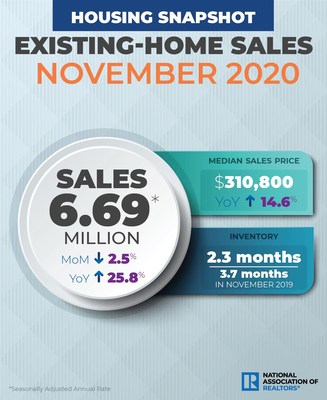
Total existing-home sales,1https://www.nar.realtor/existing-home-sales, completed transactions that include single-family homes, townhomes, condominiums and co-ops, decreased 2.5% from October to a seasonally-adjusted annual rate of 6.69 million in November. However, sales in total rose year-over-year, up 25.8% from a year ago (5.32 million in November 2019).

«Home sales in November took a marginal step back, but sales for all of 2020 are already on pace to surpass last year’s levels,» said Lawrence Yun, NAR’s chief economist. «Given the COVID-19 pandemic, it’s amazing that the housing sector is outperforming expectations.»

Yun notes that job recoveries have stalled in the past few months, and fast-rising coronavirus cases along with stricter lockdowns have weakened consumer confidence.

«Circumstances are far from being back to the pre-pandemic normal,» he said. «However, the latest stimulus package and with the vaccine distribution underway, and a very strong demand for homeownership still prevalent, robust growth is forthcoming for 2021.»  

The median existing-home price2 for all housing types in November was $310,800, up 14.6% from November 2019 ($271,300), as prices increased in every region. November’s national price increase marks 105 straight months of year-over-year gains.

Total housing inventory3 at the end of November totaled 1.28 million units, down 9.9% from October and down 22% from one year ago (1.64 million). Unsold inventory sits at an all-time low 2.3-month supply at the current sales pace, down from 2.5 months in October and down from the 3.7-month figure recorded in November 2019.

Properties typically remained on the market for 21 days in November, seasonally even with October and down from 38 days in November 2019. Seventy-three percent of homes sold in November 2020 were on the market for less than a month.

«The positive momentum that home sellers are seeing will carry on well into the new year,» Yun predicted, citing low mortgage rates and remote-work flexibilities.

Yun’s projections of a continued housing market rebound were the consensus among economic and housing experts during NAR’s Real Estate Forecast Summit, held earlier this month. Industry insiders in attendance agreed that mortgage rates will hover around 3% in the coming year, and said they expect an annual median home price increase of 8.0%.

«Housing affordability, which had greatly benefitted from falling mortgage rates, are now being challenged due to record-high home prices,» Yun said. «That could place strain on some potential consumers, particularly first-time buyers.»

First-time buyers were responsible for 32% of sales in November, equal to the percentage seen in both October 2020 and November 2019. NAR’s 2020 Profile of Home Buyers and Sellersreleased last month– revealed that the annual share of first-time buyers was 31%.

Individual investors or second-home buyers, who account for many cash sales, purchased 14% of homes in November, identical to the share recorded in October 2020 and a small decline from 16% in October 2019. All-cash sales accounted for 20% of transactions in November, up from 19% in October but unchanged from November 2019.

Distressed sales5 – foreclosures and short sales – represented less than 1% of sales in November, equal to October’s percentage but down from 2% in November 2019.

«While we still face economic and health challenges ahead, I have zero doubt that the nation will continue to recover from this pandemic,» said NAR President Charlie Oppler, a Realtor® from Franklin Lakes, N.J., and broker/owner of Prominent Properties Sotheby’s International Realty. «Whether it’s through volunteering or philanthropy, or helping a given buyer secure that dream home, Realtors® have stepped up in a major way and we will continue with those efforts in 2021 and beyond.»

According to Freddie Mac, the average commitment rate for a 30-year, conventional, fixed-rate mortgage decreased to 2.77% in November, down from 2.83% in October. The average commitment rate across all of 2019 was 3.94%.

Single-family and Condo/Co-op Sales

Single-family home sales sat at a seasonally-adjusted annual rate of 5.98 million in November, down 2.4% from 6.13 million in October, and up 25.6% from one year ago. The median existing single-family home price was $315,500 in November, up 15.1% from November 2019.

Existing condominium and co-op sales were recorded at a seasonally-adjusted annual rate of 710,000 units in November, down 2.7% from October and up 26.8% from one year ago. The median existing condo price was $271,400 in November, an increase of 9.5% from a year ago.

Regional Breakdown

Median home prices increased at double-digit rates in each of the four major regions from one year ago.

November 2020 saw existing-home sales in the Northeast drop 2.2%, recording an annual rate of 880,000, a 25.7% increase from a year ago. The median price in the Northeast was $354,100, up 17.4% from November 2019.

Existing-home sales fell 2.5% in the Midwest to an annual rate of 1,590,000 in November, but up 24.2% from a year ago. The median price in the Midwest was $239,100, a 14.6% increase from November 2019.

Existing-home sales in the South decreased 3.8% to an annual rate of 2.82 million in November, up 25.9% from the same time one year ago. The median price in the South was $270,000, a 15.0% increase from a year ago.

Existing-home sales in the West were unchanged from last month, recording an annual rate of 1,400,000 in November, a 27.3% increase from a year ago. The median price in the West was $467,600, up 13.8% from November 2019.

The National Association of Realtors® is America’s largest trade association, representing more than 1.4 million members involved in all aspects of the residential and commercial real estate industries.

For local information, please contact the local association of Realtors® for data from local multiple listing services (MLS). Local MLS data is the most accurate source of sales and price information in specific areas, although there may be differences in reporting methodology.

NOTE: NAR’s Pending Home Sales Index for November is scheduled for release on December 30, and Existing-Home Sales for December will be released January 22; release times are 10:00 a.m. ET.

Information about NAR is available at www.nar.realtor. This and other news releases are posted on the NAR Newsroom at www.nar.realtor/newsroom. Statistical data in this release, as well as other tables and surveys, are posted in the «Research and Statistics» tab.

     1 Existing-home sales, which include single-family, townhomes, condominiums and co-ops, are based on transaction closings from Multiple Listing Services. Changes in sales trends outside of MLSs are not captured in the monthly series. NAR rebenchmarks home sales periodically using other sources to assess overall home sales trends, including sales not reported by MLSs. Existing-home sales, based on closings, differ from the U.S. Census Bureau’s series on new single-family home sales, which are based on contracts or the acceptance of a deposit. Because of these differences, it is not uncommon for each series to move in different directions in the same month. In addition, existing-home sales, which account for more than 90% of total home sales, are based on a much larger data sample – about 40% of multiple listing service data each month – and typically are not subject to large prior-month revisions.

     The annual rate for a particular month represents what the total number of actual sales for a year would be if the relative pace for that month were maintained for 12 consecutive months. Seasonally adjusted annual rates are used in reporting monthly data to factor out seasonal variations in resale activity. For example, home sales volume is normally higher in the summer than in the winter, primarily because of differences in the weather and family buying patterns. However, seasonal factors cannot compensate for abnormal weather patterns.

     Single-family data collection began monthly in 1968, while condo data collection began quarterly in 1981; the series were combined in 1999 when monthly collection of condo data began. Prior to this period, single-family homes accounted for more than nine out of 10 purchases. Historic comparisons for total home sales prior to 1999 are based on monthly single-family sales, combined with the corresponding quarterly sales rate for condos.

     2 The median price is where half sold for more and half sold for less; medians are more typical of market conditions than average prices, which are skewed higher by a relatively small share of upper-end transactions. The only valid comparisons for median prices are with the same period a year earlier due to seasonality in buying patterns. Month-to-month comparisons do not compensate for seasonal changes, especially for the timing of family buying patterns. Changes in the composition of sales can distort median price data. Year-ago median and mean prices sometimes are revised in an automated process if additional data is received.

     The national median condo/co-op price often is higher than the median single-family home price because condos are concentrated in higher-cost housing markets. However, in a given area, single-family homes typically sell for more than condos as seen in NAR’s quarterly metro area price reports.

     3 Total inventory and month’s supply data are available back through 1999, while single-family inventory and month’s supply are available back to 1982 (prior to 1999, single-family sales accounted for more than 90% of transactions and condos were measured only on a quarterly basis).

     4 Survey results represent owner-occupants and differ from separately reported monthly findings from NAR’s Realtors® Confidence Index, which include all types of buyers. Investors are under-represented in the annual study because survey questionnaires are mailed to the addresses of the property purchased and generally are not returned by absentee owners. Results include both new and existing homes.

     5 Distressed sales (foreclosures and short sales), days on market, first-time buyers, all-cash transactions and investors are from a monthly survey for the NAR’s Realtors® Confidence Index, posted at nar.realtor.


Cision View original content to download multimedia:http://www.prnewswire.com/news-releases/existing-home-sales-decrease-2-5-in-november-301197590.html

SOURCE National Association of Realtors

Leupold Partners with Conservation Visions on Wild Harvest Initiative®

Leupold has renewed its partnership with Conservation Visions’ Wild Harvest Initiative® to determine the comprehensive benefits of sustainable wildlife and fish harvests in the United States and Canada.

ST. JOHN’S, NL, Dec. 22, 2020 /PRNewswire/ – Conservation Visions is announcing a renewed partnership with Leupold & Stevens, Inc., provider of the world’s most rugged, lightweight, and clear sports…

Leupold has renewed its partnership with Conservation Visions’ Wild Harvest Initiative® to determine the comprehensive benefits of sustainable wildlife and fish harvests in the United States and Canada.

ST. JOHN’S, NL, Dec. 22, 2020 /PRNewswire/ – Conservation Visions is announcing a renewed partnership with Leupold & Stevens, Inc., provider of the world’s most rugged, lightweight, and clear sports optics, in support of the Wild Harvest Initiative®.  The Wild Harvest Initiative®, a science-based program, represents the first attempt to synthesize and evaluate the combined economic, conservation, and social benefits of sustainable wild animal harvests in North American society.  It will consider the value of hunting and fishing in terms of food, livelihoods, human health, wildlife conservation and the environment, and will also extend beyond wild meat and fish, to explore other sustainable wild harvests of natural living resources, including berries and fruits, mushrooms, wild honey, medicinal plants, and more.

«Leupold & Steven’s is proud to partner with Wild Harvest Initiative® in their efforts to quantify the societal benefit of conservation and hunting,» said Bruce Pettet, President & CEO for Leupold & Stevens, Inc. «Our commitment to thoughtful stewardship needs the fact basis research and analysis WHI provides, and we look forward to the positive impacts it will generate for the hunting community.»

Shane Mahoney, President of Conservation Visions and founder of the Wild Harvest Initiative®, is encouraged by both the program’s growing partnership roster and its capacity for partner retention.  «I believe the Wild Harvest Initiative® has the potential to make a real difference, to improve circumstances for people and for nature,» he says.  «With the continued support of partners like Leupold, we will prove the modern relevance and importance of hunting and fishing and other wild harvest activities, not just to hunters and anglers but to everyone, even to those who are opposed to consumptive harvests.»

About Conservation Visions Inc.

Conservation Visions Inc. is a wildlife initiative founded by internationally recognized biologist, conservation advocate, Shane Mahoney.  It is dedicated to a world where conservation matters; where biodiversity is safeguarded, including the diversity of human cultural experience; where conservation and citizenship are viewed as inseparable; where a global responsibility to nature is recognized; where the sustainable use of natural resources is safeguarded through knowledge; and where governments make sound decisions concerning conservation and biodiversity, based on scientific and traditional wisdom.  To learn more about Conservation Visions and the Wild Harvest Initiative®, please visit www.conservationvisions.com.

Cision View original content:http://www.prnewswire.com/news-releases/leupold-partners-with-conservation-visions-on-wild-harvest-initiative-301196820.html

SOURCE Conservation Visions Inc.

New Georgia Polls Show a Tight Senate Race, Especially Among Women Voters

NEW YORK, Dec. 22, 2020 /PRNewswire/ — Non-partisan advocacy group All in Together has teamed up with Lake Research and Emerson College Polling to study women voters in 2020. The third survey of the study looked at 332 registered women voters in Georgia from <span…

NEW YORK, Dec. 22, 2020 /PRNewswire/ — Non-partisan advocacy group All in Together has teamed up with Lake Research and Emerson College Polling to study women voters in 2020. The third survey of the study looked at 332 registered women voters in Georgia from December 14 – 16th, 2020 with a +/-5.4% margin of error.  The survey reached a total of 605 registered voters in Georgia, with a +/-4% margin of error.

The Republican Senate candidates are slightly ahead in both races. Women are evenly split in both races:  50% say they voted for or plan to vote for Ossoff, while 49% side with Perdue; 50% say they voted for or plan to vote for Loeffler, while 49% side with Warnock. Men are slightly more likely to say they will vote for or they already have voted for the Republican candidates: 53% choose Perdue to 47% for Ossoff; 53% choose Loeffler to 47% for Warnock. Suburban women are a battleground and split in both races. Independent voters lean toward the Democratic candidates in both races.

It is universally important to GA women voters, and voters overall, that this is the election that will determine which party controls the Senate: 87% of women say it is very important to them personally to vote in this Senate election. This is true among both Democratic (87%) and Republican (89%) women.

Nearly three-in-ten (29%) women voters say the ads or mail pieces they have seen about the Senate race have influenced their vote choice. Among the women voters who say they’ve been influenced, a solid majority (70%) are influenced to vote for the Democratic candidates.

Forty-five percent (45%) of GA women say the Presidential Election results make them much more interested in voting in these Senate races. Turnout of young people could make a huge difference, where only 17% are much more interested, and only 10% are very confident that the votes will be counted fairly.

In a forced choice, women are more likely to say that Republican control of the Senate is important for checks and balances on the Democratic President (43%) than they are to say that with Democratic control of both the Senate and the Presidency, we are more likely to get something done on COVID economic relief and getting the economy moving (34%).

Georgia Women voters’ top priority in their vote for Senate is stopping the COVID-19 pandemic (26%) followed by getting the economy going (17%), moving ahead on economic relief (13%), balancing the Democratic President (11%), the candidate’s views reflecting their own moral views on issues (10%), and helping working families (9%).

Nearly two-thirds of both Democratic (64%) and Republican women (63%) say they are encouraging friends and neighbors to vote. Republican women are more likely to be encouraging friends and neighbors to vote in this Senate Runoff Election than they were in the Presidential Election.

Lauren Leader, CEO of All In Together said, «These polls show once again how critical women are to every election but in this important Senate runoff they will play an outsized role.»

Complete polling data is available at www.aitogether.org

Cision View original content:http://www.prnewswire.com/news-releases/new-georgia-polls-show-a-tight-senate-race-especially-among-women-voters-301197552.html

SOURCE All In Together

NextChem and JFE Engineering Corporation Sign an Agreement for the Production of Low Carbon Chemicals Products

ROME, Dec. 22, 2020 /PRNewswire/ — NextChem, Maire Tecnimont Group’s subsidiary for the development of projects and technologies for energy transition, and JFE Engineering Corporation, engineering and operative company of Japan Group JFE, have signed a commercial agreement which strengthens the cooperation between the companies.

<a…

ROME, Dec. 22, 2020 /PRNewswire/ — NextChem, Maire Tecnimont Group’s subsidiary for the development of projects and technologies for energy transition, and JFE Engineering Corporation, engineering and operative company of Japan Group JFE, have signed a commercial agreement which strengthens the cooperation between the companies.

The agreement aims at developing in cooperation the model which considers waste as a resource to produce advanced fuels, hydrogen, fertilizers and low carbon chemical products. The process of chemical conversion of waste into syngas and the use of this intermediate to produce circular hydrogen, advanced fuels and many other key products for world economies, allows to contribute to the decarbonization of production processes and to reduce the carbon footprint in the final use phase of products.

The alliance between the companies allows an integrated enhancement of plant technologies of JFE and Maire Tecnimont Group for the realization of Waste to Chemical projects, starting from the feasibility study from an economic and technical perspective, up to the turn key construction, including the high qualified training of the staff in JFE plants in Japan. Starting from JFE’s experience Nextchem has defined an integrated Waste to Chemicals technological platform that is ready and willing to license worldwide.

«The recovery of carbon and hydrogen contained in waste allows to reduce the use of fossil sources for the production of fuels and basic chemicals. The collaboration between NextChem and JFE Engineering Corporation enhances the know-how of the Groups. NextChem aims to expand its offer to the global market of technological solutions for the energy transition and circular economy, stimulating the demand. Our technological Waste to Chemical platform is solid, referenced, ready and profitable; it is our response to the forced and virtuous path to a low-carbon economy, to the problem of dependence from abroad of many countries for some basic products of the chemical industry and also to the global problem of recovery of waste fractions currently not recyclable», commented Pierroberto Folgiero, CEO of Maire Tecnimont Group and NextChem.

Logo – https://mma.prnewswire.com/media/1390855/NextChem_Logo.jpg


Cision View original content to download multimedia:http://www.prnewswire.com/news-releases/nextchem-and-jfe-engineering-corporation-sign-an-agreement-for-the-production-of-low-carbon-chemicals-products-301197580.html

SOURCE NextChem S.p.A

In New National Ad From No Labels, National Co-Chair Larry Hogan Hails Bipartisan House Problem Solvers and Senate Allies For Spurring Passage Of COVID-19 Relief Bill

WASHINGTON, Dec. 22, 2020 /PRNewswire/ — Today, in the wake of the U.S. Congress voting to pass an urgently needed COVID-19 relief bill, No Labels released an ad saluting the bipartisan group of senators and House Problem Solvers Caucus members who revived the negotiations that led to ultimate passage of the bill. The ad features new No Labels national co-chair and Maryland Governor Larry Hogan, who said, «This is what real bipartisan…

WASHINGTON, Dec. 22, 2020 /PRNewswire/ — Today, in the wake of the U.S. Congress voting to pass an urgently needed COVID-19 relief bill, No Labels released an ad saluting the bipartisan group of senators and House Problem Solvers Caucus members who revived the negotiations that led to ultimate passage of the bill. The ad features new No Labels national co-chair and Maryland Governor Larry Hogan, who said, «This is what real bipartisan leadership looks like. This relief package will save lives, save businesses, and save jobs. It’s what Americans have been waiting for.»

You can view the full ad here.

For months, leaders in Washington were unable or unwilling to pass a successor bill to the March CARES Act despite a clear and growing need for one. But a bipartisan group of senators and members of the House Problem Solvers Caucus spent months working relentlessly to find common ground and on December 1, they released a compromise $908 billion proposal. The final COVID-19 relief bill that passed today closely tracks both the topline number and many of the particulars of the «908» proposal.

Added Hogan, who was announced as No Labels national co-chair on December 15, «I saw up close the way this bipartisan group of House and Senate members worked through tough issues together and how they just would not give up. They knew the American people needed help and they put their differences aside to deliver relief. This bipartisan agreement must be just the start. As we look toward 2021, this is how our government needs to work, with Democrats and Republicans putting the labels aside and putting country before party.»

No Labels has inspired the creation of the House Problem Solvers Caucus—which in this Congress featured 50 members evenly divided between the parties. And since last year, No Labels has been bringing House and Senate members—from both parties—together to talk about where they could find common ground. These «bicameral» meetings—which have been attended by Governor Hogan—are becoming the place where an entirely new approach to governance is being born. A place where rank-and file-members, frustrated by the breakdown of regular order and the refusal of others to compromise, are taking the initiative to forge their own solutions.

In the wake of the December 1 $908 billion COVID-19 relief proposal, The Hill noted that the power of No Labels’ House and Senate allies could «grow exponentially in the next Congress.»

No Labels is a nationwide movement of Democrats, Republicans and independents working to build the bipartisan governing coalition capable of solving America’s toughest challenges.

Cision View original content to download multimedia:http://www.prnewswire.com/news-releases/in-new-national-ad-from-no-labels-national-co-chair-larry-hogan-hails-bipartisan-house-problem-solvers-and-senate-allies-for-spurring-passage-of-covid-19-relief-bill-301197578.html

SOURCE No Labels

Congress Protects Patients and Delays Medicare Payment Cuts; Still More Work to Be Done

WASHINGTON, Dec. 22, 2020 /PRNewswire/ — Congress voted to protect patients’ access to surgical care by delaying steep Medicare payment cuts from the Centers for Medicare & Medicaid Services (CMS) that it included in the 2021 Medicare Physician Fee Schedule (MPFS), according to the Surgical Care Coalition.

<a href="https://mma.prnewswire.com/media/1192720/SCC_Logo.html"…

WASHINGTON, Dec. 22, 2020 /PRNewswire/ — Congress voted to protect patients’ access to surgical care by delaying steep Medicare payment cuts from the Centers for Medicare & Medicaid Services (CMS) that it included in the 2021 Medicare Physician Fee Schedule (MPFS), according to the Surgical Care Coalition.

«Congress rightly prioritized patients by rejecting CMS’s disastrous Medicare payment cuts,» said John A. Wilson, MD, FAANS, FACS, President of the American Association of Neurological Surgeons. «COVID-19 has pushed our health care system to the brink, and physicians fighting on the front lines will not have this misguided policy hanging over their heads. There is still work to do to ensure patients have timely access to surgical care in 2022 and beyond, but this is a significant step in the right direction.»

The Consolidated Appropriations Act, 2021, passed by Congress late Monday prevents significant Medicare cuts by increasing all Medicare payment codes by 3.75 percent for 2021 and delaying an add-on code for three years.

If Congress did not make these changes, the MPFS would cut Medicare payments to some surgical specialties by up to nine percent. The cuts were set to take effect on January 1, 2021.

«Congressional leaders recognized it is irresponsible to cut health care in the middle of a pandemic. We applaud them and our legislative champions, Sen. Boozman and Reps. Bera and Bucshon for putting patients first,» said David Hoyt, MD, FACS, Executive Director of the American College of Surgeons. «The Surgical Care Coalition pledges to work with policymakers to find a sustainable fix that ensures patients will have access to quality surgical care — both during and after the pandemic.»

Twelve surgical professional associations formed the Surgical Care Coalition this year to stop the Medicare physician payment cuts, formalizing an existing network that worked collectively for the past several years.

About the Surgical Care Coalition
The Surgical Care Coalition advocates for access to quality surgical care for all Americans. The Surgical Care Coalition is comprised of 12 surgical professional associations that proudly represent more than 150,000 surgeons working across the country with a common goal of improving the quality of care, and quality of life, for all patients. The founding members have worked together for nearly three decades to promote sound policy solutions to the U.S. Congress and federal regulatory agencies to solve the biggest challenges in health care.

media@surgicalcare.org


Cision View original content to download multimedia:http://www.prnewswire.com/news-releases/congress-protects-patients-and-delays-medicare-payment-cuts-still-more-work-to-be-done-301197566.html

SOURCE Surgical Care Coalition

U.S. Chemical Production Marks Fifth Month Of Growth In November

WASHINGTON, Dec. 22, 2020 /PRNewswire/ — The U.S. Chemical Production Regional Index (U.S. CPRI) rose 0.4% in November following a 1.1% gain in October and a 0.6% gain in September, according to the American Chemistry Council (ACC). During November, chemical output expanded in all regions, with the largest gains occurring in the Gulf Coast and Midwest regions. The U.S. CPRI is measured on a three-month moving average (3MMA) basis.

<div class="PRN_ImbeddedAssetReference"…

WASHINGTON, Dec. 22, 2020 /PRNewswire/ — The U.S. Chemical Production Regional Index (U.S. CPRI) rose 0.4% in November following a 1.1% gain in October and a 0.6% gain in September, according to the American Chemistry Council (ACC). During November, chemical output expanded in all regions, with the largest gains occurring in the Gulf Coast and Midwest regions. The U.S. CPRI is measured on a three-month moving average (3MMA) basis.

In November, chemical production continued to improve in many segments, including fertilizers, synthetic dyes and pigments, chlor-alkali, other inorganic chemicals, and organic chemicals. Production trends eased in coatings, manufactured fibers, consumer products, adhesives, synthetic rubber and crop protection chemicals.

As nearly all manufactured goods are produced using chemistry in some form, manufacturing activity is an important indicator for chemical demand. The manufacturing recovery continued for a fifth straight month in November, with overall factory activity up 0.7% (3MMA). The trend in production rose in nearly all key chemistry end-use industries, with the strongest gains seen in iron and steel, aerospace, rubber products, paper, structural panels, and printing.

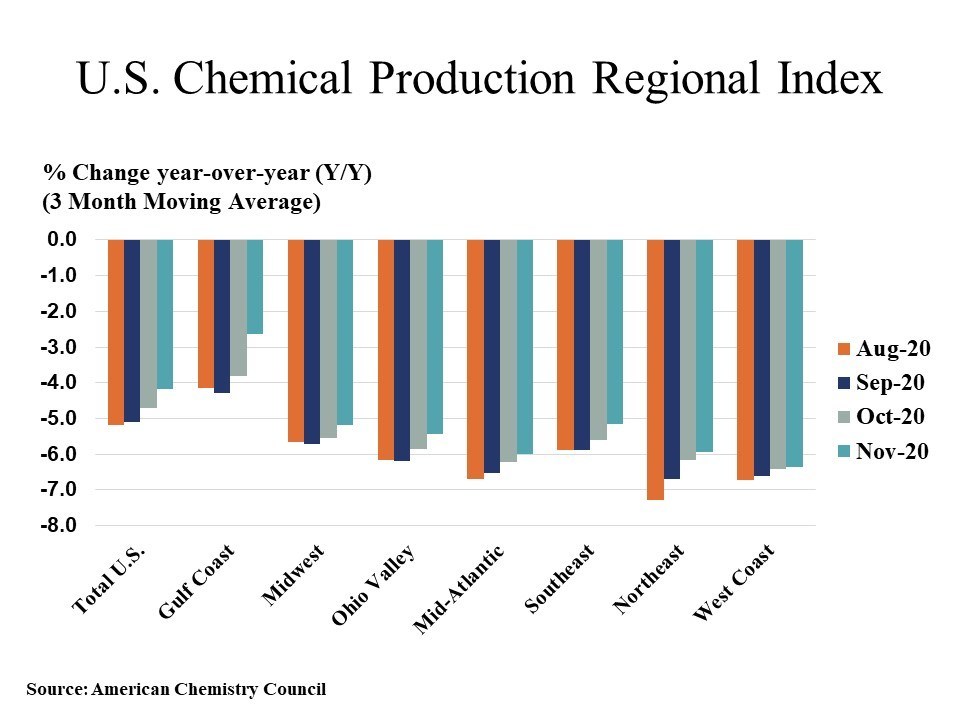
Compared with November 2019, U.S. chemical production was off 4.2% on a year-over-year basis, the eighteenth consecutive month of Y/Y declines, but shows continued improvement over the past several months. Chemical production remained lower than a year ago in all regions, with the largest year-ago declines occurring in the Northeast, Mid-Atlantic, and West Coast regions.

U.S. Chemical Production Regional Index, Percentage Change

(Seasonally adjusted, 3-month moving average)

Nov 20/

Oct 20

Nov 20/

Nov 19

Key products

Gulf Coast

1.0%

-2.6%

petrochemicals, inorganics, plastics resins, and synthetic rubber

Midwest

0.4%

-5.2%

agricultural chemicals, plastics, and paints

Ohio Valley

0.3%

-5.4%

organic chemicals, plastics and synthetic materials, and specialty chemicals

Mid-Atlantic

0.1%

-6.0%

consumer products

Southeast

0.3%

-5.2%

inorganic chemicals, fibers, and consumer products

Northeast

0.1%

-5.9%

consumer products and specialty chemicals

West Coast

0.1%

-6.3%

basic chemicals, agricultural chemicals, and consumer products

     U.S. Total

0.4%

-4.2%

The chemistry industry is one of the largest industries in the United States, a $565 billion enterprise. The manufacturing sector is the largest consumer of chemical products, and 96% of manufactured goods are directly touched by chemistry. The U.S. CPRI was developed to track chemical production activity in seven regions of the United States. The U.S. CPRI is based on information from the Federal Reserve, and includes monthly revisions as published by the Federal Reserve. To smooth month-to-month fluctuations, the U.S. CPRI is measured using a three-month moving average. The reading in November reflects production activity during September, October and November.

http://www.americanchemistry.com/newsroom
The American Chemistry Council (ACC) represents the leading companies engaged in the business of chemistry.  ACC members apply the science of chemistry to make innovative products and services that make people’s lives better, healthier and safer.  ACC is committed to improved environmental, health and safety performance through Responsible Care, common sense advocacy designed to address major public policy issues, and health and environmental research and product testing.  The business of chemistry is a $565 billion enterprise and a key element of the nation’s economy.  It is one of the nation’s largest exporters, representing ten cents out of every dollar in U.S. exports. Chemistry companies are among the largest investors in research and development.  Safety and security have always been primary concerns of ACC members, and they have intensified their efforts, working closely with government agencies to improve security and to defend against any threat to the nation’s critical infrastructure.


Cision View original content to download multimedia:http://www.prnewswire.com/news-releases/us-chemical-production-marks-fifth-month-of-growth-in-november-301196495.html

SOURCE American Chemistry Council

Reflecting on a Year of Achievements in Our National Parks

WASHINGTON, Dec. 22, 2020 /PRNewswire/ — The new year is upon us and it presents the perfect opportunity to reflect on 2020 before we embark on the adventures ahead. Throughout 2020, many found comfort and escape in the wonders of our country and discovered a newfound appreciation for nature and the outdoors. The National Park Foundation (NPF) is proud to help protect the 85 million acres of land and water that encompass the National Park System and to connect people to the natural, historical, and…

WASHINGTON, Dec. 22, 2020 /PRNewswire/ — The new year is upon us and it presents the perfect opportunity to reflect on 2020 before we embark on the adventures ahead. Throughout 2020, many found comfort and escape in the wonders of our country and discovered a newfound appreciation for nature and the outdoors. The National Park Foundation (NPF) is proud to help protect the 85 million acres of land and water that encompass the National Park System and to connect people to the natural, historical, and cultural treasures that they offer. Join us in celebrating some of our proudest accomplishments from the past year.

Protected Wildlife

We helped preserve the precious species and habitats that inhabit our national parks, including wolves, golden eagles, and cutthroat trout at Yellowstone National Park, bonneted bats in Everglades National Park, salmon at Olympic National Park, and elk at Great Sand Dunes National Park and Preserve. 

We provided financial support to Glacier National Park as they prepare for the potential return of bison to the park for the first time in 150 years. This funding allows the park, Wildlife Conservation Society, U.S. Geological Survey, and the Blackfeet Tribe to evaluate the impact of the bison’s return on the park’s habitat, its diverse species, and its cultural resources. 

Preserved Historic Landmarks

NPF provided funding and support to projects that help preserve and restore historic landmarks that commemorate important moments in our nation’s history.

Pullman National Monument is Chicago’s first National Park Service (NPS) unit and commemorates pivotal moments in the nation’s labor and civil rights history, including the founding of the Brotherhood of Sleeping Car Porters, the first African American labor union.

With the support of NPF and our donors, NPS started construction on a new visitor center at the iconic Pullman Administration Clock Tower Building. The new visitor center will have audio and visual exhibits that tell stories of industrial innovation and workers’ struggles for economic and social equity at Pullman. The new visitor center and its exhibits are expected to open to the public in the summer of 2021.

Invested in the Next Generation of Park Stewards

NPF invested more than $3.7 million in service corps programs which give young adults and veterans the opportunity to accomplish critical maintenance projects at national parks while developing technical and leadership skills for future careers. NPF supported service corps programs at parks across the country in 2020, including the all-women Nevada Conservation Corps resource crew at Great Basin National Park and Northwest Youth Corps LGBTQ+ Inclusion Crews in Oregon and Washington.

Shared Untold Stories

Debuting this year, NPF’s Women in Parks initiative supports projects and programs that help NPS tell a more comprehensive and inclusive American narrative, including the stories of Black women, Indigenous women, and all women of color.

In 2020, NPF provided 23 inaugural grants totaling more than $460,000 in funding as part of its Women in Parks initiative to unearth, preserve, and highlight women’s stories at national parks. The grants will help connect people with these stories through physical and digital park exhibits, guided walks, talks and special events, digital content, and more.

As part of the Women in Parks initiative, Martin Luther King, Jr. National Historical Park will create an exhibit interpreting and celebrating the life and legacy of Coretta Scott King, a leader for the civil rights movement in the 1960s and advocate for African American equality who worked alongside her husband, Dr. Martin Luther King, Jr.

Harpers Ferry Center for Media Services at Harpers Ferry National Historical Park will create an online exhibit that explores equality and the evolution of women’s National Park Service uniforms. This exhibit will encourage viewers to look beyond the fashion statements to see the parallels between women’s experiences in NPS and women’s struggle for equality in the U.S.

Celebrated African American History and Culture

NPF continues to support projects honoring African American history and culture through national parks. In 2020, NPF provided funding to several projects, including an endeavor by the Selma to Montgomery National Historic Trail and the Montgomery Interpretive Center at Alabama State University. This project will utilize interactive and immersive technologies, oral histories, and historical narrative to enhance visitors’ interpretive experiences while they learn about the 1965 Selma to Montgomery Voting Rights March from the point when the marchers left the City of St. Jude to protest at the Alabama State Capitol. 

Connected People to Parks

We helped people experience the beauty and wonder of our national parks from the safety of their homes. From virtual tours and webcams to educational activities and games, virtual experiences like our digital «parkcade» provided crosswords, coloring pages, national parks trivia, and more to the young and young-at-heart national park lovers.

Supported Park Partners

NPS units work closely with their philanthropic partners, oftentimes called friends groups, to raise funds, implement volunteer programs, develop connections with nearby communities, and more. In 2020, NPF helped to build the resiliency and organizational strength of these partners in several ways. We launched our Park Partner Resource Portal, which houses a variety of resources, including communication tools and Resiliency Modules to help organizations strengthen their brand, culture, leadership, strategy, and adapt to times of crisis. Additional modules will be added to the portal next year.

We also produced our Park Partner Report, which provides a comprehensive portrait of the diverse group of partners and their contributions to the National Park System. As part of this endeavor, we gathered and analyzed data, including the total number of park partners in existence, the dollar amount of in-kind support they provide to NPS, and much more.

As always, we thank our dedicated community of park champions who enable us to support NPS year-round. We hope you’re inspired to support important initiatives like these so that our national parks are protected and preserved for future generations.

ABOUT THE NATIONAL PARK FOUNDATION

The National Park Foundation is the official charity of America’s national parks and nonprofit partner to the National Park Service. Chartered by Congress in 1967, the National Park Foundation raises private funds to help protect more than 84 million acres of national parks through critical conservation and preservation efforts and connect all Americans with their incomparable natural landscapes, vibrant culture, and rich history. Find out more and become a part of the national park community at www.nationalparks.org.


Cision View original content to download multimedia:http://www.prnewswire.com/news-releases/reflecting-on-a-year-of-achievements-in-our-national-parks-301197132.html

SOURCE National Park Foundation

ACEP Applauds Congressional Action to Protect Patients from Surprise Medical Bills

WASHINGTON, Dec. 22, 2020 /PRNewswire/ — In response to the recently passed end-of-year package that includes legislation to protect patients from surprise bills, the American College of Emergency Physicians (ACEP) released the following statement:

WASHINGTON, Dec. 22, 2020 /PRNewswire/ — In response to the recently passed end-of-year package that includes legislation to protect patients from surprise bills, the American College of Emergency Physicians (ACEP) released the following statement:

«ACEP has advocated for more than two years at the federal level to protect patients from surprise medical bills, and we’re pleased Congress has passed a thoughtful solution that should not endanger access to critical, life-saving care.

«Throughout this process, ACEP has been resolute in advocating for an accessible independent dispute resolution (IDR) process that takes patients out of the middle and provides a mechanism to fairly resolve out-of-network disputes between providers and insurers. While we still have concerns that the 90-day ‘cooling off’ period that slows down access to IDR may be detrimental to smaller emergency care practices, many of which are in rural areas, we look forward to working with Congress and the administration as this policy is implemented to ensure that smaller, independent practices are not disadvantaged.

«We are also grateful that the final legislation includes other important provisions to protect patients, including limiting deductibles for out-of-network emergency care to be no higher than in-network; a reasonable payment standard; and the requirement for insurers to print a policyholder’s deductibles on their insurance card—a concept ACEP conceived and requested of Congress at the start of federal efforts to legislate on surprise billing.

«On behalf of the millions of patients we treat each year, we are thankful that the threat of receiving a surprise bill will no longer deter people from seeking the emergency care they need.» 

The American College of Emergency Physicians (ACEP) is the national medical society representing emergency medicine. Through continuing education, research, public education and advocacy, ACEP advances emergency care on behalf of its 40,000 emergency physician members, and the more than 150 million Americans they treat on an annual basis. For more information, visit www.acep.org and www.emergencyphysicians.org

Cision View original content to download multimedia:http://www.prnewswire.com/news-releases/acep-applauds-congressional-action-to-protect-patients-from-surprise-medical-bills-301197558.html

SOURCE American College of Emergency Physicians (ACEP)