NanaWall Systems Announces Additional Dates for Classes in Post-COVID Building Design

CORTE MADERA, Calif., Dec. 17, 2020 /PRNewswire/ — As the entire building and architectural communities look to develop ways to expand their ideas about how we will build after the pandemic, NanaWall Systems, the pioneer of the opening glass wall category, is offering an entirely new AIA certified education class called <a target="_blank"…

CORTE MADERA, Calif., Dec. 17, 2020 /PRNewswire/ — As the entire building and architectural communities look to develop ways to expand their ideas about how we will build after the pandemic, NanaWall Systems, the pioneer of the opening glass wall category, is offering an entirely new AIA certified education class called POST COVID-19 BUILDING DESIGN: Creating Innovative and Safer Solutions Using Large Opening Glass Walls

«In the wake of COVID-19, we’re seeing an enormous demand for content that explains the design possibilities of incorporating opening glass walls into commercial, hospitality and residential spaces,» said Matt Thomas, Marketing Director for NanaWall. «The combination of the need for increased access to fresh air and air flow is going to be a permanent feature of design going forward, and this class has been specifically developed to showcase the options available for maximizing spaces in both residential and commercial applications. We have seen so much interest in this topic that we have had to create two additional programs to accommodate all the sign ups, and we have launched an ongoing series of case studies and COVID design ideas on our website.»

Participants can expect to learn to:

  • Identify and recognize the significance of the health concerns related to the COVID-19 pandemic as they relate to building design and product selection.
  • Assess the safety aspects of incorporating designs and product selections that protects buildings, occupants and owners.
  • Explain the welfare aspects of design and product selection that can elevate the human experience with daylight and outdoor access and benefit the environment through sustainable building design.

POST COVID-19 BUILDING DESIGN will be offered on Tuesday, December 22nd and Tuesday, December 29th at 11:00AM PST / 2:00PM EST. The class will be led by Sara Frank, Education Manager of NanaWall, and Mark Gallagher, NanaWall’s Eastern Regional Sales Manager.

NanaWall provides access to AIA approved CEU classes via their continuing education portal with topics and content developed in tandem with Architectural Record and other sources. In addition to the online offerings, NanaWall offers virtual presentations during which their experts connect with firms via Zoom or Microsoft Teams to offer AIA accredited presentations, answer questions and provide additional information to supplement the approved CEU materials.

For case studies and design ideas for projects that benefit from NanaWall opening glass walls in the post-COVID environment, please visit www.nanawall.com/covid-design-ideas 

About NanaWall Systems

For over 30 years, NanaWall Systems has pioneered the category of opening glass wall systems. The company has earned the trust of architects, builders, design professionals and homeowners as a custom solution for re-imagining how buildings, people and the elements interact. NanaWall Systems is headquartered in the San Francisco Bay Area with 25 showroom and design studio locations across North America. For more information about NanaWall and its products, please visit www.nanawall.com

Facebook 
Twitter 
Pinterest 
Instagram 
Houzz 
YouTube

Contact:
April Roberts
3473307391
261651@email4pr.com

Cision View original content to download multimedia:http://www.prnewswire.com/news-releases/nanawall-systems-announces-additional-dates-for-classes-in-post-covid-building-design-301195296.html

SOURCE NanaWall Systems , Inc.

EAPC Wind Energy Business Acquired By Westwood

MINNEAPOLIS, Dec. 17, 2020 /PRNewswire/ — Westwood Professional Services, Inc. (Westwood) is pleased to announce that it completed the acquisition of <a target="_blank"…

MINNEAPOLIS, Dec. 17, 2020 /PRNewswire/ — Westwood Professional Services, Inc. (Westwood) is pleased to announce that it completed the acquisition of EAPC’s Wind Energy business on December 1, 2020. EAPC’s wind energy team has provided assessment and consulting services on more than 30,000 MW of wind farm projects throughout North America, South America, and Europe.

Jay Haley, P.E., Brian Muhs, and Anthony Schrader join Westwood as part of the acquisition. Haley, previously EAPC’s Principal of Wind Energy, will support the integration of EAPC wind clients in his new role as Wind Resource Specialist at Westwood. He feels this acquisition will provide growth opportunities to his team and expanded services for many clients. «We are excited to continue to do what we love,» Haley says. «Combining capabilities with Westwood allows us to become part of a larger team focused on the wind industry.»

Westwood’s Vice President, Wind, Steve Windingland, P.E., anticipates they will hit the ground running with Haley and his team. Windingland says, «Jay, Brian, and Anthony’s seasoned experience will bolster Westwood’s wind resource capabilities and increase the suite of available wind services to our clients.»

Westwood’s new team members bring additional services in wind resource assessment, met tower installation and service, sodar sensing equipment deployment, turbine, noise and shadow flicker studies, microwave beam path studies, and general project development due diligence.

Westwood will also be the sole sales and service provider of windPRO in the US and Canada. The software is used by many stakeholders in the wind industry. Westwood is eager to continue to implement and promote its capabilities in future work.

About Westwood Professional Services, Inc. (Westwood)
Westwood is a multi-disciplined national surveying and engineering services provider for wind energy, solar energy, energy storage, electric transmission, private development, and public infrastructure projects. Westwood was established in 1972 in Minneapolis, Minnesota and has grown to serve clients across the nation from multiple US offices. View more Westwood facts.

Awards
In 2020, Westwood placed #4 and #9 respectively on Zweig Group’s national Hot Firms’ and Best Firms to Work For Lists. Westwood also ranked consistently higher three years in a row on the Engineering News Record (ENR) List as a leading design firm in the country. The firm consistently ranks on industry top 25 lists and receives recognition for its involvement on award-winning projects nationwide.

Cision View original content to download multimedia:http://www.prnewswire.com/news-releases/eapc-wind-energy-business-acquired-by-westwood-301195108.html

SOURCE Westwood Professional Services

2020 Trends Making and Braking Rooftop Solar in the South

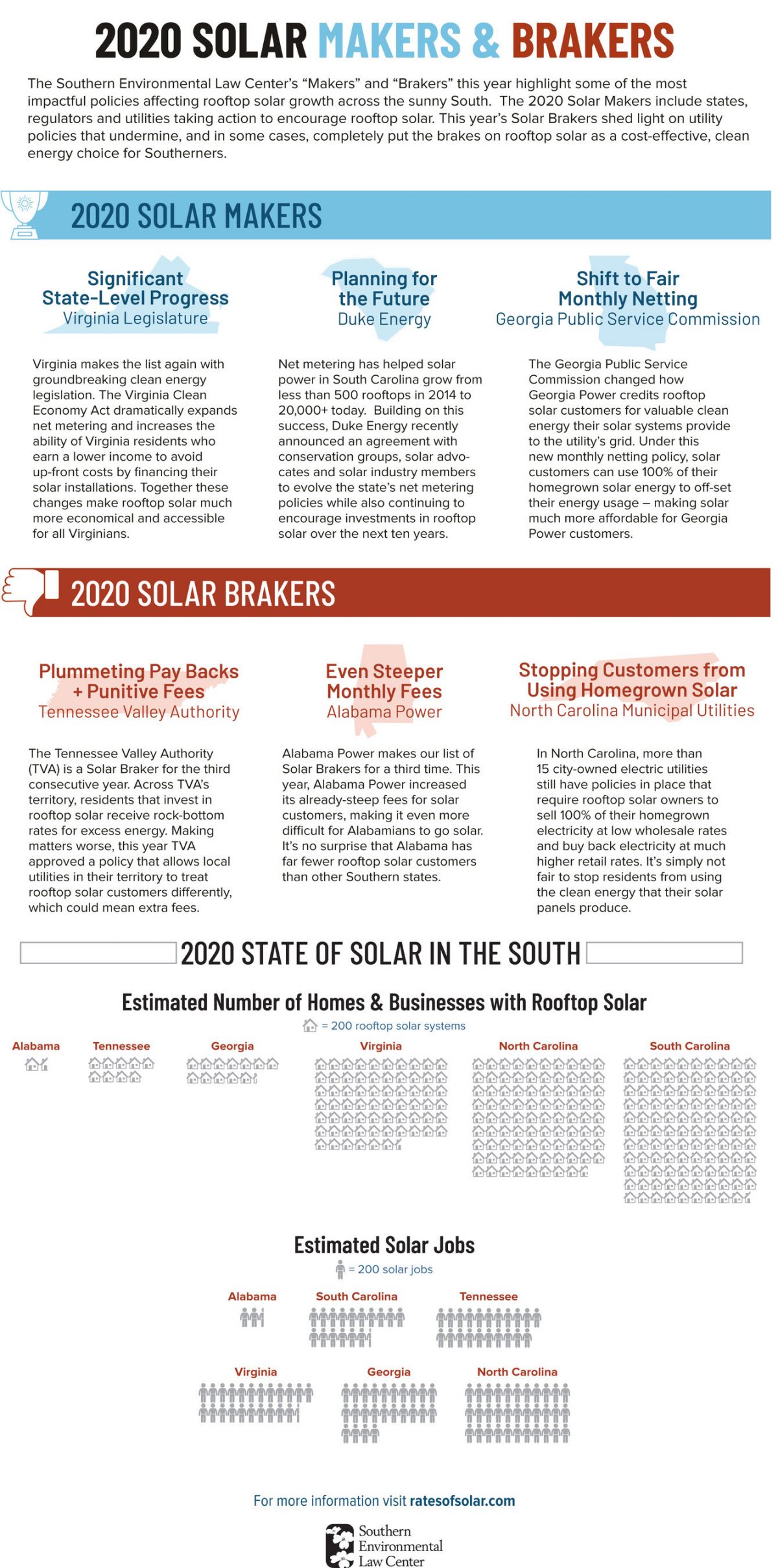
CHARLOTTESVILLE, Va., Dec. 17, 2020 /PRNewswire/ — Today the Southern Environmental Law Center (SELC) announced its 2020 Solar «Makers» and «Brakers» list highlighting some of the most impactful policies affecting rooftop solar growth across the sunny South.

<a href="https://mma.prnewswire.com/media/1388403/Southern_Environmental_Law_Center_Solar_Makers_Brakers_Infographic.html"…

CHARLOTTESVILLE, Va., Dec. 17, 2020 /PRNewswire/ — Today the Southern Environmental Law Center (SELC) announced its 2020 Solar «Makers» and «Brakers» list highlighting some of the most impactful policies affecting rooftop solar growth across the sunny South.

The 2020 Solar Makers include states, regulators and utilities taking action to encourage rooftop solar. This year’s Solar Brakers shed light on utility policies that undermine, and in some cases, completely put the brakes on rooftop solar as a cost-effective, clean energy choice for Southerners.

«In a challenging year, we are still able to highlight a few bright spots in the Southeast where solar power policies are shining,» said Lauren Bowen, Leader of SELC’s Solar Initiative. «On the whole, we’ve seen some real consistency in the kinds of policies that encourage more clean, renewable solar power and those that dampen consumer access to solar power. Especially now, consumers need more opportunities to control their electricity bills, and we are encouraged by the Solar Maker trends leading the way.»

Solar is booming across the South as more homeowners turn to clean, affordable rooftop solar to meet their energy needs and state policy makers embrace local solar growth and the benefits that come with it. Currently the Southeast has over 12 gigawatts of solar installed, and over 14.5 gigawatts installed or committed. When SELC launched Rates of Solar in 2018, there were approximately 25,000 homes and businesses in our six-state region with rooftop solar.  Two years later, that total has more than doubled. 

People in the South have some of the highest residential electric bills in the country and going solar is one of the few options that customers have to reduce the amount of energy they buy from utilities and lower their bills. Yet, residents across the region interested in putting solar on their homes, schools or businesses must first consider their utility’s rooftop solar policies before making the investment to determine if it’s a feasible option.

Southerners who want to learn more about solar policies and how their local electric utilities might be impacting solar can visit SELC’s Rates of Solar website. This digital tool summarizes complicated and often difficult-to-find rooftop solar policies for over 400 utilities across the region.

«The Rates of Solar website allows people to access the most up-to-date solar policies for hundreds of utilities across SELC’s six-state region,» said Jill Kysor, SELC staff attorney. «Our website provides simple, straightforward information for homeowners and businesses interested in rooftop solar about how utilities across the Southeast are treating those customers. As we update the website each year to capture policy changes, we are able to identify key regional trends that are making or braking rooftop solar’s growth in our region.»

Here are the 2020 Solar Makers and Brakers:

2020 Solar Makers

  • Significant State-Level Progress: Virginia legislation expands net metering and access to financing
    • This is the second year in a row that Virginia has been a Solar Maker because of groundbreaking clean energy legislation. The Virginia Clean Economy Act dramatically expands net metering, making rooftop solar more economical for a greater number of Virginians. A portion of this expanded capacity is set aside for Virginians earning a lower income, helping to broaden access to the bill-savings and other benefits of solar. The legislation also makes rooftop solar more affordable by ensuring that Virginians who earn a lower income can avoid high upfront costs by financing their solar installations. In addition to these changes, Virginia passed legislation establishing new shared solar programs, including programs for residents living in multi-family housing. The details of the new programs aren’t finalized yet, but they have the potential to further increase access to solar. With these big steps forward, Virginia to continues to pave the way for significant, local solar growth in our region. 
  • Planning for the Future: Duke Energy in South Carolina creates a long-term plan for rooftop solar
    • Net metering has encouraged the adoption of solar power in South Carolina from less than 500 rooftops in 2014 to more than 20,000 today.  Building on this success, Duke Energy recently announced an agreement with conservation groups, solar advocates, and solar industry members to evolve the state’s net metering policies while also continuing to encourage investments in rooftop solar over the next ten years.  The agreement pairs rooftop solar with smart thermostats and dynamic pricing to encourage customers to conserve electricity during peak demand while compensating more for solar production during those same times.  Customers who install rooftop solar may also be eligible to receive an upfront incentive for agreeing to a new solar plus smart thermostat program.  The program is expected to expand to solar plus storage opportunities in future years, and Duke Energy has committed to exploring a version of the program for customers earning a lower income.  The innovative new arrangement must be approved by the South Carolina Public Service Commission and is expected to be proposed in North Carolina at a later date.
  • Shift to Fair Monthly Netting: Georgia Power customers can use homegrown solar to offset energy purchases
    • The Georgia Public Service Commission directed Georgia Power to change how rooftop solar customers are credited for valuable clean energy their systems provide to the grid. Under the new monthly netting policy, customers can use 100% of their homegrown solar energy to offset their energy usage over the course of a month, making solar much more affordable than it had been under the Georgia Power’s previous policy that did not allow for monthly netting. This improved policy is only available to 5,000 Georgia Power solar customers (or 32 megawatts of new rooftop capacity, whichever comes first), just a fraction of the utility’s more than 2 million customers. The Public Service Commission created a big opportunity with this policy change, but SELC will continue to monitor what the Commissioners and Georgia Power do as the program reaches capacity.

2020 Solar Brakers

  • Plummeting Pay Backs + Punitive Fees: TVA’s rooftop policies go from bad to worse
    • The Tennessee Valley Authority (TVA) is a Solar Braker for the third consecutive year. Across TVA’s territory, residents who invest in rooftop solar receive rock-bottom rates for excess energy. The rates can change every month, giving homeowners no certainty about the credits they’ll receive for clean energy provided to their utility. Making matters worse, this year TVA approved a policy that allows retail utilities in their territory to put rooftop solar customers into a separate rate class. This opens the door for utilities to impose monthly fees on solar customers that are higher than existing monthly fees imposed on non-solar residential customers. We’ll be watching Tennessee to see whether local power companies take action on TVA’s new policy and start imposing discriminatory rates on rooftop solar customers next year.
  • Steep Monthly Fees: Alabama Power increases its already sky-high solar penalties
    • Alabama Power makes our list of Solar Brakers for a third time. Alabama Power, the largest utility in the state, imposes sky-high monthly fees on rooftop solar customers. This year, Alabama Power increased its already-steep fees for solar customers, making it even less affordable for Alabamians to go solar. In light of these additional roadblocks, it’s no surprise that Alabama has far fewer rooftop solar customers than any other Southern state.
  • Stopping Customers from Using Homegrown Energy: North Carolina municipal utilities force solar sales
    • In North Carolina, more than 15 city-owned electric utilities continue to impose punitive policies requiring rooftop solar owners to sell 100% of their homegrown electricity at low wholesale rates and buy back electricity at much higher retail rates. It’s simply not fair to stop residents from using the clean energy that their solar panels produce, especially at a time when consumers need more control over their electricity bills—not less.

Southern Environmental Law Center
For more than 30 years, the Southern Environmental Law Center has used the power of the law to champion the environment of the Southeast. With more than 80 attorneys and nine offices across the region, SELC is widely recognized as the Southeast’s foremost environmental organization and regional leader. SELC works on a full range of environmental issues to protect our natural resources and the health and well-being of all the people in our region. www.SouthernEnvironment.org


Cision View original content to download multimedia:http://www.prnewswire.com/news-releases/2020-trends-making-and-braking-rooftop-solar-in-the-south-301195277.html

SOURCE Southern Environmental Law Center

Greenland Ice Sheet Thinning–Does a Glacier’s Shape Affect it?

COLUMBIA, Md., Dec. 17, 2020 /PRNewswire/ — Scientists at Universities Space Research Association and their colleagues at NASA, University of Texas and other organizations have determined that the slope of the bedrock underneath glaciers around the Greenland ice sheet can either spread ice thinning farther inland or stall it.

Outlet glaciers are essentially rivers of ice flowing over the bedrock and draining into the ocean.  They…

COLUMBIA, Md., Dec. 17, 2020 /PRNewswire/ — Scientists at Universities Space Research Association and their colleagues at NASA, University of Texas and other organizations have determined that the slope of the bedrock underneath glaciers around the Greenland ice sheet can either spread ice thinning farther inland or stall it.

Outlet glaciers are essentially rivers of ice flowing over the bedrock and draining into the ocean.  They retreat and thin as the climate warms and this thinning spreads farther inland toward the center of the ice sheet.

Recently, by investigating the bed topography of 141 outlet glaciers around Greenland, scientists gained a better understanding of which glaciers could have a significant impact on the Greenland Ice Sheet’s contribution to sea level rise in the coming decades. They found that steep bedrock features, called «knickpoints», can effectively stall the spread of ice thinning. This often occurs in regions where the bed topography is mountainous. In contrast, in regions with more gentle topography where knickpoints are not present or are less steep, glaciers can transmit ice thinning far into the interior, away from the seacoasts. The results were published in Geophysical Research Letters. 

Universities Space Research Association scientist Dr. Denis Felikson at NASA’s Godard Space Flight Center, and the lead author of the study noted, «There are numerous small glaciers flowing over gentle topography in Northwest Greenland that can allow ice thinning to spread to the center of the ice sheet. These smaller glaciers, which have not garnered much attention may play as big a role in future sea level rise as the more well-known and well-studied glaciers.»

Glaciers that flow through gentle topography are found to either have gradual knickpoints, or no knickpoint at all. Such glaciers are of interest, and concern, because in spite of their size they have the potential to let thinning expand hundreds of kilometers inland, eroding the heart of the ice sheet. 

Researchers have hypothesized that by allowing thinning of ice sheets to spread far inland, these smaller glaciers without knickpoints will cause the ice sheet to continue to lose ice over a longer period of time than the larger glaciers flowing on a bedrock with knickpoints.

«Only recently have scientists been able to identify the steep changes in topography using digital elevation models to map the topography under the ice. Without that ability, the research team would not have been able to come up with the findings,» says Felikson.  The bed topography digital elevation model, known as the BedMachine Dataset–a high resolution model of the bed beneath the Greenland Ice Sheet –created by using airborne data from NASA’s Operation IceBridge, was crucial for this research.

Using NASA’s remote sensing data, scientists were able to determine whether thinning of the ice sheet can continue to spread upstream from a glacier’s ocean boundary by computing a single metric based on the shape of the glacier at every location along a glacier’s flow line. This helped them identify a break point between upstream and downstream glacial ice. «Ice below the knickpoint is susceptible to thinning from the glacier’s edge. But thinning does not extend upstream so the interior of the ice sheet is not impacted. This means that some parts of the Greenland Ice Sheet interior are more sensitive to what happens at the edge than other parts», says Felikson.

«Small glaciers could be impactful in terms of sea level rise, not because they are big and thick, but because they have access to more ice that they can eat away at,» said Felikson. «It will take them a lot longer to respond, but over the long term they could end up contributing significantly to sea level rise, just as the large glaciers do.

According to Felikson, «We are looking for confirmation from models for the theoretical limits on thinning that we have found, and hope that future modeling efforts will further confirm how thinning of ice spreads along glaciers. »

This research was funded by NASA under grant NNX12AP50G and by the Gale White Fellowship at the University of Texas Institute for Geophysics.

Related Resources:

Paper link: https://doi.org/10.1029/2020GL090112.

BedMachine Database Link: BedMachine v3: Complete bed topography and ocean bathymetry mapping of Greenland from multi-beam echo sounding combined with mass conservation, Geophysical Research Letters. 44. . https://doi.org/10.1002/2017GL074954

IceBridge BedMachine Greenland, Version 3. Boulder, Colorado USA. NASA National Snow and Ice Data Center Distributed Active Archive Center. doi: https://doi.org/10.5067/2CIX82HUV88Y.

About USRA
Universities Space Research Association is an independent, nonprofit research corporation where the combined efforts of in-house talent and university-based expertise merge to advance space science and technology. USRA works across disciplines including biomedicine, planetary science, astrophysics, and engineering and integrates those competencies into applications ranging from fundamental research to facility management and operations. USRA engages the creativity and authoritative expertise of the research community to develop and deliver sophisticated, forward-looking solutions to Federal agencies and other government sponsors.

PR Contact:
Suraiya Farukhi, Ph.D.
sfarukhi@usra.edu 
443-812-6945 (cell)      

Universities Space Research Association Logo (PRNewsfoto/Universities Space Research Ass)

Cision View original content to download multimedia:http://www.prnewswire.com/news-releases/greenland-ice-sheet-thinningdoes-a-glaciers-shape-affect-it-301195272.html

SOURCE Universities Space Research Association

Meijer Joins Consortium to Reinvent the Retail Bag

GRAND RAPIDS, Mich., Dec. 17, 2020 /PRNewswire/ — Meijer announced today that it’s joined the Beyond the Bag Initiative aimed at identifying, testing and implementing sustainable solutions to move beyond the single-use plastic bag.

GRAND RAPIDS, Mich., Dec. 17, 2020 /PRNewswire/ — Meijer announced today that it’s joined the Beyond the Bag Initiative aimed at identifying, testing and implementing sustainable solutions to move beyond the single-use plastic bag.

It’s among the retailer’s latest efforts to reduce waste and improve recycling, said Vik Srinivasan, Senior Vice President of Properties and Real Estate.

«Meijer operates under the philosophy that to be a good company, we must be a good neighbor,» Srinivasan said. «We are committed to lessening our impact on the environment and believe our participation in this initiative is an important step in keeping our communities clean for generations to come.»

Meijer is among numerous other retailers industrywide that are partnering in the Beyond the Bag Initiative that launched earlier this year by Closed Loop Partners’ Center for the Circular Economy. The 3-year collaboration is working to find a replacement for the single-use plastic bag that’s functional, easy for customers to use and better for the environment. The initiative also engages with stakeholders, including suppliers, materials recovery facilities, municipalities, advocacy groups and others to support this collaborative approach designed to promote viable market solutions that can be scaled, and bring value to retailers and customers.

«The scale of the challenge is vast, with single-use plastic bags used widely across industries, sectors and geographies,» said Kate Daly, Managing Director of the Center for the Circular Economy at Closed Loop Partners. «Addressing a systemic waste challenge requires bringing stakeholders together to solve for a shared challenge. That’s why we’re thrilled to have Meijer join the Consortium to Reinvent the Retail Bag, alongside CVS Health, Target, Walmart, DICK’S Sporting Goods, Kroger, Hy-Vee and Walgreens. Together, we are thinking outside the box and collectively reinventing the retail bag, and we encourage other retailers to join us.»

Meijer has made significant strides in recent years regarding its commitment to sustainable practices and the reduction of plastic waste in our environment, said Erik Petrovskis, Director of Environmental Compliance and Sustainability for Meijer. For example:

  • In January 2020, Meijer opened its first small format store, Woodward Corner Market, without single-use plastic bags. However, due to the coronavirus pandemic, the use of reusable bags has been restricted with the exceptions of customers using the company’s Shop & Scan technology and at self-checkouts.
  • Since 2014, each Meijer store has placed collection bins inside its front entrance vestibules for customers to deposit clean, dry plastic bags and films, including single-use, bread, dry cleaning, produce and water softener bags. This year, Meijer expects to recycle 6 million pounds of plastic bags that are sent to its distribution centers for remanufacturing into decking.
  • In 2019, Meijer began adding a How2Recycle label on its own brand packaging to better help customers understand how to dispose of the materials. By 2022, the How2Recycle label will be on all True Goodness by Meijer packaging.
  • In 2019, Meijer set a goal that Meijer brand packaging will be made from 100 percent reusable, recyclable or compostable materials by 2025.

«Lessening our impact on the environment through increased recycling efforts is an issue that is important to us and our customers, and one that we are working diligently to address,» Petrovskis said. «I look forward to reviewing the innovative solutions that will stem from this collaboration.»

About Meijer: Meijer is a Grand Rapids, Mich.-based retailer that operates 256 supercenters and grocery stores throughout Michigan, Ohio, Indiana, Illinois, Kentucky and Wisconsin. A privately-owned and family-operated company since 1934, Meijer pioneered the «one-stop shopping» concept and has evolved through the years to include expanded fresh produce and meat departments, as well as pharmacies, comprehensive apparel departments, pet departments, garden centers, toys and electronics. For additional information on Meijer, please visit www.meijer.com. Follow Meijer on Twitter @twitter.com/Meijer and @twitter.com/MeijerPR or become a fan at www.facebook.com/meijer.

About the Consortium to Reinvent the Retail Bag

The Beyond the Bag Initiative, launched by the Consortium to Reinvent the Retail Bag, aims to identify, pilot and implement viable design solutions and models that more sustainably serve the purpose of the current retail bag. Closed Loop Partners’ Center for the Circular Economy launched the initiative with Founding Partners CVS Health, Target and Walmart. Kroger joined as Grocery Sector Lead Partner, DICK’S Sporting Goods as Sports & Outdoors Sector Lead Partner and Hy-Vee, Meijer, and Walgreens as Supporting Partners, alongside Conservation International and Ocean Conservancy as Environmental Advisory Partners. OpenIDEO is the Consortium’s Innovation Partner. Learn more about the Consortium here

Cision View original content to download multimedia:http://www.prnewswire.com/news-releases/meijer-joins-consortium-to-reinvent-the-retail-bag-301195269.html

SOURCE Meijer

GridWise Alliance Calls On Congress To Invest $50 Billion In The Nation’s Electric Grid

WASHINGTON, Dec. 17, 2020 /PRNewswire/ — Today, the GridWise Alliance, released its comprehensive «Policy Framework for Grid Investments in Economic Recovery«, which specifically outlines the need for <a target="_blank"…

WASHINGTON, Dec. 17, 2020 /PRNewswire/ — Today, the GridWise Alliance, released its comprehensive «Policy Framework for Grid Investments in Economic Recovery«, which specifically outlines the need for $50 billion in federal spending for grid modernization. This figure, a doubling from initial calls in September for $25 billion, highlights significant increases in infrastructure and manufacturing investments to help the country meet ambitious climate goals, build resilience, secure the grid against malicious attacks, and replace aging infrastructure.

«The diverse GridWise membership led our industry’s voice in 2009 to help quickly deliver investments from the American Recovery and Reinvestment Act (ARRA) into the economy,» said Gil C. Quiniones, GridWise Alliance Board Chair.  «Together, as we did before, GridWise is shining the spotlight on the accelerated need to enhance grid flexibility, increase utility communication systems, and train our workforce for digital, high tech grid jobs.»

The «Policy Framework for Grid Investments for Economic Recovery» offers a list of guiding principles focused on how and where federal investments should flow, which stakeholders are most prepared to effectively distribute these funds, and how to protect consumers and narrow the digital divide. Seven segments of recommendations outline the most critical systems in need of immediate federal investment, including:

  1. Deployment of technologies to enhance grid flexibility        
  2. Deployment of technologies to enhance grid integration of buildings and vehicles
  3. Cybersecurity technology and workforce
  4. Section 48c manufacturing tax credit
  5. Utility communications
  6. Grid Resilience
  7. Workforce development

«I applaud the efforts of our Policy Council, a GridWise member-led committee, for finding consensus around these seven segments and affirming them through stakeholder outreach,» said GridWise Alliance CEO Steve Hauser. «We call on Congress to utilize these recommendations and include significant funding for grid modernization in any infrastructure package designed to stimulate the economy and create jobs.»

About GridWise Alliance
The GridWise Alliance (GWA) represents the broad and diverse stakeholders that design, build, and operate the electric grid.  Since 2003, the GridWise Alliance has been at the forefront of educating key industry stakeholders on the critical need to modernize our nation’s electricity system. For more information about the GridWise Alliance, visit: www.gridwise.org.

CONTACT: Richard O’Neill, Executive Director, (202) 495-3135, roneill@gridwise.org

Cision View original content to download multimedia:http://www.prnewswire.com/news-releases/gridwise-alliance-calls-on-congress-to-invest-50-billion-in-the-nations-electric-grid-301195242.html

SOURCE GridWise Alliance

Paramount Pallet Opens Largest Recycling Facility in Canada

WHITBY, Ontario, Dec. 17, 2020 /PRNewswire-PRWeb/ — Paramount Pallet, the largest full-service pallet solutions company in Canada, has moved its Toronto, Ontario plant location to a new, larger space in Whitby, Ontario to accommodate continued business growth.

Paramount Pallet’s new facility boasts 185,000 square feet of indoor production and warehouse space, 32-foot ceilings, and 34 dock doors….

WHITBY, Ontario, Dec. 17, 2020 /PRNewswire-PRWeb/ — Paramount Pallet, the largest full-service pallet solutions company in Canada, has moved its Toronto, Ontario plant location to a new, larger space in Whitby, Ontario to accommodate continued business growth.

Paramount Pallet’s new facility boasts 185,000 square feet of indoor production and warehouse space, 32-foot ceilings, and 34 dock doors. This new high-cube facility allows for storage of large inventories of pallets in a clean and dry environment. It is located just minutes from the 401 for easy access.

«We’re truly excited about our new flagship facility in Whitby,» says Paramount Pallet’s President, Mark Sura. «We’re especially pleased that it is considered the largest pallet recycling facility in Canada.» The move represents the organization’s continued commitment to serving its customers across the country, creating more job opportunities in the Whitby area, and the ability to repair and recycle more than 5 million pallets per year.

After 20 great years of serving customers from the Martin Grove Road facility, Paramount Pallet is excited to start the next chapter in the Paramount story. The organization will continue to serve companies of all sizes and industry sectors including retail, manufacturing, hospitality, food distributors, farmers, grocers, and more.

The new facility is located at:
Paramount Pallet, LP
1672 Tricont Avenue
Whitby, ON
L1N 7C3
(416) 742-6006

Paramount Pallet hosted an outdoor Ribbon Cutting Ceremony on December 14 to mark the facility’s opening. Attendees included the Mayor of Whitby, Don Mitchell, and members of the Whitby Chamber of Commerce.

Paramount Pallet is currently hiring across all Canadian plant locations. For information about job opportunities at Paramount Pallet, visit the career page or email careers@paramountpallet.com.

About Paramount Pallet
Paramount Pallet is the largest full-service solutions company in Canada, with a national network of six company-owned and operated facilities, 200 employees, and more than 30 years in business. Paramount Pallet provides pallet services to hundreds of customers across various industries throughout Canada and the United States.

Paramount Pallet allows customers to work with one provider to handle all of their pallet needs, from nationwide pallet supply to retrieval, recycled pallets, new and custom pallets, and more. Paramount Pallet has the expertise to support our customers’ supply chain needs by delivering the results they need when they need them. For more information about Paramount Pallet, visit: http://www.paramountpallet.com.

Media Contact:
Marianne Pelletier
Paramount Pallet
mpelletier@paramountpallet.com
(416) 744- 6066

##

Media Contact

Marianne Pelletier, Paramount Pallet, +1 4167446066, mpelletier@paramountpallet.com


SOURCE Paramount Pallet

Veteran Golf Course Superintendent Joins SOX Erosion Solutions As Golf Industry Specialist

BOCA RATON, Fla., Dec. 17, 2020 /PRNewswire-PRWeb/ — Nate Watkin, a veteran golf course superintendent, has been named Golf Industry Specialist for SOX Erosion Solutions™ (http://www.soxerosion.com). The South Florida-based company develops,…

BOCA RATON, Fla., Dec. 17, 2020 /PRNewswire-PRWeb/ — Nate Watkin, a veteran golf course superintendent, has been named Golf Industry Specialist for SOX Erosion Solutions™ (http://www.soxerosion.com). The South Florida-based company develops, manufactures and distributes a suite of innovative, patented, bio-engineered products that halt shoreline and hillside erosion.

The announcement was made by Ryan G. Leeds, Managing Partner of SOX Erosion Solutions.

«It is a distinct pleasure to welcome Nate to the SOX family,» said Leeds. «As an experienced and well-known golf course superintendent, he understands the challenges facing these facilities due to ongoing storm water management programs, typical retention and lake destabilization, and changing climate patterns. These and other issues contribute to significant shoreline erosion and subsequent hazardous conditions.»

SOX Erosion Solutions is an innovator in shoreline and hillside restoration with its patented systems – ShoreSOX™ and DredgeSOX™. Each involves filling an appropriately sized technical mesh containment system with organic sediment that is dredged from lake/river bottoms. In some cases mulch, compost mix, or aeration plugs are locally sourced and delivered to the site to serve as filler. Once filled, the mesh is secured and sculpted to the shoreline, using the SOX patented anchoring system to re-create the original and now living shoreline. Following installation, vegetation is planted. The mesh provides a stable environment that supports root development.

The entire process takes significantly less time than hardened options to install and is regarded as an affordable, environmentally safe alternative to rocks, bulkheads, and seawalls. In addition, the SOX mesh filters water runoff, reducing nutrient load and pollutants from seeping into the waterways. These systems reclaim valuable land and through the dredging process water, depth, and flow have been restored to enhance healthy habitats for wildlife.

«I have seen firsthand how the SOX systems enhance not only the aesthetics of a golf course but improve water quality, regenerate ecosystems and enhance the golfers’ experiences,» said Watkin. «I am grateful to join an innovative team that is committed to the golf industry.»

Prior to joining SOX Erosion Solutions, Watkin served as a golf course superintendent at Seagate Country Club (Delray Beach, FL) and Trump International Golf Club (West Palm Beach, FL), in addition to working at many other courses during his nearly two decades in the industry. In this capacity, he managed major renovations, implemented agronomic plans, and directed safety initiatives.

He is a long-standing Class A member of the Golf Course Superintendents Association of America (GCSAA).

Media Contact

David Reeves, Reeves Laverdure Public Relations, +1 (561) 212-9569, dreeves@reevespr.com


SOURCE SOX Erosion Solutions

Don’t just focus on a single risk, take a broad look at risk intersection

NEW YORK, Dec. 17, 2020 /PRNewswire/ — All eyes are on the pandemic, but let’s not forget the other economic, environmental and societal risks driving losses. These threats to businesses, individuals and government entities have not gone away while our attention is elsewhere. In many instances, they’ve grown more severe as a result of COVID-19.

<a…

NEW YORK, Dec. 17, 2020 /PRNewswire/ — All eyes are on the pandemic, but let’s not forget the other economic, environmental and societal risks driving losses. These threats to businesses, individuals and government entities have not gone away while our attention is elsewhere. In many instances, they’ve grown more severe as a result of COVID-19.

Nothing showed risk intersection better than the first 90 days of the pandemic when we were dealing with its effects on a personal level. Crumbling supply chains meant we couldn’t access necessities, like toilet paper and cleaning supplies. And the shift to a remote society meant families were suddenly fighting over broadband and quiet spaces to work and attend school.

COVID-19, shifting priorities and emerging risks
2020 is a case study on the intersection of risk. The pandemic has shifted politics, regulation, and the market – and refocused priorities – as entities plan their economic recoveries.

Millennials, who face a slump in incomes and increased unemployment, will be particularly hard hit, putting more pressure on intergenerational social contracts. We’re seeing part of a generation return home – with the accompanying tradeoffs and increased stress. Their frustrated expectations around job security and wealth building may translate into political tensions and social unrest.

COVID-19 also expedited the shift to remote working, which, according to the OECD, is unlikely to entire disappear after the COVID-19 crisis subsides. As a result, we will see an impact on everything from productivity to management styles to risk exposure.

Mental health and wellbeing
The pandemic has also significantly impacted mental health and wellbeing. Interestingly, while some individuals reported feeling less stressed under lockdown and pandemic-related restrictions, others reported increased concern about their mental health and feelings of vulnerability, exclusion and isolation. Additionally, with many schools moving to remote learning, families are struggling to balance personal, parental and professional obligations. And parents, non-parents and children alike are experiencing the impact of reduced social interaction.

The COVID-19 pandemic is already showing the first signs of increased mental illness among the young, with one in six people aged 10-19 affected. Mental illness does not exist in a silo. Higher diagnoses of mental health issues have driven global healthcare costs and disability claims higher. Mental illness can have many co-morbidities such as obesity, cardiovascular diseases, back pain or diabetes. Early treatment is key to mitigate long-term chronic illness. As a result, we have both a social and a business rationale for addressing this growing crisis.

Climate Change and weather events
Yet as the pandemic accelerates emerging risks and trends, it shouldn’t overshadow the need to transition to a more sustainable economy and a low carbon future. There are clear targets, which highlight political tensions and come with a price tag. But while reaching net-zero by 2050 is daunting, failure to achieve this target would be far more costly in the long-term.  

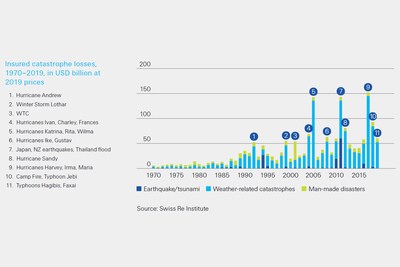
According to the Swiss Re Institute’s annual sigma report, natural catastrophes caused an estimated USD 137 billion in losses in 2019. Almost two-thirds of these losses were uninsured, revealing a protection gap where countless people and businesses are at risk of financial difficulty following an event.

And the cost of natural catastrophes keeps rising. Just over 15 years ago, Hurricane Katrina became the costliest US natural catastrophe with an estimated USD 160 billion in economic losses. Yet if it made landfall in 2020, the economic toll would likely exceed USD 175 billion. And given that this year we reached Greek letters for named storms the first time since 2005 and second time in recent history, the next Katrina is likely not far away.

Secondary perils
That being said, large named storms are not the only perils to cause significant economic damage. Secondary perils, or high-frequency, low-to-medium severity loss events, caused more than 60% of the USD 76 billion of insured natural catastrophe losses in 2018. They were also the primary loss drivers in 2019 and in the first half of 2020.

Secondary perils can happen independently, such as drought or wildfires, or they can be secondary effects of primary perils, like torrential rainfall or storm surges associated with tropical cyclones. They are becoming more frequent, severe and costly.

Warming climates may not be the sole reason for the rising losses from secondary peril events, but climate change is certainly a major contributing factor. Businesses and public entities need to do more to protect themselves against this growing risk. There are numerous traditional and innovative risk transfer solutions that can help companies mitigate these risks and better protect their balance sheets.

Loss of biodiversity
We can also reduce the risk of damage from natural catastrophes by investing in biodiversity and ecosystems, like reforesting coastal mangroves.

The loss of biodiversity and damage to ecosystems is a major global risk. Yet KPMG reports that over three quarters of the world’s largest companies don’t report risks from the loss of biodiversity despite repeated warnings of their economic and social impacts. Biodiversity loss isn’t a new problem, but we have tended to focus on single phenomena, (like the declining populations of bees), rather than on the loss of entire ecosystems and the services and benefits they provide for society – such as freshwater production or climate regulation.

The Swiss Re Institute’s Biodiversity and Ecosystem Services Index highlights which economic sectors are most reliant on nature and the exposure each country has to biodiversity and ecosystems services decline. If we understand the connectivity between these ecosystems, we can take steps to mitigate against deteriorating biodiversity and ecosystems and make our societies and businesses more resilient.

Building a better tomorrow
Of course, disruption, loss and change also bring benefits. After all, the temporary shutdown of the industrial complex meant less traffic and bluer, less-polluted skies, modern day miracles in places like L.A., even if short-lived.

Crisis can also change perspective and bring people together. We better recognize the importance of essential and frontline workers who are keeping our hospitals, transportation systems, and food supply chain running. And while there has been a decline in some forms of social capital, there may have been an uptick in volunteering in the US and many other countries.

The increase in anxiety and mental illness has made many people more willing to open up about mental health issues and reduced the stigma around discussing mental health in work and social environments.

COVID-19 is also expediting the restructuring of global supply chains, which had become increasingly complex and geographically diverse. Going forward, many businesses will likely reshape their supply chains to become less dependent on remote suppliers, to the benefit of both their bottom line and the environment.

Given the threat of climate change, this shift couldn’t come soon enough. It also fits with a greater trend of companies making decisions with environmental consequences in mind. Following the 2020 World Economic Forum, Swiss Re CEO, Christian Mumenthaler, reported it was the first time he had seen business leaders getting serious about climate change. And while climate change and COVID-19 threaten our health and economies, they give us the opportunity to rethink the way we do business and build a stronger tomorrow.

Crucially, they also challenge us to step back and look at the myriad risks we’re facing – large and small – and their relation to each other. If we do that, we’ll end up with more resilient individuals, businesses, and societies.

Just as contact tracing has shown how we are each impacted by the actions of complete strangers, the pandemic has laid bare how reliant businesses and entities are on systems, processes, and forces beyond their oversight or control. It’s up to us to connect the dots at these risk intersections and prepare ourselves for this chain reaction. In short, when we look at risk, we need to look beyond the immediate and obvious ones.

About Swiss Re Corporate Solutions
Swiss Re Corporate Solutions provides risk transfer solutions to large and mid-sized corporations around the world. Its innovative, highly customised products and standard insurance covers help to make businesses more resilient, while its industry-leading claims service provides additional peace of mind. Swiss Re Corporate Solutions serves clients from offices worldwide and is backed by the financial strength of the Swiss Re Group. Visit corporatesolutions.swissre.com or follow us on linkedin.com/company/swiss-re-corporate-solutions and Twitter @SwissRe_CS.

Cision View original content to download multimedia:http://www.prnewswire.com/news-releases/dont-just-focus-on-a-single-risk-take-a-broad-look-at-risk-intersection-301195212.html

SOURCE Swiss Re Corporate Solutions

Electrification to Spark Growth of Global Aircraft Electric Power Systems Market

The market is estimated to return to its pre-pandemic size and stability after 2024 when it is expected to reach $2.23 trillion

SANTA CLARA, Calif., Dec. 17, 2020 /PRNewswire/ — Frost & Sullivan’s recent analysis, Industry Convergence Boosting the Global Aircraft Electric Power Systems Market, finds that increasing demand for electric aircraft, changes in global fleet composition, and surging demand for new aircraft from emerging…

The market is estimated to return to its pre-pandemic size and stability after 2024 when it is expected to reach $2.23 trillion

SANTA CLARA, Calif., Dec. 17, 2020 /PRNewswire/ — Frost & Sullivan’s recent analysis, Industry Convergence Boosting the Global Aircraft Electric Power Systems Market, finds that increasing demand for electric aircraft, changes in global fleet composition, and surging demand for new aircraft from emerging economies are prominent factors driving the global aircraft electric power systems (EPS) market. EPS ensure power generation, conversion, and distribution of electricity throughout the aircraft, as well as energy storage and motorization. The market is estimated to return to its pre-pandemic size and stability after 2024 when it is expected to reach $2.23 trillion from $1.61 trillion in 2020.

For further information on this analysis, please visit: http://frost.ly/4zp

«Emergence of new technologies will help drive market recovery after the crisis, with several variables and goals set by original equipment manufacturers (OEMs) and operators, such as fuel and power efficiency, maintenance costs reduction, and new mobility patterns,» said Alejandro Gonzalez, Aerospace & Defense Research Analyst at Frost & Sullivan. «The move toward electrification of aircraft has benefited the engine segment with significant research and development (R&D) investments. This trend will continue and expand to other segments, such as motorization, as alternatives are sought to replace hydraulic and pneumatic systems in next-generation aircraft.»

Gonzalez added: «With the development of advanced materials, there is significant growth potential in distribution and storage systems. New technologies are expected to reduce the size and weight of components while increasing their efficiency and autonomy. Additionally, the need to meet the demand for new, lighter, and denser batteries will further boost the aircraft EPS market.»

The rise of new types of aircraft will boost the entire aircraft EPS segments—power generation systems, power conversion systems, power distribution systems, motorization systems, and electric storage systems—presenting lucrative growth prospects for market participants.

  • Digitization: EPS components need to be digitized by adopting new sensors to collect data in real-time with a constant connection to the cloud.
  • Emphasizing energy storage technology: EPS suppliers should assess their innovation strategies and potential partnerships to meet the demand for high-storage battery systems in large aircraft.
  • Adopting new material and manufacturing techniques: Suppliers must build components using additive manufacturing techniques to lower production costs and reduce lead times within the supply chain.
  • Focusing on all-electric aircraft technology: EPS vendors should develop lightweight, safe, and efficient electrical and electronic components that can be adapted for hybrid and electric aircraft.

Industry Convergence Boosting the Global Aircraft Electric Power Systems Market is the latest addition to Frost & Sullivan’s Aerospace & Defense research and analyses available through the Frost & Sullivan Leadership Council, which helps organizations identify a continuous flow of growth opportunities to succeed in an unpredictable future.

About Frost & Sullivan
For six decades, Frost & Sullivan has been world-renowned for its role in helping investors, corporate leaders and governments navigate economic changes and identify disruptive technologies, Mega Trends, new business models, and companies to action, resulting in a continuous flow of growth opportunities to drive future success. Contact us: Start the discussion

Industry Convergence Boosting the Global Aircraft Electric Power Systems Market

K519-22

Media Contact:
Srihari Daivanayagam, Corporate Communications
M: +91 9742676194; P: +91 44 6681 4412
E: srihari.daivanayagam@frost.com

http://ww2.frost.com

Cision View original content to download multimedia:http://www.prnewswire.com/news-releases/electrification-to-spark-growth-of-global-aircraft-electric-power-systems-market-301195205.html

SOURCE Frost & Sullivan