Dress for Success® Expands Annual Your Hour, Her Power® Campaign with «31 Days of Women in Power» to Highlight the Importance of Women Leaders

Stories of 31 groundbreaking women leaders from diverse industries will be shared throughout March in honor of Women’s History Month and International Women’s Day

NEW YORK, March 1, 2021 /PRNewswire-HISPANIC PR WIRE/ — Dress for Success, the only global nonprofit employment resource for women, today announced the expansion of its annual <a target="_blank"…

Stories of 31 groundbreaking women leaders from diverse industries will be shared throughout March in honor of Women’s History Month and International Women’s Day

NEW YORK, March 1, 2021 /PRNewswire-HISPANIC PR WIRE/ — Dress for Success, the only global nonprofit employment resource for women, today announced the expansion of its annual Your Hour, Her Power global campaign with «31 Days of Women in Power.» In honor of Women’s History Month and International Women’s Day, Dress for Success will share the stories of 31 inspiring women in leadership positions who are making an impact in their industries and beyond.

Dress for Success

Launching in partnership with O, The Oprah Magazine, Your Hour, Her Power is inspired by the belief that when a woman has access to opportunities that can change her life for the better, she becomes powerful beyond measure. By donating the equivalent of one hour of pay, individuals can help women gain access to Dress for Success’ programs, services, and tools. Given the impact of COVID-19 on women’s careers and representation in the workforce, access to employment tools and resources has never been more critical.

«Our clients were vulnerable to economic disparities spurred by hardship and gender-based biases and norms prior to the COVID-19 pandemic,» said Joi Gordon, CEO of Dress for Success. «Those disparities have been exacerbated over the past year as our women face increased financial, food, and housing insecurity due to job loss. We want every woman who has been impacted by this crisis to know that Dress for Success has a network, programs, and resources available to support them as they navigate these uncertain times.»

Women leaders, mentors, and sponsors play a significant role in empowering women as they advance in their careers. That is why Dress for Success is introducing «31 Days of Women in Power.» The campaign extension, sponsored by Arm & Hammer, Chloe Wine Collection, and Sono Bello, will honor 31 groundbreaking women executives representing diverse industries throughout March.

«Women play a pivotal role in driving business and economic gains, as well as social and cultural change, and we must continue to find ways to elevate their voices and recognize them for their contributions,» continued Gordon. «We are excited to celebrate these phenomenal women and show our clients what is possible when women are empowered and have access to tools and opportunities that position them for success.»

2021 Your Hour, Her Power honorees to be profiled on the campaign’s microsite — www.yourhourherpower.org — include:

Andi Owen
President & CEO,
Herman Miller

Gail Grimmett
Chief Experience
Officer, Wheels Up

Jenny Xu
Founder & CEO,
Talofa Games

Lizanne Kindler
CEO, Talbots

Ramona Hood
President & CEO,
FedEx Custom Critical

Cheryl Abel-Hodges
CEO, Calvin Klein

Helen Aboah
CEO, Urban Zen

Jill Evanko
President & CEO,
Chart Industries

Margaret Keane
CEO, Synchrony

Renee Gittins
Executive Director,
International Game
Developers Association

Christina Seelye
Founder & CEO,
Maximum Games

Hillary Scott
Recording Artist, Lady A

Kate Burke
COO,
AllianceBernstein

Mary Dillon
CEO, Ulta Beauty

Rima Qureshi
EVP & Chief Strategy
Officer, Verizon

Christy Pambianchi
EVP & Chief Human
Resources Officer,
Verizon

Jamie Jones Miller
National President,
Alpha Sigma Tau
Sorority

Kathy Warden
Chairman, CEO &
President,
Northrop Grumman

Mindy Grossman
Presdident & CEO,
WW International, Inc.

Stephanie Chung
Chief Growth Officer,
Wheels Up

Corinne Ripoche
CEO, Adecco Americas
& Pontoon,
Adecco Group

Janessa Cox-Irvin
Global Head of Diversity
& Inclusion 
AllianceBernstein

Leah Hoyer
VP of Creative,
Wizards of the Coast

Niki Leondakis
CEO,
CorePower Yoga

Sue Y. Nabi
CEO, COTY

Dale Bornstein
CEO, M Booth

Jasmin Allen
SVP, Hennessy
U.S., LVMH Möet
Hennessy Louis Vuitton

Linda Findley
Kozlowski

President & CEO,
Blue Apron

Penny Pennington
Managing Partner,
Edward Jones

Tami Erwin
EVP & Group CEO,
Verizon Business

Emilie Rubinfeld
Global President,
Carolina Herrera

Individuals wishing to support Dress for Success this Women’s History Month and International Women’s Day with a donation of the equivalent of one hour of their pay may visit the campaign’s microsite at www.yourhourherpower.org. Additionally, companies interested in partnering with Dress for Success throughout March may contact partnerships@dressforsuccess.org.

About Dress for Success
Dress for Success is an international nonprofit organization that empowers women to achieve economic independence by providing a network of support, professional attire, and development tools to help them thrive in work and life. Since starting operations in 1997, Dress for Success has expanded to nearly 150 cities in 25 countries. To date, the organization has helped more than 1.2 million women work towards financial independence. Visit www.dressforsuccess.org to learn more.

Logo – https://mma.prnewswire.com/media/660657/Dress_For_Success_logo.jpg

SOURCE Dress for Success

WEC Energy Group to acquire 90% ownership of Jayhawk Wind Farm

MILWAUKEE, March 1, 2021 /PRNewswire/ — WEC Energy Group (NYSE: WEC) today announced that the company has agreed to acquire a 90% ownership interest in the Jayhawk Wind Farm, to be built in Bourbon and Crawford counties, Kansas.

Jayhawk will generate renewable energy that will be sold under long-term contract to Facebook. The Jayhawk site will consist of 70 GE wind turbines with a…

MILWAUKEE, March 1, 2021 /PRNewswire/ — WEC Energy Group (NYSE: WEC) today announced that the company has agreed to acquire a 90% ownership interest in the Jayhawk Wind Farm, to be built in Bourbon and Crawford counties, Kansas.

Jayhawk will generate renewable energy that will be sold under long-term contract to Facebook. The Jayhawk site will consist of 70 GE wind turbines with a combined capacity of more than 190 megawatts.

The project is being developed by Apex Clean Energy, a leading clean energy company. Invenergy will acquire the remaining 10% ownership interest and will operate the facility. Commercial operation is expected to begin by the end of 2021.

WEC Energy Group’s investment is expected to total $302 million for the 90% ownership interest and substantially all of the tax benefits. The investment is part of the company’s $16 billion ESG Progress Plan — the largest 5-year capital plan in the company’s history. It calls for investment in efficiency, sustainability and growth.

«Our commitment to the Jayhawk project is the next step forward in our comprehensive plan to build a bright, sustainable future, serve strong vibrant customers and continue to grow earnings from our portfolio of renewable energy assets,» said Gale Klappa, executive chairman.

The transaction is subject to receiving all necessary regulatory approvals.

WEC Energy Group (NYSE: WEC), based in Milwaukee, is one of the nation’s premier energy companies, serving 4.6 million customers in Wisconsin, Illinois, Michigan and Minnesota.

The company’s principal utilities are We Energies, Wisconsin Public Service, Peoples Gas, North Shore Gas, Michigan Gas Utilities, Minnesota Energy Resources and Upper Michigan Energy Resources. Another major subsidiary, We Power, designs, builds and owns electric generating plants. In addition, WEC Infrastructure LLC owns a growing fleet of renewable generation facilities in the Midwest.

WEC Energy Group (wecenergygroup.com) is a Fortune 500 company and a component of the S&P 500. The company has approximately 42,000 stockholders of record, 7,300 employees and $37 billion of assets.

Forward-looking statements

Certain statements contained in this press release are «forward-looking statements» within the meaning of Section 27A of the Securities Act of 1933 and Section 21E of the Securities Exchange Act of 1934. These statements are based upon management’s current expectations and are subject to risks and uncertainties that could cause our actual results to differ materially from those contemplated in the statements. Readers are cautioned not to place undue reliance on these statements. Forward—looking statements include, among other things, statements concerning management’s expectations and projections regarding investment amounts, tax impacts, construction plans and completion of the project. In some cases, forward—looking statements may be identified by reference to a future period or periods or by the use of forward—looking terminology such as «anticipates,» «believes,» «estimates,» «expects,» «forecasts,» «guidance,» «intends,» «may,» «objectives,» «plans,» «possible,» «potential,» «projects,» «should,» «targets,» «will» or similar terms or variations of these terms.

Factors that could cause actual results to differ materially from those contemplated in any forward—looking statements include, but are not limited to: general economic conditions, including business and competitive conditions in the company’s service territories; the extent, duration and impact of the COVID—19 pandemic or any future health pandemics; timing, resolution and impact of rate cases and other regulatory decisions; the company’s ability to continue to successfully integrate the operations of its subsidiaries; availability of the company’s generating facilities and/or distribution systems; unanticipated changes in fuel and purchased power costs; key personnel changes; varying, adverse or unusually severe weather conditions; continued industry restructuring and consolidation; continued advances in, and adoption of, new technologies that produce power or reduce power consumption; energy and environmental conservation efforts; the company’s ability to successfully acquire and/or dispose of assets and projects; cyber—security threats and data security breaches; construction risks; equity and bond market fluctuations; changes in the company’s and its subsidiaries’ ability to access the capital markets; changes in tax legislation or our ability to use certain tax benefits and carryforwards; the impact of legislative and regulatory changes, including changes to environmental standards and greenhouse gas regulations; political developments; current and future litigation and regulatory investigations, proceedings or inquiries; changes in accounting standards; the financial performance of American Transmission Company as well as projects in which the company’s energy infrastructure business invests; the ability of the company to obtain additional generating capacity at competitive prices; goodwill and its possible impairment; and other factors described under the heading «Factors Affecting Results, Liquidity and Capital Resources» in Management’s Discussion and Analysis of Financial Condition and Results of Operations and under the headings «Cautionary Statement Regarding Forward—Looking Information» and «Risk Factors» contained in the company’s Form 10—K for the year ended December 31, 2020, and in subsequent reports filed with the Securities and Exchange Commission. The company expressly disclaims any obligation to publicly update or revise any forward—looking information.

Cision View original content:http://www.prnewswire.com/news-releases/wec-energy-group-to-acquire-90-ownership-of-jayhawk-wind-farm-301237305.html

SOURCE WEC Energy Group

Dress for Success® Expands Annual Your Hour, Her Power® Campaign with «31 Days of Women in Power» to Highlight the Importance of Women Leaders

NEW YORK, March 1, 2021 /PRNewswire/ — Dress for Success, the only global nonprofit employment resource for women, today announced the expansion of its annual Your Hour, Her Power global campaign with «31 Days of Women in Power.» In honor of Women’s History Month and International Women’s Day, Dress for Success…

NEW YORK, March 1, 2021 /PRNewswire/ — Dress for Success, the only global nonprofit employment resource for women, today announced the expansion of its annual Your Hour, Her Power global campaign with «31 Days of Women in Power.» In honor of Women’s History Month and International Women’s Day, Dress for Success will share the stories of 31 inspiring women in leadership positions who are making an impact in their industries and beyond.

Launching in partnership with O, The Oprah Magazine, Your Hour, Her Power is inspired by the belief that when a woman has access to opportunities that can change her life for the better, she becomes powerful beyond measure. By donating the equivalent of one hour of pay, individuals can help women gain access to Dress for Success’ programs, services, and tools. Given the impact of COVID-19 on women’s careers and representation in the workforce, access to employment tools and resources has never been more critical.

«Our clients were vulnerable to economic disparities spurred by hardship and gender-based biases and norms prior to the COVID-19 pandemic,» said Joi Gordon, CEO of Dress for Success. «Those disparities have been exacerbated over the past year as our women face increased financial, food, and housing insecurity due to job loss. We want every woman who has been impacted by this crisis to know that Dress for Success has a network, programs, and resources available to support them as they navigate these uncertain times.»

Women leaders, mentors, and sponsors play a significant role in empowering women as they advance in their careers. That is why Dress for Success is introducing «31 Days of Women in Power.» The campaign extension, sponsored by Arm & Hammer, Chloe Wine Collection, and Sono Bello, will honor 31 groundbreaking women executives representing diverse industries throughout March.

«Women play a pivotal role in driving business and economic gains, as well as social and cultural change, and we must continue to find ways to elevate their voices and recognize them for their contributions,» continued Gordon. «We are excited to celebrate these phenomenal women and show our clients what is possible when women are empowered and have access to tools and opportunities that position them for success.»

2021 Your Hour, Her Power honorees to be profiled on the campaign’s microsite — www.yourhourherpower.org — include:

Andi Owen
President & CEO,
Herman Miller

Gail Grimmett
Chief Experience
Officer, Wheels Up

Jenny Xu
Founder & CEO,
Talofa Games

Lizanne Kindler
CEO, Talbots

Ramona Hood
President & CEO,
FedEx Custom Critical

Cheryl Abel-Hodges
CEO, Calvin Klein

Helen Aboah
CEO, Urban Zen

Jill Evanko
President & CEO,
Chart Industries

Margaret Keane
CEO, Synchrony

Renee Gittins
Executive Director,
International Game
Developers Association

Christina Seelye
Founder & CEO,
Maximum Games

Hillary Scott
Recording Artist, Lady A

Kate Burke
COO,
AllianceBernstein

Mary Dillon
CEO, Ulta Beauty

Rima Qureshi
EVP & Chief Strategy
Officer, Verizon

Christy Pambianchi
EVP & Chief Human
Resources Officer,
Verizon

Jamie Jones Miller
National President,
Alpha Sigma Tau
Sorority

Kathy Warden
Chairman, CEO &
President,
Northrop Grumman

Mindy Grossman
Presdident & CEO,
WW International, Inc.

Stephanie Chung
Chief Growth Officer,
Wheels Up

Corinne Ripoche
CEO, Adecco Americas
& Pontoon,
Adecco Group

Janessa Cox-Irvin
Global Head of Diversity
& Inclusion 
AllianceBernstein

Leah Hoyer
VP of Creative,
Wizards of the Coast

Niki Leondakis
CEO,
CorePower Yoga

Sue Y. Nabi
CEO, COTY

Dale Bornstein
CEO, M Booth

Jasmin Allen
SVP, Hennessy
U.S., LVMH Möet
Hennessy Louis Vuitton

Linda Findley
Kozlowski

President & CEO,
Blue Apron

Penny Pennington
Managing Partner,
Edward Jones

Tami Erwin
EVP & Group CEO,
Verizon Business

Emilie Rubinfeld
Global President,
Carolina Herrera

Individuals wishing to support Dress for Success this Women’s History Month and International Women’s Day with a donation of the equivalent of one hour of their pay may visit the campaign’s microsite at www.yourhourherpower.org. Additionally, companies interested in partnering with Dress for Success throughout March may contact partnerships@dressforsuccess.org.

About Dress for Success
Dress for Success is an international nonprofit organization that empowers women to achieve economic independence by providing a network of support, professional attire, and development tools to help them thrive in work and life. Since starting operations in 1997, Dress for Success has expanded to nearly 150 cities in 25 countries. To date, the organization has helped more than 1.2 million women work towards financial independence. Visit www.dressforsuccess.org to learn more.

Cision View original content to download multimedia:http://www.prnewswire.com/news-releases/dress-for-success-expands-annual-your-hour-her-power-campaign-with-31-days-of-women-in-power-to-highlight-the-importance-of-women-leaders-301237311.html

SOURCE Dress for Success

Data Center Cooling Market to $27.30 Bn, Globally, by 2027 at 12.8% CAGR, Says Allied Market Research

PORTLAND, Ore., March 1, 2021 /PRNewswire/ — Allied Market Research recently published a report, titled, «Data Center Cooling Market by Component (Solution and Service), Type of Cooling (Room-Based Cooling, Rack-Based Cooling, and Row-Based Cooling), Type of Data Center (Enterprise Data Center, Colocation Data Center, Wholesale Data Center, Hyperscale Data Center, and Others), and Industry Vertical (BFSI, Manufacturing, IT & Telecom, Media & Entertainment, Retail, Government & Defense,…

PORTLAND, Ore., March 1, 2021 /PRNewswire/ — Allied Market Research recently published a report, titled, «Data Center Cooling Market by Component (Solution and Service), Type of Cooling (Room-Based Cooling, Rack-Based Cooling, and Row-Based Cooling), Type of Data Center (Enterprise Data Center, Colocation Data Center, Wholesale Data Center, Hyperscale Data Center, and Others), and Industry Vertical (BFSI, Manufacturing, IT & Telecom, Media & Entertainment, Retail, Government & Defense, Healthcare, Energy, and Others): Global Opportunity Analysis and Industry Forecast, 2020–2027». According to the report, the global data center cooling market was pegged at $10.54 billion in 2019 and is projected to reach $27.30 billion by 2027, registering a CAGR of 12.8% during the forecast period.

Allied_Market_Research_Logo

Prime determinants for  growth
Growing demand for efficient and cost-effective data centers, green initiatives for eco-friendly data center solutions, and significant growth in data center and power density drive the growth of the global data center cooling market. However, need of specialized infrastructure and high investment cost and cooling challenges during power outage restrain the market. Moreover, advent of liquid-based cooling and portable cooling technology and growing need for modular data center cooling approach are anticipated to present lucrative opportunities for the market players in the near future.

Download Report Sample (150 Pages PDF with Insights) @

https://www.alliedmarketresearch.com/request-sample/128

Covid-19 Scenarios-

  • The data center cooling market has undergone significant revenue growth, as the requirements from sectors such as financial institutions, telecom operators, and other services has increased.
  • As a result of the lockdown, furthermore, the demand to create and manage unstaffed data centers has increased.

Get detailed COVID-19 impact analysis on the data center cooling market: https://www.alliedmarketresearch.com/request-for-customization/128

The solutions segment would dominate the market by 2027-

Based on component, the solution segmented dominated the market in 2019, accounting for more than two-fifths of the global data center cooling market. The increase in adoption of data center cooling as it offers, energy-efficient, environment-friendly, and cost-effective cooling solutions drive the segment growth. In addition, stringent environmental safety rules imposed by various governments further augment the growth of this segment. However, the services segment is projected to showcase the fastest CAGR of 14.6% during the forecast period. Data centers are required to be maintained by trained professionals to keep efficiency intact. Moreover, the rapid growth in data centers, service providers for services such as installation & deployment, support & maintenance, and consulting for data center cooling further drive the growth of the segment.

The room-based cooling segment to lead the trail by 2027-

Based on type of cooling, the room-based cooling segment held the largest share in 2019, contributing nearly half of the global data center cooling market, owing to less capital cost as requirement of number of piping and cooling units are less. However, the rack-based cooling segment is projected to register the fastest CAGR of 15.4% through 2027, owing to extreme density capability of rack-based cooling. In addition, rack-based cooling reduces airflow path length of CRAH fan resulting in increased operational efficiency along with energy efficiency.

For Purchase Enquiry: https://www.alliedmarketresearch.com/purchase-enquiry/128

North America to rule the roost throughout the forecast period-

The market across North America held the largest share in 2019, with nearly half of the global data center cooling market, and would lead the trail by 2027. North America is the world’s biggest hub for software companies and offers data storage facilities worldwide. Therefore, with growth in number of data centers, requirement for cooling systems is also expected to increase to maintain HVAC level of data centers and support data center operations. However, the market across Asia-Pacific region is projected to register the fastest CAGR of 16.9% during the forecast period. China & India has a tremendous potential for growth in the data center cooling market, due to rapid industrialization. Furthermore, increase in number of data centers boosts the data center cooling market in this region.

Key Market Players in the industry-

  • Hitachi, Ltd.
  • Nortek Air Solutions
  • Rittal GmbH & Co. KG
  • STULZ GmbH
  • Schneider Electric
  • Vertiv Co.
  • Asetek
  • Airedale International Air Conditioning
  • Black Box Corporation
  • Fujitsu Limited

Access AVENUE- A Subscription-Based Library (Premium on-demand, subscription-based pricing model) at:

hthttps://www.alliedmarketresearch.com/library-access

Avenue is a user-based library of global market report database, provides comprehensive reports pertaining to the world’s largest emerging markets. It further offers e-access to all the available industry reports just in a jiffy. By offering core business insights on the varied industries, economies, and end users worldwide, Avenue ensures that the registered members get an easy as well as single gateway to their all-inclusive requirements.

Avenue Library Subscription | Request for 14 days free trial of before buying:

https://www.alliedmarketresearch.com/avenue/trial/starter 

Similar Reports:

Critical Infrastructure Protection (CIP) Market Expected to Reach $203 Billion by 2027

Media and Entertainment Storage Market Expected to Reach $17.88 Billion by 2027

Electronic Design Automation Software Market is Expected to Reach $20.89 Billion by 2027

About Us:

Allied Market Research (AMR) is a full-service market research and business-consulting wing of Allied Analytics LLP based in Portland, Oregon. Allied Market Research provides global enterprises as well as medium and small businesses with unmatched quality of «Market Research Reports» and «Business Intelligence Solutions.» AMR has a targeted view to provide business insights and consulting to assist its clients to make strategic business decisions and achieve sustainable growth in their respective market domain. 

We are in professional corporate relations with various companies and this helps us in digging out market data that helps us generate accurate research data tables and confirms utmost accuracy in our market forecasting. Each and every data presented in the reports published by us is extracted through primary interviews with top officials from leading companies of domain concerned. Our secondary data procurement methodology includes deep online and offline research and discussion with knowledgeable professionals and analysts in the industry.

Contact:

David Correa
5933 NE Win Sivers Drive
#205, Portland, OR 97220
United States 
Toll Free: +1-800-792-5285
UK: +44-845-528-1300
Hong Kong: +852-301-84916
India (Pune): +91-20-66346060
Fax: +1-855-550-5975
help@alliedmarketresearch.com 
Web: https://www.alliedmarketresearch.com 
Follow Us on: LinkedIn Twitter


Cision View original content:http://www.prnewswire.com/news-releases/data-center-cooling-market-to-27-30-bn-globally-by-2027-at-12-8-cagr-says-allied-market-research-301237158.html

SOURCE Allied Market Research

Climate Change Could Mint The World’s First Trillionaire

LONDON, March 1, 2021 /PRNewswire/ — Elon Musk isn’t the front runner to become the world’s first trillionaire simply because he’s iconic, genius, or ambitious.   Mentioned in today’s commentary includes:  Tesla, Inc. (NASDAQ: TSLA), NIO Limited (NYSE: NIO), Plug Power Inc. (NASDAQ: PLUG), Bloom Energy Corporation (NYSE: BE), FuelCell Energy, Inc. (NASDAQ: FCEL).

He might have tens of millions of followers on social media and…

LONDON, March 1, 2021 /PRNewswire/ — Elon Musk isn’t the front runner to become the world’s first trillionaire simply because he’s iconic, genius, or ambitious.   Mentioned in today’s commentary includes:  Tesla, Inc. (NASDAQ: TSLA), NIO Limited (NYSE: NIO), Plug Power Inc. (NASDAQ: PLUG), Bloom Energy Corporation (NYSE: BE), FuelCell Energy, Inc. (NASDAQ: FCEL).

He might have tens of millions of followers on social media and the biggest car company in the world. He might be worth just slightly more or less than Amazon’s Jeff Bezos on any given day. He might be madly driven to take us to Mars. But he’s most likely to become the world’s first trillionaire for a different reason … because he is a major figure in our fight against climate change. 

Climate change is the world’s mega-problem that can only be fought at the crossroads of high-tech and energy …Exactly where Elon Musk is positioned, along with his genius, his cult following and his endless drive. 

The world is at the dawn of a new industrial revolution, and this time, it’s green and multiple trillions of dollars are at stake. And with so much money pouring into this, the opportunities are boundless–as long as they are in some way connected to the revolution.

That revolution ties together a huge line-up of technology advancements related to everything from electric vehicles and energy storage to innovative ways to deal with a global pandemic, present, and future.

Elon Musk might end up being the world’s first trillionaire, but the revolution is minting billionaires in his wake … and all of them are tech-driven innovators who understand the most pressing issues of our time. 

All you have to do is follow the money through the new king of Wall Street, BlackRock (BLK), with its nearly $4 trillion in assets under management, eyeing anything that fits the revolutionary scenario. 

The path leads to new tech-driven visionary companies, like … NextEra, which is fast becoming the new king of energy …Or, PlugPower (PLUG), the hydrogen fuel cell play in an industry set to hit $11 trillion, that’s gained over 789% in 12 months …And Facedrive (FD, FDVRF), the pioneer of carbon-offset ride-hailing in North America, which stunned North American markets late last year with the acquisition of US-based Steer EV subscription company, and is now becoming a market leader in COVID contact-tracing technology that will help bring people back to work for real economic recovery … 

The Tech Element of the Pandemic Recovery

The pandemic recovery isn’t as easy as inventing a vaccine. The world is learning that by now. The uncertainty is alarming. 

The U.S. just passed half a million COVID-19 deaths, and cases are falling while vaccines are being slowly but surely doled out, but we’re still in for the long haul. It could be a problem for several winters to come, with or without vaccines. And that doesn’t even address the great unknown of COVID variants, including the troubling one now surging in California. Even worse, we don’t know if the existing vaccines will work against new variants

So, one can bet on the big pharma stocks behind the COVID vaccines, like Pfizer and Moderna, or you can find the tech-driven companies that are focused on fail safes, that get people back to work whether we have vaccines or not. Moderna has netted investors 34.4% year-to-date, and there doesn’t seem to be much more upside. Pfizer is actually down almost 8% YTD.

On the other hand, Facedrive (FDFDVRF ) was an early innovator of COVID contact tracing technology in Canada, and that’s won it several big deals, but the biggest boost came on February 18th, when the government of Ontario injected $2.5 million into Facedrive to accelerate deployment of the tech company’s wearable contact-tracing technology. 

TraceSCAN alerts users within a workplace who have been in close contact with individuals who have tested positive for COVID-19. That means that workers in Ontario will be alerted whether they can return to a safe workplace for economic recovery. 

Under this government project alone, Facedrive plans to manufacture some 150,000 devices and create 68 new skilled jobs for Ontario. 

With some major shoutouts from Ontario’s Minister of Economic Development, Job Creation and Trade, Vic Fedeli, who said: «In our fight against COVID-19, Ontario is continuing to support companies like Facedrive that are developing the innovative technology that adds new layers of defence against this global pandemic.»

The Clean Energy Bonanza

Clean energy investments hit half a trillion dollars for the first time in 2020. 

«The world committed a record $501.3 billion decarbonization in 2020, beating the previous year by 9% despite the economic disruption caused by the COVID-19 pandemic,» according to a BloombergNEF report. 

Renewable energy, EVs, fuel cells, batteries, charging, green hydrogen … it’s all undergoing a dramatic shift to the top of our energy hierarchy. That means it’s where all the big capital is flowing … on top of Biden’s transportation policy, which includes a $2-trillion infrastructure plan

This new infrastructure plan means an entire transportation sector based on clean, new technology and clean, new energy. It means more incentives to buy EVs, which also means more incentive for absolutely anything tied into EVs. It’s a major opportunity for a company like Facedrive, which just acquired Washington, D.C.-based Steer in September 2020

Steer is an EV subscription company founded with the ambitious goal of disrupting the entire auto industry by offering customers their own private, virtual EV showroom in the form of a subscription service for on-demand car use. It’s an all-inclusive, user risk-free service that is 100% electric, plug-in, and hybrid. 

It’s a perfect match for Facedrive’s multi-vertical, tech-driven ecosystem of offerings that precisely match where all the big money is going in our energy transition. It also tied Facedrive to yet another big household name–utility giant Exelon. The deal included a $2-million strategic investment by energy giant Exelon’s wholly-owned subsidiary, Exelorate Enterprises, LLC. It also gave Facedrive a solid footprint in the United States, where it’s on an expansion drive, with plans for Europe. 

Steer fully intends to help put even more EVs on the road, in lines with the Biden administration’s $2-trillion infrastructure plans. It also fits perfectly with Facedrive’s clean energy ambitions. The company was the first to change the ride-hailing game by challenging an industry heading to $85 billion by 2023 with an EV offering.

Uber and Lyft are playing catchup in the energy revolution. Facedrive (FDFDVRF) is already there.  Elon Musk may be headed to the trillionaire club of one, but Facedrive–and a handful of new energy-tech innovators–are surfing this same revolutionary wave, and the news can barely keep up with them. 

Tesla  (TSLA) is without a doubt one of the hottest stocks on Wall Street. And that’s a big deal for this emerging industry. As one of the world’s most exciting -and important- car makers, it has made going green a cross-industry standard for companies looking to both secure the millennial money flowing into markets, as well as maintain older investors eying the transition closely.

Elon Musk is truly a visionary of this decade. From his electric vehicle innovations and space ambitions to his forward-thinking approach on cryptocurrencies, Elon Musk may well become the first trillionaire, and Tesla shareholders are set to ride the wave.

NIO Limited (NIO) used to be just a pipe dream in the EV market. In fact, much of Wall Street was ready to give up on the company and eat their losses. It was even on the brink of bankruptcy at the end of 2019.  But China’s answer to Tesla’s dominance powered on, eclipsed estimates, and most importantly, kept its balance sheet in line. And it’s paid off. In a big way. The company has seen its share price soar from $3.24 at the start of 2020 to its current price of $46, representing a massive 1000% plus returns for investors who held strong. 

In addition to its automotive push, however, Nio, Tesla’s largest competitor in China, has also started to offer a batteries-as-a-service concept, in which car buyers can ‘lease’ the battery of their vehicle and save as much as $10,000 on the price of a new vehicle, while also offering buyers the option to swap batteries after a few years of use.

Plug Power (PLUG) is one of those plays that savvy investors are watching very closely. Currently, it’s a fairly speculative stock…But here’s the thing: it’s based on an industry that’s on track to be worth $11 trillion. This is a hydrogen fuel cell play, and the massive money inflow around hydrogen could keep PLUG–a highly volatile stock of late–pumping along nicely. If investors are getting cold feet, all it takes is a bit of a reminder as to how much money is pouring into hydrogen right now.

Plug is riding high the hydrogen hype. Its share price is up over 1350% since last January, and it’s showing no signs of slowing. Hydrogen is already being touted as the fuel of the future, and a vital component in the world’s race to reduce carbon emissions. Because of this, and because it’s one of the first movers in this fast-growing industry, it stands to win big in the long run. Whether one thinks its better to «set it and forget it» or play its volatility in the short run, it definitely deserves a space on the watch list.

Bloom Energy Corp. (BE) is another fun up-and-coming energy play. Bloom manufactures and sells solid-oxide fuel cell systems. And, yes, there’s been a ton of cash burn up to this point, but it’s heralding massive innovation–and that’s what tech startups are all about. Growth runways, not immediate profit.

That’s why we are willing to throw tons of money at our innovative future. Eventually, the narrative changes and for the successful companies, the cash burn stops and there starts to be payback for investors.

Thanks to Bloom’s forward-thinking approach to this burgeoning market, it has seen its share price soar from $7.88 at the start of 2020 to $28 at the time of writing. In the stock world, a more-than 300% return is never a bad thing. But as this sector grows, so to could Bloom’s market cap.

FuelCell Energy

(FCEL) is another up and comer that has surprised even the most tuned in investors. It’s a fairly volatile stock, sometimes rising and falling as much as 10% in a single day, but it has been on a gradual climb, and momentum is likely to persist. Up nearly 1000% since February 2020, FuelCell has been one of the biggest winners over the election season, with President Biden campaigning for a carbon-free America.

In fact, analysts even estimate the U.S. could spend as much as $1.7 trillion on clean energy initiatives over the next 10 years. And that’s great news for companies like Bloom, Plug and FuelCell. While still fairly volatile, expect these companies to find their legs in the long run. Especially as pressure increases to adhere to the new global standard of green living.

By. Siobhan Tyrrell

**IMPORTANT! BY READING OUR CONTENT YOU EXPLICITLY AGREE TO THE FOLLOWING. PLEASE READ CAREFULLY**

Forward-Looking Statements

This publication contains forward-looking information which is subject to a variety of risks and uncertainties and other factors that could cause actual events or results to differ from those projected in the forward-looking statements.  Forward looking statements in this publication include that the demand for ride sharing services will grow; that Facedrive will achieve its plans for manufacturing and selling Tracescan devices; that Steer can help change car ownership in favor of subscription services; that new tech deals will be signed by Facedrive and deals signed already will increase company revenues; that Facedrive will be able to expand to the US and globally; that Facedrive will be able to fund its capital requirements in the near term and long term; and that Facedrive will be able to carry out its business plans. These forward-looking statements are subject to a variety of risks and uncertainties and other factors that could cause actual events or results to differ materially from those projected in the forward-looking information.  Risks that could change or prevent these statements from coming to fruition include that riders are not as attracted to EV rides as expected; that competitors may offer better or cheaper alternatives to the Facedrive businesses; changing governmental laws and policies; the company’s ability to obtain and retain necessary licensing in each geographical area in which it operates; the success of the company’s expansion activities and whether markets justify additional expansion; the ability of the company to attract drivers who have electric vehicles and hybrid cars; and that the products co-branded by Facedrive may not be as merchantable as expected. The forward-looking information contained herein is given as of the date hereof and we assume no responsibility to update or revise such information to reflect new events or circumstances, except as required by law.

DISCLAIMERS

This communication is not a recommendation to buy or sell securities. Oilprice.com, Advanced Media Solutions Ltd, and their owners, managers, employees, and assigns (collectively «the Company») owns a considerable number of shares of FaceDrive (FD.V) for investment, however the views reflected herein do not represent Facedrive nor has Facedrive authored or sponsored this article. This share position in FD.V is a major conflict with our ability to be unbiased, more specifically:

This communication is for entertainment purposes only. Never invest purely based on our communication. Therefore, this communication should be viewed as a commercial advertisement only. We have not investigated the background of the featured company. Frequently companies profiled in our alerts experience a large increase in volume and share price during the course of investor awareness marketing, which often end as soon as the investor awareness marketing ceases. The information in our communications and on our website has not been independently verified and is not guaranteed to be correct.

SHARE OWNERSHIP. The owner of Oilprice.com owns a substantial number of shares of this featured company and therefore has a substantial incentive to see the featured company’s stock perform well. The owner of Oilprice.com will not notify the market when it decides to buy more or sell shares of this issuer in the market. The owner of Oilprice.com will be buying and selling shares of this issuer for its own profit. This is why we stress that you conduct extensive due diligence as well as seek the advice of your financial advisor or a registered broker-dealer before investing in any securities.

NOT AN INVESTMENT ADVISOR. The Company is not registered or licensed by any governing body in any jurisdiction to give investing advice or provide investment recommendation. ALWAYS DO YOUR OWN RESEARCH and consult with a licensed investment professional before making an investment. This communication should not be used as a basis for making any investment.

RISK OF INVESTING. Investing is inherently risky. Don’t trade with money you can’t afford to lose. This is neither a solicitation nor an offer to Buy/Sell securities. No representation is being made that any stock acquisition will or is likely to achieve profits.

DISCLAIMER:  OilPrice.com is Source of all content listed above.  FN Media Group, LLC (FNM), is a third party publisher and news dissemination service provider, which disseminates electronic information through multiple online media channels. FNM is NOT affiliated in any manner with OilPrice.com or any company mentioned herein.  The commentary, views and opinions expressed in this release by OilPrice.com are solely those of OilPrice.com and are not shared by and do not reflect in any manner the views or opinions of FNM.  FNM is not liable for any investment decisions by its readers or subscribers.  FNM and its affiliated companies are a news dissemination and financial marketing solutions provider and are NOT a registered broker/dealer/analyst/adviser, holds no investment licenses and may NOT sell, offer to sell or offer to buy any security.  FNM was not compensated by any public company mentioned herein to disseminate this press release.

FNM HOLDS NO SHARES OF ANY COMPANY NAMED IN THIS RELEASE.

This release contains «forward-looking statements» within the meaning of Section 27A of the Securities Act of 1933, as amended, and Section 21E the Securities Exchange Act of 1934, as amended and such forward-looking statements are made pursuant to the safe harbor provisions of the Private Securities Litigation Reform Act of 1995. «Forward-looking statements» describe future expectations, plans, results, or strategies and are generally preceded by words such as «may», «future», «plan» or «planned», «will» or «should», «expected,» «anticipates», «draft», «eventually» or «projected». You are cautioned that such statements are subject to a multitude of risks and uncertainties that could cause future circumstances, events, or results to differ materially from those projected in the forward-looking statements, including the risks that actual results may differ materially from those projected in the forward-looking statements as a result of various factors, and other risks identified in a company’s annual report on Form 10-K or 10-KSB and other filings made by such company with the Securities and Exchange Commission. You should consider these factors in evaluating the forward-looking statements included herein, and not place undue reliance on such statements. The forward-looking statements in this release are made as of the date hereof and FNM undertakes no obligation to update such statements.

Contact Information:

Media Contact e-mail:  editor@financialnewsmedia.com  U.S. Phone: +1(954)345-0611


Cision View original content:http://www.prnewswire.com/news-releases/climate-change-could-mint-the-worlds-first-trillionaire-301236833.html

SOURCE Oilprice.com

Hershey Announces Bold 2030 Goals to Reduce Environmental Footprint and Address Climate Change

HERSHEY, Pa., March 1, 2021 /PRNewswire/ — The Hershey Company (NYSE: HSY) today announced new commitments to advance its environmental progress and contribute to global climate action. Hershey has set ambitious new goals to reduce its global emissions in line with the global best practice of the Paris Climate Agreement, to limit global temperature rise to 1.5°C.

<a…

HERSHEY, Pa., March 1, 2021 /PRNewswire/ — The Hershey Company (NYSE: HSY) today announced new commitments to advance its environmental progress and contribute to global climate action. Hershey has set ambitious new goals to reduce its global emissions in line with the global best practice of the Paris Climate Agreement, to limit global temperature rise to 1.5°C.

«Climate change is one of the most urgent threats to our planet that we face today.» said Michele Buck, Hershey CEO.

In 2019, Hershey committed to the Science Based Targets initiative (SBTi) that it would audit its operations and develop targets to reduce its greenhouse gas emissions in line with the best available climate science. As a result of that process, Hershey today announces its goal to reduce its absolute Scope 1 and Scope 2 emissions by more than 50% and its absolute Scope 3 emissions by 25% by 2030, compared to a 2018 baseline1.

«Climate change is one of the most urgent threats to our planet that we face today. In order to deliver on our purpose to make more moments of goodness, we must operate with sustainability at the forefront and commit to doing our part to address climate change,» said Michele Buck, The Hershey Company President and Chief Executive Officer.  «We will continue to use our scale and apply the full force of our business to reduce our greenhouse emissions and drive climate action forward.»

Hershey will deploy a comprehensive, global approach to reduce emissions through targeted investments in energy efficiency, renewable energy, packaging innovations as well as sustainable land-use policies.

Hershey’s new commitments to reduce its impact on the planet are part of its Environment, Social and Governance (ESG) agenda, a key priority for the company and a focus for how it operates its business around the world.

Investing in Energy Efficiency

Renewable energy investments and energy efficiency projects will be a primary focus for Hershey to reach its Scope 1 and Scope 2 commitment. The company has signed two power purchase agreements (PPAs) that will enable the construction of two new utility-scale solar farms. Additional energy efficiency projects are being pursued around the world, and the company will continue on its path towards an increasing reliance on clean and renewable energy across all operations. These efforts, along with others, are expected to reduce Hershey’s Scope 1 and Scope 2 greenhouse gas emissions by more than 40% by 2024.

To drive this commitment forward, each Hershey location around the world has designated an Energy Champion, responsible for implementing carbon savings, meeting energy conservation goals, promoting employee engagement, and identifying opportunities for energy reduction and efficiencies. 

Advancing Sustainable Packaging Solutions

Hershey recognizes the role of innovative packaging solutions in reducing its environmental footprint and lowering its Scope 3 emissions. In 2015, the company committed to reduce its packaging weight by 25 million pounds by 2025 and has successfully delivered on that promise five years ahead of schedule.

Building on this progress, the company has set a new goal to reduce packaging weight an additional 25 million pounds by 2030.   Hershey is also targeting 100% of its plastic packaging to be recyclable, reusable or compostable by 2030. These commitments not only reduce waste, which contributes to a more circular economy, but also will help reduce emissions, contributing to the company’s new GHG reduction target. 

Hershey’s approach to sustainable packaging serves to better meet consumer needs while ensuring its longstanding commitment to food quality and safety.

Ending Deforestation by 2030

Deforestation and forest degradation are key contributors to climate change and global warming. Action on land-use is a critical part of Hershey’s plan to reduce its Scope 3 emissions, and today the company is committing to end deforestation across its supply chain by 2030 with a new company-wide deforestation policy. Hershey’s commitment to end deforestation applies to all suppliers across its raw material supply chains, though the company will prioritize achieving independent verification of compliance with this policy for the commodities in its supply chain that present the greatest risk of contributing to deforestation: cocoa, palm oil, pulp & paper (packaging), and soy. 

As part of Hershey’s No Deforestation commitment, the company will take action regarding any supplier that is not in compliance with the policy, including potentially suspending or removing them from our supply chain.  

Historically, Hershey has worked to address deforestation across key commodities, most notably cocoa. The company is a founding member of the Cocoa and Forests Initiatives in partnership with the governments of Côte d’Ivoire and Ghana and the world’s leading cocoa and chocolate companies. As part of its work to prevent deforestation, Hershey uses GPS devices to collect information about farm boundaries and create polygon maps of the farms from which it sources cocoa.  These maps are combined with satellite images to identify places where forests and other sensitive ecosystems may have been degraded or where intact forests remain in proximity to cocoa farms.

The company also remains committed to reforestation efforts in these communities. Between 2013 and 2019, Hershey distributed more than 7.4 million cocoa trees and 921,000 shade trees to promote  biodiversity, food security and income diversification.

«These environmental commitments are critical to the long-term sustainability of our business,» said Jeff King, Senior Director of Global Sustainability and Social Impact.  «The work is interconnected across our business and requires us to bring together all efforts across the company, from manufacturing, energy buying and packaging to make it work seamlessly to reach our goals.» 

About The Hershey Company

The Hershey Company is headquartered in Hershey, Pa., and is an industry-leading snacks company known for bringing goodness to the world through its iconic brands, remarkable people and enduring commitment to help children succeed. Hershey has approximately 17,000 employees around the world who work every day to deliver delicious, quality products. The company has more than 80 brands around the world that drive more than $8 billion in annual revenues, including such iconic brand names as Hershey’s, Reese’s, Kit Kat®, Jolly Rancher, Ice Breakers, SkinnyPop, and Pirate’s Booty.

For more than 125 years, Hershey has been committed to operating fairly, ethically and sustainably.  Hershey founder, Milton Hershey, created the Milton Hershey School in 1909 and since then the company has focused on helping children succeed.

To learn more visit www.thehersheycompany.com

Follow:  

Twitter
LinkedIn
Facebook
YouTube
Instagram

1 Scope 1: Direct GHG emissions occur from sources that are owned or controlled by the company.
Scope 2: Indirect greenhouse gas emissions from consumption of purchased electricity, heat or steam.
Scope 3: Other indirect emissions, such as the extraction and production of purchased materials and fuels, transport-related   activities in vehicles not owned or controlled by the reporting entity, electricity-related activities not covered in Scope 2, outsourced activities, waste disposal, etc.


Cision View original content to download multimedia:http://www.prnewswire.com/news-releases/hershey-announces-bold-2030-goals-to-reduce-environmental-footprint-and-address-climate-change-301237166.html

SOURCE The Hershey Company

Golden Star Resources Files Wassa Gold Mine NI 43-101 Technical Report

Including an Updated Mineral Reserve and Resource Estimate and Preliminary Economic Assessment Results

TORONTO, March 1, 2021 /PRNewswire/ – Golden Star Resources Ltd. (NYSE American: GSS) (TSX: GSC) (GSE: GSR) («Golden Star» or the «Company») today filed a National Instrument 43-101 («NI 43-101») technical report («Technical Report») which includes a mineral reserve and resource update and a preliminary economic assessment («PEA») of the potential expansion of…

Including an Updated Mineral Reserve and Resource Estimate and Preliminary Economic Assessment Results

TORONTO, March 1, 2021 /PRNewswire/ – Golden Star Resources Ltd. (NYSE American: GSS) (TSX: GSC) (GSE: GSR) («Golden Star» or the «Company») today filed a National Instrument 43-101 («NI 43-101») technical report («Technical Report») which includes a mineral reserve and resource update and a preliminary economic assessment («PEA») of the potential expansion of the Southern Extension zone in the Wassa underground gold mine in Ghana («Wassa Underground»). The Technical Report is available on the Company’s website and under the Company’s profile on SEDAR at www.sedar.com. All references herein to «$» are to United States dollars.

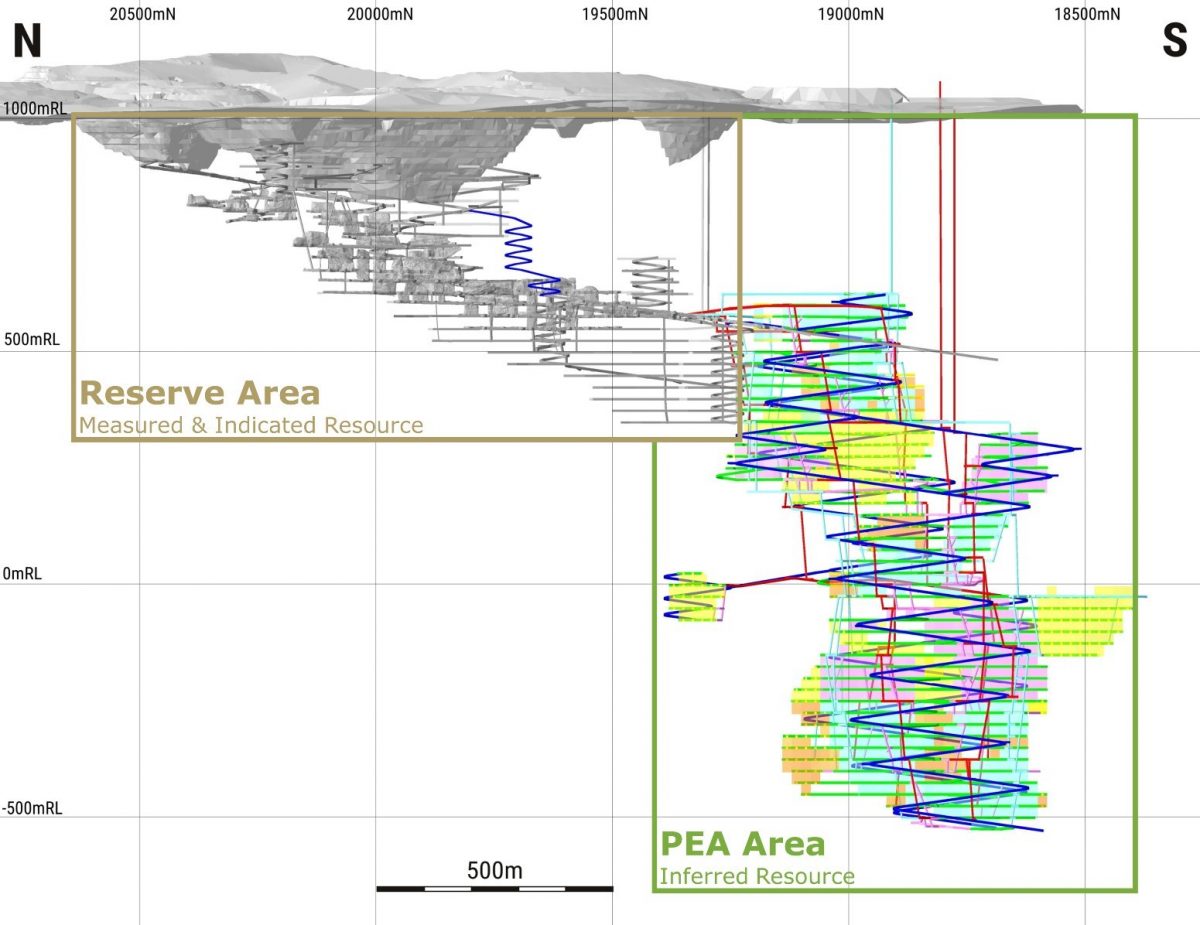
The PEA provides an assessment of the development of the Southern Extension of Wassa and the increase in mining rates to fully utilize the available process plant capacity. The PEA represents a conservative plan which excludes exploration opportunities from the scope and adopts the current mining practices and equipment to deliver a robust economic outcome while minimizing execution risk. Opportunities to improve productivity and reduce the environmental impact of the operation through the application of technology will be evaluated in the next phase of work.

MINERAL RESERVE AND RESOURCE UPDATE HIGHLIGHTS:

  • Achieved 86% increase in measured mineral resource and 98% increase in proven mineral reserve at Wassa Underground demonstrates the improving geological confidence that has been delivered by recent infill drilling programs.
  • Wassa expected to deliver increased value with cut-off grades optimized for the higher mining rates achieved in 2020 and the resulting unit cost reductions. The open pit resource has been remodelled as an underground resource which enables accelerated access, reduced upfront capital demand and removal of low-margin ounces from the plan.
  • Measured and indicated mineral resource at Wassa Underground has increased by 1.0 million ounces («Moz») after the addition of material formerly reported as open pit and the cut-off grade reduction from 1.89 grams per tonne («g/t») to 1.4g/t.
  • Total proven and probable mineral reserve has decreased by 321 thousand ounces («koz») after depletion and the conversion of the previous open pit mineral reserve. The optimized underground mineral reserve has increased by 21% to 1.1 Moz of gold.
  • The mineral reserve plan outlines a six-year mine life with annual production averaging 177 koz of gold at an all-in sustaining cost («AISC») of $881 per ounce («/oz») (excluding corporate costs), for a post-tax net present value («NPV») of approximately $336 million («m»).

PEA HIGHLIGHTS:

  • Life of mine («LOM») of 11-years from the inferred mineral resource in the Southern Extension zone, with total gold production of 3.5Moz. Average annual gold production of 294koz, representing an approximate 75% increase on the current production rate.
  • Average cash operating costs per ounce of $551 over the LOM, average AISC (excluding corporate costs) of $778/oz over the LOM. The cost estimate is based on actual activity costs from 2020 with adjustments as the mining depth increases.
  • The PEA outlines a development pathway to increase the underground mining rate to fully utilize the plant’s processing capacity with low upfront capital demand through access and haulage via twin declines.
  • Robust economics with after-tax NPV5% of approximately $783m and an internal rate of return («IRR») of 53% at consensus gold price per ounce ($1,585/oz long term).
  • The growth project is expected to be funded by its cash flow and available liquidity; the flexibility of the development strategy means that the investment phase can be slowed or accelerated subject to the gold price.
  • Opportunities to add value to the PEA outcomes include: design optimization (level spacing, stope size); haulage systems (infrastructure, electrification); resource extension (from drilling); and emissions reduction (renewables, power and water efficiency).
  • Given the strength of the prevailing gold price, the investment in drilling, development and trade-off studies will be progressed in 2021, as already outlined in the Company’s guidance for the year.

Andrew Wray, Chief Executive Officer of Golden Star, commented:
«In 2020, we focused on improving our geological confidence in the orebody through an extensive infill drilling program which has resulted in a significant increase in our measured resource and proven reserve. Converting the open pit reserve at Wassa to an underground reserve allows us to bring production from those areas forward with a lower upfront capital cost. Development of the Upper Mine will start to deliver production from 2023 and will provide a second decline access to the mine which can be incorporated into the long term mine design.

The PEA demonstrates the significant value and growth potential of Wassa, clearly laying out the path to underground mining rates in excess of 7,000tpd and production of approximately 300koz per annum when in steady state production. Following this study and with a stronger balance sheet, we are in a position to further accelerate the investment in drilling, development and exploration programs to deliver on the growth potential and value of Wassa.

With moderate conversion factors and cost estimates based on actual performance, the PEA demonstrates the potential for an after-tax NPV of $783m at the long-term consensus gold price of $1,585/oz, this being incremental to the reserve mine plan, and represents a meaningful addition to the value of Wassa.

In parallel we will be expanding our exploration efforts to add to the already impressive resource growth at Wassa, with the orebody open in almost every direction, follow up near mine open pit targets and standalone exploration targets along the 90km Wassa trend. Exploration success could further supplement the already exciting growth opportunity.»

Virtual Investor Day

The Company will conduct a conference call and webcast today, Monday, March 1, 2021 at 09.00 am ET to discuss the Technical Report, PEA results, exploration opportunities and growth strategy.

Toll Free (North America): +1 888 390 0546
Toronto Local and International: +1 416 764 8688
Toll Free (UK): 0800 652 2435
Conference ID: 07861267

Webcast: https://produceredition.webcasts.com/starthere.jsp?ei=1433535&tp_key=0dc82839cc

A replay of the webcast will be available on the Company’s website: www.gsr.com following the call.

SUMMARY OF MINERAL RESERVE & PEA MINE PLAN

Table 1 Mineral Reserve Mine Plan Summary

1. See «Non-GAAP Financial Measures»

Unit

Total/Average

Life of mine («LOM»)

Years

6

Total LOM ore mined

kt

10,818

Mining rate (range)

tpd

4,900-5,500

Average Mined Grade

g/t

3.1

Average plant throughput (steady state)

kt/year

1,967

Feed grade (including low grade stockpiles)

g/t

2.9

Recovery (LOM average)

%

94.1%

Average annual production

koz

177

Total LOM production

koz

1,024

Cash operating costs1 (LOM average)

$/oz

682

AISC1 (LOM average) – excludes corporate G&A

$/oz

881

Total Sustaining capital

$m

137

Total Growth capital

$m

48

Closure costs

$m

14

Total Capital Costs

$m

199

NPV5% After tax – 100% basis (Consensus gold price)

$m

336

Annual EBITDA

$m

151

Table 2 PEA Mine Plan Summary (Excludes Reserves)

1. See «Non-GAAP Financial Measures»

Unit

Total/Average

Life of mine («LOM»)

Years

11

Total LOM ore mined

kt

29,632

Mining rate (range)

tpd

6,700-7,400

Average Mined Grade

g/t

3.8

Average plant throughput (steady state)

kt/year

2,700

Feed grade (including low grade stockpiles)

g/t

3.8

Recovery (LOM average)

%

94.8

Average annual production

koz

294

Total LOM production

koz

3,456

Cash operating costs1 (LOM average)

$/oz

551

AISC1 (LOM average) – excludes corporate G&A

$/oz

778

Total Sustaining capital

$m

561

Total Growth capital

$m

229

Closure costs

$m

15

Total Capital Costs

$m

804

NPV5% After tax – 100% basis (Consensus long term gold price)

$m

783

After-tax IRR

$m

53%

Annual EBITDA (steady state)

$m

278

1.

See «Non-GAAP Financial Measures»

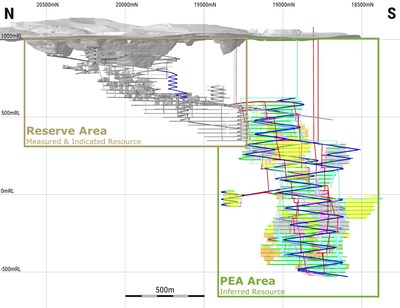
Figure 1: Wassa Mine Longitudinal View showing Mineral Reserve and PEA Area Limits (CNW Group/Golden Star Resources Ltd.)

WASSA GOLD MINE OVERVIEW

Golden Star owns a 90% interest in, and manages, Golden Star (Wassa) Limited, whose primary asset is the Wassa gold mine, with the Government of Ghana owning the remaining 10%.  The Wassa mine is located in the Western Region of Ghana, 150km west of the capital, Accra. Wassa lies within the southern portion of the Ashanti Greenstone Belt. The property covers an area of 5,289Ha with 595Ha of disturbance from Wassa activities. The mine has been operating since 1998 as an open pit operation and Wassa Underground commenced development in 2015 and reached commercial production in January 2017. Since 2017 Wassa Underground has shown consistent improvement in ore tonnage generation capacity.

SCOPE OF THE UPDATED TECHNICAL REPORT

The Technical Report has been prepared in accordance with the requirements of NI 43-101 and Form 43-101F1, and contains:

  • Updated mineral resource and mineral reserve estimates, as at December 31, 2020.
  • Summary of a PEA of the potential expansion of Wassa Underground to extract the inferred mineral resource in the Southern Extension zone.

The PEA has been prepared within the following framework:

  • Underground mining rate increase to fully utilize the installed processing capacity (2.7 million tonnes per annum («Mtpa»)).
  • Production schedules to appropriately consider conversion risk of the inferred mineral resource.
  • Resources and exploration targets outside of the Southern Extension zone are excluded from the scope of the study.
  • Methodologies and design quantities based on proven, currently available technologies.
  • Costs reflect current operational experience.
  • Minimize capital demand needed to establish full production.

This framework is intended to present a deliverable PEA plan which can be executed within the Company’s current operational and financial capacity. Potential enhancements outside of this framework are expected to be evaluated in the next phase of work. The PEA is preliminary in nature, is entirely based on an inferred mineral resource and there is no certainty that further geological drilling will result in the determination of higher mineral resource classification, nor that production and financial outcomes will be realized. Mineral resources that are not mineral reserves do not have demonstrated economic viability.

MINERAL RESOURCES UPDATE – EFFECTIVE DATE DECEMBER 31, 2020

Measured and Indicated Mineral Resources

The measured and indicated mineral resources at Wassa reduced by 4%, or 138koz, in 2020, while the grade increased from 2.34g/t to 3.76g/t, mainly due to:

  • Depletion from mine production.
  • Conversion of the open pit mineral resource for underground extraction, and application of a higher cut-off grade for the change in mining method which removed low-grade, low-margin, ounces from the estimate.
  • Reduced cut-off grade from 1.89g/t to 1.4g/t, based on lower unit costs driven by increased throughput in 2020 (gold price assumption of $1,500/oz for the mineral resource has not changed).
  • The measured mineral resource increased by 86%, demonstrating increased geological confidence as a result of definition drilling conducted in 2020 which was focussed on grade control drilling.

Measured Resource

2020

Measured Resource

2019

Change

Mt

g/t

koz

Mt

g/t

koz

% cont.Au

Wassa Open Pit

Wassa Underground

5.90

4.45

843

2.83

4.99

454

+86%

Father Brown/Adoikrom UG

Regional Open Pit

Total Wassa

5.90

4.45

843

2.83

4.99

454

+86%


Indicated Resource

2020

Indicated Resource

2019

Change

Mt

g/t

koz

Mt

g/t

koz

% cont.Au

Wassa Open Pit

29.18

1.29

1,206

-100%

Wassa Underground

18.96

3.55

2,162

13.37

3.66

1,573

+37%

Father Brown/Adoikrom UG

1.31

7.96

335

0.91

8.67

254

+32%

Regional Open Pit

3.10

1.98

197

2.51

2.32

187

+5%

Total Wassa

23.37

3.59

2,694

45.98

2.18

3,221

-16%


Measured & Indicated
Resource 2020

Measured & Indicated
Resource 2019

Change

Mt

g/t

koz

Mt

g/t

koz

% cont.Au

Wassa Open Pit

29.18

1.29

1,206

-100%

Wassa Underground

24.85

3.76

3,005

16.20

3.89

2,027

+48%

Father Brown/Adoikrom UG

1.31

7.96

335

0.91

8.67

254

+32%

Regional Open Pit

3.10

1.98

197

2.51

2.32

187

+5%

Total Wassa

29.26

3.76

3,537

48.81

2.34

3,675

-4%

Inferred Mineral Resources

The inferred mineral resources at Wassa increased by 9%, or 665koz, in 2020. The change was due to:

  • Treatment of the previous Wassa open pit resource for underground extraction.
  • Reduced cut-off grade from 1.89g/t to 1.4g/t for underground deposits and 0.62-0.89g/t to 0.55g/t for open pit deposits, based on lower unit costs driven by increased throughput in 2020 (gold price assumption for the mineral resource has not changed at $1,500/oz).
  • Re-optimization of economic shells for the open pit deposits.
  • Re-modelling of the Father Brown/Adoikrom underground deposit which separated the HG, HW and FW zones into different estimation domains.

Inferred Resource

2020

Inferred Resource

2019

Change

Mt

g/t

koz

Mt

g/t

koz

% cont.Au

Wassa Open Pit

0.62

1.31

26

-100%

Wassa Underground

70.50

3.39

7,689

58.82

3.75

7,097

+8%

Father Brown/Adoikrom UG

2.66

5.30

453

1.88

6.07

367

+23%

Regional Open Pit

0.87

1.47

41

0.42

2.14

29

+41%

Total Wassa

74.02

3.44

8,183

61.74

3.79

7,518

+9%

Notes to Mineral Resource Estimates

1.

The mineral resource estimate complies with the requirements of NI 43-101 and has been prepared and classified in accordance with the CIM Definition Standards for Mineral Resources and Mineral Reserves, adopted by the CIM Council on May 10, 2014, and the CIM Estimation of Mineral Resources and Mineral Reserves Best Practice Guidelines, adopted by CIM Council on November 29, 2019.

2.

Measured and indicated mineral resources are reported inclusive of mineral reserves.

3.

Underground deposits within the mineral resource are reported at a cut-off grade of 1.4g/t.

4.

Open pit deposits within the mineral resource are reported at a cut-off grade of 0.55g/t, within optimized pit shells calculated at a $1,500/oz gold selling price.

5.

The mineral resource models have been depleted using appropriate topographic surveys

6.

Mineral resources are reported in-situ without modifying factors.

7.

No open pit resource has been reported for the Wassa deposit, as engineering studies have determined Wassa will be mined by underground methods only.

8.

All figures are rounded to reflect the relative accuracy of the estimate.

9.

Mineral resources that are not mineral reserves do not have demonstrated economic viability.

10.

The 2020 mineral resource estimate has been prepared under supervision of S. Mitchel Wasel who is a Qualified Person («QP») as defined by NI 43-101.

MINERAL RESERVES SUMMARY – EFFECTIVE DATE DECEMBER 31, 2020

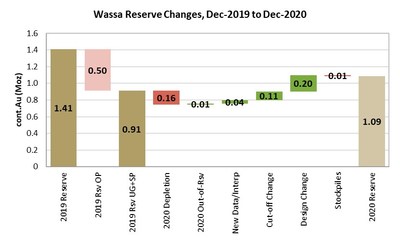
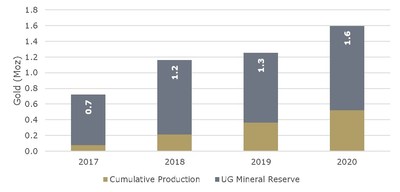
In 2020, the total proven and probable mineral reserves at Wassa decreased by 23%, or 321koz, whereas at Wassa Underground, proven and probable reserves increased by 9%, or 187koz. The change is mainly due to:

  • Depletion by mine production of net 165koz.
  • For the Upper Mine area, replacing the previously planned open pit with underground extraction, reducing the reserve by 305koz at an average implied grade of 1.21g/t.
  • Reduced cut-off grade from 2.4g/t to 1.9g/t, based on lower unit costs driven by increased throughput in 2020 and assumed ore mining rate of 5,000 tonnes per day (gold price assumption for the mineral reserve has not changed at $1,300/oz).

Proven Mineral Reserve

2020

Proven Mineral Reserve

2019

Change

Mt

g/t

koz

Mt

g/t

koz

% cont.Au

Wassa Open Pit

Wassa Underground

4.28

3.28

451

1.72

4.11

228

+98%

Stockpiles

0.69

0.58

13

1.06

0.62

21

-38%

Total Wassa

4.97

2.91

464

2.79

2.78

249

+86%


Probable Mineral Reserve

2020

Probable Mineral Reserve

2019

Change

Mt

g/t

koz

Mt

g/t

koz

% cont.Au

Wassa Open Pit

9.92

1.57

500

-100%

Wassa Underground

6.54

2.97

625

5.70

3.61

661

-5%

Stockpiles

Total Wassa

6.54

2.97

625

15.62

2.31

1,160

-46%


Proven & Probable Mineral Reserve

2020

Proven & Probable Mineral Reserve

2019

Change

Mt

g/t

koz

Mt

g/t

koz

% cont.Au

Wassa Open Pit

9.92

1.57

500

-100%

Wassa Underground

10.82

3.09

1,076

7.42

3.72

889

+9%

Stockpiles

0.69

0.58

13

1.06

0.62

21

-38%

Total Wassa

11.50

2.94

1,089

18.41

2.38

1,410

-23%

Notes to the Mineral Reserve Estimate:

1.

The mineral reserve estimate complies with the requirements of NI 43-101 and has been prepared and classified in accordance with the CIM Definition Standards for Mineral Resources and Mineral Reserves, adopted by the CIM Council on May 10, 2014, and the CIM Estimation of Mineral Resources and Mineral Reserves Best Practice Guidelines, adopted by CIM Council on November 29, 2019.

2.

The mineral reserve is reported at a cut-off grade of 1.9 g/t, calculated at a $1,300 /oz gold selling price.

3.

Modifying factors are applied as 5.0% dilution and 96.1% recovery for stopes.

4.

Material based on measured mineral resources are reported as proven mineral reserves.

5.

Material based on indicated mineral resources are reported as probable mineral reserves.

6.

Material based on inferred mineral resources are excluded from mineral reserves.

7.

Economic analysis of the mineral reserve demonstrates economic viability at $1,300/oz gold price.

8.

All figures are rounded to reflect the relative accuracy of the estimate.

Figure 2: Wassa Mineral Reserve Changes, December 2019 to December 2020 (CNW Group/Golden Star Resources Ltd.)

MINERAL RESERVE MINE PLAN

The mineral reserve mine plan includes mining and processing of ore defined by the mineral reserve only. It outlines a six-year life for Wassa Underground (2021-2026), with average annual production of 177koz at a mine site AISC of $881/oz. The plan is a continuation of the current operating strategy with no material change to the mining methodology, underground infrastructure or processing plant. The recent investment in infrastructure, such as the paste fill plant and electrical upgrades, is expected to support the increased mining rates outlined in the Mineral reserve mine plan.

Table 3 Mineral Reserve Life of Mine Plan – Operations, Cost and Capital Summary

Total/

Average

2021

2022

2023

2024

2025

2026

Mining schedule

Total ore mined

kt

10,818

1,784

1,826

1,804

1,939

2,020

1,445

Mining rate (ore)

tpd

4,937

4,888

5,003

4,943

5,299

5,534

3,958

Mined Grade

g/t

3.09

3.08

3.11

3.29

3.07

2.94

3.10

Contained gold

koz

1,076

177

183

191

191

191

144

Processing schedule

Ore processed

kt

11,504

1,945

2,126

1,804

1,939

2,020

1,670

Feed Grade

g/t

2.94

2.87

2.75

3.29

3.07

2.94

2.76

Contained gold

koz

1,089

180

188

191

191

191

148

Recovery

%

94.1%

94.6%

94.0%

94.7%

94.1%

93.7%

93.1%

Production

koz

1,024

170

177

180

180

179

138

Operating costs

Mining

$m

374.0

70.1

65.5

66.4

70.5

60.8

40.7

Mining

$/t

34.57

39.29

35.89

36.82

36.35

30.09

28.15

Processing

$m

220.4

37.1

39.6

35.2

37.0

38.1

33.4

Processing

$/t

19.16

19.08

18.62

19.50

19.09

18.88

19.97

Site G&A

$m

99.9

16.7

17.1

16.4

16.7

16.9

16.1

Site G&A

$/t

9.09

8.99

8.44

9.54

9.03

8.76

10.00

Cash operating costs (exc. royalties) 1

$/oz

682

733

696

658

694

652

657

AISC (exc. corporate G&A) 1

$/oz

881

947

952

889

951

785

728

Capital expenditure

Sustaining capital

$m

136.5

25.3

33.9

29.9

34.5

12.2

0.8

Growth capital

$m

47.7

14.9

17.4

11.1

4.3

Closure2

$m

14.3

0.3

0.8

0.8

0.5

Total Capex

$m

198.5

40.2

51.3

41.3

39.6

13.0

1.3

1.

See «Non-GAAP Financial Measures»

2.

Closure costs of $14.3m include $11.9m that is expected to be spent beyond 2026 and therefore not shown in the table.

Mining Areas

The mineral reserve mine plan includes mining of:

  • Panels 1 and 2: the current operating areas extracting B-shoot, F-shoot and Hanging-wall zones.
  • Panel 3: Upper Mine B-Shoot and 242 areas, formerly planned for open pit extraction, that will now be mined from underground, which is expected to generate higher returns by removing low-grade low-margin material from the plan and allow for earlier access for production to support increased underground ore mining rates.

Operating Costs

Operating costs estimates are based on actual fixed and variable components of 2020 activity costs, applied against the scheduled design quantities. Average unit costs per ore tonne for the mineral reserve plan are:

  • Mining: $34.6/t
  • Processing: $19.2/t
  • Site G&A: $9.1/t

Capital Expenditure

Capital expenditure is expected to total approximately $184m over the six-year life of the mineral reserve mine plan. Of this total, 26% is growth capital and 74% sustaining capital. The most significant component of the growth capital is the $26.6m (including $4.5m for ventilation shafts) investment in underground development to access the mining areas, $8.6m for definition drilling of the Panel 3 areas in the Upper Mine and $12m for the ventilation upgrade ($7.5m in projects plus the $4.5m in mine development referenced above), which will commence in 2021. In addition to the above capital estimates, closure costs are expected to total $14.3m.

Table 4 Mineral Reserve Mine Plan – Capital Cost Summary

Units

Growth Capital

Sustaining Capital

Activity Total

Mine Development

$m

26.6

51.7

78.3

Mining UG

$m

33.2

33.2

Definition Drilling

$m

8.6

8.6

Processing

$m

5.5

5.5

Site G&A

$m

18.3

18.3

TSF

$m

9.8

9.8

Mobile Fleet

$m

18.2

18.2

Projects – Ventilation

$m

7.5

7.5

Projects – Other

$m

5.0

5.0

Total

$m

47.7

136.5

184.3

Closure costs

$m

14.3

Total (including closure costs)

$m

198.6

Economic Analysis

Table 5 Mineral Reserve Mine Plan – Valuation Analysis

Units

Base case $1,300/oz

Consensus case Ave.$1,751/oz

Pre-Tax Valuation – 100% basis

Project cash flow, pre-tax

$m

255.9

656.4

NPV5%

$m

212.2

560.2

Post-Tax Valuation – 100% basis

Project cash flow, after-tax

$m

147.5

394.2

NPV5%

$m

121.2

335.6

The mineral reserve as at December 31, 2020 has been valued using a discounted cash flow analysis to calculate NPV. The base case applies the mineral reserve gold assumption price of $1,300/oz with a positive cash flow, which supports declaration of a mineral reserve.

In addition, a consensus case has been calculated by applying the average annual gold price forecasts from 27 banks and financial institutions, as at the end of January 2021. This scenario shows the project as economically robust and capable of significant cash generation, with an NPV of approximately $336m. The consensus gold price applied to each year varies as detailed in Table 6.

Table 6 – Mineral Reserve Mine Plan – Gold Price Assumptions

Life of mine average

2021

2022

2023

2024

2025

2026

Base case

1,300

1,300

1,300

1,300

1,300

1,300

1,300

Consensus case

1,751

1,944

1,880

1,773

1,716

1,585

1,585

Sensitivity Analysis

Sensitivity analyses were performed for variations in gold price, gold grade, gold recovery, operating costs, capital costs and to determine their relative importance as value drivers. Full details of the sensitivity analysis are available in the Technical Report. Included in Table 7 and 8 is a summary of the mineral reserve mine plan’s NPV sensitivity to gold price, discount rate, operating cost and capital cost assumptions.

Table 7 Mineral Reserve Mine Plan – NPV and IRR Sensitivity Analysis

Gold Price

($m)

$1,200

Base case

$1,300

$1,400

$1,500

$1,600

$1,700

Consensus

$1,751 (average)

$1,800

$1,900

Discount Rate

0%

93

147

202

257

311

360

394

421

475

5%

75

121

168

214

260

302

336

353

400

7.5%

67

110

153

196

239

278

311

325

368

10%

61

101

141

181

221

256

289

300

340

Table 8 Mineral Reserve Mine Plan – Operating And Capital Cost Sensitivity

Operating cost sensitivity

($m)

-30%

-20%

-10%

0%

10%

20%

30%

Capital cost sensitivity

-30%

+226

+167

+108

+49

-6

-65

-124

-20%

+210

+151

+92

+32

-22

-82

-141

-10%

+194

+134

+75

+16

-39

-98

-157

0%

+177

+118

+59

-55

-114

-173

10%

+161

+102

+43

-16

-71

-130

-189

20%

+145

+86

+27

-32

-87

-146

-206

30%

+129

+70

+10

-49

-104

-163

-222

Opportunities

Several opportunities have been identified with potential to add value to the mineral reserve mine plan:

  • Mineral Resource. Upside potential exists to upgrade the large inferred mineral resource and to grow the defined mineralization on targets, which are not yet tested. The Company has a track record of increasing the underground mineral reserve (net of depletion) through resource-reserve conversion, as demonstrated in figure 3.

Figure 3 – Mineral Reserve – Historical Record of Growing Underground Endowment (CNW Group/Golden Star Resources Ltd.)

  • Productivity and Mine Design. Improved mining practices through application of technology, geotechnical design optimization and improvements to the paste backfill system once it is established.
  • Sustainability. Emissions reduction through electrification of diesel equipment and future use of renewable generation; improved water quality and efficiency; and comminution optimization to improve energy efficiency.

PRELIMINARY ECONOMIC ASSESMENT OF the southern extension zone

The PEA mine plan includes mining and processing of the inferred mineral resource. The PEA is preliminary in nature and there is no certainty that further geological drilling will result in the determination of higher mineral resource classification, nor that the production and financial outcomes outlined in the PEA mine plan will be realized. Mineral resources that are not mineral reserves do not have demonstrated economic viability. The PEA mine plan outlines an 11-year life, with average annual production of 294koz at an AISC of $780/oz.

The PEA represents a scoping level study within the following work streams:

  • Mining method selection
  • Stope optimization
  • Mine design to determine development quantities which inform the cost estimate
  • Ventilation design and modelling
  • Simulation of truck haulage to validate production rate forecasts
  • Definition drilling strategy
  • Preliminary scheduling
  • Review of metallurgical test work and processing capacity
  • Review of permitting requirements
  • Estimation of capital and operating costs
  • Economic analysis

The scope of the PEA is to outline an underground mining method, together with supporting infrastructure and sustainability plans, to extract the potentially economic portion of the Wassa Gold Mine inferred mineral resource. The mine plan considers a production rate which targets the processing capacity, at or close to 2.7Mtpa run-of-mine material, after a five year ramp up period. The mining plan applies proven methods and available technology to create a PEA which is considered deliverable and representative of future costs.

The Wassa Mine Southern Extension project is a brownfield growth project that can be brought into production within permitting of the existing operation and through utilizing existing infrastructure (surface and underground access, processing, utilities and mine services):

  • Access via sealed public road to within 15 km from site.
  • Electrical infrastructure with access to power through the grid and captive on-site generation.
  • Existing processing plant with permitted capacity up to 2.7 Mtpa, currently under-utilized.
  • Paste Plant infrastructure.
  • On-site tailings storage facilities with sufficient permitted capacity.
  • Waste rock storage facilities with sufficient permitted capacity.
  • Access to skilled labour given the history and scale of the gold mining industry in Ghana.
  • Use mining infrastructure which exists or will be in place at completion of extracting the mineral reserve including ventilation airways and equipment, access ramps, dewatering systems and services (power, air and water).

Conversion of Mineral Resource to PEA Mining Inventory

The PEA mine plan considers only the inferred mineral resource south of 19,240mN. Conversion risk of the inferred mineral resource has been addressed through the application of cut-off grades and modifying factors in mining Panels 4-8, which form the basis of the PEA mine plan. In Panels 4 and 5 where there is more definition drilling, 54% of the metal is included in the PEA inventory. This conversion factor decreases to a more conservative 48% for the deeper panels (Panels 7 and 8) where drilling is more widely spaced.

Table 9 Conversion of Mineral Resource to PEA Mining Inventory for Mining Panels 4-8

Unit

Panel 4

Panel 5

Panel 6

Panel 7

Panel 8

Total

Inferred Mineral Resource (in-situ)

Mt

7.8

11.5

8.6

19.6

18.6

66

Au g/t

3.0

3.1

2.7

4.0

3.6

3.4

Moz

0.76

1.14

0.74

2.52

2.14

7.3

PEA Mining Inventory

Mt

4.1

5.5

3.1

9.4

7.8

30

Au g/t

3.3

3.5

3.7

4.3

3.8

3.8

Moz

0.42

0.61

0.37

1.31

0.94

3.6

Conversion to PEA Inventory

%Moz

54%

49%

48%

50%

Cut-off Grade

g/t

2.3g/t

2.9g/t

Modifying factors

7.5% Dilution

13% Dilution

95% Ore Recovery

75% Recovery

Table 10 PEA Life of Mine Plan – Operating Summary

1. See «Non-GAAP
Financial Measures»

Total/

Average

Year

1

Year

2

Year

3

Year

4

Year

5

Year

6

Year

7

Year

8

Year

9

Year 10

Year 11

Year 12

Year 13

Year 14

Year 15

Year 16

Year 17

Mining schedule

Total ore mined

kt

29,632

14

53

108

748

1,282

2,700

2,700

2,700

2,700

2,675

2,634

2,644

2,507

2,445

2,518

1,203

Mining rate (ore)

tpd

6,826

39

145

296

2,049

3,512

7,397

7,377

7,397

7,397

7,330

7,195

7,245

6,868

6,699

6,880

3,295

Mined Grade

g/t

3.83

3.30

3.30

3.13

3.23

3.48

3.49

3.59

3.51

3.50

4.46

4.22

3.83

3.84

4.36

3.86

3.88

Contained gold

koz

3,644

2

6

11

78

143

303

311

305

304

383

357

326

310

343

313

150

Processing schedule

Ore processed

kt

29,632

14

53

108

748

1,282

2,700

2,700

2,700

2,700

2,675

2,634

2,644

2,507

2,445

2,518

1,203

Feed Grade

g/t

3.83

3.30

3.30

3.13

3.23

3.48

3.49

3.59

3.51

3.50

4.46

4.22

3.83

3.84

4.36

3.86

3.88

Contained gold

koz

3,644

2

6

11

78

143

303

311

305

304

383

357

326

310

343

313

150

Recovery

%

94.8%

95.0%

94.7%

94.2%

94.3%

95.4%

94.6%

94.7%

94.6%

94.6%

95.0%

95.0%

95.0%

95.0%

95.0%

95.0%

94.3%

Production

koz

3,456

1

5

10

73

137

287

295

289

287

364

340

309

294

326

297

142

Operating costs

Mining

$m

1,165.6

0.3

1.9

5.9

24.6

48.4

95.8

99.2

102.4

101.5

107.1

110.1

109.3

100.6

98.2

98.2

62.2

Mining

$/t

39.34

20.57

35.96

54.38

32.91

37.76

35.49

36.73

37.92

37.57

40.03

41.82

41.33

40.12

40.15

39.00

51.70

Processing

$m

520.8

0.2

0.7

1.5

10.2

14.4

47.4

47.4

47.4

47.4

47.1

46.5

46.7

44.8

44.0

44.9

30.0

Processing

$/t

17.58

13.67

13.67

13.67

13.67

11.27

17.57

17.57

17.57

17.57

17.60

17.66

17.65

17.87

17.97

17.85

24.98

Site G&A

$m

203.1

0.0

0.1

0.3

1.7

2.5

18.5

18.5

18.5

18.5

18.4

18.3

18.4

18.0

17.9

18.1

15.5

Site G&A

$/t

7.38

2.78

2.78

2.76

2.77

2.38

7.32

7.34

7.33

7.32

7.50

7.54

7.47

7.72

7.91

7.70

13.45

Cash operating costs1

$/oz

551

367

520

746

504

482

568

564

588

588

479

520

568

560

496

547

765

AISC (excluding Corporate
G&A)1

$/oz

778

432

585

811

569

655

860

849

882

882

715

765

810

733

655

718

909

Capital expenditure

Sustaining capital

$m

560.7

15.1

65.1

64.9

66.2

65.8

62.5

61.2

54.9

31.7

30.9

31.6

11.0

Growth capital

$m

228.8

4.9

12.9

25.2

37.1

73.5

64.4

10.0

0.8

Closure costs

$m

14.6

2.2

Total Capex

$m

804.1

4.9

12.9

25.2

37.1

73.5

79.5

65.1

74.9

66.2

66.6

62.5

61.2

54.9

31.7

30.9

31.6

13.2

1.

See «Non-GAAP Financial Measures»

Mining

Mining is by underground trackless decline access (1:7 gradient). Access will be from duplicate access ramps and independent ventilation infrastructure on each side of the deposit which will support the increased mining rate and provide efficient access across the large mineralized footprint (c.850 m along c.300 m across strike). Truck haulage will utilize the dual access ramps.

The mining method proposed is bottom-up long hole open stoping (LHOS) with 25 level spacing and nominal stope sizes of 25mL x 30mW x 25-100mH with cemented paste backfill. Stopes will be mined in a primary-secondary sequence down to c.1,000m depth, transitioning to pillarless retreat below that point to account for increasing in-situ stress which will need to be further investigated in future work.

Processing

The PEA plan proposes to utilize the full capacity of the existing processing plant, with underground mine production increasing to 2.7Mtpa/7,400tpd.  The plant has previously operated at these rates.

The PEA assumes average recovery of 94.8%, which is supported by current plant performance and metallurgical test work on a small number of samples that suggests processing performance for the Southern Extension feed will be similar to material currently treated. This will be evaluated in the next phase of work.

PERMITTING, ENVIRONMENTAL, AND SOCIAL AND COMMUNITY IMPACT

All required environmental and social regulatory requirements to support the PEA mine plan are in place and maintained in good standing. The Company complies with international requirements on environmental and conservation, human rights, and anti-corruption. It has adopted voluntary international codes on corporate responsibility in the areas of cyanide management, TSF design, responsible gold mining and resettlement. The Wassa Mine has posted and periodically updates its reclamation bond ($13.7m at end of 2020) as part of its licence obligations. For environmental impacts, appropriate studies and surveys have been completed, design features and management practices are established and monitoring programmes are in place for:

  • Water quality
  • Air quality
  • Noise and vibration
  • Biodiversity

Golden Star also supports several community and social initiatives via:

  • The Golden Star Development Foundation (community and social development projects).
  • The Golden Star Oil Palm Plantations (agribusiness sponsored by Golden Star which aims to become self- supporting).
  • Capacity building and livelihood enhancement (skills training, local procurement).

These initiatives proactively aim to build capacity and diversify the economy of local communities as well as reduce uptake of small-scale illegal mining.

Operating Costs

The operating cost estimation methodology is consistent with the approach taken for the mineral reserve mine plan. Lower unit costs are expected to result from the fixed and variable costs being applied over increased annual production in the PEA mine plan. Haulage cost increases in the development and operating costs have been factored into the estimates, given the significant increase in haulage distances as mining depth increases. Average unit costs per ore tonne for the mineral reserve plan are:

  • Mining: $39.33/t
  • Processing: $17.58/
  • Site G&A: $7.38/t

Capital Expenditure

Capital expenditure is expected to total approximately $790m over the life of the PEA mine plan. Of this total, 29% is growth capital and 71% is sustaining capital. The most significant component of the growth capital is the $98.3m investment in underground development to access the mining areas, approximately $46m for definition drilling of Panels 4-8 of the mine and $35m for the ventilation upgrades. In addition to the above capital estimates, closure costs are expected to total $14.6m.

There are no significant investments required in the process plant infrastructure as the mill and associated infrastructure have already been established with adequate capacity. The majority of the proposed capital expenditure is contained in underground lateral and vertical development mining. The PEA mining method relies on paste fill; the paste fill plant was constructed in 2020 and commissioning is expected to be finalized in Q1 2021. Capital has been allowed for an expansion of the paste fill system in the PEA mine plan.

Table 11 PEA Mine Plan – Capital Cost Summary

Units

Growth Capital

Sustaining Capital

Activity Total

Mine Development

$m

98.3

261.8

360.1

Mining UG

$m

11.2

84.9

96.2

Definition Drilling

$m

45.7

60.4

106.0

Processing

$m

1.2

12.7

13.8

Site G&A

$m

3.2

39.3

42.5

TSF

$m

6.8

23.0

29.8

Mobile Fleet

$m

17.6

78.7

40.6

Projects – Ventilation

$m

35.0

35.0

Projects – Other

$m

9.9

9.9

Total

$m

228.8

560.7

789.5

Closure costs

$m

14.6

Total (including closure costs)

$m

804.1

Economic Analysis

Table 12 PEA Mine Plan – Valuation Analysis

Units

Base case $1,300/oz

Consensus case Ave.$1,751/oz

Pre-Tax Valuation – 100% basis

Project cash flow, pre-tax

$m

1,379.4

2,274.7

NPV5%

$m

748.1

1,268.8

IRR

%

47%

66%

Payback period

Years

Post-Tax Valuation – 100% basis

Project cash flow, after-tax

$m

852.1

1,421.0

NPV5%

$m

452.2

783.5

IRR

%

37%

53%

Payback period

Years

The PEA mine plan has been valued using a discounted cash flow analysis to determine an NPV. The base case gold price scenario of $1,300/oz shows positive cash flow and indicates potential for the Southern Extension project of being economically viable and worthy of follow-up work.

The consensus case differs from the assumptions made for the mineral reserve mine plan, in that the short-term forecasts are not applied, and the scenario applies a flat $1,585/oz gold price assumption based on the average long term gold price forecasts from 27 banks and financial institutions, as at the end of January 2021. This scenario identifies an approximate $783m NPV for the project and a 53% post-tax IRR.

Table 13 Gold Price Assumptions

Flat Long Term Gold Price Assumption $

Base case

1,300

Consensus case

1,585

Sensitivity Analysis

Sensitivity analyses were performed for variations in gold price, gold grade, gold recovery, operating costs, capital costs and to determine their relative importance as value drivers. Full detail of the sensitivity analysis is available in the Technical Report. Set out in Table 14 is a summary of the PEA mine plan’s NPV sensitivity to gold price, discount rate, operating cost and capital cost assumptions.

Table 14 PEA Mine Plan – NPV and IRR Sensitivity Analysis

Gold Price

($m)

$1,200

Base case

$1,300

$1,400

$1,500

Consensus

$1,585

$1,600

$1,700

$1,800

$1,900

Discount Rate

0%

653

852

1,052

1,252

1,421

1,452

1,629

1,807

1,985

5%

336

452

568

685

783

801

905

1,008

1,111

7.5%

242

332

423

513

590

604

684

764

845

10%

174

245

316

388

448

459

522

585

648

IRR (%)

31.1

36.8

41.6

45.6

48.7

49.2

49.2

54.7

56.9

Table 15 PEA Mine Plan – Operating and Capital Cost Sensitivity

Operating cost sensitivity

($m)

-30%

-20%

-10%

0%

10%

20%

30%

Capital cost sensitivity

-30%

+483

+374

+264

+155

+45

-64

-174

-20%

+432

+322

+213

+103

-6

-116

-225

-10%

+380

+271

+161

+52

-58

-168

-277

0%

+329

+219

+110

-110

-219

-329

10%

+277

+168

+58

-52

-161

-271

-380

20%

+225

+116

+6

-103

-213

-322

-432

30%

+174

+64

-45

-155

-264

-374

-483

Opportunities

Several opportunities have been identified with potential to add value to the PEA mine plan and the Southern Extension zone:

  • Mineral Resource. Definition drilling to upgrade the large inferred mineral resource will allow application of lower/more conservative modifying factors, plus potentially extend the Wassa Underground mineral resource, which is open in multiple directions. In addition, there is the opportunity for exploration of identified near-mine targets.
  • Productivity and Mine Design. Stope size and level intervals are consistent with current operations and may be increased as studies progress, which would reduce development quantities and cost. Haulage optimization studies and emerging electrification technology may confirm an alternative to the planned diesel truck system, which would result in reduced costs (mostly ventilation) and emissions.
  • Sustainability. The same sustainability opportunities for the mineral reserve exist for the PEA but on a larger scale, with the longer mine life potential to support investment in electrification, infrastructure, efficiency projects and potential application of renewable energy sources.

Future Work Plan

The PEA proposes a progressive development plan for the Southern Extension zone, with three major phases of definition drilling and capital investment:

  • Panels 4 and 5: resource development drilling and studies in Years («Y») 1-2, to inform an investment decision at the end of Y2 and full stope production in Y6.
  • Panels 6 and 7: resource development drilling in Y6-7, development starting Y6 and stoping in Y8.
  • Panel 8: resource development drilling in Y10, development starting Y10 and stoping in Y12.

The PEA project execution plan proposes that the definition drilling of Panels 4 and 5, technical and trade-off studies required will be completed to inform a feasibility study by the end of Y2.

Golden Star is targeting early 2023 for the completion of a feasibility study to support a new technical report as part of the annual resource and reserve update at that time. To meet this target, Golden Star has included the definition drilling and studies proposed for Y1 in the 2021 budget and definition drilling has commenced in Q1 2021 from the 570-DDD.

Technical studies are planned to investigate the value adding opportunities identified in the PEA, which will potentially enhance the project outcomes when the feasibility study is completed.

In addition, exploration drilling programs are underway to test the in-mine extensions and near-mine targets with the aim of increasing the defined resource.


Figure 4 – Forward Work Plan (CNW Group/Golden Star Resources Ltd.)

Company Profile:

Golden Star Resources Ltd. («Golden Star») is an established gold mining company that owns and operates the Wassa underground mine in Ghana, West Africa.  Listed on the NYSE American, the Toronto Stock Exchange and the Ghanaian Stock Exchange, Golden Star is focused on delivering strong margins and free cash flow from the Wassa mine.  As the winner of the Prospectors & Developers Association of Canada 2018 Environmental and Social Responsibility Award, Golden Star remains committed to leaving a positive and sustainable legacy in its areas of operation.

Statements Regarding Forward-Looking Information

Some statements contained in this news release are «forward-looking statements» within the meaning of the Private Securities Litigation Reform Act of 1995 and «forward looking information» within the meaning of Canadian securities laws. Forward looking statements and information include but are not limited to, statements and information regarding: estimated post-tax internal rate of return and net present value of the Mineral Reserve mine plan  and with respect to the PEA mine plan; the timing for production from Wassa mineral reserve mine plan and from the PEA mine plan; the life of mine for Wassa based on the mineral reserve mine plan; the life of mine based on the PEA mine plan; estimates of capital costs, and the allocation among growth capital and sustaining capital, for the Wassa mineral reserve mine plan and the PEA mine plan; estimates of remediation costs; Wassa’s ability to deliver increased value with cut-off grades optimized for the higher mining rates achieved in 2020 and the resulting unit cost reductions; the PEA’s development pathway to increase the underground mining rate to fully utilize the plant’s processing capacity; estimates of production, AISC and cash operating costs; estimates of consensus gold price; the Company’s ability to add value to the mineral reserve mine plan; the Company’s ability to realize on opportunities to add value to the PEA mine plan; and the future work plan with respect to the PEA. Generally, forward-looking information and statements can be identified by the use of forward-looking terminology such as «plans», «expects», «is expected», «budget», «scheduled», «estimates», «forecasts», «intends», «anticipates», «believes» or variations of such words and phrases (including negative or grammatical variations) or statements that certain actions, events or results «may», «could», «would», «might» or «will be taken», «occur» or «be achieved» or the negative connotation thereof. Investors are cautioned that forward-looking statements and information are inherently uncertain and involve risks, assumptions and uncertainties that could cause actual facts to differ materially. Such statements and information are based on numerous assumptions regarding present and future business strategies and the environment in which Golden Star will operate in the future. Forward-looking information and statements are subject to known and unknown risks, uncertainties and other important factors that may cause the actual results, performance or achievements of Golden Star to be materially different from those expressed or implied by such forward-looking information and statements, including but not limited to: gold price volatility; discrepancies between actual and estimated production; mineral reserves and resources and metallurgical recoveries; mining operational and development risks; liquidity risks; suppliers suspending or denying delivery of products or services; regulatory restrictions (including environmental regulatory restrictions and liability); actions by governmental authorities; the speculative nature of gold exploration; ore type; the global economic climate; share price volatility; the availability of capital on reasonable terms or at all; risks related to international operations, including economic and political instability in foreign jurisdictions in which Golden Star operates; risks related to current global financial conditions; actual results of current exploration activities; environmental risks; future prices of gold; possible variations in mineral reserves and mineral resources, grade or recovery rates; mine development and operating risks; an inability to obtain power for operations on favourable terms or at all; mining plant or equipment breakdowns or failures; an inability to obtain products or services for operations or mine development from vendors and suppliers on reasonable terms, including pricing, or at all; public health pandemics such as COVID-19, including risks associated with reliance on suppliers, the cost, scheduling and timing of gold shipments, uncertainties relating to its ultimate spread, severity and duration, and related adverse effects on the global economy and financial markets; accidents, labor disputes and other risks of the mining industry; delays in obtaining governmental approvals or financing or in the completion of development or construction activities; litigation risks; and risks related to indebtedness and the service of such indebtedness. Although Golden Star has attempted to identify important factors that could cause actual results to differ materially from those contained in forward-looking information and statements, there may be other factors that cause results not to be as anticipated, estimated or intended. There can be no assurance that future developments affecting the Company will be those anticipated by management. Please refer to the discussion of these and other factors in management’s discussion and analysis of financial conditions and results of operations for the year ended December 31, 2020, and in our annual information form for the year ended December 31, 2019 as filed on SEDAR at www.sedar.com. The forecasts contained in this press release constitute management’s current estimates, as of the date of this press release, with respect to the matters covered thereby. We expect that these estimates will change as new information is received. While we may elect to update these estimates at any time, we do not undertake any estimate at any particular time or in response to any particular event.

Non-GAAP Financial Measures

In this press release, we use the terms «cash operating cost», «cash operating cost per ounce», «all-in sustaining costs», and «all-in sustaining costs per ounce».

«Cost of sales excluding depreciation and amortization» as found in the statements of operations includes all mine-site operating costs, including the costs of mining, ore processing, maintenance, work-in-process inventory changes, mine-site overhead as well as production taxes, royalties, severance charges and by-product credits, but excludes exploration costs, property holding costs, corporate office general and administrative expenses, foreign currency gains and losses, gains and losses on asset sales, interest expense, gains and losses on derivatives, gains and losses on investments and income tax expense/benefit.

«Cost of sales per ounce» is equal to cost of sales excluding depreciation and amortization for the period plus depreciation and amortization for the period divided by the number of ounces of gold sold (excluding pre-commercial production ounces sold) during the period.

«Cash operating cost» for a period is equal to «cost of sales excluding depreciation and amortization» for the period less royalties, the cash component of metals inventory net realizable value adjustments, materials and supplies write-off and severance charges, and «cash operating cost per ounce» is that amount divided by the number of ounces of gold sold (excluding pre-commercial production ounces sold) during the period. We use cash operating cost per ounce as a key operating metric. We monitor this measure monthly, comparing each month’s values to prior periods’ values to detect trends that may indicate increases or decreases in operating efficiencies. We provide this measure to investors to allow them to also monitor operational efficiencies of the Company’s mines. We calculate this measure for both individual operating units and on a consolidated basis. Since cash operating costs do not incorporate revenues, changes in working capital or non-operating cash costs, they are not necessarily indicative of operating profit or cash flow from operations as determined under IFRS. Changes in numerous factors including, but not limited to, mining rates, milling rates, ore grade, gold recovery, costs of labor, consumables and mine site general and administrative activities can cause these measures to increase or decrease. We believe that these measures are similar to the measures of other gold mining companies, but may not be comparable to similarly titled measures in every instance.

«All-in sustaining costs» commences with cash operating costs and then adds the cash component of metals inventory net realizable value adjustments, royalties, sustaining capital expenditures, corporate general and administrative costs (excluding share-based compensation expenses and severance charges), and accretion of rehabilitation provision. For mine site all-in sustaining costs, corporate general and administrative costs (excluding share-based compensation expenses and severance charges) are allocated based on gold sold by each operation. «All-in sustaining costs per ounce» is that amount divided by the number of ounces of gold sold (excluding pre-commercial production ounces sold) during the period. This measure seeks to represent the total costs of producing gold from current operations, and therefore it does not include capital expenditures attributable to projects or mine expansions, exploration and evaluation costs attributable to growth projects, income tax payments, interest costs or dividend payments. Consequently, this measure is not representative of all of the Company’s cash expenditures. In addition, the calculation of all-in sustaining costs does not include depreciation expense as it does not reflect the impact of expenditures incurred in prior periods. Therefore, it is not indicative of the Company’s overall profitability. Share-based compensation expenses are also excluded from the calculation of all-in sustaining costs as the Company believes that such expenses may not be representative of the actual payout on equity and liability based awards.

The Company believes that «all-in sustaining costs» will better meet the needs of analysts, investors and other stakeholders of the Company in understanding the costs associated with producing gold, understanding the economics of gold mining, assessing the operating performance and the Company’s ability to generate free cash flow from current operations and to generate free cash flow on an overall Company basis. Due to the capital intensive nature of the industry and the long useful lives over which these items are depreciated, there can be a disconnect between net earnings calculated in accordance with IFRS and the amount of free cash flow that is being generated by a mine. In the current market environment for gold mining equities, many investors and analysts are more focused on the ability of gold mining companies to generate free cash flow from current operations, and consequently the Company believes these measures are useful non-IFRS operating metrics («non-GAAP measures») and supplement the IFRS disclosures made by the Company. These measures are not representative of all of Golden Star’s cash expenditures as they do not include income tax payments or interest costs. Non-GAAP measures are intended to provide additional information only and do not have standardized definitions under IFRS and should not be considered in isolation or as a substitute for measures of performance prepared in accordance with IFRS. These measures are not necessarily indicative of operating profit or cash flow from operations as determined under IFRS.

For additional information regarding the Non-GAAP financial measures used by the Company, please refer to the heading «Non-GAAP Financial Measures» in the Company’s Management Discussion and Analysis of Financial Condition and Results of Operations for the year ended December 31, 2020, which is available at www.sedar.com.

Technical Information

The mineral reserve and mineral resource estimates have been compiled by the Company’s technical personnel in accordance with definitions and guidelines set out in the Definition Standards for Mineral Resources and Mineral Reserves adopted by the Canadian Institute of Mining, Metallurgy, and Petroleum and as required by Canada’s NI 43-101. All mineral resources are reported inclusive of mineral reserves. Mineral resources which are not mineral reserves do not have demonstrated economic viability. Mineral reserve estimates reflect the Company’s reasonable expectation that all necessary permits and approvals will be obtained and maintained. Mining dilution and mining recovery vary by deposit and have been applied in estimating the mineral reserves.

The mineral resource technical contents of this press release have been reviewed and approved by S. Mitchel Wasel, BSc Geology, a «Qualified Person» pursuant to NI 43-101. Mr. Wasel is Vice President Exploration for Golden Star and an active member of the Australasian Institute of Mining and Metallurgy. The 2020 and 2019 estimates of mineral resources were prepared under the supervision of Mr. Wasel. The mineral reserve technical contents of this press release, have been reviewed and approved by and were prepared under the supervision of Matt Varvari, Vice President, Technical Services for the Company. Mr. Varvari is a «Qualified Person» as defined by NI 43-101.

Additional scientific and technical information relating to the mineral property referenced in this news release are contained in the following current technical report for the property available at www.sedar.com: «NI 43-101 Technical Report on the Wassa Gold Mine, Mineral Resource & Mineral Reserve Update and Preliminary Economic Assessment of the Southern Extension Zone, Western Region, Ghana» effective December 31, 2020.

Cautionary Note to US Investors Concerning Estimates of Measured and Indicated Mineral Resources

This press release uses the terms «measured mineral resources» and «indicated mineral resources». The Company advises US investors that while these terms are recognized and required by NI 43-101, the US Securities and Exchange Commission («SEC») does not recognize them. Also, disclosure of contained ounces is permitted under Canadian regulations; however the SEC generally requires mineral resource information to be reported as in-place tonnage and grade. US Investors are cautioned not to assume that any part or all of the mineral deposits in these categories will ever be converted into mineral reserves.

Cautionary Note to US Investors Concerning Estimates of Inferred Mineral Resources

This press release uses the term «inferred mineral resources». The Company advises US investors that while this term is recognized and required by NI 43-101, the SEC does not recognize it. «Inferred mineral resources» have a great amount of uncertainty as to their existence, and great uncertainty as to their economic and legal feasibility. It cannot be assumed that all or any part of Inferred Mineral Resources will ever be upgraded to a higher category. In accordance with Canadian rules, estimates of inferred mineral resources cannot form the basis of feasibility or other economic studies. US investors are cautioned not to assume that any part or all of the inferred mineral resource exists, or is economically or legally mineable.

Cision View original content to download multimedia:http://www.prnewswire.com/news-releases/golden-star-resources-files-wassa-gold-mine-ni-43-101-technical-report-301237202.html

SOURCE Golden Star Resources Ltd.

Hyzon Motors to Build United States’ Largest Fuel Cell Material Production Facility

ROCHESTER, N.Y., March 1, 2021 /PRNewswire/ — Hyzon Motors Inc. («Hyzon» or the «Company»), a leading supplier of zero-emission hydrogen fuel cell powered heavy vehicles, today announced plans to build the largest fuel cell membrane electrode assembly (MEA) production line for commercial vehicles in the United States at its new Hyzon Innovation Center located in Bolingbrook, Illinois, just outside of <span…

ROCHESTER, N.Y., March 1, 2021 /PRNewswire/ — Hyzon Motors Inc. («Hyzon» or the «Company»), a leading supplier of zero-emission hydrogen fuel cell powered heavy vehicles, today announced plans to build the largest fuel cell membrane electrode assembly (MEA) production line for commercial vehicles in the United States at its new Hyzon Innovation Center located in Bolingbrook, Illinois, just outside of Chicago.

As announced previously, Hyzon plans to go public through a merger with Decarbonization Plus Acquisition Corporation (NASDAQ: DCRB, DCRBW, DCRBU), a publicly-traded special purpose acquisition company (SPAC). The combination is expected to close in the second quarter of 2021.

The MEA is the critical component of a fuel cell and accounts for about 70% of the cost of a fuel cell stack. MEAs are currently produced in Canada, Europe, Japan, Korea and China at commercial scale. Smaller scale MEA production in the United States has so far been a supply and cost bottleneck for US fuel cell vehicle production.

At full capacity, the Hyzon Innovation Center is expected to produce enough MEAs to cover the production needs for up to 12,000 hydrogen fuel cell powered trucks every year. The facility is expected to commence production of MEAs in the fourth quarter of 2021, and is planned to open with 28,000 square feet of manufacturing space, before expanding in a second phase to 80,000 square feet. Hyzon expects to eventually fill up to 50 full-time positions at this production facility.

George Gu, Chairman and Co-Founder of Hyzon, said, «The new Hyzon Innovation Center is essential to our strategy to expand the US hydrogen supply chain, reduce fuel cell costs for commercialization, and create local jobs. We chose the greater Chicago area due to its top-tier universities, national labs, equipment companies and manufacturers, and a large pool of talent for recruiting a highly-skilled workforce. We are looking forward to empowering this unique ecosystem so that we can further accelerate the energy transition and decarbonize heavy road transport.»

Craig Knight, Chief Executive Officer and Co-Founder of Hyzon, said, «We are excited about our plans to open the first high-volume MEA production line for hydrogen fuel cells in the US, which we anticipate will enable us to rapidly scale up the production of our fuel cells and deliver up to 12,000 Hyzon zero-emission heavy vehicles each year. We see a substantial uptake in Europe already, and anticipate North America will soon follow suit on this decarbonization journey for heavy transport.»

The Hyzon Innovation Center will also conduct research and development on materials for fuel cells, electrolyzers, solid-state batteries, advanced e-drive systems, autonomous driving technologies and green hydrogen production technologies.

In addition to the Hyzon Innovation Center outside Chicago, Hyzon has two facilities in Rochester, New York – one serving as a fuel cell testing facility and the other as its US headquarters, fuel cell engine production facility, and vehicle integration center. The Company currently produces commercial vehicles at its facility in Groningen, The Netherlands, through a joint venture with Holthausen Clean Technology B.V.

About Hyzon Motors Inc.
Headquartered in Rochester, NY and with operations in Europe, Singapore, Australia and China, Hyzon is a leader in hydrogen mobility. Hyzon is led by co-founders George Gu, Craig Knight and Gary Robb and is a pure-play hydrogen mobility company with an exclusive focus on hydrogen in the commercial vehicle market.  Utilizing its proven and proprietary hydrogen fuel cell technology, Hyzon aims to produce zero emission heavy duty trucks and buses for customers across in North America, Europe, and across the world. The company is contributing to the escalating adoption of hydrogen vehicles through its demonstrated technology advantage, leading fuel cell performance and history of rapid innovation. Visit www.hyzonmotors.com

Hyzon Motors Contacts

For US, Europe and Asia Media:
Brian Brooks
H+K Strategies
713.858.8842
brian.brooks@hkstrategies.com

For Australian Media:
Fraser Beattie
Cannings Purple
fbeattie@canningspurple.com.au

For Investors:
Caldwell Bailey
ICR, Inc.
HyzonMotorsIR@icrinc.com

Cision View original content:http://www.prnewswire.com/news-releases/hyzon-motors-to-build-united-states-largest-fuel-cell-material-production-facility-301237000.html

SOURCE HYZON Motors

International companies wanted: Bosch Innovation Consulting and Stryber launch the Venture Beyond innovation program

MUNICH, STUTTGART, Germany and SINGAPORE, March 1, 2021 /PRNewswire/ — Bosch Innovation Consulting, part of the Bosch Group, and Stryber AG, the largest independent corporate venture builder in DACH, are launching their global Venture Beyond program. Both companies aim to let other companies worldwide benefit from their extensive experience and method in validating and building business models. The program will take place twice a year,…

MUNICH, STUTTGART, Germany and SINGAPORE, March 1, 2021 /PRNewswire/ — Bosch Innovation Consulting, part of the Bosch Group, and Stryber AG, the largest independent corporate venture builder in DACH, are launching their global Venture Beyond program. Both companies aim to let other companies worldwide benefit from their extensive experience and method in validating and building business models. The program will take place twice a year, with each round lasting six months. Interested companies can apply now via https://goventurebeyond.com/. The first round will begin in April 2021 with a limited number of people and companies, and the second round will start in July 2021. Due to COVID 19, Venture Beyond will initially take place remotely and then move to a blend of online and offline programs. Mid-tier companies and corporations with internal innovation teams will be targeted, and the costs will be handled individually by the participants according to their needs.

Venture Beyond helps teams look outside their organization and complements them with cross-sector collective know-how and practical entrepreneurial resources. This integrated approach is different than traditional incubation or acceleration programs and will empower companies to successfully seize new growth opportunities and launch new businesses.

Stryber has mapped out, built, launched, and grown new business units and ventures with a number of industry-leading companies. The Pan-European firm headed by serial entrepreneurs brings the execution capacity and VC mindset to set up the guardrails and incentives that lead to successful outcomes. Bosch Innovation Consulting, on the other hand, is one of the most successful examples of sustainable corporate innovation at scale. It combines the expertise, resources, and performance of one of the world’s leading organizations with a successful track record of applying corporate innovation inside a truly global corporation.

«Our daily interactions with executives have shown us that many companies not only see the need to innovate and create new businesses, but they also recognize how extremely challenging it is to extract real value from those businesses,» said Jan Sedlacek, Co-Founder of Stryber. «We are making our systematic approach available to entrepreneurial-minded innovation teams through Venture Beyond. This program enables corporate teams to shorten their learning curve through knowledge transfer from innovation leaders, test and explore new business models, and significantly accelerate their innovation journey.»

Michael Nichols, Global Lead Venture Beyond at Bosch Innovation Consulting in Singapore, commented: «We have already seen the capability of our internal program to validate business models and ideas. With the Venture Beyond program, we can share these insights from all parts of the innovation value chain with external companies. This allows them to add value without having to incur the costs and steep learning curves from the last decade.»

Venture Beyond is the first program of its kind that is being rolled out by an internationally successful company. It contains all the resources you need to move from idea to an independent new business model in five distinct stages. To do this, Venture Beyond uses proprietary market screening techniques to identify market signals. Employees of the participating companies develop their ideas quickly and in close collaboration with the entire customer ecosystem, effectively compressing the exploration phase and accelerating the time to market.

About Stryber

Founded in 2016 by Jan Sedlacek and Alexander Mahr, Stryber AG is the largest independent corporate venture builder in the DACH region. The internationally expanding company combines approaches from the venture capital and start-up worlds and makes medium-sized companies and larger corporations fit for the future by building strategic corporate venture portfolios. While traditional companies invest years in the initiation of new business models and take major risks, the Stryber teams in Munich, Zurich, London and Kiev build up young companies in just a few months. Stryber’s clients include Migros, Stöckli, Swisscom and many others. Successfully founded corporate ventures include the last-mile delivery startup Miacar, which was built together with Migros in Switzerland and merged into the online supermarket myMigros in September 2020. http://www.stryber.com/ www.stryber.com

About Bosch Innovation Consulting

Bosch Innovation Consulting started as an internal consulting department for business model innovation and is a part of the Bosch Group. The internationally operating company is based in Stuttgart. Since 2021 the team has been offering external customers the opportunity to learn from their profound experience in implementing changes to existing or creation of new business models on a daily basis as an integrated part of a large corporation. Bosch Innovation Consulting has many years of in-depth experience in numerous business areas and an extensive knowledge of how to advance in an industry-agnostic way. The in-house Bosch Accelerator program has been featured in numerous well trusted publications, including the Harvard Business Review and Osterwalder’s The Invincible Company, as a leading example of rapid and efficient validation in support of an exploit-explore-innovate portfolio. www.bosch-innovation-consulting.com

– Picture is available at AP Images (http://www.apimages.com) –

Media contact
Petra Rulsch PR / Strategische Kommunikation +
Mobile: +49 160 944 944 23
E-Mail: pr@petra-rulsch.com
www.petra-rulsch.com


Cision View original content:http://www.prnewswire.com/news-releases/international-companies-wanted-bosch-innovation-consulting-and-stryber-launch-the-venture-beyond-innovation-program-301237249.html

SOURCE Stryber AG

Private Equity Bounced Back After Initial COVID-19 Shock; 2021 Set To Be A Dynamic Year For The Industry

BOSTON, March 1, 2021 /PRNewswire/ — Private equity (PE) activity ground to a sudden halt in the second quarter of 2020 as the reality of Covid-19 became apparent. But the industry quickly regained its footing and demonstrated an extreme resilience. Deal and exit value snapped back vigorously in the third quarter, ending the year 8% higher compared to 2019 levels. By all indications, PE weathered 2020’s perfect storm without taking a hit to returns, as valuations remained very high. In terms of putting large amounts of…

BOSTON, March 1, 2021 /PRNewswire/ — Private equity (PE) activity ground to a sudden halt in the second quarter of 2020 as the reality of Covid-19 became apparent. But the industry quickly regained its footing and demonstrated an extreme resilience. Deal and exit value snapped back vigorously in the third quarter, ending the year 8% higher compared to 2019 levels. By all indications, PE weathered 2020’s perfect storm without taking a hit to returns, as valuations remained very high. In terms of putting large amounts of money to work, the year’s second half ended up being as strong as any two-quarter run in recent memory.  

One number that stood out was the volume of deals transacted by PE firms, which was down by 24% (about 1,000 deals) in 2020 from recent levels meaning that total investment value was supported by larger deals. With a high level of dry powder and robust credit markets, 2021 deal markets promise to be incredibly busy as investors seek to make up for lost time. Looking at 2021 data through February, global buyout deal value is 60% higher than the average of the first two months for the past five years. 

However, high valuations also mean that there is little room for error. Soaring asset prices in sectors like technology mean that multiples for deals getting done today are at or near record highs. This has several important implications for investors in 2021 and beyond. Funds will have now more than ever before to differentiate and make bold moves. 

Special-purpose acquisition companies (SPACs) exploded back onto the financial scene in 2020, raising a stunning $83 billion in fresh capital, mostly in the US, more than six times the previous record set just a year earlier. As their surge looks set to continue into 2021, Bain & Company’s research found that SPAC returns seem to be improving in aggregate, but individual performance is still highly variable.  

Environmental, social and corporate governance (ESG) investing continues to face skepticism. But leaders in the private equity industry are moving quickly to build sustainability and responsibility into how they invest and operate. Bain & Company believes that ESG is no longer a ‘nice to have’ – it is a ‘must have’ capability for private equity firms globally.  

These are some of the topics addressed in Bain & Company’s 12th annual Global Private Equity Report, released today. Bain & Company is the world’s leading consulting advisor to private equity investors. 

«Private equity held up well in a most unprecedented and tumultuous context,» said Hugh MacArthur, global head of Bain & Company’s Private Equity practice. «The market absorbed the drop seen in the second quarter, and ended up on a high overall as dealmakers quickly adapted to working in a remote world. With the number of deals down in 2020 from recent levels, we expect to see a lot of pent-up demand returning to the market. Add to that soaring levels of dry powder and robust markets and 2021 is shaping up to be incredibly busy.» 

The Private Equity Market in 2020: Escape from the Abyss 

Having rebounded impressively from a dismal second-quarter performance, the global industry generated $592 billion in buyout deal value in 2020. That was an 8% jump from 2019’s performance and 7% higher than the five-year average of $555 billion. A full $410 billion of that total came in the third and fourth quarters as general partners (GPs) raced to put money to work. 

Amid heavy competition and a flood of investment capital―both debt and equity―buyout multiples continued to defy gravity in 2020, averaging 11.4 times earnings before interest taxes, depreciation and amortization (EBITDA) in the US as of year-end and a record 12.6 times in Europe. As a measure of how hot the market was, around 70% of US buyouts priced above 11 times EBITDA.  

Multiples rose across industries in 2020 but were especially buoyant in the sectors most immune to Covid-19 (such as payments) or those that benefited from the pandemic (like technology). What amounted to a flight to quality meant private equity targeted companies that could support more debt, and banks were happy to supply it. Despite the deep uncertainty surrounding the Covid-19 economy, debt multiples shot up in 2020, with almost 80% of deals leveraged at more than 6 times EBITDA. 

Unspent private capital overall, including that committed to venture, growth and infrastructure funds, has grown in stair-step fashion since 2013 to almost $3 trillion, with around a third of it attributed to buyout funds and SPACs. 

Exit activity in 2020 followed the same pattern as investments. Both buyers and sellers hunkered down when the Covid-19 pandemic hit in the spring, and second-quarter activity went into a skid. Exit value picked up in the second half, as revived price multiples and the threat of a tax-law change in the US gave sellers ample incentive to put companies on the market―particularly big ones. The number of exits trailed 2019’s total, but owing to an increase in deal size, global exit value hit $427 billion in 2020, on par with 2019 and in line with the five-year average.  

Once again, strategic buyers provided the largest exit channel. Sponsor-to-sponsor deals held up well, and initial public offerings increased by 121% to $81 billion as public equity markets soared. Global fund-raising of $989 billion was a decline from 2019’s all-time record of $1.09 trillion. But it was still the third-highest total in history, and if one adds in the $83 billion raised for SPACs, it was the second highest. Buyout funds alone raised about $300 billion in 2020, or $340 billion if one includes SPAC capital aimed at buyout-type targets, estimated at $41 billion.  

By all indications, private equity weathered 2020’s perfect storm without taking a hit to returns. Looking at 10-year annualized internal rate of return (IRR), funds have so far avoided the kind of damage suffered in the global financial crisis. While GPs exited fewer deals in 2020, those that did produce exits generated multiples on invested capital of about 2.3 times, slightly above the five-year average. 

SPACs: Tapping an Evolving Opportunity 

Special-purpose acquisition companies, or SPACs, are proving to be a speedier, more certain way to take a company public. However, the economics heavily benefit the sponsor and redeeming initial public offering (IPO) investors while significantly diluting non-redeeming public shareholders.  

Having died out after the global financial crisis, SPACs found new life a few years ago and then exploded back onto the financial scene in 2020, raising a stunning $83 billion in fresh capital, more than six times the previous record set just a year earlier. The momentum carried over into 2021, with more than 170 SPACs raising over $50 billion through February alone. 

According to Bain & Company, SPACs could play a meaningful long-term role in the capital markets as companies seek alternatives to traditional IPOs. But SPAC structures are likely to evolve so that SPAC sponsors will have more exposure to long-term company performance, both through the initial at-risk capital and forward purchase agreements. That will dial up the pressure to focus on more than just closing a deal and moving on—an attitude that has plagued some SPAC deals in the past.  

«In the current environment, any likely target with a public-company profile has SPAC sponsors lining up at the door,» said Brian Kmet, a partner at Bain & Company. «Winning players looking for long-term, repeatable success will have to balance their effort across three equally important jobs: finding the right deal in time; strengthening due diligence capabilities to analyze and vet their highest-potential targets; and boosting performance through management expertise, talent networks and world-class value-creation planning.»  

The Expanding Case for ESG in Private Equity 

ESG investing continues to face skepticism in the private equity industry, especially in the US. 

An analysis of ESG performance among PE firms by EcoVadis, a leading global supplier of business sustainability ratings, shows that portfolio companies owned by US-based firms trail those owned by EU-based firms by 12 points. Yet even in Europe there is ample room to grow. Looking at sustainability factors only, the great majority of EU-owned portfolio companies haven’t launched meaningful initiatives. And the broader corporate world isn’t much further along. EcoVadis data shows that PE-owned companies and corporations are pretty much neck and neck when it comes to ESG maturity scores in both the US and Europe. 

Proactive private equity players aren’t waiting for return on investment (ROI) studies to pan out before incorporating sustainability and social responsibility into how they invest and operate. Some have actually segregated these efforts into discrete funds wholly devoted to impact investing, where the goal is to generate social or environmental impact at market-rate returns. 

As ESG matures, however, the firms leading the charge—mostly in Europe—have come to consider ESG a core part of what differentiates them as competitors, baking ESG principles into sharpening due diligence, building stronger value-creation plans and preparing the most compelling exit stories.  

Editor’s Note: To arrange an interview, contact Dan Pinkney at dan.pinkney@bain.com/ +1 646 562-8102 or Aliza Medina at aliza.medina@bain.com/ +44 207 969 6480 

About Bain & Company’s Private Equity Practice 

Bain & Company is the leading consulting partner to the private equity (PE) industry and its stakeholders. PE consulting at Bain has grown sixfold over the past 15 years and now represents about one-third of the firm’s global business. We maintain a global network of more than 1,000 experienced professionals serving PE clients. Our practice is more than triple the size of the next largest consulting company serving PE firms. 

Bain’s work with PE firms spans fund types, including buyout, infrastructure, real estate and debt. We also work with hedge funds, as well as many of the most prominent institutional investors, including sovereign wealth funds, pension funds, endowments and family investment offices. Bain & Company supports its clients across a broad range of objectives that include deal generation, due diligence, immediate post-acquisition and ongoing value addition, exit planning, firm strategy and operations, and institutional investor strategy. 

About Bain & Company 

Bain & Company is a global consultancy that helps the world’s most ambitious change makers define the future. 

Across 59 offices in 37 countries, we work alongside our clients as one team with a shared ambition to achieve extraordinary results, outperform the competition and redefine industries. We complement our tailored, integrated expertise with a vibrant ecosystem of digital innovators to deliver better, faster and more enduring outcomes. Our 10-year commitment to invest more than $1 billion in pro bono services brings our talent, expertise and insight to organizations tackling today’s urgent challenges in education, racial equity, social justice, economic development and the environment. Since our founding in 1973, we have measured our success by the success of our clients, and we proudly maintain the highest level of client advocacy in the industry. 


Cision View original content to download multimedia:http://www.prnewswire.com/news-releases/private-equity-bounced-back-after-initial-covid-19-shock-2021-set-to-be-a-dynamic-year-for-the-industry-301237126.html

SOURCE Bain & Company