New Study Finds 3D Lidar Market at Tipping Point, IDTechEx Reveals

BOSTON, Nov. 13, 2020 /PRNewswire/ — A comprehensive study and market assessment of 3D lidar, with a focus on the automotive sector, reveals that while the market for lidar has expanded, the next few years will prove crucial for all involved.
<img id="prnejpg02ealeft" title="How 3D lidar operates in a self-driving vehicle. FOV = field of view, AI = artificial intelligence. Source: IDTechEx." border="0" alt="How 3D…

BOSTON, Nov. 13, 2020 /PRNewswire/ — A comprehensive study and market assessment of 3D lidar, with a focus on the automotive sector, reveals that while the market for lidar has expanded, the next few years will prove crucial for all involved.

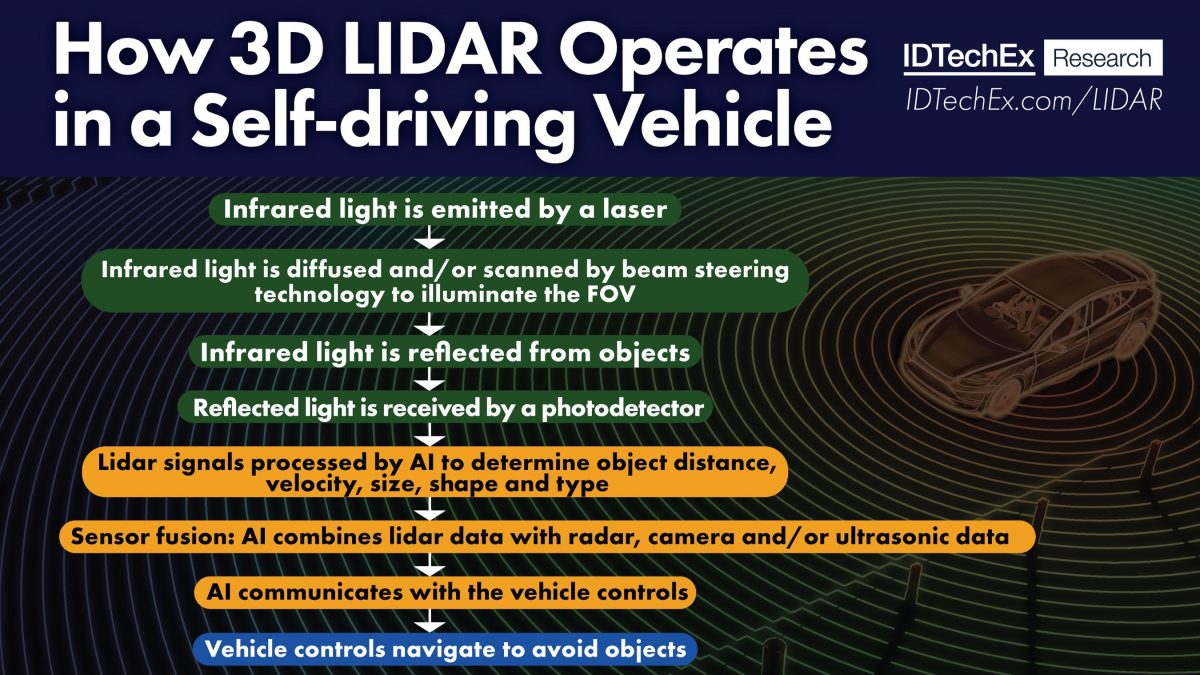
How 3D lidar operates in a self-driving vehicle. FOV = field of view, AI = artificial intelligence. Source: IDTechEx.

The report by IDTechEx, «Lidar 2020–2030: Technologies, Players, Markets and Forecasts«, provides wide-ranging analysis of more than 100 key players in the global 3D lidar market, and of the technologies and forces likely to shape that market in the next decade.

The report concludes that while each manufacturer claims to offer a unique and innovative product, in practice the landscape is cluttered. The authors explain the options available and determine their relative complexity and likely impacts on product development and positioning. They also consider how various markets for lidar are likely to develop in the short and long terms.

What is lidar and where is it used?

Lidar is an optical perception technology that uses light (from lasers) to map objects and landscapes in a way that is similar to radar’s use of radio waves. Lidar produces a three-dimensional point cloud of its targets, and when that is used in conjunction with other sensor technologies and (according to need) AI, GPS and/or neural networks, it assists the driver or even allows vehicles to navigate without a human driver. Figure 1 shows the process, and indicates technologies and sub-systems that operate with a 3D lidar system.

The essentials of lidar were explained more than 50 years ago, and it has since been used for mapping, atmospheric research, video gaming, security, civil engineering and a host of other applications.

However, the advent of autonomous vehicles in the late twentieth century, and the intense drive to develop such vehicles commercially in the twenty-first, have generated a surge of interest in lidar technologies and their applications in the automotive sector.

The race is now on to make vehicles autonomous to the greatest extent possible (levels 4 and 5). However, lidar has uses other levels of vehicle automation and ADAS, from emergency braking to level 5.

What makes a good automotive lidar system?

The important parameters that differentiate in-car lidar systems are;

  • Range – a long range is desirable, since this covers most driving scenarios, including highways/motorways.
  • Field of view – a wide field of view optimizes the vehicle’s ability to sense its surroundings.
  • Distance accuracy – This means the car can work out where objects are, with greater accuracy.
  • Angular resolution – High resolution enhances object identification.
  • Frame rate – A high frame rate means the vehicle can ‘see’ and respond to fast-moving objects.
  • Power consumption – low power consumption drives down costs and battery wear.
  • Infrared wavelength – Long wavelengths are safer for human vision and less prone to scatter.
  • Unit price – Lower prices mean manufacturers can speed up mass production and put lidar into a wide range of vehicles.

Who are the market players?

While the 3D lidar market was once dominated by a handful of companies, the market has become increasingly crowded with firms offering products for every part of the lidar system, each one claiming to be better than the last. These firms range from 3D lidar’s founders (e.g. Velodyne), established lidar producers (e.g. Luminar, AEye) and tier 1 automotive suppliers (e.g. Valeo, Magna) to start-ups.

Notably, many of these companies serve other lidar markets, as well as automotive.

There is also jostling for position in terms of lidar technologies: The IDTechEx report identifies MEMS lidar as likely to emerge with the largest market segment.

«Lidar 2020–2030: Technologies, Players, Markets and Forecasts» analyzes extensive primary and secondary data that provide information vital to companies that require, develop, invest in or supply components/materials for lidar.

For more information on this report, please visit www.IDTechEx.com/LIDAR or for the full portfolio of related research available from IDTechEx please visit www.IDTechEx.com/Research.

IDTechEx guides your strategic business decisions through its Research, Subscription and Consultancy products, helping you profit from emerging technologies. For more information, contact research@IDTechEx.com or visit www.IDTechEx.com

Image download: https://www.dropbox.com/sh/hm8oidq3mhmkk74/AABh6CnFBbT4DDjzM_avbDVza?dl=0 

Media Contact: 

Natalie Moreton 
Digital Marketing Manager 
press@IDTechEx.com 
+44(0)1223 812300 

Social Media Links:

Twitter: https://www.twitter.com/IDTechEx

LinkedIn: https://www.linkedin.com/company/idtechex/

Facebook: https://www.facebook.com/IDTechExResearch

IDTechEx_Logo

Photo: https://mma.prnewswire.com/media/1334173/LIDAR_IDTechEx.jpg

Logo: https://mma.prnewswire.com/media/478371/IDTechEx_Logo.jpg

Automotive Airbag Silicone Market worth $534 million by 2025 – Exclusive Report by MarketsandMarkets™

CHICAGO, Nov. 13, 2020 /PRNewswire/ — According to the new market research report «Automotive Airbag Silicone Market by Airbag Position (Front, Knee, Curtain/Side), Airbag Type (Cut-&-Sew Seam Sealed & One-piece-woven), ICE & Electric Vehicle (Passenger Car, LCV, HCV, BEV & PHEV/FCEV), Autonomy Level and Region – Global Forecast to…

CHICAGO, Nov. 13, 2020 /PRNewswire/ — According to the new market research report «Automotive Airbag Silicone Market by Airbag Position (Front, Knee, Curtain/Side), Airbag Type (Cut-&-Sew Seam Sealed & One-piece-woven), ICE & Electric Vehicle (Passenger Car, LCV, HCV, BEV & PHEV/FCEV), Autonomy Level and Region – Global Forecast to 2025″, published by MarketsandMarkets™, the Automotive Airbag Silicone Market is projected to grow from USD 239 million in 2020 to USD 534 million by 2025 in terms of value, at a CAGR of 17.5%.

MarketsandMarkets_Logo

Stringent safety regulations, along with increasing installations and growing demand for frontal, curtain/side, and knee airbags, are expected to fuel the Automotive Airbag Silicone Market in the coming years. The growing demand for electric vehicles and increasing penetration of airbags in commercial vehicles are expected to offer growth opportunities to players in the market during the forecast period.

Browse in-depth TOC on «Automotive Airbag Silicone Market»

81 – Tables
43 – Figures
157 – Pages

Download PDF Brochure: https://www.marketsandmarkets.com/pdfdownloadNew.asp?id=70508314

One-Piece-Woven (OPW) segment by airbag type is expected to have the largest market during the forecast period from 2020 to 2025.

OPW airbags are widely used to mitigate the effects of side collisions, while CSSS airbags are used in frontal positions to minimize injury due to the first impact. The increasing focus on minimizing rollover fatalities is expected to drive the market for OPW airbags. Moreover, curtain/side airbags need to be inflated for a longer time, which can efficiently be achieved using the OPW type of airbag. Thus, OPWs are used widely in curtain/side airbag applications.

The Battery Electric Vehicle (BEV) segment by electric vehicle is expected to register the highest growth rate during the forecast period.

BEVs use chemical energy stored in rechargeable battery packs for power. Increasing levels of automobile emissions and their impact on human health and the environment are leading regulatory bodies and OEMs towards undertaking initiatives to promote electric vehicles. BEVs are zero-emission vehicles (ZEVs). Government rebates on ZEV purchases can help increase the sales of BEVs, which will drive BEV demand. Presently, most BEVs are fitted with two frontal and two side airbags. This high penetration of airbags in BEVs is driving the need for automotive airbag silicone.

Request FREE Sample Report: https://www.marketsandmarkets.com/requestsampleNew.asp?id=70508314

North America is estimated to be the second largest market.

The North America region includes the US and Mexico. The presence of leading airbag fabric manufacturing companies—including Toray Industries Inc, Porcher Industries, Mid Mountain Materials (US), Global Safety Textiles, UTT Technische Textilien GmbH & Co kg, and TOYOBO Co. Ltd.—is currently driving the demand for automotive airbag silicone in the region. Several airbag fabric and silicone supplier companies are concentrated in Mexico to achieve cost-efficient manufacturing, making the country the largest North America market for automotive airbag silicone. The North American Free Trade Agreement (NAFTA) between the US and Mexico enables the Mexican airbag fabric and silicone provider companies to cater to the US airbag and automotive markets while achieving the economic advantages of manufacturing in Mexico.

Dow (US), Elkem Silicones (France), Shin-Etsu Chemical Co., Ltd. (Japan), Wacker Chemie AG (Germany), and Momentive (US) are the major companies operating in the global Automotive Airbag Silicone Market. These companies adopted expansion strategies and used mergers & acquisitions to gain traction in the Automotive Airbag Silicone Market.

Browse Related Reports:

Automotive Airbags & Seatbelts Market By Airbag Type (Front, Knee and Side & Curtain), Seatbelts (2-point and 3-point), Vehicle (PC, LCV, Buses and Trucks), Electric Vehicle, Component (Airbag Inflator, ACU and Airbag) and Region – Global Forecast to 2025

Automotive Silicone Market by Type (Elastomers, Gels, Resins, Fluids), Application (Interior & Exterior, Engines, Electrical), and Region (APAC, Europe, North America, South America, Middle East & Africa) – Global Forecast to 2023

About MarketsandMarkets™ 

MarketsandMarkets™ provides quantified B2B research on 30,000 high growth niche opportunities/threats which will impact 70% to 80% of worldwide companies’ revenues. Currently servicing 7500 customers worldwide including 80% of global Fortune 1000 companies as clients. Almost 75,000 top officers across eight industries worldwide approach MarketsandMarkets™ for their painpoints around revenues decisions.

Our 850 fulltime analyst and SMEs at MarketsandMarkets™ are tracking global high growth markets following the «Growth Engagement Model – GEM». The GEM aims at proactive collaboration with the clients to identify new opportunities, identify most important customers, write «Attack, avoid and defend» strategies, identify sources of incremental revenues for both the company and its competitors. MarketsandMarkets™ now coming up with 1,500 MicroQuadrants (Positioning top players across leaders, emerging companies, innovators, strategic players) annually in high growth emerging segments. MarketsandMarkets™ is determined to benefit more than 10,000 companies this year for their revenue planning and help them take their innovations/disruptions early to the market by providing them research ahead of the curve.

MarketsandMarkets’ flagship competitive intelligence and market research platform, «Knowledge Store» connects over 200,000 markets and entire value chains for deeper understanding of the unmet insights along with market sizing and forecasts of niche markets.

Contact:
Mr. Aashish Mehra
MarketsandMarkets™ INC.
630 Dundee Road
Suite 430
Northbrook, IL 60062
USA: +1-888-600-6441
Email: sales@marketsandmarkets.com
Research Insight: https://www.marketsandmarkets.com/ResearchInsight/automotive-airbag-silicone-market.asp 
Visit Our Web Site: https://www.marketsandmarkets.com 
Content Source: https://www.marketsandmarkets.com/PressReleases/automotive-airbag-silicone.asp

Logo: https://mma.prnewswire.com/media/660509/MarketsandMarkets_Logo.jpg

Watch how Volvo Cars drops new cars from 30 metres to help rescue services save lives

GOTHENBURG, Sweden, Nov. 13, 2020 /PRNewswire/ — To allow rescue services to prepare for any possible crash scenario and to simulate the forces that erupt in the most extreme crashes, beyond what can be simulated with ordinary crash testing, Volvo Cars recently took equally extreme measures. For the first time, it dropped several new Volvos multiple times from a crane, from a height of 30 metres.

<div id="prni_dvprnevid275fleft" title="Volvo Cars drops new cars from 30 meters to help…

GOTHENBURG, Sweden, Nov. 13, 2020 /PRNewswire/ — To allow rescue services to prepare for any possible crash scenario and to simulate the forces that erupt in the most extreme crashes, beyond what can be simulated with ordinary crash testing, Volvo Cars recently took equally extreme measures. For the first time, it dropped several new Volvos multiple times from a crane, from a height of 30 metres.


It is the most extreme crash test ever executed by Volvo Cars, and a crucial one. Extrication specialists often use cars crashed at the Volvo Cars Safety Centre to hone their life-saving skills.

To allow rescue services to prepare for any possible crash scenario and to simulate the forces that erupt in the most extreme crashes, beyond what can be simulated with ordinary crash testing, Volvo Cars recently took equally extreme measures. For the first time, it dropped several new Volvos multiple times from a crane, from a height of 30 metres.

This approach helped create enough damage to adequately simulate the damage found in the most extreme crash scenarios: think of single-car accidents at very high speed, accidents whereby a car hits a truck at high speed, or accidents whereby a car takes a severe hit from the side.

In such situations, people inside the car are likely to be in a critical condition. Therefore the priority is to get people out of the car and to a hospital as quickly as possible, using hydraulic rescue tools known in the industry as ‘jaws of life’. Extrication specialists often talk about the golden hour: they need to release and get a patient to the hospital within one hour after the accident has happened.

«We have been working closely together with the Swedish rescue services for many years,» says Håkan Gustafson, a senior investigator with the Volvo Cars Traffic Accident Research Team. «That is because we have the same goal: to have safer roads for all. We hope no one ever needs to experience the most severe accidents, but not all accidents can be avoided. So it is vital there are methods to help save lives when the most severe accidents do happen.»

All findings from the crashes and the resulting extrication work will be collected in an extensive research report. This report will be made available free of use to rescue workers elsewhere, allowing them to benefit from the findings and further develop their life-saving capabilities.

Usually, rescue workers get their training vehicles from scrapyards. But these cars are often up to two decades old. And in terms of steel strength, safety cage construction and overall durability, there is a vast difference between modern cars and those built fifteen to twenty years ago. And new Volvos are made of some of the hardest steel found in modern cars.

This makes it crucial for rescue workers to constantly update their familiarity with newer car models and review their processes, in order to develop new extrication techniques. In other words, these training sessions can mean the difference between life and death. So at the request of the rescue services, Volvo Cars decided to step things up a notch.

«Normally we only crash cars in the laboratory, but this was the first time we dropped them from a crane,» says Håkan Gustafson. «We knew we would see extreme deformations after the test, and we did this to give the rescue team a real challenge to work with.»

A total of ten Volvos, of different models, were dropped from the crane several times. Before the drop, Volvo Cars safety engineers made exact calculations about how much pressure and force each car needed to be exposed to, in order to reach the desired level of damage.

Contact:
Volvo Cars Media Relations
+46 031-596525
media@volvocars.com

Video: https://mma.prnewswire.com/media/1333278/Volvo_Cars_Drop.mp4  
Photo: https://mma.prnewswire.com/media/1333127/Volvo_Cars_drop_rescue_services.jpg

Volvo Cars drops new cars from 30 meters to help rescue services

Plasman Group Announces Global Rebrand

WINDSOR, ON, Nov. 12, 2020 /PRNewswire/ — Automotive and manufacturing leader Plasman Group has announced they will now be known solely as Plasman™ in the automotive, consumer and medical markets. With a rich history dating back over 40 years, the change reflects the company’s growth from a two-person tool shop into a global industry leader. Plasman™ is a key supplier of exterior trim, bumpers/fascia, interior systems, and sub-components for major OEM automotive brands, and is a significant…

WINDSOR, ON, Nov. 12, 2020 /PRNewswire/ — Automotive and manufacturing leader Plasman Group has announced they will now be known solely as Plasman™ in the automotive, consumer and medical markets. With a rich history dating back over 40 years, the change reflects the company’s growth from a two-person tool shop into a global industry leader. Plasman™ is a key supplier of exterior trim, bumpers/fascia, interior systems, and sub-components for major OEM automotive brands, and is a significant player in the consumer goods market specializing in precision molding. Recently, the Company further diversified into the medical device and biotech industry.

The Right Parts. The Right People.

Prior division names, including A-Brite Plating, A.P. Plasman, Build-A-Mold, Plastal and Thermotech, will now be united under one global brand name. It marks an exciting milestone for the company, as Plasman CEO David Wiskel explains. «It is not only about the name change, but an opportunity to reflect on everything our history has afforded us and everything we aspire to become. In the 16 plus years I have been CEO, Plasman hasn’t stopped growing. It is an exciting time for me personally, our entire team, and each of the customers we serve». 

Plasman recently introduced Omniluxe™ to their list of product offerings, dedicating a new factory in Gothenburg, Sweden to its mass production for automakers. Omniluxe is a chrome alternative that meets the strictest environmental guidelines. Its flexibility gives designers the freedom to craft complex shapes. With endless gloss options and extensive color-matching possibilities, Omniluxe is durable and environmentally friendly without compromising beauty. It can also reduce noise, vibration and harshness in a variety of applications.

Environmentally friendly products like Omniluxe are a key part of Plasman’s commitment to sustainability. Through customer, supplier and team member partnerships, they’ve created a blueprint for collectively working toward a better, more sustainable future for all. «We carefully evaluate how we work and see the future», explained David Wiskel. «We embrace sustainability challenges as opportunities to innovate and continuously improve our product design.»

About Plasman:
Plasman operates in 9 countries with over 4000 employees. Our talented and diverse team embraces collaboration, delivers solutions, and takes ownership of our environmental responsibilities. As One Driving Force™, we operate globally to meet your needs. From design to delivery, we provide the perfect part—where and when you need it, around the world every day.

Plasman is headquartered in Windsor, Ontario, Canada and owned by Insight Equity, Dallas Texas.

Related Links:
http://www.plasman.com

Photo – https://mma.prnewswire.com/media/1331679/Plasman_Plasman_Group_Announces_Global_Rebrand.jpg

Jennnifer Parent, jennifer.parent@plasman.com

Electric Truck Market Size Worth $14.19 Billion By 2027 | CAGR: 43.3%: Grand View Research, Inc.

SAN FRANCISCO, Nov. 12, 2020 /PRNewswire/ — The global electric truck market size is expected to reach USD 14.19 billion by 2027, according to a new report by Grand View Research, Inc. The market is projected to…

SAN FRANCISCO, Nov. 12, 2020 /PRNewswire/ — The global electric truck market size is expected to reach USD 14.19 billion by 2027, according to a new report by Grand View Research, Inc. The market is projected to register a CAGR of 43.3% from 2020 to 2027. Stringent emission regulations, coupled with declining battery costs and lower maintenance costs of electric trucks, are expected to drive the market growth. Electric trucks are an alternative to traditional trucks and are powered by an electric motor instead of an internal combustion engine. The electric trucks are classified into battery-electric and hybrid trucks. Increasing the adoption of electric trucks in transportation and logistics and municipal sectors to reduce greenhouse gas emissions will fuel the market growth over the forecast period.

Grand_View_Research_Logo

Key suggestions from the report:

  • The battery-electric trucks segment held the largest market share in 2019 and is anticipated to continue its dominance over the forecast period
  • China held the largest market share in 2019, owing to the presence of some of the leading market players in the country
  • The U.S. market is estimated to expand at the highest CAGR over the forecast period due to increasing demand from the logistics and transportation sector in the region

Read 90 page research report with ToC on «Electric Truck Market Size, Share & Trends Analysis Report By Vehicle Type (Battery Electric Trucks, Hybrid Trucks), By Region, And Segment Forecasts, 2020 – 2027» at:https://www.grandviewresearch.com/industry-analysis/electric-trucks-market

With the growing environmental concerns, environmental and government agencies are imposing stringent emission laws and norms that may force commercial vehicle manufacturers to invest in developing electric trucks. National and local regulations enable a supportive environment in the form of stricter emission targets and diesel bans. For instance, the European Union (EU) has enacted enactment to reduce emissions by at least 40% by 2030. This is expected to fuel market growth over the forecast period. However, due to the COVID-19 pandemic, the sales have declined in 2020. The pandemic has disrupted the manufacturing operations and supply chain worldwide.

The market in China held the largest share of the overall market in 2019, owing to the presence of several key companies such as BYD Auto Co. Ltd., Dongfeng Motor Corporation, FAW Group Co., Ltd., and Daimler AG in the region. Europe held the second-largest market share in 2019, due to increased sales in prominent countries such as Germany, Italy, France, and the Netherlands. According to the European Automobile Manufacturers Association (ACEA), around 618 medium and heavy electric trucks (battery-electric trucks, hybrid trucks) were sold in Germany in 2019.

For this report, Grand View Research has segmented the global electric truck market based on vehicle type and region:

  • Electric Trucks Vehicle Type Outlook (Revenue, USD Million, 2016 – 2027)
    • Battery electric Trucks
    • Hybrid Trucks
  • Electric Trucks Regional Outlook (Revenue, USD Million, 2016 – 2027)
    • The U.S.
    • Europe
      • Germany
      • Italy
      • France
      • Netherlands
    • China

List of Key Players of Electric Truck Market

  • AB Volvo
  • BYD Auto Co. Ltd
  • Daimler AG
  • Dongfeng Motor Corporation
  • FAW Group Co., Ltd.
  • Foton Motor Inc.
  • Isuzu Motors Ltd
  • Navistar, Inc.
  • PACCAR Inc.
  • Scania
  • Tevva Motors Limited

Find more research reports on Automotive & Transportation Industry, by Grand View Research:

  • Electric Vehicle Market – The global electric vehicle market demand was estimated at 2,373.5 thousand units in 2019 and is expected to witness a CAGR of 41.5% 2020 to 2027.
  • Utility Trucks Market – The global utility trucks market size was estimated at USD 47.90 billion in 2017 and is projected to expand further at a CAGR of 7.7% over the forecast years.
  • Automotive Catalytic Converter Market – The global automotive catalytic converter market size was valued at USD 111.00 billion in 2014.

Gain access to Grand View Compass, our BI enabled intuitive market research database of 10,000+ reports

About Grand View Research

Grand View Research, U.S.-based market research and consulting company, provides syndicated as well as customized research reports and consulting services. Registered in California and headquartered in San Francisco, the company comprises over 425 analysts and consultants, adding more than 1200 market research reports to its vast database each year. These reports offer in-depth analysis on 46 industries across 25 major countries worldwide. With the help of an interactive market intelligence platform, Grand View Research helps Fortune 500 companies and renowned academic institutes understand the global and regional business environment and gauge the opportunities that lie ahead.

Contact:
Sherry James
Corporate Sales Specialist, USA
Grand View Research, Inc.
Phone: 1-415-349-0058
Toll Free: 1-888-202-9519
Email: sales@grandviewresearch.com 
Web: https://www.grandviewresearch.com 
Follow Us: LinkedIn | Twitter 

Logo: https://mma.prnewswire.com/media/661327/Grand_View_Research_Logo.jpg

Nokian Tyres made a world record possible: Car pushing is a game of skill, not brute force

HELSINKI, Nov. 12, 2020 /PRNewswire/ — A new Guinness World Record for the fastest time to push a car one mile (1.6 km) has been set in Finland. The record was set by…

HELSINKI, Nov. 12, 2020 /PRNewswire/ — A new Guinness World Record for the fastest time to push a car one mile (1.6 km) has been set in Finland. The record was set by Jussi Kallioniemi, who says that this is not a test of brute force but rather an enormous puzzle. A key piece of the performance were the lightly rolling Nokian Hakkapeliitta R3 SUV winter tires and their extremely light rolling resistance.

13 minutes and 26 seconds. This is how long it took Jussi Kallioniemi, from Nokia, to push a passenger car, weighing 2,100 kilograms, for one mile (or exactly 1,609.34 meters) in order to claim the world record in his name. This result improves on the previous record by nearly two minutes. Guinness has officially confirmed the world record for «Fastest time to push a car one mile».

The record was set on Saturday, October 24, 2020 at the Nokian Tyres test track in Nokia. For the performance, Kallioniemi used his own car, a 2006 Saab affectionately known as «Röhkö». Technical Customer Service Manager Matti Morri from Nokian Tyres was in the driver’s seat.

– People often tell me that I don’t look like a strongman – and I’m not one. This was a performance comparable to a medium-distance run, not a show of force. There are two ways to achieve the power you need: either increase your own strength or reduce resistance, Kallioniemi says.

When pushing a car, the important part is to defeat the rolling resistance, so the lower the rolling resistance of your tires is, the lighter the car will roll. Rolling resistance refers to the energy consumed by the tire’s deformation during road contact. This is also an important topic for regular drivers. A tire with low rolling resistance is a green and economical choice.

– Even older cars can roll lightly when equipped with safe and comfortable non-studded premium winter tires like the Nokian Hakkapeliitta R3 SUV. Provided that the tire pressures are in check, using tires with low rolling resistance can save up to 0.5 liters of fuel per 100 km or substantially extend an electric vehicle’s range even in the winter. At the same time, you are conserving the environment due to the lower CO2 emissions, Morri says.

Well-being and problem-solving

The idea of pushing a car came about by accident. Jussi Kallioniemi was suffering from back pains and started rehabilitation therapy by pushing a heavy box at the gym. At some point, he started thinking about what else he could do and, through his search, he found the idea of car pushing on the Guinness website.

Kallioniemi says that he is not that interested in whether he finishes first or last in a race. Instead, he is interested in problem-solving and managing the big picture. The project even resulted in an invention that has a pending patent application. Together with his friend, Kallioniemi created a remote controller that allowed him to turn the wheel himself during practice runs, without using a driver.

– If this had been simply about brute force, I wouldn’t have had the energy to follow through with the project. My motivation is built around finding new problems to solve. When you are stretching yourself to the extreme limits, it matters when you can make it one or two percent lighter, Kallioniemi says.

– We have been working very systematically and persistently. We have moved from the large blocks toward even smaller details. A normal middle-aged man can take on a world record challenge if they take everything into account and try to get the car rolling as lightly as possible.

Brought together by the will to develop

Kallioniemi has been training at the Nokian Tyres test track in Nokia, Finland, where the premium tire manufacturer also has its headquarters. He and the global tire company are brought together by their similar attitudes.

– Our passion for tire development is similar to Jussi’s passion for training. We test our products to the extremes in all conditions. Human well-being is also very important to us. The body and mind must be in balance in order to refine our Scandinavian know-how and creativity into the world’s safest, eco-friendliest tires. This brings peace of mind for all of us, says Matti Morri from Nokian Tyres.

Versatile data on the record performance
 

The record-setting performance utilized and gathered many types of data, as the project also involved Myontec Oy, which specializes in smart clothing and muscle monitoring, and the sports electronics company Polar Electro Oy. 

– Jussi has been using a Polar monitor in his training, and he contacted us for measuring the record attempt. It was easy for us to get involved, as we saw that the record attempt is on solid ground thanks to good, versatile training. Over the years, Polar’s products have been used in outer space and in Formula 1 race cars, so measuring a record attempt sounded like a great challenge. During the performance, Jussi followed his plan exactly and did not start off too hard. The data produced by the multi-sensor unit measuring Jussi’s performance was sent in real-time to the backend service using the latest in IoT radio technology, says Smart Coaching Manager Ville Uronen From Polar.

Maximum heart rate during the performance was very low, only 164 beats per minute, even though the speed temporarily increased over the first 100 meters and reached 10.4 km/h. Muscle activity was approximately 41% of the measured maximum value. Around the middle point of the performance, Jussi was using 35% of his muscle power.

– The activity level was higher on the left side, on the front and back thigh muscles and gluteal muscles, which indicates muscle balance, but was also likely due to the fact that the track was circular in shape. Muscle load remains moderate, which allows for a steady performance and avoids heavy muscle fatigue. Jussi’s training has been very successful. His strength control was admirable during the record performance, as he was pushing the car while only using 35-40% of his maximum, says expert Heidi Jarske from Myontec. 

– Success gives me a boost of energy and enjoyment. I feel like the final piece of the puzzle has fallen into place, Kallioniemi says.

Fact: Jussi Kallioniemi

– 47 years old, lives in Nokia with his family

– Holder of the world record for «Fastest time to push a car one mile»

– He has previously set the record for «Fastest marathon carrying a 60 lb (27.2 kg) pack»: 4 h 34 min 24s

– Increased his muscle strength and stamina especially in 2019

– About 600 km of training in car pushing during 2020

– Invented a remote control for training, has a pending patent for it

Fact: Record-setting vehicle «Röhkö»

– Saab 97-X 5.3i Arc

– Engine: 5.3 l V8, 304 hp

– Weight 2,170 kg

– More than 211,000 km (131,000 miles) on the odometer

– Runs on biogas

– Lets out a nice groan when starting («röhkäisy» in Finnish)

Fact: Nokian Hakkapeliitta R3 SUV winter tire

– Nordic non-studded wintertire, winner of multiple tests

– Perfect combination of safety and driving comfort for any winter weather 

– Cryo Crystal 3 grip particles in the rubber compound grip the driving surface

– Snow Claws between the tread blocks further increase grip

– Offers fuel savings and increases EV range

– Number one choice for greener driving
– Tire size used for the record: 255/55 R18

Read more:

New world record for the fastest time to push a car one mile

Photos & videos

Guinness World Record site
 

Further information: 

World record holder Jussi Kallioniemi,
tel. +358 400 966 558, jussi.kallioniemi@radiant.fi

Manager, Content & Product Marketing Teemu Sainio,
Nokian Tyres plc, tel. +358 10 401 7296, teemu.sainio@nokiantyres.com

Twitter I YouTube I Facebook I LinkedIn I Instagram

This information was brought to you by Cision http://news.cision.com

https://news.cision.com/nokian-tyres/r/nokian-tyres-made-a-world-record-possible–car-pushing-is-a-game-of-skill–not-brute-force,c3235777

The following files are available for download:


Cross-Industry Convergence and 5G Spark Future Innovations in Mobility Technology, finds Frost & Sullivan

Non-automotive companies enter the fray to develop tech for connected, autonomous, shared, and electric mobility along with global auto majors

SANTA CLARA, California, Nov. 11, 2020 /PRNewswire/ — Frost & Sullivan’s recent analysis, Strategic Insight into the Future of the Global Mobility Technology Market, reports that advancements in mobility technology will open new growth opportunities for companies aiming to tap into mobility services and solutions of the…

Non-automotive companies enter the fray to develop tech for connected, autonomous, shared, and electric mobility along with global auto majors

SANTA CLARA, California, Nov. 11, 2020 /PRNewswire/ — Frost & Sullivan’s recent analysis, Strategic Insight into the Future of the Global Mobility Technology Market, reports that advancements in mobility technology will open new growth opportunities for companies aiming to tap into mobility services and solutions of the future, such as mobility-as-a-service, shared and autonomous fleets, and mobility operating systems. This is expected to result in greater collaborations and merger and acquisition (M&A) activities in the sector amongst automotive incumbents, technology giants, network infrastructure providers, and mobility tech start-ups.

Photo – https://mma.prnewswire.com/media/1332421/Frost_and_Sullivan_Global_Mobility_Technology_Market.jpg

For further information on this analysis, please visit: http://frost.ly/4ub

«Technology is emerging as the centerpiece in mobility. The focus is shifting from operators and business models toward developing technology capabilities. Advanced technologies, such as APIs, artificial intelligence, machine learning, cloud platforms, mobility service platforms, V2X and V2G technologies, and predictive modeling are starting to shape new mobility,» said Abhishek Iyer, Research Analyst. «The interest shown by ICT companies and start-ups towards connected, autonomous, shared, and electric (CASE) mobility has initiated a multi-industry convergence towards mobility technologies. However, a singular approach towards these aspects is restrictive in terms of capturing the huge potential that exists. The collective involvement of participants with varied capabilities is essential towards solving the future mobility equation.»

Iyer added: «As technology evolves, services are becoming more complex and nuanced. New opportunities can be found in areas such as fleet orchestration, mobility planning and designing, and seamless transition from human-driven to autonomous fleets. Also, 5G networks will play a crucial role in the advancement of future shared, automated, and connected vehicles. Omnipresent wireless networks that have extensive coverage, high data transfer speeds, and low latency will drive the advancements in highly connected shared mobility technologies.»

For further revenue opportunities, market participants should explore these strategic recommendations:

  • Providers of future mobility solutions and services must leverage and continue to build on their core technological strengths to capture underlying growth opportunities effectively.
  • While the fastest route to gaining access to these technologies is through mergers and acquisitions, companies should develop a strategic roadmap to lay out a clear picture of how their existing core expertise would integrate with the acquisition of new technology capabilities to drive innovation further.
  • Extensive collaboration among long-standing participants from the automotive and technology sector along with the value provided by new mobility technology suppliers is required to enable disruption in the evolving landscape. This collaboration becomes even more essential for existing companies to survive and thrive over the next decade, which is expected to change the face of mobility as we see it.
  • Success in the mobility technology ecosystem will depend on the development of new business models and revenue strategies, which can harness the potential of cross-industry expertise and incorporate them into mobility technology solutions and services. While the necessary focus on CASE is absolute, a well-defined and timely approach toward it will stand to make the difference.

Strategic Insight into the Future of the Global Mobility Technology Market is part of Frost & Sullivan’s global Automotive and Transportation Growth Partnership Service program.

About Frost & Sullivan

For six decades, Frost & Sullivan has been world-renowned for its role in helping investors, corporate leaders and governments navigate economic changes and identify disruptive technologies, Mega Trends, new business models, and companies to action, resulting in a continuous flow of growth opportunities to drive future success. Contact us: Start the discussion

Strategic Insight into the Future of the Global Mobility Technology Market
MF7F-18

Contact:
Francesca Valente
Global Corporate Communications
E: Francesca.Valente@frost.com
http://ww2.frost.com

Fuel Cell Cars: A Commercial Failure, IDTechEx Reports

BOSTON, Nov. 11, 2020 /PRNewswire/ — The IDTechEx report «Advanced Electric Cars 2020–2040» forecasts fuel-cell cars globally through 2040, and finds they continue to be a commercial failure for the next two decades. While fuel-cell electric vehicles (FCEVs) have been on the table as the long-range zero-emission vehicles to challenge the battery-electric vehicle (BEV), they have major drawbacks:

<ul…

BOSTON, Nov. 11, 2020 /PRNewswire/ — The IDTechEx report «Advanced Electric Cars 2020–2040» forecasts fuel-cell cars globally through 2040, and finds they continue to be a commercial failure for the next two decades. While fuel-cell electric vehicles (FCEVs) have been on the table as the long-range zero-emission vehicles to challenge the battery-electric vehicle (BEV), they have major drawbacks:

  • Currently fuel cell cars cost over 1.6x as much to buy and up to three times as much to run in fuel costs, depending on your location (compared to the average internal combustion-engine). In contrast, BEVs are increasingly reaching TCO parity with ICE vehicles in different markets around the world today.
  • FCEVs rely on Li-ion batteries for high power and energy harvesting, increasing costs (the Nikola One has a 250kWh battery).
  • Fuel cells have moving parts, which means maintenance costs can be higher than BEVs.
  • Batteries are heading towards million-mile life and 1000-mile range with 2 – 4C charging this decade: by the time fuel cell cars are affordable, batteries will have caught up and will be cheaper.
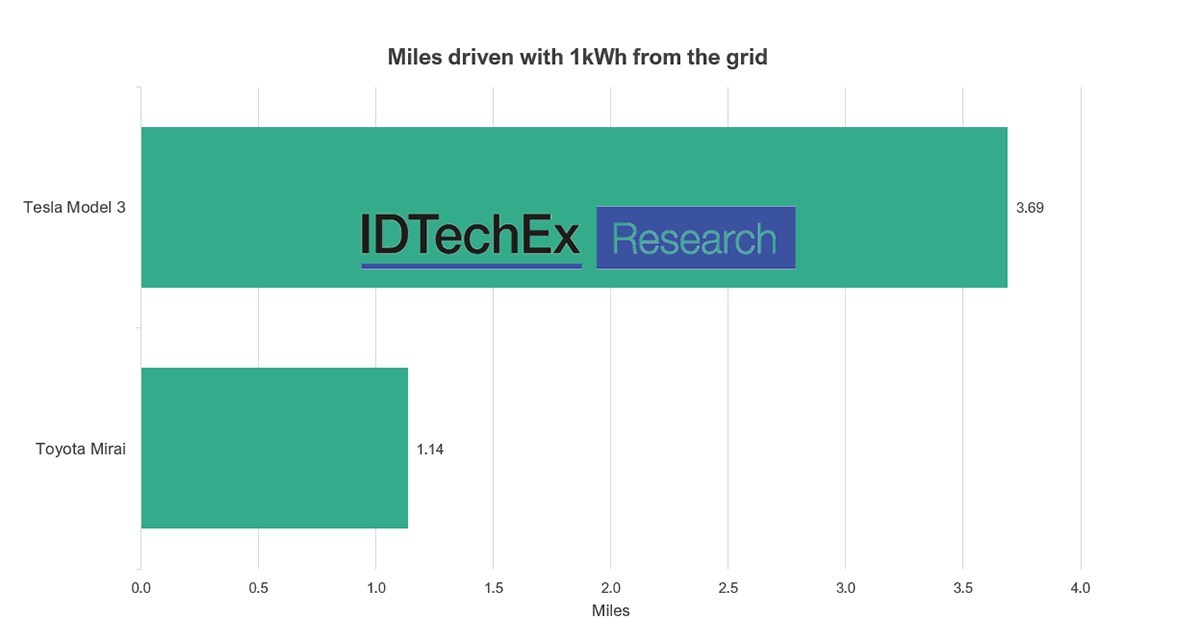
  • Fundamentally, it costs more energy to drive per mile using hydrogen than a battery because of the 60% efficiency with heat losses, in addition to using electricity from the grid to create green hydrogen.
54kWh of electricity is needed to produce 1kg of H2 from an electrolyser; battery round trip efficiency is 90%. Source: IDTechEx

One of the common arguments for fuel cells is that they can provide longer pure-electric ranges: this advantage is being eroded by the sheer pace of innovation and research for Li-ion batteries. As the IDTechEx report on Advanced Electric Cars highlights, the top three fuel cell car models are the Toyota Mirai, with 300 miles range, the Hyundai Nexo, with 413 miles range and the Honda Clarity, with 316 miles of range. Yet earlier in 2020, Tesla revealed a 400-mile Model S (EPA), spurred on by healthy competition from rival Lucid Motors which later announced the ‘Lucid Air’ BEV sedan would be the first production car with 500 miles pure electric range EPA (with initial sales planned for Q1 next year). And this is without considering potential for solar bodywork: the Lightyear One, on sale next year, achieves 463-mile range with only a 50kWh battery.

On the topic of range and range anxiety, it is also important to consider the ubiquitous deployment of charging infrastructure. Currently, sufficient hydrogen re-fuelling infrastructure does not exist to make fuel-cell car purchases tempting even for the early adopter, in part because they are an order of magnitude more expensive to deploy than fast electric chargers, as shown below.

So why should we pay attention to fuel cells? Well, they are not off the table yet in heavy-duty long-range applications such as off-road, marine and long-haul trucking. The problem is, compared to cars, these are all relatively low-volume markets and will struggle to reduce costs quickly. Batteries also compete in these areas, which means the application would need to have very specific requirements which rule out a battery. For example, re-charging massive energy capacities (over 1MWh) in a few minutes.

FCEVs will have wider uptake in certain countries with a strategy for a broader hydrogen economy, but this will be regionally isolated and not the global trend. It will also prove a disadvantage for automakers having to develop different zero-emission vehicles for different regions, particularly as startups focus purely on BEVs and set the bar high. Further research on the Hydrogen economy can be found in the IDTechEx report «The Hydrogen Economy, Fuel Cells and Hydrogen Production Methods«.

In short: if a battery can do it, it is currently the best value option for the consumer and environment. And a battery can do it for cars.

For more information, IDTechEx analyses electric vehicle markets, energy storage trends and demand across land, sea and air. This is summarized in a master electric vehicle market report, found at www.IDTechEx.com/EV. Further in-depth analysis can be found in the full portfolio of electric vehicle research available at www.IDTechEx.com/research/EV.

IDTechEx guides your strategic business decisions through its Research, Subscription and Consultancy products, helping you profit from emerging technologies. For more information, contact research@IDTechEx.com or visit www.IDTechEx.com

Image download: https://www.dropbox.com/sh/btlrnqtp9ndp1jz/AAB_QlP7w4tnem0CiLYs-Ezba?dl=0

Media Contact: 

Natalie Moreton 
Digital Marketing Manager 
press@IDTechEx.com 
+44(0)1223 812300 

Social Media Links:

Twitter: https://www.twitter.com/IDTechEx
LinkedIn: https://www.linkedin.com/company/idtechex/
Facebook: https://www.facebook.com/IDTechExResearch

IDTechEx Logo

Photo: https://mma.prnewswire.com/media/1332423/IDTechEx_Fuel_Cell_Cars.jpg

Logo: https://mma.prnewswire.com/media/478371/IDTechEx_Logo.jpg

SEAT: New Training Scheme Teaches Software Development to Production Line Staff

A pioneering SEAT training programme aims to turn 5 production line workers into software developers in 4 months

13 weeks of intensive training and 3 weeks of individual project work to become a SEAT:CODE junior programmer

The project shows that labour and industrial renewal are key to meeting the challenges of the digital age

Internal talent are a priority because of their commitment and knowledge of corporate culture

MARTORELL, Spain, Nov….

A pioneering SEAT training programme aims to turn 5 production line workers into software developers in 4 months

13 weeks of intensive training and 3 weeks of individual project work to become a SEAT:CODE junior programmer

The project shows that labour and industrial renewal are key to meeting the challenges of the digital age

Internal talent are a priority because of their commitment and knowledge of corporate culture

MARTORELL, Spain, Nov. 11, 2020 /PRNewswire/ — Five workers, four months and a project that exemplifies the labour and industrial transformation that we will experience in the coming years and in which internal talent plays a key role: from the assembly line, to lines of code. A pioneering programme to train these workers in software and incorporate them as junior programmers at SEAT:CODE. «What we aim to do is show that we are capable of transforming people who are currently in the factory , changing their role, their lives and their future through technology so that they can contribute in a different scenario» explains Carlos Buenosvinos, head of SEAT:CODE. This is the story of a great challenge.

Requirement: passion to move the future. To apply, candidates had to be SEAT employees, have an interest in programming and a certain level of English. Afterwards, a thorough selection process began.

29th June, at the starting line. IT teachers will train the 5 candidates in the necessary software knowledge, both front-end (user interface) and back-end (administrator mode) during a 16 weeks intensive course.

13th October, the final stretch. Once settled in SEAT:CODE, the 5 candidates face the last 3 weeks of the training. Now, they must fly solo, without any support, on an individual final project to present to a jury.

Nearing the finish line. For the candidates, there is very little left to know if they have succeeded and become part of the SEAT:CODE team. «This is where my future begins,» said 25 year old candidate Oscar Orellana González, «developing applications and websites with SEAT».

The standard-bearers. They have been the first, but won’t be the last. «The impact potential of these new roles within the company is extremely high. If we commit to more employees going through this process, it will generate a major benefit, and with other companies embracing this opportunity, the result will be a highly competitive environment» concludes Carlos Buenosvinos, head of SEAT:CODE.

*GeeksHubs aims to position IT professionals by changing the model of tech education and talent through its own coding school, the GeeksHubs Academy, and its specialised Tech Recruitment department.

Video: https://www.youtube.com/watch?v=NYnyUPzUtiA  
Photo: https://mma.prnewswire.com/media/1332246/From_the_production_line_to_a_line_of_code_01.jpg  
Photo: https://mma.prnewswire.com/media/1332247/From_the_production_line_to_a_line_of_code_02.jpg  
Photo: https://mma.prnewswire.com/media/1332248/From_the_production_line_to_a_line_of_code_03.jpg  

16 weeks of intensive training to become a SEAT:CODE junior programmer


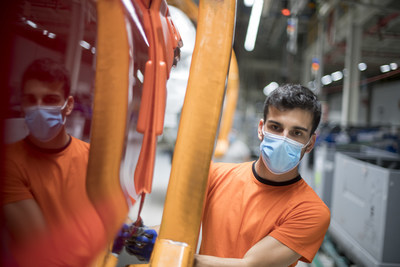
Óscar Orellana is busy fitting belts, crossbeams and airbag modules


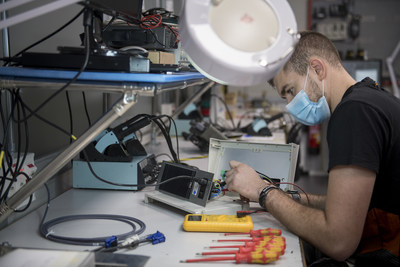
In the electronics laboratory, Adrián Hitos checks that the machines are working correctly for the last time


Frost & Sullivan Unfolds the Future of Vehicle Platform Strategies in the Age of CASE

Mobility experts from Frost & Sullivan, Pininfarina, and REE present in a webinar key growth opportunities, new business models, and strategies for mobility market players

SANTA CLARA, Calif., Nov. 11, 2020 /PRNewswire/ — As the automotive industry converges toward Connected, Autonomous, Shared, and Electric (CASE) mobility, OEMs have worked on re-engineering their conventional platforms to accommodate electric vehicle (EV) components such as batteries and motors. However,…

Mobility experts from Frost & Sullivan, Pininfarina, and REE present in a webinar key growth opportunities, new business models, and strategies for mobility market players

SANTA CLARA, Calif., Nov. 11, 2020 /PRNewswire/ — As the automotive industry converges toward Connected, Autonomous, Shared, and Electric (CASE) mobility, OEMs have worked on re-engineering their conventional platforms to accommodate electric vehicle (EV) components such as batteries and motors. However, the industry’s transition from a vehicle-centric to a service-centric approach is necessitating the development of new digital platforms (software, back-haul connectivity, and cloud). Future modular EV platforms will be flexible and multifaceted, with various vehicle types and shapes being built on the same program, saving OEMs the time, effort, and money required to launch new models. OEMs will call for partnerships based on their strategies, with traditional OEMs taking a gradual approach, while new developers such as Tesla and Waymo starting ahead of the curve.

Frost & Sullivan invites you to an upcoming Mobility webinar, «Future of Skateboard/Platform Architectures and Benchmarking of Key Industry Players’ Strategies» on Thursday, Nov. 19, 2020, at 02.00 PM (GMT)/09.00 AM (EST). Join our Mobility experts Sarwant Singh, Arunprasad Nandakumar,  and Kamalesh Mohanarangam, along with industry stalwarts Giuseppe Bonollo, Senior VP at Pininfarina, and Daniel Barel, Co-Founder and CEO at REE, as they discuss growth opportunities for traditional OEMs, business strategies to accelerate existing services, strategic imperatives on emerging products to help the EV industry stay resilient, and more.

For more information and to register for the webinar, please visit: http://frost.ly/4tm.

The unique insights you can gain from this webinar include:

  • Discover how market players can translate industry trends into optimal growth, as well as new business models and how to ensure profitability.
  • Uncover how a collaborative approach of platform development will not only help fast track development activities but also reduce the overall manufacturer investment required.
  • Recognize how operational or redundancy functionalities will need to be a core in-built attribute of future EV/AD platforms.
  • Learn how modularity will enable a range of diverse functionalities to be introduced into the vehicle without the need to change the fundamental building blocks of the platform itself.
  • Understand how the skateboard platform and rolling chassis offers the OEMs the flexibility to offer a different segment of vehicles and different body styles based on the same platform.

This webinar will also be recorded and available on-demand at http://frost.ly/1ti.

About Frost & Sullivan

For six decades, Frost & Sullivan has been world-renowned for its role in helping investors, corporate leaders and governments navigate economic changes and identify disruptive technologies, Mega Trends, new business models, and companies to action, resulting in a continuous flow of growth opportunities to drive future success. Contact us: Start the discussion.

Press Contact:
Priya George,
Corporate Communications
M: +91 98403 55432; P: +91 44 6681 4414
E: priyag@frost.com