Electric Bus Market Revenue to Cross $53 Bn by 2027; Global Market Insights, Inc.

SELBYVILLE, Del., March 3, 2021 /PRNewswire/ — Global Market Insights Inc. has recently added a new report on the electric bus market which estimates the market valuation for the…

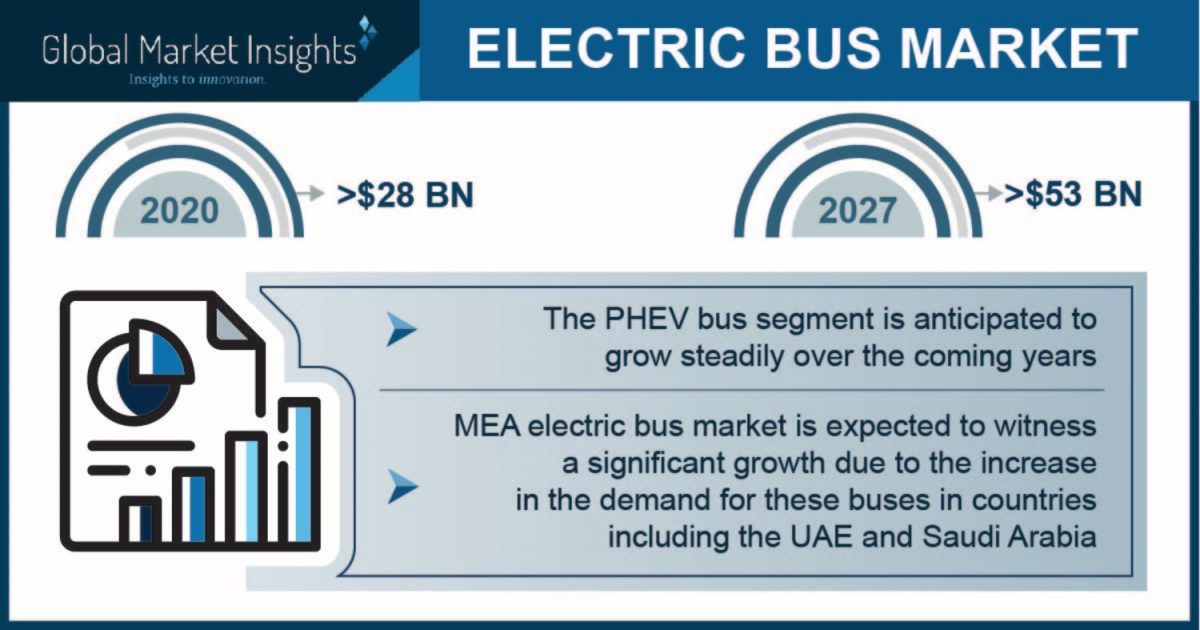
SELBYVILLE, Del., March 3, 2021 /PRNewswire/ — Global Market Insights Inc. has recently added a new report on the electric bus market which estimates the market valuation for the electric bus will cross US$ 53 billion by 2027. The market is anticipated to witness a surging growth rate due to the stringent emission regulations imposed by government authorities such as the Environmental Protection Agency (EPA). For instance, EPA’s vehicle greenhouse gas rules will aid in eliminating about six billion metric tons of GHG pollution by 2025.

The electric bus industry is facing several challenges due to the rapid spread of the COVID-19 pandemic across the globe. International and domestic trade has been impacted significantly owing to the trade and travel restrictions imposed by various governments. The sales of electric buses have witnessed a steady decline in the market. However, the market will witness significant growth due to the economic revival and containment of the virus by 2021.

Request for a sample of this research report @ https://www.gminsights.com/request-sample/detail/4959 

The PHEV bus segment is anticipated to grow steadily over the coming years. Hybrid buses are powered by a combination of electric and diesel/gasoline engines, providing them with an enhanced range in terms of kilometers. The low cost of these buses compared to all-electric and FECVs will augment their market representation.

The Middle East & Africa electric bus market is expected to witness significant growth due to the increase in the demand for these buses in countries including the UAE and Saudi Arabia. Factors, such as the growing presence of OEMs in the region, development of sustainable electric mass transit solutions, and government support, are further contributing to the market growth. For instance, in November 2019, China’s Shanghai Wanxiang Group assisted Egypt’s Arab Organisation for Industrialisation in introducing its first electric bus in the country.

Similarly, in May 2019, Foton Motor and Egypt’s Military Production Ministry signed an agreement to manufacture more than 2,000 electric buses in the country by the next four years. The adoption of electric buses in the region will propel the market growth during the forecast timeline.

The players active in the electric bus market are AB Volvo, BYD Co. Ltd, Daimler AG, Yutong, Ankai Bus, NFI Group Inc Proterra Inc., Zhongtong Bus Holdings Co., Scania AG, VDL Group, Ltd. Solaris, and Alexander Dennis Ltd. These players emphasize on mergers and acquisitions to enhance their business operations. For instance, in September 2018, CAF Group announced the acquisition of Solaris Bus and Coach. The acquisition aided the company to enter the global electric bus market.

Some major findings in the electric bus market report include:                              

  • Rising emphasis on the integration of advanced technologies including automated control systems and sensors into the buses will propel the industry size.
     
  • The all-electric bus segment will witness a high growth rate owing to increasing government regulations toward vehicular emissions and supportive policy measures.
     
  • Proliferation of numerous market players coupled with the growing adoption of these buses in intercity and intracity travel is augmenting the electric bus market share in Asia Pacific and Europe.
     
  • Key players operating in the electric bus market include AB Volvo, BYD, Proterra, Yutong, and VDL Group.
     
  • Major strategies adopted by the market players include new product launches and strategic partnerships with other industry players to enhance their market share.

Request for customization of this research report at https://www.gminsights.com/roc/4959

Partial chapters of report table of contents (TOC):

Chapter 3 Industry Insights

3.1    Industry segmentation

3.2    Impact of COVID-19 on electric bus industry landscape

3.2.1    Global outlook

3.2.2    Regional impact

3.2.2.1    North America

3.2.2.2    Europe

3.2.2.3    Asia Pacific

3.2.2.4    Latin America

3.2.2.5    MEA

3.2.3    Industry value chain

3.2.3.1    Research & development

3.2.3.2    Manufacturing

3.2.3.3    Marketing

3.2.3.4    Supply

3.2.4    Competitive landscape

3.2.4.1    Strategy

3.2.4.2    Distribution network

3.2.4.3    Business growth

3.3    Industry ecosystem analysis

3.3.1    Component suppliers

3.3.2    Technology providers

3.3.3    Manufacturers

3.3.4    End use landscape

3.3.5    Distribution channel analysis

3.3.6    Vendor matrix

3.4    Technology & innovation landscape

3.5    Policy support for electric vehicles across the globe

3.6    EV charging infrastructure outlook

3.7    Regulatory landscape

3.7.1    North America

3.7.2    Europe

3.7.3    Asia Pacific

3.7.4    Latin America

3.7.5    MEA

3.8    Industry impact forces

3.8.1    Growth drivers

3.8.1.1    Increasing focus on electrification of public transport across the globe

3.8.1.2    Low maintenance requirements of electric buses

3.8.1.3    Supportive government initiatives for development of charging infrastructure in North America

3.8.1.4    Growing investments by European OEMs in battery technologies

3.8.1.5    Rising demand for clean mobility and transportation solutions in Asia Pacific

3.8.1.6    Rising inclination towards alternative fuels in Latin America and MEA

3.8.2    Industry pitfalls & challenges

3.8.2.1    High initial cost of electric buses

3.9    Growth potential analysis

3.10    Porter’s analysis

3.10.1    Supplier power

3.10.2    Buyer power

3.10.3    Threat of new entrants

3.10.4    Threat of substitutes

3.10.5    Internal rivalry

3.11    PESTEL analysis

About Global Market Insights

Global Market Insights, Inc., headquartered in Delaware, U.S., is a global market research and consulting service provider; offering syndicated and custom research reports along with growth consulting services. Our business intelligence and industry research reports offer clients with penetrative insights and actionable market data specially designed and presented to aid strategic decision making. These exhaustive reports are designed via a proprietary research methodology and are available for key industries such as chemicals, advanced materials, technology, renewable energy and biotechnology.

Contact Us:
Arun Hegde
Corporate Sales, USA
Global Market Insights, Inc.
Phone: 1-302-846-7766
Toll Free: 1-888-689-0688
Email: sales@gminsights.com

Related Images

electric-bus-market-size-worth.jpg
Electric Bus Market size worth over $53 Bn by 2027
Electric Bus Market size is set to be over USD 53 billion by 2027, according to a new research report by Global Market Insights, Inc.

Related Links

Electric Motorcycles & Scooters Market

Electric Motors Market Size in Transportation

Cision View original content to download multimedia:http://www.prnewswire.com/news-releases/electric-bus-market-revenue-to-cross-53-bn-by-2027-global-market-insights-inc-301239209.html


SOURCE Global Market Insights Inc.

CECO Environmental Corp. Reports Fourth Quarter and Full Year 2020 Results

DALLAS, March 3, 2021 /PRNewswire/ — CECO Environmental Corp. (Nasdaq: CECE), a leading global air quality and fluid handling company serving the energy, industrial and other niche markets, today reported its financial results for the fourth quarter and full year of 2020.

<a href="https://mma.prnewswire.com/media/629371/CECO_Env_Logo.html" target="_blank"…

DALLAS, March 3, 2021 /PRNewswire/ — CECO Environmental Corp. (Nasdaq: CECE), a leading global air quality and fluid handling company serving the energy, industrial and other niche markets, today reported its financial results for the fourth quarter and full year of 2020.

Results of the Fourth Quarter 2020*

  • Revenue of $82.9 million, compared with $89.4 million
  • Gross profit of $26.2 million (31.6% margin), compared with $30.0 million (33.6% margin)
  • Operating income of $3.7 million, compared with $7.0 million
  • Non-GAAP operating income of $8.8 million, compared with $9.6 million
  • Net income of $1.8 million, compared with $8.4 million
  • Non-GAAP net income of $5.6 million, compared with $9.6 million
  • Adjusted EBITDA of $9.9 million, compared with $10.1 million
  • Earnings per diluted share was $0.05, compared with $0.24
  • Non-GAAP earnings per diluted share of $0.16, compared with $0.27
  • Bookings of $77.2 million, compared with $67.7 million
  • Backlog of $183.1 million, compared with $189.1 million as of September 30, 2020
  • Cash and Cash equivalents of $36.0 million, compared with $35.6 million
  • Bank Debt of $74.0 million, compared with $67.3 million

Results of the Full Year 2020*

  • Revenue of $316.0 million, compared with $341.9 million
  • Gross profit of $105.1 million (33.3% margin), compared with $114.1 million (33.4% margin)
  • Operating income of $13.3 million, compared with $18.0 million
  • Non-GAAP operating income was $28.2 million in both 2020 and 2019
  • Net income of $8.2 million, compared with $17.7 million
  • Non-GAAP net income of $19.5 million, compared with $20.9 million
  • Adjusted EBITDA of $32.8 million, compared with $33.0 million
  • Earnings per diluted share was $0.23, compared with $0.50
  • Non-GAAP earnings per diluted share of $0.55, compared with $0.59
  • Bookings of $279.6 million, compared with $383.7 million

*    All comparisons are versus the comparable prior-year period, unless otherwise stated

Todd Gleason, CECO’s Chief Executive Officer, commented, «We are pleased with the strong finish to a very challenging 2020.  We delivered sequential improvements in bookings, revenue, adjusted EBITDA and operating margin expansion.  Our focus on delivering differentiated solutions in key environmental categories drove double-digit bookings growth in the fourth quarter.  We continued to prudently manage our cost structure which yielded steady EBITDA despite year-over-year decline in revenues.»  

Mr. Gleason added, «I am very proud of the way CECO responded to the crisis in 2020.  We focused on operational items we can control and maintained our customer-focused execution.  CECO enters 2021 with a healthy balance sheet, improving end markets and a continued focus on operational costs and execution.  We are advancing our strategic growth process which will leverage our improved cost structure to drive sustainable shareholder value.»

CONFERENCE CALL

A conference call is scheduled for today at 8:30 a.m. ET to discuss the Company’s fourth quarter and fiscal 2020 financial results. 

The live webcast and slides can also be accessed at https://investors.cecoenviro.com/events-webcasts-and-presentations. In addition, the conference call may also be accessed by dialing (888) 346-4547 (Toll-Free) within the U.S., (855) 669-9657 (Toll-Free) within Canada or Toll/International (412) 317-5251.

A replay of the conference call will be available on the Company’s website for 7 days.  The replay may be accessed by dialing toll free (877) 344-7529 within North America or Toll/International (412) 317-0088 and entering passcode 10152419.

ABOUT CECO ENVIRONMENTAL

CECO Environmental is a global leader in air quality and fluid handling serving the energy, industrial and other niche markets. Providing innovative technology and application expertise, CECO helps companies grow their business with safe, clean and more efficient solutions that help protect our shared environment. In regions around the world, CECO works to improve air quality, optimize the energy value chain and provide custom engineered solutions for industries including power generation, wastewater treatment, poly silicon fabrication, petrochemical processing, electric vehicle production, battery recycling, general industrial, refining, and a wide range of other industries. CECO is listed on Nasdaq under the ticker symbol «CECE». For more information, please visit www.cecoenviro.com.

Contact:

Matthew Eckl, Chief Financial Officer
(888) 990-6670
investor.relations@onececo.com


CECO ENVIRONMENTAL CORP. AND SUBSIDIARIES

CONSOLIDATED BALANCE SHEETS

December 31,

(dollars in thousands, except per share data)

2020

2019

ASSETS

Current assets:

Cash and cash equivalents

$

35,992

$

35,602

Restricted cash

1,819

1,356

Accounts receivable, net

63,046

68,434

Costs and estimated earnings in excess of billings on uncompleted contracts

45,498

34,805

Inventories, net

17,343

20,578

Prepaid expenses and other current assets

11,530

9,899

Prepaid income taxes

7,790

8,231

Assets held for sale

467

593

Total current assets

183,485

179,498

Property, plant and equipment, net

16,228

15,274

Right-of-use assets from operating leases

11,376

13,607

Goodwill

161,820

152,020

Intangible assets – finite life, net

29,637

31,283

Intangible assets – indefinite life

12,937

14,291

Deferred charges and other assets

3,831

2,664

Total assets

$

419,314

$

408,637

LIABILITIES AND SHAREHOLDERS’ EQUITY

Current liabilities:

Current portion of debt

$

3,125

$

2,500

Accounts payable and accrued expenses

84,997

78,319

Billings in excess of costs and estimated earnings on uncompleted contracts

20,691

34,369

Income taxes payable

543

Total current liabilities

109,356

115,188

Other liabilities

20,576

20,372

Debt, less current portion

69,491

63,001

Deferred income tax liability, net

6,970

5,943

Operating lease liabilities

9,310

11,116

Total liabilities

215,703

215,620

Commitments and contingencies

Shareholders’ equity:

Preferred stock, $.01 par value; 10,000 shares authorized, none issued

Common stock, $.01 par value; 100,000,000 shares authorized, 35,504,757
      and 35,275,465 shares issued and outstanding at September 30, 2020
      and December 31, 2019, respectively

355

353

Capital in excess of par value

255,296

253,869

Accumulated loss

(38,141)

(46,344)

Accumulated other comprehensive loss

(14,496)

(14,505)

203,014

193,373

Less treasury stock, at cost, 137,920 shares at December 31, 2020 and 2019

(356)

(356)

Shareholders’ equity less NCI

202,658

193,017

Noncontrolling interest

953

Total shareholders’ equity

203,611

193,017

Total liabilities and shareholders’ equity

$

419,314

$

408,637


CECO ENVIRONMENTAL CORP. AND SUBSIDIARIES

CONDENSED CONSOLIDATED STATEMENTS OF OPERATIONS

(unaudited)

Three Months Ended December 31,

For the Year Ended December 31,

(dollars in thousands, except per share data)

2020

2019

2020

2019

Net sales

$

82,930

$

89,413

$

316,011

$

341,869

Cost of sales

56,707

59,369

210,883

227,770

Gross profit

26,223

30,044

105,128

114,099

Selling and administrative expenses

17,561

20,406

76,926

85,978

Amortization and earnout expenses

3,253

2,019

8,799

8,499

Restructuring expenses

578

129

2,331

1,097

Acquisition and integration expenses

287

465

1,354

465

Executive transition expenses

1,522

Loss on divestitures, net of selling costs

70

Intangible asset impairment

850

850

Income from operations

3,694

7,025

13,346

17,990

Other income

976

656

2,033

751

Interest expense

(795)

(1,078)

(3,535)

(5,397)

Income before income taxes

3,875

6,603

11,844

13,344

Income tax expense (benefit)

2,123

(1,794)

3,672

(4,363)

Net income

$

1,752

$

8,397

$

8,172

$

17,707

Less net loss attributable to noncontrolling interest

28

39

Net income attributable to CECO Environmental Corp.

$

1,780

$

8,397

$

8,211

$

17,707

Earnings per share:

Basic

$

0.05

$

0.24

$

0.23

$

0.51

Diluted

$

0.05

$

0.24

$

0.23

$

0.50

Weighted average number of common shares outstanding:

Basic

35,366,837

35,117,916

35,289,616

34,987,878

Diluted

35,655,014

35,352,957

35,520,670

35,484,273


CECO ENVIRONMENTAL CORP. AND SUBSIDIARIES

RECONCILIATION OF GAAP TO NON-GAAP MEASURES

Three Months Ended December 31,

For the Year Ended December 31,

(dollars in millions)

2020

2019

2020

2019

Operating income as reported in accordance with GAAP

$

3.7

$

7.0

$

13.3

$

18.0

Operating margin in accordance with GAAP

4.5

%

7.8

%

4.2

%

5.3

%

Amortization and earnout expenses

3.3

2.0

8.8

8.5

Restructuring expenses

0.6

0.1

2.3

1.1

Acquisition and integration expenses

0.3

0.5

1.4

0.5

Executive transition expenses

1.5

Loss on divestitures, net of selling costs

0.1

Intangible asset impairment

0.9

0.9

Non-GAAP operating income

$

8.8

$

9.6

$

28.2

$

28.2

Non-GAAP operating margin

10.6

%

10.7

%

8.9

%

8.2

%

Three Months Ended December 31,

For the Year Ended December 31,

(dollars in millions)

2020

2019

2020

2019

Net income as reported in accordance with GAAP

$

1.8

$

8.4

$

8.2

$

17.7

Amortization and earnout expenses

3.3

2.0

8.8

8.5

Restructuring expenses

0.6

0.1

2.3

1.1

Acquisition and integration expenses

0.3

0.5

1.4

0.5

Executive transition expenses

1.5

Loss on divestitures, net of selling costs

0.1

Intangible asset impairment

0.9

0.9

Deferred financing fee adjustment

0.4

Foreign currency remeasurement

(1.0)

0.3

(0.5)

Tax benefit of adjustments

(1.3)

(0.4)

(3.9)

(2.5)

Zhongli tax benefit

(4.4)

Non-GAAP net income

$

5.6

$

9.6

$

19.5

$

20.9

Depreciation

0.6

0.5

2.5

2.1

Non-cash stock compensation

0.5

2.0

2.8

Other (income) expense, net

(1.0)

0.3

(2.3)

(0.3)

Interest expense

0.8

1.1

3.5

5.0

Income tax expense

3.4

(1.4)

7.6

2.5

Adjusted EBITDA

$

9.9

$

10.1

$

32.8

$

33.0

Earnings per share:

Basic

$

0.05

$

0.24

$

0.23

$

0.51

Diluted

$

0.05

$

0.24

$

0.23

$

0.50

Non-GAAP net income per share:

Basic

$

0.16

$

0.27

$

0.55

$

0.60

Diluted

$

0.16

$

0.27

$

0.55

$

0.59


NOTE REGARDING NON-GAAP FINANCIAL MEASURES

CECO is providing certain non-GAAP historical financial measures as presented above as the Company believes that these figures are helpful in allowing individuals to better assess the ongoing nature of CECO’s core operations.  A «non-GAAP financial measure» is a numerical measure of a company’s historical financial performance that excludes amounts that are included in the most directly comparable measure calculated and presented in the GAAP statement of operations.

Non-GAAP operating income, non-GAAP net income, non-GAAP operating margin, non-GAAP net income per basic and diluted share and adjusted EBITDA, as we present them in the financial data included in this press release, have been adjusted to exclude the effects of amortization expenses for acquisition related intangible assets, contingent retention and earnout expenses, restructuring expenses primarily relating to severance and legal expenses, acquisition and integration expenses which include retention, legal, accounting, banking, and other expenses, executive transition expenses, loss on divestitures, net of selling costs necessary to complete the divestiture such as legal, accounting and compliance, intangible asset impairment and other nonrecurring or infrequent items and the associated tax benefit of these items.  Management believes that these items are not necessarily indicative of the Company’s ongoing operations and their exclusion provides individuals with additional information to compare the Company’s results over multiple periods.  Management utilizes this information to evaluate its ongoing financial performance. Our financial statements may continue to be affected by items similar to those excluded in the non-GAAP adjustments described above, and exclusion of these items from our non-GAAP financial measures should not be construed as an inference that all such costs are unusual or infrequent.

Non-GAAP operating income, non-GAAP net income, non-GAAP operating margin, non-GAAP net income per basic and diluted share and adjusted EBITDA are not calculated in accordance with GAAP, and should be considered supplemental to, and not as a substitute for, or superior to, financial measures calculated in accordance with GAAP. Non-GAAP financial measures have limitations in that they do not reflect all of the costs associated with the operations of our business as determined in accordance with GAAP. As a result, you should not consider these measures in isolation or as a substitute for analysis of CECO’s results as reported under GAAP.  Additionally, CECO cautions investors that non-GAAP financial measures used by the Company may not be comparable to similarly titled measures of other companies.

In accordance with the requirements of Regulation G issued by the Securities and Exchange Commission, non-GAAP operating income, non-GAAP net income, non-GAAP operating margin and non-GAAP net income per basic and diluted share and adjusted EBITDA stated in the tables above are reconciled to the most directly comparable GAAP financial measures. 

SAFE HARBOR

Any statements contained in this Press Release, other than statements of historical fact, including statements about management’s beliefs and expectations, are forward-looking statements and should be evaluated as such. These statements are made on the basis of management’s views and assumptions regarding future events and business performance. We use words such as «believe,» «expect,» «anticipate,» «intends,» «estimate,» «forecast,» «project,» «will,» «plan,» «should» and similar expressions to identify forward-looking statements. Forward-looking statements involve risks and uncertainties that may cause actual results to differ materially from any future results, performance or achievements expressed or implied by such statements. Potential risks and uncertainties, among others, that could cause actual results to differ materially are discussed under «Part I – Item 1A. Risk Factors» of the Company’s Annual Report on Form 10-K for the fiscal year ended December 31, 2020, and include, but are not limited to: the sensitivity of our business to economic and financial market conditions generally and economic conditions in our service areas; dependence on fixed price contracts and the risks associated therewith, including actual costs exceeding estimates and method of accounting for revenue; the effect of growth on our infrastructure, resources, and existing sales; the ability to expand operations in both new and existing markets; the potential for contract delay or cancellation; liabilities arising from faulty services or products that could result in significant professional or product liability, warranty, or other claims; changes in or developments with respect to any litigation or investigation; failure to meet timely completion or performance standards that could result in higher cost and reduced profits or, in some cases, losses on projects; the potential for fluctuations in prices for manufactured components and raw materials, including as a result of tariffs and surcharges; the substantial amount of debt incurred in connection with our strategic transactions and our ability to repay or refinance it or incur additional debt in the future; the impact of federal, state or local government regulations; economic and political conditions generally; our ability to successfully realize the expected benefits of our restructuring program; our ability to successfully integrate acquired businesses and realize the synergies from strategic transactions; unpredictability and severity of catastrophic events, including cyber-security threats, acts of terrorism or outbreak of war or hostilities or public health crises, such as uncertainties regarding the extent and duration of impacts of matters associated with the novel coronavirus («COVID-19»), as well as management’s response to any of the aforementioned factors. Many of these risks are beyond management’s ability to control or predict. Should one or more of these risks or uncertainties materialize, or should the assumptions prove incorrect, actual results may vary in material aspects from those currently anticipated. Investors are cautioned not to place undue reliance on such forward-looking statements as they speak only to our views as of the date the statement is made. Furthermore, forward-looking statements speak only as of the date they are made. Except as required under the federal securities laws or the rules and regulations of the Securities and Exchange Commission, we undertake no obligation to update or review any forward-looking statements, whether as a result of new information, future events or otherwise.


Cision View original content to download multimedia:http://www.prnewswire.com/news-releases/ceco-environmental-corp-reports-fourth-quarter-and-full-year-2020-results-301238759.html

SOURCE CECO Environmental Corp.

Schneider Electric Extends 3-Phase Easy UPS 3L from 250 kVA to 600 kVA to Make Business Continuity Easy with Optimised Investment

LONDON, March 3, 2021 /PRNewswire/ — Schneider Electric, the leader in digital transformation of energy management and automation, today announced it has extended Easy UPS 3L from 250 kVA to 600 kVA (400V) with the addition of 250, 300, and 400 kVA 3-phase

LONDON, March 3, 2021 /PRNewswire/ — Schneider Electric, the leader in digital transformation of energy management and automation, today announced it has extended Easy UPS 3L from 250 kVA to 600 kVA (400V) with the addition of 250, 300, and 400 kVA 3-phase Uninterruptible Power Supplies (UPSs) for external batteries. Available in most countries, the Easy UPS 3L simplifies and streamlines configuration and service, delivering high availability and predictability to medium and large commercial buildings and light industrial UPS applications.

With its compact footprint, highly available parallel and redundant design, and robust electrical specifications, Easy UPS 3L protects critical equipment in a wide range of environments from damage due to power outages, surges, and spikes. It is up to 96% efficient to bring predictability to utility costs. Easy UPS 3L includes a wide battery voltage window and accommodates a variety of battery configurations. It comes with a full range of options and accessories making it easy to integrate into different environments.

«With this extension to Easy UPS 3L, Schneider Electric continues to fill a market need by offering easy, robust, and competitive solutions that prioritise efficiency, flexibility, predictability, and reliability for today’s connected businesses. It is easy to configure, install, use, and service,» said Mustafa Demirkol, Global VP, 3-Phase UPS Offer Management & Marketing, Schneider Electric. «Thanks to an exceptional combination of competitive specifications, robust and fault-tolerant design that enhances resiliency and reliability, and an optimised footprint that saves valuable real estate, the Easy UPS 3L is the ideal choice for easy business continuity and optimised investment, whether it’s on your shop floor or in your electrical room.»

Customers benefit from Schneider’s global service setup with strong local networks of service specialists that provide customers with a complete range of services throughout the entire Easy UPS 3L lifecycle. The start-up service is included to ensure the Easy UPS 3L is properly and safely configured for best performance, reliability, safety, and peace of mind.

Simple to configure, use, and service, Easy UPS 3L:

  • Offers resiliency against harsh environments with conformal coated printed circuit boards, replaceable dust filter, unity power factor, and strong overload protection, all of which make Easy UPS 3L a reliable solution for business continuity.
  • Provides less system complexity and saves on CapEx investment.
  • Versatile architecture and parallel for redundancy or for increased capacity. You can install up to 5 UPSs in parallel for capacity, or 5 +1 UPSs in parallel for redundancy. If a power block becomes inoperable, the load will continue to be supported by the remaining power blocks, provided that the load is below the capacity of the functional power blocks in the system.
  • Enables easy monitoring and management with EcoStruxure IT’s cloud-based software suite when you buy the optional network card. For more information, visit www.schneider-electric.com/ecostruxure-it and try EcoStruxure IT Expert monitoring solution for free for 30 days.

To learn more about Easy UPS 3L, visit our web page.

Discover EcoStruxure

About EcoStruxure

EcoStruxure is Schneider Electric’s open, interoperable, IoT-enabled system architecture and platform. It delivers enhanced value around safety, reliability, efficiency, sustainability, and connectivity for customers. EcoStruxure leverages advancements in IoT, mobility, sensing, cloud, analytics, and cybersecurity to deliver innovation at every level. This includes connected products, edge computing control and apps, analytics, and services. EcoStruxure has been deployed in more than 480,000 sites, with the support of more than 20,000 system integrators and developers, connecting over 1.6 million assets under management through over 40 digital services.

About Schneider Electric

Schneider’s purpose is to empower all to make the most of our energy and resources, bridging progress and sustainability for all. We call this Life Is On. Our mission is to be your digital partner for Sustainability and Efficiency. We drive digital transformation by integrating world-leading process and energy technologies, end-point to cloud connecting products, controls, software and services, across the entire lifecycle, enabling integrated company management, for homes, buildings, data centers, infrastructure, and industries. We are the most local of global companies. We are advocates of open standards and partnership ecosystems that are passionate about our shared Meaningful Purpose, Inclusive, and Empowered values.

www.se.com 

Discover Life Is On

Related resources on SE.com:

Hashtags: #LifeIsOn #IndustrialUPS #CommercialUPS #EasyUPS3L #BusinessContinuityMadeEasy

Follow us on: Twitter | Facebook | LinkedIn | YouTube | Instagram | Blog  

Cision View original content:http://www.prnewswire.com/news-releases/schneider-electric-extends-3-phase-easy-ups-3l-from-250-kva-to-600-kva-to-make-business-continuity-easy-with-optimised-investment-301239493.html

SOURCE Schneider Electric UK

Commonwealth Fusion Systems Selects 47-Acre Site in Devens, Mass., for Historic Commercial Fusion Energy Campus

CAMBRIDGE, Mass., March 3, 2021 /PRNewswire/ — Commonwealth Fusion Systems (CFS), the leading company commercializing fusion energy, today announced it will build a 47-acre commercial fusion energy campus in Devens, Massachusetts. The campus will be the birthplace of the commercial…

CAMBRIDGE, Mass., March 3, 2021 /PRNewswire/ — Commonwealth Fusion Systems (CFS), the leading company commercializing fusion energy, today announced it will build a 47-acre commercial fusion energy campus in Devens, Massachusetts. The campus will be the birthplace of the commercial fusion energy industry and home to the compact fusion device SPARC that will demonstrate fusion can work as a power source. It will also include the company’s corporate offices as well as an advanced manufacturing facility as it prepares to scale quickly and bring fusion power to market.

«This campus is an important milestone in our mission to commercialize fusion energy and combat climate change. This will be the site where we harness fusion and prove it can work as a clean, limitless power source for the first time in history,» said CFS CEO Bob Mumgaard.

CFS, in collaboration with MIT, is designing and building the world’s first net energy fusion device, SPARC, based on a combination of proven plasma physics and groundbreaking high temperature superconducting (HTS) magnets. These HTS magnets are the key technology that will enable SPARC and future fusion power plants around the world. This roadmap was validated through peer-reviewed research published in a leading scientific journal that shows SPARC will achieve net energy if the magnets work. A full-scale magnet demonstration is set to take place in June 2021. CFS will construct these HTS magnets for SPARC and future fusion power plants at the Devens campus in a 165,000ft2 manufacturing facility.

Devens is a regional enterprise zone managed by MassDevelopment, the Commonwealth’s finance and development agency. Following a series of public hearings, meetings, and submissions by CFS, the Devens Enterprise Commission, Devens’ permitting authority, unanimously approved CFS’ permit application.

«Historically we have had many technologies that change the world start in Massachusetts, and when Commonwealth Fusion Systems does it by bringing fusion energy technology to life we will be able to say they did it at their first-of-its-kind campus in Devens,» said MassDevelopment President and CEO Dan Rivera. «The former U.S. Army base today boasts an ecosystem of cutting-edge technology and manufacturing companies thanks to its proximity to major research and education hubs, first-rate utility infrastructure, and commitment to fostering innovation. As the Commonwealth’s finance and economic development agency tasked with redeveloping Devens, MassDevelopment is thrilled to welcome Commonwealth Fusion Systems to the community.»

King Street Properties of Boston will develop and own the manufacturing facility. Construction on the campus will begin in spring 2021.

About CFS

CFS is on track to bring fusion energy technology to market. CFS was spun out of MIT and combines the decades of research experience of MIT’s Plasma Science and Fusion Center with the innovation and speed of the private sector. Supported by the world’s leading investors in breakthrough energy technologies, CFS is uniquely positioned to deliver the fastest path to commercial fusion energy.

For more information:

Kristen Cullen
Kristen@cfs.energy


Cision View original content to download multimedia:http://www.prnewswire.com/news-releases/commonwealth-fusion-systems-selects-47-acre-site-in-devens-mass-for-historic-commercial-fusion-energy-campus-301239387.html

SOURCE Commonwealth Fusion Systems

CNG and LPG Vehicle Market Sales Volume To Reach 102.3 Million Units by 2030: P&S Intelligence

NEW YORK, March 3, 2021 /PRNewswire/ — On a gasoline-equivalent basis, the per-gallon cost of compressed natural gas (CNG) in Europe ranges from $1.50 to $2.80. Compared to diesel and gasoline (petrol), this results in fuel cost savings of up to 75%. This is a key factor that will likely propel the global <a target="_blank"…

NEW YORK, March 3, 2021 /PRNewswire/ — On a gasoline-equivalent basis, the per-gallon cost of compressed natural gas (CNG) in Europe ranges from $1.50 to $2.80. Compared to diesel and gasoline (petrol), this results in fuel cost savings of up to 75%. This is a key factor that will likely propel the global CNG and LPG vehicle market sales volume from 56.2 million units in 2019 to 102.3 million units by 2030, at a 5.9% CAGR between 2020 and 2030, according to P&S Intelligence.

P_and_S_Intelligence_Logo

Similarly, the per-gallon cost of liquefied petroleum gas (LPG) on a gasoline-equivalent basis is $2.00. This leads to almost 50% cost savings for every gallon of fuel. In addition, the CNG and LPG vehicle market is being driven by the lower greenhouse gas emissions of CNG than gasoline and diesel. Similarly, installing an LPG filling station is cheap, and LPG tanks are small, thus leaving more space for passengers and cargo inside the vehicle.

Get the sample copy of this report at @ https://www.psmarketresearch.com/market-analysis/cng-and-lpg-vehicle-market/report-sample

The COVID-19 pandemic has almost stopped the CNG and LPG vehicle market growth in its tracks, as factory shutdowns have led to a slump in their production. Moreover, with restrictions on non-essential movement, the demand for transportation services has reduced significantly, which is why ride-hailing companies are not purchasing cars currently. Even individuals are not buying automobiles because of the widespread financial distress due to salary cuts and unemployment.

The CNG bifurcation is predicted to keep holding the larger share in the CNG and LPG vehicle market in the coming years, based on fuel type. Due to environmental concerns, the demand for CNG vehicles is growing around the world, especially in the emerging economies of Asia-Pacific (APAC).

Browse detailed report on CNG and LPG Vehicle Market Research Report: By Fuel Type (CNG, LPG), Vehicle Type (Passenger Car, Light and Heavy-Duty Truck, Bus) – Global Industry Analysis and Growth Forecast to 2030 – https://www.psmarketresearch.com/market-analysis/cng-and-lpg-vehicle-market

In the years to come, the bus category will grow the fastest in the CNG and LPG vehicle market, on the basis of vehicle type. With efforts on to reduce the rate of environmental degradation, many countries around the world are including CNG buses in their public transportation fleets. For instance, since December 2002, Delhi Transport Corporation (DTC) has been operating an all-CNG bus fleet, with orders for 1,000 more given in January 2021.

APAC is the largest CNG and LPG vehicle market presently owing to the growing automotive industry of Japan, China, India, and South Korea. The Latin America, Middle East, and Africa (LAMEA) region will witness the fastest increase in the sale of CNG and LPG vehicles in the near future, as the economic growth in Brazil, Mexico, and other developing countries here is allowing people to spend more on automobiles.

Make enquiry about this report at @ https://www.psmarketresearch.com/send-enquiry?enquiry-url=cng-and-lpg-vehicle-market

Major players in the global CNG and LPG vehicle market are General Motors Co., Ford Motor Co., Toyota Motor Corporation, Fiat Chrysler Automobiles N.V., Tata Motors Ltd., Honda Motors Co. Ltd., Daimler AG, AB Volvo, Volkswagen AG, and Suzuki Motors Corp.

Browse More Reports:

Electric Scooter and Motorcycle Market

The Asia-Pacific accounted for the largest share of the electric scooter and motorcycle market in the past and is predicted to maintain its dominance over the market in the years to come as well.

https://www.psmarketresearch.com/market-analysis/electric-scooter-and-motorcycle-market

Electric Truck Market

Geographically, the Asia-Pacific region has emerged as the largest electric truck market in the past and is further is expected to create the largest demand for these trucks in the near future as well.

https://www.psmarketresearch.com/market-analysis/electric-truck-market

About P&S Intelligence

P&S Intelligence is a provider of market research and consulting services catering to the market information needs of burgeoning industries across the world. Providing the plinth of market intelligence, P&S as an enterprising research and consulting company, believes in providing thorough landscape analyses on the ever-changing market scenario, to empower companies to make informed decisions and base their business strategies with astuteness.

Contact:                      

Prajneesh Kumar
P&S Intelligence
Contact: +1-347-960-6455
Email: enquiry@psmarketresearch.com
Web: https://www.psmarketresearch.com

Logo: https://mma.prnewswire.com/media/1224988/P_and_S_Intelligence_Logo.jpg

Insights on the Travel Arrangement and Reservation Services Global Market to 2030 – Identify Growth Segments for Investment

DUBLIN, March 3, 2021 /PRNewswire/ — The «Travel Arrangement and Reservation Services Global Market Report 2021: COVID-19 Impact and Recovery to 2030» report has been added to ResearchAndMarkets.com’s offering.

Research and Markets Logo

This report provides strategists, marketers and senior management with the critical information they need to assess the global travel arrangement and reservation services market as it emerges from the COVID-19 shut down.

The global travel arrangement and reservation services market is expected to grow from $303.59 billion in 2020 to $370.1 billion in 2021 at a compound annual growth rate (CAGR) of 21.9%. The growth is mainly due to the companies rearranging their operations and recovering from the COVID-19 impact, which had earlier led to restrictive containment measures involving social distancing, remote working, and the closure of commercial activities that resulted in operational challenges. The market is expected to reach $474.36 billion in 2025 at a CAGR of 6%.

Reasons to Purchase

  • Gain a truly global perspective with the most comprehensive report available on this market covering 50+ geographies.
  • Understand how the market is being affected by the coronavirus and how it is likely to emerge and grow as the impact of the virus abates.
  • Create regional and country strategies on the basis of local data and analysis.
  • Identify growth segments for investment.
  • Outperform competitors using forecast data and the drivers and trends shaping the market.
  • Understand customers based on the latest market research findings.
  • Benchmark performance against key competitors.
  • Utilize the relationships between key data sets for superior strategizing.
  • Suitable for supporting your internal and external presentations with reliable high quality data and analysis

Where is the largest and fastest growing market for the travel arrangement and reservation services? How does the market relate to the overall economy, demography and other similar markets? What forces will shape the market going forward? The Travel Arrangement and Reservation Services market global report answers all these questions and many more.

The report covers market characteristics, size and growth, segmentation, regional and country breakdowns, competitive landscape, market shares, trends and strategies for this market. It traces the market’s historic and forecast market growth by geography. It places the market within the context of the wider travel arrangement and reservation services market, and compares it with other markets.

  • The market characteristics section of the report defines and explains the market.
  • The market size section gives the market size ($b) covering both the historic growth of the market, the impact of the COVID-19 virus and forecasting its recovery.
  • Market segmentations break down market into sub markets.
  • The regional and country breakdowns section gives an analysis of the market in each geography and the size of the market by geography and compares their historic and forecast growth. It covers the impact and recovery trajectory of COVID-19 for all regions, key developed countries and major emerging markets.
  • Competitive landscape gives a description of the competitive nature of the market, market shares, and a description of the leading companies. Key financial deals which have shaped the market in recent years are identified.
  • The trends and strategies section analyses the shape of the market as it emerges from the crisis and suggests how companies can grow as the market recovers.
  • The travel arrangement and reservation services market section of the report gives context. It compares the travel arrangement and reservation services market with other segments of the commercial services market by size and growth, historic and forecast. It analyses GDP proportion, expenditure per capita, travel arrangement and reservation services indicators comparison.

Major companies in the travel arrangement and reservation services market include Carlson Wagonlit Travel; American Express; BCD Travel; Expedia and Priceline Group.

The travel arrangement and reservation services market consists of sales of travel arrangement and reservation services and related goods by entities (organizations, sole traders and partnerships) that provide travel agency services, arrange and assemble tours or provide other travel arrangement and reservation services. The travel arrangement and reservation services market is segmented into travel agencies; tour operators; convention and visitors bureaus; and other travel arrangement and reservation services.

Western Europe was the largest region in the global travel arrangement and reservation services market, accounting for 49% of the market in 2020. Asia Pacific was the second largest region accounting for 21% of the global travel arrangement and reservation services market. Africa was the smallest region in the global travel arrangement and reservation services market.

Travel agencies and tour operators are increasingly using chat bots to offer personalized travel bookings to customers. A chat bot is an artificial intelligence program that can simulate a conversation with customers through messages or telephone calls and perform tasks such as ticket bookings and hotel reservations. Chat bots are an alternative to mobile applications and websites that provide personalized recommendations and bookings based on travel preferences and date of travel. For instance, Booking.com allows travellers to book flights and hotels through chat bots on Skype, Facebook Messenger and Slack. Other such chat bots include Dorothy, DoNotPay, Expedia and Air New Zealand’s Oscar.

Key Topics Covered:

1. Executive Summary

2. Report Structure

3. Travel Arrangement and Reservation Services Market Characteristics
3.1. Market Definition
3.2. Key Segmentations

4. Travel Arrangement and Reservation Services Market Product Analysis
4.1. Leading Products/ Services
4.2. Key Features and Differentiators
4.3. Development Products

5. Travel Arrangement and Reservation Services Market Supply Chain
5.1. Supply Chain
5.2. Distribution
5.3. End Customers

6. Travel Arrangement and Reservation Services Market Customer Information
6.1. Customer Preferences
6.2. End Use Market Size and Growth

7. Travel Arrangement and Reservation Services Market Trends and Strategies

8. Impact of COVID-19 on Travel Arrangement and Reservation Services

9. Travel Arrangement and Reservation Services Market Size and Growth
9.1. Market Size
9.2. Historic Market Growth, Value ($ Billion)
9.2.1. Drivers of the Market
9.2.2. Restraints on the Market
9.3. Forecast Market Growth, Value ($ Billion)
9.3.1. Drivers of the Market
9.3.2. Restraints on the Market

10. Travel Arrangement and Reservation Services Market Regional Analysis
10.1. Global Travel Arrangement and Reservation Services Market, 2020, by Region, Value ($ Billion)
10.2. Global Travel Arrangement and Reservation Services Market, 2015-2020, 2020-2025F, 2030F, Historic and Forecast, by Region
10.3. Global Travel Arrangement and Reservation Services Market, Growth and Market Share Comparison, by Region

11. Travel Arrangement and Reservation Services Market Segmentation
11.1. Global Travel Arrangement and Reservation Services Market, Segmentation by Type
11.2. Global Travel Arrangement and Reservation Services Market, Segmentation by Mode of Travel
11.3. Global Travel Arrangement and Reservation Services Market, Segmentation by Mode of Booking

12. Travel Arrangement and Reservation Services Market Metrics
12.1. Travel Arrangement and Reservation Services Market Size, Percentage of GDP, 2015-2025, Global
12.2. Per Capita Average Travel Arrangement and Reservation Services Market Expenditure, 2015-2025, Global

13. Asia-Pacific Travel Arrangement and Reservation Services Market

14. Western Europe Travel Arrangement and Reservation Services Market

15. Eastern Europe Travel Arrangement and Reservation Services Market

16. North America Travel Arrangement and Reservation Services Market

17. South America Travel Arrangement and Reservation Services Market

18. Middle East Travel Arrangement and Reservation Services Market

19. Africa Travel Arrangement and Reservation Services Market

20. Travel Arrangement and Reservation Services Market Competitive Landscape
20.1. Competitive Market Overview
20.2. Market Shares
20.3. Company Profiles
20.3.1. Carlson Wagonlit Travel
20.3.1.1. Company Overview
20.3.1.2. Products and Services
20.3.1.3. Strategy
20.3.1.4. Financial Performance
20.3.2. American Express
20.3.2.1. Company Overview
20.3.2.2. Products and Services
20.3.2.3. Strategy
20.3.2.4. Financial Performance
20.3.3. BCD Travel
20.3.3.1. Company Overview
20.3.3.2. Products and Services
20.3.3.3. Strategy
20.3.3.4. Financial Performance
20.3.4. Expedia
20.3.4.1. Company Overview
20.3.4.2. Products and Services
20.3.4.3. Strategy
20.3.4.4. Financial Performance
20.3.5. Priceline Group
20.3.5.1. Company Overview
20.3.5.2. Products and Services
20.3.5.3. Strategy
20.3.5.4. Financial Performance

21. Key Mergers and Acquisitions in the Travel Arrangement and Reservation Services Market

22. Market Background: Commercial Services Market
22.1. Commercial Services Market Characteristics
22.2. Commercial Services Market Historic and Forecast, 2015-2020, 2020-2025F, 2030F Growth, by Segment, Value ($ Billion), Global
22.3. Global Commercial Services Market, 2020, by Region, Value ($ Billion)
22.4. Global Commercial Services Market, 2015-2020, 2020-2025F, 2030F, Historic and Forecast, by Region
22.5. Global Commercial Services Market, 2015-2020, 2020-2025F, 2030F, Segmentation by Type, Value ($ Billion)

23. Recommendations
23.1. Global Travel Arrangement and Reservation Services Market in 2025 – Growth Countries
23.2. Global Travel Arrangement and Reservation Services Market in 2025 – Growth Segments
23.3. Global Travel Arrangement and Reservation Services Market in 2025 – Growth Strategies

24. Appendix
24.1. NAICS Definitions of Industry Covered in this Report
24.2. Abbreviations
24.3. Currencies
24.4. Research Inquiries
24.5. About the Publisher

25. Copyright and Disclaimer

For more information about this report visit https://www.researchandmarkets.com/r/9ayx8b

Media Contact:

Research and Markets
Laura Wood, Senior Manager
press@researchandmarkets.com

For E.S.T Office Hours Call +1-917-300-0470
For U.S./CAN Toll Free Call +1-800-526-8630
For GMT Office Hours Call +353-1-416-8900

U.S. Fax: 646-607-1907
Fax (outside U.S.): +353-1-481-1716

Cision View original content:http://www.prnewswire.com/news-releases/insights-on-the-travel-arrangement-and-reservation-services-global-market-to-2030—identify-growth-segments-for-investment-301239483.html

SOURCE Research and Markets

CNG and LPG Vehicle Market Sales Volume To Reach 102.3 Million Units by 2030: P&S Intelligence

NEW YORK, March 3, 2021 /PRNewswire/ — On a gasoline-equivalent basis, the per-gallon cost of compressed natural gas (CNG) in Europe ranges from $1.50 to $2.80. Compared to diesel and gasoline (petrol), this results in fuel cost savings of up to 75%. This is a key factor that will likely propel the global <a target="_blank"…

NEW YORK, March 3, 2021 /PRNewswire/ — On a gasoline-equivalent basis, the per-gallon cost of compressed natural gas (CNG) in Europe ranges from $1.50 to $2.80. Compared to diesel and gasoline (petrol), this results in fuel cost savings of up to 75%. This is a key factor that will likely propel the global CNG and LPG vehicle market sales volume from 56.2 million units in 2019 to 102.3 million units by 2030, at a 5.9% CAGR between 2020 and 2030, according to P&S Intelligence.

P_and_S_Intelligence_Logo

Similarly, the per-gallon cost of liquefied petroleum gas (LPG) on a gasoline-equivalent basis is $2.00. This leads to almost 50% cost savings for every gallon of fuel. In addition, the CNG and LPG vehicle market is being driven by the lower greenhouse gas emissions of CNG than gasoline and diesel. Similarly, installing an LPG filling station is cheap, and LPG tanks are small, thus leaving more space for passengers and cargo inside the vehicle.

Get the sample copy of this report at @ https://www.psmarketresearch.com/market-analysis/cng-and-lpg-vehicle-market/report-sample

The COVID-19 pandemic has almost stopped the CNG and LPG vehicle market growth in its tracks, as factory shutdowns have led to a slump in their production. Moreover, with restrictions on non-essential movement, the demand for transportation services has reduced significantly, which is why ride-hailing companies are not purchasing cars currently. Even individuals are not buying automobiles because of the widespread financial distress due to salary cuts and unemployment.

The CNG bifurcation is predicted to keep holding the larger share in the CNG and LPG vehicle market in the coming years, based on fuel type. Due to environmental concerns, the demand for CNG vehicles is growing around the world, especially in the emerging economies of Asia-Pacific (APAC).

Browse detailed report on CNG and LPG Vehicle Market Research Report: By Fuel Type (CNG, LPG), Vehicle Type (Passenger Car, Light and Heavy-Duty Truck, Bus) – Global Industry Analysis and Growth Forecast to 2030 – https://www.psmarketresearch.com/market-analysis/cng-and-lpg-vehicle-market

In the years to come, the bus category will grow the fastest in the CNG and LPG vehicle market, on the basis of vehicle type. With efforts on to reduce the rate of environmental degradation, many countries around the world are including CNG buses in their public transportation fleets. For instance, since December 2002, Delhi Transport Corporation (DTC) has been operating an all-CNG bus fleet, with orders for 1,000 more given in January 2021.

APAC is the largest CNG and LPG vehicle market presently owing to the growing automotive industry of Japan, China, India, and South Korea. The Latin America, Middle East, and Africa (LAMEA) region will witness the fastest increase in the sale of CNG and LPG vehicles in the near future, as the economic growth in Brazil, Mexico, and other developing countries here is allowing people to spend more on automobiles.

Make enquiry about this report at @ https://www.psmarketresearch.com/send-enquiry?enquiry-url=cng-and-lpg-vehicle-market

Major players in the global CNG and LPG vehicle market are General Motors Co., Ford Motor Co., Toyota Motor Corporation, Fiat Chrysler Automobiles N.V., Tata Motors Ltd., Honda Motors Co. Ltd., Daimler AG, AB Volvo, Volkswagen AG, and Suzuki Motors Corp.

Browse More Reports:

Electric Scooter and Motorcycle Market

The Asia-Pacific accounted for the largest share of the electric scooter and motorcycle market in the past and is predicted to maintain its dominance over the market in the years to come as well.

https://www.psmarketresearch.com/market-analysis/electric-scooter-and-motorcycle-market

Electric Truck Market

Geographically, the Asia-Pacific region has emerged as the largest electric truck market in the past and is further is expected to create the largest demand for these trucks in the near future as well.

https://www.psmarketresearch.com/market-analysis/electric-truck-market

About P&S Intelligence

P&S Intelligence is a provider of market research and consulting services catering to the market information needs of burgeoning industries across the world. Providing the plinth of market intelligence, P&S as an enterprising research and consulting company, believes in providing thorough landscape analyses on the ever-changing market scenario, to empower companies to make informed decisions and base their business strategies with astuteness.

Contact:                      

Prajneesh Kumar
P&S Intelligence
Contact: +1-347-960-6455
Email: enquiry@psmarketresearch.com
Web: https://www.psmarketresearch.com

Cision View original content:http://www.prnewswire.com/news-releases/cng-and-lpg-vehicle-market-sales-volume-to-reach-102-3-million-units-by-2030-ps-intelligence-301239484.html

SOURCE P&S Intelligence

Bariatric Surgery Reduces Diabetes Symptoms and Patient Healthcare Costs: Jet Medical Tourism® Cites New Research for Patient Education

SAN DIEGO, March 3, 2021 /PRNewswire-PRWeb/ — The leading medical research publisher and nonprofit PLOS has published a new study that shows the safety and efficacy of bariatric surgery for patients with obesity and severe type 2 diabetes.

Although there is a wide…

SAN DIEGO, March 3, 2021 /PRNewswire-PRWeb/ — The leading medical research publisher and nonprofit PLOS has published a new study that shows the safety and efficacy of bariatric surgery for patients with obesity and severe type 2 diabetes.

Although there is a wide consensus in the global medical community about the benefits of weight loss surgery in reducing diabetes symptoms, but there has been some uncertainty about whether the surgery is safe and effective for patients with more severe symptoms who require insulin treatment.

Diabetes Resolution Impact

The study establishes that bariatric surgery can dramatically reduce or resolve the symptoms of type 2 diabetes in obesity patients, enabling many patients to completely stop their medications. Previous smaller studies have indicated that patients with highly advanced diabetes who are insulin-dependent may not achieve disease reversal with bariatric surgery.

However, the current extensive research study shows that even patients with severe diabetes who need a daily dose of insulin injections will benefit from weight loss surgery for their disease alleviation. Moreover, the patient healthcare costs over the years are likely to substantially decrease because of the reduced expenditure on diabetes oral medications and injections.

Research Findings and Methodology

Researchers analyzed comprehensive clinical data of patients who were suffering from obesity and insulin-dependent Type 2 diabetes who underwent weight loss surgery between 2009 and 2017. The data was obtained from the NBSR (National Bariatric Surgical Registry) in the UK.

According to the researchers, the most important finding of the clinical study was that within one year after their bariatric surgery, many patients were able to achieve insulin cessation. Researchers also determined specific benefits to the patients in terms of improved quality of life and reduced economic costs of their medical care over the next five years.

Efficacy of Gastric Sleeve vs. Gastric Bypass

The research study focused on the one-year post-surgery outcomes of 1,847 patients. Sixty-seven percent of the patients (two-thirds) no longer needed insulin treatment for diabetes after one year, and the rates continued to sustain over the next four years.

Insulin cessation rate for patients who underwent gastric bypass surgery was 71.7%, while the rate for vertical sleeve gastrectomy (VSG) was 64.5%. Researchers determined that because of the reduced costs of diabetes complications and improved health benefits, patients on average were able to save significantly more than what they had originally spent on their bariatric surgery.

Enhanced Longevity and Better Health

The Covid-19 pandemic has shown that diabetics are at a higher risk of complications that may arise from acute viral infections. The Covid-19 related mortality rate of these patients has been higher according to many studies conducted in different countries.

Clearly, full resolution or significant reduction of severe diabetes symptoms through gastric sleeve or gastric bypass surgery can have life-saving benefits for many patients who are struggling with obesity-related type 2 diabetes.

Safe and Affordable Bariatric Surgery Options

Many patients are reluctant to choose bariatric surgery in the US or Canada because of the prohibitively high costs of treatment. Fortunately, thousands of patients are now undergoing safe and advanced gastric bypass and gastric sleeve surgery in Mexico every year at a fraction of the cost compared to their home country.

It is important to evaluate all treatment options in consultation with a qualified and experienced bariatric surgeon. Patients should also review gastric bypass and gastric sleeve before and after photos to gain a clearer understanding of the potential results and form realistic expectations. For the eligible candidates, bariatric surgery in Mexico can provide life-altering benefits.

Media Contact

Marketing Department, Jet Medical Tourism®, +1 855-506-6188, schedule@jetmedicaltourism.com


SOURCE Jet Medical Tourism®

CNG and LPG Vehicle Market Sales Volume To Reach 102.3 Million Units by 2030: P&S Intelligence

NEW YORK, March 3, 2021 /PRNewswire/ — On a gasoline-equivalent basis, the per-gallon cost of compressed natural gas (CNG) in Europe ranges from $1.50 to $2.80. Compared to diesel and gasoline (petrol), this results in fuel cost savings of up to 75%. This is a key factor that will likely propel the global <a target="_blank"…

NEW YORK, March 3, 2021 /PRNewswire/ — On a gasoline-equivalent basis, the per-gallon cost of compressed natural gas (CNG) in Europe ranges from $1.50 to $2.80. Compared to diesel and gasoline (petrol), this results in fuel cost savings of up to 75%. This is a key factor that will likely propel the global CNG and LPG vehicle market sales volume from 56.2 million units in 2019 to 102.3 million units by 2030, at a 5.9% CAGR between 2020 and 2030, according to P&S Intelligence.

P_and_S_Intelligence_Logo

Similarly, the per-gallon cost of liquefied petroleum gas (LPG) on a gasoline-equivalent basis is $2.00. This leads to almost 50% cost savings for every gallon of fuel. In addition, the CNG and LPG vehicle market is being driven by the lower greenhouse gas emissions of CNG than gasoline and diesel. Similarly, installing an LPG filling station is cheap, and LPG tanks are small, thus leaving more space for passengers and cargo inside the vehicle.

Get the sample copy of this report at @ https://www.psmarketresearch.com/market-analysis/cng-and-lpg-vehicle-market/report-sample

The COVID-19 pandemic has almost stopped the CNG and LPG vehicle market growth in its tracks, as factory shutdowns have led to a slump in their production. Moreover, with restrictions on non-essential movement, the demand for transportation services has reduced significantly, which is why ride-hailing companies are not purchasing cars currently. Even individuals are not buying automobiles because of the widespread financial distress due to salary cuts and unemployment.

The CNG bifurcation is predicted to keep holding the larger share in the CNG and LPG vehicle market in the coming years, based on fuel type. Due to environmental concerns, the demand for CNG vehicles is growing around the world, especially in the emerging economies of Asia-Pacific (APAC).

Browse detailed report on CNG and LPG Vehicle Market Research Report: By Fuel Type (CNG, LPG), Vehicle Type (Passenger Car, Light and Heavy-Duty Truck, Bus) – Global Industry Analysis and Growth Forecast to 2030 – https://www.psmarketresearch.com/market-analysis/cng-and-lpg-vehicle-market

In the years to come, the bus category will grow the fastest in the CNG and LPG vehicle market, on the basis of vehicle type. With efforts on to reduce the rate of environmental degradation, many countries around the world are including CNG buses in their public transportation fleets. For instance, since December 2002, Delhi Transport Corporation (DTC) has been operating an all-CNG bus fleet, with orders for 1,000 more given in January 2021.

APAC is the largest CNG and LPG vehicle market presently owing to the growing automotive industry of Japan, China, India, and South Korea. The Latin America, Middle East, and Africa (LAMEA) region will witness the fastest increase in the sale of CNG and LPG vehicles in the near future, as the economic growth in Brazil, Mexico, and other developing countries here is allowing people to spend more on automobiles.

Make enquiry about this report at @ https://www.psmarketresearch.com/send-enquiry?enquiry-url=cng-and-lpg-vehicle-market

Major players in the global CNG and LPG vehicle market are General Motors Co., Ford Motor Co., Toyota Motor Corporation, Fiat Chrysler Automobiles N.V., Tata Motors Ltd., Honda Motors Co. Ltd., Daimler AG, AB Volvo, Volkswagen AG, and Suzuki Motors Corp.

Browse More Reports:

Electric Scooter and Motorcycle Market

The Asia-Pacific accounted for the largest share of the electric scooter and motorcycle market in the past and is predicted to maintain its dominance over the market in the years to come as well.

https://www.psmarketresearch.com/market-analysis/electric-scooter-and-motorcycle-market

Electric Truck Market

Geographically, the Asia-Pacific region has emerged as the largest electric truck market in the past and is further is expected to create the largest demand for these trucks in the near future as well.

https://www.psmarketresearch.com/market-analysis/electric-truck-market

About P&S Intelligence

P&S Intelligence is a provider of market research and consulting services catering to the market information needs of burgeoning industries across the world. Providing the plinth of market intelligence, P&S as an enterprising research and consulting company, believes in providing thorough landscape analyses on the ever-changing market scenario, to empower companies to make informed decisions and base their business strategies with astuteness.

Contact:                      

Prajneesh Kumar
P&S Intelligence
Contact: +1-347-960-6455
Email: enquiry@psmarketresearch.com
Web: https://www.psmarketresearch.com

Logo: https://mma.prnewswire.com/media/1224988/P_and_S_Intelligence_Logo.jpg

AES Sets Robust Near- and Long-Term Goals; Announces Key Developments at Uplight and in Green Hydrogen

ARLINGTON, Va., March 3, 2021 /PRNewswire/ — 


AES New Brand Logo (PRNewsfoto/The AES Corporation)

ARLINGTON, Va., March 3, 2021 /PRNewswire/ — 

Highlights Through 2025

  • Raising renewables growth target by 40% to 3 to 4 GW of long-term PPAs per year
  • Increasing investments at US utilities to achieve annual rate base growth of 9%
  • Accelerating goal to reduce coal generation to below 10% by 2025 on a proforma basis, five years earlier than the prior expectation
  • Continuing to strengthen balance sheet and targeting BBB credit metrics
  • Extending 7% to 9% average annual growth target for Adjusted EPS and Parent Free Cash Flow, from a 2020 base
  • Maintaining 4% to 6% annual dividend growth, subject to Board approval

Other Key Developments

  • Schneider Electric and private investors agree to invest in Uplight, valuing the business at $1.5 billion and AES’ stake at approximately $450 million
  • AES Gener signed a Memorandum of Understanding with an established international hydrogen producer to conduct a feasibility study for the first large green hydrogen-based ammonia project in Chile
  • Setting a new target to achieve portfolio-wide net zero carbon emissions from electricity sales by 2040

The AES Corporation (NYSE: AES) today announced robust near- and long-term goals.

«The energy sector is evolving as a result of decarbonization, electrification and digitalization, and AES is uniquely  positioned to take advantage of this shift,» said Andrés Gluski, AES President and Chief Executive Officer.  «Over the next five years, we will further transform our portfolio by materially accelerating our growth in renewables and at our US utilities.  As a result, by 2025 we expect that more than 50% of our earnings will come from the US and more than 65% will come from renewables and our US utilities.  Furthermore, today we are accelerating our target to reduce our generation from coal to below 10% by year-end 2025, by five years on a proforma basis, and initiating a target to achieve portfolio-wide net zero carbon emissions from electricity sales by 2040.»

«We continue to focus on delivering a compelling total return to shareholders and to that end, today, we are extending our target for 7% to 9% average annual growth in Adjusted EPS and Parent Free Cash Flow through 2025.  This reflects the highly contracted nature of our portfolio and the attractive investment opportunities we are seeing in renewables, US utilities and LNG infrastructure,» said Gustavo Pimenta, AES Executive Vice President and Chief Financial Officer.  «At the same time, we will continue to strengthen our balance sheet by growing our cash flow to achieve and maintain BBB credit metrics.»

Uplight, an equity method investment of AES, is the technology partner of energy providers transitioning to the clean energy ecosystem, announced today that it has signed an investment agreement with a consortium of investors, including Schneider Electric (EURONEXT: SU), and private investors, including Coatue Management and Inclusive Capital Partners.  This transaction values Uplight at $1.5 billion and following closing, AES’ effective economic interest in Uplight will be approximately 30%.  This transaction is subject to regulatory approvals and customary closing conditions.

AES Gener signed a Memorandum of Understanding in February 2021 with an established international hydrogen producer to conduct a feasibility study for the first large green hydrogen-based ammonia project in Chile.  This project has the potential to require more than 800 MW of new renewable energy supply.

Guidance and Expectations1

The Company is extending its average annual growth rate target of 7% to 9% through 2025 for both Adjusted EPS and Parent Free Cash Flow, from a 2020 base.

The Company’s average annual growth through 2025 is expected to be primarily driven by: contributions from annual renewables additions of 3 to 4 GW; rate base growth at US utilities; investments in LNG infrastructure in the Company’s Mexico, Central America and the Caribbean Strategic Business Unit (SBU) and in Vietnam; and growth at existing businesses.  The Company’s average annual growth rate target through 2025 also includes the impact from contract roll-offs through 2025, and announced asset sales and additional retirements in order to achieve the Company’s 2025 decarbonization goal.  

The Company is also reaffirming its 2021 guidance for Adjusted EPS of $1.50 to $1.58, compared to 2020 Adjusted EPS of $1.44.  The Company is also reaffirming its expectation for 2021 Parent Free Cash Flow of $775 to $825 million, compared to 2020 Parent Free Cash Flow of $777 million

1    Adjusted EPS and Parent Free Cash Flow are non-GAAP financial measures.  See attached «Non-GAAP Measures» for definitions of Adjusted EPS and Parent Free Cash Flow, a description of the adjustments to reconcile Adjusted EPS to Diluted EPS for the year ended December 31, 2020.  The Company is not able to provide corresponding GAAP equivalent or reconciliation for its Adjusted EPS guidance and Parent Free Cash Flow expectations without unreasonable effort.

The Company is also accelerating its goal to reduce coal generation to below 10% by 2025 on a proforma basis2, five years earlier than its prior expectation.  Additionally, the Company is setting a new target to achieve portfolio-wide net zero carbon emissions from electricity sales by 2040.

2    Based on annual generation in MWh from the portfolio as of, or expected by the relevant date, adjusted for: (i) (+) generation from new assets added to the portfolio; and (ii) (-) actual generation from announced asset sales or retirements. 

Conference Call Information

AES will host a Virtual Investor Day on Wednesday, March 3, 2021 at 9:00 a.m. Eastern Standard Time (EST).  It will be open to the media and the public in listen-only mode by telephone and webcast.  Interested parties may listen to the teleconference by dialing 1-888-317-6003 at least ten minutes before the start of the call.  International callers should dial +1-412-317-6061.  The Conference ID for this call is 9119894.  Internet access to the event and presentation materials will be available on the AES website at www.aes.com by selecting «Investors» and then «Presentations and Webcasts.»

A webcast replay, as well as a replay in downloadable MP3 format, will be accessible at www.aes.com beginning shortly after the completion of the event.

About AES

The AES Corporation (NYSE: AES) is a Fortune 500 global energy company accelerating the future of energy.  Together with our many stakeholders, we’re improving lives by delivering the greener, smarter energy solutions the world needs.  Our diverse workforce is committed to continuous innovation and operational excellence, while partnering with our customers on their strategic energy transitions and continuing to meet their energy needs today.  For more information, visit www.aes.com.

Safe Harbor Disclosure

This news release contains forward-looking statements within the meaning of the Securities Act of 1933 and of the Securities Exchange Act of 1934. Such forward-looking statements include, but are not limited to, those related to future earnings, growth and financial and operating performance. Forward-looking statements are not intended to be a guarantee of future results, but instead constitute AES’ current expectations based on reasonable assumptions. Forecasted financial information is based on certain material assumptions. These assumptions include, but are not limited to, our expectations regarding the COVID-19 pandemic, accurate projections of future interest rates, commodity price and foreign currency pricing, continued normal levels of operating performance and electricity volume at our distribution companies and operational performance at our generation businesses consistent with historical levels, as well as the execution of PPAs, conversion of our backlog and growth investments at normalized investment levels and rates of return consistent with prior experience.

Actual results could differ materially from those projected in our forward-looking statements due to risks, uncertainties and other factors. Important factors that could affect actual results are discussed in AES’ filings with the Securities and Exchange Commission (the «SEC»), including, but not limited to, the risks discussed under Item 1A: «Risk Factors» and Item 7: «Management’s Discussion & Analysis» in AES’ 2019 Annual Report on Form 10-K and in subsequent reports filed with the SEC. Readers are encouraged to read AES’ filings to learn more about the risk factors associated with AES’ business. AES undertakes no obligation to update or revise any forward looking statements, whether as a result of new information, future events or otherwise.

Any Stockholder who desires a copy of the Company’s 2020 Annual Report on Form 10-K filed February 25, 2021 with the SEC may obtain a copy (excluding Exhibits) without charge by addressing a request to the Office of the Corporate Secretary, The AES Corporation, 4300 Wilson Boulevard, Arlington, Virginia 22203. Exhibits also may be requested, but a charge equal to the reproduction cost thereof will be made. A copy of the Form 10-K may be obtained by visiting the Company’s website at www.aes.com.

Website Disclosure

AES uses its website, including its quarterly updates, as channels of distribution of Company information.  The information AES posts through these channels may be deemed material.  Accordingly, investors should monitor our website, in addition to following AES’ press releases, quarterly SEC filings and public conference calls and webcasts.  In addition, you may automatically receive e-mail alerts and other information about AES when you enroll your e-mail address by visiting the «Subscribe to Alerts» page of AES’ Investors website.  The contents of AES’ website, including its quarterly updates, are not, however, incorporated by reference into this release.

THE AES CORPORATION
NON-GAAP FINANCIAL MEASURES
(Unaudited)
RECONCILIATION OF ADJUSTED PRE-TAX CONTRIBUTION (PTC) AND ADJUSTED EPS

Adjusted PTC is defined as pre-tax income from continuing operations attributable to The AES Corporation excluding gains or losses of the consolidated entity due to (a) unrealized gains or losses related to derivative transactions and equity securities; (b) unrealized foreign currency gains or losses; (c) gains, losses, benefits and costs associated with dispositions and acquisitions of business interests, including early plant closures, and gains and losses recognized at commencement of sales-type leases; (d) losses due to impairments; (e) gains, losses and costs due to the early retirement of debt; (f) costs directly associated with a major restructuring program, including, but not limited to, workforce reduction efforts, relocations, and office consolidation; and (g) net gains at Angamos, one of our businesses in the South America SBU, associated with the early contract terminations with Minera Escondida and Minera Spence. Adjusted PTC also includes net equity in earnings of affiliates on an after-tax basis adjusted for the same gains or losses excluded from consolidated entities.

Adjusted EPS is defined as diluted earnings per share from continuing operations excluding gains or losses of both consolidated entities and entities accounted for under the equity method due to (a) unrealized gains or losses related to derivative transactions and equity securities; (b) unrealized foreign currency gains or losses; (c) gains, losses, benefits and costs associated with dispositions and acquisitions of business interests, including early plant closures, the tax impact from the repatriation of sales proceeds, and gains and losses recognized at commencement of sales-type leases; (d) losses due to impairments; (e) gains, losses and costs due to the early retirement of debt; (f) costs directly associated with a major restructuring program, including, but not limited to, workforce reduction efforts, relocations and office consolidation; (g) net gains at Angamos, one of our businesses in the South America SBU, associated with the early contract terminations with Minera Escondida and Minera Spence; and (h) tax benefit or expense related to the enactment effects of 2017 U.S. tax law reform and related regulations and any subsequent period adjustments related to enactment effects.

The GAAP measure most comparable to Adjusted PTC is income from continuing operations attributable to The AES Corporation. The GAAP measure most comparable to Adjusted EPS is diluted earnings per share from continuing operations. We believe that Adjusted PTC and Adjusted EPS better reflect the underlying business performance of the Company and are considered in the Company’s internal evaluation of financial performance. Factors in this determination include the variability due to unrealized gains or losses related to derivative transactions or equity securities remeasurement, unrealized foreign currency gains or losses, losses due to impairments, strategic decisions to dispose of or acquire business interests, retire debt or implement restructuring initiatives, and the non-recurring nature of the impact of the early contract terminations at Angamos, which affect results in a given period or periods. In addition, for Adjusted PTC, earnings before tax represents the business performance of the Company before the application of statutory income tax rates and tax adjustments, including the effects of tax planning, corresponding to the various jurisdictions in which the Company operates. Adjusted PTC and Adjusted EPS should not be construed as alternatives to income from continuing operations attributable to The AES Corporation and diluted earnings per share from continuing operations, which are determined in accordance with GAAP.

For the year ended December 31, 2020, the Company changed the definitions of Adjusted Operating Margin, Adjusted PTC and Adjusted EPS to exclude net gains at Angamos, one of our businesses in the South America SBU, associated with the early contract terminations with Minera Escondida and Minera Spence. We believe the inclusion of the effects of this non-recurring transaction would result in a lack of comparability in our results of operations and would distort the metrics that our investors use to measure us.

THE AES CORPORATION
NON-GAAP FINANCIAL MEASURES
(Unaudited)
RECONCILIATION OF ADJUSTED PRE-TAX CONTRIBUTION (PTC) AND ADJUSTED EPS

Twelve Months Ended
December 31, 2020

Net of NCI (1)

Per Share (Diluted) Net of NCI (1)

(in millions, except per share amounts)

Income (loss) from continuing operations, net of tax, attributable to AES and Diluted EPS

$

43

$

0.06

Add: Income tax expense from continuing operations attributable to AES

130

Pre-tax contribution

$

173

Adjustments

Unrealized derivative and equity securities losses

$

3

$

0.01

Unrealized foreign currency losses (gains)

(10)

(0.01)

Disposition/acquisition losses (gains)

112

0.17

(2)

Impairment losses

928

1.39

(3)

Loss on extinguishment of debt

223

0.33

(4)

Net gains from early contract terminations at Angamos

(182)

(0.27)

(5)

U.S. Tax Law Reform Impact

0.02

(6)

Less: Net income tax benefit

(0.26)

(7)

Adjusted PTC and Adjusted EPS

$

1,247

$

1.44

_____________________________

(1)

NCI is defined as Noncontrolling Interests.

(2)

Amount primarily relates to loss on sale of Uruguaiana of $85 million, or $0.13 per share, loss on sale of the Kazakhstan HPPs of $30 million, or $0.05 per share, as a result of the final arbitration decision, and advisor fees associated with the successful acquisition of additional ownership interest in AES Brasil of $9 million, or $0.01 per share; partially offset by gain on sale of OPGC of $23 million, or $0.03 per share.

(3)

Amount primarily relates to asset impairments at Gener of $527 million, or $0.79 per share, other-than-temporary impairment of OPGC of $201 million, or $0.30 per share, impairments at our Guacolda and sPower equity affiliates, impacting equity earnings by $85 million, or $0.13 per share, and $57 million, or $0.09 per share, respectively; impairment at Hawaii of $38 million, or $0.06 per share, and impairment at Panama of $15 million, or $0.02 per share.

(4)

Amount primarily relates to losses on early retirement of debt at the Parent Company of $146 million, or $0.22 per share, DPL of $32 million, or $0.05 per share, Angamos of $17 million, or $0.02 per share, and Panama of $11 million, or $0.02 per share.

(5)

Amount represents adjustment to tax law reform remeasurement due to incremental deferred taxes related to DPL of $16 million, or $0.02 per share.

(6)

Amount primarily relates to income tax benefits associated with the impairments at Gener and Guacolda of $164 million, or $0.25 per share, and income tax benefits associated with losses on early retirement of debt at the Parent Company of $31 million, or $0.05 per share; partially offset by income tax expense related to net gains at Angamos associated with the early contract terminations with Minera Escondida and Minera Spence of $49 million, or $0.07 per share.

(7)

Amount primarily relates to the income tax benefits associated with the impairments at OPGC of $23 million, or $0.03 per share, Guacolda of $13 million, or $0.02 per share, Hawaii of $13 million, or $0.02 per share, and Kilroot and Ballylumford of $11 million, or $0.02 per share, and income tax benefits associated with losses on early retirement of debt of $24 million, or $0.04 per share; partially offset by an adjustment to income tax expense related to 2018 gains on sales of business interests, primarily Masinloc, of $25 million, or $0.04 per share. 


Reconciliation of Parent Free Cash Flow1

$ in Millions

December 31, 2020

Net Cash Provided by Operating Activities at the Parent Company2

$434

Subsidiary Distributions to QHCs Excluded from Schedule 13

198

Subsidiary Distributions Classified in Investing Activities4

238

Parent-Funded SBU Overhead and Other Expenses Classified in Investing or Financing Activities

(85)

Other

(8)

Parent Free Cash Flow1

$777


1

Parent Free Cash Flow (a non-GAAP financial measure) should not be construed as an alternative to Consolidated Net Cash Provided by Operating Activities, which is determined in accordance with US GAAP. Parent Free Cash Flow is equal to Subsidiary Distributions less cash used for interest costs, development, general and administrative activities, and tax payments by the Parent Company. Management uses Parent Free Cash Flow to determine the cash available to pay dividends, repay recourse debt, make equity investments, fund share buybacks, pay Parent Company hedging costs and make foreign exchange settlements. We believe that Parent Free Cash Flow is useful to investors because it better reflects the Parent Company’s cash available to make growth investments, pay shareholder dividends, and make principal payments on recourse debt. Factors in this determination include availability of subsidiary distributions to the Parent Company and the Company’s investment plan.

2

Refer to Part IV—Item 15—Schedule I—Condensed Financial Information of Registrant of the Company’s 2020 10-K filed with the SEC on February 25, 2021.

3

Subsidiary distributions received by Qualified Holding Companies («QHCs») excluded from Schedule 1.  Subsidiary Distributions should not be construed as an alternative to Consolidated Net Cash Provided by Operating Activities, which is determined in accordance with US GAAP. Subsidiary Distributions are important to the Parent Company because the Parent Company is a holding company that does not derive any significant direct revenues from its own activities but instead relies on its subsidiaries’ business activities and the resultant distributions to fund the debt service, investment and other cash needs of the holding company. The reconciliation of the difference between the Subsidiary Distributions and Consolidated Net Cash Provided by Operating Activities consists of cash generated from operating activities that is retained at the subsidiaries for a variety of reasons which are both discretionary and non-discretionary in nature. These factors include, but are not limited to, retention of cash to fund capital expenditures at the subsidiary, cash retention associated with non-recourse debt covenant restrictions and related debt service requirements at the subsidiaries, retention of cash related to sufficiency of local GAAP statutory retained earnings at the subsidiaries, retention of cash for working capital needs at the subsidiaries, and other similar timing differences between when the cash is generated at the subsidiaries and when it reaches the Parent Company and related holding companies.

4

Subsidiary distributions that originated from the results of operations of an underlying investee but were classified as investing activities when received by the relevant holding company included in Schedule 1.

5

Net cash payments for parent-funded SBU overhead, business development, taxes, transaction costs, and capitalized interest that are classified as investing activities or excluded from Schedule 1.


Cision View original content to download multimedia:http://www.prnewswire.com/news-releases/aes-sets-robust-near–and-long-term-goals-announces-key-developments-at-uplight-and-in-green-hydrogen-301239121.html

SOURCE The AES Corporation