Hyundai Motor’s Delivery of XCIENT Fuel Cell Trucks in Europe Heralds Its Commercial Truck Expansion to Global Markets

  • With a successful launch in Europe, Hyundai announces plans to offer XCIENT Fuel Cell heavy-duty commercial trucks in North America and China
  • Production capacity of XCIENT Fuel Cell to reach 2,000 units per year by 2021 to support expansion in Europe, the U.S. and China as demand for clean transport solutions grows
  • First seven units of the world’s first mass-produced…

  • With a successful launch in Europe, Hyundai announces plans to offer XCIENT Fuel Cell heavy-duty commercial trucks in North America and China
  • Production capacity of XCIENT Fuel Cell to reach 2,000 units per year by 2021 to support expansion in Europe, the U.S. and China as demand for clean transport solutions grows
  • First seven units of the world’s first mass-produced heavy-duty fuel cell truck delivered to customers in Switzerland start hauling today, emitting only water

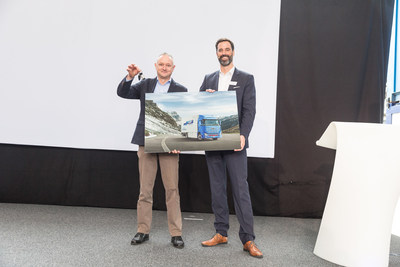
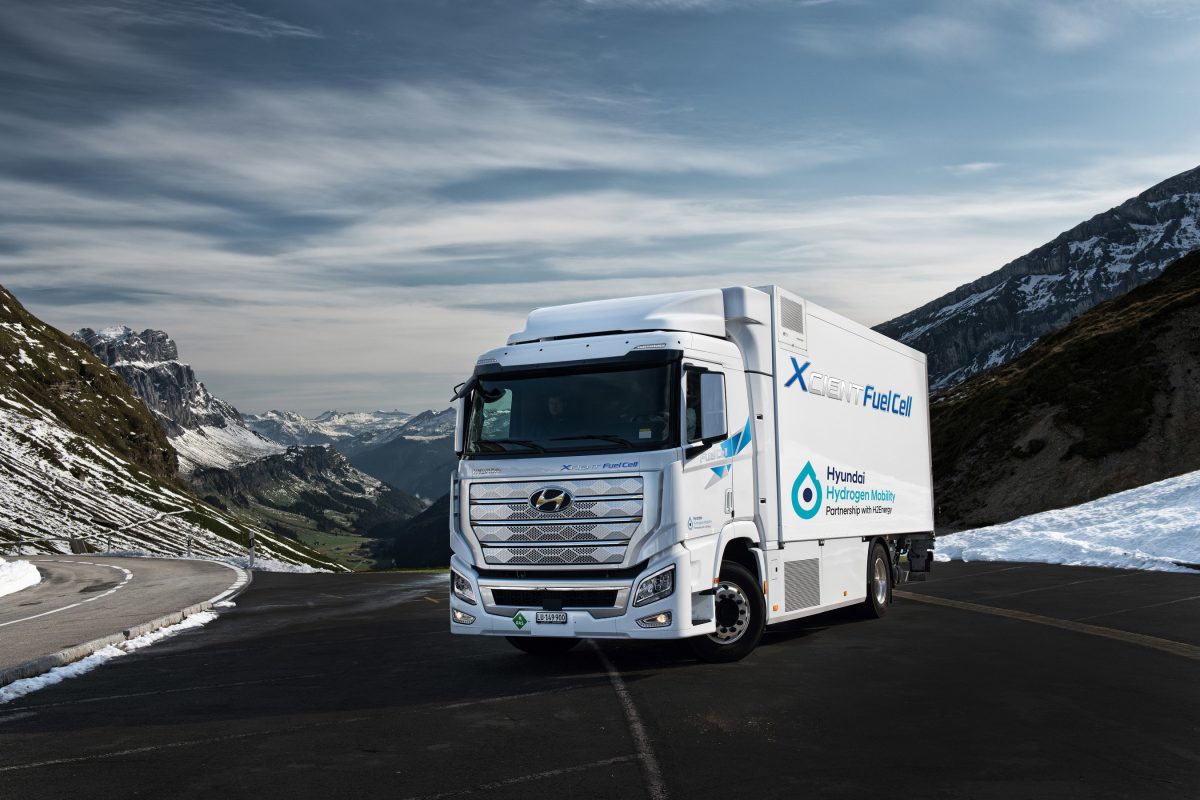
SEOUL, South Korea and LUZERN, Switzerland, Oct. 7, 2020 /PRNewswire/ — Hyundai Motor Company today delivered the first seven units of its XCIENT Fuel Cell, the world’s first mass-produced fuel cell electric heavy-duty truck, to customers in Switzerland, with a total of 50 hitting the roads there this year. The delivery of XCIENT Fuel Cell marks the official entry of Hyundai’s commercial vehicles in the European market, a touchstone for the company’s expansion into the North American and Chinese commercial markets.

Hyundai Motor’s Delivery of XCIENT Fuel Cell Trucks in Europe


Hyundai Motor’s Delivery of XCIENT Fuel Cell Trucks in Europe


Hyundai Motor’s Delivery of XCIENT Fuel Cell Trucks in Europe


Hyundai Motor’s Delivery of XCIENT Fuel Cell Trucks in Europe


Hyundai Motor’s Delivery of XCIENT Fuel Cell Trucks in Europe

«The delivery of XCIENT Fuel Cell starts a new chapter not only for Hyundai’s hydrogen push, but also the global community’s use of hydrogen as a clean energy source,» said In Cheol Lee, Executive Vice President and Head of Commercial Vehicle Division at Hyundai Motor. «Today’s delivery is just a beginning as it opens endless possibilities for clean mobility. With successful delivery of the first XCIENT Fuel Cell trucks, we proudly announce our plan to expand beyond Europe to North America and China where we are already making great progress.»

Production capacity of the XCIENT Fuel Cell will reach 2,000 units per year by 2021 to support its expansion into Europe, the U.S. and China as demand for clean mobility grows. The increase in capacity will be backed by a USD 1.3 billion investment in addition to a previously announced USD 6.4 billion stake in establishing a hydrogen ecosystem to support creation of a hydrogen society.

In the U.S., Hyundai is collaborating with logistics leaders to supply mass-produced fuel cell heavy-duty trucks. Hyundai revealed the fuel cell-powered HDC-6 NEPTUNE Concept Class 8 heavy-duty truck at the North American Commercial Vehicle (NACV) Show in October 2019, hinting at what the future holds and Hyundai’s plans for it. To back this plan, Hyundai is partnering with companies to build a complete hydrogen value chain covering everything from hydrogen production and charging stations to service and maintenance. The North American market will also get a 6×4 tractor model. By 2030, Hyundai expects more than 12,000 fuel cell trucks to hit the U.S. roads.

Hyundai also is working with various parties in China, which aims to get 1 million hydrogen vehicles on its roads by 2030 as the country’s hydrogen industry is on a sharp growth trend, creating massive potential. Initially, Hyundai will focus on China’s four major hydrogen hubs: Jin-jin-ji, Yangtze River Delta, Guangdong Province and Sichuan Province. It is currently discussing cooperative initiatives such as a joint venture with local partners. 

Three fuel cell electric trucks are scheduled for launch in China: a medium-duty truck in 2022, a heavy-duty truck in in a couple of years, and another heavy-duty truck strategically designed for the China market. With these models, Hyundai’s goal is to achieve aggregate sales volume of 27,000 units by 2030.

A key to Hyundai’s global expansion of fuel cell trucks will be the successful launch of XCIENT Fuel Cell in Europe. The seven customers who received the first batch of XCIENT Fuel Cell trucks will haul payloads of consumer goods around Switzerland, emitting nothing but clean water. The operations will be backed by a robust green hydrogen ecosystem.

In 2019, Hyundai Motor Company formed Hyundai Hydrogen Mobility (HHM), a joint venture with Swiss company H2 Energy. HHM also is partnering with Hydrospider, a joint venture of H2 Energy, Alpiq and Linde. The customers will be leasing XCIENT Fuel Cell trucks from HHM on a pay-per-use basis that does not require an initial investment. Hyundai will take the success in Switzerland to broader European markets as Hyundai establishes solutions and partner networks in Germany, Norway, the Netherlands and Austria.

As part of its production expansion plan, Hyundai expects to supply 1,600 commercial fuel cell trucks by 2025. Currently, Coop, Migros, Traveco, Galliker Logistics, Camion Transport, F. Murpf AG and G. Leclerc Transport AG along with others have placed orders for XCIENT Fuel Cell. They will be utilizing the trucks to haul everything from food to cars around Europe.

To support the growing hydrogen ecosystem, Hyundai has a business case for more than 100 hydrogen fueling stations in Switzerland, which is enough not only for commercial vehicles, but also passenger fuel cell electric vehicles. Likewise, Hyundai plans to act as a sector coupler in bringing various players to the hydrogen value chain as part of its efforts to bring value.

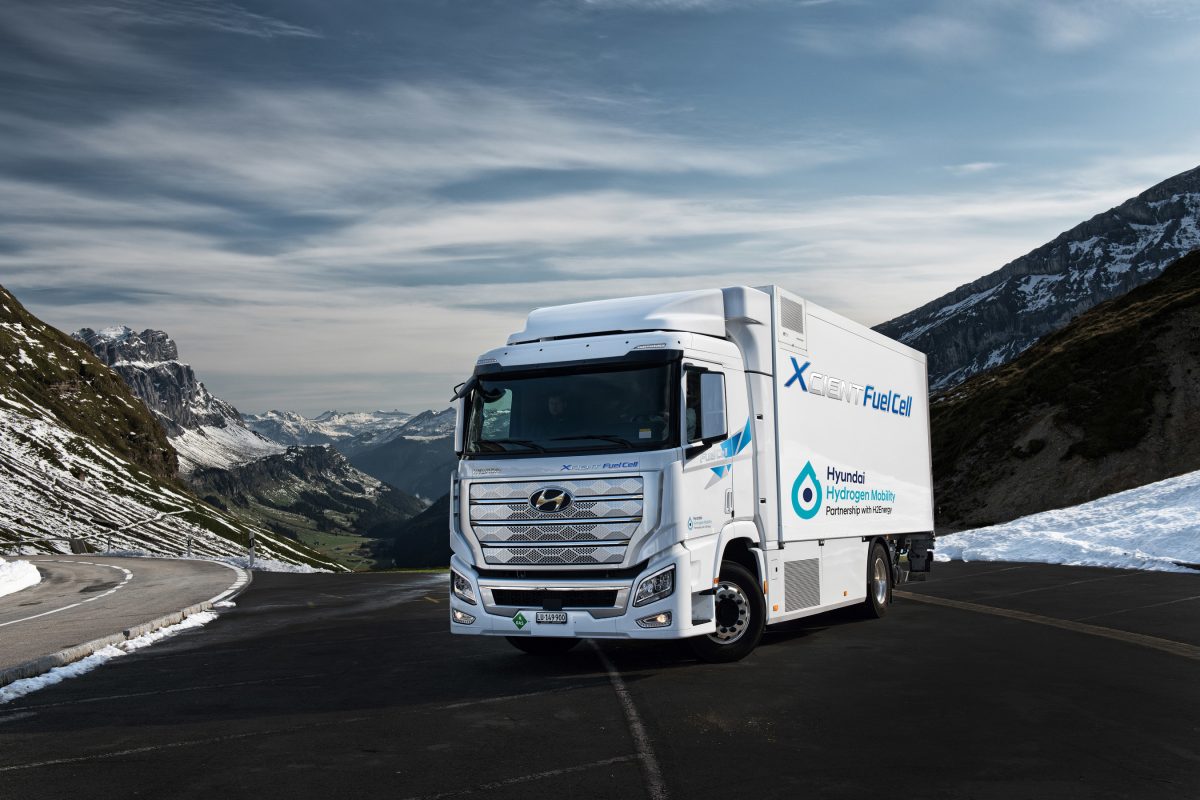
XCIENT is powered by a 190-kW hydrogen fuel cell system with dual 95-kW fuel cell stacks. Seven large hydrogen tanks offer a combined storage capacity of around 32.09 kg of hydrogen. The driving range per charge for XCIENT Fuel Cell is about 400km*, which was developed with an optimal balance between the specific requirements from the potential commercial fleet customers and the charging infrastructure in Switzerland. Refueling time for each truck takes approximately 8~20 minutes.

Hyundai has been devoting itself to further develop fuel cell technology and establish the supply chain to realize a ‘Hydrogen Economy’ for a better and cleaner future, an effort receiving worldwide acclaim. Hyundai Motor’s Hydrogen Mobility Solution won the Truck Innovation Award at the International Truck of the Year (IToY) last year, and XCIENT FC won the Innovation Award in hydrogen energy and fuel cell technology at the 5th Shanghai Forum held on September this year.

* Driving distance range around 400km in the 4X2 truck with refrigerated upfit configuration while operating 34ton truck + trailer combination


Photo – https://mma.prnewswire.com/media/1307882/XCIENT_Fuel_Cell_Trucks_1.jpg  
Photo – https://mma.prnewswire.com/media/1308782/XCIENT_Fuel_Cell_Trucks_2.jpg  
Photo – https://mma.prnewswire.com/media/1308783/XCIENT_Fuel_Cell_Trucks_Panorama.jpg  
Photo – https://mma.prnewswire.com/media/1308784/XCIENT_Fuel_Cell_Trucks_3.jpg  
Photo – https://mma.prnewswire.com/media/1308785/XCIENT_Fuel_Cell_Trucks_4.jpg  

4 preguntas frecuentes sobre programas del Gobierno

WASHINGTON, 7 de octubre de 2020 /PRNewswire-HISPANIC PR WIRE/ — Encontrar información confiable y oficial sobre los programas y servicios del Gobierno de Estados Unidos puede ser un reto, sobre todo cuando uno no sabe dónde buscar. Es por esto que, para celebrar el Mes de la Herencia Hispana, en USAGov en Español, su guía de…

WASHINGTON, 7 de octubre de 2020 /PRNewswire-HISPANIC PR WIRE/ — Encontrar información confiable y oficial sobre los programas y servicios del Gobierno de Estados Unidos puede ser un reto, sobre todo cuando uno no sabe dónde buscar. Es por esto que, para celebrar el Mes de la Herencia Hispana, en USAGov en Español, su guía de información del Gobierno, escogimos las preguntas más frecuentemente hechas por los hispanos y las respondimos en conjunto con las agencias federales respectivas.

USA.gov en español.

¿Cuántos créditos necesito para recibir los beneficios de jubilación del Seguro Social y cuál es la edad mínima para jubilarse?

Usted debe contar con una cantidad mínima de 40 créditos para tener derecho a recibir los beneficios de jubilación. Un trabajador puede ganar un máximo de cuatro créditos por año y un máximo de cuarenta en su vida laboral. Si no está seguro de cuántos créditos tiene, puede crear una cuenta en línea (en inglés) para tener acceso a su estado de cuenta.

Para jubilarse y comenzar a recibir los beneficios del Seguro Social debe tener, por lo menos, 62 años. Sin embargo, si usted elige postergar los beneficios recibirá un aumento en la cantidad que reciba dependiendo de la edad a la que los reclame. Para evaluar cada caso en particular, es recomendable consultar el planificador de beneficios por jubilación.

¿Cómo puedo saber si soy elegible para obtener ayuda para mis gastos básicos?

Encuentre información actualizada sobre los beneficios y programas del Gobierno disponibles y verifique su elegibilidad para más de 1,000 programas federales y estatales a través de un cuestionario interactivo con el buscador del sitio web Benefits.gov.

Explore los beneficios según la categoría, como educación y capacitación, vivienda y servicios públicos, entre otras. Adicionalmente, puede filtrar los resultados por agencia, a nivel estatal y federal, conocer las últimas actualizaciones y noticias relacionadas con los programas de beneficios y obtener respuestas a sus preguntas más urgentes.

¿Cuál es la diferencia entre Medicare y Medicaid?

Medicare es un seguro médico para las personas mayores de 65 años, personas más jóvenes con discapacidades o enfermedad renal terminal, sin importar sus ingresos. Obtenga más información sobre elegibilidad y planes de Medicare.

Medicaid es un programa de asistencia de salud que cubre los gastos médicos de las personas de bajos ingresos, sin importar su edad. Averigüe si usted o su familia son elegibles para Medicaid.

Usted puede tener Medicare y Medicaid si es elegible para los dos programas.

¿Cómo puedo obtener ayuda para la vivienda?

Si necesita ayuda con el pago de su alquiler de su hogar, desea reparar el lugar donde vive o comprar su primera casa, conozca los beneficios que el Gobierno de Estados Unidos ofrece a propietarios e inquilinos de casas o apartamentos.

Encuentre información sobre el programa de vivienda pública en su estado, para facilitar el alquiler a bajo costo de casas o departamentos a familias de bajos recursos; averigüe si puede beneficiarse del Programa de Vales de Elección de Vivienda o si puede acceder al programa de préstamos de la Administración Federal de Vivienda Federal (FHA, sigla en inglés) y más en USAGov en Español.

Para más información de contacto de otros departamentos y agencias del Gobierno; direcciones de sitios web, correos electrónicos, números de teléfono, direcciones y más visite nuestro directorio de agencias federales.

USAGov en Español es parte de USAGov, un programa federal que lo conecta a la información y los servicios de las agencias, los departamentos y programas del Gobierno de Estados Unidos. USAGov lo ayuda a encontrar respuestas a sus preguntas en inglés y español. Contáctenos por teléfono, o a través de las redes sociales en Facebook o Twitter.

Logo – https://mma.prnewswire.com/media/799928/USA_gov_en_espanol_Logo.jpg


FUENTE USA.gov en español

Duke Energy to expand electric vehicle charging in South Carolina

GREENVILLE, S.C., Oct. 7, 2020 /PRNewswire/ — As new electric vehicles (EV) enter the market and strong sales growth continues nationwide, the Public Service Commission of South Carolina (PSCSC) has approved two Duke Energy electric transportation (ET) pilot programs that will allow South Carolina to join other states in deploying EV infrastructure to meet the needs of this growing market.

<div…

GREENVILLE, S.C., Oct. 7, 2020 /PRNewswire/ — As new electric vehicles (EV) enter the market and strong sales growth continues nationwide, the Public Service Commission of South Carolina (PSCSC) has approved two Duke Energy electric transportation (ET) pilot programs that will allow South Carolina to join other states in deploying EV infrastructure to meet the needs of this growing market.

Originally proposed in 2018, Duke Energy Carolinas and Duke Energy Progress participated in extensive working-group sessions with stakeholders for feedback on the innovative plans. The approved programs – the first in the Carolinas – reflect the inclusion of much of that feedback, as well as agreements with the Office of Regulatory Staff and ChargePoint.

«Electric vehicles are coming to South Carolina, but more investment is needed to grow the adoption of this evolving technology and the benefits it brings to the state,» said Mike Callahan, Duke Energy’s South Carolina president. «We’re listening to our customers to ensure we understand their electrification plans and needs. These pilot programs will help prepare us to meet the challenge to ensure we can keep up with increasing demand for electrification.»

Program Details

Fast Charging Program

  • Duke Energy will install, own and operate 60 fast chargers across Duke Energy Carolinas and Duke Energy Progress South Carolina territories to provide a foundational level of infrastructure and facilitate EV market growth. Fast chargers installed under this program will feature next-generation power output of 100 kilowatts (kW) and above, ensuring South Carolina keeps pace with advances in the market.

Residential EV Charging Program

  • This program will provide up to a total of $1,000 for 400 residential Duke Energy Carolinas customers who install a Level 2 charging station, provide access to their charging data, and manage EV charging load to occur during off-peak periods.

Duke Energy Carolinas is the electric utility that serves customers primarily in the Upstate region of South Carolina, while Duke Energy Progress serves customers in the Pee Dee.

The pilot programs were designed to support the growing EV market in South Carolina considering the significant economic benefits created by switching transportation fuel from gasoline to electricity. Expanding access to fast-charging infrastructure will allow customers across South Carolina who drive electric to enjoy significant fuel cost savings and help eliminate emissions from transportation. The residential program from Duke Energy Carolinas will also gather current charging load data to better understand the effects of EVs on Duke Energy’s electric system and determine the ability of customers to respond to load management programs.

The findings of these programs will be available to the public through an annual stakeholder engagement process as well as a final report submitted to the PSCSC. The programs start Jan. 1, 2021. Duke Energy customers interested in participating can learn more at www.duke-energy.com/business/products/park-and-plug.

The South Carolina programs join others that have been proposed or implemented across the states served by Duke Energy. The company is also leading by example, recently announcing that by 2030, Duke Energy will convert all its light-duty vehicles to electric and 50 percent of its medium-duty, heavy-duty and off-road vehicles to EV, plug-in hybrids or other zero-carbon alternatives.

Duke Energy

Duke Energy (NYSE: DUK), a Fortune 150 company headquartered in Charlotte, N.C., is one of the largest energy holding companies in the U.S. It employs 29,000 people and has an electric generating capacity of 51,000 megawatts through its regulated utilities and 2,300 megawatts through its nonregulated Duke Energy Renewables unit.

Duke Energy is transforming its customers’ experience, modernizing the energy grid, generating cleaner energy and expanding natural gas infrastructure to create a smarter energy future for the people and communities it serves. The Electric Utilities and Infrastructure unit’s regulated utilities serve 7.8 million retail electric customers in six states: North Carolina, South Carolina, Florida, Indiana, Ohio and Kentucky. The Gas Utilities and Infrastructure unit distributes natural gas to 1.6 million customers in five states: North Carolina, South Carolina, Tennessee, Ohio and Kentucky. The Duke Energy Renewables unit operates wind and solar generation facilities across the U.S., as well as energy storage and microgrid projects.

Duke Energy was named to Fortune’s 2020 «World’s Most Admired Companies» list and Forbes’ «America’s Best Employers» list. More information about the company is available at duke-energy.com. The Duke Energy News Center contains news releases, fact sheets, photos, videos and other materials. Duke Energy’s illumination features stories about people, innovations, community topics and environmental issues. Follow Duke Energy on Twitter, LinkedIn, Instagram and Facebook.

Contact: Ryan Mosier
24-Hour: 800.559.3853

Cision View original content to download multimedia:http://www.prnewswire.com/news-releases/duke-energy-to-expand-electric-vehicle-charging-in-south-carolina-301147820.html

SOURCE Duke Energy

Hyundai Motor’s Delivery of XCIENT Fuel Cell Trucks in Europe Heralds Its Commercial Truck Expansion to Global Markets

  • With a successful launch in Europe, Hyundai announces plans to offer XCIENT Fuel Cell heavy-duty commercial trucks in North America and China
  • Production capacity of XCIENT Fuel Cell to reach 2,000 units per year by 2021 to support expansion in Europe, the U.S. and China as demand for clean transport solutions grows
  • First seven units of the world’s first mass-produced…

  • With a successful launch in Europe, Hyundai announces plans to offer XCIENT Fuel Cell heavy-duty commercial trucks in North America and China
  • Production capacity of XCIENT Fuel Cell to reach 2,000 units per year by 2021 to support expansion in Europe, the U.S. and China as demand for clean transport solutions grows
  • First seven units of the world’s first mass-produced heavy-duty fuel cell truck delivered to customers in Switzerland start hauling today, emitting only water

SEOUL, South Korea and LUZERN, Switzerland, Oct. 7, 2020 /PRNewswire/ — Hyundai Motor Company today delivered the first seven units of its XCIENT Fuel Cell, the world’s first mass-produced fuel cell electric heavy-duty truck, to customers in Switzerland, with a total of 50 hitting the roads there this year. The delivery of XCIENT Fuel Cell marks the official entry of Hyundai’s commercial vehicles in the European market, a touchstone for the company’s expansion into the North American and Chinese commercial markets.
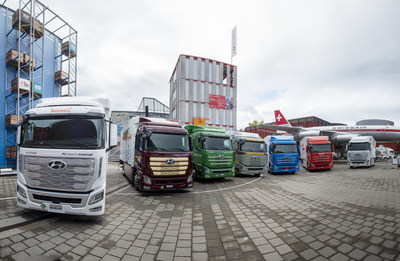
Hyundai Motor’s Delivery of XCIENT Fuel Cell Trucks in Europe


Hyundai Motor’s Delivery of XCIENT Fuel Cell Trucks in Europe


Hyundai Motor’s Delivery of XCIENT Fuel Cell Trucks in Europe


Hyundai Motor’s Delivery of XCIENT Fuel Cell Trucks in Europe


Hyundai Motor’s Delivery of XCIENT Fuel Cell Trucks in Europe

«The delivery of XCIENT Fuel Cell starts a new chapter not only for Hyundai’s hydrogen push, but also the global community’s use of hydrogen as a clean energy source,» said In Cheol Lee, Executive Vice President and Head of Commercial Vehicle Division at Hyundai Motor. «Today’s delivery is just a beginning as it opens endless possibilities for clean mobility. With successful delivery of the first XCIENT Fuel Cell trucks, we proudly announce our plan to expand beyond Europe to North America and China where we are already making great progress.»

Production capacity of the XCIENT Fuel Cell will reach 2,000 units per year by 2021 to support its expansion into Europe, the U.S. and China as demand for clean mobility grows. The increase in capacity will be backed by a USD 1.3 billion investment in addition to a previously announced USD 6.4 billion stake in establishing a hydrogen ecosystem to support creation of a hydrogen society.

In the U.S., Hyundai is collaborating with logistics leaders to supply mass-produced fuel cell heavy-duty trucks. Hyundai revealed the fuel cell-powered HDC-6 NEPTUNE Concept Class 8 heavy-duty truck at the North American Commercial Vehicle (NACV) Show in October 2019, hinting at what the future holds and Hyundai’s plans for it. To back this plan, Hyundai is partnering with companies to build a complete hydrogen value chain covering everything from hydrogen production and charging stations to service and maintenance. The North American market will also get a 6×4 tractor model. By 2030, Hyundai expects more than 12,000 fuel cell trucks to hit the U.S. roads.

Hyundai also is working with various parties in China, which aims to get 1 million hydrogen vehicles on its roads by 2030 as the country’s hydrogen industry is on a sharp growth trend, creating massive potential. Initially, Hyundai will focus on China’s four major hydrogen hubs: Jin-jin-ji, Yangtze River Delta, Guangdong Province and Sichuan Province. It is currently discussing cooperative initiatives such as a joint venture with local partners. 

Three fuel cell electric trucks are scheduled for launch in China: a medium-duty truck in 2022, a heavy-duty truck in in a couple of years, and another heavy-duty truck strategically designed for the China market. With these models, Hyundai’s goal is to achieve aggregate sales volume of 27,000 units by 2030.

A key to Hyundai’s global expansion of fuel cell trucks will be the successful launch of XCIENT Fuel Cell in Europe. The seven customers who received the first batch of XCIENT Fuel Cell trucks will haul payloads of consumer goods around Switzerland, emitting nothing but clean water. The operations will be backed by a robust green hydrogen ecosystem.

In 2019, Hyundai Motor Company formed Hyundai Hydrogen Mobility (HHM), a joint venture with Swiss company H2 Energy. HHM also is partnering with Hydrospider, a joint venture of H2 Energy, Alpiq and Linde. The customers will be leasing XCIENT Fuel Cell trucks from HHM on a pay-per-use basis that does not require an initial investment. Hyundai will take the success in Switzerland to broader European markets as Hyundai establishes solutions and partner networks in Germany, Norway, the Netherlands and Austria.

As part of its production expansion plan, Hyundai expects to supply 1,600 commercial fuel cell trucks by 2025. Currently, Coop, Migros, Traveco, Galliker Logistics, Camion Transport, F. Murpf AG and G. Leclerc Transport AG along with others have placed orders for XCIENT Fuel Cell. They will be utilizing the trucks to haul everything from food to cars around Europe.

To support the growing hydrogen ecosystem, Hyundai has a business case for more than 100 hydrogen fueling stations in Switzerland, which is enough not only for commercial vehicles, but also passenger fuel cell electric vehicles. Likewise, Hyundai plans to act as a sector coupler in bringing various players to the hydrogen value chain as part of its efforts to bring value.

XCIENT is powered by a 190-kW hydrogen fuel cell system with dual 95-kW fuel cell stacks. Seven large hydrogen tanks offer a combined storage capacity of around 32.09 kg of hydrogen. The driving range per charge for XCIENT Fuel Cell is about 400km*, which was developed with an optimal balance between the specific requirements from the potential commercial fleet customers and the charging infrastructure in Switzerland. Refueling time for each truck takes approximately 8~20 minutes.

Hyundai has been devoting itself to further develop fuel cell technology and establish the supply chain to realize a ‘Hydrogen Economy’ for a better and cleaner future, an effort receiving worldwide acclaim. Hyundai Motor’s Hydrogen Mobility Solution won the Truck Innovation Award at the International Truck of the Year (IToY) last year, and XCIENT FC won the Innovation Award in hydrogen energy and fuel cell technology at the 5th Shanghai Forum held on September this year.

* Driving distance range around 400km in the 4X2 truck with refrigerated upfit configuration while operating 34ton truck + trailer combination

Cision View original content to download multimedia:http://www.prnewswire.com/news-releases/hyundai-motors-delivery-of-xcient-fuel-cell-trucks-in-europe-heralds-its-commercial-truck-expansion-to-global-markets-301147819.html

SOURCE Hyundai Motor Company

4 preguntas frecuentes sobre programas del Gobierno

WASHINGTON, 7 de octubre de 2020 /PRNewswire-HISPANIC PR WIRE/ — Encontrar información confiable y oficial sobre los programas y servicios del Gobierno de Estados Unidos puede ser un reto, sobre todo cuando uno no sabe dónde buscar. Es por esto que, para celebrar el Mes de la Herencia Hispana, en USAGov en Español, su guía de…

WASHINGTON, 7 de octubre de 2020 /PRNewswire-HISPANIC PR WIRE/ — Encontrar información confiable y oficial sobre los programas y servicios del Gobierno de Estados Unidos puede ser un reto, sobre todo cuando uno no sabe dónde buscar. Es por esto que, para celebrar el Mes de la Herencia Hispana, en USAGov en Español, su guía de información del Gobierno, escogimos las preguntas más frecuentemente hechas por los hispanos y las respondimos en conjunto con las agencias federales respectivas.

USA.gov en español.

¿Cuántos créditos necesito para recibir los beneficios de jubilación del Seguro Social y cuál es la edad mínima para jubilarse?

Usted debe contar con una cantidad mínima de 40 créditos para tener derecho a recibir los beneficios de jubilación. Un trabajador puede ganar un máximo de cuatro créditos por año y un máximo de cuarenta en su vida laboral. Si no está seguro de cuántos créditos tiene, puede crear una cuenta en línea (en inglés) para tener acceso a su estado de cuenta.

Para jubilarse y comenzar a recibir los beneficios del Seguro Social debe tener, por lo menos, 62 años. Sin embargo, si usted elige postergar los beneficios recibirá un aumento en la cantidad que reciba dependiendo de la edad a la que los reclame. Para evaluar cada caso en particular, es recomendable consultar el planificador de beneficios por jubilación.

¿Cómo puedo saber si soy elegible para obtener ayuda para mis gastos básicos?

Encuentre información actualizada sobre los beneficios y programas del Gobierno disponibles y verifique su elegibilidad para más de 1,000 programas federales y estatales a través de un cuestionario interactivo con el buscador del sitio web Benefits.gov.

Explore los beneficios según la categoría, como educación y capacitación, vivienda y servicios públicos, entre otras. Adicionalmente, puede filtrar los resultados por agencia, a nivel estatal y federal, conocer las últimas actualizaciones y noticias relacionadas con los programas de beneficios y obtener respuestas a sus preguntas más urgentes.

¿Cuál es la diferencia entre Medicare y Medicaid?

Medicare es un seguro médico para las personas mayores de 65 años, personas más jóvenes con discapacidades o enfermedad renal terminal, sin importar sus ingresos. Obtenga más información sobre elegibilidad y planes de Medicare.

Medicaid es un programa de asistencia de salud que cubre los gastos médicos de las personas de bajos ingresos, sin importar su edad. Averigüe si usted o su familia son elegibles para Medicaid.

Usted puede tener Medicare y Medicaid si es elegible para los dos programas.

¿Cómo puedo obtener ayuda para la vivienda?

Si necesita ayuda con el pago de su alquiler de su hogar, desea reparar el lugar donde vive o comprar su primera casa, conozca los beneficios que el Gobierno de Estados Unidos ofrece a propietarios e inquilinos de casas o apartamentos.

Encuentre información sobre el programa de vivienda pública en su estado, para facilitar el alquiler a bajo costo de casas o departamentos a familias de bajos recursos; averigüe si puede beneficiarse del Programa de Vales de Elección de Vivienda o si puede acceder al programa de préstamos de la Administración Federal de Vivienda Federal (FHA, sigla en inglés) y más en USAGov en Español.

Para más información de contacto de otros departamentos y agencias del Gobierno; direcciones de sitios web, correos electrónicos, números de teléfono, direcciones y más visite nuestro directorio de agencias federales.

USAGov en Español es parte de USAGov, un programa federal que lo conecta a la información y los servicios de las agencias, los departamentos y programas del Gobierno de Estados Unidos. USAGov lo ayuda a encontrar respuestas a sus preguntas en inglés y español. Contáctenos por teléfono, o a través de las redes sociales en Facebook o Twitter.

Logo – https://mma.prnewswire.com/media/799928/USA_gov_en_espanol_Logo.jpg


FUENTE USA.gov en español

4 preguntas frecuentes sobre programas del Gobierno

WASHINGTON, 7 de octubre de 2020 /PRNewswire-HISPANIC PR WIRE/ — Encontrar información confiable y oficial sobre los programas y servicios del Gobierno de Estados Unidos puede ser un reto, sobre todo cuando uno no sabe dónde buscar. Es por esto que, para celebrar el Mes de la Herencia Hispana, en USAGov en Español, su guía de…

WASHINGTON, 7 de octubre de 2020 /PRNewswire-HISPANIC PR WIRE/ — Encontrar información confiable y oficial sobre los programas y servicios del Gobierno de Estados Unidos puede ser un reto, sobre todo cuando uno no sabe dónde buscar. Es por esto que, para celebrar el Mes de la Herencia Hispana, en USAGov en Español, su guía de información del Gobierno, escogimos las preguntas más frecuentemente hechas por los hispanos y las respondimos en conjunto con las agencias federales respectivas.

USA.gov en español.

¿Cuántos créditos necesito para recibir los beneficios de jubilación del Seguro Social y cuál es la edad mínima para jubilarse?

Usted debe contar con una cantidad mínima de 40 créditos para tener derecho a recibir los beneficios de jubilación. Un trabajador puede ganar un máximo de cuatro créditos por año y un máximo de cuarenta en su vida laboral. Si no está seguro de cuántos créditos tiene, puede crear una cuenta en línea (en inglés) para tener acceso a su estado de cuenta.

Para jubilarse y comenzar a recibir los beneficios del Seguro Social debe tener, por lo menos, 62 años. Sin embargo, si usted elige postergar los beneficios recibirá un aumento en la cantidad que reciba dependiendo de la edad a la que los reclame. Para evaluar cada caso en particular, es recomendable consultar el planificador de beneficios por jubilación.

¿Cómo puedo saber si soy elegible para obtener ayuda para mis gastos básicos?

Encuentre información actualizada sobre los beneficios y programas del Gobierno disponibles y verifique su elegibilidad para más de 1,000 programas federales y estatales a través de un cuestionario interactivo con el buscador del sitio web Benefits.gov.

Explore los beneficios según la categoría, como educación y capacitación, vivienda y servicios públicos, entre otras. Adicionalmente, puede filtrar los resultados por agencia, a nivel estatal y federal, conocer las últimas actualizaciones y noticias relacionadas con los programas de beneficios y obtener respuestas a sus preguntas más urgentes.

¿Cuál es la diferencia entre Medicare y Medicaid?

Medicare es un seguro médico para las personas mayores de 65 años, personas más jóvenes con discapacidades o enfermedad renal terminal, sin importar sus ingresos. Obtenga más información sobre elegibilidad y planes de Medicare.

Medicaid es un programa de asistencia de salud que cubre los gastos médicos de las personas de bajos ingresos, sin importar su edad. Averigüe si usted o su familia son elegibles para Medicaid.

Usted puede tener Medicare y Medicaid si es elegible para los dos programas.

¿Cómo puedo obtener ayuda para la vivienda?

Si necesita ayuda con el pago de su alquiler de su hogar, desea reparar el lugar donde vive o comprar su primera casa, conozca los beneficios que el Gobierno de Estados Unidos ofrece a propietarios e inquilinos de casas o apartamentos.

Encuentre información sobre el programa de vivienda pública en su estado, para facilitar el alquiler a bajo costo de casas o departamentos a familias de bajos recursos; averigüe si puede beneficiarse del Programa de Vales de Elección de Vivienda o si puede acceder al programa de préstamos de la Administración Federal de Vivienda Federal (FHA, sigla en inglés) y más en USAGov en Español.

Para más información de contacto de otros departamentos y agencias del Gobierno; direcciones de sitios web, correos electrónicos, números de teléfono, direcciones y más visite nuestro directorio de agencias federales.

USAGov en Español es parte de USAGov, un programa federal que lo conecta a la información y los servicios de las agencias, los departamentos y programas del Gobierno de Estados Unidos. USAGov lo ayuda a encontrar respuestas a sus preguntas en inglés y español. Contáctenos por teléfono, o a través de las redes sociales en Facebook o Twitter.

Logo – https://mma.prnewswire.com/media/799928/USA_gov_en_espanol_Logo.jpg


FUENTE USA.gov en español

Boom Makes History with Supersonic XB-1 Rollout

DENVER, Oct. 7, 2020 /PRNewswire/ — Boom Supersonic, the aerospace company building the world’s fastest airliner, today unveils its supersonic demonstrator,

DENVER, Oct. 7, 2020 /PRNewswire/ — Boom Supersonic, the aerospace company building the world’s fastest airliner, today unveils its supersonic demonstrator, XB-1, history’s first independently developed supersonic jet. 

To design and build XB-1, Boom recruited a team of experts from around the industry, forged relationships with key suppliers, and built a strong safety culture. XB-1 is slated to fly for the first time in 2021 and will undergo a 100% carbon-neutral flight test program. Boom’s innovations include developing one of the highest-efficiency civil supersonic engine intakes ever tested, demonstrating Boom’s ability to deliver a breakthrough in propulsive efficiency for Overture.

«Boom continues to make progress towards our founding mission—making the world dramatically more accessible,» said Blake Scholl, Boom founder and CEO. «XB-1 is an important milestone towards the development of our commercial airliner, Overture, making sustainable supersonic flight mainstream and fostering human connection.»

This morning at 11AM MDT, the world will see XB-1 fully assembled for the first time and hear from the team that designed, built and are currently testing the aircraft. Boom’s XB-1 virtual rollout will highlight some of XB-1’s notable features including:

  • Shape: XB-1’s 71-foot-long fuselage has been optimally shaped for high-speed aerodynamic efficiency.
  • Materials: The carbon-composite airframe maintains its strength and rigidity, even under the high temperatures and stresses of supersonic flight.
  • Wing: The delta wing balances low-speed stability at takeoff and landing with high-speed efficiency.
  • Propulsion: Three J85-15 engines, designed by General Electric, provide more than 12,000 pounds of thrust, allowing XB-1 to fly at breakthrough supersonic speeds.
  • Cockpit ergonomics: Guidance and feedback from XB-1’s test pilots played a key role in cockpit design, which was the product of hundreds of hours of human factors and usability testing.
  • Forward vision system: XB-1 leverages a high-resolution video camera and cockpit display to give pilots a virtual window through the nose, providing superior runway visibility for landing.

Additionally, Boom will be sharing the virtual presentation stage with a number of aerospace leaders, Boom partners and investors. These guests will discuss the supersonic future, XB-1, and their excitement for Overture. Event speakers include:

  • NASA Leaders and Astronauts: Maj. Gen. Charles F. Bolden, Jr, USMC (Ret.), 12th NASA Administrator and Capt. Robert «Hoot» Gibson, USN (Ret.)
  • Chief Concorde pilot for British Airways, Captain Mike Bannister
  • Supersonic: The Design and Lifestyle of Concorde author Lawrence Azerrad
  • U.S. Air Force Brig. General Ryan Britton
  • Chairman of Japan Airlines, Yoshiharu Ueki
  • Strategy Director at Rolls-Royce Civil Aerospace, Simon Carlisle
  • Founder of Prometheus Fuels, Rob McGinnis, a company producing net zero carbon jet fuel, an evolution beyond low-carbon sustainable fuels
  • Boom investors, Sam Altman, Emerson Collective, John Collison, Reid Hoffman, Jeff Holden, Greg McAdoo and Sir Michael Moritz
  • Boom advisors, Dr. Ray O. Johnson and Dr. Lourdes Maurice

After rollout, XB-1 will complete its ongoing, extensive ground test program before heading to Mojave, California in 2021 for flight test. At the same time, the company will finalize Overture’s propulsion system and conduct wind tunnel tests to validate aircraft design. When XB-1 breaks the sound barrier in flight, Boom will be finalizing the design of Overture, whose own rollout is on track for 2025.

About the XB-1 Rollout Event

The event streams at 11 a.m. MDT on www.boomsupersonic.com, followed by a Q&A session with Boom’s Founder & CEO. Viewers may submit questions throughout the event. The virtual rollout broadcast will be available on demand on Boom’s website after the initial streaming event, as well as on Boom’s YouTube channel.

More details can be found at boomsupersonic.com/xb-1.

About Boom
Boom Supersonic is redefining commercial flight by bringing sustainable supersonic flight back to the skies with Overture. As the world’s fastest airliner, Overture is designed and committed to industry-leading standards of speed, safety, and sustainability. Boom’s vision is to bring families, businesses, and cultures closer together through supersonic travel and make the world dramatically more accessible. Boom is the first commercial airplane manufacturer to commit to a carbon-neutral flight test program and to build sustainability into its entire aircraft program. The company is backed by world-class investors and has 30 aircraft on pre-order. Founded in 2014, Boom has assembled a team of over 140 full-time employees who have made contributions to over 220 air and spacecraft programs. For more information, please visit https://boomsupersonic.com.

Cision View original content to download multimedia:http://www.prnewswire.com/news-releases/boom-makes-history-with-supersonic-xb-1-rollout-301147181.html

SOURCE Boom Supersonic

Sonesta Continues Dramatic Domestic Growth

NEWTON, Mass., Oct. 7, 2020 /PRNewswire/ — Sonesta International Hotels Corporation is now one of the nation’s fastest growing hospitality management companies, with the pending addition of another large hotel portfolio in the coming months. Service Properties Trust (Nasdaq: SVC) announced today that it will transfer branding and management of 98 hotels to Sonesta, including 2 full-service, 56 select-service and 40 extended-stay hotels across the U.S.

<div…

NEWTON, Mass., Oct. 7, 2020 /PRNewswire/ — Sonesta International Hotels Corporation is now one of the nation’s fastest growing hospitality management companies, with the pending addition of another large hotel portfolio in the coming months. Service Properties Trust (Nasdaq: SVC) announced today that it will transfer branding and management of 98 hotels to Sonesta, including 2 full-service, 56 select-service and 40 extended-stay hotels across the U.S.

Sonesta will transition management of 9 of these hotels on December 15, 2020 and the remaining 89 on January 31, 2021. This latest announcement follows two other recent SVC transactions contributing to Sonesta’s substantial growth and Sonesta’s new position as SVC’s largest operator:

  • Four hotels were transferred by SVC during September 2020 and have all been reflagged as Sonesta hotels.
  • 103 hotels will be transferred by SVC on November 30 including 22 full-service and 81 extended-stay hotels in the U.S., the District of Columbia, Ontario, Canada and Puerto Rico. Reservations are currently being accepted at these properties on Sonesta.com for stays beginning December 1, 2020.

«We’re proud that SVC continues to grow its relationship with Sonesta by entrusting us with management of another sizable portfolio of their hotels and resorts», said Carlos Flores, President and CEO, Sonesta International Hotels Corporation. «We are prepared and confident in our abilities to ensure these hotels receive the same level of exceptional care and support as Sonesta’s existing 80 plus properties.  We’re thrilled to welcome these new hotels to our growing portfolio of destinations.»

It is expected that by the end of Q1 2021, Sonesta will have over 250 properties in the U.S. and over 280 properties globally, expanding its U.S. footprint in key tourism and business destinations by more than fourfold.  In the U.S., Sonesta will increase from three to five brands: Royal Sonesta, Sonesta Hotels & Resorts, Sonesta ES Suites, and the two newest brands Sonesta Select and Sonesta Simply Suites.

A complete list of hotel locations will be available upon request. Visit Sonesta.com for the latest brand news, updates and more information on the Sonesta Travel Pass guest loyalty program and to book a stay.  

Featuring a portfolio of diverse and distinctive properties as individual as its guests, there is no typical Sonesta. With a full range of exceptional options found in many of the most memorable destinations in the world, Sonesta proudly exceeds guest’s expectations delivering an authentic experience time and time again.

Sonesta is one of the fastest growing hospitality companies in the U.S., celebrating an approximate 350% increase in its national portfolio. You will soon find nearly 300 Sonesta properties across seven brands operating in the U.S., Canada, Chile, Colombia, Ecuador, Egypt, Peru and St. Maarten. Discover Sonesta hotels, resorts and suites in many of the most traveled U.S. destinations, including Atlanta, Austin, Boston, Chicago, Hilton Head, Houston, Los Angeles, New Orleans, Portland, San Francisco, San Jose, Seattle and St. Louis. For more about Sonesta and its locations, visit Sonesta.com or call +1.617.315.9200 or 800.Sonesta (800.766.3782) in the U.S. and Canada. Follow us on social media @SonestaHotels.

* High-resolution images are available at www.sonesta.com/media for all Sonesta hotels.
Media Contact: Lorie Juliano, ljuliano@sonesta.com office: 617.421.5429 mobile: 508.843.3769

Cision View original content to download multimedia:http://www.prnewswire.com/news-releases/sonesta-continues-dramatic-domestic-growth-301147786.html

SOURCE Sonesta International Hotels Corporation

New Research Indicates Racial Justice is Top Factor Motivating Young Voters of Color

WASHINGTON, Oct. 7, 2020 /PRNewswire-HISPANIC PR WIRE/ — Young voters of color say they are headed to the polls in November because they want to see change around systemic inequality and racism, according to a series of focus groups and findings from a recent poll released today by Advancement…

WASHINGTON, Oct. 7, 2020 /PRNewswire-HISPANIC PR WIRE/ — Young voters of color say they are headed to the polls in November because they want to see change around systemic inequality and racism, according to a series of focus groups and findings from a recent poll released today by Advancement Project National Office. The data was collected as a part of the organization’s Young Voters of Color Get Out the Vote Campaign. The campaign, which launches today, aims to motivate and mobilize young people of color—recognizing that Black, Brown, Native American and Asian American voters will make up one third of all eligible voters in 2020.

National poll reveals structural inequality, police brutality and coronavirus pandemic are at top of minds for young voters of color heading to the polls.

The nationally survey of 1,915 eligible Black, Latinx, Native and Asian American and Pacific Islanders (AAPI) voters ages 18-24 years old, found that young people of color were best motivated to vote with bold messages centering the issues they care most about: racism and systemic inequality.

«Young voters like me are anxious to get to the November election and are scrambling to understand the voting environment,» said Kelsey Perine a senior at Southern University and A & M College and member of Advancement Project’s Young Voters of Color Advisory Committee. «For young people, it can be hard to register in states like Louisiana and it can be challenging to sift through information to learn what is true and untrue. We need to hear about the issues we care about and what to do if we get turned away from the polls.»

Key findings of the national polling (margin of error +/- 3%) and three focus groups including the following:

  • The top issues motivating young voters to cast a ballot this November are: racial justice, the coronavirus pandemic and police brutality.
  • Concerns about coronavirus exposure, confusion about new voting methods, worries about the post office, and lack of awareness of vote-by-mail are indicate more education is needed on how to vote.
  • While young people of color are broadly skeptical of the nation’s political system, they remain engaged in their communities: 27% of respondents reported they had protested this year and 25% reported volunteering their time with a nonprofit or charity in 2020.
  • Qualitative data shows many feel very much left out of the political process and conversation.
  • Messaging describing voting as a «duty of all citizens in a democracy» resonated the least with young voters of color.

«Young people of color have led the racial justice movement this summer with significant wins around policing. They are leading racial justice campaigns in the streets and intend to vote on the issues that mean the most to their communities this fall,» said Judith Browne Dianis, Executive Director of Advancement Project National Office.

Survey results indicate that seventy-eight percent (78%) of young voters of color have taken one or more political actions this year including signing a petition, posting or sharing content online, and protesting. One in four said they had participated in a protest. 

«National, state and local groups reaching out to young people of color during the election season should talk explicitly about racism, injustice and inequality,» Jorge L. Vasquez Jr., Power and Democracy Program Director at Advancement Project National Office.  «We must continue educating young voters about how to safely and securely cast a ballot in 2020. Clear communications about available voting options will help address their understandable anxiety about unfamiliar voting methods and COVID-19 exposure at the polls.»

Advancement Project National Office’s Young Voters of Color Get Out the Vote digital campaign will focus on reaching and helping to educate low-propensity young voters of color, first-time voters, and young voters of color who are eligible to vote but are currently unregistered.

Access the campaign’s messaging guide here.

Advancement Project National Office is a next-generation, multi-racial civil rights organization. Rooted in the great human rights struggles for equality and justice, we exist to fulfill America’s promise of a caring, inclusive and just democracy. We use innovative tools and strategies to strengthen social movements and achieve high impact policy change. Visit www.advancementproject.org 

CONTACT  
Jeralyn Cave, Advancement Project National Office 
jcave@advancementproject.org 
(202) 921-7321

Photo – https://mma.prnewswire.com/media/1308830/BLM.jpg

SOURCE Advancement Project National Office

Washington Voters Support Full Transition to Electric Cars by 2030

SEATTLE, Oct. 7, 2020 /PRNewswire/ — A new poll from Yale University, George Mason University and Climate Nexus, and commissioned by the…

SEATTLE, Oct. 7, 2020 /PRNewswire/ — A new poll from Yale University, George Mason University and Climate Nexus, and commissioned by the nonprofit Coltura, finds 59 percent of Washington voters support a policy requiring new cars in Washington state to be electric starting in 2030.

By a margin of more than 12-to-1, voters believe ending the sale of new gas-powered vehicles in 2030 would have a positive effect on climate change (75% to 6%) and would benefit the health of people in the state (73% to 5%). 

«Requiring that new vehicles be electric by 2030 will result in sharp reductions of carbon emissions and air pollution, and put Washington state on the road to powering its vehicles with cheap, clean, renewable electricity produced in Washington,» said Matthew Metz, co-executive director of Coltura. «It achieves these goals with minimal government spending by creating large, guaranteed EV markets that will incentivize the private sector to invest in EVs and charging.»

Last year, Coltura supported the Clean Cars 2030 bill sponsored by Washington State Representative Nicole Macri (D-Seattle) providing that model-year 2030 and later vehicles must be electric to be registered in Washington. Rep. Macri said, «Washingtonians want to accelerate the switch to clean vehicles as fast as possible, and my bill will help the state lead the nation in this direction.»

«A large majority of Washingtonians are worried about climate change, and they understand the impact it is having on extreme weather, including recent wildfires,» said Dr. Anthony Leiserowitz, Director of the Yale Program on Climate Change Communication. «Washington voters support policies like requiring all new cars to be electric by 2030 that will address climate change.»

Providing a 2030 sunset date to sales of new fossil fuel vehicles will allow utilities, automakers, and landlords to prepare for a smooth off-ramp from dependence on fossil fuels. 

Last month, California Gov. Gavin Newsom announced that the Golden State will be shifting to 100% zero-emission vehicles by 2035.  This survey represents the first public opinion polling on policies that would phase out gasoline-powered vehicles.

Climate Nexus Polling, in partnership with the Yale Program on Climate Change Communication and the George Mason University Center for Climate Change Communication, conducted a representative survey of 812 registered voters in Washington state September 15-29, 2020, with an oversample of 100 voters contacted by phone in state senate districts 3, 5, and 44 (total N=300 interviewed by phone) on September 24-28, 2020.  The total N-size for the mixed mode sample is N=1,112 registered voters. The margin of error for the representative online sample is approximately +/- 3.5%. The poll was sponsored by the state advocacy non-profit Coltura. You can access the toplines here

Coltura is a west-coast based nonprofit improving climate, health and equity by accelerating the switch from gasoline and diesel to cleaner alternatives. Coltura focuses on changing gasoline supply, gasoline demand, and gasoline culture through innovative legal and policy pathways, media, and art.

Contact: Matthew Metz; (206) 799-2795
256176@email4pr.com

Cision View original content:http://www.prnewswire.com/news-releases/washington-voters-support-full-transition-to-electric-cars-by-2030-301147777.html

SOURCE Coltura