Honda lidera por eficiencia en combustible y menores emisiones de CO2 entre fabricantes de automóviles de línea completa según informe U.S. EPA Trends

– Honda continua su larga trayectoria de liderazgo por economía en combustible y bajas emisiones de CO2 según EPA entre los principales fabricantes de automóviles de línea completa por más de 40 años

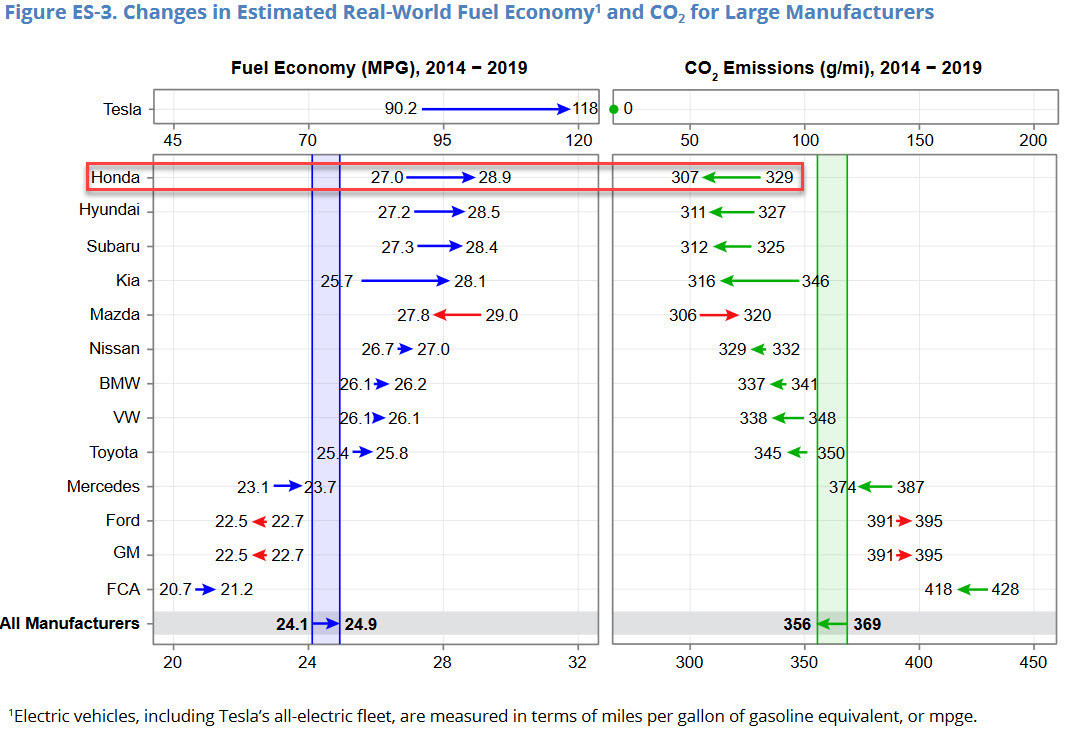
– Los 28.9 mpg de eficiencia en combustible promedio de la flota Honda son 4 mpg más que el promedio de la industria

– Las emisiones promedio de CO2 de la flota superaron el promedio de la industria por 49 g/mi

– Honda establece cifra récord por venta de vehículos eléctricos en los Estados Unidos en 2020

<span…

– Honda continua su larga trayectoria de liderazgo por economía en combustible y bajas emisiones de CO2 según EPA entre los principales fabricantes de automóviles de línea completa por más de 40 años

– Los 28.9 mpg de eficiencia en combustible promedio de la flota Honda son 4 mpg más que el promedio de la industria

– Las emisiones promedio de CO2 de la flota superaron el promedio de la industria por 49 g/mi

– Honda establece cifra récord por venta de vehículos eléctricos en los Estados Unidos en 2020

WASHINGTON, 8 de enero de 2021 /PRNewswire-HISPANIC PR WIRE/ — Dando continuidad a una historia de más de 40 años como líder por eficiencia en combustible, Honda se ratifica como el fabricante de automóviles de línea completa con mayor eficiencia en combustible en los Estados Unidos, según un nuevo informe publicado el pasado miércoles por la Agencia de Protección Ambiental de los Estados Unidos (EPA). En promedio, la flota de Honda es la más económica en consumo de combustible y la de menores emisiones de CO2 de todos los fabricantes de automóviles de línea completa para el año modelo 2019 (MY2019), el último año para el que se cuenta con todos los datos que conforman la base del informe.

Honda Leads Full-Line Automakers in Fuel Efficiency and Lowest CO2 Emissions According to U.S. EPA Trends Report

El informe EPA Automotive Trends de 2020 clasificó a Honda en el primer lugar entre fabricantes de automóviles de línea completa y en segundo lugar a nivel general con un promedio de economía en consumo de combustible «real» para la flota de los Estados Unidos de 28.9 millas por galón (mpg), una mejora de 1.9 mpg en cinco años y 4 mpg por encima del promedio de la industria para el MY2019. Asimismo, el promedio de emisiones de CO2 de la flota de Honda fue de 307 gramos/milla, una mejora de 22 gramos/milla en comparación con los resultados de 2014 y 49 gramos/milla menos (mejor) que el promedio de la industria para el año modelo 2019.

La primera clasificación de los vehículos más eficientes en combustible en los Estados Unidos de la EPA, realizada en 1976, le otorgó el primer lugar al Honda Civic. A partir de ahí, los demás informes de la agencia han destacado a Honda entre los líderes en las mediciones anuales de eficiencia en combustible. Esto quiere decir que Honda ha priorizado la eficiencia de combustible de sus productos durante más de 40 años.

En 2020, Honda estableció un nuevo récord absoluto por comercialización de vehículos eléctricos en los Estados Unidos, con un crecimiento en ventas del 4.5 % a pesar de las grandes dificultades del mercado.

Como parte de los esfuerzos para reducir las emisiones de CO2 en el mundo, Honda se ha planteado el objetivo de que dos tercios de sus automóviles vendidos en 2030 sean eléctricos, y está realizando grandes inversiones para la producción de estos vehículos en los Estados Unidos1, incluido el recientemente renovado Accord Hybrid, el CR-V Hybrid, el Insight y el superdeportivo híbrido Acura NSX.

El compromiso de Honda con el ambiente

Con base en su visión «Cielos azules para nuestros hijos», Honda se enfoca en desarrollar tecnologías para abordar los intereses energéticos y ambientales de la sociedad. La compañía pretende que los vehículos eléctricos representen dos tercios de las ventas de 2030 a nivel global. La Iniciativa de electrificación de Honda en Norteamérica busca que las tecnologías para trenes motrices eléctricos se implementen a una cartera cada vez más amplia de automóviles y camiones ligeros durante los próximos años. La línea actual de vehículos electrificados de Honda incluye el Accord Hybrid, el CR-V Hybrid y el Honda Insight, al igual que la serie Clarity.

Honda está trabajando en la reducción del impacto ambiental de sus productos a lo largo de su ciclo de vida, esto incluye reducir desperdicios y emisiones, y mejorar la eficiencia energética en la fabricación, distribución y venta de los productos Honda y Acura en Norteamérica. También plantea una reducción del 93 por ciento de los desperdicios enviados a los rellenos sanitarios desde las plantas de Honda en Norteamérica.

A través de las iniciativas «compras verdes» y «concesionarios verdes», la compañía también trabaja para promover prácticas comerciales que sean más amigables con el ambiente entre sus más de 600 proveedores de equipos originales y 1,300 concesionarios minoristas asociados. 

1 Utilizando piezas de producción nacional e importadas.

Honda Logo.

Fotografía: https://mma.prnewswire.com/media/1396617/2020_EPA_Automotive_Trends_Report_Manufacturer_Ranking.jpg

Logotipo: https://mma.prnewswire.com/media/477245/HONDALOGO_Logo.jpg


FUENTE American Honda Motor Co., Inc.

Honda lidera por eficiencia en combustible y menores emisiones de CO2 entre fabricantes de automóviles de línea completa según informe U.S. EPA Trends

– Honda continua su larga trayectoria de liderazgo por economía en combustible y bajas emisiones de CO2 según EPA entre los principales fabricantes de automóviles de línea completa por más de 40 años

– Los 28.9 mpg de eficiencia en combustible promedio de la flota Honda son 4 mpg más que el promedio de la industria

– Las emisiones promedio de CO2 de la flota superaron el promedio de la industria por 49 g/mi

– Honda establece cifra récord por venta de vehículos eléctricos en los Estados Unidos en 2020

<span…

– Honda continua su larga trayectoria de liderazgo por economía en combustible y bajas emisiones de CO2 según EPA entre los principales fabricantes de automóviles de línea completa por más de 40 años

– Los 28.9 mpg de eficiencia en combustible promedio de la flota Honda son 4 mpg más que el promedio de la industria

– Las emisiones promedio de CO2 de la flota superaron el promedio de la industria por 49 g/mi

– Honda establece cifra récord por venta de vehículos eléctricos en los Estados Unidos en 2020

WASHINGTON, 8 de enero de 2021 /PRNewswire-HISPANIC PR WIRE/ — Dando continuidad a una historia de más de 40 años como líder por eficiencia en combustible, Honda se ratifica como el fabricante de automóviles de línea completa con mayor eficiencia en combustible en los Estados Unidos, según un nuevo informe publicado el pasado miércoles por la Agencia de Protección Ambiental de los Estados Unidos (EPA). En promedio, la flota de Honda es la más económica en consumo de combustible y la de menores emisiones de CO2 de todos los fabricantes de automóviles de línea completa para el año modelo 2019 (MY2019), el último año para el que se cuenta con todos los datos que conforman la base del informe.

Honda Leads Full-Line Automakers in Fuel Efficiency and Lowest CO2 Emissions According to U.S. EPA Trends Report

El informe EPA Automotive Trends de 2020 clasificó a Honda en el primer lugar entre fabricantes de automóviles de línea completa y en segundo lugar a nivel general con un promedio de economía en consumo de combustible «real» para la flota de los Estados Unidos de 28.9 millas por galón (mpg), una mejora de 1.9 mpg en cinco años y 4 mpg por encima del promedio de la industria para el MY2019. Asimismo, el promedio de emisiones de CO2 de la flota de Honda fue de 307 gramos/milla, una mejora de 22 gramos/milla en comparación con los resultados de 2014 y 49 gramos/milla menos (mejor) que el promedio de la industria para el año modelo 2019.

La primera clasificación de los vehículos más eficientes en combustible en los Estados Unidos de la EPA, realizada en 1976, le otorgó el primer lugar al Honda Civic. A partir de ahí, los demás informes de la agencia han destacado a Honda entre los líderes en las mediciones anuales de eficiencia en combustible. Esto quiere decir que Honda ha priorizado la eficiencia de combustible de sus productos durante más de 40 años.

En 2020, Honda estableció un nuevo récord absoluto por comercialización de vehículos eléctricos en los Estados Unidos, con un crecimiento en ventas del 4.5 % a pesar de las grandes dificultades del mercado.

Como parte de los esfuerzos para reducir las emisiones de CO2 en el mundo, Honda se ha planteado el objetivo de que dos tercios de sus automóviles vendidos en 2030 sean eléctricos, y está realizando grandes inversiones para la producción de estos vehículos en los Estados Unidos1, incluido el recientemente renovado Accord Hybrid, el CR-V Hybrid, el Insight y el superdeportivo híbrido Acura NSX.

El compromiso de Honda con el ambiente

Con base en su visión «Cielos azules para nuestros hijos», Honda se enfoca en desarrollar tecnologías para abordar los intereses energéticos y ambientales de la sociedad. La compañía pretende que los vehículos eléctricos representen dos tercios de las ventas de 2030 a nivel global. La Iniciativa de electrificación de Honda en Norteamérica busca que las tecnologías para trenes motrices eléctricos se implementen a una cartera cada vez más amplia de automóviles y camiones ligeros durante los próximos años. La línea actual de vehículos electrificados de Honda incluye el Accord Hybrid, el CR-V Hybrid y el Honda Insight, al igual que la serie Clarity.

Honda está trabajando en la reducción del impacto ambiental de sus productos a lo largo de su ciclo de vida, esto incluye reducir desperdicios y emisiones, y mejorar la eficiencia energética en la fabricación, distribución y venta de los productos Honda y Acura en Norteamérica. También plantea una reducción del 93 por ciento de los desperdicios enviados a los rellenos sanitarios desde las plantas de Honda en Norteamérica.

A través de las iniciativas «compras verdes» y «concesionarios verdes», la compañía también trabaja para promover prácticas comerciales que sean más amigables con el ambiente entre sus más de 600 proveedores de equipos originales y 1,300 concesionarios minoristas asociados. 

1 Utilizando piezas de producción nacional e importadas.

Honda Logo.

Fotografía: https://mma.prnewswire.com/media/1396617/2020_EPA_Automotive_Trends_Report_Manufacturer_Ranking.jpg

Logotipo: https://mma.prnewswire.com/media/477245/HONDALOGO_Logo.jpg


FUENTE American Honda Motor Co., Inc.

Honda lidera por eficiencia en combustible y menores emisiones de CO2 entre fabricantes de automóviles de línea completa según informe U.S. EPA Trends

– Honda continua su larga trayectoria de liderazgo por economía en combustible y bajas emisiones de CO2 según EPA entre los principales fabricantes de automóviles de línea completa por más de 40 años

– Los 28.9 mpg de eficiencia en combustible promedio de la flota Honda son 4 mpg más que el promedio de la industria

– Las emisiones promedio de CO2 de la flota superaron el promedio de la industria por 49 g/mi

– Honda establece cifra récord por venta de vehículos eléctricos en los Estados Unidos en 2020

<span…

– Honda continua su larga trayectoria de liderazgo por economía en combustible y bajas emisiones de CO2 según EPA entre los principales fabricantes de automóviles de línea completa por más de 40 años

– Los 28.9 mpg de eficiencia en combustible promedio de la flota Honda son 4 mpg más que el promedio de la industria

– Las emisiones promedio de CO2 de la flota superaron el promedio de la industria por 49 g/mi

– Honda establece cifra récord por venta de vehículos eléctricos en los Estados Unidos en 2020

WASHINGTON, 8 de enero de 2021 /PRNewswire-HISPANIC PR WIRE/ — Dando continuidad a una historia de más de 40 años como líder por eficiencia en combustible, Honda se ratifica como el fabricante de automóviles de línea completa con mayor eficiencia en combustible en los Estados Unidos, según un nuevo informe publicado el pasado miércoles por la Agencia de Protección Ambiental de los Estados Unidos (EPA). En promedio, la flota de Honda es la más económica en consumo de combustible y la de menores emisiones de CO2 de todos los fabricantes de automóviles de línea completa para el año modelo 2019 (MY2019), el último año para el que se cuenta con todos los datos que conforman la base del informe.

Honda Leads Full-Line Automakers in Fuel Efficiency and Lowest CO2 Emissions According to U.S. EPA Trends Report

El informe EPA Automotive Trends de 2020 clasificó a Honda en el primer lugar entre fabricantes de automóviles de línea completa y en segundo lugar a nivel general con un promedio de economía en consumo de combustible «real» para la flota de los Estados Unidos de 28.9 millas por galón (mpg), una mejora de 1.9 mpg en cinco años y 4 mpg por encima del promedio de la industria para el MY2019. Asimismo, el promedio de emisiones de CO2 de la flota de Honda fue de 307 gramos/milla, una mejora de 22 gramos/milla en comparación con los resultados de 2014 y 49 gramos/milla menos (mejor) que el promedio de la industria para el año modelo 2019.

La primera clasificación de los vehículos más eficientes en combustible en los Estados Unidos de la EPA, realizada en 1976, le otorgó el primer lugar al Honda Civic. A partir de ahí, los demás informes de la agencia han destacado a Honda entre los líderes en las mediciones anuales de eficiencia en combustible. Esto quiere decir que Honda ha priorizado la eficiencia de combustible de sus productos durante más de 40 años.

En 2020, Honda estableció un nuevo récord absoluto por comercialización de vehículos eléctricos en los Estados Unidos, con un crecimiento en ventas del 4.5 % a pesar de las grandes dificultades del mercado.

Como parte de los esfuerzos para reducir las emisiones de CO2 en el mundo, Honda se ha planteado el objetivo de que dos tercios de sus automóviles vendidos en 2030 sean eléctricos, y está realizando grandes inversiones para la producción de estos vehículos en los Estados Unidos1, incluido el recientemente renovado Accord Hybrid, el CR-V Hybrid, el Insight y el superdeportivo híbrido Acura NSX.

El compromiso de Honda con el ambiente

Con base en su visión «Cielos azules para nuestros hijos», Honda se enfoca en desarrollar tecnologías para abordar los intereses energéticos y ambientales de la sociedad. La compañía pretende que los vehículos eléctricos representen dos tercios de las ventas de 2030 a nivel global. La Iniciativa de electrificación de Honda en Norteamérica busca que las tecnologías para trenes motrices eléctricos se implementen a una cartera cada vez más amplia de automóviles y camiones ligeros durante los próximos años. La línea actual de vehículos electrificados de Honda incluye el Accord Hybrid, el CR-V Hybrid y el Honda Insight, al igual que la serie Clarity.

Honda está trabajando en la reducción del impacto ambiental de sus productos a lo largo de su ciclo de vida, esto incluye reducir desperdicios y emisiones, y mejorar la eficiencia energética en la fabricación, distribución y venta de los productos Honda y Acura en Norteamérica. También plantea una reducción del 93 por ciento de los desperdicios enviados a los rellenos sanitarios desde las plantas de Honda en Norteamérica.

A través de las iniciativas «compras verdes» y «concesionarios verdes», la compañía también trabaja para promover prácticas comerciales que sean más amigables con el ambiente entre sus más de 600 proveedores de equipos originales y 1,300 concesionarios minoristas asociados. 

1 Utilizando piezas de producción nacional e importadas.

Honda Logo.

Fotografía: https://mma.prnewswire.com/media/1396617/2020_EPA_Automotive_Trends_Report_Manufacturer_Ranking.jpg

Logotipo: https://mma.prnewswire.com/media/477245/HONDALOGO_Logo.jpg


FUENTE American Honda Motor Co., Inc.

Despite December Drop, Manheim Used Vehicle Value Index Ends 2020 Near Record High

ATLANTA, Jan. 8, 2021 /PRNewswire/ — Wholesale used-vehicle prices (on a mix-, mileage-, and seasonally adjusted basis) decreased 0.59% month over month in December, putting the Manheim Used Vehicle Value Index to 161.1, a 14.2% gain from a year ago.

ATLANTA, Jan. 8, 2021 /PRNewswire/ — Wholesale used-vehicle prices (on a mix-, mileage-, and seasonally adjusted basis) decreased 0.59% month over month in December, putting the Manheim Used Vehicle Value Index to 161.1, a 14.2% gain from a year ago.

Manheim Market Report (MMR) prices declined each week over the four full weeks of December, resulting in a 2.2% cumulative wholesale price decline on the Three-Year-Old Index. In the last full week of December, the Three-Year-Old Index declined 0.6%, a larger than average decline for the final week of the year. MMR retention, which is the average difference in price relative to current MMR, averaged 99.4% in December. The sales conversion rate averaged 51% over the month, a decline from November and relatively low for this time of year.

On a year-over-year basis, most major market segments saw seasonally adjusted wholesale price increases in December. Luxury cars and pickup trucks outperformed the overall market, while most other major segments underperformed the overall market.

«It is clear that there has been a material step change in used vehicle values whether you look at it from a pure price trend or we gauge used values against new,» said Cox Automotive Chief Economist Jonathan Smoke. «It will be important going forward to assess if at any point this might imply a correction could happen when the imbalance is no longer so heavily weighted towards demand. As we expected, what we have been seeing so far shows no evidence of a correction or one on the horizon. Supply remains tight, and demand remains strong despite some softening this fall. While January is a bit of a wild card for the economy, as we get closer to the spring, conditions look to be very favorable for used vehicle values.»

U.S. Vehicle Sales 
According to Cox Automotive estimates, the total used-vehicle sales volume in December was down 5% year over year. The December used-vehicle SAAR is estimated at 38.0 million, down from 40 million last December but up from November’s 37 million rate. The December used-retail SAAR estimate is 20.2 million, down from 20.8 million last year but from November’s 19.6 million rate.

Cox Automotive is estimating total used-vehicle sales in 2020 at 36.7 million, down 8% from the 40 million in 2019. Retail used-vehicle sales in 2020 are estimated to be 19.5 million, down from 20.8 million in 2019.

New-vehicle sales in 2020, at 14.5 million, dropped nearly 15% from year-ago levels. Fleet sales were down 36% in 2020, while retail sales were down 10%. Sales momentum, however, picked up in the final days of December. Sales in the final month were up 6.4% year over year, with three more selling days compared to December 2019. The December SAAR came in at 16.3 million, a decrease from last year’s 16.8 million but up from November’s 15.6 million rate.

Inventory Levels Returning to Normal 
Using a rolling seven-day estimate of used retail days’ supply based on vAuto data, supply peaked at 115 days on April 8. Normal used retail supply is about 44 days’ supply. It ended December at 49 days, slightly above normal levels. Wholesale supply peaked at 149 days on April 9, when normal supply is 23. December ended with 47 days’ supply, as the wholesale sales pace slowed.

New-vehicle inventories dipped slightly in December and came in around 2.7 million units, which was down 22% from December 2019.

Rental Risk Pricing 
The average price for rental risk units sold at auction in December was up 6.4% year over year. Rental risk prices were up 1% compared to November. Average mileage for rental risk units in December, at 52,000 miles, was up 1% compared to a year ago and down 4% month over month.  

To download additional commentary on the Manheim Used Vehicle Value Index from Cox Automotive, visit the Cox Automotive Newsroom.

About Manheim 
Manheim® is the nation’s leading provider of end-to-end wholesale vehicle solutions that help dealer and commercial clients increase profits and efficiencies in their used vehicle operations. Through its physical, mobile and digital sales network, Manheim offers services for decisioning, buying and selling, floor planning, logistics, assurance and reconditioning. Operating the largest vehicle wholesale marketplace, Manheim provides clients with choices to connect and transact business how and when they want. With nearly 7 million used vehicles offered annually, Manheim team members help the company facilitate transactions representing nearly $67 billion in value. Headquartered in Atlanta, Manheim North America is a Cox Automotive™ brand. For more information, visit http://press.manheim.com

About Cox Automotive 
Cox Automotive Inc. makes buying, selling, owning, and using cars easier for everyone. The global company’s 27,000-plus team members and family of brands, including Autotrader®, Clutch Technologies, Dealer.com®, Dealertrack®, Kelley Blue Book®, Manheim®, NextGear Capital®, VinSolutions®, vAuto®, and Xtime®, are passionate about helping millions of car shoppers, 40,000 auto dealer clients across five continents, and many others throughout the automotive industry thrive for generations to come. Cox Automotive is a subsidiary of Cox Enterprises Inc., a privately owned, Atlanta-based company with annual revenues of $21 billion. www.coxautoinc.com


Cision View original content to download multimedia:http://www.prnewswire.com/news-releases/despite-december-drop-manheim-used-vehicle-value-index-ends-2020-near-record-high-301203431.html

SOURCE Cox Automotive

Despite December Drop, Manheim Used Vehicle Value Index Ends 2020 Near Record High

ATLANTA, Jan. 8, 2021 /PRNewswire/ — Wholesale used-vehicle prices (on a mix-, mileage-, and seasonally adjusted basis) decreased 0.59% month over month in December, putting the Manheim Used Vehicle Value Index to 161.1, a 14.2% gain from a year ago.

ATLANTA, Jan. 8, 2021 /PRNewswire/ — Wholesale used-vehicle prices (on a mix-, mileage-, and seasonally adjusted basis) decreased 0.59% month over month in December, putting the Manheim Used Vehicle Value Index to 161.1, a 14.2% gain from a year ago.

Manheim Market Report (MMR) prices declined each week over the four full weeks of December, resulting in a 2.2% cumulative wholesale price decline on the Three-Year-Old Index. In the last full week of December, the Three-Year-Old Index declined 0.6%, a larger than average decline for the final week of the year. MMR retention, which is the average difference in price relative to current MMR, averaged 99.4% in December. The sales conversion rate averaged 51% over the month, a decline from November and relatively low for this time of year.

On a year-over-year basis, most major market segments saw seasonally adjusted wholesale price increases in December. Luxury cars and pickup trucks outperformed the overall market, while most other major segments underperformed the overall market.

«It is clear that there has been a material step change in used vehicle values whether you look at it from a pure price trend or we gauge used values against new,» said Cox Automotive Chief Economist Jonathan Smoke. «It will be important going forward to assess if at any point this might imply a correction could happen when the imbalance is no longer so heavily weighted towards demand. As we expected, what we have been seeing so far shows no evidence of a correction or one on the horizon. Supply remains tight, and demand remains strong despite some softening this fall. While January is a bit of a wild card for the economy, as we get closer to the spring, conditions look to be very favorable for used vehicle values.»

U.S. Vehicle Sales 
According to Cox Automotive estimates, the total used-vehicle sales volume in December was down 5% year over year. The December used-vehicle SAAR is estimated at 38.0 million, down from 40 million last December but up from November’s 37 million rate. The December used-retail SAAR estimate is 20.2 million, down from 20.8 million last year but from November’s 19.6 million rate.

Cox Automotive is estimating total used-vehicle sales in 2020 at 36.7 million, down 8% from the 40 million in 2019. Retail used-vehicle sales in 2020 are estimated to be 19.5 million, down from 20.8 million in 2019.

New-vehicle sales in 2020, at 14.5 million, dropped nearly 15% from year-ago levels. Fleet sales were down 36% in 2020, while retail sales were down 10%. Sales momentum, however, picked up in the final days of December. Sales in the final month were up 6.4% year over year, with three more selling days compared to December 2019. The December SAAR came in at 16.3 million, a decrease from last year’s 16.8 million but up from November’s 15.6 million rate.

Inventory Levels Returning to Normal 
Using a rolling seven-day estimate of used retail days’ supply based on vAuto data, supply peaked at 115 days on April 8. Normal used retail supply is about 44 days’ supply. It ended December at 49 days, slightly above normal levels. Wholesale supply peaked at 149 days on April 9, when normal supply is 23. December ended with 47 days’ supply, as the wholesale sales pace slowed.

New-vehicle inventories dipped slightly in December and came in around 2.7 million units, which was down 22% from December 2019.

Rental Risk Pricing 
The average price for rental risk units sold at auction in December was up 6.4% year over year. Rental risk prices were up 1% compared to November. Average mileage for rental risk units in December, at 52,000 miles, was up 1% compared to a year ago and down 4% month over month.  

To download additional commentary on the Manheim Used Vehicle Value Index from Cox Automotive, visit the Cox Automotive Newsroom.

About Manheim 
Manheim® is the nation’s leading provider of end-to-end wholesale vehicle solutions that help dealer and commercial clients increase profits and efficiencies in their used vehicle operations. Through its physical, mobile and digital sales network, Manheim offers services for decisioning, buying and selling, floor planning, logistics, assurance and reconditioning. Operating the largest vehicle wholesale marketplace, Manheim provides clients with choices to connect and transact business how and when they want. With nearly 7 million used vehicles offered annually, Manheim team members help the company facilitate transactions representing nearly $67 billion in value. Headquartered in Atlanta, Manheim North America is a Cox Automotive™ brand. For more information, visit http://press.manheim.com

About Cox Automotive 
Cox Automotive Inc. makes buying, selling, owning, and using cars easier for everyone. The global company’s 27,000-plus team members and family of brands, including Autotrader®, Clutch Technologies, Dealer.com®, Dealertrack®, Kelley Blue Book®, Manheim®, NextGear Capital®, VinSolutions®, vAuto®, and Xtime®, are passionate about helping millions of car shoppers, 40,000 auto dealer clients across five continents, and many others throughout the automotive industry thrive for generations to come. Cox Automotive is a subsidiary of Cox Enterprises Inc., a privately owned, Atlanta-based company with annual revenues of $21 billion. www.coxautoinc.com


Cision View original content to download multimedia:http://www.prnewswire.com/news-releases/despite-december-drop-manheim-used-vehicle-value-index-ends-2020-near-record-high-301203431.html

SOURCE Cox Automotive

More Families Can Claim Earned Income Tax Credit and Child Tax Credit, Announced With Second Stimulus Checks, Reports Bambridge Accountants New York

NEW YORK, Jan. 8, 2021 /PRNewswire/ — In addition to the second stimulus checks for $600 per person that were announced as part of the Further Consolidated Appropriations Act (FCAA), the Act also contains tax reliefs for…

NEW YORK, Jan. 8, 2021 /PRNewswire/ — In addition to the second stimulus checks for $600 per person that were announced as part of the Further Consolidated Appropriations Act (FCAA), the Act also contains tax reliefs for education, business meals, and help for those who did not receive the first stimulus check, reports Bambridge Accountants New York.

More individuals and families will also be able to claim the Earned Income Tax Credit and Child Tax Credit when they file their 2020 tax returns.

The FCAA allows for more people to claim for the Lifetime Learning Tax Credit. While the credit remains the same, 20% of qualified tuition during the tax year, up to $10,000, the income level at which the credit is phased out has been lifted. The level of income where the credit is phased out is increased from $59,000 to $80,000 for single filers and $118,000 to $160,000 for married filing jointly.

After 2017, the deduction for business meals was reduced to 50%. The FCAA allows for business meals to be expensed at 100% for tax years 2021 and 2022.

Both the Earned Income Tax Credit (EITC) and Child Tax Credit (CTC) are based on individuals and families receiving a minimum amount of earned income. The FCAA allows for these individuals and families to use their 2019 income if that would give a larger EITC or CTC than their 2020 income. This is a temporary relief to help people where their income fell in 2020 due to coronavirus.

Finally, the FCAA allows for individuals who missed out on the first stimulus check for $1,200 to now claim that payment. Taxpayers who filed as married filing jointly and their spouse did not have a social security number, but had an ITIN, were denied the first stimulus check. The FCAA now corrects that and those individuals will be able to claim the $1,200 plus any amounts for qualifying children.

Alistair Bambridge, partner at Bambridge Accountants New York, explains: «For families and individuals where their income fell in 2020, if they have been laid off or had reduced work, these changes to the EITC and CTC will be welcome news and will ensure they still receive the credits they are entitled to. Many families rely on these credits to raise their children, and they are designed to lift them out of poverty.»

Contact Alistair Bambridge, alistair@bambridgeaccountants.com, +1 646 956 5566.

Bambridge Accountants New York is a New York-based firm specializing in U.S. expat tax, U.K. expats, international tax and cross border taxation.

www.bambridgeaccountants.com

Related Images

earned-income-tax-credit-child-tax.jpg
Earned Income Tax Credit Child Tax Credit
Earned Income Tax Credit Child Tax Credit 2020

Cision View original content to download multimedia:http://www.prnewswire.com/news-releases/more-families-can-claim-earned-income-tax-credit-and-child-tax-credit-announced-with-second-stimulus-checks-reports-bambridge-accountants-new-york-301203406.html

SOURCE Bambridge Accountants New York

MGM Resorts International Confirms Receipt of Support Letter from IAC/InterActiveCorp

LAS VEGAS, Jan. 8, 2021 /PRNewswire/ —  

LAS VEGAS, Jan. 8, 2021 /PRNewswire/ —  

NOT FOR RELEASE, PUBLICATION OR DISTRIBUTION, IN WHOLE OR IN PART, DIRECTLY OR INDIRECTLY, IN, INTO, OR FROM ANY JURISDICTION WHERE TO DO SO WOULD CONSTITUTE A VIOLATION OF THE RELEVANT LAWS OR REGULATIONS OF THAT JURISDICTION

THIS ANNOUNCEMENT DOES NOT CONSTITUTE AN ANNOUNCEMENT OF A FIRM INTENTION TO MAKE AN OFFER UNDER RULE 2.7 OF THE UK’S CITY CODE ON TAKEOVERS AND MERGERS (THE «CODE»). THERE CAN BE NO CERTAINTY THAT ANY FIRM OFFER WILL BE MADE 

MGM Resorts International (NYSE: MGM) («MGM» or the «Company») notes the announcement dated January 4, 2021 by Entain plc («Entain»), its partner in the U.S. sports betting and iGaming market, regarding a possible offer by MGM, for the entire issued and to be issued share capital of Entain, of 0.6 MGM shares for each Entain share, which, based on closing prices on December 31, 2020, represents a value of 1,383 pence per Entain share and a premium of 22% to Entain’s share price (the «Proposed Transaction»). 

In accordance with Rule 2.10 of the UK’s City Code on Takeovers and Mergers, MGM confirms that, it has received a non-binding letter of intent from IAC/InterActiveCorp («IAC»), MGM’s largest shareholder with interest in 59,033,902 MGM shares, setting out IAC’s support of the Proposed Transaction.

IAC considers the strategic rationale for MGM’s proposed combination with Entain to be compelling and believes that:

  • A combination would position the combined company as a pure play omni-channel global leader in gaming and entertainment;
  • The future of gaming will be omni-channel, and the long-term winners in global gaming will deliver customers compelling digital and physical experiences under one brand and loyalty program and will leverage customer acquisition spend across a holistic consumer journey in gaming;
  • An alignment of incentives and goals through a combination would accelerate the growth and market penetration of BetMGM, a leader in the US, which we believe to potentially be the largest online sportsbetting and iGaming market in the world;
  • MGM’s asset base, including its 34mm MLife customers, its leadership position in Las Vegas, China and key 7 regional markets in the US, combined with Entain’s complementary physical footprint in the UK and Europe, its leading technology platform and its digital presence in UK, Germany, Belgium, Italy, Brazil and 15+ other countries could expand the combined company’s market opportunities by leveraging each company’s local geographic and operational expertise in new markets; and
  • A strong balance sheet and robust annual free cash flow generation would allow the combined business to aggressively pursue its growth objectives such as US online market penetration, new development in key international gaming markets, future M&A and returning capital to shareholders.

MGM has also indicated that a partial cash alternative could also be made available to Entain shareholders. IAC, has indicated in its letter of intent that it would be willing to consider funding a portion of the partial cash alternative through a further investment in MGM due to IAC’s confidence in MGM and its prospects. IAC further indicated in its non-binding letter of intent that it is IAC’s current intention that IAC’s additional investment into MGM for these purposes could be up to US$1 billion. The terms and amount of such investment would require the mutual agreement of IAC and MGM.

IAC has to date invested approximately US$1 billion in MGM with an initial investment thesis of accelerating MGM’s penetration of the $450 billion global gaming market. IAC notes in its letter of intent that IAC continues to strongly support this objective for MGM whether or not a transaction with Entain is consummated. 

In accordance with Rule 2.5 of the UK’s City Code on Takeovers and Mergers (the «Code»), the Company reserves the right to:

  1. vary the form and/or mix of the consideration described in this announcement; and
  2. make the offer on less favourable terms:
    a)  with the recommendation or consent of the Board of Entain;
    b)  if Entain announces, declares or pays any dividend or any other distribution to shareholders, in which case the Company will have the right to make an equivalent reduction to the proposed price;
    c)  if a third party announces a firm intention to make an offer for Entain on less favourable terms than its proposal; or
    d)  following the announcement by Entain of a whitewash transaction pursuant to the Code.

Any offer for Entain is governed by the Code on Takeovers and Mergers. Under Rule 2.6 of the Code, MGM must by not later than 5.00 p.m. on 1 February 2021 either announce a firm intention to make an offer for Entain in accordance with Rule 2.7 of the Code or announce that it does not intend to make an offer, in which case the announcement will be treated as a statement to which Rule 2.8 of the Code applies. This deadline will only be extended with the consent of the Panel in accordance with Rule 2.6 of the Code.

There can be no certainty that any offer will be made for Entain.

Enquiries:

Joele Frank
Meaghan Repko     +1 212 355 4449
Dan Katcher                                                      

PJT Partners (Lead financial adviser to MGM)
Simon Lyons     +44 (0) 20 3650 1100 /
Amish Barot      +1 212 364 7800
Jonathan Hall

Finsbury Glover Hering
James Leviton     +44 20 7251 3801
Chris Ryall

ABOUT MGM RESORTS INTERNATIONAL
MGM Resorts International (NYSE: MGM) is an S&P 500® global entertainment company with national and international locations featuring best-in-class hotels and casinos, state-of-the-art meetings and conference spaces, incredible live and theatrical entertainment experiences, and an extensive array of restaurant, nightlife and retail offerings. MGM Resorts creates immersive, iconic experiences through its suite of Las Vegas-inspired brands. The MGM Resorts portfolio encompasses 29 unique hotel and destination gaming offerings in the United States and Macau, including some of the most recognizable resort brands in the industry such as Bellagio, MGM Grand, ARIA and Park MGM. The Company’s 50/50 venture, BetMGM, LLC, offers U.S. sports betting and online gaming through market-leading brands, including BetMGM and partypoker. The Company is currently pursuing targeted expansion in Asia through the integrated resort opportunity in Japan. Through its «Focused on What Matters: Embracing Humanity and Protecting the Planet» initiative, MGM Resorts commits to creating a more sustainable future, while striving to make a bigger difference in the lives of its employees, guests, and in the communities where it operates. The global employees of MGM Resorts are proud of their company for being recognized as one of FORTUNE® Magazine’s World’s Most Admired Companies®. For more information, please visit us at www.mgmresorts.com. Please also connect with us @MGMResortsIntl on Twitter as well as Facebook and Instagram.

Important notices
This announcement is not intended to, and does not, constitute or form part of any offer, invitation or the solicitation of an offer to purchase, subscribe for or otherwise acquire, or to sell, transfer or otherwise dispose of, any securities or the solicitation of any vote or approval in any jurisdiction, whether pursuant to this announcement or otherwise.

The release, publication or distribution of this announcement in, into or from jurisdictions outside the United States or the United Kingdom may be restricted by law and therefore persons into whose possession this announcement comes should inform themselves about, and observe, such restrictions.  Any failure to comply with the restrictions may constitute a violation of the securities law of any such jurisdiction.

Statements in this release that are not historical facts are «forward-looking» statements and «safe harbor statements» that involve risks and/or uncertainties, including those described in the Company’s public filings with the SEC. The Company has based forward-looking statements on management’s current expectations and assumptions and not on historical facts.  Examples of these statements include, but are not limited to, statements the Company makes regarding the expected benefits of any transaction. These forward-looking statements involve a number of risks and uncertainties. Among the important factors that could cause actual results to differ materially from those indicated in such forward-looking statements include the continued impact of the COVID-19 pandemic on the Company’s business, the general economic conditions and market conditions in the markets in which the Company operates and competition with other destination travel locations throughout the United States and the world, the design, timing and costs of expansion projects, risks relating to international operations, permits, licenses, financings, approvals and other contingencies in connection with growth in new or existing jurisdictions and additional risks and uncertainties described in the Company’s Form 10-K, Form 10-Q and Form 8-K reports (including all amendments to those reports). In providing forward-looking statements, the Company is not undertaking any duty or obligation to update these statements publicly as a result of new information, future events or otherwise, except as required by law. If the Company updates one or more forward-looking statements, no inference should be drawn that it will make additional updates with respect to those other forward-looking statements.

Disclaimer
PJT Partners (UK) Limited («PJT Partners») which is authorised and regulated by the Financial Conduct Authority in the United Kingdom is acting exclusively for MGM and no one else in connection with the matters described herein and will not be responsible to anyone other than MGM for providing the protections afforded to clients of PJT Partners or for providing advice in connection with the matters described herein. Neither PJT Partners nor any of its subsidiaries, branches or affiliates owes or accepts any duty, liability or responsibility whatsoever (whether direct or indirect, whether in contract, in tort, under statute or otherwise) to any person who is not a client of PJT Partners in connection with this announcement, any statement contained herein or otherwise.

Disclosure requirements of the Code
Under Rule 8.3(a) of the Code, any person who is interested in 1% or more of any class of relevant securities of an offeree company or of any securities exchange offeror (being any offeror other than an offeror in respect of which it has been announced that its offer is, or is likely to be, solely in cash) must make an Opening Position Disclosure following the commencement of the offer period and, if later, following the announcement in which any securities exchange offeror is first identified. An Opening Position Disclosure must contain details of the person’s interests and short positions in, and rights to subscribe for, any relevant securities of each of (i) the offeree company and (ii) any securities exchange offeror(s). An Opening Position Disclosure by a person to whom Rule 8.3(a) applies must be made by no later than 3.30 pm (London time) on the 10th business day following the commencement of the offer period and, if appropriate, by no later than 3.30 pm (London time) on the 10th business day following the announcement in which any securities exchange offeror is first identified. Relevant persons who deal in the relevant securities of the offeree company or of a securities exchange offeror prior to the deadline for making an Opening Position Disclosure must instead make a Dealing Disclosure.

Under Rule 8.3(b) of the Code, any person who is, or becomes, interested in 1% or more of any class of relevant securities of the offeree company or of any securities exchange offeror must make a Dealing Disclosure if the person deals in any relevant securities of the offeree company or of any securities exchange offeror. A Dealing Disclosure must contain details of the dealing concerned and of the person’s interests and short positions in, and rights to subscribe for, any relevant securities of each of (i) the offeree company and (ii) any securities exchange offeror(s), save to the extent that these details have previously been disclosed under Rule 8. A Dealing Disclosure by a person to whom Rule 8.3(b) applies must be made by no later than 3.30 pm (London time) on the business day following the date of the relevant dealing.

If two or more persons act together pursuant to an agreement or understanding, whether formal or informal, to acquire or control an interest in relevant securities of an offeree company or a securities exchange offeror, they will be deemed to be a single person for the purpose of Rule 8.3.

Opening Position Disclosures must also be made by the offeree company and by any offeror and Dealing Disclosures must also be made by the offeree company, by any offeror and by any persons acting in concert with any of them (see Rules 8.1, 8.2 and 8.4).

Details of the offeree and offeror companies in respect of whose relevant securities Opening Position Disclosures and Dealing Disclosures must be made can be found in the Disclosure Table on the Takeover Panel’s website at www.thetakeoverpanel.org.uk, including details of the number of relevant securities in issue, when the offer period commenced and when any offeror was first identified. You should contact the Panel’s Market Surveillance Unit on +44 (0)20 7638 0129 if you are in any doubt as to whether you are required to make an Opening Position Disclosure or a Dealing Disclosure.

Disclosure under Rule 26.1 of the Code
In accordance with Rule 26.1 of the Code, subject to certain restrictions relating to persons resident in restricted jurisdictions, a copy of this announcement will be available at MGM’s website (investors.mgmresorts.com) no later than 12 noon (London time) / 7 a.m. (New York time) on 11 January 2021 (being the business day following the date of this announcement). The content of the website referred to in this announcement is not incorporated into and does not form part of this announcement.

Cision View original content to download multimedia:http://www.prnewswire.com/news-releases/mgm-resorts-international-confirms-receipt-of-support-letter-from-iacinteractivecorp-301203429.html

SOURCE MGM Resorts International

Global Plastics Recycling Markets Report 2020: Markets Should Grow from $26.5 Billion in 2020 to $34.4 Billion by 2025

DUBLIN, Jan. 8, 2021 /PRNewswire/ — The «Plastics Recycling: Global Markets» report has been added to ResearchAndMarkets.com’s

DUBLIN, Jan. 8, 2021 /PRNewswire/ — The «Plastics Recycling: Global Markets» report has been added to ResearchAndMarkets.com’s offering.

Research and Markets Logo

The global market for plastic recycling should grow from $26.5 billion in 2020 to $34.4 billion by 2025, at a compound annual growth rate (CAGR) of 5.4% for the forecast period of 2020-2025.

The global market for plastic recycling by non-durable goods source should grow from $21.5 billion in 2020 to $27.9 billion by 2025, at a CAGR of 5.4% for the forecast period of 2020-2025.

The global market for plastic recycling by durable goods source should grow from $5 billion in 2020 to $6.6 billion by 2025, at a CAGR of 5.5% for the forecast period of 2020-2025.

In 2020, the global plastic recycling business was heavily impacted by the coronavirus disease (COVID-19) pandemic. Collecting and recycling recyclable waste has been suspended, widely. Recycled volume slumped in the first half of 2020. China and some other countries have quickly recovered from the pandemic.

In 2019, the global plastic recycling industry rebounded back to nearly the level of 2017, before China started to significantly ban its post-consumer plastics import in Jan 2018.

Three factors contributed to the quick recovery of the global plastic recycling market:

  • Europe significantly improved its capacity to recycle locally-collected plastic waste, increasing processed volume by more than four billion pounds per year from 2017-2019.
  • China has a huge appetite for recycled plastics. Vietnam, Malaysia, South Korea, Japan, Indonesia, Thailand and many other countries set up facilities to produce recycled pellets and sell to the Chinese market.
  • Most other countries also increased domestic recycling capacity.

The report includes:

  • Comprehensive overview of the global markets for plastics recycling within the industry
  • Analyses of the global market trends, with data corresponding to market size for 2019, estimates for 2020, and projections of compound annual growth rates (CAGRs) through 2025
  • Assessment of market potential for recycled plastics, revenue forecast in dollar value terms and market volumes on the basis of resin type, source of waste, end use, application sector and geographical region
  • Country specific data and analysis of China, India, Vietnam, Indonesia, Japan, South Korea, Germany, Italy, France, U.K., Spain, U.S., Canada, Mexico, Brazil, Australia and South Africa
  • Latest information on major market drivers, opportunities and challenges, industry chain structure, regulatory and environmental updates, macroeconomic trends, and technological advancements that are affecting the overall marketplace
  • Identification of companies best-positioned to meet the global plastics recycling market demand owing to their proprietary technologies, mergers and acquisitions, joint ventures and other strategic alliances
  • Competitive landscape of the leading companies encompassing their successful marketing strategies, key contribution, and recent developments
  • Company profiles of market leading participants, including CarbonLITE, Kunststoffrecycling Ges.m.b.H, LyondellBasell, MBA Polymers Inc., MTM Plastics GmbH, Montello S.p.A., Teijin, Recycled Plastics UK and Shakti Plastics Industries

Key Topics Covered:

Chapter 1 Introduction

  • Study Goals and Objectives
  • Reasons for Doing This Study
  • Scope of Report
  • Target Audience of the Study
  • Methodology and Information Sources
  • Geographic Breakdown
  • Analyst’s Credentials
  • Custom Research
  • Related Reports

Chapter 2 Summary and Highlights

  • Summary
  • Highlights
  • Largest and Fastest Growing Markets
  • Significant Market Trends

Chapter 3 Overview of Plastic Recycling

  • Background
  • The Economics of Plastic Recycling
  • Plastic Recycling Industry
  • How Plastics are Made
  • Classifications of Plastics
  • End-use Markets
  • Recycling

Chapter 4 Global Markets for Plastic Recycling

  • Global Plastic Recycling Market by Region
  • Global Plastic Recycling Market by Source
    • Bottles
    • Films
    • Automotive
    • Electrical and Electronics
  • Global Plastic Recycling Market by Resin
    • Polyethylene Terephthalate
    • High-Density Polyethylene
    • LDPE and LLDPE
    • Polypropylene
    • Polyvinyl Chloride
    • Polystyrene
    • Polyurethane
    • Polycarbonate
    • Mixed Resins
  • Global Plastic Recycling Market by End Use
    • Consumer Products
    • Building Products
    • Automotive
    • Industrial and Commercial

Chapter 5 Asian Market for Plastic Recycling

Chapter 6 European Market for Plastic Recycling

Chapter 7 North American Markets for Plastic Recycling

Chapter 8 Rest of the World Market for Plastic Recycling

Chapter 9 Company Profiles

  • ACI Plastics
  • American Plastic Lumber Inc.
  • Anfu
  • Astron
  • Axion International
  • Axion Polymers
  • B&F Plastics
  • Billion Enterprise Co. Ltd.
  • Blue Mountain Plastics
  • Blue Ridge Plastics
  • Butler Macdonald
  • Carbonlite
  • Clean Tech Inc.
  • Clodam Do Brasil
  • Cobeplast
  • Commercial Plastics Recycling Inc.
  • Conigliaro Industries
  • Delta Plastics
  • Dentis
  • East Coast Electronics Recycling
  • EFS Plastics Inc.
  • EPD Plastic Industries Sdn. Bhd.
  • Galloo
  • Geo-Tech Polymers
  • Hangzhou Taifor Chemical Textile Fiber Co. Ltd.
  • Heng Hiap Industries Sdn. Bhd.
  • IAV Global
  • Indorama Ventures Public Co. Ltd.
  • JK Plastics Pty. Ltd.
  • Kunststoffrecycling Ges. M.B.H
  • KW Plastics
  • Los Angeles Fiber Co.
  • Lyondellbasell
  • Malaysian Companies
  • Mas Maschinen-Und Anlagenbau Schulz GmbH
  • MBA Polymers Germany GmbH
  • MBA Polymers Inc.
  • MBA Polymers India Pvt. Lvt.
  • Mobius Technologies GmbH
  • Mondo Polymer Technologies
  • Montello S.p.A.
  • MTM Plastics GmbH
  • Nexcycle Canada Ltd.
  • Ningbo Dafa Chemical Fiber Co. Ltd.
  • Pet Recycling Co.
  • Petcia
  • Phoenix Technologies L.P.
  • Plasgran Ltd.
  • Plasteak Inc.
  • Plastic Recycling Inc.
  • Plasticruz
  • Plasticycle Corp.
  • Polindo Utama
  • Polywood
  • Pt. Production Recycling Indonesia
  • Rapac Inc.
  • Rastra of the Americas L.L.C.
  • Recycled Plastics UK
  • Recycling Technologies
  • Renew Plastics
  • Reprocessed Plastics Inc.
  • RPM Plastic Pallets
  • Selectech Inc.
  • Shakti Plastics Industries
  • Shandong Yongping Renewable Tiomin Resources Inc.
  • Shanghai Tianqiang Environmental Protection Technology Co. Ltd.
  • Teijin
  • Thai Plastic Recycle Group Co. Ltd.
  • Tomra Systems ASA
  • Transcontinental Recycling Montreal/Enviroplast Inc.
  • Trex Co.
  • Wellman Neufchateau Recyclage
  • Werlor Waste Control Inc.
  • Yemm & Hart Ltd.

For more information about this report visit https://www.researchandmarkets.com/r/afcu2c

Media Contact:

Research and Markets
Laura Wood, Senior Manager
press@researchandmarkets.com

For E.S.T Office Hours Call +1-917-300-0470
For U.S./CAN Toll Free Call +1-800-526-8630
For GMT Office Hours Call +353-1-416-8900

U.S. Fax: 646-607-1907
Fax (outside U.S.): +353-1-481-1716

Cision View original content:http://www.prnewswire.com/news-releases/global-plastics-recycling-markets-report-2020-markets-should-grow-from-26-5-billion-in-2020-to-34-4-billion-by-2025–301203328.html

SOURCE Research and Markets

AIDA Cruises extends pause of its cruise season until end of February 2021

ROSTOCK, Germany, Jan. 8, 2021 /PRNewswire/ — The extension of the lockdown in Germany until at least Jan. 31, 2021, and a further tightening of the measures to contain the COVID-19 pandemic, such as the restriction of the radius of movement in areas with high incidence rates or the further limitation of private contacts, have led to further restrictions of public life and international travel.

As…

ROSTOCK, Germany, Jan. 8, 2021 /PRNewswire/ — The extension of the lockdown in Germany until at least Jan. 31, 2021, and a further tightening of the measures to contain the COVID-19 pandemic, such as the restriction of the radius of movement in areas with high incidence rates or the further limitation of private contacts, have led to further restrictions of public life and international travel.

As a result, AIDA Cruises unfortunately must cancel all seven-day cruises with AIDAperla and AIDAmar around the Canary Islands through the end of Feb. 2021.

The company hopes to continue the Canary Islands season as of March 6, 2021, after the infection situation in Germany has eased significantly.

For all other countries in the winter destinations of AIDA Cruises, the call of cruise ships is not permitted until further notice. Therefore, AIDA unfortunately must also cancel all cruises with AIDAprima in the Orient planned for winter 2021, including the transit voyage from Dubai to Palma (Mallorca).

The first Mediterranean cruise with AIDAstella will start on March 6, 2021.

AIDAsol will cast off for its first trip to the metropolises of Northern Europe on March 6, 2021, as well.

The transit cruise with AIDAsol from Palma (Mallorca) to Hamburg planned for Feb. 19, 2021 has to be canceled, as well as the voyages to Norway with AIDAcara and AIDAaura between Feb. 20 up to and including April 3, 2021 (AIDAcara) and March 27, 2021 (AIDAaura).

All guests whose voyage cannot take place as originally scheduled will be informed immediately.

AIDA very much wants guests to enjoy their long-awaited AIDA holidays at a later date. To this end, the company offers rebooking options from its diverse range of cruises.

Rostock, January 08, 2021

Cision View original content:http://www.prnewswire.com/news-releases/aida-cruises-extends-pause-of-its-cruise-season-until-end-of-february-2021-301203423.html

SOURCE AIDA Cruises

Hospital PMI™ at 62.6%; December 2020 Hospital ISM® Report On Business®

TEMPE, Ariz., Jan. 8, 2021 /PRNewswire/ — Economic activity in the hospital subsector grew in December for the seventh consecutive month, say the nation’s hospital supply executives in the latest Hospital ISM® Report On Business®.

The report was issued today by Nancy LeMaster, MBA, Chair of the Institute for Supply Management® (ISM®) Hospital Business Survey Committee: «The Hospital…

TEMPE, Ariz., Jan. 8, 2021 /PRNewswire/ — Economic activity in the hospital subsector grew in December for the seventh consecutive month, say the nation’s hospital supply executives in the latest Hospital ISM® Report On Business®.

The report was issued today by Nancy LeMaster, MBA, Chair of the Institute for Supply Management® (ISM®) Hospital Business Survey Committee: «The Hospital PMI™ registered 62.6 percent in December, unchanged from November. This was the seventh month of growth following two months of contraction. The Business Activity, New Orders, and Backlog of Orders indexes grew in December, while the Employment Index contracted. The Case Mix Index decreased to 62 percent, down 0.5 percentage point compared to the November reading of 62.5 percent. The Days Payable Outstanding Index increased to 52.5 percent, up 1.5 percentage points from the November reading of 51 percent. The Technology Spend Index registered 52 percent, a decrease of 6 percentage points from the November reading of 58 percent.

«December comments from Business Survey Committee panelists echoed and reinforced the same issues highlighted in November. COVID-19 spikes account for most of patient volumes, and elective procedures are once again being delayed due to lack of capacity. Availability of personal protective equipment (PPE) continues to be a challenge, but staffing has become an even bigger issue. Such comments as, ‘Having a difficult time finding employees, especially environmental services department (EVS) and other support staff’ and ‘COVID-19 burnout is causing vacancies across the system’ were typical,» says LeMaster.

Hospital PMI History

Month

Hospital PMI

Month

Hospital PMI

Dec 2020

62.6

Jun 2020

63.6

Nov 2020

62.6

May 2020

45.1

Oct 2020

63.0

Apr 2020

46.9

Sep 2020

63.3

Mar 2020

63.8

Aug 2020

63.8

Feb 2020

59.4

Jul 2020

68.9

Jan 2020

57.4

Average for 12 months – 60.0

High – 68.9

Low – 45.1

About This Report
The information compiled in this report is for the month of December 2020.

The data presented herein is obtained from a survey of hospital supply executives based on information they have collected within their respective organizations. ISM® makes no representation, other than that stated within this release, regarding the individual company data collection procedures. The data should be compared to all other economic data sources when used in decision-making.

Data and Method of Presentation
The Hospital ISM® Report On Business® is based on data compiled from hospital purchasing and supply executives nationwide. Survey responses reflect the change, if any, in the current month compared to the previous month. For each of the indicators measured (Business Activity, New Orders, Employment, Supplier Deliveries, Inventories, Prices, Prices: Pharmaceuticals, Prices: Supplies, Backlog of Orders, New Export Orders, Imports, Inventory Sentiment, Case Mix, Days Payable Outstanding, Technology Spend, and Touchless Orders), this report shows the percentage reporting each response and the diffusion index. Responses represent raw data and are never changed.

The Hospital PMI is a composite index computed from the following, equally weighted indexes: Business Activity, New Orders, Employment and Supplier Deliveries. Diffusion indexes have the properties of leading indicators and are convenient summary measures showing the prevailing direction of change and the scope of change. A Hospital PMI index reading above 50 percent indicates that the hospital sub-sector is generally expanding; below 50 percent indicates that it is generally declining. For the sub-indexes, except Supplier Deliveries, an index reading above 50 percent indicates that the sub-index is generally expanding; below 50 percent indicates that it is generally contracting. A Supplier Deliveries Index above 50 percent indicates slower deliveries and below 50 percent indicates faster deliveries.

The Hospital ISM® Report On Business® survey is sent out to the Hospital Business Survey Committee respondents the first part of each month. Respondents are asked to ONLY report on U.S. operations for the current month. ISM® receives survey responses throughout most of any given month, with the majority of respondents generally waiting until late in the month to submit responses to give the most accurate picture of current business activity. ISM® then compiles the report for release on the fifth business day of the following month.

ISM ROB Content
The Institute for Supply Management® («ISM») Report On Business® (Manufacturing, Services, and Hospital reports) («ISM ROB») contains information, text, files, images, video, sounds, musical works, works of authorship, applications, and any other materials or content (collectively, «Content») of ISM («ISM ROB Content»). ISM ROB Content is protected by copyright, trademark, trade secret, and other laws, and as between you and ISM, ISM owns and retains all rights in the ISM ROB Content. ISM hereby grants you a limited, revocable, nonsublicensable license to access and display on your individual device the ISM ROB Content (excluding any software code) solely for your personal, non-commercial use. The ISM ROB Content shall also contain Content of users and other ISM licensors. Except as provided herein or as explicitly allowed in writing by ISM, you shall not copy, download, stream, capture, reproduce, duplicate, archive, upload, modify, translate, publish, broadcast, transmit, retransmit, distribute, perform, display, sell, or otherwise use any ISM ROB Content.

Except as explicitly and expressly permitted by ISM, you are strictly prohibited from creating works or materials (including, but not limited to tables, charts, data streams, time-series variables, fonts, icons, link buttons, wallpaper, desktop themes, online postcards, montages, mashups and similar videos, greeting cards, and unlicensed merchandise) that derive from or are based on the ISM ROB Content. This prohibition applies regardless of whether the derivative works or materials are sold, bartered, or given away. You shall not either directly or through the use of any device, software, internet site, web-based service, or other means remove, alter, bypass, avoid, interfere with, or circumvent any copyright, trademark, or other proprietary notices marked on the Content or any digital rights management mechanism, device, or other content protection or access control measure associated with the Content including geo-filtering mechanisms. Without prior written authorization from ISM, you shall not build a business utilizing the Content, whether or not for profit.

You shall not create, recreate, distribute, incorporate in other work, or advertise an index of any portion of the Content unless you receive prior written authorization from ISM. Requests for permission to reproduce or distribute ISM ROB Content can be made by contacting Michelle Rusk in writing at: ISM Research, Institute for Supply Management, 309 W. Elliot Road, Suite 113, Tempe, AZ 85284-1556, or by emailing mrusk@ismworld.org; subject: Content Request.

ISM shall not have any liability, duty, or obligation for or relating to the ISM ROB Content or other information contained herein, any errors, inaccuracies, omissions or delays in providing any ISM ROB Content, or for any actions taken in reliance thereon. In no event shall ISM be liable for any special, incidental, or consequential damages, arising out of the use of the ISM ROB. Report On Business®, PMI®, NMI®, Manufacturing PMI®, Services PMI, and Hospital PMIare registered trademarks and trademarks of Institute for Supply Management®. Institute for Supply Management® and ISM® are registered trademarks of Institute for Supply Management, Inc.

About Institute for Supply Management®
Institute for Supply Management® (ISM®) serves supply management professionals in more than 90 countries. Its 50,000 members around the world manage about US$1 trillion in corporate and government supply chain procurement annually. Founded in 1915 as the first supply management institute in the world, ISM is committed to advancing the practice of supply management to drive value and competitive advantage for its members, contributing to a prosperous and sustainable world. ISM leads the profession through the ISM Report On Business®, its highly regarded certification programs and the ISM Mastery Model®. This report has been issued by the association since 1931, except for a four-year interruption during World War II.

The full text version of the Hospital ISM® Report On Business® is posted on ISM®‘s website at www.ismrob.org on the fifth business day* of every month at 10:00 a.m. ET.

The next Hospital ISM® Report On Business® featuring January 2021 data will be released at 10:00 a.m. ET on Friday, February 5, 2021.

*Unless the New York Stock Exchange is closed.

Contact: 

Michelle Rusk

Report On Business® Analyst

ISM®, ROB/Research Manager

Tempe, Arizona

+1 480.455.5944

Email: mrusk@ismworld.org


Institute for Supply Management logo. (PRNewsFoto/Institute for Supply Management)

 

Cision View original content to download multimedia:http://www.prnewswire.com/news-releases/hospital-pmi-at-62-6-december-2020-hospital-ism-report-on-business-301203197.html

SOURCE Institute for Supply Management