Outlook on the Aircraft Engines Global Market to 2028 – by Engine Type, Aircraft Type, Application and Geography

DUBLIN, Jan. 8, 2021 /PRNewswire/ — The «Aircraft Engines Market Size, Market Share, Application Analysis, Regional Outlook, Growth Trends, Key Players, Competitive Strategies and Forecasts, 2020 to 2028» report has been added to ResearchAndMarkets.com’s offering.

Research and Markets Logo

The report offers strategic insights into the global aircraft engines market with a focus on the market size and estimates for the duration 2018 to 2028. The said research study covers an in-depth analysis of market segments based on engine type, aircraft type, application, and cross-sectional study across different geographies. The study covers the comparative analysis of each sub-segment for the years 2019 & 2028. The report also provides a prolific view on market dynamics such as market drivers, restraints, and opportunities.

Aircraft engine can be defined as the most vital parts of the propulsion system which converts fuel energy into useful mechanical energy used to lift and propel the aircraft. Almost every aircraft except some hybrid or solar-powered aircraft use some form of the mechanical engine for their propulsion. A variety of aircraft engines are available for different end-use application aircraft including, passenger, cargo, military, and aerospace applications. Air transport for cargo and military application has been on the rise consistently for the past few decades. In order to fulfill the demand, a number of new aircraft are introduced continuously. With a consistently rising demand for all the aforementioned end-user application, the aircraft engines market is also expected to grow in proportion to the demand for aircraft.

With the onset of the COVID-19 pandemic, there has been a significant decline in air travel in 2020. For instance, some of the major airports across the world witnessed a fall of about 90% in terms of the number of people traveling. This has resulted in an unprecedented downturn in the overall airline industry. Thereby, the demand for aircraft engines from the commercial segment is expected to witness a significant decline during the forecast period from 2020 to 2028. However, the demand from military and government applications is expected to remain steady during the forecast period from 2020 to 2028.

Rising fuel prices, strict emission norms, and the need for powerful engines have forced the aircraft engine manufacturers to upgrade their existing products. In order to fulfill the aforementioned demands, aircraft engine manufacturers are engaged to design and develop more sophisticated and efficient engines. Aircraft with better fuel injection systems and low noise emission is a result of perpetual technological development in the field of engine design. Manufacturing companies, OEMs, and airline companies are forming alliances and strategic partnerships to develop better and economical engines for different end-use aircraft verticals. In addition, the companies are also striving to acquire contracts from government airline agencies and military organizations to provide aircraft engines. Owing to breath-taking competition between airline companies and continued demand for new aircraft, the overall aircraft engines market is expected to demonstrate a uniform growth throughout the forecast period.

In order to help strategic decision-makers, the report also includes competitive profiling of the leading aircraft engine manufacturing companies, their strategies, market positioning, and key developments. Some of the major players profiled in the report include General Electric Company, Rolls-Royce Motor Cars Limited, Honeywell International Inc., United Technologies Corporation, Pratt & Whitney Division, Snecma S.A, Hindustan Aeronautics Limited, United Technologies Corporation, Safran, The Boeing Company, International Aero Engines AG, Engine Alliance LLC, Extron, Inc. and MTU Aero Engines AG.

Other in-depth analysis provided in the report includes:

  • Current and future market trends to justify the forthcoming attractive markets within the aircraft engine.
  • Market fuelers, market impediments, and their impact on the market growth
  • Market inclination insights and key trend analysis for aircraft engines market
  • In-depth competitive environment analysis
  • Trailing 2-Year market size data (2018 – 2019)

Overall, the research study provides a holistic view of the global aircraft engines market, offering market size and estimates for the period from 2020 to 2028, keeping in mind the above-mentioned factors.

The global aircraft engines market is segmented, based on aircraft type, into the following categories:

  • Fixed Wing Aircraft
  • Rotary Wing Aircraft

In 2019, the fixed-wing was the dominating segment in terms of revenue in the overall aircraft engines market by wing type. Fixed-wing aircraft generally includes airplanes and gliders with a small capacity. Fixed-wing aircraft are extensively used in commercial aviation as well as for cargo application. In addition, fixed-wing

aircraft are also used for fighter planes for defense applications. With a wide variety of end-use applications and consistently growing demand for the aforementioned application, the market for fixed-wing aircraft is expected to dominate the segment throughout the forecast period.

Rotary wing aircraft engine trailed the fixed-wing aircraft market in the base year of 2019. Rotary wing aircraft or helicopters are used for a wide array of applications such as commercial air transport, emergency medical transport, rescue operations, and many other military and defense applications. The growing demand for all the aforementioned applications has promoted rotary-wing aircraft from past decades. Consequently, the demand for engines for rotary aircraft engines is expected to grow consistently in the following years.

The global aircraft engines market is segmented, based on engine type, into the following categories:

  • Turboprop
  • Turbofan
  • Turboshaft
  • Piston Engine

In 2019, the turbofan engine dominated the overall aircraft engines market in terms of revenue. The turbofan engines are commonly used for civil and commercial aircraft. Perpetual development in the field of civil aviation and aircraft engines has been observed for the past few years. This has drawn the attention of many major airline companies to invest in advanced turbofan engines. The demand for such engines is rising consistently due to its fuel economy and reliability of the engines. Owing to the aforementioned factors, the market for the turbofan engine is expected to grow throughout the forecast period.

Turboshaft engines trailed the turbofan engine in terms of revenue in the overall aircraft engines market in the base year of 2019. Turboshaft engines are extensively used in helicopters. Consistently rising demands for helicopters for a variety of end-use applications including commercial aviation, medical services, emergency, and rescue operations, and military applications have boosted the demand for the turboshaft engines. The engines are small and economical compared to other aircraft engines. Owing to the features and versatility offered by the helicopters, the market for the turboshaft engine is expected to demonstrate consistent growth in the following years.

The global aircraft engines market is segmented, based on application, into the following categories:

  • Commercial Aircraft
  • Military Aircraft
  • Others

Consistently growing trade and passenger transport among different countries has boosted the commercial aviation industry significantly. The blooming aviation industry has generated the demand for new and advanced aircraft. Manufacturers are continuously engaged in the enhancement of current engines for a more economical and comfortable aviation experience. With the perpetual growth of commercial aviation, the market segment is expected to dominate the overall aircraft engines market throughout the forecast period. In 2019, the commercial aircraft engines segment dominated the overall aircraft engines market. However, the commercial segment is expected to witness lower demand due to the travel restrictions resulting from the COVID-19 pandemic during the forecast period from 2020 to 2028.

The military aircraft engine segment trailed the commercial aircraft engine segment in the base year 2019. Military and defense organization across the globe are consistently strengthening their air-force defense system by adding a new and improved version of fighter aircraft and helicopters. Rising terrorist activities and territorial disputes among nations have forced the nation to incorporate state of the art air defense system including fighter aircraft and helicopters. Subsequently, the military aircraft engine segment is expected to grow at a significant rate in the following years. In addition, with curtailed demand from the commercial segment, military and government applications offer key growth opportunities in the aircraft engines market.

The global aircraft engines market has been segmented, on the basis of geographical regions, as per the following regions and countries:

  • North America
  • U.S.
  • Canada
  • Europe
  • UK
  • Germany
  • France
  • Rest of Europe
  • Asia Pacific
  • China
  • Japan
  • India
  • Rest of Asia Pacific
  • Rest of the World
  • Latin America
  • Middle East and Africa

In 2019, North America dominated the overall aircraft engines market in terms of revenue as well as in volume. A consistent rise in the aviation industry has been observed in the past few years in North America especially in the U.S. Rising trade activities and passenger transportation has encouraged the growth of the aviation industry. Consequently, the demand for aircraft engines has uplifted significantly. In addition, strengthening the defense capabilities of new and advanced aircraft has also aided the overall aircraft engines market to flourish in this region. North America is expected to dominate the overall aircraft engines market throughout the forecast period from 2020 to 2028.

Europe trailed North America in the overall aircraft engines market in terms of revenue and volume. The heavy concentration of industrial manufacturing and established market has boosted the trade significantly, within and outside of the European region. The use of aircraft for cargo transportation has uplifted the aviation industry in this region. In addition, tourism in this region has also escalated the passenger transport through aircraft. With the growth in the aviation industry, the market for an aircraft engine is also expected to show significant growth in the following years.

Key Topics Covered:

1. Preface
1.1. Report Scope and Description
1.2. Research Methodology
1.2.1. Phase I-Secondary Research
1.2.2. Phase II-Primary Research
1.2.3. Phase II-Expert Panel Review
1.2.4. Assumptions
1.2.5. Approach Adopted

2. Executive Summary
2.1. Global Aircraft Engine Market Snapshot
2.2. Global Aircraft Engine Market, By Engine Type
2.3. Global Aircraft Engine Market, By Aircraft Type
2.4. Global Aircraft Engine Market, By Application
2.5. Global Aircraft Engine Market, By Geography

3. Global Aircraft Engine Market Analysis
3.1. Global Aircraft Engine Market Overview
3.2. Market Inclination Insights
3.2.1. Recent Trends
3.2.2. Future Outlook
3.3. Market Dynamics
3.3.1. Market Drivers
3.3.2. Market Challenges
3.4. See-Saw Analysis
3.5. Attractive Investment Proposition
3.6. Market Positioning of Key Industry Participants
3.6.1. Major Strategies Adopted
3.6.2. Analyst Recommendations

4. Global Aircraft Engine Market Revenue, By Engine Type, 2018 – 2028 (US$ Mn)
4.1. Market Analysis
4.2. Turboprop
4.3. Turbofan
4.4. Turboshaft
4.5. Piston Engine

5. Global Aircraft Engine Market Revenue, By Aircraft Types, 2018 – 2028 (US$ Mn)
5.1. Market Analysis
5.2. Fixed Wing Aircraft Types
5.3. Rotary Wing Aircraft Types

6. Global Aircraft Engine Market Revenue, By Application, 2018 – 2028 (US$ Mn)
6.1. Market Analysis
6.2. Commercial Aircraft
6.3. Military Aircraft
6.4. Others

7. North America Aircraft Engine Market Analysis, 2018 – 2028 (US$ Mn)

8. Europe Aircraft Engine Market Analysis, 2018 – 2028 (US$ Mn)

9. Asia Pacific Aircraft Engine Market Analysis, 2018 – 2028 (US$ Mn)

10. Rest of World Aircraft Engine Market Analysis, 2018 – 2028 (US$ Mn)

11. Company Profiles
11.1. General Electric Company
11.2. Rolls-Royce Motor Cars Limited
11.3. Honeywell International Inc.
11.4. United Technologies Corporation
11.5. Pratt & Whitney Division Snecma S.A
11.6. Hindustan Aeronautics Limited
11.7. United Technologies Corporation
11.8. Safran
11.9. The Boeing Company
11.10. International Aero Engines AG
11.11. Engine Alliance LLC
11.12. Extron Inc.
11.13. MTU Aero Engines AG

For more information about this report visit https://www.researchandmarkets.com/r/oxu32j

Research and Markets also offers Custom Research services providing focused, comprehensive and tailored research.

Media Contact:

Research and Markets
Laura Wood, Senior Manager
press@researchandmarkets.com

For E.S.T Office Hours Call +1-917-300-0470
For U.S./CAN Toll Free Call +1-800-526-8630
For GMT Office Hours Call +353-1-416-8900

U.S. Fax: 646-607-1907
Fax (outside U.S.): +353-1-481-1716

Cision View original content:http://www.prnewswire.com/news-releases/outlook-on-the-aircraft-engines-global-market-to-2028—by-engine-type-aircraft-type-application-and-geography-301203334.html

SOURCE Research and Markets

RM LAW Announces Class Action Lawsuit Against SolarWinds Corporation

BERWYN, Pa., Jan. 8, 2021 /PRNewswire/ — RM LAW, P.C. announces that a class action lawsuit has been filed on behalf of all persons or entities that purchased SolarWinds Corporation («SolarWinds» or the «Company») (NYSE: SWI) securities during the period from February 24, 2020 through…

BERWYN, Pa., Jan. 8, 2021 /PRNewswire/ — RM LAW, P.C. announces that a class action lawsuit has been filed on behalf of all persons or entities that purchased SolarWinds Corporation («SolarWinds» or the «Company») (NYSE: SWI) securities during the period from February 24, 2020 through December 15, 2020 inclusive (the «Class Period»).

SolarWinds shareholders may, no later than March 5, 2021 move the Court for appointment as a lead plaintiff of the Class. If you purchased shares of SolarWinds and would like to learn more about these claims or if you wish to discuss these matters and have any questions concerning this announcement or your rights, contact Richard A. Maniskas, Esquire toll-free at (844) 291-9299 or to sign up online, click here.

The complaint alleges that throughout the Class Period, Defendants misrepresented and concealed that: (1) since mid-2020, SolarWinds’ Orion monitoring products had a vulnerability that allowed hackers to compromise the server upon which the products ran; (2) SolarWinds’ update server had an easily accessible password; and (3) consequently, SolarWinds’ customers, including the Federal Government, Microsoft, Cisco, and Nvidia, were vulnerable to hacks.

Investors allegedly began to learn the truth on Dec. 13, 2020 when Reuters reported Russian hackers had infiltrated the U.S. Treasury and Commerce departments’ systems by tampering with SolarWinds updates.

Then, on Dec. 14, 2020 SolarWinds confirmed the vulnerability was inserted in its Orion monitoring products and existed in updates released between March and June 2020.

On Dec. 15, 2020, Reuters reported that (1) a security researcher alerted SolarWinds last year that anyone could access the company’s update server by using the password «solarwinds123,» and (2) a cyber security expert noticed that even days after SolarWinds knew their software was compromised the malicious updates were still available for download.

Significantly, shortly before these events unfolded and caused SolarWinds shares to crater, two investors controlling a majority of SolarWinds’ board of directors sold $285 million of SolarWinds shares.

If you are a member of the class, you may, no later than March 5, 2021 request that the Court appoint you as lead plaintiff of the class.  A lead plaintiff is a representative party that acts on behalf of other class members in directing the litigation.  In order to be appointed lead plaintiff, the Court must determine that the class member’s claim is typical of the claims of other class members, and that the class member will adequately represent the class.  Under certain circumstances, one or more class members may together serve as «lead plaintiff.»  Your ability to share in any recovery is not, however, affected by the decision whether or not to serve as a lead plaintiff.  You may retain RM LAW, P.C. or other counsel of your choice, to serve as your counsel in this action.

For more information regarding this, please contact RM LAW, P.C.  (Richard A. Maniskas, Esquire) toll-free at (844) 291-9299 or by email at rm@maniskas.com or click here.   For more information about class action cases in general or to learn more about RM LAW, P.C. please visit our website by clicking here

 RM LAW, P.C. is a national shareholder litigation firm.  RM LAW, P.C. is devoted to protecting the interests of individual and institutional investors in shareholder actions in state and federal courts nationwide.

CONTACT:

RM LAW, P.C.

Richard A. Maniskas, Esquire

1055 Westlakes Dr., Ste. 300

Berwyn, PA 19312

484-324-6800

844-291-9299

rm@maniskas.com

Cision View original content to download multimedia:http://www.prnewswire.com/news-releases/rm-law-announces-class-action-lawsuit-against-solarwinds-corporation-301203461.html

SOURCE RM LAW, P.C.

To Advance Zero-Emissions Future, GM Invites ‘Everybody In’

DETROIT, Jan. 8, 2021 /PRNewswire/ — General Motors is debuting a new marketing campaign as part of the company’s comprehensive efforts to accelerate mass adoption of electric vehicles. The «Everybody In» campaign is a call to action meant to reflect a movement that’s inclusive and accessible. The company is also evolving its brand identity as GM transforms itself to deliver on a vision that creates a world with zero crashes, zero emissions and zero congestion.

«There are moments in history…

DETROIT, Jan. 8, 2021 /PRNewswire/ — General Motors is debuting a new marketing campaign as part of the company’s comprehensive efforts to accelerate mass adoption of electric vehicles. The «Everybody In» campaign is a call to action meant to reflect a movement that’s inclusive and accessible. The company is also evolving its brand identity as GM transforms itself to deliver on a vision that creates a world with zero crashes, zero emissions and zero congestion.

«There are moments in history when everything changes. Inflection points. We believe such a point is upon us for the mass adoption of electric vehicles,» said Deborah Wahl, GM global chief marketing officer. «Unlike ever before, we have the solutions, capability, technology and scale to put everyone in an EV. Our new brand identity and campaign are designed to reflect this.»

The «Everybody In» campaign sets an optimistic and inclusive tone for the company’s EV future and focuses on three themes:

  • Exciting a new generation of buyers and accelerating EV adoption;
  • Demonstrating GM’s EV leadership, which includes the investment of $27 billion in EV and AV products through 2025 and the launches of 30 new EVs globally by the end of 2025; and
  • Highlighting the range, performance and flexibility of the Ultium platform.

Ultium will be the foundation for GM’s next-generation EV lineup, powering everything from mass-market to high-performance vehicles, including the GMC HUMMER EV and Cadillac LYRIQ. GM’s Ultium platform will be capable of delivering an EV that can go up to 450 miles on a full charge1, will power EVs of many sizes, shapes and price points, and is capable of 0-60 mph2 performance in as little as three seconds for some models.

«GM has the talent, technology and ambition to advance a safer world for all, help reduce emissions and accelerate toward our all-electric future,» said Wahl. «‘Everybody In’ demonstrates our intent to lead, while inviting others – policymakers, partners, individuals – to play an active role in moving society forward, whether that’s helping to expand infrastructure, advocating for progress in their communities, or simply taking an EV for a test drive to learn about the benefits of EV ownership.»

Influencers who defy expectations and represent all walks of life will be used throughout the campaign. These change agents include Malcolm Gladwell, author of «The Tipping Point,» professional surfer and shark attack survivor Bethany Hamilton, fitness instructor Cody Rigsby and gamer Erin A. Simon.

«Everybody In» ushers in new brand identity
As GM amplifies its EV message, it has also created a revitalized brand identity designed for a digital-first environment. The new logo builds on a strong heritage while bringing a more modern and vibrant look to GM’s familiar blue square. The new brand identity extends to technology brands including Ultium. The team of GM designers tasked with creating the new logo considered how to balance the history and trust inherent to the existing design with GM’s vision for the future.

According to Sharon Gauci, GM executive director of Global Industrial Design: «This was a project our team took so personally, not just for ourselves but for the 164,000 employees this logo represents. At every step we wanted to be intentional and deliberate because this logo signifies creative and innovative thinking across the global General Motors family.»

The new GM logo features a color gradient of vibrant blue tones, evoking the clean skies of a zero-emissions future and the energy of the Ultium platform. The rounded edges and lower-case font create a more modern, inclusive feel. The underline of the «m» connects to the previous GM logos as well as visually representing the Ultium platform. And within the negative space of the «m» is a nod to the shape of an electrical plug.

A new way to learn more
To complement the «Everybody In» campaign and new GM brand identity, the company will launch a new GM.com site on Jan. 11, 2021 to share the latest information and stories about GM’s work across electrification, safety, citizenship and the road to autonomous driving. GM.com will celebrate the people and the technologies that are moving GM forward and play a meaningful role in bringing news and updates to audiences around the world.

General Motors (NYSE:GM) is a global company focused on advancing an all-electric future that is inclusive and accessible to all. At the heart of this strategy is the Ultium battery platform, which powers everything from mass-market to high-performance vehicles. General Motors, its subsidiaries and its joint venture entities sell vehicles under the Chevrolet, Buick, GMC, CadillacBaojun and Wuling brands. More information on the company and its subsidiaries can be found at https://www.gm.com.

1 GM estimated. EPA estimates not available. Vehicle range may vary based on several factors, including temperatures, terrain, battery age, and vehicle use and maintenance.

2 GM estimated.


Cision View original content:http://www.prnewswire.com/news-releases/to-advance-zero-emissions-future-gm-invites-everybody-in-301203451.html

SOURCE General Motors Co.

To Advance Zero-Emissions Future, GM Invites ‘Everybody In’

DETROIT, Jan. 8, 2021 /PRNewswire/ — General Motors is debuting a new marketing campaign as part of the company’s comprehensive efforts to accelerate mass adoption of electric vehicles. The «Everybody In» campaign is a call to action meant to reflect a movement that’s inclusive and accessible. The company is also evolving its brand identity as GM transforms itself to deliver on a vision that creates a world with zero crashes, zero emissions and zero congestion.

«There are moments in history…

DETROIT, Jan. 8, 2021 /PRNewswire/ — General Motors is debuting a new marketing campaign as part of the company’s comprehensive efforts to accelerate mass adoption of electric vehicles. The «Everybody In» campaign is a call to action meant to reflect a movement that’s inclusive and accessible. The company is also evolving its brand identity as GM transforms itself to deliver on a vision that creates a world with zero crashes, zero emissions and zero congestion.

«There are moments in history when everything changes. Inflection points. We believe such a point is upon us for the mass adoption of electric vehicles,» said Deborah Wahl, GM global chief marketing officer. «Unlike ever before, we have the solutions, capability, technology and scale to put everyone in an EV. Our new brand identity and campaign are designed to reflect this.»

The «Everybody In» campaign sets an optimistic and inclusive tone for the company’s EV future and focuses on three themes:

  • Exciting a new generation of buyers and accelerating EV adoption;
  • Demonstrating GM’s EV leadership, which includes the investment of $27 billion in EV and AV products through 2025 and the launches of 30 new EVs globally by the end of 2025; and
  • Highlighting the range, performance and flexibility of the Ultium platform.

Ultium will be the foundation for GM’s next-generation EV lineup, powering everything from mass-market to high-performance vehicles, including the GMC HUMMER EV and Cadillac LYRIQ. GM’s Ultium platform will be capable of delivering an EV that can go up to 450 miles on a full charge1, will power EVs of many sizes, shapes and price points, and is capable of 0-60 mph2 performance in as little as three seconds for some models.

«GM has the talent, technology and ambition to advance a safer world for all, help reduce emissions and accelerate toward our all-electric future,» said Wahl. «‘Everybody In’ demonstrates our intent to lead, while inviting others – policymakers, partners, individuals – to play an active role in moving society forward, whether that’s helping to expand infrastructure, advocating for progress in their communities, or simply taking an EV for a test drive to learn about the benefits of EV ownership.»

Influencers who defy expectations and represent all walks of life will be used throughout the campaign. These change agents include Malcolm Gladwell, author of «The Tipping Point,» professional surfer and shark attack survivor Bethany Hamilton, fitness instructor Cody Rigsby and gamer Erin A. Simon.

«Everybody In» ushers in new brand identity
As GM amplifies its EV message, it has also created a revitalized brand identity designed for a digital-first environment. The new logo builds on a strong heritage while bringing a more modern and vibrant look to GM’s familiar blue square. The new brand identity extends to technology brands including Ultium. The team of GM designers tasked with creating the new logo considered how to balance the history and trust inherent to the existing design with GM’s vision for the future.

According to Sharon Gauci, GM executive director of Global Industrial Design: «This was a project our team took so personally, not just for ourselves but for the 164,000 employees this logo represents. At every step we wanted to be intentional and deliberate because this logo signifies creative and innovative thinking across the global General Motors family.»

The new GM logo features a color gradient of vibrant blue tones, evoking the clean skies of a zero-emissions future and the energy of the Ultium platform. The rounded edges and lower-case font create a more modern, inclusive feel. The underline of the «m» connects to the previous GM logos as well as visually representing the Ultium platform. And within the negative space of the «m» is a nod to the shape of an electrical plug.

A new way to learn more
To complement the «Everybody In» campaign and new GM brand identity, the company will launch a new GM.com site on Jan. 11, 2021 to share the latest information and stories about GM’s work across electrification, safety, citizenship and the road to autonomous driving. GM.com will celebrate the people and the technologies that are moving GM forward and play a meaningful role in bringing news and updates to audiences around the world.

General Motors (NYSE:GM) is a global company focused on advancing an all-electric future that is inclusive and accessible to all. At the heart of this strategy is the Ultium battery platform, which powers everything from mass-market to high-performance vehicles. General Motors, its subsidiaries and its joint venture entities sell vehicles under the Chevrolet, Buick, GMC, CadillacBaojun and Wuling brands. More information on the company and its subsidiaries can be found at https://www.gm.com.

1 GM estimated. EPA estimates not available. Vehicle range may vary based on several factors, including temperatures, terrain, battery age, and vehicle use and maintenance.

2 GM estimated.


Cision View original content:http://www.prnewswire.com/news-releases/to-advance-zero-emissions-future-gm-invites-everybody-in-301203451.html

SOURCE General Motors Co.

Global Biobased and Sustainable Plastics Report 2020-2030 with Profiles of 150+ Companies

DUBLIN, Jan. 8, 2021 /PRNewswire/ — The «The Global Market for Biobased and Sustainable Plastics 2020-2030» report has been added to…

DUBLIN, Jan. 8, 2021 /PRNewswire/ — The «The Global Market for Biobased and Sustainable Plastics 2020-2030» report has been added to ResearchAndMarkets.com’s offering.

Research and Markets Logo

The biobased and sustainable plastics sector aims to create green products from biological based inputs, residue and wastes. This will play an important role in global efforts to achieve a green circular economy. Compared to the conventional plastics sector the industry is small, but undergoing rapid developments due to new technological innovations and increased consumer and industry demand. A market boom is expected over the next few years, with production capacities to increase by >30% by 2025.

The report contents include:

  • Analysis of non-biodegradable bio-based plastics and biodegradable plastics.
  • Global production capacities for biobased and sustainable plastics, market demand and trends 2019-2030.
  • Analysis of biobased polymers market including Polylactic acid (Bio-PLA), Polyethylene terephthalate (Bio-PET), Polytrimethylene terephthalate (Bio-PTT), Polyethylene furanoate (Bio-PEF), Polyamides (Bio-PA), Poly(butylene adipate-co-terephthalate) (Bio-PBAT), Polybutylene succinate (PBS) and copolymers, Polyethylene (Bio-PE), Polypropylene (Bio-PP)
  • Analysis of biodegradable polymers including Polyhydroxyalkanoates (PHA), Polysaccharides, Microfibrillated cellulose (MFC), Cellulose nanocrystals, Cellulose nanofibers, Protein-based bioplastics, Algal and fungal.
  • Market segmentation analysis for biobased and sustainable plastics including packaging, consumer products, automotive, building & construction, textiles, electronics and agriculture markets.
  • More than 150 companies profiled including biobased and sustainable plastics products and production capacities. Companies profiled include major producers such as NatureWorks, Total Corbion, Danimer Scientific, Novamont, Mitsubishi Chemicals, Indorama, Braskem, Avantium, Borealis, Cathay, Dupont, BASF, Arkema, DuPont, BASF and many more. Profiles include biobased and sustainable plasticsproducts and production capacities.
  • Profiles of start-up producers and product developers including AMSilk GmbH, Notpla, CARAPAC Company, Loliware, Bolt Threads, Ecovative, CH-Bioforce Oy, Xampla, Spero Renewables, Checkerspot, Kraig Biocraft Laboratories, Spiber and many more.

Key Topics Covered:

1. EXECUTIVE SUMMARY
1.1 Market trends
1.1.1 Need to replace single use items
1.1.2 Product sustainability
1.1.3 Pollution
1.1.4 Reduction in emissions
1.1.5 Performance of bioplastics
1.1.6 Government policy and sustainability agendas
1.2 Global production to 2030
1.3 Main producers and global production capacities
1.3.1 Producers
1.3.2 By biobased and sustainable plastic type
1.3.3 By region
1.4 Global demand for biobased and sustainable plastics in 2019, by market
1.5 Impact of COVID-19 pandemic on the bioplastics market and future demand
1.6 Industry developments in 2020-capacities, market news and investments
1.7 Challenges for the bioplastics market

2 RESEARCH METHODOLOGY

3 THE GLOBAL PLASTICS MARKET
3.1 Global production
3.2 The importance of plastic
3.3 Issues with plastics use

4 BIO-BASED OR SUSTAINABLE PLASTICS
4.1 Drop-in bio-based plastics
4.2 Novel bio-based plastics

5 BIODEGRADABLE AND COMPOSTABLE PLASTICS
5.1 Biodegradability
5.2 Compostability

6 ADVANTANGES AND DISADVANTAGES COMPARED TO CONVENTIONAL PLASTICS

7 TYPES OF BIOBASED AND/OR BIODEGRADABLE PLASTICS

8 MARKET LEADERS BY BIOBASED AND/OR BIODEGRADABLE PLASTIC TYPES

9 SYNTHETIC BIO-BASED POLYMERS
9.1 Polylactic acid (Bio-PLA)
9.1.1 Market analysis
9.1.2 Producers
9.2 Polyethylene terephthalate (Bio-PET)
9.2.1 Market analysis
9.2.2 Producers
9.3 Polytrimethylene terephthalate (Bio-PTT)
9.3.1 Market analysis
9.3.2 Producers
9.4 Polyethylene furanoate (Bio-PEF)
9.4.1 Market analysis
9.4.2 Comparative properties to PET
9.4.3 Producers
9.5 Polyamides (Bio-PA)
9.5.1 Market analysis
9.5.2 Producers
9.6 Poly(butylene adipate-co-terephthalate) (Bio-PBAT)
9.6.1 Market analysis
9.6.2 Producers
9.7 Polybutylene succinate (PBS) and copolymers
9.7.1 Market analysis
9.7.2 Producers
9.8 Polyethylene (Bio-PE)
9.8.1 Market analysis
9.8.2 Producers
9.9 Polypropylene (Bio-PP)
9.9.1 Market analysis
9.9.2 Producers

10 NATURAL BIO-BASED POLYMERS
10.1 Polyhydroxyalkanoates (PHA)
10.1.1 Market analysis
10.1.2 Commercially available PHAs
10.1.3 Producers
10.2 Polysaccharides
10.2.1 Microfibrillated cellulose (MFC)
10.2.1.1 Market analysis
10.2.1.2 Producers
10.2.2 Cellulose nanocrystals
10.2.2.1 Market analysis
10.2.2.2 Producers
10.2.3 Cellulose nanofibers
10.2.3.1 Market analysis
10.2.3.2 Producers
10.3 Protein-based bioplastics
10.3.1 Types, applications and producers
10.4 Algal and fungal
10.4.1 Types, applications and producers

11 PRODUCTION OF BIOBASED AND SUSTAINABLE PLASTICS BY REGION
11.1 North America
11.2 Europe
11.3 Asia-Pacific
11.3.1 China
11.3.2 Japan
11.4 Latin America

12 MARKET SEGMENTATION OF BIOBASED AND SUSTAINABLE PLASTICS
12.1 Packaging
12.1.1 Sustainable packaging
12.1.2 Edible packaging
12.2 Consumer products
12.3 Automotive
12.4 Building & construction
12.5 Textiles
12.6 Electronics
12.7 Agriculture and horticulture

13 COMPANY PROFILES (158 COMPANY PROFILES)

14 REFERENCES

Companies Mentioned

  • NatureWorks
  • Total Corbion
  • Danimer Scientific
  • Novamont
  • Mitsubishi Chemicals
  • Indorama
  • Braskem
  • Avantium
  • Borealis
  • Cathay
  • Dupont
  • BASF
  • Arkema
  • AMSilk GmbH
  • Notpla
  • CARAPAC Company
  • Loliware
  • Bolt Threads
  • Ecovative
  • CH-Bioforce Oy
  • Xampla
  • Spero Renewables
  • Checkerspot
  • Kraig Biocraft Laboratories
  • Spiber

For more information about this report visit https://www.researchandmarkets.com/r/n63x7w

Research and Markets also offers Custom Research services providing focused, comprehensive and tailored research.

Media Contact:

Research and Markets
Laura Wood, Senior Manager
press@researchandmarkets.com

For E.S.T Office Hours Call +1-917-300-0470
For U.S./CAN Toll Free Call +1-800-526-8630
For GMT Office Hours Call +353-1-416-8900

U.S. Fax: 646-607-1907
Fax (outside U.S.): +353-1-481-1716

Cision View original content:http://www.prnewswire.com/news-releases/global-biobased-and-sustainable-plastics-report-2020-2030-with-profiles-of-150-companies-301203332.html

SOURCE Research and Markets

Honda lidera por eficiencia en combustible y menores emisiones de CO2 entre fabricantes de automóviles de línea completa según informe U.S. EPA Trends

– Honda continua su larga trayectoria de liderazgo por economía en combustible y bajas emisiones de CO2 según EPA entre los principales fabricantes de automóviles de línea completa por más de 40 años

– Los 28.9 mpg de eficiencia en combustible promedio de la flota Honda son 4 mpg más que el promedio de la industria

– Las emisiones promedio de CO2 de la flota superaron el promedio de la industria por 49 g/mi

– Honda establece cifra récord por venta de vehículos eléctricos en los Estados Unidos en 2020

<span…

– Honda continua su larga trayectoria de liderazgo por economía en combustible y bajas emisiones de CO2 según EPA entre los principales fabricantes de automóviles de línea completa por más de 40 años

– Los 28.9 mpg de eficiencia en combustible promedio de la flota Honda son 4 mpg más que el promedio de la industria

– Las emisiones promedio de CO2 de la flota superaron el promedio de la industria por 49 g/mi

– Honda establece cifra récord por venta de vehículos eléctricos en los Estados Unidos en 2020

WASHINGTON, 8 de enero de 2021 /PRNewswire-HISPANIC PR WIRE/ — Dando continuidad a una historia de más de 40 años como líder por eficiencia en combustible, Honda se ratifica como el fabricante de automóviles de línea completa con mayor eficiencia en combustible en los Estados Unidos, según un nuevo informe publicado el pasado miércoles por la Agencia de Protección Ambiental de los Estados Unidos (EPA). En promedio, la flota de Honda es la más económica en consumo de combustible y la de menores emisiones de CO2 de todos los fabricantes de automóviles de línea completa para el año modelo 2019 (MY2019), el último año para el que se cuenta con todos los datos que conforman la base del informe.

Honda Leads Full-Line Automakers in Fuel Efficiency and Lowest CO2 Emissions According to U.S. EPA Trends Report

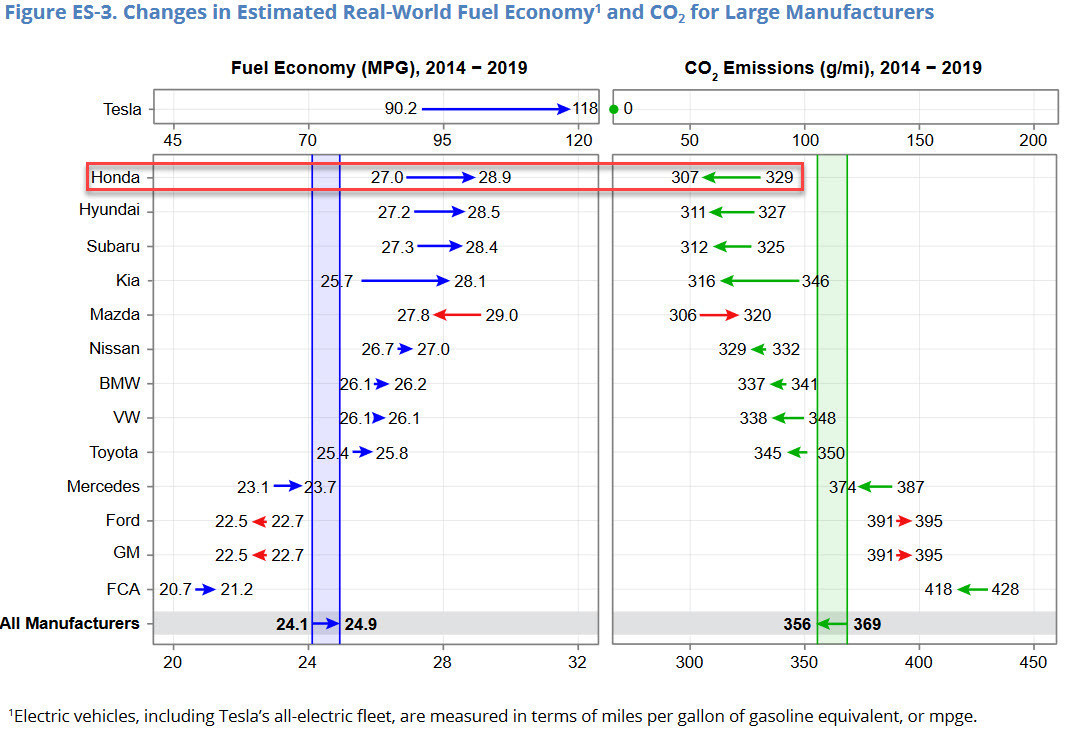
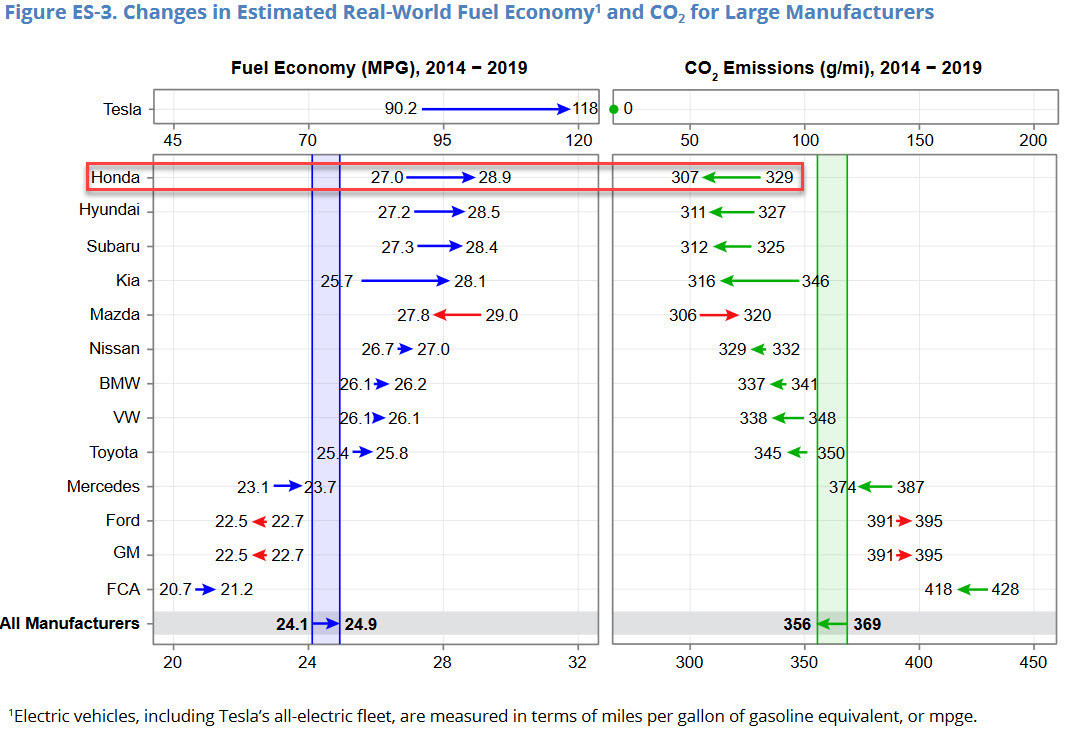
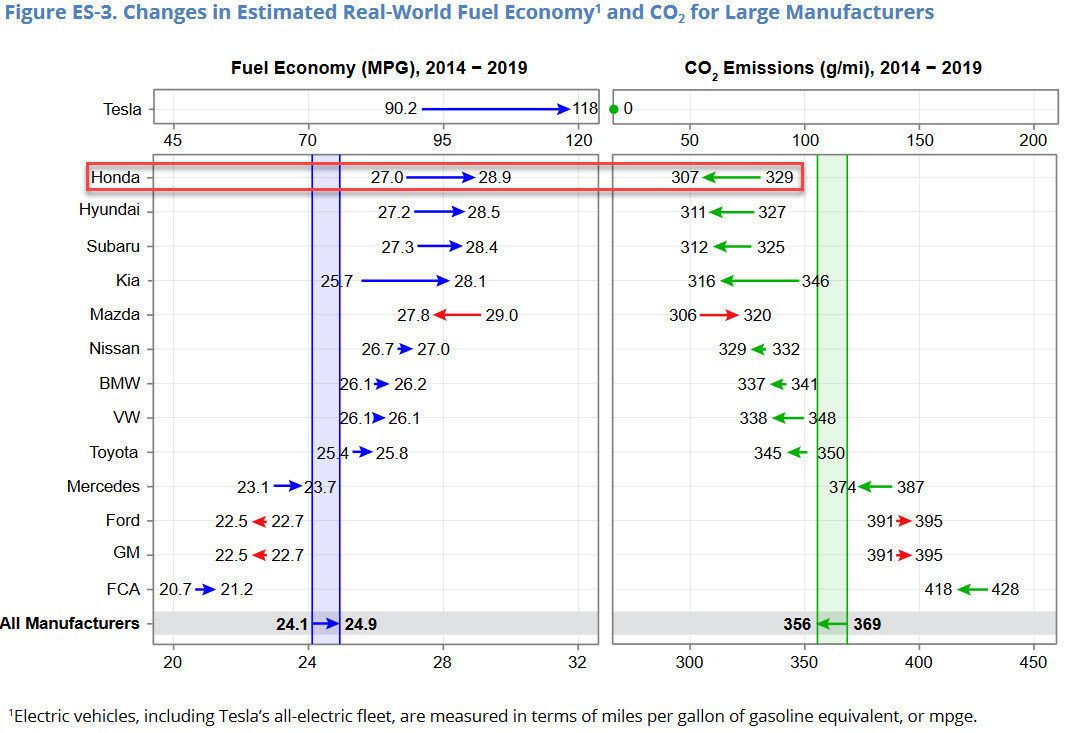
El informe EPA Automotive Trends de 2020 clasificó a Honda en el primer lugar entre fabricantes de automóviles de línea completa y en segundo lugar a nivel general con un promedio de economía en consumo de combustible «real» para la flota de los Estados Unidos de 28.9 millas por galón (mpg), una mejora de 1.9 mpg en cinco años y 4 mpg por encima del promedio de la industria para el MY2019. Asimismo, el promedio de emisiones de CO2 de la flota de Honda fue de 307 gramos/milla, una mejora de 22 gramos/milla en comparación con los resultados de 2014 y 49 gramos/milla menos (mejor) que el promedio de la industria para el año modelo 2019.

La primera clasificación de los vehículos más eficientes en combustible en los Estados Unidos de la EPA, realizada en 1976, le otorgó el primer lugar al Honda Civic. A partir de ahí, los demás informes de la agencia han destacado a Honda entre los líderes en las mediciones anuales de eficiencia en combustible. Esto quiere decir que Honda ha priorizado la eficiencia de combustible de sus productos durante más de 40 años.

En 2020, Honda estableció un nuevo récord absoluto por comercialización de vehículos eléctricos en los Estados Unidos, con un crecimiento en ventas del 4.5 % a pesar de las grandes dificultades del mercado.

Como parte de los esfuerzos para reducir las emisiones de CO2 en el mundo, Honda se ha planteado el objetivo de que dos tercios de sus automóviles vendidos en 2030 sean eléctricos, y está realizando grandes inversiones para la producción de estos vehículos en los Estados Unidos1, incluido el recientemente renovado Accord Hybrid, el CR-V Hybrid, el Insight y el superdeportivo híbrido Acura NSX.

El compromiso de Honda con el ambiente

Con base en su visión «Cielos azules para nuestros hijos», Honda se enfoca en desarrollar tecnologías para abordar los intereses energéticos y ambientales de la sociedad. La compañía pretende que los vehículos eléctricos representen dos tercios de las ventas de 2030 a nivel global. La Iniciativa de electrificación de Honda en Norteamérica busca que las tecnologías para trenes motrices eléctricos se implementen a una cartera cada vez más amplia de automóviles y camiones ligeros durante los próximos años. La línea actual de vehículos electrificados de Honda incluye el Accord Hybrid, el CR-V Hybrid y el Honda Insight, al igual que la serie Clarity.

Honda está trabajando en la reducción del impacto ambiental de sus productos a lo largo de su ciclo de vida, esto incluye reducir desperdicios y emisiones, y mejorar la eficiencia energética en la fabricación, distribución y venta de los productos Honda y Acura en Norteamérica. También plantea una reducción del 93 por ciento de los desperdicios enviados a los rellenos sanitarios desde las plantas de Honda en Norteamérica.

A través de las iniciativas «compras verdes» y «concesionarios verdes», la compañía también trabaja para promover prácticas comerciales que sean más amigables con el ambiente entre sus más de 600 proveedores de equipos originales y 1,300 concesionarios minoristas asociados. 

1 Utilizando piezas de producción nacional e importadas.

Honda Logo.

Fotografía: https://mma.prnewswire.com/media/1396617/2020_EPA_Automotive_Trends_Report_Manufacturer_Ranking.jpg

Logotipo: https://mma.prnewswire.com/media/477245/HONDALOGO_Logo.jpg


FUENTE American Honda Motor Co., Inc.

Honda lidera por eficiencia en combustible y menores emisiones de CO2 entre fabricantes de automóviles de línea completa según informe U.S. EPA Trends

– Honda continua su larga trayectoria de liderazgo por economía en combustible y bajas emisiones de CO2 según EPA entre los principales fabricantes de automóviles de línea completa por más de 40 años

– Los 28.9 mpg de eficiencia en combustible promedio de la flota Honda son 4 mpg más que el promedio de la industria

– Las emisiones promedio de CO2 de la flota superaron el promedio de la industria por 49 g/mi

– Honda establece cifra récord por venta de vehículos eléctricos en los Estados Unidos en 2020

<span…

– Honda continua su larga trayectoria de liderazgo por economía en combustible y bajas emisiones de CO2 según EPA entre los principales fabricantes de automóviles de línea completa por más de 40 años

– Los 28.9 mpg de eficiencia en combustible promedio de la flota Honda son 4 mpg más que el promedio de la industria

– Las emisiones promedio de CO2 de la flota superaron el promedio de la industria por 49 g/mi

– Honda establece cifra récord por venta de vehículos eléctricos en los Estados Unidos en 2020

WASHINGTON, 8 de enero de 2021 /PRNewswire-HISPANIC PR WIRE/ — Dando continuidad a una historia de más de 40 años como líder por eficiencia en combustible, Honda se ratifica como el fabricante de automóviles de línea completa con mayor eficiencia en combustible en los Estados Unidos, según un nuevo informe publicado el pasado miércoles por la Agencia de Protección Ambiental de los Estados Unidos (EPA). En promedio, la flota de Honda es la más económica en consumo de combustible y la de menores emisiones de CO2 de todos los fabricantes de automóviles de línea completa para el año modelo 2019 (MY2019), el último año para el que se cuenta con todos los datos que conforman la base del informe.

Honda Leads Full-Line Automakers in Fuel Efficiency and Lowest CO2 Emissions According to U.S. EPA Trends Report

El informe EPA Automotive Trends de 2020 clasificó a Honda en el primer lugar entre fabricantes de automóviles de línea completa y en segundo lugar a nivel general con un promedio de economía en consumo de combustible «real» para la flota de los Estados Unidos de 28.9 millas por galón (mpg), una mejora de 1.9 mpg en cinco años y 4 mpg por encima del promedio de la industria para el MY2019. Asimismo, el promedio de emisiones de CO2 de la flota de Honda fue de 307 gramos/milla, una mejora de 22 gramos/milla en comparación con los resultados de 2014 y 49 gramos/milla menos (mejor) que el promedio de la industria para el año modelo 2019.

La primera clasificación de los vehículos más eficientes en combustible en los Estados Unidos de la EPA, realizada en 1976, le otorgó el primer lugar al Honda Civic. A partir de ahí, los demás informes de la agencia han destacado a Honda entre los líderes en las mediciones anuales de eficiencia en combustible. Esto quiere decir que Honda ha priorizado la eficiencia de combustible de sus productos durante más de 40 años.

En 2020, Honda estableció un nuevo récord absoluto por comercialización de vehículos eléctricos en los Estados Unidos, con un crecimiento en ventas del 4.5 % a pesar de las grandes dificultades del mercado.

Como parte de los esfuerzos para reducir las emisiones de CO2 en el mundo, Honda se ha planteado el objetivo de que dos tercios de sus automóviles vendidos en 2030 sean eléctricos, y está realizando grandes inversiones para la producción de estos vehículos en los Estados Unidos1, incluido el recientemente renovado Accord Hybrid, el CR-V Hybrid, el Insight y el superdeportivo híbrido Acura NSX.

El compromiso de Honda con el ambiente

Con base en su visión «Cielos azules para nuestros hijos», Honda se enfoca en desarrollar tecnologías para abordar los intereses energéticos y ambientales de la sociedad. La compañía pretende que los vehículos eléctricos representen dos tercios de las ventas de 2030 a nivel global. La Iniciativa de electrificación de Honda en Norteamérica busca que las tecnologías para trenes motrices eléctricos se implementen a una cartera cada vez más amplia de automóviles y camiones ligeros durante los próximos años. La línea actual de vehículos electrificados de Honda incluye el Accord Hybrid, el CR-V Hybrid y el Honda Insight, al igual que la serie Clarity.

Honda está trabajando en la reducción del impacto ambiental de sus productos a lo largo de su ciclo de vida, esto incluye reducir desperdicios y emisiones, y mejorar la eficiencia energética en la fabricación, distribución y venta de los productos Honda y Acura en Norteamérica. También plantea una reducción del 93 por ciento de los desperdicios enviados a los rellenos sanitarios desde las plantas de Honda en Norteamérica.

A través de las iniciativas «compras verdes» y «concesionarios verdes», la compañía también trabaja para promover prácticas comerciales que sean más amigables con el ambiente entre sus más de 600 proveedores de equipos originales y 1,300 concesionarios minoristas asociados. 

1 Utilizando piezas de producción nacional e importadas.

Honda Logo.

Fotografía: https://mma.prnewswire.com/media/1396617/2020_EPA_Automotive_Trends_Report_Manufacturer_Ranking.jpg

Logotipo: https://mma.prnewswire.com/media/477245/HONDALOGO_Logo.jpg


FUENTE American Honda Motor Co., Inc.

Honda lidera por eficiencia en combustible y menores emisiones de CO2 entre fabricantes de automóviles de línea completa según informe U.S. EPA Trends

– Honda continua su larga trayectoria de liderazgo por economía en combustible y bajas emisiones de CO2 según EPA entre los principales fabricantes de automóviles de línea completa por más de 40 años

– Los 28.9 mpg de eficiencia en combustible promedio de la flota Honda son 4 mpg más que el promedio de la industria

– Las emisiones promedio de CO2 de la flota superaron el promedio de la industria por 49 g/mi

– Honda establece cifra récord por venta de vehículos eléctricos en los Estados Unidos en 2020

<span…

– Honda continua su larga trayectoria de liderazgo por economía en combustible y bajas emisiones de CO2 según EPA entre los principales fabricantes de automóviles de línea completa por más de 40 años

– Los 28.9 mpg de eficiencia en combustible promedio de la flota Honda son 4 mpg más que el promedio de la industria

– Las emisiones promedio de CO2 de la flota superaron el promedio de la industria por 49 g/mi

– Honda establece cifra récord por venta de vehículos eléctricos en los Estados Unidos en 2020

WASHINGTON, 8 de enero de 2021 /PRNewswire-HISPANIC PR WIRE/ — Dando continuidad a una historia de más de 40 años como líder por eficiencia en combustible, Honda se ratifica como el fabricante de automóviles de línea completa con mayor eficiencia en combustible en los Estados Unidos, según un nuevo informe publicado el pasado miércoles por la Agencia de Protección Ambiental de los Estados Unidos (EPA). En promedio, la flota de Honda es la más económica en consumo de combustible y la de menores emisiones de CO2 de todos los fabricantes de automóviles de línea completa para el año modelo 2019 (MY2019), el último año para el que se cuenta con todos los datos que conforman la base del informe.

Honda Leads Full-Line Automakers in Fuel Efficiency and Lowest CO2 Emissions According to U.S. EPA Trends Report

El informe EPA Automotive Trends de 2020 clasificó a Honda en el primer lugar entre fabricantes de automóviles de línea completa y en segundo lugar a nivel general con un promedio de economía en consumo de combustible «real» para la flota de los Estados Unidos de 28.9 millas por galón (mpg), una mejora de 1.9 mpg en cinco años y 4 mpg por encima del promedio de la industria para el MY2019. Asimismo, el promedio de emisiones de CO2 de la flota de Honda fue de 307 gramos/milla, una mejora de 22 gramos/milla en comparación con los resultados de 2014 y 49 gramos/milla menos (mejor) que el promedio de la industria para el año modelo 2019.

La primera clasificación de los vehículos más eficientes en combustible en los Estados Unidos de la EPA, realizada en 1976, le otorgó el primer lugar al Honda Civic. A partir de ahí, los demás informes de la agencia han destacado a Honda entre los líderes en las mediciones anuales de eficiencia en combustible. Esto quiere decir que Honda ha priorizado la eficiencia de combustible de sus productos durante más de 40 años.

En 2020, Honda estableció un nuevo récord absoluto por comercialización de vehículos eléctricos en los Estados Unidos, con un crecimiento en ventas del 4.5 % a pesar de las grandes dificultades del mercado.

Como parte de los esfuerzos para reducir las emisiones de CO2 en el mundo, Honda se ha planteado el objetivo de que dos tercios de sus automóviles vendidos en 2030 sean eléctricos, y está realizando grandes inversiones para la producción de estos vehículos en los Estados Unidos1, incluido el recientemente renovado Accord Hybrid, el CR-V Hybrid, el Insight y el superdeportivo híbrido Acura NSX.

El compromiso de Honda con el ambiente

Con base en su visión «Cielos azules para nuestros hijos», Honda se enfoca en desarrollar tecnologías para abordar los intereses energéticos y ambientales de la sociedad. La compañía pretende que los vehículos eléctricos representen dos tercios de las ventas de 2030 a nivel global. La Iniciativa de electrificación de Honda en Norteamérica busca que las tecnologías para trenes motrices eléctricos se implementen a una cartera cada vez más amplia de automóviles y camiones ligeros durante los próximos años. La línea actual de vehículos electrificados de Honda incluye el Accord Hybrid, el CR-V Hybrid y el Honda Insight, al igual que la serie Clarity.

Honda está trabajando en la reducción del impacto ambiental de sus productos a lo largo de su ciclo de vida, esto incluye reducir desperdicios y emisiones, y mejorar la eficiencia energética en la fabricación, distribución y venta de los productos Honda y Acura en Norteamérica. También plantea una reducción del 93 por ciento de los desperdicios enviados a los rellenos sanitarios desde las plantas de Honda en Norteamérica.

A través de las iniciativas «compras verdes» y «concesionarios verdes», la compañía también trabaja para promover prácticas comerciales que sean más amigables con el ambiente entre sus más de 600 proveedores de equipos originales y 1,300 concesionarios minoristas asociados. 

1 Utilizando piezas de producción nacional e importadas.

Honda Logo.

Fotografía: https://mma.prnewswire.com/media/1396617/2020_EPA_Automotive_Trends_Report_Manufacturer_Ranking.jpg

Logotipo: https://mma.prnewswire.com/media/477245/HONDALOGO_Logo.jpg


FUENTE American Honda Motor Co., Inc.

Honda lidera por eficiencia en combustible y menores emisiones de CO2 entre fabricantes de automóviles de línea completa según informe U.S. EPA Trends

– Honda continua su larga trayectoria de liderazgo por economía en combustible y bajas emisiones de CO2 según EPA entre los principales fabricantes de automóviles de línea completa por más de 40 años

– Los 28.9 mpg de eficiencia en combustible promedio de la flota Honda son 4 mpg más que el promedio de la industria

– Las emisiones promedio de CO2 de la flota superaron el promedio de la industria por 49 g/mi

– Honda establece cifra récord por venta de vehículos eléctricos en los Estados Unidos en 2020

<span…

– Honda continua su larga trayectoria de liderazgo por economía en combustible y bajas emisiones de CO2 según EPA entre los principales fabricantes de automóviles de línea completa por más de 40 años

– Los 28.9 mpg de eficiencia en combustible promedio de la flota Honda son 4 mpg más que el promedio de la industria

– Las emisiones promedio de CO2 de la flota superaron el promedio de la industria por 49 g/mi

– Honda establece cifra récord por venta de vehículos eléctricos en los Estados Unidos en 2020

WASHINGTON, 8 de enero de 2021 /PRNewswire-HISPANIC PR WIRE/ — Dando continuidad a una historia de más de 40 años como líder por eficiencia en combustible, Honda se ratifica como el fabricante de automóviles de línea completa con mayor eficiencia en combustible en los Estados Unidos, según un nuevo informe publicado el pasado miércoles por la Agencia de Protección Ambiental de los Estados Unidos (EPA). En promedio, la flota de Honda es la más económica en consumo de combustible y la de menores emisiones de CO2 de todos los fabricantes de automóviles de línea completa para el año modelo 2019 (MY2019), el último año para el que se cuenta con todos los datos que conforman la base del informe.

Honda Leads Full-Line Automakers in Fuel Efficiency and Lowest CO2 Emissions According to U.S. EPA Trends Report

El informe EPA Automotive Trends de 2020 clasificó a Honda en el primer lugar entre fabricantes de automóviles de línea completa y en segundo lugar a nivel general con un promedio de economía en consumo de combustible «real» para la flota de los Estados Unidos de 28.9 millas por galón (mpg), una mejora de 1.9 mpg en cinco años y 4 mpg por encima del promedio de la industria para el MY2019. Asimismo, el promedio de emisiones de CO2 de la flota de Honda fue de 307 gramos/milla, una mejora de 22 gramos/milla en comparación con los resultados de 2014 y 49 gramos/milla menos (mejor) que el promedio de la industria para el año modelo 2019.

La primera clasificación de los vehículos más eficientes en combustible en los Estados Unidos de la EPA, realizada en 1976, le otorgó el primer lugar al Honda Civic. A partir de ahí, los demás informes de la agencia han destacado a Honda entre los líderes en las mediciones anuales de eficiencia en combustible. Esto quiere decir que Honda ha priorizado la eficiencia de combustible de sus productos durante más de 40 años.

En 2020, Honda estableció un nuevo récord absoluto por comercialización de vehículos eléctricos en los Estados Unidos, con un crecimiento en ventas del 4.5 % a pesar de las grandes dificultades del mercado.

Como parte de los esfuerzos para reducir las emisiones de CO2 en el mundo, Honda se ha planteado el objetivo de que dos tercios de sus automóviles vendidos en 2030 sean eléctricos, y está realizando grandes inversiones para la producción de estos vehículos en los Estados Unidos1, incluido el recientemente renovado Accord Hybrid, el CR-V Hybrid, el Insight y el superdeportivo híbrido Acura NSX.

El compromiso de Honda con el ambiente

Con base en su visión «Cielos azules para nuestros hijos», Honda se enfoca en desarrollar tecnologías para abordar los intereses energéticos y ambientales de la sociedad. La compañía pretende que los vehículos eléctricos representen dos tercios de las ventas de 2030 a nivel global. La Iniciativa de electrificación de Honda en Norteamérica busca que las tecnologías para trenes motrices eléctricos se implementen a una cartera cada vez más amplia de automóviles y camiones ligeros durante los próximos años. La línea actual de vehículos electrificados de Honda incluye el Accord Hybrid, el CR-V Hybrid y el Honda Insight, al igual que la serie Clarity.

Honda está trabajando en la reducción del impacto ambiental de sus productos a lo largo de su ciclo de vida, esto incluye reducir desperdicios y emisiones, y mejorar la eficiencia energética en la fabricación, distribución y venta de los productos Honda y Acura en Norteamérica. También plantea una reducción del 93 por ciento de los desperdicios enviados a los rellenos sanitarios desde las plantas de Honda en Norteamérica.

A través de las iniciativas «compras verdes» y «concesionarios verdes», la compañía también trabaja para promover prácticas comerciales que sean más amigables con el ambiente entre sus más de 600 proveedores de equipos originales y 1,300 concesionarios minoristas asociados. 

1 Utilizando piezas de producción nacional e importadas.

Honda Logo.

Fotografía: https://mma.prnewswire.com/media/1396617/2020_EPA_Automotive_Trends_Report_Manufacturer_Ranking.jpg

Logotipo: https://mma.prnewswire.com/media/477245/HONDALOGO_Logo.jpg


FUENTE American Honda Motor Co., Inc.

Honda lidera por eficiencia en combustible y menores emisiones de CO2 entre fabricantes de automóviles de línea completa según informe U.S. EPA Trends

– Honda continua su larga trayectoria de liderazgo por economía en combustible y bajas emisiones de CO2 según EPA entre los principales fabricantes de automóviles de línea completa por más de 40 años

– Los 28.9 mpg de eficiencia en combustible promedio de la flota Honda son 4 mpg más que el promedio de la industria

– Las emisiones promedio de CO2 de la flota superaron el promedio de la industria por 49 g/mi

– Honda establece cifra récord por venta de vehículos eléctricos en los Estados Unidos en 2020

<span…

– Honda continua su larga trayectoria de liderazgo por economía en combustible y bajas emisiones de CO2 según EPA entre los principales fabricantes de automóviles de línea completa por más de 40 años

– Los 28.9 mpg de eficiencia en combustible promedio de la flota Honda son 4 mpg más que el promedio de la industria

– Las emisiones promedio de CO2 de la flota superaron el promedio de la industria por 49 g/mi

– Honda establece cifra récord por venta de vehículos eléctricos en los Estados Unidos en 2020

WASHINGTON, 8 de enero de 2021 /PRNewswire-HISPANIC PR WIRE/ — Dando continuidad a una historia de más de 40 años como líder por eficiencia en combustible, Honda se ratifica como el fabricante de automóviles de línea completa con mayor eficiencia en combustible en los Estados Unidos, según un nuevo informe publicado el pasado miércoles por la Agencia de Protección Ambiental de los Estados Unidos (EPA). En promedio, la flota de Honda es la más económica en consumo de combustible y la de menores emisiones de CO2 de todos los fabricantes de automóviles de línea completa para el año modelo 2019 (MY2019), el último año para el que se cuenta con todos los datos que conforman la base del informe.

Honda Leads Full-Line Automakers in Fuel Efficiency and Lowest CO2 Emissions According to U.S. EPA Trends Report

El informe EPA Automotive Trends de 2020 clasificó a Honda en el primer lugar entre fabricantes de automóviles de línea completa y en segundo lugar a nivel general con un promedio de economía en consumo de combustible «real» para la flota de los Estados Unidos de 28.9 millas por galón (mpg), una mejora de 1.9 mpg en cinco años y 4 mpg por encima del promedio de la industria para el MY2019. Asimismo, el promedio de emisiones de CO2 de la flota de Honda fue de 307 gramos/milla, una mejora de 22 gramos/milla en comparación con los resultados de 2014 y 49 gramos/milla menos (mejor) que el promedio de la industria para el año modelo 2019.

La primera clasificación de los vehículos más eficientes en combustible en los Estados Unidos de la EPA, realizada en 1976, le otorgó el primer lugar al Honda Civic. A partir de ahí, los demás informes de la agencia han destacado a Honda entre los líderes en las mediciones anuales de eficiencia en combustible. Esto quiere decir que Honda ha priorizado la eficiencia de combustible de sus productos durante más de 40 años.

En 2020, Honda estableció un nuevo récord absoluto por comercialización de vehículos eléctricos en los Estados Unidos, con un crecimiento en ventas del 4.5 % a pesar de las grandes dificultades del mercado.

Como parte de los esfuerzos para reducir las emisiones de CO2 en el mundo, Honda se ha planteado el objetivo de que dos tercios de sus automóviles vendidos en 2030 sean eléctricos, y está realizando grandes inversiones para la producción de estos vehículos en los Estados Unidos1, incluido el recientemente renovado Accord Hybrid, el CR-V Hybrid, el Insight y el superdeportivo híbrido Acura NSX.

El compromiso de Honda con el ambiente

Con base en su visión «Cielos azules para nuestros hijos», Honda se enfoca en desarrollar tecnologías para abordar los intereses energéticos y ambientales de la sociedad. La compañía pretende que los vehículos eléctricos representen dos tercios de las ventas de 2030 a nivel global. La Iniciativa de electrificación de Honda en Norteamérica busca que las tecnologías para trenes motrices eléctricos se implementen a una cartera cada vez más amplia de automóviles y camiones ligeros durante los próximos años. La línea actual de vehículos electrificados de Honda incluye el Accord Hybrid, el CR-V Hybrid y el Honda Insight, al igual que la serie Clarity.

Honda está trabajando en la reducción del impacto ambiental de sus productos a lo largo de su ciclo de vida, esto incluye reducir desperdicios y emisiones, y mejorar la eficiencia energética en la fabricación, distribución y venta de los productos Honda y Acura en Norteamérica. También plantea una reducción del 93 por ciento de los desperdicios enviados a los rellenos sanitarios desde las plantas de Honda en Norteamérica.

A través de las iniciativas «compras verdes» y «concesionarios verdes», la compañía también trabaja para promover prácticas comerciales que sean más amigables con el ambiente entre sus más de 600 proveedores de equipos originales y 1,300 concesionarios minoristas asociados. 

1 Utilizando piezas de producción nacional e importadas.

Honda Logo.

Fotografía: https://mma.prnewswire.com/media/1396617/2020_EPA_Automotive_Trends_Report_Manufacturer_Ranking.jpg

Logotipo: https://mma.prnewswire.com/media/477245/HONDALOGO_Logo.jpg


FUENTE American Honda Motor Co., Inc.