Expertos piden a Estados Unidos que ponga fin a la contratación de cárceles privadas para los migrantes

Expertos piden a Estados Unidos que ponga fin a la contratación de cárceles privadas para los migrantes

Expertos piden a Estados Unidos que ponga fin a la contratación de cárceles privadas para los migrantes

<p…


Expertos piden a Estados Unidos que ponga fin a la contratación de cárceles privadas para los migrantes

Expertos piden a Estados Unidos que ponga fin a la contratación de cárceles privadas para los migrantes

PR Newswire

NUEVA YORK, 04 February 2021 /PRNewswire Policy/ — El Grupo de Trabajo sobre la utilización de mercenarios acogió con beneplácito la decisión del gobierno entrante de Estados Unidos de dejar de utilizar los presidios federales de gestión privada, aunque consideró que no es suficiente porque deja fuera a personas que se encuentran en situación extremadamente vulnerable.

Por este motivo, los expertos en derechos humanos que integran el grupo exhortaron al gobierno del presidente Joe Biden a que también ponga fin a la subcontratación de todos los centros de detención, incluidos los que retienen a migrantes y solicitantes de asilo.

“Poner fin a la dependencia de las cárceles privadas para los presos federales es un paso alentador, pero se necesitan más acciones”, dijo Jelena Aparac, presidenta del Grupo de Trabajo.

Aparac explicó que dada la magnitud del encarcelamiento masivo que existe en Estados Unidos, la decisión anunciada beneficiará sólo a un porcentaje muy pequeño de presos federales que se encuentran recluidos en prisiones privadas, excluyendo específicamente “a las personas vulnerables recluidas en centros de asilo y migrantes que corren un riesgo particular de sufrir violaciones graves de derechos humanos”.

El 26 de enero pasado, una orden ejecutiva dispuso que el Departamento de Justicia de los Estados Unidos no renovara sus contratos con doce centros de detención penales federales administrados por empresas privadas.

Los datos de la Oficina de Estadísticas de Justicia estadounidense indican que en 2019 había unos 116.000 prisioneros recluidos en instalaciones privadas, lo que representa cerca del 7% del total de prisioneros estatales y el 16% de los presos federales.

Prisiones con fines de lucro

Los expertos independientes conminaron a Estados Unidos a “eliminar todos los centros de detención con fines de lucro”, argumentando que las personas encerradas en ellos no deben convertirse en un beneficio económico.

El Grupo de Trabajo ha expresado sistemáticamente su preocupación por la subcontratación de funciones estatales inherentes, incluidas las cárceles y los centros de detención.

Abusos graves a los migrantes

Además, ha planteado repetidamente al gobierno estadounidense y a sus contratistas los estándares inadecuados y las violaciones graves de derechos humanos en los centros de detención de migrantes.

Entre esos abusos se cuentan las esterilizaciones involuntarias, los confinamientos en régimen de aislamiento y violaciones del derecho a la atención médica.

Poder económico e influencia política

En su informe anual a la Asamblea General de la ONU de julio del año pasado, el Grupo advirtió que debido a su tamaño y poder económico, las empresas privadas de seguridad ejercen una influencia significativa en las decisiones normativas y de políticas de diferentes maneras, que van desde los debates en los pasillos del poder hasta las contribuciones a las campañas para la elección de cargos en los órganos parlamentarios u otros órganos decisorios o de otros cargos directivos.

Citó como ejemplo que a raíz de importantes presiones y contribuciones financieras de las empresas administradoras de los centros de detención, el Congreso de Estados Unidos había estado autorizando desde 2009 proyectos de ley de asignación presupuestaria que exigían a las autoridades competentes mantener una cuota diaria de camas (fijada en 34.000 para 2020) en los centros de detención de inmigrantes, independientemente del número real necesario.

Asimismo, señaló que la pandemia de COVID-19 confirmó las deficiencias flagrantes de los sistemas establecidos y reforzó la necesidad de adoptar medidas inmediatas, ya que debido a las condiciones deplorables existentes, muchos de esos centros estaban sumamente mal equipados para hacer frente a la emergencia.

Destacó también que la mayoría de las empresas privadas de seguridad tienen su sede en Norteamérica y Europa.

SOURCE Centro de Noticias ONU

NUEVA YORK, 04 February 2021 /PRNewswire Policy/ — El Grupo de Trabajo sobre la utilización de mercenarios acogió con beneplácito la decisión del gobierno entrante de Estados Unidos de dejar de utilizar los presidios federales de gestión privada, aunque consideró que no es suficiente porque deja fuera a personas que se encuentran en situación extremadamente vulnerable.

Por este motivo, los expertos en derechos humanos que integran el grupo exhortaron al gobierno del presidente Joe Biden a que también ponga fin a la subcontratación de todos los centros de detención, incluidos los que retienen a migrantes y solicitantes de asilo.

“Poner fin a la dependencia de las cárceles privadas para los presos federales es un paso alentador, pero se necesitan más acciones”, dijo Jelena Aparac, presidenta del Grupo de Trabajo.

Aparac explicó que dada la magnitud del encarcelamiento masivo que existe en Estados Unidos, la decisión anunciada beneficiará sólo a un porcentaje muy pequeño de presos federales que se encuentran recluidos en prisiones privadas, excluyendo específicamente “a las personas vulnerables recluidas en centros de asilo y migrantes que corren un riesgo particular de sufrir violaciones graves de derechos humanos”.

El 26 de enero pasado, una orden ejecutiva dispuso que el Departamento de Justicia de los Estados Unidos no renovara sus contratos con doce centros de detención penales federales administrados por empresas privadas.

Los datos de la Oficina de Estadísticas de Justicia estadounidense indican que en 2019 había unos 116.000 prisioneros recluidos en instalaciones privadas, lo que representa cerca del 7% del total de prisioneros estatales y el 16% de los presos federales.

Prisiones con fines de lucro

Los expertos independientes conminaron a Estados Unidos a “eliminar todos los centros de detención con fines de lucro”, argumentando que las personas encerradas en ellos no deben convertirse en un beneficio económico.

El Grupo de Trabajo ha expresado sistemáticamente su preocupación por la subcontratación de funciones estatales inherentes, incluidas las cárceles y los centros de detención.

Abusos graves a los migrantes

Además, ha planteado repetidamente al gobierno estadounidense y a sus contratistas los estándares inadecuados y las violaciones graves de derechos humanos en los centros de detención de migrantes.

Entre esos abusos se cuentan las esterilizaciones involuntarias, los confinamientos en régimen de aislamiento y violaciones del derecho a la atención médica.

Poder económico e influencia política

En su informe anual a la Asamblea General de la ONU de julio del año pasado, el Grupo advirtió que debido a su tamaño y poder económico, las empresas privadas de seguridad ejercen una influencia significativa en las decisiones normativas y de políticas de diferentes maneras, que van desde los debates en los pasillos del poder hasta las contribuciones a las campañas para la elección de cargos en los órganos parlamentarios u otros órganos decisorios o de otros cargos directivos.

Citó como ejemplo que a raíz de importantes presiones y contribuciones financieras de las empresas administradoras de los centros de detención, el Congreso de Estados Unidos había estado autorizando desde 2009 proyectos de ley de asignación presupuestaria que exigían a las autoridades competentes mantener una cuota diaria de camas (fijada en 34.000 para 2020) en los centros de detención de inmigrantes, independientemente del número real necesario.

Asimismo, señaló que la pandemia de COVID-19 confirmó las deficiencias flagrantes de los sistemas establecidos y reforzó la necesidad de adoptar medidas inmediatas, ya que debido a las condiciones deplorables existentes, muchos de esos centros estaban sumamente mal equipados para hacer frente a la emergencia.

Destacó también que la mayoría de las empresas privadas de seguridad tienen su sede en Norteamérica y Europa.

SOURCE Centro de Noticias ONU

Los precios de los alimentos aumentan bruscamente en enero

Los precios de los alimentos aumentan bruscamente en enero

Los precios de los alimentos aumentan bruscamente en enero

PR Newswire

<div…


Los precios de los alimentos aumentan bruscamente en enero

Los precios de los alimentos aumentan bruscamente en enero

PR Newswire

ROMA, 04 February 2021 /PRNewswire Policy/ — Los precios mundiales de los alimentos subieron por octavo mes consecutivo en enero, impulsados por los cereales, los aceites vegetales y el azúcar, según la Organización de las Naciones Unidas para la Alimentación y la Agricultura (FAO).

El índice de precios de los alimentos de la FAO, que hace un seguimiento mensual de los precios internacionales de los productos alimenticios más comercializados, registró en su publicación de hoy un promedio de 113,3 puntos en enero, es decir, un 4,3 % más que en diciembre de 2020, con lo que alcanzó su nivel más elevado desde julio de 2014.

El índice de precios de los cereales de la FAO acusó un fuerte aumento mensual del 7,1 %, impulsado por los precios internacionales del maíz, que se dispararon un 11,2 % y que actualmente se sitúan un 42,3 % por encima de su nivel de enero de 2020, lo que refleja una oferta mundial cada vez más limitada ante las compras cuantiosas por parte de China y las estimaciones inferiores a las previstas anteriormente para la producción y las existencias en los Estados Unidos, así como la suspensión temporal de los registros de exportaciones de maíz en la Argentina. Los precios del trigo subieron un 6,8 %, arrastrados por la fuerte demanda mundial y las expectativas de reducción de las ventas de la Federación de Rusia cuando sus derechos de exportación de trigo se dupliquen en marzo de 2021. La robustez de la demanda de los compradores de Asia y África sustentó los elevados precios del arroz.

El índice de precios de los aceites vegetales de la FAO aumentó un 5,8 % durante el mes, con lo que alcanzó su nivel más elevado desde mayo de 2012. Entre los factores de este incremento se incluyen la producción menor de lo previsto de aceite de palma en Indonesia y Malasia, debido al exceso de precipitaciones y a la continua escasez de mano de obra migrante, y las huelgas prolongadas en la Argentina que han reducido la disponibilidad de exportaciones de aceite de soja.

El índice de precios del azúcar de la FAO fue un 8,1 % más alto que en diciembre, al desatar la robustez de la demanda mundial de importaciones las preocupaciones por las menores disponibilidades debido al empeoramiento de las perspectivas para las cosechas en la Federación de Rusia, Tailandia y la Unión Europea, así como unas condiciones meteorológicas más secas de lo normal en América del Sur. El aumento de los precios del petróleo crudo y un real brasileño más fuerte empujaron asimismo al alza los precios internacionales del azúcar.

El índice de precios de los productos lácteos de la FAO registró un incremento del 1,6 %, sustentado por las importantes compras por parte de China, con motivo de las próximas festividades de Año Nuevo en el país, en un contexto de reducción estacional de los suministros para la exportación en Nueva Zelandia.

El índice de precios de la carne de la FAO fue un 1 % más alto que en diciembre, impulsado por las vigorosas importaciones mundiales de carne de aves de corral, especialmente del Brasil, ante los brotes de gripe aviar que han restringido la producción y las exportaciones de varios países de Europa.

Previsión de fuertes disminuciones de las reservas mundiales de cereales

La FAO también publicó hoy su Nota informativa sobre la oferta y la demanda de cereales, que informa periódicamente sobre las últimas tendencias en la producción, el consumo, el comercio y las existencias mundiales.

Por lo que respecta a la producción, las nuevas estimaciones de la FAO para 2020 apuntan a un máximo en la producción de trigo y arroz. De cara a la producción de cereales de 2021, las perspectivas iniciales indican un aumento probablemente modesto de los cultivos de trigo de invierno en el hemisferio norte, alentado por los incrementos de la superficie de cultivo en los Estados Unidos, la Federación de Rusia, Francia y la India. Se prevé que la producción de maíz en el hemisferio sur disminuya en cierta medida en la Argentina y el Brasil respecto de sus máximos históricos, pero que se mantenga por encima de la media. Las perspectivas acerca de la producción en Sudáfrica y sus países vecinos son favorables.

Al mismo tiempo, los pronósticos de este mes apuntan a mayores volúmenes del comercio mundial y a una brusca disminución de las reservas mundiales de cereales.

A nivel mundial, actualmente se prevé una utilización de cereales en 2020/21 de 2 761 millones de toneladas, 52 millones de toneladas más que en la campaña anterior. Lidera el aumento el enérgico uso de cereales secundarios para pienso en China. Según las provisiones, la utilización mundial de trigo y arroz aumentará este año un 0,7 % y un 1,8 %, respectivamente.

Se prevé que las reservas mundiales de cereales se contraigan un 2,2 % hasta los 801 millones de toneladas, su nivel más bajo en cinco años. Esto reduciría el coeficiente mundial de reservas-utilización de cereales hasta un 28,3 %, el nivel más bajo de los últimos siete años. Las nuevas cifras reflejan un cuantioso ajuste a la baja en las existencias de maíz en China.

Actualmente se prevé un comercio mundial de cereales en 2020/21 de 465,2 millones de toneladas, una expansión considerable del 5,7 % respecto del máximo alcanzado en la campaña anterior. El alza de las estimaciones refleja las compras cuantiosas de maíz por parte de China, especialmente procedente de los Estados Unidos. Los pronósticos indican que el comercio internacional de arroz se incrementará aún más, esto es, un 7,9 %, lo que refleja un fuerte crecimiento de las exportaciones de la India.

En las nuevas previsiones de la FAO se incluyen los resultados de un examen -de 2013/14- sobre el balance de la oferta y la demanda de China. Las inesperadas compras a gran escala de maíz del país en las últimas semanas apuntan a una demanda mucho mayor de piensos y a unos suministros nacionales menores de lo previsto, lo que probablemente esté vinculado a la rápida recuperación de la producción de carne de cerdo tras el brote de peste porcina africana.

SOURCE Organización para la Agricultura y la Alimentación de las Naciones Unidas (FAO)

ROMA, 04 February 2021 /PRNewswire Policy/ — Los precios mundiales de los alimentos subieron por octavo mes consecutivo en enero, impulsados por los cereales, los aceites vegetales y el azúcar, según la Organización de las Naciones Unidas para la Alimentación y la Agricultura (FAO).

El índice de precios de los alimentos de la FAO, que hace un seguimiento mensual de los precios internacionales de los productos alimenticios más comercializados, registró en su publicación de hoy un promedio de 113,3 puntos en enero, es decir, un 4,3 % más que en diciembre de 2020, con lo que alcanzó su nivel más elevado desde julio de 2014.

El índice de precios de los cereales de la FAO acusó un fuerte aumento mensual del 7,1 %, impulsado por los precios internacionales del maíz, que se dispararon un 11,2 % y que actualmente se sitúan un 42,3 % por encima de su nivel de enero de 2020, lo que refleja una oferta mundial cada vez más limitada ante las compras cuantiosas por parte de China y las estimaciones inferiores a las previstas anteriormente para la producción y las existencias en los Estados Unidos, así como la suspensión temporal de los registros de exportaciones de maíz en la Argentina. Los precios del trigo subieron un 6,8 %, arrastrados por la fuerte demanda mundial y las expectativas de reducción de las ventas de la Federación de Rusia cuando sus derechos de exportación de trigo se dupliquen en marzo de 2021. La robustez de la demanda de los compradores de Asia y África sustentó los elevados precios del arroz.

El índice de precios de los aceites vegetales de la FAO aumentó un 5,8 % durante el mes, con lo que alcanzó su nivel más elevado desde mayo de 2012. Entre los factores de este incremento se incluyen la producción menor de lo previsto de aceite de palma en Indonesia y Malasia, debido al exceso de precipitaciones y a la continua escasez de mano de obra migrante, y las huelgas prolongadas en la Argentina que han reducido la disponibilidad de exportaciones de aceite de soja.

El índice de precios del azúcar de la FAO fue un 8,1 % más alto que en diciembre, al desatar la robustez de la demanda mundial de importaciones las preocupaciones por las menores disponibilidades debido al empeoramiento de las perspectivas para las cosechas en la Federación de Rusia, Tailandia y la Unión Europea, así como unas condiciones meteorológicas más secas de lo normal en América del Sur. El aumento de los precios del petróleo crudo y un real brasileño más fuerte empujaron asimismo al alza los precios internacionales del azúcar.

El índice de precios de los productos lácteos de la FAO registró un incremento del 1,6 %, sustentado por las importantes compras por parte de China, con motivo de las próximas festividades de Año Nuevo en el país, en un contexto de reducción estacional de los suministros para la exportación en Nueva Zelandia.

El índice de precios de la carne de la FAO fue un 1 % más alto que en diciembre, impulsado por las vigorosas importaciones mundiales de carne de aves de corral, especialmente del Brasil, ante los brotes de gripe aviar que han restringido la producción y las exportaciones de varios países de Europa.

Previsión de fuertes disminuciones de las reservas mundiales de cereales

La FAO también publicó hoy su Nota informativa sobre la oferta y la demanda de cereales, que informa periódicamente sobre las últimas tendencias en la producción, el consumo, el comercio y las existencias mundiales.

Por lo que respecta a la producción, las nuevas estimaciones de la FAO para 2020 apuntan a un máximo en la producción de trigo y arroz. De cara a la producción de cereales de 2021, las perspectivas iniciales indican un aumento probablemente modesto de los cultivos de trigo de invierno en el hemisferio norte, alentado por los incrementos de la superficie de cultivo en los Estados Unidos, la Federación de Rusia, Francia y la India. Se prevé que la producción de maíz en el hemisferio sur disminuya en cierta medida en la Argentina y el Brasil respecto de sus máximos históricos, pero que se mantenga por encima de la media. Las perspectivas acerca de la producción en Sudáfrica y sus países vecinos son favorables.

Al mismo tiempo, los pronósticos de este mes apuntan a mayores volúmenes del comercio mundial y a una brusca disminución de las reservas mundiales de cereales.

A nivel mundial, actualmente se prevé una utilización de cereales en 2020/21 de 2 761 millones de toneladas, 52 millones de toneladas más que en la campaña anterior. Lidera el aumento el enérgico uso de cereales secundarios para pienso en China. Según las provisiones, la utilización mundial de trigo y arroz aumentará este año un 0,7 % y un 1,8 %, respectivamente.

Se prevé que las reservas mundiales de cereales se contraigan un 2,2 % hasta los 801 millones de toneladas, su nivel más bajo en cinco años. Esto reduciría el coeficiente mundial de reservas-utilización de cereales hasta un 28,3 %, el nivel más bajo de los últimos siete años. Las nuevas cifras reflejan un cuantioso ajuste a la baja en las existencias de maíz en China.

Actualmente se prevé un comercio mundial de cereales en 2020/21 de 465,2 millones de toneladas, una expansión considerable del 5,7 % respecto del máximo alcanzado en la campaña anterior. El alza de las estimaciones refleja las compras cuantiosas de maíz por parte de China, especialmente procedente de los Estados Unidos. Los pronósticos indican que el comercio internacional de arroz se incrementará aún más, esto es, un 7,9 %, lo que refleja un fuerte crecimiento de las exportaciones de la India.

En las nuevas previsiones de la FAO se incluyen los resultados de un examen -de 2013/14- sobre el balance de la oferta y la demanda de China. Las inesperadas compras a gran escala de maíz del país en las últimas semanas apuntan a una demanda mucho mayor de piensos y a unos suministros nacionales menores de lo previsto, lo que probablemente esté vinculado a la rápida recuperación de la producción de carne de cerdo tras el brote de peste porcina africana.

SOURCE Organización para la Agricultura y la Alimentación de las Naciones Unidas (FAO)

Pennsylvania AFL-CIO Applauds the PRO Act, Calls For Entire PA Delegation in U.S. House and Senate to Support

HARRISBURG, PA, Feb. 4, 2021 /PRNewswire/ — Today the U.S. House of Representatives and Senate both announced the introduction of Protecting the Right to Organize Act in Congress.  Our pro-union U.S. Senator Bob Casey is a co-sponsor as well as the following pro-worker congressional members: Rep. Michael Doyle, Rep. Connor Lamb, Rep. Matthew Cartwright, Rep. <span…

HARRISBURG, PA, Feb. 4, 2021 /PRNewswire/ — Today the U.S. House of Representatives and Senate both announced the introduction of Protecting the Right to Organize Act in Congress.  Our pro-union U.S. Senator Bob Casey is a co-sponsor as well as the following pro-worker congressional members: Rep. Michael Doyle, Rep. Connor Lamb, Rep. Matthew Cartwright, Rep. Susan Wild, Rep. Mary Scanlon, Rep. Madeleine Dean, Rep. Dwight Evans, Rep. Brendan Boyle, and Rep. Brian Fitzpatrick. We look forward to adding more co-sponsors in the future.

On behalf of the 700,000 workers of our Commonwealth’s union movement, the officers of the Pennsylvania AFL-CIO, President Rick Bloomingdale and Secretary-Treasurer Frank Snyder, released the following statements:

«Pennsylvania workers are about to see a new day for their rights on the job. The multi-billion-dollar union-busting industry will do everything it can to continue to deprive and attack workers’ rights. But the power of working people will seize this moment, and their voices will be heard. We commend our Commonwealth’s bi-partisan delegation of PRO Act co-sponsors for their commitment to all working people.  We urge the rest of our representatives to do sign on and support this step toward economic justice,» remarked President Rick Bloomingdale

«So-called ‘right to work’ laws are the last actual vestige of Jim Crow legislation.  Designed by an architect of hatred, these laws aimed to keep Black workers out of unions in the South.  It worked so well in depriving all working people of their rights on the job that corporations and anti-union interests exported this legislation to every state they could to destroy workers’ rights across the Country.  The PRO Act will finally remove this discriminatory attack on economic rights in America.  This is an historic act in the fight to dismantle systemic discrimination and racism,» stated Secretary-Treasurer Frank Snyder.

Cision View original content to download multimedia:http://www.prnewswire.com/news-releases/pennsylvania-afl-cio-applauds-the-pro-act-calls-for-entire-pa-delegation-in-us-house-and-senate-to-support-301222642.html

SOURCE PA AFL-CIO

Rosneft and bp Agree to Cooperate on Carbon Management and Sustainability

MOSCOW, Feb. 4, 2021 /PRNewswire/ — Rosneft Oil Company and bp have signed a Strategic Collaboration Agreement focused on supporting carbon management and sustainability activities of both companies. The agreement builds on years of partnership between the two companies and formalises key elements of their collaboration on sustainability and work to identify carbon reduction activities and low carbon opportunities.

Based on their longstanding partnership and taking into account the profound…

MOSCOW, Feb. 4, 2021 /PRNewswire/ — Rosneft Oil Company and bp have signed a Strategic Collaboration Agreement focused on supporting carbon management and sustainability activities of both companies. The agreement builds on years of partnership between the two companies and formalises key elements of their collaboration on sustainability and work to identify carbon reduction activities and low carbon opportunities.

Based on their longstanding partnership and taking into account the profound changes shaping the global energy transition to deliver more energy with less carbon, Rosneft and bp have agreed to cooperate in identifying and developing new low carbon solutions and programs that will support their shared sustainability goals. The companies also intend to join efforts in aligning with developing industry methodologies and standards on carbon management, including methane reduction initiatives and energy efficiency applications.

Rosneft and bp will also jointly evaluate new projects envisaging the use of renewables, opportunities for carbon capture, utilisation and storage (CCUS), as well as developments for hydrogen.

The companies intend to work together on opportunities for low-carbon solutions in downstream businesses, including the development of advanced fuel as well as evaluate the potential for the development of natural forest sinks and trading of forest carbon-offsets credits. The companies will cooperate in sustainable development and social investment, including biodiversity.

Commenting on the agreement signed, Rosneft Chief Executive Officer Igor Sechin said, «Rosneft and bp are united not only through the longstanding successful partnership in various areas but also in the intention to leverage this experience in future prospective projects outlined in this agreement. Joint efforts of our two companies, as the world energy industry leaders, will not only strengthen our corporate aims in sustainable development, but will also provide a significant contribution to overcoming the challenges the industry and the society face in the climate action and the satisfaction of growing global economy demand for energy resources. This is necessary for balanced social and economic development and life quality improvement.»

bp Chief Executive Officer Bernard Looney said: «We’ve been partners with Rosneft for many years now and we learn a great deal from each other. That’s important, and I believe that this agreement can be an important catalyst for progress. We both believe in the power of partnership and look forward to bringing together the best of Rosneft and bp to develop low-carbon solutions and drive down emissions.»

Note for Editors:

Rosneft was one of the first Russian members and has been a member for over ten years of the United Nations Global Compact, the largest initiative considering sustainable development. The Company was the first to reaffirm its strategic commitment to the UN Sustainable Development Goals in 2018. Climate Action is one of the priority goals for the Company.

Rosneft was also the first company in Russia to prepare the comprehensive 2035 Carbon Management Plan featuring clear targets for reducing greenhouse gas emissions. The Plan was reviewed by the Company’s Board of Directors in December 2020 and stipulates the following:

  1. Prevention of direct and indirect greenhouse gas emissions of 20 million tonnes CO2-equivalent.
  2. A 30% reduction in the intensity of direct and indirect emissions in oil and gas production.
  3. A methane emission rate below 0.25%.
  4. Zero routine flaring of associated gas.

The Company’s activities are highly praised by the global investment community that considers socially responsible investments a long-term trend. In late 2020, FTSE Russell, a unit of the London Stock Exchange, verified Rosneft’s entering the global FTSE4Good Index Series. Rosneft has been recognised as the leading oil and gas company in Russia by several international ESG ratings, such as Refinitiv, Bloomberg, Corporate Human Rights Benchmark, and has been ranked among leaders in the Climate and Water Resources international ratings of CDP.

bp’s ambition is to become a net zero company by 2050 or sooner and it has set out a strategy intended to deliver this.

Within 10 years, bp aims to have increased its annual low carbon investment 10-fold to around $5 billion a year, building out an integrated portfolio of low carbon technologies, including renewables, bioenergy and early positions in hydrogen and CCUS.

By 2030, bp aims to have developed around 50GW of net renewable generating capacity – a 20-fold increase from 2019 – and to have doubled its consumer interactions to 20 million a day.

Delivery of resilient and focused hydrocarbons will remain one of the foundations of the strategy. bp aims to drive capital and cost productivity up and emissions down completing its ongoing series of major projects, decreasing capital intensity, and to continue to high-grade its portfolio, resulting in significantly lower but more competitive production and refining throughput.

By 2030, bp aims for emissions from its operations and those associated with the carbon in its upstream oil and gas production (addressed by Aim 1 and Aim 2 of bp’s net zero ambition) to be lower by 30-35% and 35-40% respectively.

Rosneft Information Division
February 04, 2021

These materials contain statements about future events and expectations that are forward-looking in nature. Any statement in these materials that is not a statement of historical fact is a forward-looking statement that involves known and unknown risks, uncertainties and other factors which may cause actual results, performance or achievements expressed or implied by such forward-looking statements to differ. We assume no obligations to update the forward-looking statements contained herein to reflect actual results, changes in assumptions or changes in factors affecting these statements.


Cision View original content:http://www.prnewswire.com/news-releases/rosneft-and-bp-agree-to-cooperate-on-carbon-management-and-sustainability-301222640.html

SOURCE Rosneft

TSRgrow introduces Lighting as a Platform™ (LaaP) – A Revolutionary Approach to Horticulture

WARWICK, R.I., Feb. 4, 2021 /PRNewswire/ — TSRgrow, a leading horticulture solutions provider, is proud to announce Lighting as a Platform™ (LaaP), a revolutionary technology that delivers unparalleled results to indoor growers, while significantly reducing up-front and long-term operating costs.

<iframe width="560" height="315" src="https://www.youtube.com/embed/rVMsVOwQSSc"…

WARWICK, R.I., Feb. 4, 2021 /PRNewswire/ — TSRgrow, a leading horticulture solutions provider, is proud to announce Lighting as a Platform™ (LaaP), a revolutionary technology that delivers unparalleled results to indoor growers, while significantly reducing up-front and long-term operating costs.

Lighting as a Platform (LaaP) brings together TSRgrow’s solutions for commercial horticulture growing into one digital platform:  Centralized Power Server Technology, highest performance LED Lighting and integrated software applications with sensor feedback technology for real time monitoring and control.  LaaP maximizes efficiency while cutting costs in Controlled Environment Agriculture (CEA) facilities. TSRgrow LaaP is revolutionizing commercial horticulture.

LaaP eliminates local ballast equipment on each fixture from the growing area.  By centralizing power in the grow facility, installation and maintenance costs are reduced and simplified.  By removing ballast heat from the grow area, growers can reduce their HVACD cooling load requirements and equipment CAPx. These benefits are just the beginning.  LaaP produces greater light intensity and more uniform canopy coverage for each grow, reducing the total number of fixtures needed, further reducing capital expenditures. 

Compatible with Cogen, Solar and micro grids, LaaP Remote Power Servers connect directly to the AC grid or can integrate with Solar, DC storage, micro grids or Cogen systems.  Power monitoring provides real time reporting of energy usage while providing full control of every lighting fixture in the grow area, maximizing yields while saving energy.  «Designed for commercial horticulture, LaaP unites lighting, power and monitoring into one integrated system,» said Mikhail Sagal, President of TSRgrow. «It provides growers the ability to maximize their yields reducing their operating costs.»  LaaP integrates with TSRgrow’s TOTALgrow™ Solution, giving growers deeper insights across every aspect of their operation.

Additional benefits include simplified installation and maintenance, monitoring and control dashboards accessible from anywhere, and the highest performance designed for horticulture LED fixtures on the market.  Featuring power servers with the industry’s highest efficacy and lowest iTHD throughout the dimming range (0-100%), LaaP is Utility recommended and helps drive down facility operating costs for long term sustainability of your indoor, vertical or greenhouse facility.

«Taking all of the ballasts out of the flower rooms and putting then into a full IT server room, has helped us do right by our plants and our facility. Since we’re using TSRgrow’s Lighting as a Platform™, we have the ability to control our environment outside of our grow in a designated server room where we do all of our monitoring.

«During our recent 200,00 sq. ft. expansion project, the TSRgrow team was there to help us every step of the way. Before you buy, do your research. TSRgrow is a true platform technology-based company. Not just because of the lights and the technology, but also because they are a true partner to help you grow. We will be using them again during our next expansion project,» said Cliff Miller, President, Norman K, Auburn, Maine.

If you aren’t considering LaaP now, you should be.

About TSRgrow 

TSRgrow is an industry-leading full-service designer and manufacturer of commercial horticulture LED lighting systems for indoor and greenhouse growing operations. Founded over twelve years ago, this USA-based company offers horticultural TOTALgrow Solutions, best-in-class LED lighting systems, and industry support to help cultivators achieve the ideal balance of yield, energy and profitability.

TSRgrow’s industry leading LED lighting solutions have been developed in cooperation with university and industry leaders and are engineered to maximize energy efficiency. With design and manufacturing in the USA, TSRgrow Lighting as a Platform (LaaP) featuring remote power servers, environment monitoring, and full lighting management, is designed for commercial horticulture.  As a full-service horticulture solution company supporting hundreds of thousands of square feet of canopy, TSRgrow works with growers, owners and operators in all aspects of their operations, bringing benefits in indoor, vertical and commercial greenhouse growing.

Contact TSRgrow Today

Contact TSRgrow today to learn more about how their growing solutions can outperform conventional LED fixtures. Visit us at www.TSRgrow.com

For more information, please contact Gail Farias, Marketing Manager at gail.farias@tsrgrow.com

Cision View original content to download multimedia:http://www.prnewswire.com/news-releases/tsrgrow-introduces-lighting-as-a-platform-laap–a-revolutionary-approach-to-horticulture-301222637.html

SOURCE TSRGrow

GenoBank.io and Arion Genetica Partner to Make COVID-19 Testing Easier, More Secure for Travelers

PALO ALTO, Calif., Feb. 4, 2021 /PRNewswire-HISPANIC PR WIRE/ — GenoBank.io, the leader in anonymous, privacy-securing DNA testing, has partnered with Arion Genetica and a network of laboratories based in Mexico City, Mexico. The two companies are undertaking an ambitious project: to cryptographically verify traveler’s COVID-19 tests to prevent fraud. Most countries require incoming travelers to present a negative COVID-19 test. However, there is no universal system…

PALO ALTO, Calif., Feb. 4, 2021 /PRNewswire-HISPANIC PR WIRE/ — GenoBank.io, the leader in anonymous, privacy-securing DNA testing, has partnered with Arion Genetica and a network of laboratories based in Mexico City, Mexico. The two companies are undertaking an ambitious project: to cryptographically verify traveler’s COVID-19 tests to prevent fraud. Most countries require incoming travelers to present a negative COVID-19 test. However, there is no universal system in place to ensure that the test results provided by the travelers are accurate. GenoBank.io has the solution.

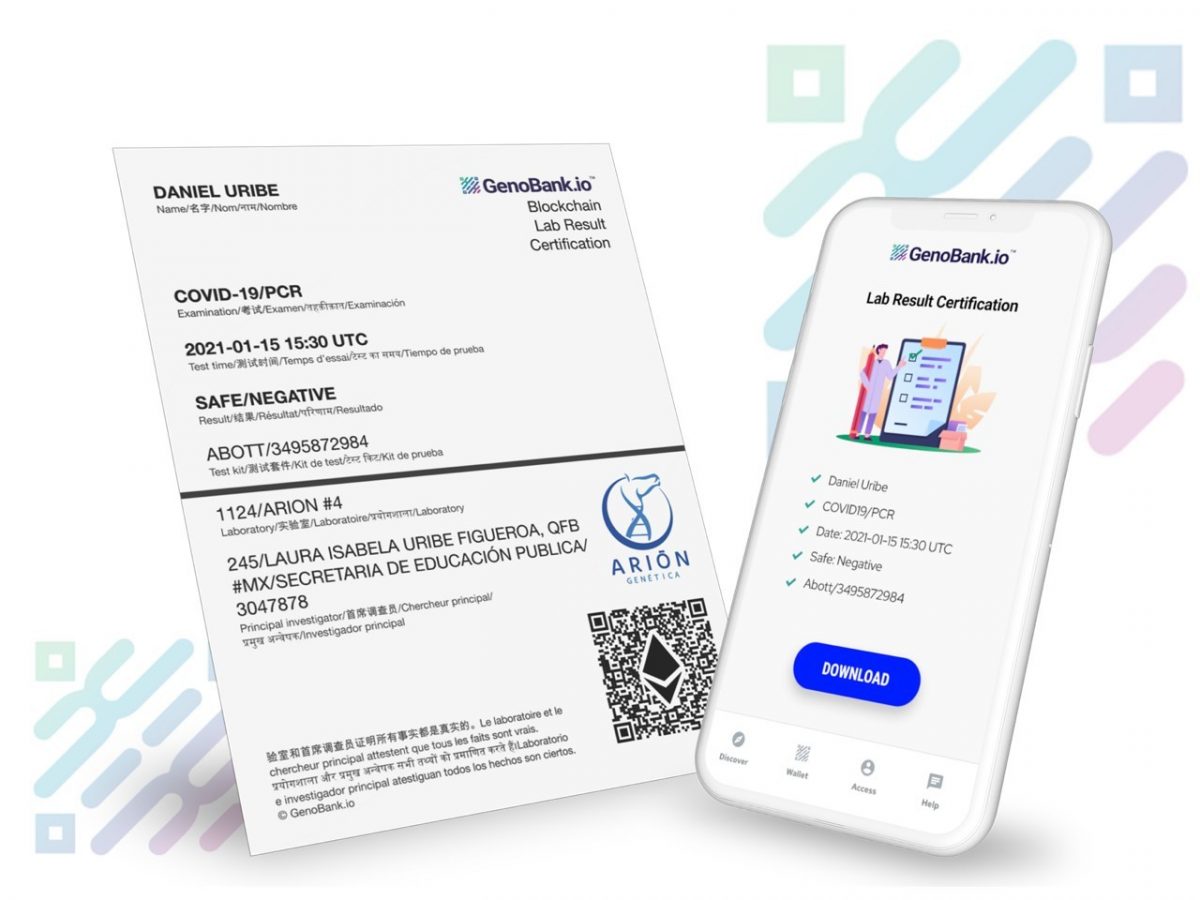
GenoBank.io is providing Arion Genetica with the technology to certify COVID-19 lab test results for travelers heading into the United States. Laboratories around the world can register with GenoBank.io and receive certified lab results that their customers can pass along to Border Officers and Airline personnel. Lab results are encrypted and stamped into a public blockchain to provide a verifiable chain of custody that ensures the lab results are legitimate. These certified lab results are accepted by the U.S. Department of Homeland Security to help speed up the testing process, ensuring easier entry and minimized risk for US travelers.

«Our goal is to help travellers get back to their lives faster by giving traceability to COVID lab results. GenoBank.io empowers laboratories by providing a verifiable chain of custody over the lab results of its customers» says GenoBank.io’s founder and CEO, Daniel Uribe. «This provides certainty that lab results are not forged or tampered by using a unique cryptographic signature paired to each Lab Rep ID. Results are made immutable upon being recorded into the blockchain and have a time stamp that makes them valid for only 3 days. This is all achieved via a QR code that protects the privacy of users.»

As Arion Genetica Chief Scientific Officer. Ms. Laura U. Figueroa says, «We have 3 big challenges to comply with CDC order. The first is to avoid the tampering of lab results. The second is to protect the privacy of our customers and the third is to ensure that the certificates are verifiable by travel authorities from countries around the world. GenoBank.io is helping us by recording laboratory results onto the blockchain.»

More information on the platform can be found on https://genobank.io/certificates

GenoBank.io is the first privacy-preserving DNA/RNA test kit and platform that guarantees consumers control over their laboratory data. Their patent pending technology leverages blockchain and differential privacy to anonymize DNA data while making it available for analysis. To support Genobank’s mission to provide the world with control over their DNA and gain a financial stake in their success, visit their crowdfunding campaign on WeFunder (https://wefunder.com/genobank).

Arion Genetica is an innovative provider of laboratory tests in Mexico, including COVID-19, reproductive and DNA testing. Arion Genetica offers timely, accurate results in the detection for infectious agents and genetic analysis. The lab’s main focus is on genomic applications, COVID-19 tests, reproductive health, and oncology.

SOURCE Genobank.io

GenoBank.io and Arion Genetica Partner to Make COVID-19 Testing Easier, More Secure for Travelers

PALO ALTO, Calif., Feb. 4, 2021 /PRNewswire-HISPANIC PR WIRE/ — GenoBank.io, the leader in anonymous, privacy-securing DNA testing, has partnered with Arion Genetica and a network of laboratories based in Mexico City, Mexico. The two companies are undertaking an ambitious project: to cryptographically verify traveler’s COVID-19 tests to prevent fraud. Most countries require incoming travelers to present a negative COVID-19 test. However, there is no universal system…

PALO ALTO, Calif., Feb. 4, 2021 /PRNewswire-HISPANIC PR WIRE/ — GenoBank.io, the leader in anonymous, privacy-securing DNA testing, has partnered with Arion Genetica and a network of laboratories based in Mexico City, Mexico. The two companies are undertaking an ambitious project: to cryptographically verify traveler’s COVID-19 tests to prevent fraud. Most countries require incoming travelers to present a negative COVID-19 test. However, there is no universal system in place to ensure that the test results provided by the travelers are accurate. GenoBank.io has the solution.

GenoBank.io is providing Arion Genetica with the technology to certify COVID-19 lab test results for travelers heading into the United States. Laboratories around the world can register with GenoBank.io and receive certified lab results that their customers can pass along to Border Officers and Airline personnel. Lab results are encrypted and stamped into a public blockchain to provide a verifiable chain of custody that ensures the lab results are legitimate. These certified lab results are accepted by the U.S. Department of Homeland Security to help speed up the testing process, ensuring easier entry and minimized risk for US travelers.

«Our goal is to help travellers get back to their lives faster by giving traceability to COVID lab results. GenoBank.io empowers laboratories by providing a verifiable chain of custody over the lab results of its customers» says GenoBank.io’s founder and CEO, Daniel Uribe. «This provides certainty that lab results are not forged or tampered by using a unique cryptographic signature paired to each Lab Rep ID. Results are made immutable upon being recorded into the blockchain and have a time stamp that makes them valid for only 3 days. This is all achieved via a QR code that protects the privacy of users.»

As Arion Genetica Chief Scientific Officer. Ms. Laura U. Figueroa says, «We have 3 big challenges to comply with CDC order. The first is to avoid the tampering of lab results. The second is to protect the privacy of our customers and the third is to ensure that the certificates are verifiable by travel authorities from countries around the world. GenoBank.io is helping us by recording laboratory results onto the blockchain.»

More information on the platform can be found on https://genobank.io/certificates

GenoBank.io is the first privacy-preserving DNA/RNA test kit and platform that guarantees consumers control over their laboratory data. Their patent pending technology leverages blockchain and differential privacy to anonymize DNA data while making it available for analysis. To support Genobank’s mission to provide the world with control over their DNA and gain a financial stake in their success, visit their crowdfunding campaign on WeFunder (https://wefunder.com/genobank).

Arion Genetica is an innovative provider of laboratory tests in Mexico, including COVID-19, reproductive and DNA testing. Arion Genetica offers timely, accurate results in the detection for infectious agents and genetic analysis. The lab’s main focus is on genomic applications, COVID-19 tests, reproductive health, and oncology.

SOURCE Genobank.io

GenoBank.io and Arion Genetica Partner to Make COVID-19 Testing Easier, More Secure for Travelers

PALO ALTO, Calif., Feb. 4, 2021 /PRNewswire/ — GenoBank.io, the leader in anonymous, privacy-securing DNA testing, has partnered with Arion Genetica and a network of laboratories based in Mexico City, Mexico. The two companies are undertaking an ambitious project: to cryptographically verify traveler’s COVID-19 tests to prevent fraud. Most countries require incoming travelers to present a negative COVID-19 test. However, there is no universal system in place to ensure…

PALO ALTO, Calif., Feb. 4, 2021 /PRNewswire/ — GenoBank.io, the leader in anonymous, privacy-securing DNA testing, has partnered with Arion Genetica and a network of laboratories based in Mexico City, Mexico. The two companies are undertaking an ambitious project: to cryptographically verify traveler’s COVID-19 tests to prevent fraud. Most countries require incoming travelers to present a negative COVID-19 test. However, there is no universal system in place to ensure that the test results provided by the travelers are accurate. GenoBank.io has the solution.

GenoBank.io is providing Arion Genetica with the technology to certify COVID-19 lab test results for travelers heading into the United States. Laboratories around the world can register with GenoBank.io and receive certified lab results that their customers can pass along to Border Officers and Airline personnel. Lab results are encrypted and stamped into a public blockchain to provide a verifiable chain of custody that ensures the lab results are legitimate. These certified lab results are accepted by the U.S. Department of Homeland Security to help speed up the testing process, ensuring easier entry and minimized risk for US travelers.

«Our goal is to help travellers get back to their lives faster by giving traceability to COVID lab results. GenoBank.io empowers laboratories by providing a verifiable chain of custody over the lab results of its customers» says GenoBank.io’s founder and CEO, Daniel Uribe. «This provides certainty that lab results are not forged or tampered by using a unique cryptographic signature paired to each Lab Rep ID. Results are made immutable upon being recorded into the blockchain and have a time stamp that makes them valid for only 3 days. This is all achieved via a QR code that protects the privacy of users.»

As Arion Genetica Chief Scientific Officer. Ms. Laura U. Figueroa says, «We have 3 big challenges to comply with CDC order. The first is to avoid the tampering of lab results. The second is to protect the privacy of our customers and the third is to ensure that the certificates are verifiable by travel authorities from countries around the world. GenoBank.io is helping us by recording laboratory results onto the blockchain.»

More information on the platform can be found on https://genobank.io/certificates

GenoBank.io is the first privacy-preserving DNA/RNA test kit and platform that guarantees consumers control over their laboratory data. Their patent pending technology leverages blockchain and differential privacy to anonymize DNA data while making it available for analysis. To support Genobank’s mission to provide the world with control over their DNA and gain a financial stake in their success, visit their crowdfunding campaign on WeFunder (https://wefunder.com/genobank).

Arion Genetica is an innovative provider of laboratory tests in Mexico, including COVID-19, reproductive and DNA testing. Arion Genetica offers timely, accurate results in the detection for infectious agents and genetic analysis. The lab’s main focus is on genomic applications, COVID-19 tests, reproductive health, and oncology.

Cision View original content to download multimedia:http://www.prnewswire.com/news-releases/genobankio-and-arion-genetica-partner-to-make-covid-19-testing-easier-more-secure-for-travelers-301222625.html

SOURCE Genobank.io

Vertimass President and CEO Dr. Charles Wyman Ranked Among Top 2% of Scientists Worldwide, #11 in Biotechnology

IRVINE, Calif., Feb. 4, 2021 /PRNewswire/ — Vertimass is proud to announce that its President and Chief Executive Officer Dr. Charles Wyman was recently ranked as the number 11 scientist globally in biotechnology in Stanford University’s list of the World’s Top 2% of Scientists. The comprehensive list identified the top 2 percent of the most-cited scientists among the world’s nearly 7 million considered.

<div…

IRVINE, Calif., Feb. 4, 2021 /PRNewswire/ — Vertimass is proud to announce that its President and Chief Executive Officer Dr. Charles Wyman was recently ranked as the number 11 scientist globally in biotechnology in Stanford University’s list of the World’s Top 2% of Scientists. The comprehensive list identified the top 2 percent of the most-cited scientists among the world’s nearly 7 million considered.

Vertimass Executive Vice President Tom Mullen explained, «Dr. Wyman’s citations leave a legacy of progress and innovation in the world of biotechnology that will live on for decades to come. He is a remarkable scientist and an even more remarkable asset to the Vertimass team as we continue to develop our breakthrough Vertimass biofuels technology, positively impacting the fuel industry with technologies that substantially expand the use of sustainable transportation fuels to reduce greenhouse gas emissions and improve energy security and domestic economies.»

This Stanford database is said to have been developed in order to assess scientists for career-long citation impact, and the authors reviewed the citation counts for hundreds of thousands of authors who have published their research findings in peer-reviewed scientific journals, ultimately identifying the top 2% of authors. To learn more about this study please read here and to access the full list, please visit: https://data.mendeley.com/datasets/btchxktzyw/2  

Vertimass President and CEO Dr. Charles Wyman noted, «It is an honor to be included in a group of such influential scientists and engineers.  I am proud that my contributions over a long career have a positive impact, and look forward to Vertimass’ groundbreaking technology helping fulfill the immediate need to rapidly reduce the carbon footprint for transportation.»

Dr. Wyman’s experience includes 17 years of leadership positions with increasing responsibilities at the National Renewable Energy Laboratory (NREL); over 26 years as a professor at the University of New Hampshire, Dartmouth College, and the University of California Riverside; and 8 years in industrial engineering and management positions at Monsanto Company; Badger Engineers; and BC International, a startup focused on commercializing cellulosic ethanol technology. He was also a founder of Mascoma Corporation and an officer in the United States Army. He holds Ph.D. and master’s degrees in chemical engineering from Princeton University, a Bachelor of Science in chemical engineering from the University of Massachusetts, and an MBA from the University of Denver.

About Vertimass LLC

Vertimass LCC is based in Irvine, Calif. The mission of Vertimass LLC is to develop and widely license breakthrough technologies that substantially expand production of sustainable transportation fuels and chemicals that reduce greenhouse gas emissions and improve energy security and domestic economies. Commercialization of proprietary Vertimass technology can overcome the blend wall that currently impedes expansion of ethanol production from multiple sources of biomass and open up large new markets for aircraft and heavy-duty vehicle fuels and for chemicals not currently amenable to ethanol. For more information, visit http://www.vertimass.com/

This is neither an offer to sell nor a solicitation of an offer to buy any security. Such an offer may only be made by means of an offering document that must accompany or precede this information. There is no assurance that this strategy will succeed to meet its objectives. All investments have risk including loss of investment; please see the risk factors section of the offering document. Securities offered through Shopoff Securities, Inc. Member FINRA/SIPC.

Contact:

 Julie Leber

 Spotlight Marketing Communications

 949.427.1391

 julie@spotlightmarcom.com


Cision View original content to download multimedia:http://www.prnewswire.com/news-releases/vertimass-president-and-ceo-dr-charles-wyman-ranked-among-top-2-of-scientists-worldwide-11-in-biotechnology-301222621.html

SOURCE Vertimass LLC