CHA Social Media Campaign Encourages Public to Wear Masks

WASHINGTON, July 23, 2020 /PRNewswire-HISPANIC PR WIRE/ — The Catholic Health Association of the United States (CHA) is collaborating with its members and partner organizations in promoting the #LoveThyNeighbor social media campaign that encourages the wearing of masks in public as a way to slow the spread of the coronavirus.

<img id="prnejpg06bbleft" title="#LoveThyNeighbor mask…

WASHINGTON, July 23, 2020 /PRNewswire-HISPANIC PR WIRE/ — The Catholic Health Association of the United States (CHA) is collaborating with its members and partner organizations in promoting the #LoveThyNeighbor social media campaign that encourages the wearing of masks in public as a way to slow the spread of the coronavirus.

#LoveThyNeighbor mask campaign

«Wearing a mask is about caring for your friends and neighbors and follows Christ’s simple commandment to love one another. It’s an easy, safe and effective way to protect everyone and promote the common good,» said Sr. Mary Haddad, RSM, the president and CEO of CHA.  «Wearing a mask as recommended by health officials can make a big difference in slowing the transmission of COVID-19, which is critically important while a vaccine is being developed.»

CHA has created a microsite – www.chausa.org/masks – where the public can download images and animated GIF and MP4 files in English and Spanish to share on social media.  The animations present a series of myths and facts designed to clarify some of the misinformation about wearing masks.  The webpage also provides links to useful information, resources and articles about the importance of wearing masks in public during the pandemic.

Catholic hospitals, health systems and sponsoring congregations that are members of CHA started sharing the campaign on their social media channels earlier this month.  Among other organizations joining CHA in promoting the #LoveThyNeighbor campaign is the Association of Catholic Colleges and Universities (ACCU). «In a pandemic, everyone holds an ethical responsibility for one another.  It’s love of neighbor, good science and good health all rolled into one,» said Rev. Dennis H. Holtschneider, CM, president of the ACCU.   

To learn more about how several CHA members such as Ascension, CommonSpirit Health, Bon Secours Mercy Health, CHRISTUS and Mercy are using various strategies and tactics to encourage the use of masks by the public, please see this article from Catholic Health World.

The Catholic Health Association of the United States is the national leadership organization of the Catholic health ministry, representing the largest nonprofit provider of health care services in the nation.

  • 1 in 7 patients in the U.S. is cared for in a Catholic hospital each day.
  • Catholic health care, which includes more than 2,200 hospitals, nursing homes, long-term care facilities, systems, sponsors, and related organizations, serves the full continuum of health care across our nation.
  • Learn more at www.chausa.org.


#LoveThyNeighbor mask campaign


Photo – https://mma.prnewswire.com/media/1218816/cha_maskslovethyneighbor.jpg
Photo – https://mma.prnewswire.com/media/1218818/cha_mask.jpg
Logo – https://mma.prnewswire.com/media/1138720/Catholic_Health_Association_Logo.jpg

SOURCE Catholic Health Association of the United States

UMass Online Launches 34 High Demand Online Degree and Certificate Programs

BOSTON, July 23, 2020 /PRNewswire-HISPANIC PR WIRE/ — UMass Online launched 34 fully online degree and certificate programs since the beginning of FY20, the latest in the university’s continued commitment to world-class online educational offerings. The new programs include a mix of undergraduate and graduate certificates, bachelor’s degrees, master’s degrees and a doctorate within STEM, health care, business and criminal justice. The launch of these new programs comes on the heels of <a…

BOSTON, July 23, 2020 /PRNewswire-HISPANIC PR WIRE/ — UMass Online launched 34 fully online degree and certificate programs since the beginning of FY20, the latest in the university’s continued commitment to world-class online educational offerings. The new programs include a mix of undergraduate and graduate certificates, bachelor’s degrees, master’s degrees and a doctorate within STEM, health care, business and criminal justice. The launch of these new programs comes on the heels of a major partnership announcement between UMass Online and Mass General Brigham, the state’s largest private employer, through which UMass Online will develop degree completion programs specifically for MGB employees.

University of Massachusetts Online Logo

«With unemployment at a record high, the University of Massachusetts is responding by creating access to programs that will contribute to a robust economic recovery,» UMass System Chancellor of Academic Programs Katherine Newman said. «Adding fully online degree and certificate programs in areas with projected employment growth will help professionals navigate careers in a shifting workforce.»

«Our responsibility to the Commonwealth, higher education and adult learners is to provide pathways to completion that provide learners with confidence and security,» said UMass Online CEO Don Kilburn. «As employers focus on filling skills gaps across the country unemployed and working professionals are seeking pathways to secure employment and career advancement.»

According to the Bureau of Labor Statistics Commissioner’s Statement on the Employment Situation, the unemployment rate was 11.1 percent nationally as of July 2, 2020.

The BLS data also highlights a stark disparity in employment resiliency between college-educated and non-college-educated workers that was present before the COVID-19 pandemic which has since been exacerbated. In June of 2020, 16.6 percent of those without a high school diploma were unemployed, along with 12.1 percent of those with a high school diploma. Meanwhile, 6.9 percent of those with a bachelor’s degree or higher were unemployed.

In addition to the online degree and certificate programs UMass Online currently offers, its new programs provide more opportunity for those seeking to either upskill within their chosen fields or adapt to new career paths during and beyond the pandemic.

UMass Amherst

UMass Boston

UMass Dartmouth

UMass Lowell

According to the National Student Clearinghouse, there are 36 million Americans with postsecondary education and training who have not completed their program and are no longer enrolled.

UMass Online has recently renewed its focus on providing new and expedited pathways to degree completion opportunities for those with prior college credit.

«Thousands of working adults will benefit from expanded UMass online programming,» said Chancellor Newman. «We are committed to ensuring that Massachusetts citizens have access to world-class, affordable and accessible programs that are aligned with the needs of our economy and our business community.»

In January, U.S. News & World Report ranked UMass Online programs prominently in its annual Best Online Colleges list, with UMass Amherst and UMass Lowell having the top two online bachelor’s programs in New England for the second consecutive year.

All four UMass undergraduate campuses were rated in the top category of U.S. News & World Report’s Best Colleges rankings for the fourth consecutive year in 2019, making UMass one of the few university systems in the nation to have each campus so acclaimed. For the fifth straight year, UMass was named to Reuters’ list of the World’s Most Innovative Universities, ranking 63rd globally and 33rd among U.S. institutions.

Adult learners can earn undergraduate or graduate degrees and certificates either fully online, on-campus or through blended learning options. A complete list of degree and certificate programs can be found at UMass Online. To view the catalog of 4,000 courses available, visit online courses.

About UMass Online:
UMass Online, the online learning consortium of the University of Massachusetts, provides marketing and technology support for UMass’ online offerings that enable students, professionals, and lifelong learners to take courses anywhere, anytime. With nearly 200 undergraduate and graduate degree, certificate and professional development programs and more than 4,000 courses available from UMass, UMass Online’s marketing and technology services support one of the largest accredited online programs available. Programs span the disciplines for which the University is best known: business, liberal arts, education, management, nursing, public health, criminal justice, information technology, and other disciplines.

Logo – https://mma.prnewswire.com/media/1218368/UMass_Logo.jpg

SOURCE University of Massachusetts

SafeatHomePPE.com and MascarasYSalud.com Sites Launch to Help Families Stay Safe with Masks, Gloves, Sanitizers and other PPE Products

COMMERCE, California, July 23, 2020 /PRNewswire-HISPANIC PR WIRE/ — Safe at Home PPE, a California based personal protective equipment retailer for families, announced its new site launch www.safeathomeppe.com and Spanish language site, <a target="_blank"…

COMMERCE, California, July 23, 2020 /PRNewswire-HISPANIC PR WIRE/ — Safe at Home PPE, a California based personal protective equipment retailer for families, announced its new site launch www.safeathomeppe.com and Spanish language site, www.mascarasysalud.com today.

Safe at Home PPE is a Los Angeles based, minority owned provider of personal protective equipment for families and businesses.

«Safe at Home PPE was developed to offer reasonably priced PPE products specifically for families. We want to make sure families have convenient quality medical grade masks, gloves, sanitizers and other products that help protect their health in one easy to shop place. We also wanted to makorniae sure our sourcing doesn’t take from the medical PPE industry and used our existing manufacturing supply chain to produce these. We seek FDA compliance with all of our products and price them as economically as possible to help families out,» said Oscar George, Safe at Home PPE and Mascaras Y Salud CEO. 

www.SafeatHomePPE.com and www.MascarasYSalud.com offer face coverings including 3 layer masks, face shields and KN95 respirator masks, as well as PVC gloves (non-latex to help allergy prone families) and PPE Kits for the whole family to easily manage their safety. They also offer contactless thermometers, sanitizers and wipes. 

«COVID-19 has transmitted to over 3 million people in the US with over 140,000 succumbing to it. As families venture back to work, school and just generally living their lives, providing the necessary safety products that are convenient and affordable is our number one goal,» Oscar George said. 

SafeatHomePPE.com and MascarasYSalud.com are also donating 10% of all sales through July 31st to the Hispanic Scholarship Fund, HSF to help Hispanic students in their education. 

About Safe at Home PPE and Mascaras Y Salud
Safe At Home PPE and Mascaras Y Salud are a Commerce, CA minority owned business built to help families with their personal protective equipment needs.  Like most of their customers, when the coronavirus began, they could not find quality and affordable supplies like gloves, masks and sanitizers for loved ones. Using resources developed over many years sourcing their world renowned event supply business, Portofino International, they were able to set up a reliable supply chain of quality products. Their goal is to help families stay protected until COVID-19 is no longer a threat to our communities. 

Photo – https://mma.prnewswire.com/media/1218503/Safe_at_Home_PPE.jpg

SOURCE Safe at Home

The Home Depot Announces Renewable Energy Goal and Pledges to Eliminate EPS Foam and PVC Film from Private Brands by 2023 in Annual Responsibility Report

ATLANTA, July 23, 2020 /PRNewswire-HISPANIC PR WIRE/ — The Home Depot®, the world’s largest home improvement retailer, today announced companywide sustainability progress in its 2020 Responsibility Report, which outlines the company’s 2019 progress on its corporate responsibility strategic pillars: focus on people, operate sustainably and strengthen communities. The report also introduces several new goals and provides an update on the company’s recent response to COVID-19 and social…

ATLANTA, July 23, 2020 /PRNewswire-HISPANIC PR WIRE/ — The Home Depot®, the world’s largest home improvement retailer, today announced companywide sustainability progress in its 2020 Responsibility Report, which outlines the company’s 2019 progress on its corporate responsibility strategic pillars: focus on people, operate sustainably and strengthen communities. The report also introduces several new goals and provides an update on the company’s recent response to COVID-19 and social equality issues.

The Home Depot logo.

New goals include a commitment to produce and procure energy from 335 megawatts of renewable and alternative energy projects by 2025 – equivalent to the amount of energy it takes to power more than 90,000 homes. Additionally, the company pledged to eliminate expanded polystyrene (EPS) foam and polyvinyl chloride (PVC) film from its private brand packaging by 2023. 

As part of its existing pledge to reduce carbon dioxide emissions by 50 percent by 2035, The Home Depot reduced its greenhouse gas emissions by 10 percent in 2019, driven primarily by energy reductions and supply chain efficiencies. The company reduced its electricity consumption in U.S. stores by 383 million kilowatt hours, tripling its 2018 reduction while at the same time adding three new U.S. stores to its footprint.

«We believe our commitment to continuing progress on environmental, social and governance issues has made our company stronger, had a lasting positive impact on the environment, deepened our relationships with associates and customers, and created long-term shareholder value,» said Craig Menear, chairman, CEO and president of The Home Depot. «I want to thank our associates and suppliers for the significant progress we made last year and look forward to making meaningful progress in the future.»

The Home Depot’s Corporate Responsibility strategy is centered on three key pillars: focusing on people, operating sustainably, strengthening communities.

Focus on People

  • The Home Depot continued to make strides in improving its diversity and inclusion in 2019. Last year, more than 33 percent of new hires were female and more than 50 percent were ethnically diverse. In 2020, in support of its commitment to racial equality and social justice, the company established an executive-led task force to further expand its ongoing work to strengthen African American and other minority communities, combat discrimination and deepen its diversity.
  • In 2019, The Homer Fund – The Home Depot’s associate-funded assistance fund – provided more than 8,200 associates with more than $16 million in grants. Since its inception in 1999, The Homer Fund has awarded associates in need more than $200 million in grants.
  • To support associates during the COVID-19 pandemic, The Home Depot has provided more than $1 billion in expanded benefits to-date. These benefits include expanded paid time off for all hourly associates (and additional time for associates who are 65 and older or in higher-risk categories as defined by the Centers for Disease Control and Prevention), weekly bonuses for full-time and part-time hourly associates, and extended backup dependent care with no copays.

Operating Sustainably

  • In 2019, The Home Depot’s U.S. stores used 35 percent less electricity than they did in 2010. The company’s substantial energy-saving progress in 2019 was led by the rolling installation of LED lighting across its U.S. stores. About 60 percent of its U.S. stores had LED lighting installed by the end of 2019, and the upgrades continue. Overall, U.S. store energy consumption dropped 12 percent last year.
  • As The Home Depot commits to produce or procure energy from 335 megawatts of renewable and alternative energy projects by 2025, the company plans to nearly double the number of stores with on-site solar panels and continue to leverage on-site fuel cells and offsite wind and solar energy.
  • By partnering with suppliers to improve products and packaging, 1.44 million pounds of plastic were eliminated, and another 7.73 million pounds of virgin plastic were replaced with recycled plastic in 2019.
  • A more efficient supply chain means reduced business costs and less impact on the environment. By packing trailers to maximize space, the company was able to avoid approximately 10,500 truck trips traveling 15 million miles. The Home Depot is also partnering with other companies to fill underloaded trucks by buying and selling trailer space. And by using artificial intelligence (AI) to leverage data on optimal truck performance based on weight, the company is enabling fuller trucks to use fuel more efficiently.

Strengthening Communities

  • The Home Depot Foundation continued its efforts to improve the homes and lives of U.S. veterans, assist communities affected by natural disasters and train skilled tradespeople to fill the labor gap. Since 2011, the Foundation’s total investment in veterans causes surpassed $335 million – part of its $500 million pledge by 2025.
  • The Foundation has established trades training programs for military members and high school students in more than 15 states, as well as an innovative K12 program in Georgia, all part of its $50 million commitment to train 20,000 tradespeople by 2028 to address the skilled labor shortage and provide a path to quality jobs.
  • In 2019, the Foundation gave $3.5 million to help communities recover from natural disasters and partnered with nonprofits like Operation Blessing, the American Red Cross, Team Rubicon and Convoy of Hope.
  • Throughout the COVID-19 crisis, The Home Depot has prioritized the safety and well-being of associates and customers, while remaining open to provide essential products and services to its communities. The company has contributed more than $50 million to support communities, including donations of personal protective equipment (PPE) to first responders, hospitals and healthcare workers, with more than 95 percent of its stores contributing PPE and other supplies in their local communities.

New to the report this year is the inclusion of disclosures aligned with the Sustainability Accounting Standards Board (SASB) and the Task Force on Climate-related Financial Disclosures (TCFD) frameworks. The company also continues to apply the Global Reporting Initiative (GRI) Sustainability Reporting Standards as an identification and cross reference tool, which it has done for the last 5 years, and highlights 10 United Nations Sustainable Development Goals that align within The Home Depot’s sphere of influence. In addition to these disclosure frameworks, the report includes charts on materiality touchpoints, progress on stated goals and an ESG transparency chart that highlights The Home Depot’s key environmental, social and governance (ESG) metrics from 2017 through 2019.

For more information on The Home Depot’s commitment to environmental, social, and governance issues, please view the 2020 Responsibility Report on The Home Depot’s corporate newsroom, Built from Scratch.

About The Home Depot

The Home Depot is the world’s largest home improvement specialty retailer, with 2,293 retail stores in all 50 states, the District of Columbia, Puerto Rico, U.S. Virgin Islands, Guam, 10 Canadian provinces and Mexico. In fiscal 2019, The Home Depot had sales of $110.2 billion and earnings of $11.2 billion. The company employs more than 400,000 associates. The Home Depot’s stock is traded on the New York Stock Exchange (NYSE: HD) and is included in the Dow Jones industrial average and Standard & Poor’s 500 index.

Certain statements contained herein constitute «forward-looking statements» as defined in the Private Securities Litigation Reform Act of 1995. These forward-looking statements may relate to, among other things, our goals, commitments and programs and projections of future results; the impact on our business, operations and financial results of the COVID-19 pandemic; our business plans, strategies, initiatives and objectives and their expected execution and impact; management of relationships with our associates, suppliers and vendors; and our assumptions and expectations regarding any of the foregoing. Forward-looking statements are based on currently available information and our current assumptions, expectations and projections about future events. These statements are not guarantees of future performance and are subject to future events, risks and uncertainties – many of which are beyond our control, dependent on the actions of third parties, or currently unknown to us – as well as potentially inaccurate assumptions that could cause actual results to differ materially from our expectations and projections. These risks and uncertainties include, but are not limited to, those described in Item 1A, «Risk Factors,» and elsewhere in our Annual Report on Form 10-K for our fiscal year ended February 2, 2020 and in our subsequent Quarterly Reports on Form 10-Q.

Forward-looking statements speak only as of the date they are made, and we do not undertake to update these statements other than as required by law. You are advised, however, to review any further disclosures we make on related subjects in our periodic filings with the Securities and Exchange Commission.

Logo – https://mma.prnewswire.com/media/118058/the_home_depot_logo.jpg

SOURCE The Home Depot

FIBRA Prologis Announces Second Quarter 2020 Earnings Results

MEXICO CITY, July 22, 2020 /PRNewswire-HISPANIC PR WIRE/ — FIBRA Prologis (BMV:FIBRAPL 14), a leading owner and operator of Class-A industrial real estate in Mexico, today reported results for the second quarter of 2020.

HIGHLIGHTS FROM THE QUARTER:

  • Rent collections were 97.9 percent.
  • Period-end occupancy was 95.5 percent.
  • Net effective rent on rollovers increased 13.2 percent.
  • Weighted average…

MEXICO CITY, July 22, 2020 /PRNewswire-HISPANIC PR WIRE/ — FIBRA Prologis (BMV:FIBRAPL 14), a leading owner and operator of Class-A industrial real estate in Mexico, today reported results for the second quarter of 2020.

HIGHLIGHTS FROM THE QUARTER:

  • Rent collections were 97.9 percent.
  • Period-end occupancy was 95.5 percent.
  • Net effective rent on rollovers increased 13.2 percent.
  • Weighted average customer retention was 82.6 percent.
  • Same store cash NOI decreased 11.4 percent.
  • Completed asset acquisitions totaled Ps.8.8 billion (US$358.5 million).

Net earnings per CBFI was Ps. (0.4416) (US$(0.0189)) for the quarter compared with Ps. 0.7487 (US$0.0395) for the same period in 2019.

Funds from operations (FFO) per CBFI as defined by FIBRA Prologis was Ps. 0.9131 (US$0.0383) for the quarter compared with Ps. 0.8325 (US$0.0434) for the same period in 2019.

STRONG OPERATING RESULTS CONTINUE

«Our performance in the quarter exceeded our expectations, underscoring the resiliency of our investment strategy,» said Luis Gutiérrez, CEO, Prologis Property Mexico. «While COVID-19 continues to affect daily life, our portfolio and customers are key contributors to the supply chain that serves the stay-at-home economy. We remain cautiously optimistic in our outlook given the adoption of e-commerce and nearshoring of manufacturing operations, both of which advanced in the first half of the year and show no signs of slowing down.»

Gutierrez added: «Despite uneven macroeconomic conditions, FIBRA Prologis was able to acquire Prologis Park Grande, the premier logistics park in Mexico City, as well as two, urban, Last Touch® facilities. The acquisitions deepen our presence in the country’s key consumption.»

Operating Portfolio

2Q20

2Q19

Notes

Period End Occupancy 

95.5%

96.6%

Three of six markets above 95%

Leases Commenced

5.1 MSF

2.0 MSF

66% of leasing activity related to Mexico City and Guadalajara; 64% of 2020 expirations addressed in 1H 2020

Customer Retention

82.6%

85.1%

Net Effective Rent Change

13.2%

16.0%

Four of six markets recorded positive net effective rent change of at least 10%

Same Store Cash NOI

-11.4%

3.9%

Higher concessions, the result of  longer lease terms  along with a weaker peso and lower average occupancy partly offset by higher rents

Same Store NOI

-6.0%

0.9%

SOLID FINANCIAL POSITION

At June 30, 2020, FIBRA Prologis’ leverage was 29.0 percent and liquidity was Ps. 6.6 billion (US$283.0 million), which included Ps. 5.9 billion (US$255.0 million) of available capacity on its unsecured credit facility and Ps. 658.0 million (US$28.4 million) of unrestricted cash.

GUIDANCE UPDATE

«FIBRA Prologis reported solid operational and financial performance while maintaining significant liquidity,» said Jorge Girault, senior vice president, Finance, Prologis Property Mexico. «While we have no visibility into how long the pandemic will last, we are encouraged by our performance. As a result, we are adjusting our guidance to reflect our current outlook for the second half of 2020.»

(US$ in million, except per CBFI amounts)

22.75MXN per USD (average for full year)

Previous

Revised

FFO per CBFI*

US$0.1400 – 0.1600

US$0.1550 – 0.1650

Full Year 2020 Distributions per CBFI

US$0.097

US$0.097

Year End Occupancy

94.0 – 96.0%

95.0 – 96.0%

Same Store NOI (Cash)**

-4.0 – 1.0%

-5.0 – -3.0%

Annual Capital Expenditures as % of NOI

13.0 – 14.0%

13.0 – 14.0%

Asset Management and Professional Fees

US$19.0

US$19.0 – 21.0

Building Acquisitions

US$350 – 400.0

US$350 – 400.0

*Excludes the impact of foreign exchange movements

** Based in U.S. dollars

WEBCAST & CONFERENCE CALL INFORMATION

FIBRA Prologis will host a live webcast/conference call to discuss quarterly results, current market conditions and future outlook. Here are the event details:

  • Thursday, July 23, 2020, at 9 a.m. CT/10 a.m. ET.
  • Live webcast at www.fibraprologis.com, in the Investor Relations section, by clicking News & Events.
  • Dial in: +1 833 714-0919 or +1 778 560-2663 and enter Passcode 8796378.

A telephonic replay will be available July 23–July 30 at +1 800 585-8367  from the U.S. and Canada or at +1 416 621-4642 from all other countries using conference code 8796378. The replay will be posted in the Investor Relations section of the FIBRA Prologis website.

ABOUT FIBRA PROLOGIS

FIBRA Prologis is a leading owner and operator of Class-A industrial real estate in Mexico. As of June 30, 2020, FIBRA Prologis was comprised of 201 logistics and manufacturing facilities in six industrial markets in Mexico totaling 39.0 million square feet (3.6 million square meters) of gross leasable area.

FORWARD-LOOKING STATEMENTS

The statements in this release that are not historical facts are forward-looking statements. These forward-looking statements are based on current expectations, estimates and projections about the industry and markets in which FIBRA Prologis operates, management’s beliefs and assumptions made by management.  Such statements involve uncertainties that could significantly impact FIBRA Prologis financial results. Words such as «expects,» «anticipates,» «intends,» «plans,» «believes,» «seeks,» «estimates,» variations of such words and similar expressions are intended to identify such forward-looking statements, which generally are not historical in nature.  All statements that address operating performance, events or developments that we expect or anticipate will occur in the future — including statements relating to rent and occupancy growth, acquisition activity, development activity, disposition activity, general conditions in the geographic areas where we operate, our debt and financial position, are forward-looking statements. These statements are not guarantees of future performance and involve certain risks, uncertainties and assumptions that are difficult to predict. Although we believe the expectations reflected in any forward-looking statements are based on reasonable assumptions, we can give no assurance that our expectations will be attained and therefore, actual outcomes and results may differ materially from what is expressed or forecasted in such forward-looking statements. Some of the factors that may affect outcomes and results include, but are not limited to: (i) national, international, regional and local economic climates, (ii) changes in financial markets, interest rates and foreign currency exchange rates, (iii) increased or unanticipated competition for our properties, (iv) risks associated with acquisitions, dispositions and development of properties, (v) maintenance of real estate investment trust («FIBRA») status and tax structuring, (vi) availability of financing and capital, the levels of debt that we maintain and our credit ratings, (vii) risks related to our investments (viii) environmental uncertainties, including risks of natural disasters, (ix) risks related to the coronavirus pandemic, and (x) those additional factors discussed in reports filed with the «Comisión Nacional Bancaria y de Valores» and  the Mexican Stock Exchange by FIBRA Prologis under the heading «Risk Factors.» FIBRA Prologis undertakes no duty to update any forward-looking statements appearing in this release.

Non-Solicitation – Any securities discussed herein or in the accompanying presentations, if any, have not been registered under the Securities Act of 1933 or the securities laws of any state and may not be offered or sold in the United States absent registration or an applicable exemption from the registration requirements under the Securities Act and any applicable state securities laws. Any such announcement does not constitute an offer to sell or the solicitation of an offer to buy the securities discussed herein or in the presentations, if and as applicable.

Logo – https://mma.prnewswire.com/media/528012/FIBRA__Logo.jpg


SOURCE FIBRA Prologis

California Alcohol Policy Alliance (CAPA) holds Governor Gavin Newsom accountable for COVID-19 response failure of making alcohol «essential»

SAN FRANCISCO, July 22, 2020 /PRNewswire-HISPANIC PR WIRE/ — The California Alcohol Policy Alliance (CAPA) held a virtual press event today to acknowledge California Governor Gavin Newsom’s failure to make public health and…

SAN FRANCISCO, July 22, 2020 /PRNewswire-HISPANIC PR WIRE/ — The California Alcohol Policy Alliance (CAPA) held a virtual press event today to acknowledge California Governor Gavin Newsom’s failure to make public health and safety essential by instead making alcohol essential in the state during the #COVID19 pandemic. The event launched a letter writing campaign to Newsom urging him and the California Department of Alcohol Beverage Control (ABC) to remove alcohol outlets from essential services, to protect public health and safety. Several youth groups across the state say many of their teenaged peers are getting creative to get alcohol, and it’s working.

«Kids today are dressing up at this time as senior citizens to buy alcohol. Teens across TikTok are participating in this challenge and it’s crucial now more than ever that ABC policies are still followed and more importantly our leaders address the issues that are driving teens at high rates to alcohol in the first place,» said Eric, a high school senior from the Contra Costa County Youth Health Coalition. «We need lasting reforms that hinder this pattern from continuing through the pandemic and after it has passed.»

Speakers at the event outlined a litany of issues that have emerged as the coronavirus rages across California. Alcohol consumption is increasing and ways to get alcohol are easing. The California Alcohol Policy Alliance (CAPA) is alarmed by the loosening of alcohol regulations which they call  «an immediate threat to the health and well-being of communities.» This indicates a serious failure in California by the Governor and the top state agencies reporting to him to acknowledge and address public health and safety concerns of making alcohol essential during the pandemic. The catastrophic annual alcohol-related harms that already plague the state have been dismissed along with the rise in those harms being experienced now that alcohol was deemed essential.

«The California Alcoholic Beverage Control Department needs to make the wellbeing of the people of California essential and not bail out big alcohol,» stated Gilbert Mora, Co-Chair, California Alcohol Policy Alliance (CAPA). «Where is the science behind the public consumption of alcohol being essential? No one can drink with their mask on.»

According to a study released by the nonprofit research institute RTI International, 35% of people surveyed reported excessive drinking and 27% reported binge drinking in April. About 30% of those surveyed revealed they are drinking several more days per month than they did before the pandemic. The increase is attributed to the stress, boredom and loneliness during the stay at home orders.

Some states, including California, are making it easier to get alcohol. Nationwide alcohol sales climbed 26% between March and June this year compared to the same time last year, according to the Nielsen Corp, driven mainly by online orders which skyrocketed to 243%.

At the beginning of the stay-at-home order in March, the ABC provided special permits allowing cocktails-to-go and alcohol delivery to boost sales for alcohol businesses. On July 1, due to the sudden increase of positive cases and hospitalizations, Governor Newsom announced another shutdown of indoor dining, causing alcohol outlets to heavily rely on takeout and delivery. 

«Over-concentration is already epidemic in major California cities,» said Carson Benowitz-Fredericks, research manager at Alcohol Justice. «The Los Angeles Drug and Alcohol Policy Alliance reports that 80% of Los Angeles census tracts are over-concentrated, and San Francisco has an even greater density of licensees—so much so that San Francisco legislators appeal to the state for even more licenses because new restaurants cannot make enough money from food sales alone to compete with their neighbors. By giving every alcohol licensee access to an individual’s home through delivery, nearly every single census track becomes massively oversaturated.»

The prevalence of virtual events such as COVID happy hours, wine and spirits tastings, online parties and social media posts that promote new names for cocktails such as «quarintinis» are highlighting drinking as a way to relieve boredom. This is a danger to public health.

People who are alcohol dependent have weakened immune systems, making it harder to fight off Covid-19. Even individuals who are not addicted but drinking more during the pandemic are at risk for alcohol misuse, which leads to drunk driving, as well as increases in violence, domestic abuse and financial problems. Excessive drinking also increases the risk for liver disease, breast cancer, depression, stroke and heart attack.

Moreover, there is a disproportionate number of alcohol businesses and alcohol advertising in low income minority communities, increases the potential for alcohol related problems in neighborhoods that are already under-resourced.

Veronica de Lara/Co-Chair of CAPA said, «Why are the impacts of alcohol harms and misuse not considered in the state-wide COVID-19 response? What is the science behind alcohol being essential during a global pandemic? Why are we deregulating alcohol? We want answers! Our communities and our families demand public health and safety over economic gain.»

Because of the high potential for risky behaviors and subsequent community disruption during the pandemic, CAPA and its community partners strongly urge Governor Newsom to remove alcohol from the list of essential businesses and reinstate ABC regulations that prevent alcohol takeout, delivery, and expanded public consumption in public spaces. Specifically, CAPA is requesting the Governor to:

  • Rescind all «temporary» alcohol rules and regulation rollbacks
  • Create statewide standard alcohol policy regulations within the Covid-19 response
  • Address the disproportionate increase in alcohol harms to low income communities of color
  • Increase alcohol taxes and allocate the additional funds to treatment and prevention
  • Retire outdated/unused alcohol licenses

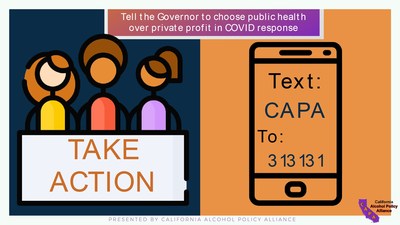
CAPA is urging Californians to Text the word CAPA to 313131 to send a message to the Governor asking him to closely re-examine California’s relationship with Big Alcohol, acknowledge that excessive alcohol use is No. 3 on the list of preventable causes of death in the state and make public health essential, not alcohol.

California currently suffers over 10,500 alcohol-related deaths, 165,000 alcohol-related hospitalizations and $35 billion in related economic harm.

The California Alcohol Policy Alliance (CAPA) unites diverse organizations and communities in California to protect health and safety, and prevent alcohol-related harm through statewide action.

CAPA Member Organizations

  • Alcohol Justice
  • Alcohol-Narcotics Education Foundation of California
  • ADAPP, Inc.
  • ADAPT San Ramon Valley
  • Bay Area Community Resources
  • Behavioral Health Services, Inc.
  • CA Council on Alcohol Problems
  • CASA for Safe & Healthy Neighborhoods
  • Center for Human Development
  • Center for Open Recovery
  • DogPAC of San Francisco
  • Dolores Huerta Foundation
  • Eden Youth & Family Center
  • Institute for Public Strategies
  • FASD Network of Southern CA
  • FreeMUNI – SF
  • Friday Night Live Partnership
  • Koreatown Youth & Community Center
  • Laytonville Healthy Start
  • L.A. County Friday Night Live
  • L.A. Drug & Alcohol Policy Alliance
  • L.A. County Office of Education
  • Lutheran Office of Public Policy – CA
  • MFI Recovery Center
  • Mountain Communities Family Resource Center
  • National Asian Pacific American Families Against Substance Abuse
  • National Council on Alcoholism & Drug Dependence – Orange County
  • Partnership for a Positive Pomona
  • Paso por Paso, Inc.
  • Project SAFER
  • Pueblo y Salud
  • Reach Out
  • San Marcos Prevention Coalition
  • San Rafael Alcohol & Drug Coalition
  • SAY San Diego
  • Saving Lives Drug & Alcohol Coalition
  • South Orange County Coalition
  • Tarzana Treatment Centers, Inc.
  • The Wall Las Memorias Project
  • UCEPP Social Model Recovery Systems
  • Women Against Gun Violence
  • Youth For Justice

For more information: https://alcoholjustice.org/press-packets

Contact: 

Mayra Jimenez 323 683-4687

Jorge Castillo 213 840-3336                                                             

Michael Scippa 415 548-0492      


California Alcohol Policy Alliance (CAPA) AlcoholPolicyAlliance.org

Photo – https://mma.prnewswire.com/media/1218513/CAPA___Take_Action.jpg
Logo – https://mma.prnewswire.com/media/469269/Califorina_Alcohol_Policy_Alliance_Logo.jpg

SOURCE California Alcohol Policy Alliance

Mazda To Resume Full Factory Operation Worldwide In August Amid Strong US Sales And Demand

IRVINE, Calif., July 22, 2020 /PRNewswire-HISPANIC PR WIRE/ — Starting in August, Mazda Motor Corporation will return to normal factory operations, or pre-COVID-19 levels, amid increased sales and future forecast for product demand in the U.S. In June, Mazda North American Operations achieved a sales increase of nearly 11 percent year-over-year. Most notably, the three-row CX-9 and MX-5 roadster volumes grew approximately 50 percent and 25 percent, respectively.

<div id="prni_dvprnejpg5418left"…

IRVINE, Calif., July 22, 2020 /PRNewswire-HISPANIC PR WIRE/ — Starting in August, Mazda Motor Corporation will return to normal factory operations, or pre-COVID-19 levels, amid increased sales and future forecast for product demand in the U.S. In June, Mazda North American Operations achieved a sales increase of nearly 11 percent year-over-year. Most notably, the three-row CX-9 and MX-5 roadster volumes grew approximately 50 percent and 25 percent, respectively.

Mazda North American Operations is headquartered in Irvine, Calif., and oversees the sales, marketing, parts and customer service support of Mazda vehicles in the United States and Mexico through nearly 700 dealers. Operations in Mexico are managed by Mazda Motor de Mexico in Mexico City. For more information on Mazda vehicles, including photography and B-roll, please visit the online Mazda media center at www.mazdausamedia.com.

Through the remainder of July, Mazda will end production adjustments implemented at plants in Japan, Mexico and Thailand caused by the pandemic. Mazda has been monitoring inventory levels and modifying production since the end of March. Currently, almost all dealerships worldwide have resumed sale operations.

Globally, Mazda remains cautious and flexible regarding the risk posed by COVID-19 and will closely monitor trends and demand in each market where Mazda vehicles are shipped.

Mazda North American Operations is headquartered in Irvine, California, and oversees the sales, marketing, parts and customer service support of Mazda vehicles in the United States and Mexico through approximately 620 dealers. Operations in Mexico are managed by Mazda Motor de Mexico in Mexico City. For more information on Mazda vehicles, including photography and B-roll, please visit the online Mazda media center at InsideMazda.MazdaUSA.com/Newsroom.

Follow MNAO’s social media channels through Twitter and Instagram at @MazdaUSA and Facebook at Facebook.com/MazdaUSA.

Logo – https://mma.prnewswire.com/media/53154/mazda_north_american_operations_logo.jpg  

SOURCE Mazda North American Operations

Toyota Motor North America Announces Executive Changes

PLANO, Texas, July 22, 2020 /PRNewswire-HISPANIC PR WIRE/ — Toyota Motor North America (TMNA) announced executive changes to its Social Innovation and Toyota de Mexico operations.

<img id="prnejpg855cleft" title="Toyota logo. (PRNewsFoto/Toyota Media Relations) (PRNewsfoto/Toyota Motor North America)" border="0" alt="Toyota logo. (PRNewsFoto/Toyota Media Relations) (PRNewsfoto/Toyota…

PLANO, Texas, July 22, 2020 /PRNewswire-HISPANIC PR WIRE/ — Toyota Motor North America (TMNA) announced executive changes to its Social Innovation and Toyota de Mexico operations.

Toyota logo. (PRNewsFoto/Toyota Media Relations) (PRNewsfoto/Toyota Motor North America)

Effective September 1, 2020, Sean Suggs, president of Toyota Motor Manufacturing, Mississippi (TMMMS), will be assigned as group vice president, chief social innovation officer, TMNA. Suggs will take on a dual-capped role, keeping his TMMMS responsibilities until further notice. 

In his new role, Suggs is responsible for TMNA’s philanthropic efforts, the Toyota USA Foundation, and the corporate diversity and inclusion strategy. He will report to Sandra Phillips Rogers, group vice president, general counsel, chief legal officer and chief diversity officer, TMNA.

As president of TMMMS, Suggs will continue to report to Brian Krinock, senior vice president, vehicle plants, TMNA.

Suggs is replacing Albert (Al) Smith, Jr., group vice president, chief social innovation officer, TMNA, who is retiring after 30 years with the company. Smith was instrumental in shaping the company’s Social Innovation team and its direction. Under his leadership, Toyota has been recognized by numerous organizations for its commitment to improving the communities where we operate and for its diversity and inclusion initiatives, resulting in Toyota’s rise in the rankings to 10th place on DiversityInc’s 2020 Top 50 Companies for Diversity®.

«Strong community engagement and inclusiveness have become more prevalent in our daily lives,» said Phillips Rogers. «We thank Al for all he has done for our company, and Sean will continue to uphold Toyota’s commitment for Respect for All, while helping to create future initiatives that will make a lasting, positive impact on our workplace, marketplace and society.»

In addition, effective August 3, 2020, Luis Lozano, external affairs senior director, general counsel and compliance, Toyota Motor Sales de México (TMEX) will be assigned as president of Toyota de Mexico (TdM). Lozano will replace Mike Bafan, current president of TdM.

Lozano, who joined the company in 2005, will be responsible for public affairs, including Legal and Compliance, Government and Regulatory Affairs, Communications and Corporate Social Responsibility, and Customs and Trade Compliance for Toyota in Mexico. He will report to Chris Reynolds, chief administrative officer, manufacturing and corporate resources, TMNA. 

Bafan remains chairman of Toyota Manufacturing de Baja California (TMMBC) and Toyota Motor Manufacturing de Guanajuato (TMMGT) and group vice president, Manufacturing Project Innovation Center (MPIC), TMNA, based in Plano, Texas.

Tom Sullivan remains president of TMEX responsible for sales and working with Toyota’s dealer network in Mexico.

Additionally, Jun Umemura, who served as group vice president of Mexico Affairs, TMNA, will be retiring after more than 50 years of service with Toyota.

During Umemura’s 50-year career with Toyota, he has helped the company establish its U.S. manufacturing operations in 1984 and was involved with the planning and start-up of the company’s first wholly-owned vehicle manufacturing facilities in Kentucky and Ontario, Canada.  He was also responsible for the start-up of Toyota Motor Manufacturing Baja California (TMMBC), Toyota’s first plant in Mexico, established in 2002. In 2016, he became group vice president of TMNA, responsible for Mexico operations, as well as Board member and executive advising officer for TMEX, TMMBC and Toyota Motor Manufacturing Guanajuato (TMMGT).

«Jun’s Toyota career spans five decades and helped lay the groundwork for our manufacturing footprint, represented today by 14 plants in North America,» said Reynolds. «At the same time, Al’s career spanned three decades and his contributions to the organizations’ shared impact strategy, corporate planning, sales and service operations are unparalleled. We thank Jun and Al for their dedicated service to Toyota and our customers, and welcome Sean and Luis, both of whom are proven leaders, well-respected within the industry and passionate about our company.»

About Toyota:
Toyota (NYSE:TM) has been a part of the cultural fabric in the U.S. and North America for more than 60 years, and is committed to advancing sustainable, next-generation mobility through our Toyota and Lexus brands. During that time, Toyota has created a tremendous value chain as our teams have contributed to world-class design, engineering, and assembly of more than 40 million cars and trucks in North America, where we have 14 manufacturing plants, 15 including our joint venture in Alabama (10 in the U.S.), and directly employ more than 47,000 people (over 36,000 in the U.S.). Our 1,800 North American dealerships (nearly 1,500 in the U.S.) sold nearly 2.8 million cars and trucks (nearly 2.4 million in the U.S.) in 2019.

Through the Start Your Impossible campaign, Toyota highlights the way it partners with community, civic, academic and governmental organizations to address our society’s most pressing mobility challenges. We believe that when people are free to move, anything is possible. For more information about Toyota, visit www.toyotanewsroom.com.

Contact:  Victor Vanov 469.292.1318

Logo – https://mma.prnewswire.com/media/785813/TOYOTA_MEDIA_RELATIONS_LOGO.jpg  

SOURCE Toyota Motor North America

COVID-19 impacts Texas home sales, while prices rise in second quarter of 2020

AUSTIN, Texas, July 22, 2020 /PRNewswire-HISPANIC PR WIRE/ — The mandatory shelter-in-place orders related to COVID-19 caused the number of home sales across Texas to decline in the second quarter of 2020, while median price increased, according to the <a target="_blank"…

AUSTIN, Texas, July 22, 2020 /PRNewswire-HISPANIC PR WIRE/ — The mandatory shelter-in-place orders related to COVID-19 caused the number of home sales across Texas to decline in the second quarter of 2020, while median price increased, according to the 2020-Q2 Texas Quarterly Housing Report released today by Texas Realtors.

Texas Association of Realtors logo.

«Even though Texans entered Q2 in the jaws of COVID-19, the housing market held its own,» said Cindi Bulla, chairman of Texas Realtors. «The second quarter of 2020 fared amazingly well by comparison to the same period of 2019, which was arguably one of our best years ever. Gov. Abbott’s early declaration of real estate as an essential service allowed Texas Realtors to transition to virtual platforms and carefully choreographed safety protocols for the few necessary in-person contacts, virtually eliminating disruption to the real estate sector.»

Home sales declined 9.9%, with 91,970 homes sold in the second quarter of 2020. Statewide, the median price increased 2.9% to $252,000. Of all the homes sold within the second quarter, 34.6% were priced from $200,000 to $299,999, the highest share of sales among all price-class distributions.

Jim Gaines, Ph.D., chief economist with the Real Estate Center at Texas A&M University, commented, «With COVID-19 and the mandatory shut down, the Texas housing market performed as expected in Q2. We have a tighter market compared to last year, causing prices to remain high. However, in June we saw demand pick up with buyers becoming more active and taking advantage of the low interest rates. The housing market is one of the few segments of the economy that has held strong. Barring another shutdown, we anticipate it to perform reasonably well in Q3.»

Active listings declined 22% in Q2 to 88,337 listings. Texas homes spent an average of 57 days on the market during the same time frame, five days more than the second quarter of 2019.

Housing inventory in Texas declined 0.9 months to 3.0 months of inventory. According to the Real Estate Center at Texas A&M University, a market balanced between supply and demand has between 6.0 and 6.5 months of inventory.

Chairman Bulla concluded, «It’s important to note that closed sales are off by only 10% compared to the second quarter of 2019. Pent up demand still resulted in rising prices, though at a slower pace. There is every reason for optimism as we move into Q3. However, our biggest problem remains the availability of affordable inventory.»

About the Texas Quarterly Housing Report
Data for the Texas Quarterly Housing Report is provided by the Data Relevance Project, a partnership among local REALTOR® associations and their MLSs, and Texas REALTORS®, with analysis by the Real Estate Center at Texas A&M. The report provides quarterly real estate sales data for Texas and 25 metropolitan statistical areas in Texas. To view the report in its entirety, visit texasrealestate.com

About Texas REALTORS®
With more than 135,000 members, Texas REALTORS® is a professional membership organization that represents all aspects of real estate in Texas. In 2020, Texas REALTORS® is celebrating a century of shaping Texas by being the advocate for private property rights, maintaining the highest standards of professionalism, and providing its members with the tools to achieve success. Visit texasrealestate.com to learn more.

Contact: Morgan Moritz, mmoritz@piercom.com

Logo – https://mma.prnewswire.com/media/175272/texas_association_of_realtors_logo.jpg

SOURCE Texas REALTORS

Don Q Introduces Reserva 7 Años

PONCE, Puerto Rico, July 22, 2020 /PRNewswire-HISPANIC PR WIRE/ — Destilería Serrallés Inc., the producer of Don Q, Puerto Rico’s number-one rum, is proud to announce the launch of Don Q Reserva 7, the latest addition to its curated portfolio of aged rums made with the finest reserves from the distillery in Ponce, PR.

<img id="prnejpga953left" title=" " border="0" alt=" " align="middle"…

PONCE, Puerto Rico, July 22, 2020 /PRNewswire-HISPANIC PR WIRE/ — Destilería Serrallés Inc., the producer of Don Q, Puerto Rico’s number-one rum, is proud to announce the launch of Don Q Reserva 7, the latest addition to its curated portfolio of aged rums made with the finest reserves from the distillery in Ponce, PR.

The distillery’s continuous focus on expanding its aged and super premium offering aligns with increased consumer demand and curiosity in the segment. Jaiker Soto, Master Blender, crafted a vibrant blend of multi-column distilled light rums and single copper column distilled heavy rums, which were aged for a minimum of seven years in American white oak barrels.  For this unique blend, Soto collaborated with Silvia Santiago, Senior VP of Manufacturing and Maestra Ronera, along with Roberto Serrallés, sixth-generation rum maker, bringing together decades of rum making experience for the creation of this superb rum.

The team hand selected and blended Puerto Rican rums that were aged for a minimum of seven years to create a new Don Q rum variant that is radiant and bold with an intricate start and a mature, yet brilliant, long finish. This versatile rum expression is best enjoyed neat, on the rocks, in a cocktail like the Classic 7 or Honey Breeze, or to elevate a favorite mixed drink, simply by adding soda or fresh juice.

«We wanted to create a rum with a distinctive flavor profile and maturity that had balanced notes and the characteristics fans have come to expect from Don Q Rums.  With Reserva 7, our goal was to craft a rum that honored the Serrallés family and their legacy of making world-class rum,» says Soto. «It was an honor to taste through reserves and blend a selection of aged rums to create a smooth and elegant expression with notes of roasted oak, caramelized fruit, honey and chocolate.»

Color: Bright intense amber 

Aroma: The rum greets the nose with refined notes of oak, dark caramel and spices, characteristic of its long aging. Its robust body is reminiscent of chocolate, toasted almonds, raisins and apricot.

Alcohol: 80 Proof, 40% ALC/VOL

Don Q Reserva 7 is presented in a new bottle design with the brand’s updated image and logo. The elongated glass bottle evokes the refinement and simplicity that has characterized the rums crafted by the Serrallés family for 155 years.  The brand’s new packaging highlights Don Q’s values of heritage and quality and was executed by Stranger and Stranger, the world-renowned, internationally awarded British firm that specializes in packaging design for premium spirit brands globally. 

Don Q’s Reserva 7 will be available starting August 2020 at select liquor stores, supermarkets, hotels and restaurants, Drizly and other third-party services throughout the country and online via www.donqrum.com with a MSRP of $24.99. For more drink recommendations, visit www.donqrum.com or follow on social media: Facebook.com/DonQ  and @donqrum.

About Destilería Serrallés:
Destilería Serrallés is one of America’s oldest family-owned businesses with a rum making tradition that spans 6 generations and 155 years. Based in Ponce, Puerto Rico, the distillery produces its flagship product, the award-winning Don Q rum brand, the #1 selling rum on the island. The Distillery has been awarded the «Green Award» from The Drinks Business, which recognizes leaders in environmental practices within the beverage industry, and more recently was recognized as «World Class Distillery,» by World Spirits Awards. For additional information, visit us at https://donq.com/ and follow us on social media: Facebook.com/DonQ and @donqrum.

About Serrallés USA:
Serrallés USA, based in Stamford CT, is the USA distribution company of Destilería Serrallés. Serrallés USA’s portfolio includes: Don Q Cristal, Don Q Gold, Don Q Gran Añejo, Don Q Reserva 7, Don Q Signature Release Single Barrel 2005, 2007 & 2009, Don Q Double Aged Vermouth Cask Finish, Don Q Double Aged Sherry Cask Finish, Don Q Oak Barrel Aged Spiced, Don Q Limón, Don Q Coco, Don Q Pasión, Don Q Piña, Don Q 151, Reserva de la Familia Serrallés, Palo Viejo & Caliche Rum; as well as a sales and marketing alliance with Barrow’s Intense Ginger Liqueur. Please visit us at https://donq.com/ and follow us on http://facebook.com/DonQ and @donqrum.

For more information about Don Q Rum, please contact Baltz & Company:
Sarah Abell (917.584.8567; sabell@baltzco.com) or
Annette Malkin (212.600.5828; amalkin@baltzco.com)

Logo – https://mma.prnewswire.com/media/1217660/Don_Q_Logo.jpg

SOURCE Don Q Rum