Full Spectrum CBD Oil – Best Pure CBD Oil Analysis & Customers Review

NEW YORK, Jan. 15, 2021 /PRNewswire/ — Full Spectrum CBD Oil: Our body has so many functions to perform daily tasks. These days people have hectic and sleepless nights. People suffer a lot from depression and stress. These things do not give any calm mind. This is the reason people aren’t able to do any work patiently. This needs to get cured of life. There is no fun if life is simple and without any…

NEW YORK, Jan. 15, 2021 /PRNewswire/ — Full Spectrum CBD Oil: Our body has so many functions to perform daily tasks. These days people have hectic and sleepless nights. People suffer a lot from depression and stress. These things do not give any calm mind. This is the reason people aren’t able to do any work patiently. This needs to get cured of life. There is no fun if life is simple and without any adventures. Doing a plain job is of course not a fun thing. But facing such health problems make life adventures. Though these problems need to be cured in the early stage. Because after some time it can become dangerous for life. So Full Spectrum CBD Oil helps to keep the mind calm and remove all the pain from the body.

REPORT IN THE OFFICIAL WEBSITE: http://thecbdoil.net/651/full-spectrum-cbd-oil/reports/

The working of Full Spectrum CBD Oil depends on the CO2 extraction. It takes high extraction levels and thus, helps in taking better oil extraction. It maintains a high level of purity in oil extraction. This helps in the working process of the supplement. It contains a hemp plant that absorbs all the unhealthy things from the body and thus gives nutrients and other vitamins to the body. It is easier to choose any Best Pure CBD Oil but difficult to know what is good for our health. Full Spectrum CBD Oil serves the best and effective ingredients along with the working of them. There is no harm in getting used to this Full Spectrum CBD Oil. It helps to stronger the immunity power of the body.

So this means it gives wonderful working and results. Take a lot of water and have better meals. Do not take any supplements with this one. Do not take an overdose of this Full Spectrum CBD Oil. It should be taken on time with proper meals. If the packing of the Best Pure CBD Oil is cracked or has any fault does not use that supplement. Use the supplement in a proper way to get effective results. Check CBD Oil in Official Website – http://thecbdoil.net/

Full Spectrum CBD Oil contains a great variety of ingredients that helps give the best results. Inflammation and joints pains are two factors which cause a lot of problem at work. It makes the body unhealthy and unconscious. Therefore, it has a formula that works best for curing health problems. Ingredients are hemp extract, vegetable glycerin, and other nutrients. These ingredients help in removing stress, depression, and other health problems. So there is no heavy dose in this Full Spectrum CBD Oil plus all the ingredients of this Full Spectrum CBD Oil are natural and healthy. There are no side effects with the use of this supplement. Within 15-45 minutes this Best Pure CBD Oil starts to show the effects on the body. There are times when some people get later working. It depends upon the health and problems of the body. MUST SEE: «Shocking New Best CBD Oil Report – This May Change Your Mind»

Full Spectrum CBD Oil has many good and effective benefits. It helps the body to remain healthy for the long term. Also, it increases the vitality and metabolism along with many benefits. Here are some of the benefits of the supplement given. It helps to improve life’s vitality and endurance. It supports weight loss and gives the best sleep patterns. It reduces stress and depression. It provides the body with a better immune system and stronger metabolism. It protects the body from getting any side effects or is attacked by foreign particles. It cleans all misleads in the body and gives the right path to the bloodstream. It maintains blood sugar levels in the body. It maintains muscles and joint pain. It helps to reduce many damages in the body. So these are some of the benefits which are provided by the Best Pure CBD Oil. After the use of this supplement, there are many benefits caused by it. Because good effects could make you wonderful or healthy and side effects could make the worst of health. Therefore, it is much needed to know the side effects of any supplement. But with Full Spectrum CBD Oil there is no chance of getting any side effects. It is the biggest boon on human life with this supplement that it does not give any harmful effects. For the best and effective results, it is mandatory to use it in an ineffective and better way.

There should be a complete routine of the utilization of meals and supplements on time. Therefore, this supplement gives the best way to utilize it and gives amazing benefits. Here are some steps in which one should utilize Full Spectrum CBD Oil. Take the necessary steps required to get healthy results. Consume the supplement two times in a day for effective results.

Full Spectrum CBD Oil is a rescue from all the pain, anxiety, and inflammation. This supplement contains all the natural ingredients which help to provide the body a cure. It gives better mental health. Thus, this supplement has the best and effective ingredients. When things are extracted from the plant directly it gives many benefits. Similarly, Full Spectrum CBD Oil is a supplement that is made with the ingredients that are extracted from the natural plants itself. So the working of this Best Pure CBD Oil does not include any harmful effects. It works naturally to provide the body healthy mindset. It helps to improve mood swings. It helps to keep your mind away from all the stress, depression, and anxiety. This results in a concentrated and focused mind. The ingredients of this supplement work so effectively that within 30 days of use, you will get the results. So there is no chemical added in this supplement and you get the best results.

Full Spectrum CBD Oil Official Website: http://thecbdoil.net/

Full Spectrum CBD Oil
support@thecbdoil.net 
TOLL FREE (866) 680-3917

Cision View original content:http://www.prnewswire.com/news-releases/full-spectrum-cbd-oil—best-pure-cbd-oil-analysis–customers-review-301209417.html

SOURCE Full Spectrum CBD Oil

Little Kamper Takes on Big Waste

MANTECA, Calif., Jan. 15, 2021 /PRNewswire/ — From Yosemite campsites to stadium tailgate parties, 1lb propane tanks are the popular way to fuel portable BBQ’s, camp stoves and lanterns. So popular, it’s estimated that over 40 million of the dark green tanks are sold every year. The big problem with those little tanks is the cost of cleaning up the hazardous waste they leave behind.

MANTECA, Calif., Jan. 15, 2021 /PRNewswire/ — From Yosemite campsites to stadium tailgate parties, 1lb propane tanks are the popular way to fuel portable BBQ’s, camp stoves and lanterns. So popular, it’s estimated that over 40 million of the dark green tanks are sold every year. The big problem with those little tanks is the cost of cleaning up the hazardous waste they leave behind.

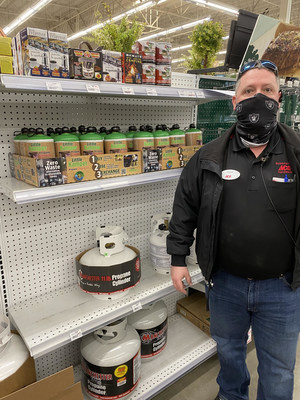
Enter the Little Kamper 1lb propane tank exchange, a sustainable alternative to disposable tanks. Using a DOT-certified refillable 1lb tank, the Little Kamper program puts tanks on participating retailer shelves and allows customers to buy, use, and exchange their empty tanks for prefilled replacements. For customers who want eco-friendly products, the Little Kamper is zero-waste. For retailers who want repeat customers, the exchange model brings customers back for more.

«This is an exciting step for us,» observed Little Kamper’s Josh Simpson, «because we know that eco-friendly consumers want a better mousetrap and most retailers already understand the simplicity of tank exchange. Our Little Kamper fits in that space.»

What people don’t realize about 1lb propane tanks

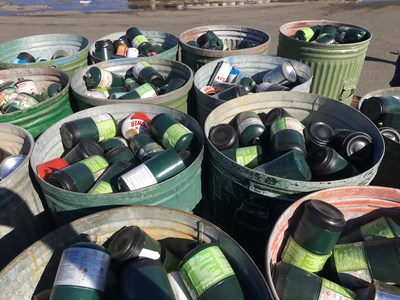
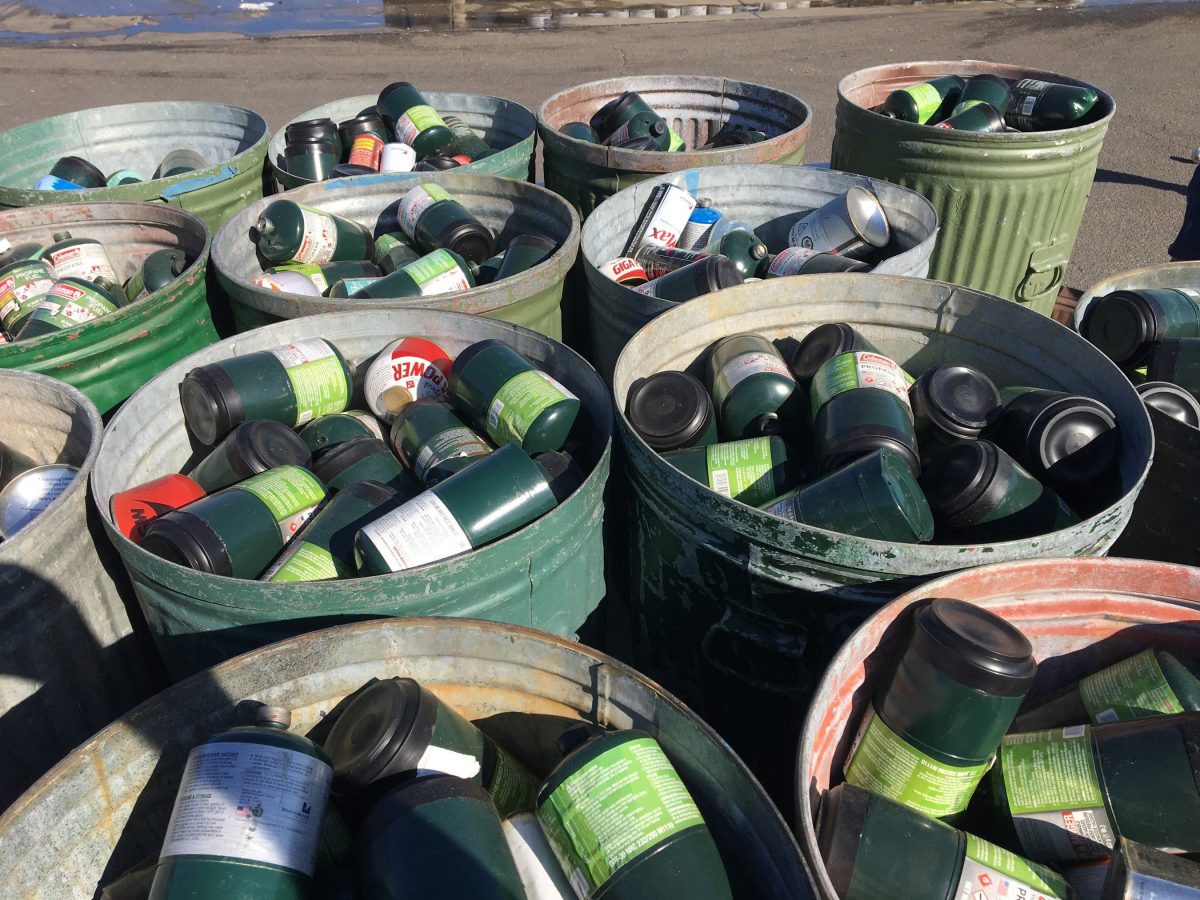
The propane tank collection bins in the campgrounds at Yosemite National Park don’t exactly scream «hazardous waste» to the people who camp in the park. But in fact, many people who use 1lb tanks discard them with liquid propane still in the tanks and that makes them hazardous waste.

«People don’t realize how frequently these tanks are thrown away with liquid propane still inside» observed Doug Kobold, Executive Director of the California Product Stewardship Council (CPSC). CPSC works with the State of California’s Department of Resource Recovery and Recycling (Cal Recycle) to reduce the volume of problem products flowing into California’s waste stream. «The communities that end up with these tanks in their waste stream don’t have a specified funding source to cover the cost of their proper recycling», say Kobold.  The end result is local taxpayers and ratepayers get stuck with the bill.

Little Kamper tank exchange is available in Yosemite National Park’s retail stores and a growing number of independent retail outlets in California. The company is expanding distribution and has inventory ready to supply new stores for the 2021 recreation season. To find a retailer near you, or become a Little Kamper retailer, visit www.LittleKamper.com.

Cision View original content to download multimedia:http://www.prnewswire.com/news-releases/little-kamper-takes-on-big-waste-301209284.html

SOURCE Little Kamper, Inc.

Little Kamper Takes on Big Waste

MANTECA, Calif., Jan. 15, 2021 /PRNewswire/ — From Yosemite campsites to stadium tailgate parties, 1lb propane tanks are the popular way to fuel portable BBQ’s, camp stoves and lanterns. So popular, it’s estimated that over 40 million of the dark green tanks are sold every year. The big problem with those little tanks is the cost of cleaning up the hazardous waste they leave behind.

MANTECA, Calif., Jan. 15, 2021 /PRNewswire/ — From Yosemite campsites to stadium tailgate parties, 1lb propane tanks are the popular way to fuel portable BBQ’s, camp stoves and lanterns. So popular, it’s estimated that over 40 million of the dark green tanks are sold every year. The big problem with those little tanks is the cost of cleaning up the hazardous waste they leave behind.

Enter the Little Kamper 1lb propane tank exchange, a sustainable alternative to disposable tanks. Using a DOT-certified refillable 1lb tank, the Little Kamper program puts tanks on participating retailer shelves and allows customers to buy, use, and exchange their empty tanks for prefilled replacements. For customers who want eco-friendly products, the Little Kamper is zero-waste. For retailers who want repeat customers, the exchange model brings customers back for more.

«This is an exciting step for us,» observed Little Kamper’s Josh Simpson, «because we know that eco-friendly consumers want a better mousetrap and most retailers already understand the simplicity of tank exchange. Our Little Kamper fits in that space.»

What people don’t realize about 1lb propane tanks

The propane tank collection bins in the campgrounds at Yosemite National Park don’t exactly scream «hazardous waste» to the people who camp in the park. But in fact, many people who use 1lb tanks discard them with liquid propane still in the tanks and that makes them hazardous waste.

«People don’t realize how frequently these tanks are thrown away with liquid propane still inside» observed Doug Kobold, Executive Director of the California Product Stewardship Council (CPSC). CPSC works with the State of California’s Department of Resource Recovery and Recycling (Cal Recycle) to reduce the volume of problem products flowing into California’s waste stream. «The communities that end up with these tanks in their waste stream don’t have a specified funding source to cover the cost of their proper recycling», say Kobold.  The end result is local taxpayers and ratepayers get stuck with the bill.

Little Kamper tank exchange is available in Yosemite National Park’s retail stores and a growing number of independent retail outlets in California. The company is expanding distribution and has inventory ready to supply new stores for the 2021 recreation season. To find a retailer near you, or become a Little Kamper retailer, visit www.LittleKamper.com.

Cision View original content to download multimedia:http://www.prnewswire.com/news-releases/little-kamper-takes-on-big-waste-301209284.html

SOURCE Little Kamper, Inc.

California housing market ends year on high note as sales continue strong in December and median price reaches another record high, C.A.R. reports

LOS ANGELES, Jan. 15, 2021 /PRNewswire/ — Despite a global pandemic that lingered most of the year, two lockdowns and a struggling economy, California’s housing market closed out 2020 on a high note, recording solid sales and a fifth record-high median price in December, the 

LOS ANGELES, Jan. 15, 2021 /PRNewswire/ — Despite a global pandemic that lingered most of the year, two lockdowns and a struggling economy, California’s housing market closed out 2020 on a high note, recording solid sales and a fifth record-high median price in December, the CALIFORNIA ASSOCIATION OF REALTORS® (C.A.R.) said today. 

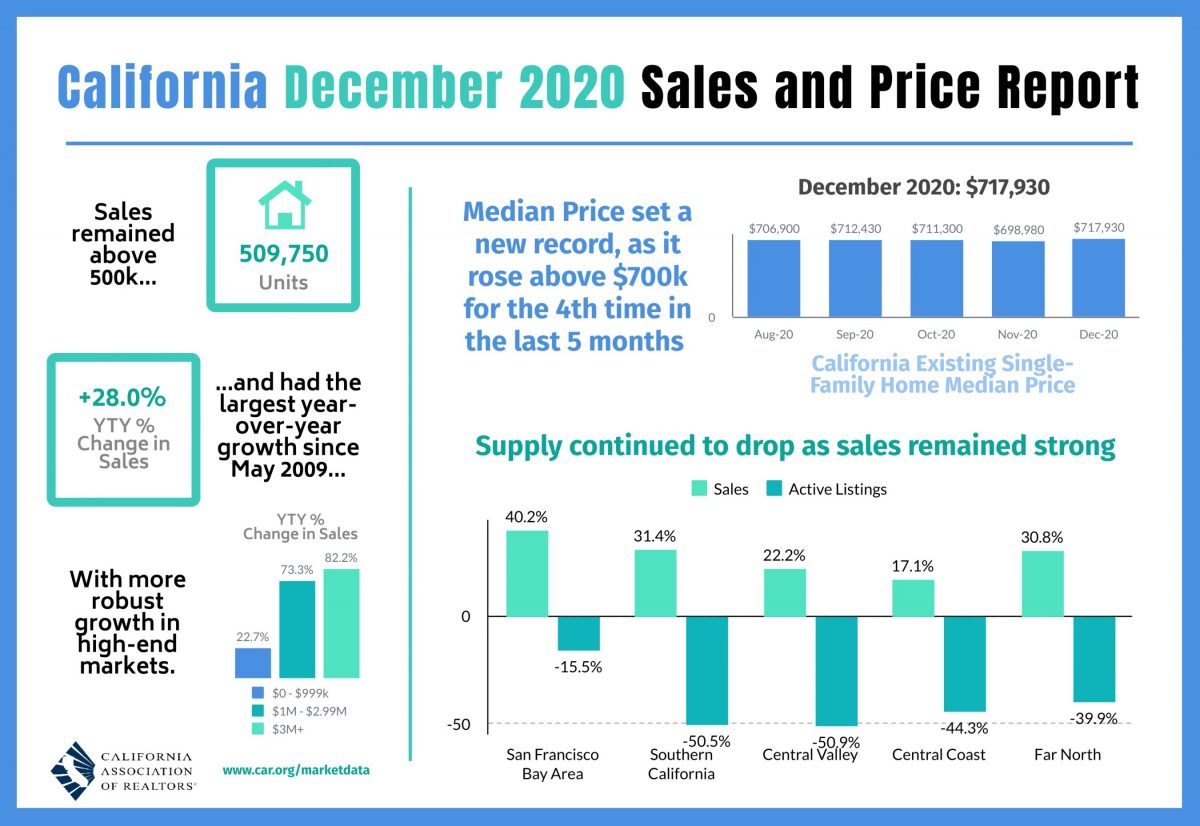
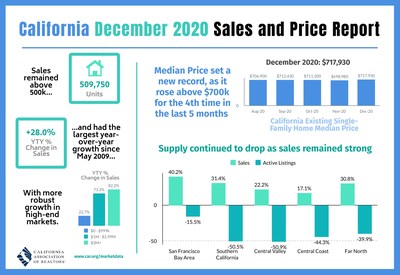
– Infographic: https://www.car.org/marketing/clients/infographics/December%202020%20Sales%20and%20Price

Closed escrow sales of existing, single-family detached homes in California totaled a seasonally adjusted annualized rate of 509,750 units in December, according to information collected by C.A.R. from more than 90 local REALTOR® associations and MLSs statewide. The statewide annualized sales figure represents what would be the total number of homes sold during 2020 if sales maintained the December pace throughout the year. It is adjusted to account for seasonal factors that typically influence home sales.

December home sales ticked up 0.2 percent from 508,820 in November and were up 28 percent from a year ago, when 398,370 homes were sold on an annualized basis. The year-over-year, double-digit sales gain was the fifth consecutive and the largest yearly gain since May 2009. For the year as a whole, annual home sales rose to a preliminary 411,870 closed escrow sales in California, up 3.5 percent from 2019’s pace of 397,960.

«It’s a testament to the strength of the market that even after the pandemic effectively shut down the spring home-buying season in 2020, the market still was able to recover the substantial sales lost in the first half of the year and even top 2019’s levels,» said C.A.R. President Dave Walsh, vice president and manager of the Compass San Jose office. «With mortgage rates expected to stay near the lowest in history, demand for homeownership will continue to be strong, so home sales should remain elevated into the first half of 2021, as motivated buyers take advantage of the increased purchasing power.»

After dipping below $700,000 the previous month, California’s median home price bounced back above that benchmark and set another record high in December. The statewide median home price rose 2.7 percent on a month-to-month basis to $717,930 in December, up from November’s $698,890. Home prices continued to gain on a year-over-year basis with the statewide median price surging 16.8 percent from $614,880 recorded last December. The double-digit increase from last year was the fifth in a row, and the month-to-month gain was higher than the long-run average of 0.8 percent observed between 1979 and 2019. The statewide median home price for the entire year was $659,380, an increase of 11.3 percent from a revised $592,230 in 2019.

«Home prices, which usually peak during the summer, were unseasonably strong in December,» said C.A.R. Vice President and Chief Economist Jordan Levine. «The imbalance between supply and demand continues to fuel home price gains as would-be home sellers remain reluctant to list their homes during the pandemic, contributing to a more-than-40-percent year-over-year decline in active listings for the seventh straight month.»

Perhaps due to increasing home prices, more consumers said it is a good time to sell, according to C.A.R.’s monthly Consumer Housing Sentiment Index. Conducted in early January, the poll found that 59 percent of consumers said it is a good time to sell, up from 55 percent a month ago, and up from 56 percent a year ago. Meanwhile, low interest rates continue to fuel the optimism for homebuying; one-fourth of the consumers who responded to the poll believed that now is a good time to buy a home, unchanged from last year.

Other key points from C.A.R.’s December 2020 resale housing report include:

  • At the regional level, sales increased by double-digits in all major regions in December, with a year-over-year gain of over 20 percent for each region, except the Central Coast region. The San Francisco Bay Area remained on top with the highest gain of 40.2 percent over last year, followed by Southern California (31.4 percent), the Far North (30.8 percent) and the Central Valley (22.2 percent). Sales in the Central Coast region were softer than the other regions but still improved 17.1 percent from a year ago.
  • For the year as a whole, all major regions except the Far North surpassed their 2019 sales levels. The Central Coast was the strongest market among all regions, with annual sales increasing 5.5 percent from 2019. Both the San Francisco Bay Area and Southern California recorded a sales improvement of 1.9 percent from last year, while the Central Valley inched up 0.3 percent. The Far North was the only major region that trailed behind last year’s level, with a slight dip of 0.3 percent.
  • With homebuying interest remaining high, sales in resort communities continued to exhibit strong gains from the prior year. Mammoth Lakes saw the biggest sales increase in December, surging 116.7 percent from a year ago, followed by Lake Arrowhead (78.6 percent), Big Bear (54.1 percent) and South Lake Tahoe (31.7 percent). For the year 2020, sales increased 92.7 percent in Big Bear, 51 percent in Lake Arrowhead, 49.5 percent in South Lake Tahoe and 37.5 percent in Mammoth Lake.
  • At the regional level, all major regions posted an increase in the median price from last year by more than 10 percent. The Central Coast region had the largest year-over-year price increase in December, gaining 17.9 percent from a year ago. The San Francisco Bay Area had the second largest increase of 16.4 percent, followed by the Central Valley (15.5 percent), the Far North (15.2 percent) and Southern California (13.0 percent).
  • All but one of the 51 counties tracked by C.A.R. reported a year-over-year price gain, with 48 of them increasing by 10 percent or more. Mono had the highest price growth, with an increase of 120 percent year-over-year. Lassen was the only county whose median price dropped, declining 13.1 percent from a year ago.
  • The surge in the coronavirus cases continues to play a role in the decrease in active listings as homeowners remain concerned about the worsening coronavirus pandemic situation. As a result, C.A.R.’s Unsold Inventory Index (UII) dropped to 1.3 months in December, matching the record-low set in spring 2004. The index indicates the number of months it would take to sell the supply of homes on the market at the current rate of sales.
  • Active listings fell 47.1 percent from last year and continued to drop more than 40 percent on a year-over-year basis for the seventh straight month. On a month-to-month basis, for-sale properties dropped 18.6 percent in December, higher than the 5-year average of -14.0 percent, observed between 2015 and 2019.
  • Except for the Bay Area, all major regions experienced a year-over-year decline of 35 percent or more in for-sale properties in December. The Central Valley had the biggest year-over-year drop of 50.9 percent in December, followed by Southern California (50.5 percent), the Central Coast (-44.3 percent), the Far North (-39.9 percent) and the San Francisco Bay Area (-15.5 percent).
  • Forty-eight of the 51 counties reported by C.A.R. experienced a year-over-year decline in active listings in December. Merced had the biggest drop from last year, with a decline of 70.1 percent, followed by San Bernardino (-68.6%) and Sutter (-66.9%). Twenty counties had less than half the active listings they had in December 2019. San Francisco (115.1%), San Mateo (26.3%), and Santa Clara (7.7%) were the only counties in California with an increase in active listings from the prior year.
  • The median number of days it took to sell a California single-family home was 11 days in December, down from 28 days in December 2019, and only 2 days longer than the lowest number of days ever recorded in the previous month.
  • C.A.R.’s statewide sales-price-to-list-price ratio* was 100.1 percent in December 2020 and 98.3 percent in December 2019.
  • The statewide average price per square foot** for an existing single-family home remained elevated and improved solidly on an annual basis. December’s price per square foot was $330 compared to $289 in December 2019. While the December 2020 figure did not set a new record, it was still the second highest statewide median price per square foot since August 2007.
  • The 30-year, fixed-mortgage interest rate averaged 2.68 percent in December, down from 3.72 percent in December 2019, according to Freddie Mac. The five-year, adjustable mortgage interest rate was an average of 2.79 percent, compared to 3.39 percent in December 2019.

Note:  The County MLS median price and sales data in the tables are generated from a survey of more than 90 associations of REALTORS® throughout the state and represent statistics of existing single-family detached homes only. County sales data are not adjusted to account for seasonal factors that can influence home sales. Movements in sales prices should not be interpreted as changes in the cost of a standard home. The median price is where half sold for more and half sold for less; medians are more typical than average prices, which are skewed by a relatively small share of transactions at either the lower end or the upper end. Median prices can be influenced by changes in cost, as well as changes in the characteristics and the size of homes sold. The change in median prices should not be construed as actual price changes in specific homes.

*Sales-to-list-price ratio is an indicator that reflects the negotiation power of home buyers and home sellers under current market conditions. The ratio is calculated by dividing the final sales price of a property by its last list price and is expressed as a percentage. A sales-to-list ratio with 100 percent or above suggests that the property sold for more than the list price, and a ratio below 100 percent indicates that the price sold below the asking price.

**Price per square foot is a measure commonly used by real estate agents and brokers to determine how much a square foot of space a buyer will pay for a property. It is calculated as the sale price of the home divided by the number of finished square feet. C.A.R. currently tracks price-per-square foot statistics for 50 counties.

Leading the way…® in California real estate for more than 110 years, the CALIFORNIA ASSOCIATION OF REALTORS® (www.car.org) is one of the largest state trade organizations in the United States with more than 200,000 members dedicated to the advancement of professionalism in real estate. C.A.R. is headquartered in Los Angeles.

December 2020 County Sales and Price Activity

(Regional and condo sales data not seasonally adjusted)

December 2020

Median Sold Price of Existing Single-Family Homes

Sales

State/Region/County

Dec.

2020

Nov.

2020

Dec.

2019

Price MTM% Chg

Price YTY% Chg

 Sales MTM% Chg

 Sales YTY% Chg

Calif. Single-family home

$717,930

$698,980

r

$614,880

2.7%

16.8%

0.2%

28.0%

Calif. Condo/Townhome

$520,000

$520,000

$477,000

0.0%

9.0%

8.3%

31.3%

Los Angeles Metro Area

$625,250

$630,000

$550,000

-0.8%

13.7%

14.3%

31.6%

Central Coast

$825,000

$825,000

$700,000

0.0%

17.9%

5.3%

17.1%

Central Valley

$395,000

$400,000

$342,000

-1.3%

15.5%

5.4%

22.2%

Far North

$325,000

$340,000

$282,000

-4.4%

15.2%

18.0%

30.8%

Inland Empire

$450,000

$450,000

$385,000

0.0%

16.9%

13.0%

34.9%

San Francisco Bay Area

$1,058,000

$1,100,000

$908,750

-3.8%

16.4%

1.5%

40.2%

Southern California

$650,000

$657,820

$575,000

-1.2%

13.0%

12.4%

31.4%

San Francisco Bay Area

Alameda

$1,060,000

$1,049,040

$881,500

1.0%

20.2%

5.4%

44.5%

Contra Costa

$763,000

$810,000

$665,000

-5.8%

14.7%

7.9%

52.4%

Marin

$1,459,000

$1,425,000

$1,300,000

2.4%

12.2%

-5.9%

59.6%

Napa

$842,000

$824,500

$765,000

2.1%

10.1%

26.0%

45.8%

San Francisco

$1,581,000

$1,697,500

$1,450,000

-6.9%

9.0%

5.6%

53.8%

San Mateo

$1,700,000

$1,650,000

$1,475,000

3.0%

15.3%

-2.9%

35.9%

Santa Clara

$1,375,000

$1,383,000

$1,225,000

-0.6%

12.2%

-8.8%

31.0%

Solano

$510,000

$505,250

$455,500

0.9%

12.0%

-3.8%

8.6%

Sonoma

$720,000

$715,000

$647,500

0.7%

11.2%

5.7%

39.4%

Southern California

Los Angeles

$709,500

$664,160

$641,340

6.8%

10.6%

22.1%

30.5%

Orange

$950,000

$930,000

$840,000

2.2%

13.1%

5.5%

25.1%

Riverside

$488,250

$490,000

$420,000

-0.4%

16.3%

15.8%

39.0%

San Bernardino

$378,500

$380,250

$320,000

-0.5%

18.3%

8.5%

28.2%

San Diego

$730,000

$740,000

$655,000

-1.4%

11.5%

4.4%

30.3%

Ventura

$740,000

$760,000

$657,000

-2.6%

12.6%

-1.4%

41.7%

Central Coast

Monterey

$785,000

$850,000

$613,250

-7.6%

28.0%

1.6%

18.4%

San Luis Obispo

$711,000

$699,500

$615,500

1.6%

15.5%

13.9%

35.1%

Santa Barbara

$970,000

$955,000

$770,000

1.6%

26.0%

0.7%

2.7%

Santa Cruz

$1,070,000

$1,050,000

$889,000

1.9%

20.4%

3.0%

11.1%

Central Valley

Fresno

$325,000

$323,500

$285,000

0.5%

14.0%

5.3%

9.2%

Glenn

$297,500

$334,750

$252,000

-11.1%

18.1%

28.6%

50.0%

Kern

$300,000

$290,000

$262,900

3.4%

14.1%

14.5%

43.1%

Kings

$281,750

$265,000

$255,000

6.3%

10.5%

17.6%

28.2%

Madera

$335,000

$320,000

$285,100

4.7%

17.5%

7.0%

35.6%

Merced

$315,000

$315,500

$278,800

-0.2%

13.0%

19.0%

-11.9%

Placer

$559,000

$552,650

$495,000

1.1%

12.9%

2.5%

32.6%

Sacramento

$442,250

$442,500

$385,000

-0.1%

14.9%

1.6%

24.9%

San Benito

$729,500

$665,590

$600,000

9.6%

21.6%

-39.7%

-6.4%

San Joaquin

$435,750

$441,500

$391,500

-1.3%

11.3%

9.7%

26.4%

Stanislaus

$380,000

$389,000

$335,000

-2.3%

13.4%

0.9%

14.8%

Tulare

$295,000

$280,000

$252,000

5.4%

17.1%

12.7%

9.1%

Far North

Butte

$408,460

$405,000

$351,720

0.9%

16.1%

24.1%

17.9%

Lassen

$215,000

$231,250

$247,500

-7.0%

-13.1%

-39.5%

-8.0%

Plumas

$305,000

$385,000

$270,500

-20.8%

12.8%

0.0%

50.0%

Shasta

$307,500

$327,250

$275,000

-6.0%

11.8%

35.0%

50.5%

Siskiyou

$228,000

$263,000

$225,000

-13.3%

1.3%

-31.4%

-16.7%

Tehama

$273,250

$371,000

$237,500

-26.3%

15.1%

41.9%

33.3%

Other Calif. Counties

Amador

$355,000

$360,000

$300,000

-1.4%

18.3%

20.3%

66.0%

Calaveras

$397,500

$407,120

$339,500

-2.4%

17.1%

-7.9%

79.2%

Del Norte

$346,000

$308,750

$276,780

12.1%

25.0%

70.0%

36.0%

El Dorado

$538,350

$585,000

$465,000

-8.0%

15.8%

-1.0%

64.2%

Humboldt

$370,000

$351,000

$318,500

5.4%

16.2%

0.8%

31.6%

Lake

$306,950

$317,000

$271,500

-3.2%

13.1%

-2.3%

31.3%

Mariposa

$380,000

$374,000

$299,900

1.6%

26.7%

-16.0%

75.0%

Mendocino

$540,000

$494,000

$447,000

9.3%

20.8%

4.3%

56.5%

Mono

$880,000

$806,000

$400,000

9.2%

120.0%

0.0%

40.0%

Nevada

$508,000

$466,250

$400,000

9.0%

27.0%

21.0%

44.0%

Sutter

$369,900

$370,000

$308,250

0.0%

20.0%

14.1%

19.1%

Tuolumne

$330,000

$337,500

$292,000

-2.2%

13.0%

24.2%

82.3%

Yolo

$515,000

$511,000

$441,000

0.8%

16.8%

7.0%

10.5%

Yuba

$360,000

$352,500

$299,850

2.1%

20.1%

-13.1%

4.3%

r = revised
NA = not available

December 2020 County Unsold Inventory and Days on Market

(Regional and condo sales data not seasonally adjusted)

December 2020

Unsold Inventory Index

Median Time on Market

State/Region/County

Dec.

2020

Nov.

2020

Dec.

2019

Dec.

2020

Nov.

2020

Dec.

2019

Calif. Single-family homes

1.3

1.9

2.5

11.0

9.0

28.0

Calif. Condo/Townhomes

1.6

2.2

2.1

17.0

14.0

28.0

Los Angeles Metro Area

1.4

2.1

2.8

11.0

10.0

31.0

Central Coast

1.7

2.1

2.7

11.0

10.0

38.0

Central Valley

1.3

1.6

2.2

8.0

7.0

22.0

Far North

2.1

3.0

4.0

19.0

14.5

47.0

Inland Empire

1.4

2.1

3.3

12.0

11.0

38.0

San Francisco Bay Area

1.1

1.6

1.4

13.0

11.0

27.0

Southern California

1.3

2.0

2.7

10.0

9.0

28.0

San Francisco Bay Area

Alameda

0.8

1.3

0.9

9.0

8.0

20.0

Contra Costa

0.9

1.3

1.4

8.0

7.0

23.0

Marin

1.0

1.5

1.7

28.0

25.5

59.0

Napa

2.3

3.7

3.6

37.0

35.0

65.0

San Francisco

1.2

2.0

0.8

27.0

18.0

20.0

San Mateo

1.1

1.8

1.1

12.0

11.0

23.0

Santa Clara

1.1

1.4

1.1

9.0

8.0

19.0

Solano

1.4

1.7

2.2

29.0

27.5

38.5

Sonoma

2.1

2.7

3.0

37.0

33.0

56.5

Southern California

Los Angeles

1.4

2.1

2.4

10.0

9.0

24.0

Orange

1.3

2.0

2.3

11.0

10.0

29.0

Riverside

1.4

2.1

3.4

13.0

11.0

36.0

San Bernardino

1.3

2.0

3.3

11.0

10.0

42.0

San Diego

1.2

1.6

2.2

8.0

7.0

20.0

Ventura

1.1

1.7

3.8

27.0

27.0

51.0

Central Coast

Monterey

2.0

2.3

3.0

10.0

11.0

28.5

San Luis Obispo

1.6

2.2

3.3

10.0

10.5

41.5

Santa Barbara

1.6

2.0

2.6

15.0

10.0

35.5

Santa Cruz

1.4

2.0

1.7

10.5

8.0

44.0

Central Valley

Fresno

1.4

1.8

2.5

7.0

7.0

18.5

Glenn

2.2

3.4

5.4

5.0

26.5

24.0

Kern

1.5

2.1

2.3

11.0

8.0

20.0

Kings

1.3

2.0

2.8

7.0

6.0

20.0

Madera

1.9

2.1

4.5

13.0

14.0

27.0

Merced

1.3

2.0

2.7

14.0

10.5

34.0

Placer

1.1

1.5

1.9

7.0

8.0

27.0

Sacramento

1.0

1.3

1.6

7.0

7.0

19.0

San Benito

2.0

1.4

2.5

9.0

9.0

27.0

San Joaquin

1.0

1.4

2.4

8.0

7.0

25.0

Stanislaus

1.3

1.6

2.0

8.0

7.0

20.0

Tulare

1.5

2.0

2.6

8.5

7.0

23.0

Far North

Butte

1.4

2.5

2.7

7.0

7.0

42.0

Lassen

3.7

2.5

4.5

100.0

72.5

148.0

Plumas

2.9

3.8

6.7

91.0

118.0

168.0

Shasta

1.8

3.0

4.0

17.0

8.0

30.5

Siskiyou

3.7

2.9

5.5

31.0

11.0

39.0

Tehama

3.4

5.1

5.3

45.5

41.0

91.0

Other Calif. Counties

Amador

1.9

2.7

5.4

23.0

17.0

58.5

Calaveras

1.5

1.8

4.9

61.0

62.5

87.0

Del Norte

2.2

5.3

5.1

127.0

116.0

142.0

El Dorado

1.3

1.6

3.6

20.0

18.0

57.0

Humboldt

1.8

2.2

4.2

12.0

12.5

35.5

Lake

2.5

3.5

5.8

35.0

27.0

64.5

Mariposa

2.8

3.1

7.4

73.0

34.0

67.0

Mendocino

2.6

3.3

6.3

67.0

51.0

68.0

Mono

2.0

2.5

6.9

106.0

105.0

148.0

Nevada

1.8

2.7

3.6

20.0

11.5

34.0

Sutter

0.9

1.4

2.2

10.0

6.0

35.0

Tuolumne

1.9

2.8

5.8

30.0

24.5

60.5

Yolo

1.4

1.9

2.1

13.0

9.0

29.0

Yuba

1.2

1.2

2.7

7.0

9.0

26.5

r = revised
NA = not available

Cision View original content to download multimedia:http://www.prnewswire.com/news-releases/california-housing-market-ends-year-on-high-note-as-sales-continue-strong-in-december-and-median-price-reaches-another-record-high-car-reports-301209396.html

SOURCE CALIFORNIA ASSOCIATION OF REALTORS® (C.A.R.)

California housing market ends year on high note as sales continue strong in December and median price reaches another record high, C.A.R. reports

LOS ANGELES, Jan. 15, 2021 /PRNewswire/ — Despite a global pandemic that lingered most of the year, two lockdowns and a struggling economy, California’s housing market closed out 2020 on a high note, recording solid sales and a fifth record-high median price in December, the 

LOS ANGELES, Jan. 15, 2021 /PRNewswire/ — Despite a global pandemic that lingered most of the year, two lockdowns and a struggling economy, California’s housing market closed out 2020 on a high note, recording solid sales and a fifth record-high median price in December, the CALIFORNIA ASSOCIATION OF REALTORS® (C.A.R.) said today. 

– Infographic: https://www.car.org/marketing/clients/infographics/December%202020%20Sales%20and%20Price

Closed escrow sales of existing, single-family detached homes in California totaled a seasonally adjusted annualized rate of 509,750 units in December, according to information collected by C.A.R. from more than 90 local REALTOR® associations and MLSs statewide. The statewide annualized sales figure represents what would be the total number of homes sold during 2020 if sales maintained the December pace throughout the year. It is adjusted to account for seasonal factors that typically influence home sales.

December home sales ticked up 0.2 percent from 508,820 in November and were up 28 percent from a year ago, when 398,370 homes were sold on an annualized basis. The year-over-year, double-digit sales gain was the fifth consecutive and the largest yearly gain since May 2009. For the year as a whole, annual home sales rose to a preliminary 411,870 closed escrow sales in California, up 3.5 percent from 2019’s pace of 397,960.

«It’s a testament to the strength of the market that even after the pandemic effectively shut down the spring home-buying season in 2020, the market still was able to recover the substantial sales lost in the first half of the year and even top 2019’s levels,» said C.A.R. President Dave Walsh, vice president and manager of the Compass San Jose office. «With mortgage rates expected to stay near the lowest in history, demand for homeownership will continue to be strong, so home sales should remain elevated into the first half of 2021, as motivated buyers take advantage of the increased purchasing power.»

After dipping below $700,000 the previous month, California’s median home price bounced back above that benchmark and set another record high in December. The statewide median home price rose 2.7 percent on a month-to-month basis to $717,930 in December, up from November’s $698,890. Home prices continued to gain on a year-over-year basis with the statewide median price surging 16.8 percent from $614,880 recorded last December. The double-digit increase from last year was the fifth in a row, and the month-to-month gain was higher than the long-run average of 0.8 percent observed between 1979 and 2019. The statewide median home price for the entire year was $659,380, an increase of 11.3 percent from a revised $592,230 in 2019.

«Home prices, which usually peak during the summer, were unseasonably strong in December,» said C.A.R. Vice President and Chief Economist Jordan Levine. «The imbalance between supply and demand continues to fuel home price gains as would-be home sellers remain reluctant to list their homes during the pandemic, contributing to a more-than-40-percent year-over-year decline in active listings for the seventh straight month.»

Perhaps due to increasing home prices, more consumers said it is a good time to sell, according to C.A.R.’s monthly Consumer Housing Sentiment Index. Conducted in early January, the poll found that 59 percent of consumers said it is a good time to sell, up from 55 percent a month ago, and up from 56 percent a year ago. Meanwhile, low interest rates continue to fuel the optimism for homebuying; one-fourth of the consumers who responded to the poll believed that now is a good time to buy a home, unchanged from last year.

Other key points from C.A.R.’s December 2020 resale housing report include:

  • At the regional level, sales increased by double-digits in all major regions in December, with a year-over-year gain of over 20 percent for each region, except the Central Coast region. The San Francisco Bay Area remained on top with the highest gain of 40.2 percent over last year, followed by Southern California (31.4 percent), the Far North (30.8 percent) and the Central Valley (22.2 percent). Sales in the Central Coast region were softer than the other regions but still improved 17.1 percent from a year ago.
  • For the year as a whole, all major regions except the Far North surpassed their 2019 sales levels. The Central Coast was the strongest market among all regions, with annual sales increasing 5.5 percent from 2019. Both the San Francisco Bay Area and Southern California recorded a sales improvement of 1.9 percent from last year, while the Central Valley inched up 0.3 percent. The Far North was the only major region that trailed behind last year’s level, with a slight dip of 0.3 percent.
  • With homebuying interest remaining high, sales in resort communities continued to exhibit strong gains from the prior year. Mammoth Lakes saw the biggest sales increase in December, surging 116.7 percent from a year ago, followed by Lake Arrowhead (78.6 percent), Big Bear (54.1 percent) and South Lake Tahoe (31.7 percent). For the year 2020, sales increased 92.7 percent in Big Bear, 51 percent in Lake Arrowhead, 49.5 percent in South Lake Tahoe and 37.5 percent in Mammoth Lake.
  • At the regional level, all major regions posted an increase in the median price from last year by more than 10 percent. The Central Coast region had the largest year-over-year price increase in December, gaining 17.9 percent from a year ago. The San Francisco Bay Area had the second largest increase of 16.4 percent, followed by the Central Valley (15.5 percent), the Far North (15.2 percent) and Southern California (13.0 percent).
  • All but one of the 51 counties tracked by C.A.R. reported a year-over-year price gain, with 48 of them increasing by 10 percent or more. Mono had the highest price growth, with an increase of 120 percent year-over-year. Lassen was the only county whose median price dropped, declining 13.1 percent from a year ago.
  • The surge in the coronavirus cases continues to play a role in the decrease in active listings as homeowners remain concerned about the worsening coronavirus pandemic situation. As a result, C.A.R.’s Unsold Inventory Index (UII) dropped to 1.3 months in December, matching the record-low set in spring 2004. The index indicates the number of months it would take to sell the supply of homes on the market at the current rate of sales.
  • Active listings fell 47.1 percent from last year and continued to drop more than 40 percent on a year-over-year basis for the seventh straight month. On a month-to-month basis, for-sale properties dropped 18.6 percent in December, higher than the 5-year average of -14.0 percent, observed between 2015 and 2019.
  • Except for the Bay Area, all major regions experienced a year-over-year decline of 35 percent or more in for-sale properties in December. The Central Valley had the biggest year-over-year drop of 50.9 percent in December, followed by Southern California (50.5 percent), the Central Coast (-44.3 percent), the Far North (-39.9 percent) and the San Francisco Bay Area (-15.5 percent).
  • Forty-eight of the 51 counties reported by C.A.R. experienced a year-over-year decline in active listings in December. Merced had the biggest drop from last year, with a decline of 70.1 percent, followed by San Bernardino (-68.6%) and Sutter (-66.9%). Twenty counties had less than half the active listings they had in December 2019. San Francisco (115.1%), San Mateo (26.3%), and Santa Clara (7.7%) were the only counties in California with an increase in active listings from the prior year.
  • The median number of days it took to sell a California single-family home was 11 days in December, down from 28 days in December 2019, and only 2 days longer than the lowest number of days ever recorded in the previous month.
  • C.A.R.’s statewide sales-price-to-list-price ratio* was 100.1 percent in December 2020 and 98.3 percent in December 2019.
  • The statewide average price per square foot** for an existing single-family home remained elevated and improved solidly on an annual basis. December’s price per square foot was $330 compared to $289 in December 2019. While the December 2020 figure did not set a new record, it was still the second highest statewide median price per square foot since August 2007.
  • The 30-year, fixed-mortgage interest rate averaged 2.68 percent in December, down from 3.72 percent in December 2019, according to Freddie Mac. The five-year, adjustable mortgage interest rate was an average of 2.79 percent, compared to 3.39 percent in December 2019.

Note:  The County MLS median price and sales data in the tables are generated from a survey of more than 90 associations of REALTORS® throughout the state and represent statistics of existing single-family detached homes only. County sales data are not adjusted to account for seasonal factors that can influence home sales. Movements in sales prices should not be interpreted as changes in the cost of a standard home. The median price is where half sold for more and half sold for less; medians are more typical than average prices, which are skewed by a relatively small share of transactions at either the lower end or the upper end. Median prices can be influenced by changes in cost, as well as changes in the characteristics and the size of homes sold. The change in median prices should not be construed as actual price changes in specific homes.

*Sales-to-list-price ratio is an indicator that reflects the negotiation power of home buyers and home sellers under current market conditions. The ratio is calculated by dividing the final sales price of a property by its last list price and is expressed as a percentage. A sales-to-list ratio with 100 percent or above suggests that the property sold for more than the list price, and a ratio below 100 percent indicates that the price sold below the asking price.

**Price per square foot is a measure commonly used by real estate agents and brokers to determine how much a square foot of space a buyer will pay for a property. It is calculated as the sale price of the home divided by the number of finished square feet. C.A.R. currently tracks price-per-square foot statistics for 50 counties.

Leading the way…® in California real estate for more than 110 years, the CALIFORNIA ASSOCIATION OF REALTORS® (www.car.org) is one of the largest state trade organizations in the United States with more than 200,000 members dedicated to the advancement of professionalism in real estate. C.A.R. is headquartered in Los Angeles.

December 2020 County Sales and Price Activity

(Regional and condo sales data not seasonally adjusted)

December 2020

Median Sold Price of Existing Single-Family Homes

Sales

State/Region/County

Dec.

2020

Nov.

2020

Dec.

2019

Price MTM% Chg

Price YTY% Chg

 Sales MTM% Chg

 Sales YTY% Chg

Calif. Single-family home

$717,930

$698,980

r

$614,880

2.7%

16.8%

0.2%

28.0%

Calif. Condo/Townhome

$520,000

$520,000

$477,000

0.0%

9.0%

8.3%

31.3%

Los Angeles Metro Area

$625,250

$630,000

$550,000

-0.8%

13.7%

14.3%

31.6%

Central Coast

$825,000

$825,000

$700,000

0.0%

17.9%

5.3%

17.1%

Central Valley

$395,000

$400,000

$342,000

-1.3%

15.5%

5.4%

22.2%

Far North

$325,000

$340,000

$282,000

-4.4%

15.2%

18.0%

30.8%

Inland Empire

$450,000

$450,000

$385,000

0.0%

16.9%

13.0%

34.9%

San Francisco Bay Area

$1,058,000

$1,100,000

$908,750

-3.8%

16.4%

1.5%

40.2%

Southern California

$650,000

$657,820

$575,000

-1.2%

13.0%

12.4%

31.4%

San Francisco Bay Area

Alameda

$1,060,000

$1,049,040

$881,500

1.0%

20.2%

5.4%

44.5%

Contra Costa

$763,000

$810,000

$665,000

-5.8%

14.7%

7.9%

52.4%

Marin

$1,459,000

$1,425,000

$1,300,000

2.4%

12.2%

-5.9%

59.6%

Napa

$842,000

$824,500

$765,000

2.1%

10.1%

26.0%

45.8%

San Francisco

$1,581,000

$1,697,500

$1,450,000

-6.9%

9.0%

5.6%

53.8%

San Mateo

$1,700,000

$1,650,000

$1,475,000

3.0%

15.3%

-2.9%

35.9%

Santa Clara

$1,375,000

$1,383,000

$1,225,000

-0.6%

12.2%

-8.8%

31.0%

Solano

$510,000

$505,250

$455,500

0.9%

12.0%

-3.8%

8.6%

Sonoma

$720,000

$715,000

$647,500

0.7%

11.2%

5.7%

39.4%

Southern California

Los Angeles

$709,500

$664,160

$641,340

6.8%

10.6%

22.1%

30.5%

Orange

$950,000

$930,000

$840,000

2.2%

13.1%

5.5%

25.1%

Riverside

$488,250

$490,000

$420,000

-0.4%

16.3%

15.8%

39.0%

San Bernardino

$378,500

$380,250

$320,000

-0.5%

18.3%

8.5%

28.2%

San Diego

$730,000

$740,000

$655,000

-1.4%

11.5%

4.4%

30.3%

Ventura

$740,000

$760,000

$657,000

-2.6%

12.6%

-1.4%

41.7%

Central Coast

Monterey

$785,000

$850,000

$613,250

-7.6%

28.0%

1.6%

18.4%

San Luis Obispo

$711,000

$699,500

$615,500

1.6%

15.5%

13.9%

35.1%

Santa Barbara

$970,000

$955,000

$770,000

1.6%

26.0%

0.7%

2.7%

Santa Cruz

$1,070,000

$1,050,000

$889,000

1.9%

20.4%

3.0%

11.1%

Central Valley

Fresno

$325,000

$323,500

$285,000

0.5%

14.0%

5.3%

9.2%

Glenn

$297,500

$334,750

$252,000

-11.1%

18.1%

28.6%

50.0%

Kern

$300,000

$290,000

$262,900

3.4%

14.1%

14.5%

43.1%

Kings

$281,750

$265,000

$255,000

6.3%

10.5%

17.6%

28.2%

Madera

$335,000

$320,000

$285,100

4.7%

17.5%

7.0%

35.6%

Merced

$315,000

$315,500

$278,800

-0.2%

13.0%

19.0%

-11.9%

Placer

$559,000

$552,650

$495,000

1.1%

12.9%

2.5%

32.6%

Sacramento

$442,250

$442,500

$385,000

-0.1%

14.9%

1.6%

24.9%

San Benito

$729,500

$665,590

$600,000

9.6%

21.6%

-39.7%

-6.4%

San Joaquin

$435,750

$441,500

$391,500

-1.3%

11.3%

9.7%

26.4%

Stanislaus

$380,000

$389,000

$335,000

-2.3%

13.4%

0.9%

14.8%

Tulare

$295,000

$280,000

$252,000

5.4%

17.1%

12.7%

9.1%

Far North

Butte

$408,460

$405,000

$351,720

0.9%

16.1%

24.1%

17.9%

Lassen

$215,000

$231,250

$247,500

-7.0%

-13.1%

-39.5%

-8.0%

Plumas

$305,000

$385,000

$270,500

-20.8%

12.8%

0.0%

50.0%

Shasta

$307,500

$327,250

$275,000

-6.0%

11.8%

35.0%

50.5%

Siskiyou

$228,000

$263,000

$225,000

-13.3%

1.3%

-31.4%

-16.7%

Tehama

$273,250

$371,000

$237,500

-26.3%

15.1%

41.9%

33.3%

Other Calif. Counties

Amador

$355,000

$360,000

$300,000

-1.4%

18.3%

20.3%

66.0%

Calaveras

$397,500

$407,120

$339,500

-2.4%

17.1%

-7.9%

79.2%

Del Norte

$346,000

$308,750

$276,780

12.1%

25.0%

70.0%

36.0%

El Dorado

$538,350

$585,000

$465,000

-8.0%

15.8%

-1.0%

64.2%

Humboldt

$370,000

$351,000

$318,500

5.4%

16.2%

0.8%

31.6%

Lake

$306,950

$317,000

$271,500

-3.2%

13.1%

-2.3%

31.3%

Mariposa

$380,000

$374,000

$299,900

1.6%

26.7%

-16.0%

75.0%

Mendocino

$540,000

$494,000

$447,000

9.3%

20.8%

4.3%

56.5%

Mono

$880,000

$806,000

$400,000

9.2%

120.0%

0.0%

40.0%

Nevada

$508,000

$466,250

$400,000

9.0%

27.0%

21.0%

44.0%

Sutter

$369,900

$370,000

$308,250

0.0%

20.0%

14.1%

19.1%

Tuolumne

$330,000

$337,500

$292,000

-2.2%

13.0%

24.2%

82.3%

Yolo

$515,000

$511,000

$441,000

0.8%

16.8%

7.0%

10.5%

Yuba

$360,000

$352,500

$299,850

2.1%

20.1%

-13.1%

4.3%

r = revised
NA = not available

December 2020 County Unsold Inventory and Days on Market

(Regional and condo sales data not seasonally adjusted)

December 2020

Unsold Inventory Index

Median Time on Market

State/Region/County

Dec.

2020

Nov.

2020

Dec.

2019

Dec.

2020

Nov.

2020

Dec.

2019

Calif. Single-family homes

1.3

1.9

2.5

11.0

9.0

28.0

Calif. Condo/Townhomes

1.6

2.2

2.1

17.0

14.0

28.0

Los Angeles Metro Area

1.4

2.1

2.8

11.0

10.0

31.0

Central Coast

1.7

2.1

2.7

11.0

10.0

38.0

Central Valley

1.3

1.6

2.2

8.0

7.0

22.0

Far North

2.1

3.0

4.0

19.0

14.5

47.0

Inland Empire

1.4

2.1

3.3

12.0

11.0

38.0

San Francisco Bay Area

1.1

1.6

1.4

13.0

11.0

27.0

Southern California

1.3

2.0

2.7

10.0

9.0

28.0

San Francisco Bay Area

Alameda

0.8

1.3

0.9

9.0

8.0

20.0

Contra Costa

0.9

1.3

1.4

8.0

7.0

23.0

Marin

1.0

1.5

1.7

28.0

25.5

59.0

Napa

2.3

3.7

3.6

37.0

35.0

65.0

San Francisco

1.2

2.0

0.8

27.0

18.0

20.0

San Mateo

1.1

1.8

1.1

12.0

11.0

23.0

Santa Clara

1.1

1.4

1.1

9.0

8.0

19.0

Solano

1.4

1.7

2.2

29.0

27.5

38.5

Sonoma

2.1

2.7

3.0

37.0

33.0

56.5

Southern California

Los Angeles

1.4

2.1

2.4

10.0

9.0

24.0

Orange

1.3

2.0

2.3

11.0

10.0

29.0

Riverside

1.4

2.1

3.4

13.0

11.0

36.0

San Bernardino

1.3

2.0

3.3

11.0

10.0

42.0

San Diego

1.2

1.6

2.2

8.0

7.0

20.0

Ventura

1.1

1.7

3.8

27.0

27.0

51.0

Central Coast

Monterey

2.0

2.3

3.0

10.0

11.0

28.5

San Luis Obispo

1.6

2.2

3.3

10.0

10.5

41.5

Santa Barbara

1.6

2.0

2.6

15.0

10.0

35.5

Santa Cruz

1.4

2.0

1.7

10.5

8.0

44.0

Central Valley

Fresno

1.4

1.8

2.5

7.0

7.0

18.5

Glenn

2.2

3.4

5.4

5.0

26.5

24.0

Kern

1.5

2.1

2.3

11.0

8.0

20.0

Kings

1.3

2.0

2.8

7.0

6.0

20.0

Madera

1.9

2.1

4.5

13.0

14.0

27.0

Merced

1.3

2.0

2.7

14.0

10.5

34.0

Placer

1.1

1.5

1.9

7.0

8.0

27.0

Sacramento

1.0

1.3

1.6

7.0

7.0

19.0

San Benito

2.0

1.4

2.5

9.0

9.0

27.0

San Joaquin

1.0

1.4

2.4

8.0

7.0

25.0

Stanislaus

1.3

1.6

2.0

8.0

7.0

20.0

Tulare

1.5

2.0

2.6

8.5

7.0

23.0

Far North

Butte

1.4

2.5

2.7

7.0

7.0

42.0

Lassen

3.7

2.5

4.5

100.0

72.5

148.0

Plumas

2.9

3.8

6.7

91.0

118.0

168.0

Shasta

1.8

3.0

4.0

17.0

8.0

30.5

Siskiyou

3.7

2.9

5.5

31.0

11.0

39.0

Tehama

3.4

5.1

5.3

45.5

41.0

91.0

Other Calif. Counties

Amador

1.9

2.7

5.4

23.0

17.0

58.5

Calaveras

1.5

1.8

4.9

61.0

62.5

87.0

Del Norte

2.2

5.3

5.1

127.0

116.0

142.0

El Dorado

1.3

1.6

3.6

20.0

18.0

57.0

Humboldt

1.8

2.2

4.2

12.0

12.5

35.5

Lake

2.5

3.5

5.8

35.0

27.0

64.5

Mariposa

2.8

3.1

7.4

73.0

34.0

67.0

Mendocino

2.6

3.3

6.3

67.0

51.0

68.0

Mono

2.0

2.5

6.9

106.0

105.0

148.0

Nevada

1.8

2.7

3.6

20.0

11.5

34.0

Sutter

0.9

1.4

2.2

10.0

6.0

35.0

Tuolumne

1.9

2.8

5.8

30.0

24.5

60.5

Yolo

1.4

1.9

2.1

13.0

9.0

29.0

Yuba

1.2

1.2

2.7

7.0

9.0

26.5

r = revised
NA = not available

Cision View original content to download multimedia:http://www.prnewswire.com/news-releases/california-housing-market-ends-year-on-high-note-as-sales-continue-strong-in-december-and-median-price-reaches-another-record-high-car-reports-301209396.html

SOURCE CALIFORNIA ASSOCIATION OF REALTORS® (C.A.R.)

LaLiga North America Creates New Platform to Recruit American Talent

NEW YORK, Jan. 15, 2021 /PRNewswire-HISPANIC PR WIRE/ — LaLiga North America, together with global sports agency ISL, is launching LaLiga Next: a platform that will provide young American soccer players, between the ages of 14 to 18, the opportunity to showcase their talent and start a professional soccer career in a LaLiga youth club.

The launch of LaLiga Next is an important milestone for LaLiga in the United States, as it is the first…

NEW YORK, Jan. 15, 2021 /PRNewswire-HISPANIC PR WIRE/ — LaLiga North America, together with global sports agency ISL, is launching LaLiga Next: a platform that will provide young American soccer players, between the ages of 14 to 18, the opportunity to showcase their talent and start a professional soccer career in a LaLiga youth club.

The launch of LaLiga Next is an important milestone for LaLiga in the United States, as it is the first legitimate selection/recruitment process for youth American soccer players led by an international sports league in North America.

This project is part of LaLiga North America’s action plan to contribute to the growth of soccer in the United States, while continuing to provide all resources and opportunities to help American talent in its preparation for the 2026 World Cup.

With these types of initiatives, LaLiga is encouraging and facilitating the arrival of new American talents to Spain at a young age, such as Sergiño Dest and Konrad De La Fuente from FC Barcelona, and Yunus Musah from Valencia FC.

«LaLiga Next aims to contribute to the development of young American talent, providing players an opportunity to showcase their talent, an experience that will step up their game, and ultimately, the chance to kick off their dream of becoming a professional soccer player and one day represent their country in the World Cup,» says Nicolás García Hemme, VP of Strategy & Business Development for LaLiga North America. «Our goal is to collaborate with local clubs to become their international recruitment arm and continue to add new locations every year in different American regions.»

This unprecedented initiative will start between June 21st and July 13th, with several Talent ID held across different cities in the United States and is expected to gather thousands of participants. Approximately 60 players will be selected from LaLiga scouts to embark on a Spanish Showcase in Madrid. During a period of 10 days, this group of players will train and compete with the best clubs in Spain under the supervision of different technical directors from LaLiga youth cubs, who will recruit the best player from each age category to participate in a sponsored training camp with a LaLiga youth club.

«Soccer in the US is becoming a reference in the production of talent; Dest, Pulisic, Musah, Tyler Adams, Reyna just to name a few. The common trait of all these American players is that they have experience overseas. For that reason, we strongly believe that having an established path such as LaLiga Next will enable aspiring professional soccer players in the United States achieve their dreams,» explains Marc Segarra, ISL Co-founder.

LaLiga Next will open the doors of European soccer to American players, creating a quality reference in US soccer, while positioning Spain as an attractive market for young US players.

For more information please visit www.laliganext.com.

ABOUT LALIGA NORTH AMERICA:
LaLiga North America is a joint venture between LaLiga and Relevent Sports Group, which serves as the exclusive representation of LaLiga in the U.S. and Canada for all business and development activities. The operation supports the league’s growth in the region through consumer-related activities including content development, events and activations, marketing agreements, youth academies, development of youth soccer coaches, exhibition matches and plans to have an official LaLiga Santander match played in the U.S.

ABOUT ISL:
ISL is a global, fast-growing, full-scale Sports Marketing and Management agency HQ in Miami. Since founding the company in 2013 ISL has helped the largest and most valuable sports brands in the world reach the US market. ISL’s clients portafolio range from renowned soccer institutions such as FCBarcelona, Manchester City, or Real Madrid to soccer players including Luis Suarez, Marcelo Viera and many others.Over the last decade ISL has organized over 1500 soccer events with over 100,000 clients around the world, from 45 different States in North America, to Spain and Costa Rica, building out a remarkable market share within the sports industry.

Contact: Ben Sosenko, bsosenko@rsgrp.com

SOURCE LaLiga North America

ConnectDER Granted U.S. Patent for Innovations to their Industry-Leading Plug and Play Distributed Energy Resource Connection

FALLS CHURCH, Va., Jan. 15, 2021 /PRNewswire/ — ConnectDER, the innovative company that enables utilities and homeowners to expand access to distributed energy resources, has received a patent for innovations to their ‘plug and play’ solutions for distributed energy resources (DER’s)….

FALLS CHURCH, Va., Jan. 15, 2021 /PRNewswire/ — ConnectDER, the innovative company that enables utilities and homeowners to expand access to distributed energy resources, has received a patent for innovations to their ‘plug and play’ solutions for distributed energy resources (DER’s).  The patent is for a reinvention of the standard utility power meter; one that combines the ubiquitous metering and communications of a «smart meter» with a plug and socket interface for solar power, electric vehicles, and energy storage systems.  The new meter will benefit homeowners and utilities alike by cutting installation costs, providing seamless communication between the DER and the grid operator, and ensuring DERs are metered and compensated accurately for their contribution to grid stability – allowing for significantly more clean energy on the grid.  The collar received U.S. Pat. No. 10,830,802 on November 10, 2020 from the U.S. Patent and Trademark Office.  

«ConnectDER is dedicated to increasing the accessibility and economic feasibility of clean, distributed sources of power.  This latest update to our technology will make connecting DER’s as easy as plugging in an appliance for every building,» said Whit Fulton, CEO of ConnectDER. «This new meter will meet or exceed regulatory compliance in regard to accuracy, safety, power quality, and automatic disconnection capabilities. More importantly, by making the interconnection both safer and more familiar to customers, we can accelerate the maturation of the DER market from a niche to the mainstream.»

U.S. homeowners are increasingly embracing distributed energy resources — from electric vehicles to rooftop solar and home energy storage. A recent report by consultancy Wood Mackenzie forecasts that 387 gigawatts of DER could be added to U.S. power grids by 2025.

About ConnectDER

ConnectDER enables easy, safe, low-cost, and rapid connection of distributed energy resources (DERs) to the power grid, via connection at the electric meter socket. Our flagship products come in two versions: the Simple ConnectDER™, which provides the basic connection, and the Smart ConnectDER™, which adds metering and grid support functions for the local utility.  For more information, visit www.ConnectDER.com.

Media Contact:
Sam Boykin
9174472657
289301@email4pr.com

Cision View original content to download multimedia:http://www.prnewswire.com/news-releases/connectder-granted-us-patent-for-innovations-to-their-industry-leading-plug-and-play-distributed-energy-resource-connection-301209390.html

SOURCE ConnectDER

LaLiga North America Creates New Platform to Recruit American Talent

NEW YORK, Jan. 15, 2021 /PRNewswire/ — LaLiga North America, together with global sports agency ISL, is launching LaLiga Next: a platform that will provide young American soccer players, between the ages of 14 to 18, the opportunity to showcase their talent and start a professional soccer career in a LaLiga youth club.

<a…

NEW YORK, Jan. 15, 2021 /PRNewswire/ — LaLiga North America, together with global sports agency ISL, is launching LaLiga Next: a platform that will provide young American soccer players, between the ages of 14 to 18, the opportunity to showcase their talent and start a professional soccer career in a LaLiga youth club.

The launch of LaLiga Next is an important milestone for LaLiga in the United States, as it is the first legitimate selection/recruitment process for youth American soccer players led by an international sports league in North America.

This project is part of LaLiga North America’s action plan to contribute to the growth of soccer in the United States, while continuing to provide all resources and opportunities to help American talent in its preparation for the 2026 World Cup.

With these types of initiatives, LaLiga is encouraging and facilitating the arrival of new American talents to Spain at a young age, such as Sergiño Dest and Konrad De La Fuente from FC Barcelona, and Yunus Musah from Valencia FC.

«LaLiga Next aims to contribute to the development of young American talent, providing players an opportunity to showcase their talent, an experience that will step up their game, and ultimately, the chance to kick off their dream of becoming a professional soccer player and one day represent their country in the World Cup,» says Nicolás García Hemme, VP of Strategy & Business Development for LaLiga North America. «Our goal is to collaborate with local clubs to become their international recruitment arm and continue to add new locations every year in different American regions.»

This unprecedented initiative will start between June 21st and July 13th, with several Talent ID held across different cities in the United States and is expected to gather thousands of participants. Approximately 60 players will be selected from LaLiga scouts to embark on a Spanish Showcase in Madrid. During a period of 10 days, this group of players will train and compete with the best clubs in Spain under the supervision of different technical directors from LaLiga youth cubs, who will recruit the best player from each age category to participate in a sponsored training camp with a LaLiga youth club.

«Soccer in the US is becoming a reference in the production of talent; Dest, Pulisic, Musah, Tyler Adams, Reyna just to name a few. The common trait of all these American players is that they have experience overseas. For that reason, we strongly believe that having an established path such as LaLiga Next will enable aspiring professional soccer players in the United States achieve their dreams,» explains Marc Segarra, ISL Co-founder.

LaLiga Next will open the doors of European soccer to American players, creating a quality reference in US soccer, while positioning Spain as an attractive market for young US players.

For more information please visit www.laliganext.com.

ABOUT LALIGA NORTH AMERICA:
LaLiga North America is a joint venture between LaLiga and Relevent Sports Group, which serves as the exclusive representation of LaLiga in the U.S. and Canada for all business and development activities. The operation supports the league’s growth in the region through consumer-related activities including content development, events and activations, marketing agreements, youth academies, development of youth soccer coaches, exhibition matches and plans to have an official LaLiga Santander match played in the U.S.

ABOUT ISL:
ISL is a global, fast-growing, full-scale Sports Marketing and Management agency HQ in Miami. Since founding the company in 2013 ISL has helped the largest and most valuable sports brands in the world reach the US market. ISL’s clients portafolio range from renowned soccer institutions such as FCBarcelona, Manchester City, or Real Madrid to soccer players including Luis Suarez, Marcelo Viera and many others.Over the last decade ISL has organized over 1500 soccer events with over 100,000 clients around the world, from 45 different States in North America, to Spain and Costa Rica, building out a remarkable market share within the sports industry.

Contact: Ben Sosenko, bsosenko@rsgrp.com

Cision View original content to download multimedia:http://www.prnewswire.com/news-releases/laliga-north-america-creates-new-platform-to-recruit-american-talent-301209387.html

SOURCE LaLiga North America

HUANENG POWER INTERNATIONAL, INC. DOMESTIC POWER GENERATION DECREASED BY 0.24% FOR THE YEAR OF 2020

BEIJING, Jan. 15, 2021 /PRNewswire/ — Huaneng Power International, Inc. («HPI», the «Company») (NYSE: HNP; HKEx: 902; SSE: 600011) today announced its power generation for the whole year of 2020.

According to the preliminary statistics of the Company, for the fourth quarter of 2020, the Company’s total power generation by power plants within China on consolidated basis amounted to 110.410 billion kWh, representing an increase of 7.38% over the same period of…

BEIJING, Jan. 15, 2021 /PRNewswire/ — Huaneng Power International, Inc. («HPI», the «Company») (NYSE: HNP; HKEx: 902; SSE: 600011) today announced its power generation for the whole year of 2020.

According to the preliminary statistics of the Company, for the fourth quarter of 2020, the Company’s total power generation by power plants within China on consolidated basis amounted to 110.410 billion kWh, representing an increase of 7.38% over the same period of 2019. Total electricity sold by the Company amounted to 103.979 billion kWh, representing an increase of 3.78% over the same period of 2019. For the whole year of 2020, the Company’s total power generation by the power plants within China on consolidated basis amounted to 404.016 billion kWh, representing a decrease of 0.24% over the same period of 2019, and the total electricity sold by the Company amounted to 379.894 billion kWh, representing a decrease of 2.14% over the same period of 2019. For the whole year of 2020, the Company’s average on-grid electricity settlement price for its power plants within China amounted to RMB413.63 per MWh, representing a decrease of 0.81% over the same period of 2019. For the whole year of 2020, the Company’s market based electricity sold amounted to 221.405 billion kWh, with a ratio of 58.33% comparing to the corresponding total electricity sold, representing an increase of 1.93 percentage points compared to the same period of 2019.

The decrease in the Company’s annual power generation was mainly attributable to:

  1. In the first half of 2020, as affected by the pandemic, the electricity demand in the society as a whole decreased drastically, resulting in a significant decrease in power generation of the Company in the first half of the year. Although the Company achieved a year-on-year growth in both the third and fourth quarters, its annual power generation still decreased by 0.24% year-on-year.
  2. This year, substantial amount of new power generation units, such as wind power and PV power, have been put into operation in China. Also, there is more water in the summer, and clean energy on-grid has been further increased, thereby squeezing the space for growth in thermal power generation.
  3. The number of newly operated thermal power generation units in the region where the Company is located increased, resulting in a decrease in the average utilization hours of the local area. With fewer new thermal power units by the Company and the total installed capacity in the regions increases, the Company’s capacity proportionate share decreases, resulting in a year-on-year decrease in thermal power generation..

The power generations (in billion kWh) of the Company, by regions, are listed below:

Region

Power Generation

Electricity sold

October to December

2020

Change

January to December

2020

Change

October to December

2020

Change

January to December

2020

Change

Heilongjiang Province

3.702

1.68%

14.126

1.10%

3.534

0.85%

13.238

1.19%

Coal-fired

3.314

1.63%

12.853

1.57%

3.145

1.01%

11.988

1.70%

Wind-power

0.357

0.77%

1.138

-4.09%

0.357

-1.70%

1.117

-4.07%

PV

0.031

21.10%

0.135

2.95%

0.031

17.01%

0.133

2.53%

Jilin Province

2.7

11.25%

11.102

6.85%

2.482

8.58%

10.385

6.04%

Coal-fired

2.214

6.71%

9.513

5.24%

2.028

4.08%

8.881

4.55%

Wind-power

0.359

28.11%

1.141

11.93%

0.337

24.14%

1.084

9.50%

Hydro-power

0.019

——

0.076

80.49%

0.019

——

0.075

82.22%

PV

0.054

319.21%

0.145

137.25%

0.053

317.04%

0.143

137.18%

Biomass power

0.053

-9.59%

0.228

-0.45%

0.045

-15.46%

0.202

-2.28%

Liaoning Province

5.251

8.17%

18.771

-2.05%

4.875

7.98%

17.455

-2.17%

Coal-fired

5.115

8.57%

18.191

-2.19%

4.739

43.60%

16.882

-2.33%

Wind-power

0.096

-11.56%

0.376

-0.12%

0.096

-12.19%

0.373

-0.22%

Hydro-power

0.002

139.28%

0.042

44.53%

0.002

71.41%

0.041

46.96%

PV

0.038

15.57%

0.163

1.63%

0.037

14.95%

0.159

1.90%

Inner Mongolia

0.064

-6.55%

0.212

-3.74%

0.061

-8.91%

0.208

-4.39%

Wind-power

0.064

-6.55%

0.212

-3.74%

0.061

-8.91%

0.208

-4.39%

Hebei Province

3.468

14.64%

12.175

-5.70%

3.247

15.64%

11.363

-5.79%

Coal-fired

3.322

13.50%

11.661

-7.73%

3.104

13.71%

10.862

-8.05%

Wind-power

0.134

53.70%

0.457

107.90%

0.132

95.61%

0.446

127.39%

PV

0.012

0.64%

0.056

4.16%

0.012

5.38%

0.055

5.22%

Gansu Province

3.588

2.60%

13.151

15.04%

3.407

2.92%

12.496

15.27%

Coal-fired

3.105

4.31%

10.793

14.93%

2.941

4.52%

10.199

15.13%

Wind-power

0.483

-7.17%

2.358

15.54%

0.467

-6.12%

2.297

15.92%

Ningxia

0.004

-10.10%

0.023

1.63%

0.004

-4.38%

0.023

1.20%

PV

0.004

-10.10%

0.023

1.63%

0.004

-4.38%

0.023

1.20%

Beijing

2.459

6.76%

8.579

1.36%

2.352

8.99%

8.218

2.20%

Coal-fired

0.279

-65.17%

0.987

-32.19%

0.245

-65.45%

0.87

-32.57%

Combined Cycle

2.18

45.05%

7.591

8.33%

2.107

45.48%

7.347

8.85%

Tianjin

2.104

-2.03%

6.743

-2.85%

1.973

-2.37%

6.338

-2.84%

Coal-fired

1.534

-7.30%

5.101

-5.56%

1.428

-7.40%

4.741

-5.71%

Combined Cycle

0.557

13.45%

1.628

5.91%

0.542

13.33%

1.583

6.03%

PV

0.012

1130.42%

0.015

390.71%

0.003

409.30%

0.015

365.47%

Shanxi Province

3.343

-5.28%

10.911

-3.99%

3.099

-6.23%

10.133

-4.36%

Coal-fired

2.213

-12.31%

8.139

-10.51%

2.024

-12.95%

7.461

-11.04%

Combined Cycle

0.941

2.09%

2.176

2.74%

0.916

2.05%

2.118

2.72%

Wind-power

0.033

——

0.033

——

0.006

——

0.006

——

PV

0.155

86.50%

0.563

270.47%

0.154

85.78%

0.548

275.47%

Shandong Province

23.774

6.82%

81.839

-4.77%

22.262

0.32%

76.227

-8.45%

Coal-fired

23.458

6.82%

80.494

-5.02%

21.895

-0.05%

74.963

-8.70%

Wind-power

0.208

-2.75%

0.829

6.34%

0.265

30.43%

0.76

1.60%

PV

0.103

27.06%

0.512

24.25%

0.102

26.31%

0.504

23.48%

Bactericidal-power

0.004

0.004

Henan Province

5.562

12.02%

21.244

-3.48%

5.209

11.12%

19.951

-3.78%

Coal-fired

5.095

6.14%

19.487

-7.64%

4.778

5.27%

18.287

-7.95%

Combined Cycle

0.034

54.03%

0.61

43.85%

0.033

56.91%

0.595

44.10%

Wind-power

0.429

210.74%

1.124

142.78%

0.394

219.48%

1.046

142.33%

PV

0.004

-11.70%

0.023

-7.04%

0.004

-9.80%

0.023

-5.63%

Jiangsu Province

9.734

4.53%

37.742

-4.41%

9.068

2.71%

35.609

-4.76%

Coal-fired

7.755

-2.56%

30.772

-7.28%

7.328

-2.43%

29.045

-7.08%

Combined Cycle

1.123

37.50%

4.187

-7.25%

0.914

13.97%

3.917

-11.49%

Wind-power

0.803

56.93%

2.604

56.49%

0.776

59.25%

2.478

55.87%

PV

0.052

115.98%

0.179

53.03%

0.051

68.66%

0.169

47.24%

Shanghai

4.894

14.04%

17.468

-0.78%

4.63

14.42%

16.488

-0.89%

Coal-fired

4.58

11.80%

15.976

2.52%

4.325

12.11%

15.036

2.53%

Combined Cycle

0.307

58.14%

1.477

-26.95%

0.299

58.27%

1.44

-26.99%

PV

0.006

——

0.015

——

0.006

——

0.012

——

Chongqing

2.676

15.66%

9.355

-5.53%

2.498

15.98%

8.712

-5.60%

Coal-fired

2.326

9.62%

7.727

-6.82%

2.156

9.61%

7.125

-6.97%

Combined Cycle

0.305

134.25%

1.385

0.61%

0.297

134.89%

1.351

0.63%

Wind-power

0.046

-26.47%

0.243

4.15%

0.044

-26.12%

0.236

3.85%

Zhejiang Province

6.121

-10.84%

25.169

-2.24%

5.869

-11.03%

24.121

-2.37%

Coal-fired

5.901

-11.40%

24.385

-2.76%

5.654

-11.59%

23.353

-2.91%

Combined Cycle

0.21

8.50%

0.731

20.02%

0.206

8.20%

0.715

19.91%

PV

0.01

-13.51%

0.053

-10.90%

0.009

-16.35%

0.053

-10.77%

Hubei Province

4.383

-3.44%

15.38

-23.22%

4.136

-3.19%

14.446

-23.32%

Coal-fired

4.191

-3.52%

14.484

-24.77%

3.949

-3.25%

13.571

-24.93%

Wind-power

0.132

-21.08%

0.552

-4.40%

0.13

-21.15%

0.542

-4.33%

Hydro-power

0.055

131.14%

0.322

79.07%

0.054

136.99%

0.312

78.92%

PV

0.004

3.16%

0.022

-1.74%

0.004

-6.65%

0.021

-2.00%

Hunan Province

2.902

-6.08%

10.28

-9.47%

2.718

-6.26%

9.593

-9.81%

Coal-fired

2.729

-7.31%

9.328

-10.87%

2.548

-7.56%

8.664

-11.22%

Wind-power

0.126

10.12%

0.595

12.65%

0.124

10.19%

0.579

10.92%

Hydro-power

0.04

46.35%

0.313

-6.61%

0.039

48.37%

0.307

-6.68%

PV

0.008

38.39%

0.044

63.27%

0.008

50.40%

0.043

66.17%

Jiangxi Province

6.316

15.37%

21.585

4.00%

6.054

15.49%

20.666

4.08%

Coal-fired

6.047

13.72%

20.537

1.81%

5.793

13.78%

19.648

1.88%

Wind-power

0.19

20.36%

0.821

40.38%

0.187

23.75%

0.806

41.17%

PV

0.08

——

0.228

——

0.074

——

0.213

——

Auhui Province

1.911

39.51%

5.692

-3.88%

1.836

40.30%

5.423

-3.86%

Coal-fired

1.698

32.25%

5.13

-7.34%

1.627

32.96%

4.886

-7.05%

Wind-power

0.19

134.37%

0.451

49.67%

0.186

130.65%

0.425

42.32%

Hydro-power

0.023

482.24%

0.112

31.23%

0.023

433.24%

0.111

31.71%

Fujian Province

4.32

38.25%

17.246

56.10%

4.108

-14.69%

16.382

15.26%

Coal-fired

4.318

38.31%

17.235

56.17%

4.106

-14.69%

16.371

15.28%

PV

0.002

-23.17%

0.012

-3.20%

0.002

-19.40%

0.012

-1.12%

Guangdong Province

6.514

18.57%

24.438

9.20%

6.253

18.92%

23.136

8.13%

Coal-fired

5.774

5.20%

22.625

1.19%

5.529

5.27%

21.642

1.25%

Combined Cycle

0.735

——

1.79

——

0.718

——

1.471

——

PV

0.006

-4.07%

0.023

5.68%

0.006

-4.29%

0.023

5.33%

Guangxi

0.235

101.24%

0.715

84.36%

0.221

98.21%

0.68

84.96%

Combined Cycle

0.124

53.52%

0.443

62.34%

0.12

53.74%

0.426

63.46%

Wind-power

0.111

217.43%

0.272

136.64%

0.101

201.77%

0.255

137.14%

Yunnan Province

2.238

52.76%

7.853

80.19%

2.075

54.31%

7.253

81.07%

Coal-fired

2.106

60.50%

7.251

95.60%

1.947

62.91%

6.668

97.69%

Wind-power

0.121

-14.17%

0.566

-5.89%

0.117

-14.26%

0.55

-5.84%

Hydro-power

0.011

-13.83%

0.036

-27.62%

0.01

-16.61%

0.035

-28.40%

Guizhou Province

0.06

22.17%

0.301

38.72%

0.058

22.88%

0.29

36.50%

Wind-power

0.041

-13.86%

0.221

2.46%

0.041

-13.85%

0.219

2.99%

PV

0.019

——

0.08

——

0.017

——

0.071

——

Hainan Province

2.088

-19.54%

11.915

-8.23%

1.949

-19.17%

11.062

-8.10%

Coal-fired

1.858

-24.09%

11.303

-9.55%

1.724

-23.96%

10.464

-9.48%

Combined Cycle

0.114

52.21%

0.329

89.12%

0.111

52.43%

0.32

89.07%

Wind-power

0.056

51.35%

0.113

15.03%

0.055

48.32%

0.11

15.12%

Hydro-power

0.043

287.64%

0.069

-37.43%

0.042

285.65%

0.068

-37.48%

PV

0.018

-26.89%

0.101

-3.47%

0.017

-27.23%

0.1

-3.53%

Total

110.410

7.38%

404.016

-0.24%

103.979

3.78%

379.894

-2.14%

In the fourth quarter of 2020, the power generation of Tuas Power Limited in Singapore, which is wholly owned by the Company, accounted for a market share of 21.2% in Singapore, representing a decrease of 0.2 percentage points compared to the same period of 2019; the annual accumulated power generation accounted for a market share of 21.4%, representing an increase of 0.7 percentage point compared to the same period last year.

In the fourth quarter of 2020, the Company’s capacity of newly installed units is as follows: (unit: MW)

Unit type

Controlled installed capacity

Equity-based installed capacity

Thermal power

980

548.8

Wind power

1,305

1,148.756

PV

211.03

122.83

Biomass power

65

65

Total

2,561.03

1,885.386

In the fourth quarter of 2020, the Company completed the acquisition of the wind power assets of Shandong Huaneng Laizhou Wind Power Co., Ltd. (53.25 MW), thereby increasing the Company’s controlled installed capacity by 53.25 MW and the equity-based installed capacity by 42.6 MW.

In the fourth quarter of 2020, the operation of Unit No. 2 (352 MW) of Huaneng Nantong Power Plant, Unit No. 4 (138MW) and Unit No. 5 (138MW) of Haikou Power Plant and Unit No. 1 (600MW) of Tuas Power Plant, being subsidiaries of the Company, has expired. The shutdown procedures were completed, and the above mentioned units are no longer included in the statistics of Company’s installed capacity.

At the same time, the installed capacity of certain power plants invested by the Company changed in the fourth quarter of 2020.

In conclusion, as of 31 December 2020, the Company had a controlled installed capacity of 113,357 MW, and an equity-based installed capacity of 98,948 MW.

About Huaneng Power International, Inc.
Huaneng Power International, Inc. is one of China’s largest listed power producers with controlled generation capacity of 113,357 MW and equity-based generation capacity of 98,948 MW. The power plants of the Company are located in 26 provinces, autonomous regions and municipalities in China. The Company also has a wholly-owned power company in Singapore, and an invested power company in Pakistan.

For enquiries, please contact:
Huaneng Power International, Inc.                   
Ms. ZHU Tao / Ms. ZHAO Lin / Mr. CHEN Zhelu                                 
Tel:  (8610) 6608 6750 / 6322 6596 / 6322 6554
Fax: (8610) 6322 6888        
Email: zqb@hpi.com.cn

Wonderful Sky Financial Group Limited
Ms. Ketrina Yang / Ms. Karly Lai
Tel: (852) 3970 2171 / (852) 3970 2286
Fax: (852) 3102 0210
Email: hpi@wsfg.hk

Cision View original content:http://www.prnewswire.com/news-releases/huaneng-power-international-inc-domestic-power-generation-decreased-by-0-24-for-the-year-of-2020–301209382.html

SOURCE Huaneng Power International, Inc.

Toyota Research Institute y Dynamic Design Lab de la Universidad Stanford estudian cómo mejorar la seguridad en automóviles

Inspirada por las habilidades de los pilotos de drifting, una investigación busca combinar las tecnologías de automatización de vehículos con algoritmos de inteligencia artificial

LOS ALTOS, California, 15 de enero de 2021 /PRNewswire-HISPANIC PR WIRE/ — ¿Qué pasaría si todos los conductores que se vieran en situaciones peligrosas tuvieran los reflejos instintivos de un piloto profesional de carreras y la capacidad de previsión calculadora de una supercomputadora para evitar una colisión? Los…

Inspirada por las habilidades de los pilotos de drifting, una investigación busca combinar las tecnologías de automatización de vehículos con algoritmos de inteligencia artificial

LOS ALTOS, California, 15 de enero de 2021 /PRNewswire-HISPANIC PR WIRE/ — ¿Qué pasaría si todos los conductores que se vieran en situaciones peligrosas tuvieran los reflejos instintivos de un piloto profesional de carreras y la capacidad de previsión calculadora de una supercomputadora para evitar una colisión? Los investigadores del Toyota Research Institute están trabajando con el Dynamic Design Lab de Stanford para que esta visión se haga realidad.

Inspirada por las habilidades de los pilotos de drifting, una investigación busca combinar las tecnologías de automatización de vehículos con algoritmos de inteligencia artificial (PRNewsfoto/Toyota Research Institute)

La investigación de los ingenieros se enfoca en cómo integrar el instinto de los conductores profesionales en la tecnología de conducción autónoma. Su objetivo es diseñar un nuevo nivel de tecnología activa de seguridad y compartirlo abiertamente de tal manera que Toyota y otros fabricantes puedan desplegarlo en las carreteras.

«Cada día se presentan accidentes vehiculares mortales que son resultado de situaciones extremas en las que la mayoría de los conductores necesitarían habilidades superhumanas para evitar una colisión», mencionó Gill Pratt, director ejecutivo de TRI y director científico de Toyota Motor Corporation (TMC). «La realidad es que cada conductor tiene vulnerabilidades, y para evitar una colisión, los conductores en ocasiones deben ejecutar maniobras que están por sobre sus capacidades. Por medio de este proyecto, el TRI aprenderá de algunos de los mejores conductores del mundo para desarrollar sofisticados algoritmos de control que eleven las habilidades de conducción humanas y mantengan seguras a las personas. Esta es la esencia del enfoque de Toyota Guardian™».

Los accidentes automovilísticos causan anualmente cerca de 40,000 muertes en los Estados Unidos, y cerca de 1.25 millones a nivel mundial. El objetivo de Toyota es reducir esa cantidad a cero. Si bien la mayoría de las colisiones se presentan en situaciones cotidianas, hay ocasiones en las que los conductores tienen que ejecutar maniobras que se acercan o incluso superan los límites de maniobrabilidad del vehículo. Por ejemplo, al enfrentar el asfalto mojado o deslizante, los conductores profesionales pueden decidir derrapar («drift») el automóvil en una curva.

«Desde 2008, nuestro laboratorio se ha inspirado en conductores humanos de autos de carreras para diseñar algoritmos que les permitan a los vehículos autónomos maniobrar en las situaciones de emergencia más desafiantes», comentó el profesor Chris Gerdes del Dynamic Design Laboratory de la Universidad Stanford.  «Con esta investigación tenemos la oportunidad de acercar estas ideas mucho más para salvar vidas en la vía». 

El TRI ha apoyado la investigación del Dynamic Design Lab durante muchos años. El proyecto actual se basa en el artículo publicado por Stanford «Opening New Dimensions: Vehicle Motion Planning and Control using Brakes while Drifting» (Abriendo nuevas dimensiones: control y planificación del movimiento del vehículo utilizando los frenos al derrapar), en el cual los investigadores de la universidad demostraron derrapes avanzados con MARTY, un DeLorean eléctrico autónomo. Los resultados experimentales de Stanford arrojaron una arquitectura de prueba de concepto capaz de controlar con los frenos, la dirección y la propulsión un vehículo de tracción trasera mientras está derrapando. El TRI está implementando actualmente esta arquitectura en plataformas de diferentes vehículos, incluido el GR Supra.

El TRI también está aplicando la experiencia y el conocimiento en ingeniería de Toyota en los deportes a motor y en desarrollos avanzados. Toyota Racing Development (TRD U.S.A., Inc.) en los Estados Unidos aporta conocimientos técnicos y experienciales de gran valor para los deportes a motor y el drifting. De forma paralela, el TRI también trabaja con el Vehicle Dynamics Control Team de Toyota Motor Corporation, con sede en Japón, para implementar la arquitectura de derrape en futuros vehículos Toyota.

Acerca del Toyota Research Institute
El Toyota Research Institute (TRI), creado en 2015, busca desarrollar tecnologías activas de seguridad vehicular y de conducción autónoma, robótica y otras tecnologías de amplificación humana.  Bajo el liderazgo del Dr. Gill Pratt, los investigadores del TRI aprovechan la inteligencia artificial en beneficio de la sociedad y para mejorar la condición humana creando un futuro donde todos tengan la libertad de moverse, interactuar y explorar. El TRI tiene su sede en los Estados Unidos, con oficinas en Los Altos, California, Cambridge, Massachusetts y Ann Arbor, Míchigan. Para obtener más información acerca del TRI, por favor visite http://tri.global.

Contactos para los medios

Stephen Hughes
Gerente de Comunicaciones
Toyota Research Institute
Stephen.Hughes@tri.global
650-422-8947

Wendy Rosen
Directora de Comunicaciones
Toyota Research Institute
Wendy.Rosen@tri.global
650-284-6429

Toyota Research Institute Logo (PRNewsfoto/Toyota Research Institute)


Fotografía: https://mma.prnewswire.com/media/1420787/1_TRI_EVDC_Action.jpg
Logotipo: https://mma.prnewswire.com/media/534539/Toyota_Research_Institute_Logo.jpg


FUENTE Toyota Research Institute