Dress for Success® amplía su campaña anual «Your Hour, Her Power®» con «31 Days of Women in Power» para enaltecer la importancia de las mujeres líderes

NUEVA YORK, 1 de marzo de 2021 /PRNewswire-HISPANIC PR WIRE/ — Dress for Success, el único recurso mundial sin fines de lucro para el empleo de las mujeres, anunció hoy la ampliación de su campaña global

NUEVA YORK, 1 de marzo de 2021 /PRNewswire-HISPANIC PR WIRE/ — Dress for Success, el único recurso mundial sin fines de lucro para el empleo de las mujeres, anunció hoy la ampliación de su campaña global Your Hour, Her Power con «31 Days of Women in Power». En conmemoración del Mes de la Historia de la Mujer y el Día Internacional de la Mujer, Dress for Success compartirá las historias de 31 inspiradoras mujeres en posiciones de liderazgo que repercuten en sus industrias y más allá de estas.
Dress for Success

Lanzada en alianza con O, The Oprah Magazine, la campaña Your Hour, Her Power está inspirada en la idea de que cuando una mujer tiene acceso a oportunidades que pueden cambiar su vida para mejorar, ella se vuelve más poderosa de lo imaginable. Mediante la donación del equivalente a una hora de salario, las personas pueden aportar para que diferentes mujeres tengan acceso a los programas, servicios y herramientas de Dress for Success. Dado el impacto de la COVID-19 en las carreras y en la participación de las mujeres en la fuerza laboral, el acceso a las herramientas y los recursos para el empleo nunca fue tan determinante como ahora.

«Nuestras clientas eran vulnerables a las desigualdades económicas causadas por las dificultades y los sesgos y normas basadas en el género antes de la pandemia de COVID-19», señaló Joi Gordon, directora ejecutiva de Dress for Success. «Estas desigualdades se exacerbaron en el último año debido al incremento de la inseguridad financiera, alimentaria y de vivienda que enfrentan nuestras mujeres por la pérdida de empleos. Queremos que toda mujer que haya resultado afectada por esta crisis tenga presente que Dress for Success tiene una red, unos programas y unos recursos disponibles para apoyarlas mientras atraviesan estos tiempos inciertos».

Las líderes, mentoras y patrocinadoras juegan un papel muy importante en la empoderación de las mujeres para que avancen en sus carreras. Esta es la razón por la que Dress for Success presenta «31 Days of Women in Power». La ampliación de la campaña, patrocinada por Arm & Hammer, Chloe Wine Collection y Sono Bello, rendirá homenaje durante el mes de marzo a 31 revolucionarias mujeres ejecutivas que representan diferentes industrias.

«Las mujeres desempeñan un papel esencial en el impulso de las empresas y los resultados económicos, al igual que en el cambio social y cultural, y debemos seguir encontrando las formas de hacer oír sus voces y reconocerlas por sus contribuciones», complementó Gordon. «Nos emociona celebrar a estas mujeres fenomenales, y mostrarles a nuestros clientes lo que se puede lograr cuando las mujeres están empoderadas y tienen acceso a las herramientas y oportunidades que las posicionan para el éxito».

Entre las mujeres homenajeadas en Your Hour, Her Power 2021 que se perfilarán en el micrositio de la campaña (www.yourhourherpower.org) se encuentran las siguientes:

Andi Owen
Presidenta y directora ejecutiva
Herman Miller

Gail Grimmett
Directora de Experiencias
Wheels Up

Jenny Xu
Fundadora y directora ejecutiva
Talofa Games

Lizanne Kindler
Directora ejecutiva de Talbots

Ramona Hood
Presidenta y directora ejecutiva
FedEx Custom Critical

Cheryl Abel-Hodges
Directora ejecutiva de Calvin Klein

Helen Aboah
Directora ejecutiva de Urban Zen

Jill Evanko
Presidenta y directora ejecutiva
Chart Industries

Margaret Keane
Directora ejecutiva de Synchrony

Renee Gittins
Directora ejecutiva
International Game Developers Association

Christina Seelye
Fundadora y directora ejecutiva
Maximum Games

Hillary Scott
Cantante de Lady A

Kate Burke
Directora de operaciones
AllianceBernstein

Mary Dillon
Directora ejecutiva de Ulta Beauty

Rima Qureshi
Vicepresidenta ejecutiva y directora de estrategia
Verizon

Christy Pambianchi
Vicepresidenta ejecutiva y directora de recursos humanos
Verizon

Jamie Jones Miller
Presidenta nacional
Alpha Sigma Tau Sorority

Kathy Warden
Miembro de la junta, directora ejecutiva y presidenta
Northrop Grumman

Mindy Grossman
Presidenta y directora ejecutiva
WW International, Inc.

Stephanie Chung
Directora de crecimiento
Wheels Up

Corinne Ripoche
Directora ejecutiva
Adecco Americas y Pontoon de Adecco Group

Janessa Cox-Irvin
Directora global de Diversidad e Inclusión
AllianceBernstein

Leah Hoyer
Vicepresidenta de Creatividad
Wizards of the Coast

Niki Leondakis
Directora ejecutiva
CorePower Yoga

Sue Y. Nabi
Directora ejecutiva de COTY

Dale Bornstein
Directora ejecutiva de M Booth

Jasmin Allen
Vicepresidenta sénior
Hennessy U.S., LVMH Möet
Hennessy Louis Vuitton

Linda Findley Kozlowski
Presidenta y directora ejecutiva
Blue Apron

Penny Pennington
Socia directiva
Edward Jones

Tami Erwin
Vicepresidenta ejecutiva y directora ejecutiva de grupo
Verizon Business

Emilie Rubinfeld
Presidenta global
Carolina Herrera

Las personas que deseen apoyar a Dress for Success en este Mes de la Historia de la Mujer y del Día Internacional de la Mujer con una donación equivalente a una hora de su salario, pueden visitar el micrositio de la campaña en www.yourhourherpower.org. Además, las compañías interesadas en asociarse con Dress for Success durante el mes de marzo, pueden ponerse en contacto en partnerships@dressforsuccess.org.

Acerca de Dress for Success
Dress for Success es una organización internacional sin fines de lucro que empodera a las mujeres para que alcancen la independencia económica, ofreciéndoles una red de apoyo, atuendos profesionales y herramientas de desarrollo que les ayuden a prosperar en el trabajo y en la vida. Desde el inicio de operaciones en 1997, Dress for Success se ha expandido a cerca de 150 ciudades en 25 países. A la fecha, la organización ha ayudado a más de 1.2 millones de mujeres a trabajar por su independencia financiera. Visite www.dressforsuccess.org para obtener más información.

Logotipo: https://mma.prnewswire.com/media/660657/Dress_For_Success_logo.jpg


FUENTE Dress for Success

Greenberg Traurig Launches A Multi-Office, Cross-Practice Hydrogen Group

NEW YORK, March 1, 2021 /PRNewswire-PRWeb/ — To respond to the needs of clients in the growing hydrogen sector, global law firm Greenberg Traurig, LLP has established a multi-office, cross-practice Hydrogen Group. The group has broad experience across multiple areas, including energy, technology, project development, securities, carbon credit, governmental subsidies, regulatory, finance, and tax.

In addition, Greenberg Traurig recently launched a Hydrogen Webinar Series. The series kicked…

NEW YORK, March 1, 2021 /PRNewswire-PRWeb/ — To respond to the needs of clients in the growing hydrogen sector, global law firm Greenberg Traurig, LLP has established a multi-office, cross-practice Hydrogen Group. The group has broad experience across multiple areas, including energy, technology, project development, securities, carbon credit, governmental subsidies, regulatory, finance, and tax.

In addition, Greenberg Traurig recently launched a Hydrogen Webinar Series. The series kicked off with an insightful discussion regarding the hydrogen revolution in Europe and its business opportunities and practical challenges. The next webinar in the series is scheduled for March 11, 2021 and will focus on Hydrogen Infrastructure Challenges and Case Studies.  

«The growing use of hydrogen as an energy storage carrier and alternative fuel resource raises a myriad of legal issues that cross numerous disciplines. Leveraging Greenberg Traurig’s vast geographic platform and cross-practice collaboration, our Hydrogen Group is uniquely positioned to provide clients with a full-service approach to complex hydrogen matters,» said Greenberg Traurig’s Energy & Natural Resources Practice co-chair William Garner, who co-leads the Hydrogen Group with Amsterdam shareholder Marijn Bodelier.

Greenberg Traurig currently represents leading companies in the hydrogen sector including project developers, manufacturers and end users. Members of the Hydrogen Group have extensive experience in renewable energy project development, natural gas pipeline siting and development, carbon capture and sequestration development, environmental permitting, project finance, taxation, transactional and regulatory law. 

«Our team’s unique combination of strengths allows us to advise clients through the multiple phases of a hydrogen development project and counsel clients on the legal aspects of addressing new business opportunities in what can be called the ‘hydrogen economy’,» said Bodelier.

Hydrogen as a fuel is used in heat applications, transportation, and electricity production. When produced using renewable power (Green Hydrogen) or in conjunction with carbon capture technologies (Blue Hydrogen), hydrogen can become a completely circular, zero-carbon source of energy that can be stored, transported and applied at commercial and industrial scales.

Technological advances, environmental policies, incentives and mandates as well as growing demand for sustainable investing and financing (including Environmental and Social Governance, or ESG, programs) appear to contribute to the creation of opportunities in the hydrogen economy. These factors also likely encourage the development of hydrogen projects and assets using hydrogen.

«As global momentum builds to reduce carbon emissions, hydrogen has emerged as an important option for providing abundant low-carbon energy as a substitute for hydrocarbons. As the business and legal landscape of the hydrogen economy continues to evolve, our goal is combining our expansive energy industry knowledge with this industry specific focus to offer clients a broad range of experience and resources,» said Kenneth M. Minesinger, co-chair of the firm’s Energy & Natural Resources Practice.  

About Greenberg Traurig’s Energy & Natural Resources Practice: Greenberg Traurig’s Energy & Natural Resources Practice has broad transactional, regulatory, and litigation experience across most sectors of the energy industry, including oil and gas, LNG, electricity, coal, wind, solar and other renewable energy sources, and water. The firm’s exceptional multi-office platform, including key offices in major energy centers, enables us to serve and implement legal strategies for energy clients throughout the U.S. and internationally.

About Greenberg Traurig, LLP: Greenberg Traurig, LLP (GT) has approximately 2,200 attorneys in 40 locations in the United States, Latin America, Europe, Asia, and the Middle East. GT has been recognized for its philanthropic giving, diversity, and innovation, and is consistently among the largest firms in the U.S. on the Law360 400 and among the Top 20 on the Am Law Global 100 The firm is net carbon neutral with respect to its office energy usage and Mansfield Rule 3.0 Certified. Web: http://www.gtlaw.com, Twitter: @GT_Law.

Media Contact

Lourdes Brezo Martinez, Greenberg Traurig, LLP, 2128012131, martinezl@gtlaw.com

Twitter


SOURCE Greenberg Traurig, LLP

American Horticultural Society Declines NOVA Parks Offer for River Farm

ALEXANDRIA, Va., March 1, 2021 /PRNewswire-PRWeb/ — The American Horticultural Society board of directors has voted to decline a proposal submitted by NOVA Parks, the Northern Virginia Conservation Trust, and their partners to purchase an option to acquire AHS’s headquarters property, River Farm, on the banks of the Potomac River.

AHS has listed the 25-acre property for sale so the proceeds could be used to further AHS’s national mission and programs and create a significant endowment to…

ALEXANDRIA, Va., March 1, 2021 /PRNewswire-PRWeb/ — The American Horticultural Society board of directors has voted to decline a proposal submitted by NOVA Parks, the Northern Virginia Conservation Trust, and their partners to purchase an option to acquire AHS’s headquarters property, River Farm, on the banks of the Potomac River.

AHS has listed the 25-acre property for sale so the proceeds could be used to further AHS’s national mission and programs and create a significant endowment to ensure its long-term financial future. «We deeply appreciate the interest of NOVA Parks in River Farm and their proposal to purchase an option on the property, which if exercised, would involve payments to AHS over several years. We deliberated carefully over the proposal and its terms and concluded that their offer as currently written simply does not meet AHS’s needs. So, with thanks to them for their interest, the board declined the offer,» noted AHS Board Chair Terry Hayes.

The American Horticultural Society has made its national headquarters at River Farm for decades, according to Vice Chair of the Board, Bob Murray, and has realized that the future of the Society lies in expanding its national impact by selling River Farm, investing the proceeds in national programs and the endowment. River Farm remains on the market. The sale is being handled by real estate agent Sue Goodhart of Compass Real Estate Group in Alexandria, VA.

Bob Brackman, Interim Executive Director, noted that the COVID pandemic has been especially hard on AHS affecting its donors and staff, dramatically reducing many valued programs that were financially important to AHS, and reinforced the urgency of putting AHS on a solid, permanent financial foundation. Brackman added, «Once River Farm is sold, AHS will determine the best location for its headquarters to serve and build our national audience.»

The AHS Board will continue to review and consider offers. Board Chair Hayes reiterated that AHS’s strong preference is that the buyer of the property would maintain it for single use and not subdivide it and ideally continue to allow the public to access the property as much as possible. The Board welcomes further dialogue with NOVA Parks to the extent they are interested in submitting a different proposal.

Media Contact

Leslie Komet Ausburn, Komet Marketing Communications, 2103268992, leslie@kometcommunications.com

Twitter


SOURCE American Horticultural Society

U.S. Chemical Production Rose In January

WASHINGTON, March 1, 2021 /PRNewswire/ — The U.S. Chemical Production Regional Index (U.S. CPRI) rose 0.8% in January following a 1.4% gain in December and a 1.1% gain in November, according to the American Chemistry Council (ACC). During January, chemical output expanded in nearly all regions. The Gulf Coast region showed the largest gain, with smaller gains seen in the Midwest, Southeast, Ohio Valley, and Northeast regions. Output was flat in the Mid-Atlantic region and edged lower in the West…

WASHINGTON, March 1, 2021 /PRNewswire/ — The U.S. Chemical Production Regional Index (U.S. CPRI) rose 0.8% in January following a 1.4% gain in December and a 1.1% gain in November, according to the American Chemistry Council (ACC). During January, chemical output expanded in nearly all regions. The Gulf Coast region showed the largest gain, with smaller gains seen in the Midwest, Southeast, Ohio Valley, and Northeast regions. Output was flat in the Mid-Atlantic region and edged lower in the West Coast. The U.S. CPRI is measured on a three-month moving average (3MMA) basis.

Chemical production continued to expand in chlor-alkali, fertilizers, organic chemicals, synthetic rubber, plastic resins, manufactured fibers, industrial gases, and synthetic dyes and pigments, measured on a 3MMA basis. Production eased for coatings, adhesives, crop protection, consumer products, and other specialty chemicals.

As nearly all manufactured goods are produced using chemistry in some form, manufacturing activity is an important indicator for chemical demand. The manufacturing recovery continued for a sixth consecutive month in January, with overall factory activity up by 1.0% (3MMA). The trend in production increased in many key chemistry end-use industries, with the strongest gains seen in food and beverages, appliances, motor vehicles, aerospace, construction supplies, fabricated metal products, iron and steel products, petroleum refining, oil and gas extraction, plastic products, structural panels, textile products, and furniture.

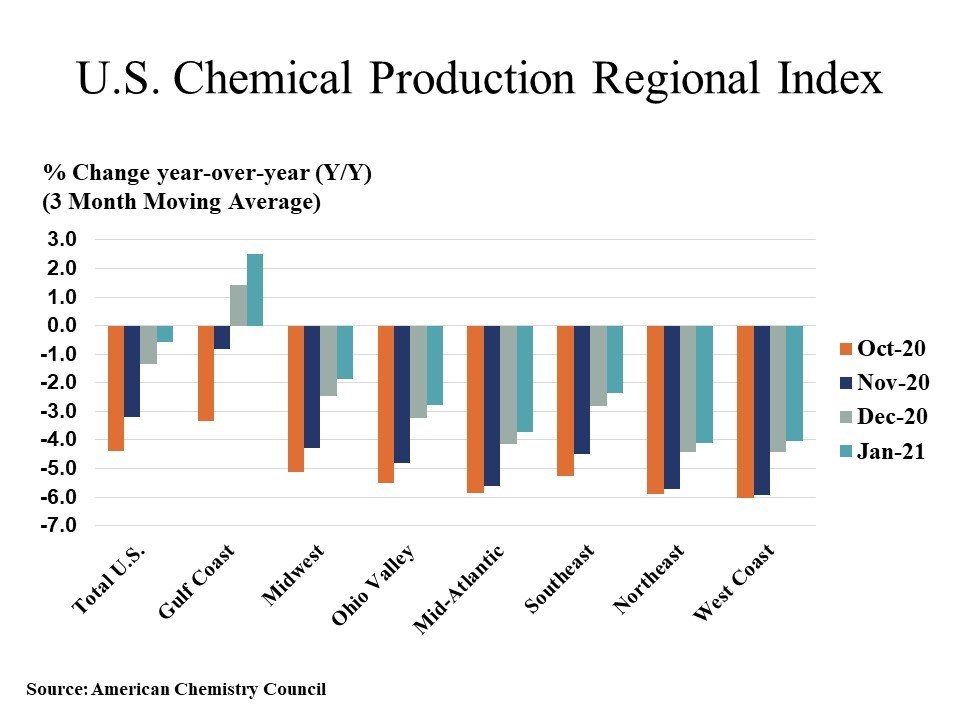
Compared with January 2020, U.S. chemical production remained off by 0.6% on a year-over-year (Y/Y) basis, the twentieth straight month of Y/Y declines, but showed continued improvement compared with earlier in the year. Chemical production remained lower than a year ago in all regions except in the Gulf Coast region, which was up 2.5% Y/Y.

U.S. Chemical Production Regional Index, Percentage Change

(Seasonally adjusted, 3-month moving average)

Jan 21/
Dec 20

Jan 21/
Jan 20

Key products

Gulf Coast

1.4%

2.5%

petrochemicals, inorganics, plastics resins, and synthetic rubber

Midwest

0.4%

-1.9%

agricultural chemicals, plastics, and paints

Ohio Valley

0.2%

-2.8%

organic chemicals, plastics and synthetic materials, and specialty chemicals

Mid-Atlantic

0.0%

-3.7%

consumer products

Southeast

0.3%

-2.4%

inorganic chemicals, fibers, and consumer products

Northeast

0.1%

-4.1%

consumer products and specialty chemicals

West Coast

-0.1%

-4.0%

basic chemicals, agricultural chemicals, and consumer products

     U.S. Total

0.8%

-0.6%

The chemistry industry is one of the largest industries in the United States, a $565 billion enterprise. The manufacturing sector is the largest consumer of chemical products, and 96% of manufactured goods are touched by chemistry. The U.S. CPRI was developed to track chemical production activity in seven regions of the United States. The U.S. CPRI is based on information from the Federal Reserve, and as such, includes monthly revisions as published by the Federal Reserve. To smooth month-to-month fluctuations, the U.S. CPRI is measured using a three-month moving average. Thus, the reading in January reflects production activity during November, December, and January.

http://www.americanchemistry.com/newsroom
The American Chemistry Council (ACC) represents the leading companies engaged in the business of chemistry.  ACC members apply the science of chemistry to make innovative products and services that make people’s lives better, healthier and safer.  ACC is committed to improved environmental, health and safety performance through Responsible Care, common sense advocacy designed to address major public policy issues, and health and environmental research and product testing.  The business of chemistry is a $565 billion enterprise and a key element of the nation’s economy.  It is one of the nation’s largest exporters, representing ten cents out of every dollar in U.S. exports. Chemistry companies are among the largest investors in research and development.  Safety and security have always been primary concerns of ACC members, and they have intensified their efforts, working closely with government agencies to improve security and to defend against any threat to the nation’s critical infrastructure.

Cision View original content to download multimedia:http://www.prnewswire.com/news-releases/us-chemical-production-rose-in-january-301237875.html

SOURCE American Chemistry Council

Georgia Power’s preparedness efforts help reduce outage times for customers

ATLANTA, March 1, 2021 /PRNewswire/ — The average outage time for Georgia Power customers was 42% less than the national average in 2019, according to the most recent available data from the U.S. Energy Information Administration. With severe storm weather possible throughout the year, the company’s comprehensive storm response plans help ensure the readiness of critical personnel and facilities necessary to continue providing the safe and reliable energy customers expect and deserve.

ATLANTA, March 1, 2021 /PRNewswire/ — The average outage time for Georgia Power customers was 42% less than the national average in 2019, according to the most recent available data from the U.S. Energy Information Administration. With severe storm weather possible throughout the year, the company’s comprehensive storm response plans help ensure the readiness of critical personnel and facilities necessary to continue providing the safe and reliable energy customers expect and deserve.

«We prepare every year knowing it will be nothing like the year before,» said Georgia Power’s Storm Center Director David Maske. «Our teams know firsthand the impacts severe weather can have on our customers, and we remain prepared to respond whenever we are called upon.»

In 2020 alone, the company responded to more than 26 severe weather events that impacted Georgia in a record-breaking storm season, with the most impactful storm Hurricane Zeta, which caused significant damage to Georgia Power’s distribution system leading to over 5,700 cases of damage and impacting over 822,000 customers. Zeta’s impacts were severe and were exacerbated when a strong cold front with gusty winds quickly followed behind the storm, less than 12 hours later. More than 4,000 Georgia Power personnel, with assistance from out-of-state utilities, were mobilized as part of the company’s restoration effort. Throughout 2020, Georgia Power crews responded to more than 22,650 outage events and replaced or repaired 8,500 spans of wire equal to nearly 400 miles of power lines.

Storm Response Pandemic Preparations
Georgia Power teams are prepared to respond to service interruptions that might occur because of severe weather while taking proactive actions including special «distancing» and other precautions to help protect customers and employees from the spread of the virus.

In the field, the power restoration process includes these key steps:

  • Assessing Conditions – Responding crews – or in major storms, damage assessment teams – work to identify trouble spots and the resources needed to fix them, which could involve coming onto customers’ property. Crews will employ appropriate distancing efforts and customers are asked to keep children and pets indoors and maintain safe distances from crew members as well.
  • Making Repairs – Georgia Power crews focus on repairs that return power to the greatest number of customers in the least amount of time.

Regardless of the storm season, Georgia Power encourages customers to keep safety first, with the following tips:

Before a Storm: Stay aware and check the weather forecast before heading outdoors. Make plans for vulnerable family members who might have difficulty in a power outage. Turn off large appliances as power surges can overload them and charge cell phones in case you lose power.

During a Storm: Take safe shelter inside a sturdy building away from windows and doors. Avoid contact with conductors of electricity – appliances, metal objects and water.

After a Storm: Never touch any downed or low-hanging wire, including telephone or TV wires that touch a power line. Never pull tree limbs off of power lines yourself or enter areas with debris or downed trees as downed power lines may be buried in wreckage.

For additional tools you can use to stay prepared for severe weather, visit www.Georgiapower.com/storm.

About Georgia Power
Georgia Power is the largest electric subsidiary of Southern Company (NYSE: SO), America’s premier energy company. Value, Reliability, Customer Service and Stewardship are the cornerstones of the company’s promise to 2.6 million customers in all but four of Georgia’s 159 counties. Committed to delivering clean, safe, reliable and affordable energy at rates below the national average, Georgia Power maintains a diverse, innovative generation mix that includes nuclear, coal and natural gas, as well as renewables such as solar, hydroelectric and wind. Georgia Power focuses on delivering world-class service to its customers every day and the company is recognized by J.D. Power as an industry leader in customer satisfaction. For more information, visit www.GeorgiaPower.com and connect with the company on Facebook (Facebook.com/GeorgiaPower), Twitter (Twitter.com/GeorgiaPower) and Instagram (Instagram.com/ga_power).


Cision View original content to download multimedia:http://www.prnewswire.com/news-releases/georgia-powers-preparedness-efforts-help-reduce-outage-times-for-customers-301237841.html

SOURCE Georgia Power

CME Group Announces Multiple Micro E-mini Equity Index Futures Trading Volume Records

CHICAGO, March 1, 2021 /PRNewswire/ — CME Group, the world’s leading and most diverse derivatives marketplace, today announced that Micro E-mini Equity Index futures reached back-to-back trading volume records last week of 4.4 million contracts on February 26 and 4.2 million contracts on <span…

CHICAGO, March 1, 2021 /PRNewswire/ — CME Group, the world’s leading and most diverse derivatives marketplace, today announced that Micro E-mini Equity Index futures reached back-to-back trading volume records last week of 4.4 million contracts on February 26 and 4.2 million contracts on February 25, across all four indexes – the S&P 500, Nasdaq-100, Russell 2000 and Down Jones Industrial Average Indexes. These new highs surpassed the prior record of 4.1 million contracts set on September 8, 2020.

Additionally, a record 1.9 million Micro E-mini Nasdaq-100 futures contracts traded on February 25, exceeding the prior record of 1.8 million contracts on September 3, 2020. Micro E-mini Russell 2000 reached a record 362,663 contracts traded on February 26, exceeding the prior record of 327,842 contracts set on January 29, 2021.

«Our Micro E-mini Equity Index futures are among the most actively traded equity index products, enabling clients to manage risk in our highly liquid markets,» said Tim McCourt, Global Head of Equity Index and Alternative Investment Products, CME Group. «Since their introduction in May 2019, we’ve seen strong growth and participation across Micro E-mini Equity Index futures and options, including among sophisticated, active traders. Their smaller size allows traders of all sizes to more nimbly execute equity trading strategies, scale index exposure up or down or hedge existing equity portfolio positions.»   

For more information on CME Group’s Micro E-mini Equity Index products, please see: www.cmegroup.com/microeminis.

As the world’s leading and most diverse derivatives marketplace, CME Group (www.cmegroup.com) enables clients to trade futures, options, cash and OTC markets, optimize portfolios, and analyze data – empowering market participants worldwide to efficiently manage risk and capture opportunities. CME Group exchanges offer the widest range of global benchmark products across all major asset classes based on interest ratesequity indexesforeign exchangeenergyagricultural products and metals.  The company offers futures and options on futures trading through the CME Globex® platform, fixed income trading via BrokerTec and foreign exchange trading on the EBS platform. In addition, it operates one of the world’s leading central counterparty clearing providers, CME Clearing. With a range of pre- and post-trade products and services underpinning the entire lifecycle of a trade, CME Group also offers optimization and reconciliation services through TriOptima, and trade processing services through Traiana.

CME Group, the Globe logo, CME, Chicago Mercantile Exchange, Globex, and, E-mini are trademarks of Chicago Mercantile Exchange Inc.  CBOT and Chicago Board of Trade are trademarks of Board of Trade of the City of Chicago, Inc.  NYMEX, New York Mercantile Exchange and ClearPort are trademarks of New York Mercantile Exchange, Inc.  COMEX is a trademark of Commodity Exchange, Inc. BrokerTec, EBS, TriOptima, and Traiana are trademarks of BrokerTec Europe LTD, EBS Group LTD, TriOptima AB, and Traiana, Inc., respectively. Dow Jones, Dow Jones Industrial Average, S&P 500 and S&P are service and/or trademarks of Dow Jones Trademark Holdings LLC, Standard & Poor’s Financial Services LLC and S&P/Dow Jones Indices LLC, as the case may be, and have been licensed for use by Chicago Mercantile Exchange Inc.  All other trademarks are the property of their respective owners. 

CME-G

Cision View original content:http://www.prnewswire.com/news-releases/cme-group-announces-multiple-micro-e-mini-equity-index-futures-trading-volume-records-301237814.html

SOURCE CME Group

National Kidney Foundation Applauds Congressional Champions for Legislation to Protect Living Organ Donors

WASHINGTON, March 1, 2021 /PRNewswire/ — Living organ donors can suffer job losses, denial of insurance coverage, and significantly higher health-insurance premiums after giving the gift of life, but four bipartisan Members of Congress have come together to change that by introducing

WASHINGTON, March 1, 2021 /PRNewswire/ — Living organ donors can suffer job losses, denial of insurance coverage, and significantly higher health-insurance premiums after giving the gift of life, but four bipartisan Members of Congress have come together to change that by introducing The Living Donor Protection Act of 2021 (LDPA), S. 377 and H.R. 1225.

«We applaud Senators Kirsten Gillibrand (D-NY) and Tom Cotton (R-AR) and Congressman Jerry Nadler (D-NY) and Congresswoman Jaime Herrera Beutler (R-WA) for joining together to reintroduce the Living Donor Protection Act (LPDA), which will help advance kidney transplantation and remove critical barriers to organ donation,» said Kevin Longino, CEO, National Kidney Foundation and a kidney transplant patient.

Specifically, the Living Donor Protection Act of 2021 will protect living organ donors and promote organ donation in three easy, low-cost ways: 

  • Prohibits life, disability, and long-term care insurance companies from denying or limiting coverage and from charging higher premiums for living organ donors;
  • Amends the Family and Medical Leave Act of 1993 to specifically include living organ donation as a serious health condition for private and civil service employees, and;
  • Directs the U.S. Department of Health and Human Services (HHS) to update their materials on live organ donation to reflect these new protections and encourage more individuals to consider donating an organ.

Every day, 17 patients die on the transplant waitlist, 12 die waiting for a kidney. Of the over 100,000 patients on the waitlist, only 22,817 received a kidney transplant in 2020. Patients wait an average of 3-5 years for a kidney transplant, but in some states the wait can be as long as 10 years. The availability of living donors is crucial to the survival of many kidney patients. Living donation was responsible for a total of 5,726 transplants in 2020, a decrease of 22.6 percent over the record of 7,397 living donor transplants set in 2019. Living organ donation not only saves lives, it saves money. Each year, Medicare alone spends approximately $89,000 per dialysis patient and less than half, $35,000, for a transplant patient.

Quotes from Members of Congress

«There are few acts more selfless than donating an organ to someone else. To donate an organ is to save someone’s life—those who make that sacrifice should be able to do so without facing needless roadblocks or insurance discrimination. Yet, with insurance companies charging living organ donors higher premiums or refusing them coverage altogether, it can often feel economically impossible to donate an organ,» said Rep. Nadler. «The Living Donor Protection Act, which I’m proud to sponsor alongside Rep. Hererra Beutler and Senators Gillibrand and Cotton, seeks to knock down those roadblocks and provide selfless donors with the certainty they deserve.»

«The Living Donor Protection Act would encourage more organ donors to step forward by protecting them from denial of insurance coverage, higher health-insurance premiums, and job loss. Not only do living organ donors save lives, but these transplants have better patient outcomes and are more cost-effective for the Medicare system,» said Senator Cotton.

«I appreciate NKF’s longstanding work on behalf of living donors and am happy to work with them and bipartisan colleagues in the House and Senator Cotton to sponsor the Living Donor Protection Act,» said Senator Gillibrand. «There are far too many people who have to wait far too long to receive a life-saving organ transplant. The bipartisan Living Donor Protection Act would help ensure that the individuals who are willing to save someone’s life through an organ donation can do so without facing insurance discrimination or losing their job as they recover from their generous act. I urge all my colleagues to cosponsor the Living Donor Protect Act and help us pass this bill this Congress.

«We lose a dozen American lives each day because folks are forced to wait too long for kidney transplants. But there’s hope here; there’s action Congress can take to help get more people this life-saving treatment before it’s too late. I’m proud to help reintroduce the Living Donor Protection Act that will protect living organ donors and remove barriers for those waiting in a long line to receive a transplant. I’m going to continue championing common-sense, bipartisan solutions that seek to match life-saving organs with the thousands of Americans who desperately need them.» – Congresswoman Jaime Herrera Beutler

Quote from the American Council of Life Insurers

«The Living Donor Protection Act makes certain someone is not denied access to life, disability or long-term care insurance coverage solely because of their selfless act to be a living organ donor,» said American Council of Life Insurers President and CEO Susan Neely. «America’s life insurers have long been committed to providing access to financial security for all Americans, regardless of where or how they work, their life stage, or the economic status of their household. That is why we strongly support this bill and hope it will help more people choose to save a life through organ donation.»

The National Kidney Foundation encourages the public to email their legislators regarding the LDPA, and also join the conversation on social media by using the hashtag #MyKidneysMyLife and tweeting their legislators to support the Living Donor Protection Act of 2021! Learn more at advocacy.kidney.org

About National Kidney Foundation Living Organ Donation Resources:
THE BIG ASK: THE BIG GIVE platform, which provides nationwide outreach, is designed to increase kidney transplantation through training and tools that help patients and families find a living donor. It includes direct patient and care partner support through our toll-free help line 855-NKF-CARES, peer mentoring from a fellow kidney patient or a living donor, online communities, an advocacy campaign to remove barriers to donation, and a multi-media public awareness campaign. All resources are free and designed to teach kidney patients, or their advocates, how to make a «big ask» to their friends, loved ones, or community to consider making a «big give,» a living organ donation. www.kidney.org/livingdonation.

Kidney Disease Facts
In the United States, 37 million adults are estimated to have chronic kidney disease—and approximately 90 percent don’t know they have it.  1 in 3 adults in the U.S. are at risk for chronic kidney disease.  Risk factors for kidney disease include: diabetes, high blood pressure, heart disease, obesity, and family history. People of Black or African American, Hispanic or Latino, American Indian or Alaska Native, Asian American, or Native Hawaiian or Other Pacific Islander descent are at increased risk for developing the disease. Blacks or African Americans are almost 4 times more likely than White Americans to have kidney failure.  Hispanics are 1.3 times more likely than non-Hispanics to have kidney failure.

Approximately 750,000 Americans have irreversible kidney failure and need dialysis or a kidney transplant to survive. More than 500,000 of these patients receive dialysis at least three times per week to replace kidney function. Nearly 100,000 Americans are on the waitlist for a kidney transplant right now.  Depending on where a patient lives, the average wait time for a kidney transplant can be upwards of three to seven years.

About the National Kidney Foundation
The National Kidney Foundation (NKF) is the largest, most comprehensive, and longstanding patient-centric organization dedicated to the awareness, prevention, and treatment of kidney disease in the U.S. For more information about NKF, visit www.kidney.org.

####

Facebook.com 
twitter.com/nkf 
www.kidney.org

Cision View original content to download multimedia:http://www.prnewswire.com/news-releases/national-kidney-foundation-applauds-congressional-champions-for-legislation-to-protect-living-organ-donors-301237796.html

SOURCE National Kidney Foundation

ACB Supports Accessible and Inclusive Currency

ALEXANDRIA, Va., March 1, 2021 /PRNewswire/ — On Friday, February 19, the American Council of the Blind sent the following letter to Secretary Yellen and the U.S. Treasury regarding the proposed Harriet Tubman redesign of the $20 bill.

<a…

ALEXANDRIA, Va., March 1, 2021 /PRNewswire/ — On Friday, February 19, the American Council of the Blind sent the following letter to Secretary Yellen and the U.S. Treasury regarding the proposed Harriet Tubman redesign of the $20 bill.

This is a tremendous opportunity for the U.S. to make a significant milestone in history in two ways.

According to recent press reports, as well as statements from the White House Press Office, the Biden Administration is considering accelerating the redesign of the $20 bill to incorporate a picture of Harriet Tubman. The Council welcomes such a redesign, provided that the newly redesigned bill incorporates an accessibility feature for the blind and visually impaired. Inclusion of an accessibility feature is required by the federal district court’s injunctive order dated Oct. 3, 2008, which mandates that accessibility be provided in all future currency redesigns. See Am. Council of the Blind v. Paulson, 581 F. Supp. 2d 1 (D.D.C. 2008).

The American Council of the Blind has been striving for accessible currency for the past 45 years. U.S. paper currency of all denominations is of the same size, shape, and texture. The currency of the United States is the only major currency in the world which does not incorporate an accessibility feature for the blind and visually impaired. The time to rectify this injustice has long since passed.

Our currency stands as a symbol for who we are as a nation. As a nation, we must be committed to equality for all people, including those with visual disabilities. It is therefore imperative that the next redesign incorporate an accessibility feature. This action is not only required by the injunctive order issued by the court; it is also the right thing to do.

«This is a tremendous opportunity for the U.S. to make a significant milestone in history in two ways. First, by implementing the court mandate of 2008 and making the bill accessible, the U.S. would join 81 other countries who already provide accessible currency for people who are blind and visually impaired. Secondly, placing Harriet Tubman’s picture on the $20 bill would be historic as she would be the first person of color to be pictured on U.S. currency. I encourage the Department of Printing & Engraving to implement both of these actions,» said Peggy R. Garrett, chair of ACB’s Multicultural Affairs Committee.

The American Council of the Blind is a national grassroots consumer organization representing Americans who are blind and visually impaired. With more than 65 affiliates, ACB strives to increase the independence, security, equality of opportunity, and to improve quality of life for all blind and visually impaired people. Learn more by visiting www.acb.org.

Cision View original content to download multimedia:http://www.prnewswire.com/news-releases/acb-supports-accessible-and-inclusive-currency-301237697.html

SOURCE American Council of the Blind

Carbon Capture Technology Faces a Difficult Few Years, Finds IDTechEx Research

BOSTON, March 1, 2021 /PRNewswire/ — Carbon capture, utilization, and storage (CCUS), or carbon capture and storage (CCS), is a set of technologies used to strip carbon dioxide from industrial waste gases or directly from the atmosphere. Once the carbon dioxide is captured, it is either stored permanently underground (carbon storage) or it is used for a range of industrial applications (carbon utilization), such as CO2-derived fuels or building materials….

BOSTON, March 1, 2021 /PRNewswire/ — Carbon capture, utilization, and storage (CCUS), or carbon capture and storage (CCS), is a set of technologies used to strip carbon dioxide from industrial waste gases or directly from the atmosphere. Once the carbon dioxide is captured, it is either stored permanently underground (carbon storage) or it is used for a range of industrial applications (carbon utilization), such as CO2-derived fuels or building materials. CCUS technologies are likely to play a key role in the fight against climate change, with the UN estimating that CCUS could mitigate between 1.5 and 6.3 gigatonnes of CO2 equivalents per year by 2050.

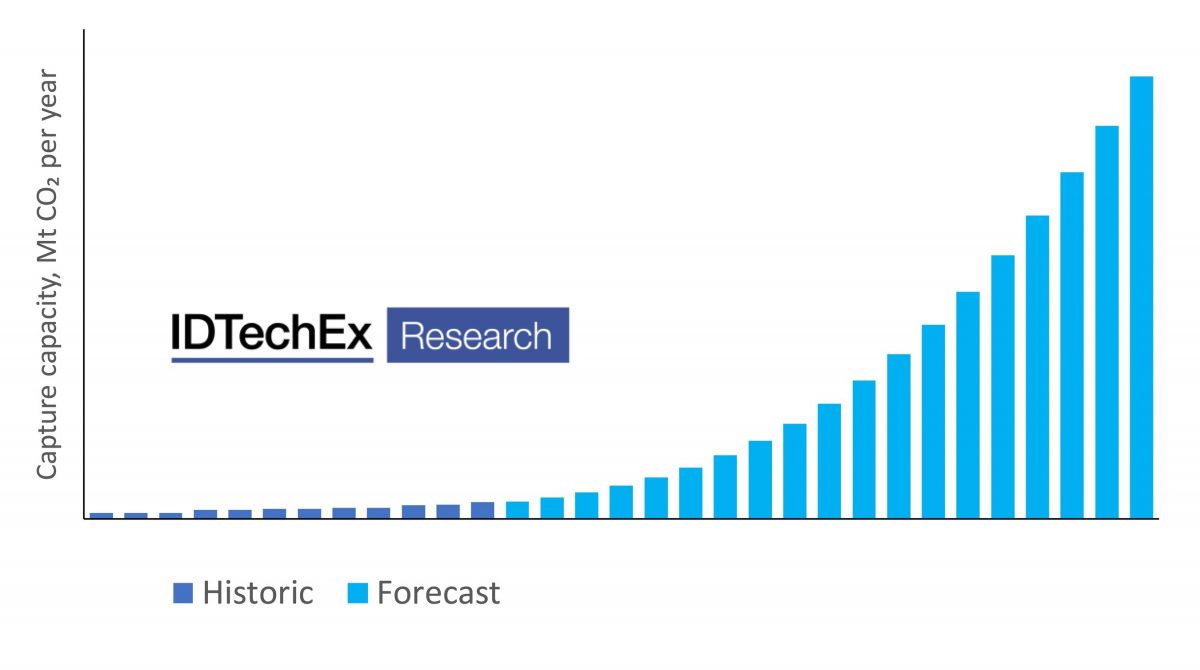
The world has already taken its steps along this pathway. Over the last decade, the deployment of carbon capture technology has been steadily scaling up, with global carbon capture capacity reaching 40 million tonnes in 2020. Plans for more than 30 new CCUS facilities have been announced since 2017. If all these projects proceeded, global capture capacity would triple to around 140 million tonnes per year.

However, this is a drop in the ocean compared with global CO2 emissions, which reached 36 billion tonnes in 2019. Although global emissions are believed to have dropped to around 31 billion tonnes in 2020, stemming from the global slowdown in the wake of COVID-19, this is probably a blip in the wider picture, and global CO2 emissions are likely to continue growing over the next few years. For CCUS to have a meaningful impact on emissions in a timely manner, it will need to scale up hundreds of times compared with today’s levels.

CCUS technologies also face some major challenges that could hamper widespread deployment. Although each aspect of CO2 capture, utilization, and storage faces its own challenges, a common challenge facing all aspects of the industry is that of economics.

Separating out CO2 from a mixture of gases is costly. Although separation is fairly straightforward for waste streams with high concentrations of CO2, such as in natural gas processing or ammonia production, it becomes costlier as the relative amount of CO2 in the stream decreases. Capturing one tonne of CO2 from a flue gas stream in an average coal-fired power plant currently costs around $40-80. Capturing CO2 directly from the atmosphere can cost around $600. The energy requirements to capture the CO2 are also an issue – a coal plant equipped with CO­2­ capturing equipment can require about 25% more fuel to generate the same amount of power as one without it.

Once the carbon has been captured, there’s the challenge of what to do with it. Captured CO2 can either be stored underground or utilized for various industrial applications. Underground storage is by far the most widely used option, with most industrial-scale CCUS facilities using captured CO2 for enhanced oil recovery (EOR), where CO­2 is injected into oil wells to boost productivity. This is somewhat problematic in its own sense, as it is essentially using CO2 to access more oil which will then be burned to give out CO2, but it also requires high oil prices to be commercially viable. The drop in oil prices stemming from the COVID-19 pandemic made EOR less viable in 2020, resulting in the Petra Nova facility’s closure in Texas, which was the world’s largest installation of CO2 capture on a power plant. Carbon pricing schemes and tax credits such as the 45Q scheme in the US can help make CO2 storage more viable, although such schemes are still in their early stages across much of the world.

Despite these challenges, progress in CCUS may be something the world can’t afford to ignore. Innovative companies across the world are working to overcome the challenges associated with CCUS, for example, through improved capture technology and the development of catalysts that can quickly and cheaply convert CO2 molecules into useful chemicals and fuels. The next few years could be essential in ensuring the future success of the industry. «Carbon Capture, Utilization and Storage 2021-2040«, a new report from IDTechEx, explores the technical and commercial factors that are key to ensuring the success of the industry.

This report provides a comprehensive view of the global CCUS industry, providing a detailed analysis of both the technological and economic factors that are set to shape the industry over the next twenty years. The report considers carbon capture, carbon utilization, and carbon storage individually, discussing the technology innovations, key players, and opportunities within each area, alongside a twenty-year forecast for the deployment of carbon capture technology.

For more information on this report, please visit www.IDTechEx.com/CCUS, or for the full portfolio of Green Technology research available from IDTechEx, please visit www.IDTechEx.com/Research/GreenTech.

About IDTechEx

IDTechEx guides your strategic business decisions through its Research, Subscription and Consultancy products, helping you profit from emerging technologies. For more information, contact research@IDTechEx.com or visit www.IDTechEx.com.

Images download:
https://www.dropbox.com/sh/urfjjopzx3z5u92/AABdcoDFWoCwq4o9RlnAh_F0a?dl=0
 

Media Contact:

Natalie Moreton
Digital Marketing Manager
press@IDTechEx.com
+44(0)1223 812300

Social Media Links:

Twitter: https://www.twitter.com/IDTechEx
LinkedIn: https://www.linkedin.com/company/idtechex/
Facebook: https://www.facebook.com/IDTechExResearch


Cision View original content to download multimedia:http://www.prnewswire.com/news-releases/carbon-capture-technology-faces-a-difficult-few-years-finds-idtechex-research-301237746.html

SOURCE IDTechEx

Matson Publishes New Sustainability Report

HONOLULU, March 1, 2021 /PRNewswire/ — Matson, Inc. (NYSE: MATX), a leading U.S. carrier in the Pacific, has published a new Sustainability Report that describes the company’s commitment to responsible environmental, social and governance practices.

HONOLULU, March 1, 2021 /PRNewswire/ — Matson, Inc. (NYSE: MATX), a leading U.S. carrier in the Pacific, has published a new Sustainability Report that describes the company’s commitment to responsible environmental, social and governance practices.

«Over more than a century, Matson’s business has been built on earning the trust of the customers and communities we serve and conducting our business with integrity. This report highlights Matson’s achievements and the measures we are taking to advance responsible, sustainable and ethical practices throughout our company,» said Matt Cox, chairman and chief executive officer. «I am proud of the work Matson is doing and we remain committed to building on our rich history.»

Matson’s new report focuses on three areas that the company considers most important: environmental stewardship; caring for its employees and communities; and operating its business ethically, safely and reliably. The report provides detail on the company’s strategic approach, measures its progress and celebrates its key achievements. The company intends to issue reports annually.

Some highlights of the inaugural report include:

  • Environment: Reduced CO2 emissions by 13% between 2017 and 2019 and finished building four state-of-the-art U.S.-built ships which have numerous environmental features to help reduce GHG emissions
  • Diversity: Encouraged professional development and committed to providing new scholarships and internships aimed at increasing diversity among individuals pursuing studies in transportation and logistics
  • Safety/COVID-19: Pioneered internal COVID safety policies and protocols and shared best practices with the U.S. Coast Guard and other maritime leaders

«This is an exciting time for Matson,» said Rachel Lee, vice president, sustainability and governance. «We are making progress toward achieving Matson’s sustainability goals – from moving toward a low-carbon future; to promoting a diverse workforce and an equitable and inclusive culture; and continuing to protect our employees in the face of an unprecedented pandemic.»

More information on Matson’s sustainability activities, including a downloadable copy of its 2019-2020 Sustainability Report is available at: www.matson.com/sustainability.

About Matson

Founded in 1882, Matson (NYSE: MATX) is a leading provider of ocean transportation and logistics services.  Matson provides a vital lifeline to the domestic non-contiguous economies of Hawaii, Alaska, and Guam, and to other island economies in Micronesia.  Matson also operates two premium, expedited services from China to Long Beach, California, provides service to Okinawa, Japan and various islands in the South Pacific, and operates an international export service from Dutch Harbor to Asia.  The Company’s fleet of owned and chartered vessels includes containerships, combination container and roll-on/roll-off ships and custom-designed barges.  Matson Logistics, established in 1987, extends the geographic reach of Matson’s transportation network throughout the continental U.S.  Its integrated, asset-light logistics services include rail intermodal, highway brokerage, warehousing, freight consolidation, Asia supply chain services, and forwarding to Alaska.  Additional information about the Company is available at www.matson.com.

Matson Investor Relations inquiries:

Matson News Media inquiries:

Lee Fishman

Keoni Wagner

Matson, Inc.

Matson, Inc.

510.628.4227

510.628.4534

lfishman@matson.com

kwagner@matson.com


Cision View original content to download multimedia:http://www.prnewswire.com/news-releases/matson-publishes-new-sustainability-report-301237692.html

SOURCE MATSON, INC. – PR