AUTOCRYPT Launches C-V2X Solution Demonstrating Interoperability with China C-SCMS Standards

SEOUL, South Korea, Nov. 26, 2020 /PRNewswire/ — AUTOCRYPT Co., Ltd., a leading V2X security solutions provider, announced the launch of its new C-V2X solution, supporting Chinese Secure Credential Management System (C-SCMS) standards. AUTOCRYPT received verification tests for compatibility by the C-V2X working group at China Academy of Information and Communications Technology (CAICT), under the new International Mobile Telecommunications-2020 (IMT-2020(5G)) Standard for 5G networks, devices, and…

SEOUL, South Korea, Nov. 26, 2020 /PRNewswire/ — AUTOCRYPT Co., Ltd., a leading V2X security solutions provider, announced the launch of its new C-V2X solution, supporting Chinese Secure Credential Management System (C-SCMS) standards. AUTOCRYPT received verification tests for compatibility by the C-V2X working group at China Academy of Information and Communications Technology (CAICT), under the new International Mobile Telecommunications-2020 (IMT-2020(5G)) Standard for 5G networks, devices, and services.

China currently leads the world in usage of LTE communications and currently has the third best-selling automotive brand in the market. The nation has set itself on a progressive path in the automotive industry by standardizing the LTE-V2X communications system throughout the entire country, making it mandatory to implement LTE-based C-V2X technology rather than Dedicated Short-Range Communications, or DSRC, into C-ITS projects. China has promoted active deployment of the technology and has already begun C-V2X technology demonstrations in 30 regions. Wuxi, Tianjin and Changsha cities have been designated as the first main cities in the country to become C-V2X commercialization areas, undergoing major developments. 

Last month, AUTOCRYPT’s solution was verified for interoperability by the China Industry Innovation Alliance for Intelligent and Connected Vehicles (CAICV), undergoing testing for «four-layers» interoperability between OEM, OBU terminal, V2X communication module, and PKI to comply with C-SCMS standards.

Overseas solutions providers often face challenges in entering market as China’s regulations for C-SCMS differ from existing standards. Unlike the existing SCMS structure, China’s SCMS (C-SCMS) standards utilize a Certificate Trust List (CTL) which configures trust relationships between several PKI (Multiple Root CA) systems. Additionally, C-SCMS allows the download of a security certificate without a registration certificate, further requiring stability measures to be implemented into the protocol.

AUTOCRYPT’s C-V2X security solution has met the challenge to demonstrate compliance, verifying the new solution’s C-SCMS technical standards, making AUTOCRYPT’s security solutions ready for implementation into the country’s Cooperative Intelligent Transport Systems (C-ITS) projects.

CEO and co-Founder Daniel ES Kim remarked, «When it comes to autonomous vehicles and their secure operation, it is essential to ensure compliance with the standards set by the governing parties.» He continued, «AUTOCRYPT currently leads the field in terms of C-ITS security projects, and with this interoperability verification, we are confident that our C-V2X based autonomous driving security solutions will continue to contribute to C-ITS deployment and development in China

AUTOCRYPT is the leading player in transportation security technologies. Beginning in 2007 as an in-house venture at Penta Security Systems Inc., AUTOCRYPT spun off as a separate entity in 2019 as its presence expanded worldwide. Recognized by TU-Automotive as the Best Auto Cybersecurity Product/Solution of 2019, AUTOCRYPT continues to pave the way in transportation and mobility security through a multi-layered, holistic approach. Through security solutions for V2X/C-V2X, V2G (including PnC security), in-vehicle security, and Fleet Management, AUTOCRYPT ensures that security is prioritized before vehicles hit the road.

Autotech Co Hong Kong Limited Completes Two-Year Autonomous Research Project

Autotech Co Hong Kong Limited has completed its research, which has taken over two years, on the exploration of how autonomous cars handle rural roads.

HONG KONG, Nov. 26, 2020 /PRNewswire/ — Autotech Co Hong Kong Limited has concluded a two-year research project exploring how autonomous…

Autotech Co Hong Kong Limited has completed its research, which has taken over two years, on the exploration of how autonomous cars handle rural roads.

HONG KONG, Nov. 26, 2020 /PRNewswire/ — Autotech Co Hong Kong Limited has concluded a two-year research project exploring how autonomous cars handle rural roads.

The ‘Theia AI’ project, which started in October 2018 in the eastern region of Hong Kong, tested how autonomous vehicles could deal with less inhabited suburban and rural areas.

The project involved two key trials. The first trial saw Autotech create an on-demand and shared car service using autonomous Theia AI electric cars which would provide a link between Lohas Park train station and Kowloon Bay east of the city. The autonomous cars were tested in several different situations.

The second trial was a shuttle service which stopped at predetermined stops around the region in order to see how autonomous cars could be used to provide accurate and efficient transport.

«Rural and more remote areas have previously posed a challenge to autonomous cars as roads often lack markings and road signs, while narrow streets, roundabouts and tunnels can make things tougher for the car. Also, these challenges are not consistent as they are in urban environments,» said Cheng Jun, Chief Executive Officer at Autotech Co Hong Kong Limited

The ultimate goal for Autotech was for an autonomous car to drive the 10-kilometre journey from the train station to the suburban area, following a route which had all of these obstacles.

Autotech engineers were also able to track and control the autonomous cars with 100mm precision to ensure that it continued on the right route, handling restricted roads and remaining on course including through roads without painted road markings.

«We have now completed the research project which has allowed our engineers to further enhance our Theia AI autonomous cars with even more ability to view the areas surrounding the vehicle in its 360-degree field. It now means our cars can observe more objects and obstacles in real-time,» said Yuan Wuhan, Chief Technology Officer at Autotech Co Hong Kong Limited

The autonomous cars were also able to handle occasional loss of the GPS signal during testing and operated at speeds which are ‘considered safe by regular drivers’, according to Autotech.

The team at Autotech also evaluated featured infrastructure components such as linked traffic signals and road cameras, which connected to the autonomous cars and allowed them to view obstacles beyond their regular field of vision.

About
Established in 2012 with headquarters in Shenzhen, China, Autotech Co Hong Kong Limited is a pioneering technology company developing an open-source product that supports the future of autonomous driving.

Media Contact
Brian Huang – Investor Relations
Telephone: +852 5808 0686
Email: brian.huang@globalautotech.com 
95 Queensway, Admiralty, Central District, Hong Kong.

Related Links

Autotech Co Hong Kong Limited

Robot Shuttle $18 Billion Market Attracts Diversity, IDTechEx Reports

BOSTON, Nov. 25, 2020 /PRNewswire/ — Commercial vehicles go battery-electric assisted by battery life of one million miles (fit-and-forget) and ranges of up to 600 miles being imminent. Shenzhen alone has 70,000 electric logistics vehicles. Next come robot buses, robotrucks and robotaxis with driver elimination reducing cost by intensive use. IDTechEx has a report on the topic, «<a target="_blank"…

BOSTON, Nov. 25, 2020 /PRNewswire/ — Commercial vehicles go battery-electric assisted by battery life of one million miles (fit-and-forget) and ranges of up to 600 miles being imminent. Shenzhen alone has 70,000 electric logistics vehicles. Next come robot buses, robotrucks and robotaxis with driver elimination reducing cost by intensive use. IDTechEx has a report on the topic, «Electric, Hybrid & Fuel Cell Light Commercial Vehicles 2021-2041«.

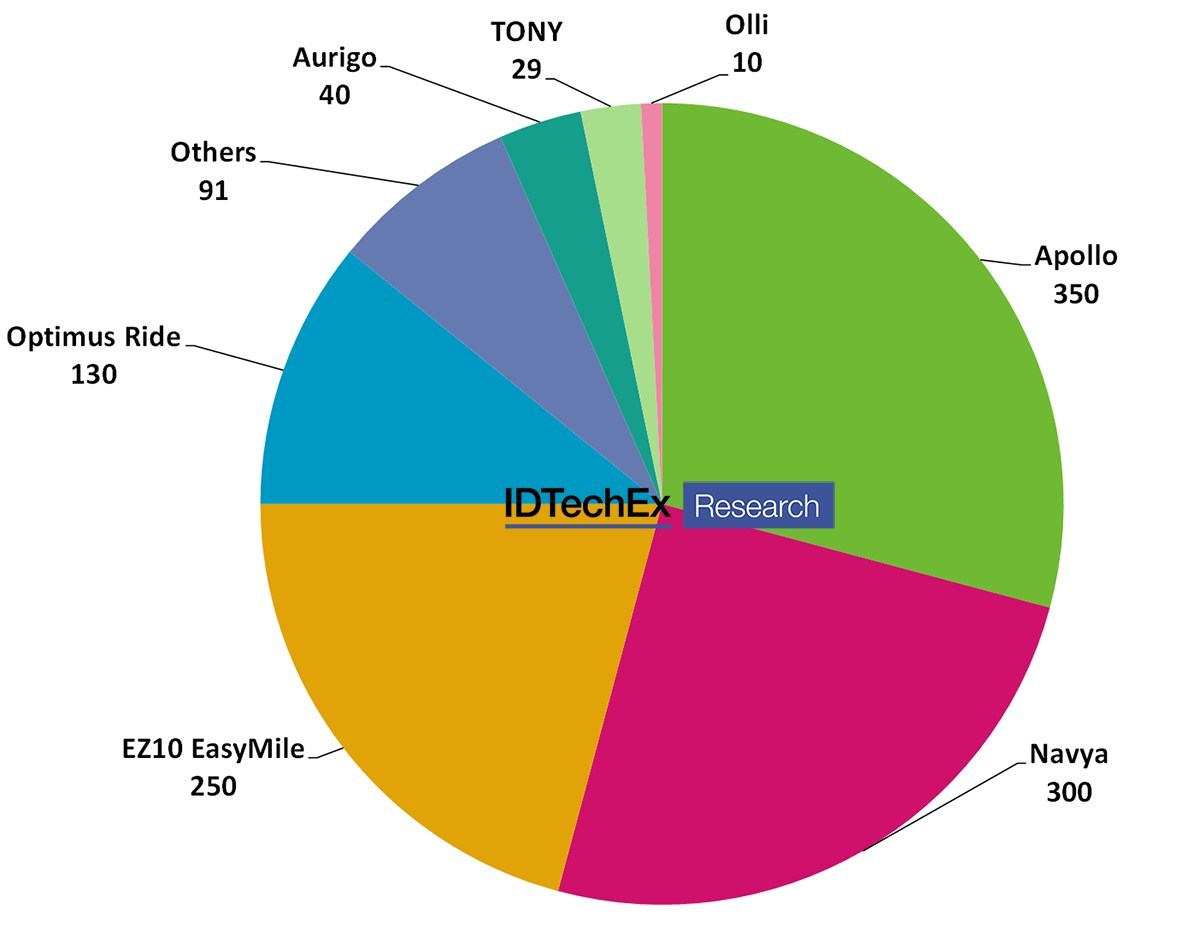
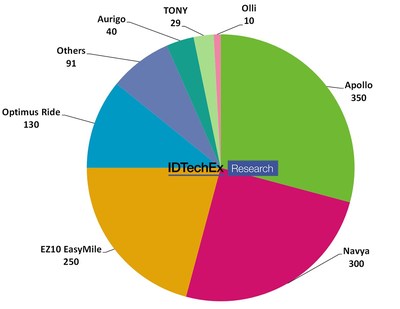
Number of robot shuttles trialing by country by type. Source: IDTechEx report "Robot Shuttles and Autonomous Buses 2020-2040", www.IDTechEx.com/Shuttles

Radically different robot shuttles will do these tasks and much more. See the IDTechEx report, «Robot Shuttles and Autonomous Buses 2020-2040«. Specifically for cities, they replace ten or more types of vehicle and they will be allowed to go where none of these are allowed, such as down paths, across plazas, into shopping malls, symmetrical so no U-turns, with some even moving sideways when needed.

Superb technology roadmap

Expect multiple paybacks such as windows on all sides carrying moving color advertising paying the cost of the school bus mode twice a day. The IDTechEx report, «Micro-LED Displays 2020-2030: Technology, Commercialization, Opportunity, Market and Players» describes that new technology. Solar-on-supercapacitor bodies replacing batteries, with wireless top-up?

Toyota Woven City plans robot shuttles as the only vehicles allowed centrally, so no congestion or accidents. Its e-Palette robot shuttles reconfigure from fast food to utility vehicles, taxis, buses, hire cars, parcel post and mobile libraries. The poor and disabled are empowered. No sidewalks needed.

However, all robot vehicles need to wait to 2030 or so to go big time with trusted, safe, insurable, legal, affordable Level 5 autonomy with no driver capability. Then exponential growth to $18 billion in 2040 awaits. Let us look at the latest situation with robot shuttles followed by an appraisal of new robot versions of what we have already.

Very widely trialing

There are 36 projects in 15 countries with trials in 20 countries. Ignore those using golf cars or small buses. They are unable to test even the shuttle essentials such as no U-turns, travel and impact strength in two directions, smallest footprint per passenger, rapid reconfiguration.

The best types emerging are upright, boxy, 8-20 person symmetrical vehicles with small footprint, all-round vision, large sliding doors, quiet, zero-emission and able perform many different tasks even in one day, surviving intensive use, gated to never exceed 50-60 kph.

They are backed by giants like Toyota and Baidu to startups, one having raised $1 billion. Trials mainly explore new people applications, often free-of-charge, from empowering the poor and disabled, inner circulators or viably filling in gaps in the transportation network and replacing very underutilised vehicles such as school buses and private cars.

Local Motors

Local Motors has recently received $15 million from Future Creation Fund II in Japan for its 80% 3D-printed Olli robot shuttle project trialing worldwide. Its new partner, Florida’s Mobility-as-a-Service (MaaS) provider BEEP, plans to deploy hundreds. Olli 2.0 has 160 km range, speed of up to 40 km/h. Its Protean in-wheel motors improve safety, performance and space. Perhaps it will fit Protean 360 degree motor-wheels next – like castors on a trolley. See the IDTechEx report, «Electric Motors for Electric Vehicles: Land, Water, Air 2020-2030«.

Einride and Streat are subsets

Swedish «Einride Pods» are remotely-controlled electric trucks with no driver’s cab. Lee Sungwook has recently drawn a concept food truck «Streat» like a windowless robot shuttle. This autonomous, pre-fab food-truck would be customized based on the restaurant running within it and rented out at low cost, he suggests.

Pollution drives fewer, not just cleaner vehicles

Air pollution is now the world’s fourth killer (State of Global Air Report late 2020) – 4.5 million deaths from outdoor air pollution in 2019. Over 90% of the global population lives in areas where fine particulate matter levels do not meet the World Health Organization guidelines. Since even «zero-emission» vehicles emit these particles from their tires, the message is now fewer, not just cleaner vehicles. Multipurposing robot shuttles come to the rescue.

For the full portfolio of Electric Vehicle and Robotics research available from IDTechEx please visit www.IDTechEx.com/Research.  

  IDTechEx guides your strategic business decisions through its Research, Subscription and Consultancy products, helping you profit from emerging technologies. For more information, contact research@IDTechEx.com or visit www.IDTechEx.com

Images download: https://www.dropbox.com/sh/d382lqucgqnnxb3/AADzj1T6JeD9_rX3zl9HzcYra?dl=0 

Media Contact:

Natalie Moreton
Digital Marketing Manager
press@IDTechEx.com 
+44(0)1223 812300

Social Media Links:
Twitter: https://www.twitter.com/IDTechEx 
LinkedIn: https://www.linkedin.com/company/idtechex/ 
Facebook: https://www.facebook.com/IDTechExResearch

IDTechEx Logo

Photo: https://mma.prnewswire.com/media/1342781/IDTechEx_Robot_Shuttles_Autonomous_Buses.jpg

Logo: https://mma.prnewswire.com/media/478371/IDTechEx_Logo.jpg

Home relocation services see more takers in WFH world

– Agarwal Packers and Movers, DRS Group from Hyderabad is leading the way

– The company launches new campaign #Bade Bhaiya Matlab Agarwal Packers and Movers, the original founder of the company, DRS Group

HYDERABAD, India, Nov. 25, 2020 /PRNewswire/ — The country’s home relocation companies are seeing good traction thanks to work from home (WFH) norms and the preference for owned houses during the COVID-19 pandemic. The…

– Agarwal Packers and Movers, DRS Group from Hyderabad is leading the way

– The company launches new campaign #Bade Bhaiya Matlab Agarwal Packers and Movers, the original founder of the company, DRS Group

HYDERABAD, India, Nov. 25, 2020 /PRNewswire/ — The country’s home relocation companies are seeing good traction thanks to work from home (WFH) norms and the preference for owned houses during the COVID-19 pandemic. The home relocation business has also seen a spurt as families relocate to save rent or work from home from their home town or some of them have taken decision to move to home town or near to home town to take up completely different profession and get away from the hustle and bustle life of metros.

Agarwal Packers and Movers (DRS Group, Hyderabad based), original owners of the brand, a renowned name in relocation business and transportation industry is one such company which eases the pain of home relocation and have specially designed vehicles to relocate cars, pets and plants, along with other household items in one go.

Mr. Anjani Kumar Agarwal, CEO said, «Although there was no activity in the initial period of the lockdown, the real action has started from August with easing of lockdown. WFH is driving relocation business in the last three months. During the pandemic, people have realised the importance of owning a house and many of them also temporarily moved homes to other towns and cities. The need for hygiene and safety measures during the pandemic has moved some of the relocation business from un-organised players to organised player like us as we have pre-defined safety measures and audits are done unlike unorganised players in the sector.»

Agarwal Packers and Movers is also focusing on storage solutions given the unique benefits that the opportunity provides. «We have seen a massive increase in storage solutions usage in the last few months. Some individuals are moving back to their home towns, pushing up demand for storage solutions, where household items and other belongings are stocked securely in warehouses for a desired period at a nominal rental cost. In fact, we are witnessing an increase in usage by 25% during the last couple of months, indicating the trend is here to stay. Some of our patrons have been from banking and defence, ITeS, and public sector.»

The company recently launched a new campaign #Bade Bhaiya matlab Agarwal Packers and Movers, the original founder of the company, DRS Group, to reach out to its current and potential customers across India.

Generally 80% of the relocation business comes from Defence, ITeS, PSU and private sector employees moving from one city to another city based on their internal transfer policies. Now the major trend, witnessed is WFH, which is driving the business.

Government of India’s recent guidelines issued for easing of regulations for Business Process Outsourcing (BPO) and IT Enabled Services (ITES), KPOs to reduce the compliance burden for the industry and facilitate ‘Work from Home’ and ‘Work from Anywhere’, is driving not only growth of ITeS and Other services, but also drives incidental services like relocation of employees moving to Tier III and Tier IV cities.

Agarwal Packers and Movers is really excited to ride this new wave of opportunity which has emerged from COVID-19 crisis. Every crisis throws new opportunities, in the changing dynamics of the sector. The company has always come out with new solutions in the era of relocation services and remained in the forefront in bringing innovation to the household of the customers, who have been serving for more than three decades by renowned, reliable and original Agarwal packers and movers.

The company currently has a fleet of 450 vehicles which are in to relocation & transport services and two large warehouses in Hyderabad.

About Agarwal Packers and Movers, DRS Group (Hyderabad Based):

Agarwal Packers and Movers, DRS Group (Hyderabad based), the original owners of the brand, was promoted by Dayanand Agarwal, Anjani Kumar Agarwal and Sanjay Agarwal and has three decades of impeccable track record in relocation, transportation and warehousing businesses. The Company has mastered the relocations services and has emerged as leader in the country. The company is also in to warehousing and incidental transport services for leading multinational and large domestic companies. Packing and moving business is carried under brand name of ‘Agarwal Packers and Movers’ which is renowned name in household relocation across the country

Website: www.agarwalpackers.in 

Photo: https://mma.prnewswire.com/media/1342640/Bade_Bhaiya.jpg

Media Contact: 
info@agarwalpackers.in
+91-9360014001
Agarwal Packers and Movers, DRS Group, Hyderabad


Vehicle Electrification Market to Reach $140.29 Bn, Globally, by 2027 at 11.3% CAGR, Says Allied Market Research

Decreasing prices of batteries per KWH, increasing adoption of fuel-efficient mobility solutions, and effective performance requirements from vehicles drive the growth of the global vehicle electrification market.

PORTLAND, Ore., Nov. 25, 2020 /PRNewswire/ — Allied Market Research recently published a report, titled, «Vehicle Electrification Market by Product…

Decreasing prices of batteries per KWH, increasing adoption of fuel-efficient mobility solutions, and effective performance requirements from vehicles drive the growth of the global vehicle electrification market.

PORTLAND, Ore., Nov. 25, 2020 /PRNewswire/ — Allied Market Research recently published a report, titled, «Vehicle Electrification Market by Product Type (Starter Motor, Alternator, Electric Car Motors, Electric Water Pumps, Electric Oil Pump, Electric Vacuum Pump, Electric Fuel Pump, Electric Power Steering, Actuators, and Start/Stop System), Sales Channel (Original Equipment Manufacturers (OEMs) and Aftermarket), and Vehicle Type (Internal Combustion Engine Vehicle, Micro & Full Hybrid Vehicle, and Plug-in Hybrid Electric Vehicle (PHEV) & Battery Electric Vehicle (BEV)): Global Opportunity Analysis and Industry Forecast, 2020–2027″. As per the report, the global vehicle electrification industry generated $70.14 billion in 2019, and is projected to reach $140.29 billion by 2027, growing at a CAGR of 11.3% from 2020 to 2027.

Allied_Market_Research_Logo

Download Report Sample (286 Pages PDF with Insights, Charts, Tables, Figures) at https://www.alliedmarketresearch.com/request-sample/2548

Major determinates of market growth

Reduction in prices of batteries per KWH and growing adoption of fuel-efficient mobility solutions along with effective performance requirements drive the growth of the global vehicle electrification market. However, decrease in production and sales of automotive and high dependence on mechanical & hydraulic systems in existing vehicles hamper the market growth. On the contrary, increase in need for cost-effective solutions and rise in electrification of commercial vehicles and fleets are expected to create lucrative opportunities for the market players in the future.

Covid-19 scenario:

  • The pandemic has severely affected the development of vehicle electrification technology for business model transformation as the industry has been facing demand shock with an uncertain recovery timeline.
  • Due to economical uncertainty across the globe, consumer confidence has decreased in 2020, which affected the demand for vehicle electrification technology.

Get detailed COVID-19 impact analysis on the Vehicle Electrification Market Request Now!

The electric car motors segment to manifest the highest CAGR through 2027

By product type, the electric car motors segment is expected to register the highest CAGR of 16.3% during the forecast period, due to adoption of the electrical vehicles across the globe. However, the electric power steering segment held the largest share in 2019, accounting for more than one-fourth of the global vehicle electrification market, owing to a cost-effective solution along with high compatibility across all vehicle types.

The internal combustion engine vehicle segment dominated the market

By vehicle type, the internal combustion engine vehicle segment held the lion’s share in 2019, contributing to more than 90% of the global vehicle electrification market, owing to existing fleet and trend of electrification. However, the plug-in hybrid electric vehicle (PHEV) & battery electric vehicle (BEV) segment is expected to portray the highest CAGR of 16.6% during the forecast period, due to adoption of the electrical vehicles and rise in support for green mobility across the globe.

Interested to Procure The Data? Inquire here at https://www.alliedmarketresearch.com/purchase-enquiry/2548

Asia-Pacific, followed by North America, to register the highest CAGR by 2027

By region, the market across Asia-Pacific is anticipated to manifest the highest CAGR of 12.9% from 2020 to 2027. Moreover, the region held the largest share in 2019, accounting for nearly two-fifths of the market, owing to wide presence of the automotive manufacturers as well as availability of the cost-effective manufacturing solutions in the region. The global vehicle electrification market across North America is expected to register a CAGR of 11.2% during the forecast period.

Major market players

  • CONTINENTAL AG
  • AISIN SEIKI Co., Ltd.
  • Hitachi Automotive Systems, Ltd.
  • Delphi Technologies
  • ZF FRIEDRICHSHAFEN AG
  • Robert Bosch GmbH
  • BorgWarner Inc.
  • Denso Corporation
  • Johnson Electric Holdings Limited.
  • Magna International Inc.

Schedule a Free Consultation Call with Our Analysts/Industry Experts to Find Solution for Your Business at https://www.alliedmarketresearch.com/connect-to-analyst/2548

Similar Reports We Have on Electric Vehicle Industry:

Electric Vehicle Market by Type (Battery Electric Vehicles (BEV), Hybrid Electric Vehicles (HEV), and Plug-in Hybrid Electric Vehicles (PHEV)), Vehicle Class (Mid-Priced and Luxury), and Vehicle Type (Two-wheelers, Passenger Cars, and Commercial Vehicles): Global Opportunity Analysis and Industry Forecast, 2020–2035.

Electric Bikes Market by Product Type (Pedelecs, Throttle on Demand, and Scooter & Motorcycle), Drive Mechanism (Hub Motor, Mid Drive, and Others), Battery Type (Lead-acid, Lithium-ion (Li-ion), Nickel-metal hydride (NiMh), and Others) – Global Opportunity Analysis and Industry Forecast, 2017-2035.

Pedelec Market by bicycle type (MTB, race, cross, urban, and foldable) and on battery types (SLA, NiMH, and SCiB) – Global Opportunity Analysis and Industry Forecast, 2017-2035.

Electric Mobility Scooter Market by Battery Type (SLA, Li-ion, and NiMH), and by Number of Tire (2 Wheeler, 3 Wheeler, 4 Wheeler, and 5 Wheeler) – Global Opportunity Analysis and Industry Forecast, 2017-2035.

Luxury Car Market by Vehicle Type (Hatchback, Sedan, and Sport utility vehicle) and Fuel Type (Gasoline, Diesel, and Electric): Global Opportunity Analysis and Industry Forecast, 2019–2035.

About Allied Market Research

Allied Market Research (AMR) is a full-service market research and business-consulting wing of Allied Analytics LLP, based in Portland, Oregon. AMR provides global enterprises as well as medium and small businesses with unmatched quality of «Market Research Reports» and «Business Intelligence Solutions.» AMR has a targeted view to provide business insights and consulting to assist its clients to make strategic business decisions and achieve sustainable growth in their respective market domain.

AMR launched its user-based online library of reports and company profiles, Avenue. An e-access library is accessible from any device, anywhere, and at any time for entrepreneurs, stakeholders, and researchers and students at universities. With reports on more than 60,000 niche markets with data comprising of 600,000 pages along with company profiles on more than 12,000 firms, Avenue offers access to the entire repository of information through subscriptions. A hassle-free solution to clients’ requirements is complemented with analyst support and customization requests.

Contact:

David Correa
5933 NE Win Sivers Drive
#205, Portland, OR 97220
United States
USA/Canada (Toll Free):
+1-800-792-5285, +1-503-894-6022, +1-503-446-1141
UK: +44-845-528-1300
Hong Kong: +852-301-84916
India (Pune): +91-20-66346060
Fax: +1(855)550-5975
help@alliedmarketresearch.com 
Web: www.alliedmarketresearch.com
Allied Market Research Blog:
https://blog.alliedmarketresearch.com 
Follow Us on | Facebook | Twitter | LinkedIn |

Logo: https://mma.prnewswire.com/media/636519/Allied_Market_Research_Logo.jpg


Global Automotive Aftermarket to Witness Huge Upswing in Near Future Says P&S Intelligence

NEW YORK, Nov. 25, 2020 /PRNewswire/ — Due to the increase in the average age of vehicles, the demand for replacement components is expected to surge in the coming years, especially in emerging economies, such as those in Asia-Pacific (APAC) and Latin America, Middle East, and Africa (LAMEA). For instance, the average age of the vehicles is predicted to increase from…

NEW YORK, Nov. 25, 2020 /PRNewswire/ — Due to the increase in the average age of vehicles, the demand for replacement components is expected to surge in the coming years, especially in emerging economies, such as those in Asia-Pacific (APAC) and Latin America, Middle East, and Africa (LAMEA). For instance, the average age of the vehicles is predicted to increase from four years to six years in China from 2010 to 2020, mainly due to huge improvements in the quality of the automobiles being manufactured, which is itself a result of the rapid adoption of advanced products.

P_and_S_Intelligence_Logo

The other major factors pushing the demand for automotive parts across the world are the burgeoning demand for electric vehicles, on account of the increasing implementation of government policies and regulations promoting the adoption of eco-friendly modes of transportation. Moreover, there has been a huge rise in green consciousness throughout the world since the last few years, which is boosting the popularity of electric vehicles. Fuelled by the above factors, the global automotive aftermarket is expected to grow from $803.22 billion in 2019 to $1,370.17 billion in 2030, with a CAGR of 5.07% between 2020 and 2030, according to the market research report published by P&S Intelligence.

Get the sample copy this report @ https://www.psmarketresearch.com/market-analysis/automotive-aftermarket/report-sample

The biggest rage currently being witnessed in the automotive aftermarket is the rising number of joint ventures amongst the major vehicle manufacturing companies, vehicle repair service providers, and other stakeholders. This allows the major companies to transfer the vehicle manufacturing technology to the smaller service providers, manufacture new aftermarket devices, and penetrate the markets of developing nations. For instance, DENSO CORPORATION and Smiths Manufacturing (Pty.) Ltd. announced a joint venture in July 2019, named DENSO Sales South Africa (Pty.) Ltd., in order to sell various aftermarket products and services in South Africa.

Browse report overview with detailed TOC on Automotive Aftermarket Research Report: By Component (Engine Parts, Drive Transmission and Steering Parts, Suspension and Braking Parts, Equipment, Electrical Parts), Distribution Channel (Offline Distribution Channel, Online Distribution Channel) – Industry Size, Trend, Growth and Demand Forecast to 2030 @ https://www.psmarketresearch.com/market-analysis/automotive-aftermarket

Geographically, the highest demand for vehicle component replacement was observed in Asia-Pacific (APAC) in 2019, and this trend is set to continue during the forecast period. This is primarily ascribed to the rapid rise in the number of vehicles in operation (VIO), especially in China and India. Moreover, the presence of major companies supplying automotive aftermarket components in APAC is predicted to further fuel the rise in the demand for these components in the region.

Therefore, it can be concluded that owing to the increasing sale of automobiles in various countries across the world, the demand for aftermarket components is expected to witness substantial growth in the coming years.

Make Enquiry Before Purchase @ https://www.psmarketresearch.com/send-enquiry?enquiry-url=automotive-aftermarket

Market Size Breakdown by Segment

By Component

  • Engine Parts
    • Pistons and piston rings
    • Engine valves and parts
    • Fuel injection systems and carburetors
    • Powertrain components and others
  • Drive Transmission and Steering Parts
    • Gearboxes
    • Wheels
    • Steering systems
    • Axles
    • Clutch assembly systems and other parts
  • Suspension and Braking Parts
    • Brake calipers
    • Brake pads
    • Suspension systems
  • Equipment
    • Headlights and & headlight components
    • Wipers and washer systems
    • Dashboard instruments
    • Other equipment
  • Electrical Parts
    • Starter motors
    • Spark plugs
    • Electric ignition systems
    • Batteries and other parts

Browse Other Reports

E-Commerce in Automotive Aftermarket

In the coming years, higher CAGR in the e-commerce in automotive aftermarket, of 25.8%, is expected to be observed by the direct-to-consumer bifurcation, under segmentation by channel. This would be on account of the changing consumer preference to shop online, and rise in the number of people who like to perform vehicle repairs and upgrades themselves.

https://www.psmarketresearch.com/market-analysis/e-commerce-in-automotive-aftermarket

Connected Car Market

Currently, the largest revenue contribution to the connected car market is made by North America, due to the early adoption of advanced technologies, such as the internet of things (IoT) and autonomous driving.

https://www.psmarketresearch.com/market-analysis/connected-car-market

About P&S Intelligence

P&S Intelligence is a provider of market research and consulting services catering to the market information needs of burgeoning industries across the world. Providing the plinth of market intelligence, P&S as an enterprising research and consulting company, believes in providing thorough landscape analyses on the ever-changing market scenario, to empower companies to make informed decisions and base their business strategies with astuteness.

Contact:
Prajneesh Kumar
P&S Intelligence
Contact: +1-347-960-6455
Email: enquiry@psmarketresearch.com
Web: https://www.psmarketresearch.com

Logo: https://mma.prnewswire.com/media/1224988/P_and_S_Intelligence_Logo.jpg


General Motors Sparkles in 48 Volt, IDTechEx Reports

BOSTON, Nov. 24, 2020 /PRNewswire/ — It is in China that General Motors is leading the way in 48V hybrid cars and their next technology. This 48V mild hybridization of conventional car models gives them another ten years in the market. They do not become illegal from tightening emissions regulations, indeed they gain up to 15% reduction in emission and fuel consumption. The upgrade consists of little more than replacing the alternator with a motor-starter-generator…

BOSTON, Nov. 24, 2020 /PRNewswire/ — It is in China that General Motors is leading the way in 48V hybrid cars and their next technology. This 48V mild hybridization of conventional car models gives them another ten years in the market. They do not become illegal from tightening emissions regulations, indeed they gain up to 15% reduction in emission and fuel consumption. The upgrade consists of little more than replacing the alternator with a motor-starter-generator and adding a lithium-ion battery to the lead-acid one. A DC-DC converter charges them and delivers their electricity to a host of new electrical devices, even increasing comfort and performance along the way. The recent IDTechEx report, «48V Full Hybrid, 48V Mild Hybrid, 48V BEV Cars: Markets, Technology Roadmap 2021-2041«, reveals that under 20% of traditional car manufacturers are passing up on this precious buying of time as they race to the end game of battery electric.

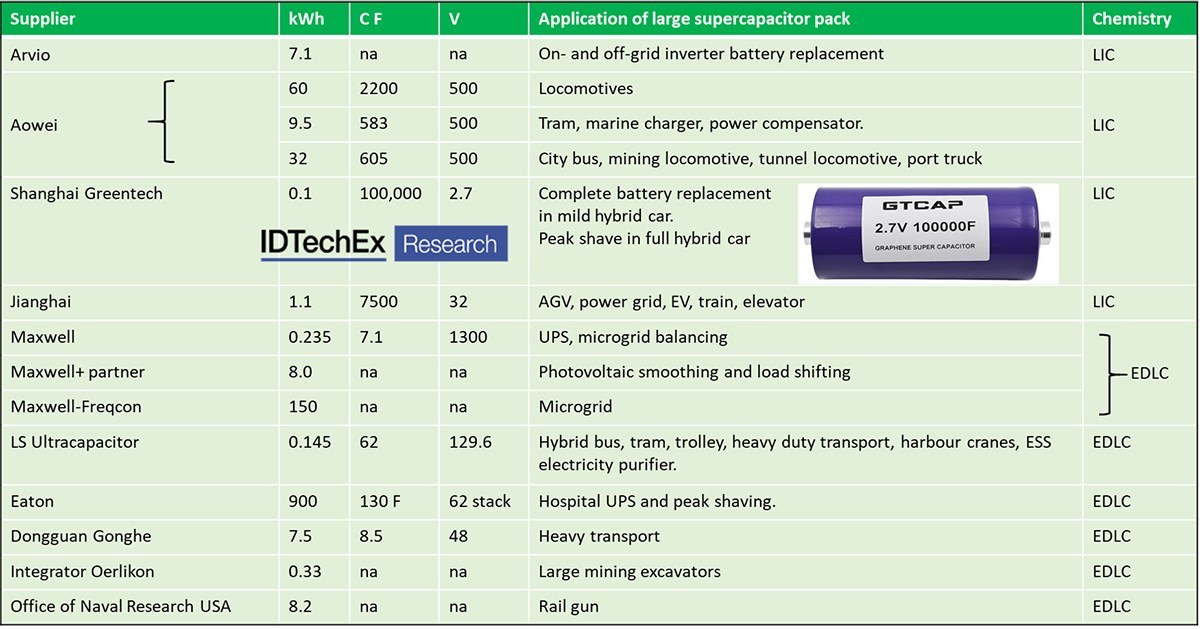
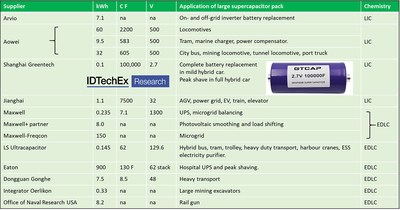
Examples of the large emerging market for 0.1 kWh to 1MWh supercapacitors. Source: IDTechEx “Supercapacitor Markets, Technology Roadmap, Opportunities 2021-2041”, www.IDTechEx.com/Supercaps

Huge sales

48V hybrid sales could rise to a massive 20% of all car production boosted by the recent discovery that there is even a simple path to 48V full hybrids (HEV) as upgrades of existing models. Far more electrification is possible than previously realized when you add one of the many low-cost e-axles now available to make it a full hybrid, going long distances on electric only, with much more efficient regenerative braking. IDTechEx believes that HEVs could drop 10% in cost and it proposes solar wrap as an easy route to 10% more electricity on top of that.

Supercapacitors next

IDTechEx praises Geely working with Tesla Maxwell to add a large supercapacitor that permits many more electric devices to kick in at the same time, saving on the size of the lithium-ion battery. This is a natural progression from supercapacitors already replacing lithium-ion batteries in ten million microhybrid cars, primarily thanks to Tesla Maxwell.

However, GM China is working on a next stage that replaces the two batteries and the converter with a single cheaper, better-performing device, smaller and lighter too. Its MODACS (Multiple Output Dynamically Adjustable Capacity) device has supercapacitor and battery electrodes swimming in the same electrolyte. Another form of CAB (capacitor assisted battery), its multiple switches and tabbing means it can even act as a 12V battery that is charging while also acting as a 48V battery that is discharging and vice versa. Goodbye lead. Cold cranking improves and they boast, «an old CAB is actually stronger than a new LFP (lithium-ion) battery.»

Another supercapacitor advance in China is versions from Anhui and Toomen, rivaling the energy density of lithium-ion batteries eight years ago. That raises the prospect of completely replacing lithium-ion batteries in 48V vehicles and conventional HEVs. Beyond performance and fit-and-forget, supercapacitors increasingly offer no disposal issues compared to the cost and misery of recycling toxic batteries. In Europe, Skeleton Technologies is launching a clever compromise of supercapacitor parameters that could even increase the range of EVs. See the new IDTechEx reports, «Supercapacitor Markets, Technology Roadmap, Opportunities 2021-2041» and «Supercapacitor Materials and Formats 2020-2040«. Little wonder VW Group has recently set up a supercapacitor research center, having announced self-healing supercapacitor car bodywork.

GM launching many 48V cars

Meanwhile, this year Chevrolet introduced its first 48V model in China, the Monza 48V, followed by five new Orlando 48V variants.

«The Orlando is a functional nameplate that now integrates traditional propulsion technology with electrification for a refined driving experience with lower fuel consumption and lower emissions,» said Scott Lawson, general director of Chevrolet for SAIC-GM. «It also offers different seating and styling options to meet the personalized needs of today’s car buyers.»

The new variants maintain the new-generation 1.35L Ecotec dual-jet turbocharged engine and six-speed DSS start/stop transmission. They add a 48V mild hybrid system consisting of a 48V motor, 48V power battery, power management module and hybrid control unit. The system has five working modes: Auto Start, E-boost, Smart Charge, Brake Energy Regeneration and E-idle. They provide a more powerful, smoother and quieter driving experience when starting, accelerating, cruising and braking. Its fuel consumption is as low as 6.1 liters/100 kilometers, which is a 9% improvement. They meet the China 6B emission standard. FAW in China may launch a 48V full hybrid next year but GM is sure to have an answer.

For the full portfolio of Electric Vehicle and Energy Storage research available from IDTechEx please visit www.IDTechEx.com/Research.

IDTechEx guides your strategic business decisions through its Research, Subscription and Consultancy products, helping you profit from emerging technologies. For more information, contact research@IDTechEx.com or visit www.IDTechEx.com

Image download: https://www.dropbox.com/sh/6zaoqlvxdpeycdk/AADL_NlFvyNUIZRu1jyYUAK-a?dl=0 

Media Contact:
Natalie Moreton
Digital Marketing Manager
press@IDTechEx.com 
+44(0)1223 812300

Social Media Links:
Twitter: https://www.twitter.com/IDTechEx 
LinkedIn: https://www.linkedin.com/company/idtechex/ 
Facebook: https://www.facebook.com/IDTechExResearch

IDTechEx Logo

Photo: https://mma.prnewswire.com/media/1341736/IDTechEx_Supercapacitors.jpg

Logo: https://mma.prnewswire.com/media/478371/IDTechEx_Logo.jpg

Surge in Global Demand for Personal Mobility Brings New Momentum to Two-wheeler Industry, Says Frost & Sullivan

By the end of 2020, China could overtake India and become the world’s biggest 2W market, creating major growth opportunities

SANTA CLARA, Calif., Nov. 24, 2020 /PRNewswire/ — Frost & Sullivan’s recent analysis, COVID-19 Impact Assessment, Recovery Road, and Growth Opportunities for the Global Two-wheeler Industry, 2019–2025, finds there is pent-up demand and a growing need for personal and…

By the end of 2020, China could overtake India and become the world’s biggest 2W market, creating major growth opportunities

SANTA CLARA, Calif., Nov. 24, 2020 /PRNewswire/ — Frost & Sullivan’s recent analysis, COVID-19 Impact Assessment, Recovery Road, and Growth Opportunities for the Global Two-wheeler Industry, 2019–2025, finds there is pent-up demand and a growing need for personal and cost-effective mobility solutions due to the pandemic. Two-wheeler (2W) sales across the globe are rapidly gaining momentum, even faster than passenger vehicles. The study examines the COVID-19 impact on production, sales, and OEM strategies. It also shares insights on recovery and future growth prospects in key technology areas, and the market forecast across seven regions: North America, South America, Africa, EU-27, Association of Southeast Asian Nations (ASEAN), Asia-Pacific (APAC), and South Asia. By 2025, the global 2W market is estimated to reach 63.9 million units from 56.1 million in 2019.

Photo – https://mma.prnewswire.com/media/1341709/Frost_And_Sullivan_Two_Wheelers.jpg

For further information on this analysis, please visit: http://frost.ly/4uh

«South Asia’s dominance of the global 2W market is set to continue until 2025, with global sales expected to rise quickly. Even though the demand from ASEAN markets remains stable, the global unit sales share of Africa and South America will increase,» said Viroop Narla, Program Manager, Mobility Practice at Frost & Sullivan. «EU-27, China, and some Association of Southeast Asian Nations (ASEAN) markets could rebound faster than India, South America, and the majority of Asian countries where the pandemic is still a threat. By the end of 2020, China could overtake India and become the world’s biggest 2W market.»

Narla added: «The 2W market holds the key to enabling mass adoption of electric vehicles in the world, as private customers benefit from hassle-free and economical ownership, while fleet companies will also benefit from the low cost of transportation. Cooperation between companies engaged in charging, battery swapping, and vehicle maintenance will enable a transition to a successful electric vehicle ecosystem, as the simplicity of the 2W is the key to unlocking the future of EV transportation.»

Despite being negatively impacted by the pandemic, the future looks bright for the two-wheeler industry and presents immense growth prospects for market participants involved, including:

  • OEMs should consider introducing advanced features in mass-market vehicles to increase penetration, especially in high-sales-volume markets. The majority of connected and rider safety technologies are primarily targeted at only the premium vehicles segment.
  • OEMs and other ecosystem players should capitalize on the opportunity that 2W provides to enable a massive scaling up of micro-mobility and last-mile delivery services due to lower delivery costs.
  • OEMs should launch vehicles before the growth phase for EVs and leverage existing vehicle platforms in EV manufacturing to accelerate development.
  • OEMs should prioritize digital tools to empower staff to build new customer touchpoints and enable a complete online customer journey from virtual showrooms and configurations to payments and delivery.
  • OEM sales strategies should include new retail solutions, including subscription and leasing, as an integral part of the process as new customer demographics move toward asset-light models.

COVID-19 Impact Assessment, Recovery Road, and Growth Opportunities for the Global Two-wheeler Industry, 2019–2025 is the latest addition to Frost & Sullivan’s Automotive & Transportation research and analyses available through the Frost & Sullivan Leadership Council, which helps organizations identify a continuous flow of growth opportunities to succeed in an unpredictable future.

About Frost & Sullivan

For six decades, Frost & Sullivan has been world-renowned for its role in helping investors, corporate leaders and governments navigate economic changes and identify disruptive technologies, Mega Trends, new business models, and companies to action, resulting in a continuous flow of growth opportunities to drive future success. Contact us: Start the discussion

COVID-19 Impact Assessment, Recovery Road, and Growth Opportunities for the Global Two-wheeler Industry, 2019–2025

MF5A-18

Media Contact:
Srihari Daivanayagam, Corporate Communications
M: +91 9742676194; P: +91 44 6681 4412
E: srihari.daivanayagam@frost.com

http://ww2.frost.com

Brigade Electronics discusses high definition versus standard definition CCTV cameras for vehicle safety

PORTLAND, Ind., Nov. 24, 2020 /PRNewswire/ — Vehicle CCTV has grown in popularity over the last few years with many fleet operators choosing to equip their vehicles with the technology to improve safety, support driver training, and prevent fraudulent claims. Vehicle CCTV has even helped to reduce insurance premiums for companies, with the recorded footage proving invaluable when it comes…

PORTLAND, Ind., Nov. 24, 2020 /PRNewswire/ — Vehicle CCTV has grown in popularity over the last few years with many fleet operators choosing to equip their vehicles with the technology to improve safety, support driver training, and prevent fraudulent claims. Vehicle CCTV has even helped to reduce insurance premiums for companies, with the recorded footage proving invaluable when it comes to settling conflicting reports, providing invaluable evidence, and deterring perpetrators from targeting vehicles.

Brigade Electronics discusses high definition versus standard definition CCTV cameras for vehicle safety

For fleet operators considering investing in commercial vehicle CCTV, understanding the benefits of each system and what is most appropriate could save money in the long term. Here, Corey Heniser, from Brigade Electronics INC, explains the differences between high definition and standard cameras.

High Definition v Standard Definition Vehicle CCTV

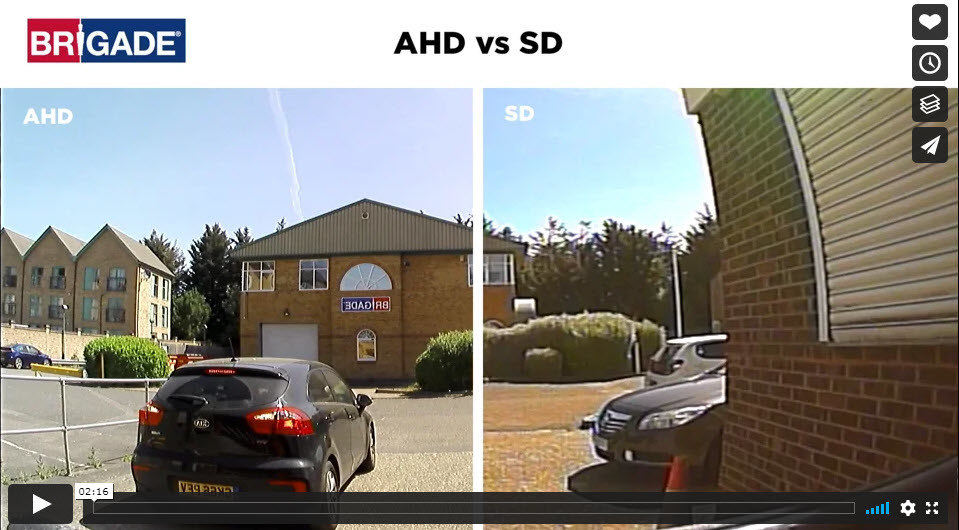
The main difference between high definition (HD) and standard definition (SD) is the number of pixels contained in the displayed image. HD images have more pixels per square inch compared to SD, meaning a HD system will provide much clearer pictures with finer details. Typically, HD is referred to as a 720p and above.

Ultimately, HD will provide more clarity and detail, allowing drivers to see an object or person in a vehicle’s blind spot with ease so they can act quickly to prevent a collision.

HD formats – analogue v digital

The HD system is available in two different formats – analogue or digital. Ultimately, this refers to the method which footage is recorded and delivered.

Analogue cameras capture images and send the signal over coaxial cables (a type of electrical cable) to a recorder or ECU (electronic control unit). These images are then converted from an analogue format into digital signals, compressed and then stored on a hard drive or shown in real time on a monitor.

Digital cameras or IP cameras (internet protocol cameras) capture images digitally from the outset. These cameras send data over a computer network rather than via a recorder or ECU first.

How to decide which format is best

IP cameras offer high-definition footage via a digital camera with its own IP address. Instead of transmitting video over a video cable to a monitor, the IP cameras transmit via a data connection where images are safely stored to the HDD memory. This means they can be connected easily to expansion modules using Power Over Network (PON) without the need to invest in expensive additional equipment.

Due to video latency (effectively a time lag for footage appearing on screen) IP cameras should not be relied on as an aid for maneuvering or blind spot monitoring. However, IP cameras are an excellent choice for general monitoring of vehicles, such as ensuring passengers are safely seated on buses, and doors are not obstructed before a vehicle pulls away.

Analogue HD cameras on the other hand have no video latency making them ideal for providing drivers with a clear view in real-time. This also means that on-screen display menus are supported, offering a better user experience during operation. Analogue HD technology can transmit video over traditional cabling across distances of up to 1640 feet – plenty of cable length for any commercial vehicle.

Monitors for viewing HD footage

To view HD footage, drivers will require a HD compatible monitor. Monitors that only support SD footage can still display images from a HD camera, but without the benefits of the clarity that HD offers. For example, if the image is a HD quality of 1080p, but the monitor can only display 480 pixels per square inch, the driver will still only receive a SD image.

Watch Brigade’s AHD vs SD video.

Photo: https://mma.prnewswire.com/media/1340756/Brigade_high_definition_vs_standard.jpg

Manufacturers of Unmanned Surface Vessels Leverage Collision Avoidance Sensor Market, Valuation to Touch Mark of ~US$ 12 Bn by 2027: TMR

– Automobile companies consider technologies in collision avoidance sensor market as pivot for incorporating smart sensors for improving safety and reliability, research in autonomous vehicles to spur developments

– Market to clock CAGR of 13% During 2019- 2027, adoption in unmanned aerial vehicles (UAVs) to open new vistas in Asia and North America

ALBANY, N.Y, Nov. 23, 2020 /PRNewswire/ — <a…

– Automobile companies consider technologies in collision avoidance sensor market as pivot for incorporating smart sensors for improving safety and reliability, research in autonomous vehicles to spur developments

– Market to clock CAGR of 13% During 2019- 2027, adoption in unmanned aerial vehicles (UAVs) to open new vistas in Asia and North America

ALBANY, N.Y, Nov. 23, 2020 /PRNewswire/ — Collision avoidance sensors form a key part of next-gen, smart sensor systems used in wide range of automobiles, notably vehicles, unmanned aerial vehicles (UAVs), and mobile robots. They can range from unidirectional to multidirectional in order to make driving safety and convenient.

Transparency Market Research Logo

Rise in investments on research and development of mobile robots has also spurred Stakeholders Park their funds in boosting the commercialization of flexible Time-of-Flight (ToF) sensor arrays.

Analysts at TMR opine that companies should harness align data streams from next-gen radars, cameras, and ultrasonic systems and aim for multimodal data fusion. This will allow them to develop safety and reliability in autonomous vehicles.

The aforementioned investments trend and emerging investment avenues are expected to spur the global collision avoidance sensor market to expand at healthy CAGR of 13% during 2019–2027. By 2027-end, the global market is projected to reach a mark of ~US$ 12 Bn.

Download PDF Brochure https://www.transparencymarketresearch.com/sample/sample.php?flag=B&rep_id=66575

Key Findings of Collision Avoidance Sensor Market Report

  • Of the various frequencies, there is a conscious shift toward 77-GHz radars, especially in high-end vehicles
  • Aerospace & defense sectors are expected to endow sizable revenue shares to global collision avoidance sensor market
  • Opportunities in warehousing & logistic end-use industry expected to expand at rapid pace during 2019 – 2027
  • Europe is the leading market among all geographies
  • Revenue streams in North America and Asia Pacific to rise at healthy pace

Explore 225 pages of top-notch research, incisive insights, and detailed country-level projections on Collision Avoidance Sensor Market (Technology: Radar, LiDAR, Ultrasound, and Others; Application: Object Detection, Blind Spot Detection, Lane Departure Warning System, Adaptive Cruise Control, Parking Assistance, and Others; and End-use Industry: Automotive, Aerospace & Defense, Marine, Warehousing & Logistics, and Others) – Global Industry Analysis, Size, Share, Growth, Trends, and Forecast, 2019- 2027 at https://www.transparencymarketresearch.com/collision-avoidance-sensors-market.html

Collision Avoidance Sensor Market: Key Driving Factors and Promising Avenues

  • Software algorithms and the SLAM (simultaneous localization and mapping) technology are new frontiers in the collision avoidance sensors market.
  • The growing popularity of omnidirectional vision drones in various commercial and consumer application has bolstered the adoption of collision avoidance sensors.
  • Growing penetration of drones in commercial and government sectors has spurred the prospects for developers of collision avoidance sensors. Leading automakers seeking revenue streams in the collision avoidance sensor market are thus integrating these sensors with lane departure warning systems.
  • Increased focus of numerous globally prominent automakers in improving the safety and convenience attributes has spurred the growth prospects in the collision avoidance sensors market.
  • The growing demand for lane departure warning systems has led to the incorporation of cutting-edge collision avoidance sensors.
  • The advent of side mirror cameras has expanded the functionality of smart sensor systems.
  • Over the past decades, technological advancements in unmanned aerial vehicles (UAVs) aim at improving the real-time obstacle detection mechanism, thereby boosting the collision avoidance sensors market.
  • Investments in developing time-of-Flight (ToF) sensor for high-end mobile robots have encouraging new vistas for stakeholders in the market. A large deal of the momentum has come from the growing penetration of robotics in logistics and warehouses.

Analyze global collision avoidance sensor market growth in 30+ countries including US, Canada, Germany, United Kingdom, France, Italy, Russia, Poland, Benelux, Nordic, China, Japan, India, and South Korea. Request a sample of the study

Collision Avoidance Sensor Market: Regional Landscape

Geographically, Europe is the leading market and is expected to see spate of investments in the development of autonomous vehicles that incorporate advanced sensor systems. Over the past few years, investments in this regional market has risen remarkably due to stringent implementation of regulatory norms pertaining to the safety of passengers. This has been underpinned by growing investments in the development of radar, LiDAR, and ultrasonic sensors for collision avoidance. Thus, Europe will keep witnessing sizable revenue streams in the global collision avoidance sensor market.

Meanwhile, the opportunities in Asia Pacific and North America are expected to rise at promising growth rate during 2019 – 2027. The demand for premium vehicles is a key trend that has expanded the revenue potential of the Asia Pacific market.

Collision Avoidance Sensor Market: Competitive Landscape

The global market is highly fragmented with the top five players accounting for relatively small shares—around 25%–in 2018. Further, stratups and new entrants find drones with multiple direction obstacle avoidance sensor system a promising avenue to park their funds.

Some of the key players are Microchip Technology Inc., Honeywell International Inc., Continental AG, Denso Corporation, and Robert Bosch GmbH.

Request the Covid19 Impact Analysis at https://www.transparencymarketresearch.com/sample/sample.php?flag=covid19&rep_id=66575

Global Collision Avoidance Sensor Market: Segmentation

Collision Avoidance Sensor Market, by Technology

  • Radar
  • LiDAR
  • Ultrasound
  • Others

Collision Avoidance Sensor Market, by Application

  • Object Detection
  • Blind Spot Detection
  • Lane Departure Warning System
  • Adaptive Cruise Control
  • Parking Assistance
  • Others

Collision Avoidance Sensor Market, by End-use Industry

  • Automotive (including Passenger Vehicles and Commercial Vehicles)
  • Aerospace & Defense
  • Marine
  • Warehousing & Logistics
  • Others

Collision Avoidance Sensor Market, by Region

  • North America
    • U.S.
    • Canada
    • Rest of North America
  • Europe
    • U.K.
    • Italy
    • France
    • Rest of Europe
  • Asia Pacific (APAC)
    • Japan
    • China
    • India
    • Rest of APAC
  • Middle East & Africa (MEA)
    • GCC Countries
    • South Africa
    • Rest of MEA
  • South America
    • Brazil
    • Rest of South America

Explore Transparency Market Research’s award-winning coverage of the Global Electronics & Semiconductors Industry:

Sensor Signal Conditioner (SSC) ICs Market – The global market is estimated to expand at a CAGR of ~8% during the forecast period, owing to numerous factors, regarding which TMR offers thorough insights and forecasts in its report on the global sensor signal conditioner (SSC) ICs market. Sensor signal conditioner (SSC) ICs helps in conditioning of signals coming out from sensors and going toward the computer.

Smart Antenna Market – The global smart antenna market is projected to expand at a CAGR of 7.9% during the forecast period 2019-2027. According to the report, the global market will continue to be influenced by a range of macroeconomic and industry-specific factors. Increasing application of smart antennas in smartphones and growing demand for smart antennas in wireless communication has increased the penetration and growth of the smart antenna market globally.

High Resolution Dispensing Systems and Equipment Market – The integration of automation in various industries such as automotive, oil and gas, aerospace and defense, and fluids is set to contribute to the growth of the global high resolution dispensing systems and equipment in the coming years. The need for control, accuracy, and customization across these end-user industries is expected to be a major factor boosting the market during the forecast period.

About Transparency Market Research

Transparency Market Research is a global market intelligence company, providing global business information reports and services. Our exclusive blend of quantitative forecasting and trends analysis provides forward-looking insight for thousands of decision makers. Our experienced team of analysts, researchers, and consultants use proprietary data sources and various tools and techniques to gather and analyse information.

Our data repository is continuously updated and revised by a team of research experts, so that it always reflects the latest trends and information. With a broad research and analysis capability, Transparency Market Research employs rigorous primary and secondary research techniques in developing distinctive data sets and research material for business reports.

Contact
Mr Rohit Bhisey
Transparency Market Research
State Tower,
90 State Street,
Suite 700,
Albany NY – 12207
United States
USA – Canada Toll Free: 866-552-3453
Email: sales@transparencymarketresearch.com 
Website: https://www.transparencymarketresearch.com 
Press Release Source: https://www.transparencymarketresearch.com/pressrelease/collision-avoidance-sensors-market.htm

Logo: https://mma.prnewswire.com/media/1085206/Transparency_Market_Research_Logo.jpg