Toyota Introduces Second-Generation Mirai Fuel Cell Electric Vehicle as Design and Technology Flagship Sedan

NEWPORT COAST, Calif., Dec. 16, 2020 /PRNewswire/ — Beauty, technology and a hint of the future come together in Toyota’s new flagship sedan, the all-new 2021 Mirai. The 2016-2020 Mirai was the first production fuel-cell electric vehicle (FCEV) offered for sale to retail customers in North America. Now, for 2021, Toyota has fully rebooted the Mirai as a premium rear-wheel drive sports-luxury FCEV with striking design, cutting-edge technology, more engaging driving…

NEWPORT COAST, Calif., Dec. 16, 2020 /PRNewswire/ — Beauty, technology and a hint of the future come together in Toyota’s new flagship sedan, the all-new 2021 Mirai. The 2016-2020 Mirai was the first production fuel-cell electric vehicle (FCEV) offered for sale to retail customers in North America. Now, for 2021, Toyota has fully rebooted the Mirai as a premium rear-wheel drive sports-luxury FCEV with striking design, cutting-edge technology, more engaging driving performance and a significantly longer EPA-estimated range rating.

The model name, which means future in Japanese, is wholly appropriate, as the 2021 Mirai is powered by the latest evolution of the brand’s advanced fuel cell electric vehicle (FCEV) powertrain. The new Mirai is one part of an electrification strategy that also includes Toyota’s current and future hybrids and upcoming battery electric vehicles (BEVs). Toyota put the auto industry on the road to modern electrification in 1997 with the first Prius hybrid and today remains the global leader in gas/electric hybrid sales.

Built on the rear-wheel drive GA-L platform that also underpins the larger Lexus LS sedan, the 2021 Toyota Mirai makes a major design departure from the front-wheel drive first-generation version. The body is lower, longer, and wider, with its bolder stance accentuated by standard 19-inch alloy wheels.

A more powerful fuel cell system provides a more engaging driving experience than its pioneering forerunner. The rear-wheel drive layout and four-wheel independent suspension deliver a true sports-luxury sedan driving feel, with greater handling agility than before, yet also with a more comfortable ride. The RWD layout also allowed for increased hydrogen storage to boost EPA-estimated range to 402 miles (Mirai XLE grade), a 30 percent increase over the first-generation Mirai.

The new Mirai’s clean, modern profile was inspired by coupes, yet the new design is also more practical than before. Improved use of space enables a five-seat cabin versus the four-seat layout in the first-generation Mirai. The new Mirai’s interior matches the elegant tone of the exterior.

The 2021 Mirai features more advanced user and safety tech, including Toyota Safety Sense 2.5+. This latest generation of Toyota’s driver-assist technology suite includes Full Speed Dynamic Radar Cruise Control, automatic emergency braking, and Lane Keep Assist. In addition, Blind Spot Monitor with Rear Cross Traffic Alert is standard on the 2021 Mirai.

Electrifying Design, Slippery Aero

The switch to a rear-wheel drive platform delivers a «twofer» in the 2021 Mirai. The new layout facilitates the coupe-like proportions and bolder stance. At the same time, the new platform allowed for a roomier cabin with more usable space on the inside and in the trunk. The result is neither «form follows function» nor the opposite; it is perhaps better described as «form marries function,» and it’s a beautiful marriage, indeed.

The 2021 Mirai conveys a sense of motion with a classic GT car stance (long-hood, sweeping roofline, short rear deck), rendered in a practical four-door sedan package. The cabin silhouette flows rearward with flush, smooth side surfaces, accented by a dynamic sculpted rocker area with a kickup near the rear wheel.

The body tapers to the rear and blends into an integrated rear spoiler. The effect is that of a single metal form sculpted into a bold shape. The Limited grade is equipped with an exclusive dual-panel panorama roof, which features fixed glass panels and a power sunshade.

The 2021 Mirai will be offered in five exterior colors: Black, Oxygen White, Supersonic Red, Hydro Blue, and Heavy Metal. Hydro Blue, exclusive to the Limited grade, is created with primer, silver base, clear, blue clear, and final clear layers.

The «function» aspect of Mirai manifests in a larger body with more passenger room. Wheelbase, height, length and width are all increased over the first-generation Mirai. Weight increases by just 176 lbs., yet weight distribution improves to near 50:50, and the center of gravity is lower to significantly enhance handling agility.

2021 Mirai (XLE grade)

2016-2020 Mirai

Change for 2021 model

Wheelbase

114.9 in. (2920mm)

 109.4 in. (2780mm)

 +5.5 in. (+140mm)

Length

4975mm (195.8 in.)

192.5 in. (4890mm)

 +3.3 in. (+85mm)

Width

74.2 in. (1885mm)

71.4 in. (1815mm)

+2.7 in. (+70mm)

Height

57.9 in. (1470mm)

60.4 in. (1535mm)

-2.5 in. (-65mm)

Seating capacity

5

4

+1

Curb weight

4,255 lbs.

4,079 lbs.

+176 lbs.

Weight distribution

50:50

58:42

Improved agility and handling

Sleek Details

The 2021 Mirai introduces a new lighting signature for a Toyota sedan, with long, narrow headlights that sweep rearward into the fenders. Both grades are equipped with auto-leveling bi-beam LED headlights, multi-LED front and rear turn signal indicators, Daytime Running Lights (DRL), and clearance lights. The LED side marker lamps are etched with the Mirai logo.

At the rear, a thin LED taillight panel spans the car’s width, tapered in the center, and creates a unique nighttime signature with three distinct gradation lines. Color-keyed heated power-folding outside mirrors feature turn signal indicators, defrosters, blind spot warning, and puddle lights.

As much as the new Mirai design catches the eye and tugs at the heart, it is bound to cheat … the wind, that is. The super-low 0.29 coefficient of drag owes not only to the body’s shape, but also to details such as optimized airflow through the wheel wells, a flat full undercover, aero stabilizing fins at the front edge of the side windows and windshield wipers that retract to a lower position when not in use.

The wipers show the kind of detail Toyota infused to raise comfort and convenience to a higher level in the Mirai. They feature direct-spray washer fluid arms, and, when in use, operate more quietly thanks to slower speed at the reversing point.

The Mirai XLE grade rides on standard 19-inch five-twin-spoke aerodynamic wheels, with the Limited grade distinguished by black machined-finished versions. The Limited also offers optional 20-inch Super Chrome alloy wheels.

Flagship Accommodations

The Mirai’s clean, modern layout is infused with a hint of luxury. The cabin embraces occupants in comfort and understated elegance while making cutting-edge multimedia tech easily accessible.

The concept starts with more interior room than the first-gen Mirai, with clever design that further heightens the feeling of spaciousness. The dash panel appears as a single sculptural form, seamlessly integrating all controls, displays and ventilation. The dash is nearly 3 inches wider than in the first-gen Mirai and is also angled more steeply (28.4 degrees vs. 32.7 degrees), enhancing the feeling of spaciousness.

As on Toyota’s GR Supra sports car, the Mirai’s dash design flows into the door panels to wrap the driver and passenger, and the driver section is further defined by a console that’s more enclosing on that side. The console armrest is a significant 3.7 in. wider and 2.3 in. longer than in the first Mirai.

The feeling of luxury comes through in the choice of materials. Major portions of the dash, as well as the console armrest, are wrapped in SofTex synthetic leather. A seamless punched-metal panel resembling a speaker grille runs atop the dash, concealing the audio speakers and creating a sophisticated textural design element. This motif is repeated on the rear package shelf, as well.

Elegant copper-color or satin chrome metal trim outlines the console and then rises to follow the edge of the SoftTex dash covering. With copper trim, the upholstery stitching is beige; with satin chrome trim, it’s gray. The climate control outlet vents blend into a thin horizontal trim panel running just beneath the metal trim line.

Two rows of switches, one below the center display and another within the dash trim below that, are zoned by function. Three-dimensional steps give the steering wheel switches a high-quality feel.

Comfort and Tech: Above and Beyond

The Mirai combines exacting craftsmanship and high tech to give the Mirai comfort that’s above the ordinary. Starting with what’s «above,» the headliner is hardly conventional. An infrared reflective layer on the roof-facing surface blocks that part of the spectrum to help reduce heat buildup inside the cabin, resulting in reduced electrical load on the air conditioning system. Also within the headliner, a layer of Thinsulate™ also helps to block heat as well as provide additional sound damping. The side windows are UV-Protected and water-repellent.

The Mirai XLE grade features SoftTex upholstery and heated, power-adjustable front seats (8-way for driver, 4-way for passenger). The Limited steps up to perforated SoftTex-trimmed heated and ventilated front and rear seats, including an 8-way power front passenger seat.

The Limited interior is available in dramatic two-tone color schemes: white and brown or black. LED ambient lighting includes eight driver-selectable colors and blue footwell illumination. A standard digital rear view mirror with a HomeLink® transmitter in the Limited can be switched from conventional to digital modes. The latter relays an expansive camera view from behind the vehicle and can also brighten the nighttime image.

For rear seat passengers in the Limited, digital touch switches on the rear of the center console operate the audio and climate controls and the panorama roof’s power sunshade. The Limited features manual sunshades for the side windows and a power shade for the rear window.

Dual Digital Displays

The Mirai XLE and Limited both employ an 8-inch color TFT LCD digital gauge cluster and a 12.3-inch touchscreen multimedia display. Within the 8-inch gauge cluster, a 4.2-in. multi-information display includes an ECO drive indicator that helps the driver to maximize fuel efficiency by providing acceleration guidance and assigning a score on economical driving. Hydrogen fuel level and remaining range are always shown.

The 12.3-inch display provides easy access for the driver or front passenger, and the multimedia, climate control, and navigation content can be toggled from left and right. Both model grades come standard with a Dynamic Navigation three-year free trial and Premium Audio playing through 14 JBL® speakers, including subwoofer. The system features the latest in-demand connectivity tech, including Bluetooth® wireless technology, Android Auto™, Apple CarPlay®, Amazon Alexa compatibility and SiriusXM® with 3-month All Access trial.

The 12.3-inch display also relays imagery from the Bird’s Eye View Camera with Perimeter Scan, Overhead 360-Degree View in drive and reverse, and Curb View (standard on Limited and available for XLE).

FCEV: Making Electricity from Hydrogen

Even those familiar with EVs may still be unacquainted with FCEVs. The easiest way to understand an FCEV is that it is a «plug-less» electric vehicle. There’s no need to charge the battery, which can take several hours in an EV even with fast charging. Instead, the FCEV driver simply fills the tank with hydrogen in about five minutes, just as millions of drivers do every day with gas vehicles.

With an FCEV, the fuel is non-toxic, compressed hydrogen gas rather than liquid gasoline. As it did with the first-generation Mirai, Toyota will include up to $15,000 of complimentary hydrogen.

An FCEV generates its own electricity onboard from hydrogen, with water as the only emission. A fuel cell «stack» combines the stored hydrogen with oxygen from the air, and a chemical reaction that produces electric current, and water, which drops out of a hidden vent pipe beneath the car.

The fuel cell is composed of an anode, a cathode, and an electrolyte membrane. Hydrogen is passed through the anode, and oxygen through the cathode. The hydrogen molecules are split into electrons and protons. As protons pass through the electrolyte membrane, electrons go through a circuit, generating an electric current. At the cathode, the protons, electrons, and oxygen combine to produce water molecules. There are no other byproducts.

The excess electricity generated by the Mirai’s fuel cell and by regenerative braking is stored in a lithium-ion battery. As a result, pressing the accelerator pedal yields immediate flow of electric power jointly from the fuel cell and battery to the rear-mounted AC synchronous electric motor, which drives the rear wheels through a fixed gear ratio.

Smaller, Lighter, More Powerful

The second-gen Mirai features a more highly evolved FC system. Still 650v as in the first Mirai, the next-generation fuel cell stack is about 20 percent smaller and 50 percent lighter than the previous stack, and so fits easily under the hood. The new, smaller stack allowed the switch to rear-wheel drive. In comparison, the first-gen Mirai was FWD, and the larger stack was placed under a raised section of the passenger compartment floor.

A compact, lightweight power control unit is now integrated with the FC stack case, further reducing overall system size. Relocating the air intake manifold and optimizing the gas channel separator electrodes and seals has resulted in a 12-percent increase in power output over the first-gen stack (128kw, up from 114kw). That translates to 182 hp and 221 lb-ft. of torque vs. 151 hp and 247 lb-ft for the first-gen Mirai.

In the 2021 Mirai, a lithium-ion battery is smaller and lighter (98.3 lb. vs. 103.4 lb.) and has higher capacity than the nickel metal-hydride battery used in the first-gen model (310.8v and 4.0 Ah, compared to 244.8v and 6.5 Ah in the earlier car). The more compact battery package fits between the rear seat and trunk, and the trunk can carry 2-3 golf bags. Cooling air for the battery is silently pulled in from the cabin.

In the Toyota Mirai, compressed hydrogen fuel is stored in three 10,000-psi carbon-fiber-reinforced high-pressure tanks: one mounted longitudinally in the center of the car; another mounted transversely under the rear seat, and a third below the battery. The three tanks together hold about 11 pounds of hydrogen.

Electric «Supercharger»

There’s no combustion in an FCEV, of course, but there is a kind of air supercharger. An electric air compressor pressurizes the intake air, and a water-cooled intercooler reduces the temperature of the compressed air before it enters the FC stack. A water-cooled oil cooler integrated with the air compressor helps to provide reliability.

The intake system is designed to mitigate noise, which will be virtually unnoticeable to occupants. The inlet design and sound-absorbing material in the air cleaner prevent air column resonance. By necessity, the intake air for the fuel cell must be purified; the electret air cleaner element captures ultra-fine particles (PM 2.5), and a charcoal filter removes chemical substances. The resulting air released from the system is cleaner than the intake air.

Driving the Mirai

Driving the Toyota Mirai is like driving a Toyota Hybrid – meaning a thoroughly «normal» experience. Get in, buckle up, push the Start button, and the Mirai is ready to drive immediately. Shift the gear selector into D, and off you go. While the 2021 Mirai will initially be offered only in California, it is fully optimized for cold weather operation; the FC system has been tested in extremely cold conditions and can start at an outside temperature as low as -22°F. 

Operation of the FC system and battery is seamless. Normal initial acceleration uses battery energy, like a battery EV would. After initial acceleration, it smoothly transitions to FC+EV operation, and then fully to FC power to the EV drivetrain when cruising. As a result, the driver feels a natural, linear response to the accelerator.

Like a Toyota hybrid vehicle, the FC also sends electricity to be stored in the battery, and the battery is also charged by the motor-generator during deceleration. Direct current from the battery is converted into three-phase alternating current for the FC air compressor and the electric drive motor. In the 2021 Mirai, a second DC/DC converter augments the main DC/DC converter to respond to the auxiliary load increase.

The Mirai provides excellent everyday driving performance, for example accelerating from 25 mph to 45 mph in 2.8 seconds. The driver can tailor the driving feel via the Drive Mode Select switch, which offers ECO, NORMAL and SPORT modes. NORMAL provides an excellent balance between driving performance and fuel efficiency. Selecting ECO mode prioritizes efficiency by optimizing air conditioning operation, while SPORT mode quickens accelerator response and tightens steering feel for a more dynamic driving experience.

As on Toyota Hybrids, Predictive Efficient Drive can learn repeatedly traveled routes to optimize charging and discharging of the battery to help maximize fuel economy and driving range.

Luxury Car Chassis

To make the second-generation Mirai its new sedan flagship, Toyota based it on the GA-L platform also used for the Lexus LS sedan. (The LS uses a larger version of the platform.) The change to rear-wheel drive and resulting new layout for the FC system and EV powertrain yield a near 50:50 weight distribution, versus 58:42 for the front-wheel drive first-gen Mirai.

The high-strength platform provides the foundation for superb handling agility and an exceptionally smooth, quiet ride. Laser screw welding and adhesive structure bonding, proven on many other Toyota and Lexus models, are among the construction techniques used to give the Mirai a truly premium feel on the road.

The suspension is completely new and fully befitting a flagship luxury-sport sedan. Sophisticated multilink suspension replaces strut-type front suspension and beam axle rear suspension used for the first-gen Mirai. Suspension geometry and stiffness provide highly responsive, direct-feeling steering. The result is a much higher level of handling precision, giving the second-gen Mirai a distinctly sporting feel to match its future-looking powertrain.

Active Cornering Assist engages the stability control to reduce understeer in certain cornering situations. Hill Start Assist Control, standard for both grades, allows smoother, safe takeoffs from stops on hills.

Electric power steering delivers quick response, with a tight 38.6-ft. turning circle for easy maneuverability. Both the XLE and Limited grades are equipped with 19 x 8-inch alloy wheels and 235/55R19 all-season tires. The Limited in addition offers optional 20 x 8.5-inch turbine-style Super Chrome alloy wheels with 245/45ZR20 tires.

Mirai Safety

Toyota Safety Sense 2.5+ equips the 2021 Mirai to help avoid collisions or mitigate their impact. Also featured on other 2021 Toyotas, including the Camry and Highlander, TSS 2.5+ is the next phase in Toyota’s evolution of active safety systems. A number of functions that are part of the Toyota Safety Sense have been enhanced.

For starters, the Pre-Collision System with Pedestrian Detection (PCS w/PD), features multiple enhancements. By enhancing the system capabilities, it is now possible for the system to help detect not only the vehicle ahead but also a preceding bicyclist in daytime and even a preceding pedestrian in low-light conditions. TSS 2.5+ also enhances the PCS w/PD system with intersection support. At intersections, the system may detect an oncoming vehicle or pedestrian when performing a left-hand turn and may provide audio/visual alerts and automatic braking in certain conditions. Additional PCS functions include emergency steering assist, which is designed to stabilize the driver’s emergency steering maneuvers within their lane while avoiding a preceding pedestrian, bicyclist or vehicle.

Each Mirai comes equipped with Full-Speed Dynamic Radar Cruise Control (DRCC), which can activate the feature above 30 mph, have a system designed to perform vehicle-to-vehicle distance controls down to 0 mph and resume from a stop. DRCC also includes a new feature that allows for smoother overtaking of slower vehicles. If traveling behind a vehicle traveling slower than the preset speed, once the driver engages the turn signal and initiates steering input the system will provide an initial increase in acceleration in preparation for changing lanes; after changing lanes, the vehicle will continue acceleration until it reaches the preset driving speed.

Lane Departure Alert is designed to help notify the driver via steering wheel vibrations or audible alert if it senses the vehicle is leaving the lane without engaging a turn signal. When DRCC is set and engaged, Lane Tracing Assist (LTA) is designed to assist the driver by providing a slight steering force to help center the vehicle in its lane using visible lane markers or a preceding vehicle.

Additional TSS 2.5+ features include Automatic High Beams, which detects preceding or oncoming vehicles and automatically switches between high beam and low beam headlights. Road Sign Assist (RSA), which is designed to recognize certain road sign information using a forward-facing camera and display them on the multi-information display (MID). With DRCC engaged and activated, RSA can also adjust speed up to the posted speed limit if driving slower or down to the posted speed limit if driving faster than posted.

In addition to the TSS 2.5+ system, to help Mirai drivers change lanes with confidence, Blind Spot Monitor is designed to help detect and warn you of vehicles approaching or positioned in the adjacent lanes. Rear Cross Traffic Alert (RCTA) can offer added peace of mind by helping to detect vehicles approaching from either side while backing out and alerting you with a visual and audible warning.

Two-Grade Model Strategy

Toyota will offer the 2021 Mirai in two grades, XLE and Limited, rather than only a top-of-line mono-spec version as with the first-generation model. The new strategy will make the Mirai accessible to a wider market.

The Mirai XLE comes well equipped with standard SofTex-trimmed seating featuring heated, 8-way power driver and 4-way power passenger seats; dual-zone automatic climate control with remote feature; Smart Key System remote keyless entry system with trunk-release, panic button and remote illuminated entry; auto-leveling LED headlamps; LED front interior reading lights; Toyota Premium Multimedia system with navigation and 14 JBL speakers; Qi wireless charger; power tilt/telescoping steering wheel; auto-dimming rearview mirror, and electronic parking brake.

Connected Services include Safety Connect® with 1-year trial; Service Connect with 10-year trial; Remote Connect with 1-year trial; Wi-Fi Connect with up to 2 GB within 3-month trial, and Destination Assist with 1-year trial. (See toyota.com/connected-services and toyota.com/audio-multimedia for details.)

As an option, the XLE offers the Advanced Technology Package that includes Bird’s Eye View Camera, Front and Rear Parking Assist with Automated Braking, and Front Seat Foot Illumination.

The Mirai Limited grade makes those features standard, along with ventilated front seats, heated rear seating, three-zone automatic climate control (two-zone in front, one-zone in rear with separate digital control panel), ambient lighting, and a panorama roof.

Mirai Pricing

The 2021 Mirai will roll into dealers with more grades, more options and a lower starting MSRP. The Mirai XLE grade has a starting MSRP of $49,500, which is $9,050 less than the starting MSRP of the outgoing 2020 Mirai. An Advanced Technology Package, which includes Bird’s Eye View camera, front and rear Parking Assist with Automated Braking and front seat foot illumination, can be added to the XLE for $1,410.

The Limited grade has a starting MSRP of $66,000, with optional 20″ Super Chrome Alloy wheels available for an additional $1,120. Both the XLE and Limited grades have a Special Color price of $425 for Oxygen White, Heavy Metal, Supersonic Red and Hydro Blue (Limited only).

Mirai XLE grade will have a starting lease price of $499 a month, while the Limited grade lease pricing starts at $549 a month. Special launch incentives will be available when this next-generation Mirai first goes on sale, including special finance rates, retail cash back and launch cash back.

Each Mirai comes with up to $15,000 of complimentary hydrogen. Extended ToyotaCare, good for three years or 35,000 miles, will come standard with each Mirai. Other owner benefits include roadside assistance for three years (unlimited miles), an eight-year/100,000-mile FCEV warranty on key fuel cell electric vehicle components, a complimentary rental experience for up to 21 days during the first three years of ownership, and much more.

Toyota’s Fuel Cell Future

Toyota, projects that fuel cell electric technology will one day be as common as the company’s hybrid electric technology.

Fuel cell technology pre-dates the automobile by half a century. In 1838, a Welsh physicist combined hydrogen and oxygen in the presence of an electrolyte and produced an electric current, though not enough to be useful. By the 1960s, the technology was being used in America’s Gemini and Apollo spacecraft, where it provided crews with both electricity and water from stored hydrogen and oxygen.

Fuel cells had been studied for the automotive sector, but the technology only recently became practical and cost-effective. Toyota began its fuel cell development around the same time as its original Prius nearly 25 years ago, and the Mirai shares technology from the company’s hybrid program.

Toyota developed the solid-polymer electrolyte fuel cells used in the first- and second-generation Mirai models. To help foster FCEV proliferation, the company has released over 5000 of its patents, royalty-free.

Toyota remains committed to fuel cell technology as a powertrain for the future. It is a scalable technology that can be made small enough to power a phone or large enough to power a building, or anything in between. For example, Toyota recently installed fuel cell powertrains in a fleet of Kenworth class-8 semi-trucks that are rated for a maximum 80,000-pound load. These big rigs are currently used for moving freight in and around the Ports of Los Angeles and Long Beach, California.

More FCEVs will be entering the market over the next few years, as the cost, size and weight of fuel cell systems are reduced and the fueling infrastructure grows.

Ample Domestic Fuel Supply

Hydrogen can be produced from a variety of domestic resources. The goal of the Hydrogen Council, for which Toyota is a founding member, is to use decarbonized hydrogen for transportation such as that produced from bio-resources or renewable electricity via electrolysis by 2030. As of November 2020, the U.S. Department of Energy Alternative Fuels Data Center indicated 43 hydrogen fueling stations open in California, plus one in Hawaii. Toyota has joined with other manufacturers, as well as local governments, to help expand the number of hydrogen fueling stations that are built each year and to expand the market.

About Toyota

Toyota (NYSE:TM) has been a part of the cultural fabric in the U.S. for more than 60 years, and is committed to advancing sustainable, next-generation mobility through our Toyota and Lexus brands, plus our nearly 1,500 dealerships. 

Toyota has created a tremendous value chain and directly employs more than 36,000 in the U.S. The company has contributed world-class design, engineering, and assembly of more than 30 million cars and trucks at our 9 manufacturing plants, 10 including our joint venture in Alabama that is scheduled to begin production in 2021.

To help inspire the next generation for a career in STEM-based fields, including mobility, Toyota launched its virtual education hub at www.TourToyota.com with an immersive experience and chance to visit many of our U.S. manufacturing facilities. The hub also includes a series of free STEM-based lessons and curriculum through Toyota USA Foundation partners, virtual field trips and more. For more information about Toyota, visit www.toyotanewsroom.com.


Media Contacts:

Nathan Kokes
469-292-3103
nathan.kokes@toyota.com

Zachary Reed
469-292-3499
zachary.reed@toyota.com


Note to Editors: Photos and b-roll can be found on ToyotaNewsroom.com 

For customer inquiries, please call: 800-331-4331

Cision View original content to download multimedia:http://www.prnewswire.com/news-releases/toyota-introduces-second-generation-mirai-fuel-cell-electric-vehicle-as-design-and-technology-flagship-sedan-301193778.html

SOURCE Toyota

IGT ADVANTAGE Casino Management System to Maximize Performance at Iconic South African Casino

LONDON, Dec. 16, 2020 /PRNewswire/ — International Game Technology PLC («IGT») (NYSE: IGT) announced today that it has replaced a competitor’s system with its IGT ADVANTAGE® Casino Management System (CMS) at the newly reopened Carousel Casino in North West Province, South Africa, which now features the country’s first-ever deployment of the IGT ADVANTAGE Resort Wallet™ carded cashless module.

LONDON, Dec. 16, 2020 /PRNewswire/ — International Game Technology PLC («IGT») (NYSE: IGT) announced today that it has replaced a competitor’s system with its IGT ADVANTAGE® Casino Management System (CMS) at the newly reopened Carousel Casino in North West Province, South Africa, which now features the country’s first-ever deployment of the IGT ADVANTAGE Resort Wallet™ carded cashless module.

«We selected the IGT ADVANTAGE CMS for the Carousel re-launch due to its proven stability, user-friendly configuration, and ability to automate more parts of the business, which frees our staff to focus on delivering a superior gaming experience to patrons,» said Mario Morfou, Chairman of the Board of Directors for Lakama Resorts and Casino. «In addition, IGT’s on-the-ground support team implemented the new system flawlessly within a compressed timeframe, reinforcing IGT’s status as a leader in systems service and customer support.»

«The delivery of our IGT ADVANTAGE solution to the newly reopened Carousel Casino demonstrates the power and reliability of our system in South Africa’s Class III casino vertical,» said Mark MacCombie, IGT Vice President, Sales and Operations, EMEA. «Carousel can now benefit from IGT’s proven solution to maximize floor performance, generate incremental revenue, simplify operations, and increase player loyalty.»

The Carousel Casino will be deploying a proven suite of IGT ADVANTAGE products that include Machine Accounting, Patron Management, Cage and Table Accounting, and Table Manager, as well as several powerful marketing products such as Carded Lucky Coin and M5. M5 is a powerful tool enabling dynamic HTML5 content creation for the sbNexGen® II multimedia player tracking display, giving Carousel patrons a modern casino experience with enhanced interfaces, targeted messaging, and engaging bonusing.

The IGT ADVANTAGE CMS, which connects 400 machines at the property, provides a complete toolset to help drive business outcomes and improve operational efficiency. Its breadth of features is based on nearly three decades of use in the field, and includes the most comprehensive and flexible cashless offering available.

The IGT ADVANTAGE Resort Wallet carded cashless module maximizes the guest experience at Carousel with a true single-card solution, giving players the option to easily move funds from game to game using their club card. Integration with Carousel’s patron management and point-of-sale systems means players gain quick and easy access to their gaming balances, players club rewards, and property services and amenities using a single card, reducing operational costs, increasing club membership, and driving carded play.

The Resort Wallet solution is a turnkey, add-on product for IGT ADVANTAGE casino management system customers who want to give players a cashless wagering option through a physical loyalty card, a mobile app, or both. It is also available with IGTPay™, the Company’s proprietary, fully integrated external funding payments gateway.

Carousel Casino has been one of South Africa’s most popular entertainment destinations since it first opened in 1991. Following closure in March 2020 due to pandemic-related restrictions, the site was acquired by Betanogenix affiliate Lakama Resorts and Casino, a subsidiary company of the Lakama Group of Companies which holds interests in multiple gaming operations in the country, including Class II (bingo) and Independent Site Operator (ISO) locations. IGT has supplied Betanogenix with the majority of the operator’s electronic bingo terminals since 2017.

For more information, visit IGT.com, or go to Facebook at facebook.com/IGT, follow us on Twitter at twitter.com/IGTnews, or watch IGT videos on YouTube at youtube.com/igt. 

About IGT
IGT (NYSE:IGT) is the global leader in gaming. We deliver entertaining and responsible gaming experiences for players across all channels and regulated segments, from Gaming Machines and Lotteries to Sports Betting and Digital. Leveraging a wealth of compelling content, substantial investment in innovation, player insights, operational expertise, and leading-edge technology, our solutions deliver unrivaled gaming experiences that engage players and drive growth. We have a well-established local presence and relationships with governments and regulators in more than 100 countries around the world, and create value by adhering to the highest standards of service, integrity, and responsibility. IGT has approximately 11,000 employees. For more information, please visit www.igt.com.

Contact:

Phil O’Shaughnessy, Global Communications, toll free in U.S./Canada +1 (844) IGT-7452; outside U.S./Canada +1 (401) 392-7452
Francesco Luti, +39 3485475493; for Italian media inquiries
James Hurley, Investor Relations, +1 (401) 392-7190
Rhonda Whittaker, Global Communications, +1 (506) 878-6471

© 2020 IGT

The trademarks and/or service marks used herein are either trademarks or registered trademarks of IGT, its affiliates or its licensors.

Cision View original content to download multimedia:http://www.prnewswire.com/news-releases/igt-advantage-casino-management-system-to-maximize-performance-at-iconic-south-african-casino-301193428.html

SOURCE International Game Technology PLC

Shojin Chef Daisuke Nomura Unveils Original Menu of Tapas with European Olive Oils

A surprising bond between the Mediterranean Diet and Washoku

TOKYO, Dec. 16, 2020 /PRNewswire/ — In this third year of the Olive Oil World Tour to promote European olive oil, Olive Oils from Spain (https://oliveoilworldtour.jp/) appointed Daisuke Nomura, owner-chef of Shojin Sougo, a shojin cuisine (Buddhist vegetarian cuisine) restaurant in

A surprising bond between the Mediterranean Diet and Washoku

TOKYO, Dec. 16, 2020 /PRNewswire/ — In this third year of the Olive Oil World Tour to promote European olive oil, Olive Oils from Spain (https://oliveoilworldtour.jp/) appointed Daisuke Nomura, owner-chef of Shojin Sougo, a shojin cuisine (Buddhist vegetarian cuisine) restaurant in Tokyo’s Roppongi district, as campaign ambassador (http://www.sougo.tokyo/). Nomura has recently conceived an original tapas menu that combines washoku (Japanese cuisine) with the Mediterranean diet, where olive oil plays a central part:

  • Marinated Broccoli Served with Unohana (Soybean Pulp)

Features boiled broccoli marinated in a mix of kelp stock, salt and extra virgin Olive Oil from Spain to achieve a fruity aroma that’s not usually associated with the Japanese cuisine, as well as Okara (soybean pulp), a good quality source of protein that Japan is proud of. Okara is seasoned with a sweet and sour sauce to create a refreshing, salad-style dish.

  • Domyoji Olive Rice Croquette

Uses Domyoji rice flour to create the crispy but glutinous texture. The croquette has a whole olive inside which, when cooked, releases the perfect amount of salty flavor into the mouth, complementing the flavor of Domyoji dough fried in olive oil.

The Mediterranean diet and washoku were inscribed by UNESCO as intangible cultural heritage in November 2010 and December 2013, respectively. Mediterranean cuisine has been widely acclaimed for being served at a table where diners talk and have an enjoyable, relaxing time while eating. Washoku, meanwhile, was inscribed for being a traditional social custom that has been passed down over generations. The Mediterranean diet is characterized by plentiful portions of whole grains and cereals, seasonal fruits and vegetables, beans, and nuts. Rather than meat, fish is a customarily consumed dish. The food also contains plenty of olive oil and involves little consumption of the saturated fatty acids that lead to the obesity and lifestyle diseases associated with a heavy intake of meat-based oils.

Commenting on his new corroboration menu, Nomura said, «I inspired by tapas that I ate in bars in Spain, which were all beautiful and vivid in the eyes, and incorporated the idea into my shojin dishes. I’m particularly attracted to Spanish olive oil’s ability to add flavor. Enjoy adding to and replacing flavors using olive oil at home to discover new ways to pair olive oil with your daily Japanese dishes. You will be surprised how easy it is to create really delicious fusion dishes.»

Nomura’s recipes will be presented at the Olive Oil World Tour’s official campaign site.

Photo – https://mma.prnewswire.com/media/1387176/Olive_Oils_from_Spain_Shojin.jpg


Blockchain Based eSports Platform BitSport Announces First Ever Gaming DeFi, Presale and Listings on Uniswap and Hotbit Exchange

LONDON, Dec. 16, 2020 /PRNewswire/ — The BitSport BFI token presale will offer a great opportunity for investors to sponsor entire tournaments, back individual esports players in tournaments and as well sponsor talented gamers on its newly rolled out DeFi application on BitSport.

According to NewZoo, the world’s 2.7 billion gamers will spend

LONDON, Dec. 16, 2020 /PRNewswire/ — The BitSport BFI token presale will offer a great opportunity for investors to sponsor entire tournaments, back individual esports players in tournaments and as well sponsor talented gamers on its newly rolled out DeFi application on BitSport.

According to NewZoo, the world’s 2.7 billion gamers will spend $159.3 billion on games in 2020, with the market set to surpass $200 Billion by 2023. With consistent handcore gamer activity and rising numbers of new casual gamers brought on by Covid-19, more people are spending their time and money on competitive gaming activities. Additionally, the decrease in real-life sports betting due to various global restrictions has further increased interest in the eSports market.

BitSport

BitSport is an eSports leader who is trying to balance out this lop-sided system. BitSport’s eSport platform is a decentralized, social gaming ecosystem aiming to offer a huge opportunity for any players wanting to monetize their gaming skills, expertise, or time.

CEO Quote (taken from this content)

«BitSport is one of the first ever Peer to Peer Blockchain driven competitive eSports platforms opening up several monetization avenues for Gaming and eSports in a competitive and decentralized fashion.»

P2P Challenges and Matches

BitSport P2P Challenges enable users to monetize their eSports game skills by creating a challenge or accepting challenges from other global users while staking BTP tokens. BitSport’s smart contract escrow ensures transparency, in addition to fair resolutions of any potential game disputes. BitSport P2P matches are designed to financially benefit professional gamers, while simultaneously growing the community by allowing anyone to back or support the top players and tournaments.

BitSport Tournaments And Sponsorship

BitSport will be hosting four seasonal tournaments, over four different continents each year (chosen by the BitPlay community). Designed to bring together competitive gamers and eSports enthusiasts around the world, the BitSport powered tournaments will be streamed and broadcasted on popular and prominent platforms to millions of viewers around the world. The tournament qualifiers will be organized and played in the first two weeks of every new quarter.

Anyone can sponsor a tournament on BitSport to earn passive returns. Each tournament creates with it a smart contract fund where any user can stake stablecoins (DAI, USDT, USDC) to farm BFI token rewards, which can be claimed at any time. Stakeholders can even pool their collective funds to sponsor a BitSport user, allowing access to liquidity, while winning profits are distributed at a predetermined ratio amongst sponsorship pool participants and the gamer.

BitSport Meets DeFi

The platform enables anyone to be a part of the DeFi wave and earn from sponsoring players, events, and tournaments. Users of the platform can sponsor their favourite eSports player, by staking native BFI tokens, or stable coins (like DAI and USDT) in a pool with other platform users to farm more BFI. Sponsoring extends far beyond the player on BitSport though. Users can back specific tournaments and challenges with others to farm both BFI and BTP tokens.

To further collaborate with DeFi users and create greater access to BFI tokens, BitSport have enabled automatic swaps on DeFi token swap platforms for stable coins such as DAI, USDT and USDC. By increasing interoperability and access to all of these digital currencies BitSport aims to grow its ecosystem, community, and increase synergy with DeFi token users and gamers alike.

BitSport will create a bigger market for its token and increased interest by aligning with DeFi users and investors. BFI can be used by anyone to:

  • Sponsor players on the platform, which will secure investors a cut of the shared revenue pool when those sponsored players win an event or tournament.
  • To sponsor the tournaments and events themselves to farm more BFI and BTP tokens.

BFI Token Presale

The BFI token presale starts at 1:00PM UTC on 10th of December with 57,000 tokens minted in total, and only 20,000 of those tokens available in the presale. With this very limited supply and numerous ways for users to make easy returns on the platform, BFI may sell out before the end of the sale on the 23rd of December. 

The initial 20,000 BFI for pre-sale is also being sold at a 10% price drop from listing price, and with listings announced the day after the presale completion on leading exchanges Uniswap and HotBit there is a good chance that the BFI token will prove very popular to investors. To join the presale users can connect with any of the following wallets:

  • MetaMask
  • BinaceWallet
  • WalletConnect
  • Coinbase
  • Ledger
  • Trezor

Take part in the BitSport presale today and secure some of the 20,000 BFI tokens available before they sell out.

Learn more about BitSport – https://bitsport.gg 
Follow BitSport on Twitter – https://www.twitter.com/bitsportgaming 
Join the BitSport chat on Telegram – https://t.me/bitsport_finance

Blockchain Based eSports Platform BitSport Announces First Ever Gaming DeFi, Presale and Listings on Uniswap and Hotbit Exchange

LONDON, Dec. 16, 2020 /PRNewswire/ — The BitSport BFI token presale will offer a great opportunity for investors to sponsor entire tournaments, back individual esports players in tournaments and as well sponsor talented gamers on its newly rolled out DeFi application on BitSport.

According to NewZoo, the world’s 2.7 billion gamers will spend

LONDON, Dec. 16, 2020 /PRNewswire/ — The BitSport BFI token presale will offer a great opportunity for investors to sponsor entire tournaments, back individual esports players in tournaments and as well sponsor talented gamers on its newly rolled out DeFi application on BitSport.

According to NewZoo, the world’s 2.7 billion gamers will spend $159.3 billion on games in 2020, with the market set to surpass $200 Billion by 2023. With consistent handcore gamer activity and rising numbers of new casual gamers brought on by Covid-19, more people are spending their time and money on competitive gaming activities. Additionally, the decrease in real-life sports betting due to various global restrictions has further increased interest in the eSports market.

BitSport

BitSport is an eSports leader who is trying to balance out this lop-sided system. BitSport’s eSport platform is a decentralized, social gaming ecosystem aiming to offer a huge opportunity for any players wanting to monetize their gaming skills, expertise, or time.

CEO Quote (taken from this content)

«BitSport is one of the first ever Peer to Peer Blockchain driven competitive eSports platforms opening up several monetization avenues for Gaming and eSports in a competitive and decentralized fashion.»

P2P Challenges and Matches

BitSport P2P Challenges enable users to monetize their eSports game skills by creating a challenge or accepting challenges from other global users while staking BTP tokens. BitSport’s smart contract escrow ensures transparency, in addition to fair resolutions of any potential game disputes. BitSport P2P matches are designed to financially benefit professional gamers, while simultaneously growing the community by allowing anyone to back or support the top players and tournaments.

BitSport Tournaments And Sponsorship

BitSport will be hosting four seasonal tournaments, over four different continents each year (chosen by the BitPlay community). Designed to bring together competitive gamers and eSports enthusiasts around the world, the BitSport powered tournaments will be streamed and broadcasted on popular and prominent platforms to millions of viewers around the world. The tournament qualifiers will be organized and played in the first two weeks of every new quarter.

Anyone can sponsor a tournament on BitSport to earn passive returns. Each tournament creates with it a smart contract fund where any user can stake stablecoins (DAI, USDT, USDC) to farm BFI token rewards, which can be claimed at any time. Stakeholders can even pool their collective funds to sponsor a BitSport user, allowing access to liquidity, while winning profits are distributed at a predetermined ratio amongst sponsorship pool participants and the gamer.

BitSport Meets DeFi

The platform enables anyone to be a part of the DeFi wave and earn from sponsoring players, events, and tournaments. Users of the platform can sponsor their favourite eSports player, by staking native BFI tokens, or stable coins (like DAI and USDT) in a pool with other platform users to farm more BFI. Sponsoring extends far beyond the player on BitSport though. Users can back specific tournaments and challenges with others to farm both BFI and BTP tokens.

To further collaborate with DeFi users and create greater access to BFI tokens, BitSport have enabled automatic swaps on DeFi token swap platforms for stable coins such as DAI, USDT and USDC. By increasing interoperability and access to all of these digital currencies BitSport aims to grow its ecosystem, community, and increase synergy with DeFi token users and gamers alike.

BitSport will create a bigger market for its token and increased interest by aligning with DeFi users and investors. BFI can be used by anyone to:

  • Sponsor players on the platform, which will secure investors a cut of the shared revenue pool when those sponsored players win an event or tournament.
  • To sponsor the tournaments and events themselves to farm more BFI and BTP tokens.

BFI Token Presale

The BFI token presale starts at 1:00PM UTC on 10th of December with 57,000 tokens minted in total, and only 20,000 of those tokens available in the presale. With this very limited supply and numerous ways for users to make easy returns on the platform, BFI may sell out before the end of the sale on the 23rd of December. 

The initial 20,000 BFI for pre-sale is also being sold at a 10% price drop from listing price, and with listings announced the day after the presale completion on leading exchanges Uniswap and HotBit there is a good chance that the BFI token will prove very popular to investors. To join the presale users can connect with any of the following wallets:

  • MetaMask
  • BinaceWallet
  • WalletConnect
  • Coinbase
  • Ledger
  • Trezor

Take part in the BitSport presale today and secure some of the 20,000 BFI tokens available before they sell out.

Learn more about BitSport – https://bitsport.gg 
Follow BitSport on Twitter – https://www.twitter.com/bitsportgaming 
Join the BitSport chat on Telegram – https://t.me/bitsport_finance

Cision View original content:http://www.prnewswire.com/news-releases/blockchain-based-esports-platform-bitsport-announces-first-ever-gaming-defi-presale-and-listings-on-uniswap-and-hotbit-exchange-301193848.html

SOURCE BitSport

Sterling Global Aviation Logistics Expands Operations and Customer Service Capabilities in APAC Region

NEW YORK, Dec. 16, 2020 /PRNewswire-PRWeb/ — As part of an ongoing global expansion plan, Sterling has recruited aviation logistics specialist Lanny Schindelmeiser as Vice President – APAC to support clients’ mission-critical logistics requirements in the Asia-Pacific region. Lanny will be responsible for developing strategic expansion plans for the region and enhancing Sterling’s operational and customer service capabilities.

Based in

NEW YORK, Dec. 16, 2020 /PRNewswire-PRWeb/ — As part of an ongoing global expansion plan, Sterling has recruited aviation logistics specialist Lanny Schindelmeiser as Vice President – APAC to support clients’ mission-critical logistics requirements in the Asia-Pacific region. Lanny will be responsible for developing strategic expansion plans for the region and enhancing Sterling’s operational and customer service capabilities.

Based in Singapore, he brings a wealth of aviation logistics experience, as well as a deep understanding of the APAC marketplace. Mr. Schindelmeiser has over 26 years of aviation experience, and will provide customized solutions for aircraft manufacturers, commercial and business aircraft operators, as well as maintenance and repair organizations, in order to optimize their supply chain and minimize aircraft downtime.

Mr. Schindelmeiser has worked in various management positions in aerospace logistics throughout his career. He recently held the position of Group Leader Customer Support at Mitsubishi Aircraft in Japan, General Manager of Metro Jet LTD in Hong Kong, and General Manager at Bombardier Tianjin Aviation Services in China.

«We are so pleased to have Lanny join the Sterling Aviation team, bringing his extensive logistics experience and deep knowledge of the APAC region. He will surely help to support our clients unprecedented challenges and create innovative solutions for their aviation and aerospace global supply chain,» says Robert Broderick, EVP Sterling Global Aviation Logistics.

Sterling’s local Customer Service team will provide 24/7 pickup and delivery of critical AOG parts to anywhere in the world, no matter how remote, with an array of shipping options including next flight out, priority freight, dedicated drives, specialized trucking, on board courier and aircraft chartering. They will also consult with clients on proper documentation, regulatory compliance, VAT and prepayment of duties and taxes.

About Sterling Global Aviation Logistics
Since 1981, Sterling Global Aviation Logistics, a Kuehne and Nagel company, has been helping aviation clients with their worldwide priority shipping, transporting valuable aircraft parts swiftly and efficiently. Sterling specializes in shipping AOG aircraft parts, heavy weight or oversized freight, and dangerous goods, while keeping down time to a minimum. With a focus on providing global AOG Logistics, Sterling is at the forefront of innovations, offering precision, individualized service and dependability.

About Kuehne + Nagel
With over 79,000 employees at 1,400 locations in over 100 countries, the Kuehne + Nagel Group is one of the world’s leading logistics companies. Its strong market position lies in Sea Logistics, Air Logistics, Road Logistics and Contract Logistics, with a clear focus on integrated logistics solutions

Contact:    Marie T. Vigliarolo, SVP Marketing-Sterling Aviation
718.995.3616 ext. 2207
marie_vigliarolo@qintl.com
http://www.sterlingaog.aero

#

Media Contact

Marie T. Vigliarolo, Sterling Global Aviation Logistics, 718 995 3616 x 2207, marie_vigliarolo@qintl.com

Lori Feldman, Sterling Global Aviation Logistics, 917 599 1376, lori_feldman@qintl.com


SOURCE Sterling Global Aviation Logistics

Daytona Beach Oceanfront Resort Now Taking Reservations for Speedweeks and the Daytona 500

DAYTONA BEACH, Fla., Dec. 16, 2020 /PRNewswire-PRWeb/ — The Comfort Inn and Suites Daytona Beach Oceanfront is now taking reservations for race enthusiasts looking to partake in the January and February 2021 races taking place at the Daytona International Speedway. This resort located at 103 South Ocean Avenue, Daytona Beach, Florida 32118, is a short drive to the Daytona International Speedway. Several ride-share services are available…

DAYTONA BEACH, Fla., Dec. 16, 2020 /PRNewswire-PRWeb/ — The Comfort Inn and Suites Daytona Beach Oceanfront is now taking reservations for race enthusiasts looking to partake in the January and February 2021 races taking place at the Daytona International Speedway. This resort located at 103 South Ocean Avenue, Daytona Beach, Florida 32118, is a short drive to the Daytona International Speedway. Several ride-share services are available in the area that offer convenient transportation to and from the speedway. Those visiting with their own ground transportation will enjoy complimentary parking at the Comfort Inn and Suites Daytona Beach Oceanfront. This property offers a wide variety of room types including rooms with double queen beds or a single king bed with sleeper sofa, or an efficiency suite with a fully equipped kitchen. All of their guest rooms include a coffee/tea maker, hair dryer, 50″ flat screen television, mini-frig, microwave and most with private ocean view balconies. Guests will enjoy unlimited pool and beach access during their stay along with free parking, daily grab and go breakfast and tiki bar access Thursday through Sundays each week. Race fans looking to make their reservations are invited to visit online or call the Comfort Inn and Suites Daytona Beach Oceanfront resort directly at 386-252-2378 for best rates and availability.

Upcoming 2021 races at the Daytona International Speedway include the Rolex 24 at Daytona happening January 28th – 31st, the BMW Endurance Challenge on January 29th, the Busch Clash on February 9th, the Duel at Daytona on February 11th, the Daytona 500 on February 14th and the NASCAR Road Course Weekend February 19th – 21st. For the second consecutive year, the Daytona Road Course will feature the NASCAR Cup Series, the NASCAR Infinity Series and the NASCAR Camping World Truck Series all happening the 19th through the 21st of February.    

In addition to the races there is a whole host of things to go, see and do in Daytona Beach including the Daytona Beach Pier, the Ponce Inlet Lighthouse & Museum, scenic boat tours on board the Manatee with a cruise along the Intercoastal Waterway, sailboat tours on the Howling Owl and a visit to the Angell and Phelps Chocolate Factory.

Travelers interested in attending the 9th Annual Bonfire Beach Bash on December 19th at the Ocean Deck can take advantage of the Comfort Inn and Suites Daytona Beach Oceanfront’s $89.00 a night rate, valid for travel 12/18/20 through 12/20/20. This special rate is available for oceanfront accommodations with a double queen bed. To book this special rate call our hotel directly at (386) 252-2378 and ask for the LDECK rate code or book online here.

For more information on upcoming specials, travelers are encouraged to visit online. The Comfort Inn and Suites Daytona Beach Oceanfront is easily accessible from the Daytona Beach Airport and a short drive from the Orlando International Airport and the Orlando Sanford International Airport. For more information on best rates and availability for upcoming dates, travelers are encouraged to call 386-252-2378 or visit online.

Media Contact

Tara Patterson, Comfort Inn and Suites Daytona Beach Oceanfront, 386-252-2378, tpatterson@comfortinnandsuitesdaytona.com


SOURCE Comfort Inn and Suites Daytona Beach Oceanfront

4 Wheel Parts Racers Dominate the 2020 Racing Season

COMPTON, Calif., Dec. 16, 2020 /PRNewswire-PRWeb/ — 4 Wheel Parts (https://www.4wheelparts.com/), the largest retailer of 4×4 and off-roading products globally, is proud to finish the 2020 racing season strong with their sponsored trophy trucks. This is the first year the McMillin brothers have been on…

COMPTON, Calif., Dec. 16, 2020 /PRNewswire-PRWeb/ — 4 Wheel Parts (https://www.4wheelparts.com/), the largest retailer of 4×4 and off-roading products globally, is proud to finish the 2020 racing season strong with their sponsored trophy trucks. This is the first year the McMillin brothers have been on the 4WP Official roster, but they’ve already dominated the world of Trophy Truck racing racking up an impressive number of wins and podiums in every major Trophy Truck race this season.

Dan and Luke McMillin have worked their way through the 2020 racing season, well within the Top 5 at every major Trophy Truck race this year. Dan clenched the prestigious Baja 500 title in his all new Mason Motorsports AWD #17 Trophy Truck while Luke blazed through all 898.4 miles of the longest and toughest Baja 1000 loop race in history as the overall winner coming away with the SCORE International Trophy Truck Championship. Luke also took the top spot at the Mint 400 and the Silver State 300. In addition, Luke took 2nd Place at the Toyo Tires T1 Desert Invitational at King of The Hammers, 3rd at the Best In The Desert Vegas To Reno race and a 3rd place podium at the Baja 500.

«It’s really been an unbelievable season for our entire team. Everything seemed to come together from the beginning of the year with bringing in new sponsors and then the biggest hurdle of bringing in the results we all wanted. As a two-truck team it’s really cool they have one truck win the Baja 500 and the other win the Baja 1000 as well as the series championship. We’ve also had seven consecutive Podium Finishes in the 83 truck,» said, Luke McMillin, driver of the #83 Trophy Truck.

«We are honored to have Dan and Luke McMillan represent the 4 Wheel Parts brand and a huge congrats from our entire team for their incredible 2020 racing season,» said Joey DiGiovanni, 4WP Director of Creative Marketing and Partnerships. «We’re thrilled to see the momentum they’ve built up over the past year and can’t wait to see them dominate in 2021!»

Media Contact

Holly Irgens, Little Bird Boston, +1 (617) 680-4827, holly@littlebirdboston.com


SOURCE 4 Wheel Parts

CarMD 2020 Vehicle Health Index Finds Mitsubishi Least Likely to Need Check Engine Light Repairs, Kia Most Affordable When Repairs are Needed

IRVINE, Calif., Dec. 16, 2020 /PRNewswire/ — CarMD.com Corporation today released its 2020 CarMD® Vehicle Health Index™ Make and Model Reliability Rankings, continuing its decade-long tradition of analyzing and reporting on which model year 1996 to 2020 vehicles require the fewest check engine light repairs and which cost least to fix when they do need repairs. CarMD studies the vehicle population dating back to 1996 because that is when vehicles were first required to have an on-board…

IRVINE, Calif., Dec. 16, 2020 /PRNewswire/ — CarMD.com Corporation today released its 2020 CarMD® Vehicle Health Index™ Make and Model Reliability Rankings, continuing its decade-long tradition of analyzing and reporting on which model year 1996 to 2020 vehicles require the fewest check engine light repairs and which cost least to fix when they do need repairs. CarMD studies the vehicle population dating back to 1996 because that is when vehicles were first required to have an on-board computer that triggers the check engine light to alert the driver to a problem that impacts emissions output, fuel economy and drivability.

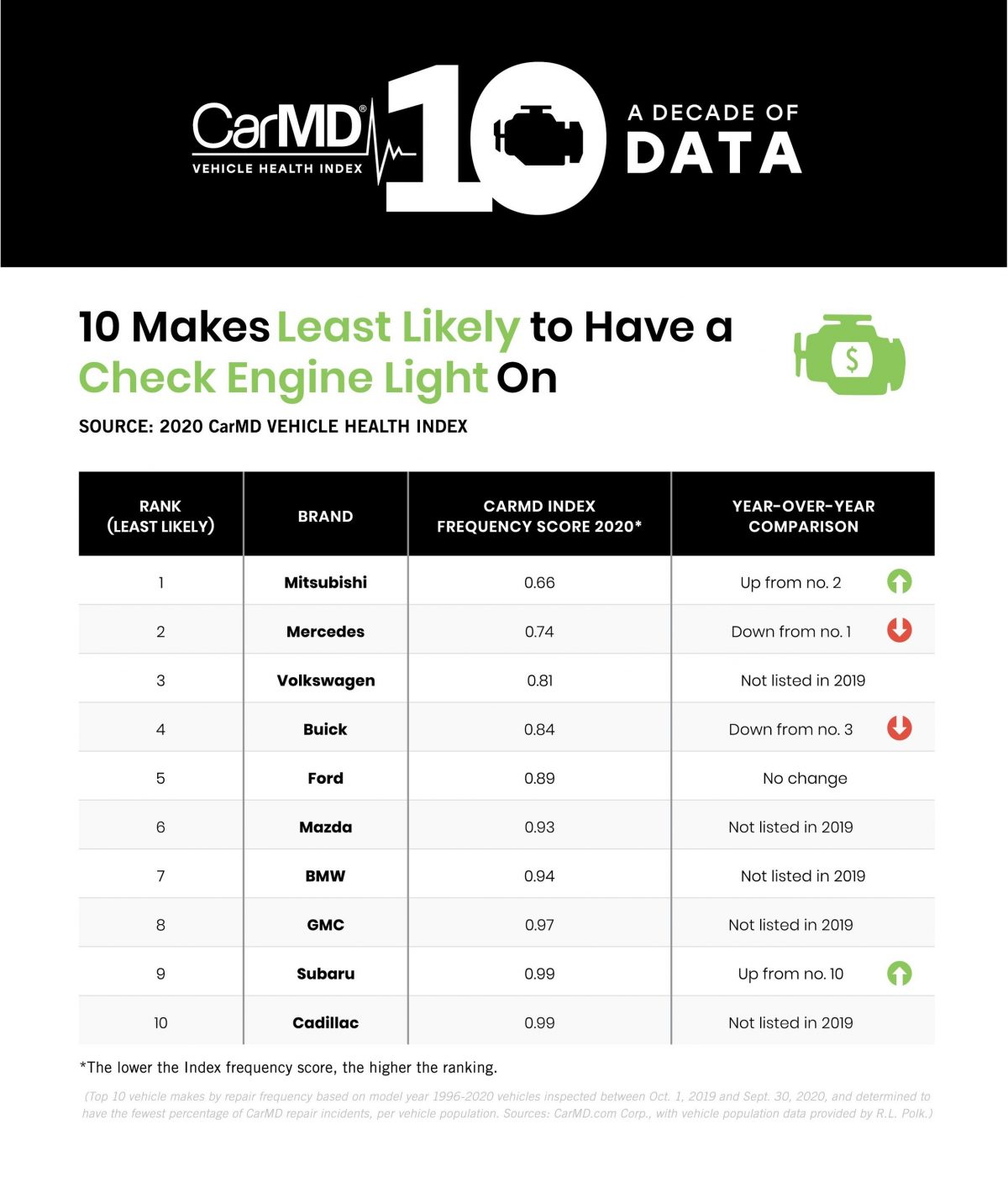
CarMD finds that Mitsubishi was the brand least likely to need check engine repairs over the past year, edging out Mercedes and Volkswagen, which rank no. 2 and no. 3 respectively. The 2018 Toyota Tacoma ranked as the vehicle least likely to need a check engine light repair; and the 2018, 2017 and 2016 Tacoma swept the category for trucks least likely to need repairs in 2020. While CarMD does not currently rank the vehicles most likely to have a check engine light problem, Vehicle Health Index calculations show that the 2018 Toyota Tacoma is more than 50% less likely to experience a check engine light issue than the worst ranked vehicle, which is a 2009 domestic SUV.

For the second consecutive year, Kia is the brand with the lowest average repair cost ($322), followed closely by Chrysler ($333) and Mazda ($339). The 2018 Hyundai Tucson cost the least on average ($34) to repair. Ford, GMC, Mazda and Volkswagen are the brands to rank in the top 10 on both lists this year, meaning they have both low frequency of check engine light incidents and low average repair costs.

«Having a reliable vehicle to drive and reducing the likelihood of costly car repairs is particularly important as we wrap up 2020 – a year that has brought many challenges,» said David Rich, CarMD’s technical director. «CarMD publishes this annual report to help vehicle owners and used car shoppers make better informed buying and service decisions, and to encourage drivers to seek repairs when the check engine light comes on.» Rich notes that when used in conjunction with other solutions such as CarMD PRO SCAN, the CarMD Vehicle Health Index reports can help repair shops educate customers about upcoming repair needs.   

10 Most Reliable Brands Least Likely to Have a Check Engine Light Come On

CarMD studied data from more than 19.5 million unique model year 1996 to 2020 vehicles reporting check engine health to identify the brands least likely to need check engine repairs. To rank these brands, CarMD developed an Index frequency score formulated by the lowest percentage of repair incidents per percentage of vehicle population. From this data, CarMD found the following brands were least likely to need a check engine repair over the past year.

  1. Mitsubishi
  2. Mercedes
  3. Volkswagen
  4. Buick
  5. Ford
  6. Mazda
  7. BMW
  8. GMC
  9. Subaru
  10. Cadillac

10 Brands with the Lowest Average Repair Costs

When factoring in all of the repairs needed on the various models and model years under each automaker, CarMD found the 10 vehicle brands with the lowest average check engine light-related repair costs in 2020 were:   

  1. Kia ($322.43)
  2. Chrysler ($332.83)
  3. Mazda ($339.35)
  4. Hyundai ($352.41)
  5. Dodge ($355.92)
  6. Jeep ($359.13)
  7. Chevrolet ($375.78)
  8. Ford ($381.63)
  9. GMC ($384.40)
  10. Volkswagen ($413.06)

10 Most Reliable Vehicles Least Likely to Have a Check Engine Light Come On

Any given brand can have a mix of reliable vehicle models along with some that have more frequent issues. And vehicle reliability can vary by model year, particularly when a model change has occurred. For this reason, the CarMD Vehicle Health Index drills down to rank vehicles by year, make and model. The following 10 vehicles had the lowest check engine light-related repair frequency, resulting in fewer trips to the repair shop, parts store or dealership in 2020:

  1. 2018 Toyota Tacoma
  2. 2015 Honda CR-V
  3. 2018 Toyota Camry
  4. 2017 Honda Accord
  5. 2017 Toyota Tacoma
  6. 2018 Hyundai Santa Fe Sport
  7. 2014 Honda CR-V
  8. 2017 Ford Explorer
  9. 2018 Nissan Rogue
  10. 2016 Toyota Tacoma

10 Vehicles with the Lowest Average Repair Costs

When the check engine light comes on, the following are the 10 vehicles that CarMD found to have the lowest average repair cost among the more than 10,145 different model year, make and model vehicles analyzed by CarMD. Many of these repairs come in under the average national hourly labor rate for automotive diagnostics and repair because they require simple fixes that can be done in less than an hour or at home by a skilled enthusiast:

  1. 2018 Hyundai Tucson ($33.80)
  2. 2019 Subaru Impreza ($37.74)
  3. 2016 Mercedes-Benz GLE ($39.79)
  4. 2017 Mitsubishi Mirage ($57.14)
  5. 2018 Kia Soul ($69.69)
  6. 2017 Mitsubishi Outlander Sport ($72.56)
  7. 2019 Honda HR-V ($73.45)
  8. 2017 Hyundai Tucson ($75.35)
  9. 2018 Subaru Legacy ($78.09)
  10. 2017 Subaru Legacy ($79.93)

The most common repair on 9 out of 10 of the most affordable vehicles to fix is to inspect or replace a loose, damaged or missing gas cap or fuel cap gasket. An often quick, easy and affordable repair, if ignored fuel cap problems can reduce fuel economy and lead to additional problems down the road. For instance, the most common repair on the 2018 Hyundai Tucson is to tighten the gas cap, accounting for nearly half of this model year’s recommended repairs, while the national average for gas cap-related repairs is 4.5%. On an older 2005 Hyundai Tucson, the most common repairs are oxygen sensor and catalytic converter replacements. As vehicles age, the type of repair changes and the average cost to repair them typically increases.

This Index ranks the 10 brands/makes and 100 vehicles least likely to have a check engine light on; 10 brands/makes and 100 vehicles with the lowest average repair costs; and top three vehicles by category. To compile this index CarMD analyzed data from over 19.5 million model year 1996 to 2020 vehicles reporting check engine health from Oct. 1, 2019 – Sept.  30, 2020. The full detailed report with year-over-year scores is available at https://www.carmd.com/wp/vehicle-health-index-introduction/2020-carmd-manufacturer-vehicle-rankings/.

About CarMD
Headquartered in Irvine, Calif., CarMD.com Corporation is a leading provider of automotive diagnostic business solutions, digital automotive aftermarket platform services and vehicle data licensing. CarMD specializes in automotive technology solutions that leverage and empower the capabilities of the on-board diagnostics (OBD) port. Published tri-annually, the CarMD® Vehicle Health Index™ reports on automotive repair and maintenance trends. For more information about CarMD’s automotive aftermarket solutions, including current and archived Vehicle Health Index reports, visit www.carmd.com.


Media Contact:

Kristin Brocoff  
949.400.4899
kristinB@CarMD.com


Cision View original content to download multimedia:http://www.prnewswire.com/news-releases/carmd-2020-vehicle-health-index-finds-mitsubishi-least-likely-to-need-check-engine-light-repairs-kia-most-affordable-when-repairs-are-needed-301193770.html

SOURCE CarMD

CityHealth Urgent Care Partners With Sacramento International Airport to Offer COVID-19 Testing

SACRAMENTO, Calif., Dec. 15, 2020 /PRNewswire/ — CityHealth Urgent Care and Sacramento International Airport (SMF) today announced a partnership to provide Molecular PCR COVID-19 tests to travelers flying out of Sacramento International Airport. 

«We’re very pleased to be partnering with Sacramento International Airport to offer this testing. We see this as a great way to keep more people safe and control the spread of this…

SACRAMENTO, Calif., Dec. 15, 2020 /PRNewswire/ — CityHealth Urgent Care and Sacramento International Airport (SMF) today announced a partnership to provide Molecular PCR COVID-19 tests to travelers flying out of Sacramento International Airport. 

«We’re very pleased to be partnering with Sacramento International Airport to offer this testing. We see this as a great way to keep more people safe and control the spread of this virus,» said Sean Parkin, CEO of CityHealth. 

The testing site will open on Wednesday, Dec. 16, and will be located in the Taxi Parking Lot (between the AMPM and the East Economy Lot) at Sacramento International Airport, 5680 Crossfield Drive, Sacramento, CA. 

«Partnering with CityHealth to provide convenient no-cost COVID-19 testing for passengers, airport employees and community members is another layer of health safety for those traveling through SMF and the Sacramento community,» says Airport Director Cindy Nichol

The Molecular PCR test is the most reliable COVID-19 test available, returning results with over 99% accuracy.

Appointments are required for testing at Sacramento International Airport. The test is offered free of charge, and insurance is not required. 

Those traveling to Hawaii will need to pay a $20 documentation fee to satisfy Hawaii’s Safe Travel regulations, which require proof of a negative COVID-19 test from a Trusted Travel Partner. 

Lab results are returned within 48 hours, so those wishing to travel should schedule a test as early as possible within 72 hours before they plan to depart. 

Appointments for COVID-19 can be made at norcalcovid19testing.com.

For those wishing to travel to Hawaii, the state has implemented new travel requirements due to increased COVID-19 cases. To comply with State recommendations, CityHealth Urgent Care will provide COVID-19 test recipients with an official declaration of their results. Passengers must upload their results to the State of Hawaii’s Safe Travel website for permission to enter Hawaii. Passengers with a negative COVID-19 test will be issued a QR code, which they must present in order to board any plane bound for Hawaii. 

CityHealth Urgent Care, a designated Trusted Travel Partner for the State of Hawaii, has been a leader in providing accessible COVID-19 testing in the San Francisco Bay area. CityHealth has already opened testing locations in Downtown San Francisco and Oakland International Airport, as well as providing free mobile COVID-19 tests to essential workers in the Oakland area. 

About CityHealth Urgent Care: CityHealth Urgent Care provides walk-in urgent and primary medical care to adults and children. Both locations in San Leandro and Oakland feature a full-service medical lab and on-site partnership with City Imaging. 

Visit www.norcalcovid19testing.com for more information.

The Sacramento County Department of Airports is responsible for planning, developing, operating and maintaining the county’s four airports: Sacramento International Airport, Executive Airport,Mather Airport and Franklin Field

CityHealth CONTACT INFO

Sean Parkin
CityHealth Urgent Care 
510-984-2489
getwell@cityhealthuc.com

SAC CONTACT INFO

Samantha Mott
Sacramento International Airport
916-642-5508
MottS@saccounty.net

Related Images

masked-traveler.jpg
Masked Traveler

Related Links

Book COVID-19 Appointment

Cision View original content to download multimedia:http://www.prnewswire.com/news-releases/cityhealth-urgent-care-partners-with-sacramento-international-airport-to-offer-covid-19-testing-301193705.html

SOURCE CityHealth Urgent Care