UMass Online Launches 34 High Demand Online Degree and Certificate Programs

BOSTON, July 23, 2020 /PRNewswire-HISPANIC PR WIRE/ — UMass Online launched 34 fully online degree and certificate programs since the beginning of FY20, the latest in the university’s continued commitment to world-class online educational offerings. The new programs include a mix of undergraduate and graduate certificates, bachelor’s degrees, master’s degrees and a doctorate within STEM, health care, business and criminal justice. The launch of these new programs comes on the heels of <a…

BOSTON, July 23, 2020 /PRNewswire-HISPANIC PR WIRE/ — UMass Online launched 34 fully online degree and certificate programs since the beginning of FY20, the latest in the university’s continued commitment to world-class online educational offerings. The new programs include a mix of undergraduate and graduate certificates, bachelor’s degrees, master’s degrees and a doctorate within STEM, health care, business and criminal justice. The launch of these new programs comes on the heels of a major partnership announcement between UMass Online and Mass General Brigham, the state’s largest private employer, through which UMass Online will develop degree completion programs specifically for MGB employees.
University of Massachusetts Online Logo

«With unemployment at a record high, the University of Massachusetts is responding by creating access to programs that will contribute to a robust economic recovery,» UMass System Chancellor of Academic Programs Katherine Newman said. «Adding fully online degree and certificate programs in areas with projected employment growth will help professionals navigate careers in a shifting workforce.»

«Our responsibility to the Commonwealth, higher education and adult learners is to provide pathways to completion that provide learners with confidence and security,» said UMass Online CEO Don Kilburn. «As employers focus on filling skills gaps across the country unemployed and working professionals are seeking pathways to secure employment and career advancement.»

According to the Bureau of Labor Statistics Commissioner’s Statement on the Employment Situation, the unemployment rate was 11.1 percent nationally as of July 2, 2020.

The BLS data also highlights a stark disparity in employment resiliency between college-educated and non-college-educated workers that was present before the COVID-19 pandemic which has since been exacerbated. In June of 2020, 16.6 percent of those without a high school diploma were unemployed, along with 12.1 percent of those with a high school diploma. Meanwhile, 6.9 percent of those with a bachelor’s degree or higher were unemployed.

In addition to the online degree and certificate programs UMass Online currently offers, its new programs provide more opportunity for those seeking to either upskill within their chosen fields or adapt to new career paths during and beyond the pandemic.

UMass Amherst

UMass Boston

UMass Dartmouth

UMass Lowell

According to the National Student Clearinghouse, there are 36 million Americans with postsecondary education and training who have not completed their program and are no longer enrolled.

UMass Online has recently renewed its focus on providing new and expedited pathways to degree completion opportunities for those with prior college credit.

«Thousands of working adults will benefit from expanded UMass online programming,» said Chancellor Newman. «We are committed to ensuring that Massachusetts citizens have access to world-class, affordable and accessible programs that are aligned with the needs of our economy and our business community.»

In January, U.S. News & World Report ranked UMass Online programs prominently in its annual Best Online Colleges list, with UMass Amherst and UMass Lowell having the top two online bachelor’s programs in New England for the second consecutive year.

All four UMass undergraduate campuses were rated in the top category of U.S. News & World Report’s Best Colleges rankings for the fourth consecutive year in 2019, making UMass one of the few university systems in the nation to have each campus so acclaimed. For the fifth straight year, UMass was named to Reuters’ list of the World’s Most Innovative Universities, ranking 63rd globally and 33rd among U.S. institutions.

Adult learners can earn undergraduate or graduate degrees and certificates either fully online, on-campus or through blended learning options. A complete list of degree and certificate programs can be found at UMass Online. To view the catalog of 4,000 courses available, visit online courses.

About UMass Online:
UMass Online, the online learning consortium of the University of Massachusetts, provides marketing and technology support for UMass’ online offerings that enable students, professionals, and lifelong learners to take courses anywhere, anytime. With nearly 200 undergraduate and graduate degree, certificate and professional development programs and more than 4,000 courses available from UMass, UMass Online’s marketing and technology services support one of the largest accredited online programs available. Programs span the disciplines for which the University is best known: business, liberal arts, education, management, nursing, public health, criminal justice, information technology, and other disciplines.

Logo – https://mma.prnewswire.com/media/1218368/UMass_Logo.jpg

SOURCE University of Massachusetts

SafeatHomePPE.com and MascarasYSalud.com Sites Launch to Help Families Stay Safe with Masks, Gloves, Sanitizers and other PPE Products

COMMERCE, California, July 23, 2020 /PRNewswire-HISPANIC PR WIRE/ — Safe at Home PPE, a California based personal protective equipment retailer for families, announced its new site launch www.safeathomeppe.com and Spanish language site, <a target="_blank"…

COMMERCE, California, July 23, 2020 /PRNewswire-HISPANIC PR WIRE/ — Safe at Home PPE, a California based personal protective equipment retailer for families, announced its new site launch www.safeathomeppe.com and Spanish language site, www.mascarasysalud.com today.

Safe at Home PPE is a Los Angeles based, minority owned provider of personal protective equipment for families and businesses.

«Safe at Home PPE was developed to offer reasonably priced PPE products specifically for families. We want to make sure families have convenient quality medical grade masks, gloves, sanitizers and other products that help protect their health in one easy to shop place. We also wanted to makorniae sure our sourcing doesn’t take from the medical PPE industry and used our existing manufacturing supply chain to produce these. We seek FDA compliance with all of our products and price them as economically as possible to help families out,» said Oscar George, Safe at Home PPE and Mascaras Y Salud CEO. 

www.SafeatHomePPE.com and www.MascarasYSalud.com offer face coverings including 3 layer masks, face shields and KN95 respirator masks, as well as PVC gloves (non-latex to help allergy prone families) and PPE Kits for the whole family to easily manage their safety. They also offer contactless thermometers, sanitizers and wipes. 

«COVID-19 has transmitted to over 3 million people in the US with over 140,000 succumbing to it. As families venture back to work, school and just generally living their lives, providing the necessary safety products that are convenient and affordable is our number one goal,» Oscar George said. 

SafeatHomePPE.com and MascarasYSalud.com are also donating 10% of all sales through July 31st to the Hispanic Scholarship Fund, HSF to help Hispanic students in their education. 

About Safe at Home PPE and Mascaras Y Salud
Safe At Home PPE and Mascaras Y Salud are a Commerce, CA minority owned business built to help families with their personal protective equipment needs.  Like most of their customers, when the coronavirus began, they could not find quality and affordable supplies like gloves, masks and sanitizers for loved ones. Using resources developed over many years sourcing their world renowned event supply business, Portofino International, they were able to set up a reliable supply chain of quality products. Their goal is to help families stay protected until COVID-19 is no longer a threat to our communities. 

Photo – https://mma.prnewswire.com/media/1218503/Safe_at_Home_PPE.jpg

SOURCE Safe at Home

The Home Depot Announces Renewable Energy Goal and Pledges to Eliminate EPS Foam and PVC Film from Private Brands by 2023 in Annual Responsibility Report

ATLANTA, July 23, 2020 /PRNewswire-HISPANIC PR WIRE/ — The Home Depot®, the world’s largest home improvement retailer, today announced companywide sustainability progress in its 2020 Responsibility Report, which outlines the company’s 2019 progress on its corporate responsibility strategic pillars: focus on people, operate sustainably and strengthen communities. The report also introduces several new goals and provides an update on the company’s recent response to COVID-19 and social…

ATLANTA, July 23, 2020 /PRNewswire-HISPANIC PR WIRE/ — The Home Depot®, the world’s largest home improvement retailer, today announced companywide sustainability progress in its 2020 Responsibility Report, which outlines the company’s 2019 progress on its corporate responsibility strategic pillars: focus on people, operate sustainably and strengthen communities. The report also introduces several new goals and provides an update on the company’s recent response to COVID-19 and social equality issues.

The Home Depot logo.

New goals include a commitment to produce and procure energy from 335 megawatts of renewable and alternative energy projects by 2025 – equivalent to the amount of energy it takes to power more than 90,000 homes. Additionally, the company pledged to eliminate expanded polystyrene (EPS) foam and polyvinyl chloride (PVC) film from its private brand packaging by 2023. 

As part of its existing pledge to reduce carbon dioxide emissions by 50 percent by 2035, The Home Depot reduced its greenhouse gas emissions by 10 percent in 2019, driven primarily by energy reductions and supply chain efficiencies. The company reduced its electricity consumption in U.S. stores by 383 million kilowatt hours, tripling its 2018 reduction while at the same time adding three new U.S. stores to its footprint.

«We believe our commitment to continuing progress on environmental, social and governance issues has made our company stronger, had a lasting positive impact on the environment, deepened our relationships with associates and customers, and created long-term shareholder value,» said Craig Menear, chairman, CEO and president of The Home Depot. «I want to thank our associates and suppliers for the significant progress we made last year and look forward to making meaningful progress in the future.»

The Home Depot’s Corporate Responsibility strategy is centered on three key pillars: focusing on people, operating sustainably, strengthening communities.

Focus on People

  • The Home Depot continued to make strides in improving its diversity and inclusion in 2019. Last year, more than 33 percent of new hires were female and more than 50 percent were ethnically diverse. In 2020, in support of its commitment to racial equality and social justice, the company established an executive-led task force to further expand its ongoing work to strengthen African American and other minority communities, combat discrimination and deepen its diversity.
  • In 2019, The Homer Fund – The Home Depot’s associate-funded assistance fund – provided more than 8,200 associates with more than $16 million in grants. Since its inception in 1999, The Homer Fund has awarded associates in need more than $200 million in grants.
  • To support associates during the COVID-19 pandemic, The Home Depot has provided more than $1 billion in expanded benefits to-date. These benefits include expanded paid time off for all hourly associates (and additional time for associates who are 65 and older or in higher-risk categories as defined by the Centers for Disease Control and Prevention), weekly bonuses for full-time and part-time hourly associates, and extended backup dependent care with no copays.

Operating Sustainably

  • In 2019, The Home Depot’s U.S. stores used 35 percent less electricity than they did in 2010. The company’s substantial energy-saving progress in 2019 was led by the rolling installation of LED lighting across its U.S. stores. About 60 percent of its U.S. stores had LED lighting installed by the end of 2019, and the upgrades continue. Overall, U.S. store energy consumption dropped 12 percent last year.
  • As The Home Depot commits to produce or procure energy from 335 megawatts of renewable and alternative energy projects by 2025, the company plans to nearly double the number of stores with on-site solar panels and continue to leverage on-site fuel cells and offsite wind and solar energy.
  • By partnering with suppliers to improve products and packaging, 1.44 million pounds of plastic were eliminated, and another 7.73 million pounds of virgin plastic were replaced with recycled plastic in 2019.
  • A more efficient supply chain means reduced business costs and less impact on the environment. By packing trailers to maximize space, the company was able to avoid approximately 10,500 truck trips traveling 15 million miles. The Home Depot is also partnering with other companies to fill underloaded trucks by buying and selling trailer space. And by using artificial intelligence (AI) to leverage data on optimal truck performance based on weight, the company is enabling fuller trucks to use fuel more efficiently.

Strengthening Communities

  • The Home Depot Foundation continued its efforts to improve the homes and lives of U.S. veterans, assist communities affected by natural disasters and train skilled tradespeople to fill the labor gap. Since 2011, the Foundation’s total investment in veterans causes surpassed $335 million – part of its $500 million pledge by 2025.
  • The Foundation has established trades training programs for military members and high school students in more than 15 states, as well as an innovative K12 program in Georgia, all part of its $50 million commitment to train 20,000 tradespeople by 2028 to address the skilled labor shortage and provide a path to quality jobs.
  • In 2019, the Foundation gave $3.5 million to help communities recover from natural disasters and partnered with nonprofits like Operation Blessing, the American Red Cross, Team Rubicon and Convoy of Hope.
  • Throughout the COVID-19 crisis, The Home Depot has prioritized the safety and well-being of associates and customers, while remaining open to provide essential products and services to its communities. The company has contributed more than $50 million to support communities, including donations of personal protective equipment (PPE) to first responders, hospitals and healthcare workers, with more than 95 percent of its stores contributing PPE and other supplies in their local communities.

New to the report this year is the inclusion of disclosures aligned with the Sustainability Accounting Standards Board (SASB) and the Task Force on Climate-related Financial Disclosures (TCFD) frameworks. The company also continues to apply the Global Reporting Initiative (GRI) Sustainability Reporting Standards as an identification and cross reference tool, which it has done for the last 5 years, and highlights 10 United Nations Sustainable Development Goals that align within The Home Depot’s sphere of influence. In addition to these disclosure frameworks, the report includes charts on materiality touchpoints, progress on stated goals and an ESG transparency chart that highlights The Home Depot’s key environmental, social and governance (ESG) metrics from 2017 through 2019.

For more information on The Home Depot’s commitment to environmental, social, and governance issues, please view the 2020 Responsibility Report on The Home Depot’s corporate newsroom, Built from Scratch.

About The Home Depot

The Home Depot is the world’s largest home improvement specialty retailer, with 2,293 retail stores in all 50 states, the District of Columbia, Puerto Rico, U.S. Virgin Islands, Guam, 10 Canadian provinces and Mexico. In fiscal 2019, The Home Depot had sales of $110.2 billion and earnings of $11.2 billion. The company employs more than 400,000 associates. The Home Depot’s stock is traded on the New York Stock Exchange (NYSE: HD) and is included in the Dow Jones industrial average and Standard & Poor’s 500 index.

Certain statements contained herein constitute «forward-looking statements» as defined in the Private Securities Litigation Reform Act of 1995. These forward-looking statements may relate to, among other things, our goals, commitments and programs and projections of future results; the impact on our business, operations and financial results of the COVID-19 pandemic; our business plans, strategies, initiatives and objectives and their expected execution and impact; management of relationships with our associates, suppliers and vendors; and our assumptions and expectations regarding any of the foregoing. Forward-looking statements are based on currently available information and our current assumptions, expectations and projections about future events. These statements are not guarantees of future performance and are subject to future events, risks and uncertainties – many of which are beyond our control, dependent on the actions of third parties, or currently unknown to us – as well as potentially inaccurate assumptions that could cause actual results to differ materially from our expectations and projections. These risks and uncertainties include, but are not limited to, those described in Item 1A, «Risk Factors,» and elsewhere in our Annual Report on Form 10-K for our fiscal year ended February 2, 2020 and in our subsequent Quarterly Reports on Form 10-Q.

Forward-looking statements speak only as of the date they are made, and we do not undertake to update these statements other than as required by law. You are advised, however, to review any further disclosures we make on related subjects in our periodic filings with the Securities and Exchange Commission.

Logo – https://mma.prnewswire.com/media/118058/the_home_depot_logo.jpg

SOURCE The Home Depot

California Alcohol Policy Alliance (CAPA) responsabiliza al gobernador Gavin Newsom por la fallida medida de considerar las bebidas alcohólicas como «producto esencial» en el marco del COVID-19


SAN FRANCISCO, 23 de julio de 2020 /PRNewswire-HISPANIC PR WIRE/ — Hoy, la organización <a target="_blank"…


SAN FRANCISCO, 23 de julio de 2020 /PRNewswire-HISPANIC PR WIRE/ — Hoy, la organización California Alcohol Policy Alliance (Alianza para las Políticas sobre Consumo de Alcohol en California, CAPA) ofreció una conferencia de prensa en modalidad virtual para enunciar la fallida decisión del gobernador de California, Gavin Newsom, de considerar las bebidas alcohólicas esenciales en lugar de priorizar la salud y la seguridad públicas en el estado durante la pandemia del #COVID19. Durante el acto, se inició una campaña para enviar cartas a Newsom a fin de exigirle y exigir al Departamento de Control de Bebidas Alcohólicas de California (ABC) la eliminación de los puntos de venta de bebidas alcohólicas de la lista de servicios esenciales con el objetivo de proteger la salud y la seguridad públicas. Diversos grupos de jóvenes de todo el estado señalan que muchos de sus compañeros adolescentes se las ingenian para comprar alcohol y sí lo consiguen.

«En estos tiempos, los chicos se disfrazan de adultos mayores para comprar bebidas alcohólicas. Hay adolescentes participando en este desafío en TikTok y es más crucial que nunca vigilar el cumplimiento de las políticas del ABC; más importante aún es que nuestras autoridades atiendan las problemáticas detrás del auge en el índice de consumo de alcohol entre adolescentes, esa debería de ser la prioridad. Necesitamos reformas duraderas que obstaculicen la continuidad de este patrón de comportamiento durante la pandemia y después de la pandemia», dijo Eric, estudiante del último año de preparatoria y miembro de la Coalición para la Salud Juvenil del Condado de Contra Costa

Las personas que tomaron la palabra durante el evento presentaron una serie de problemáticas surgidas a medida que el coronavirus arrasa en California. El consumo de alcohol está aumentando y las formas de obtener alcohol se están facilitando. La organización CAPA está alarmada por el relajamiento de la normatividad en torno al alcohol y lo denomina «una amenaza inmediata a la salud y el bienestar de las comunidades». Esto indica una grave falla por parte del gobernador de California y las principales autoridades del estado a su cargo al no reconocer y atender cuestiones de salud y seguridad públicas, e incluir el alcohol entre los artículos esenciales durante la pandemia. Los catastróficos daños anuales relacionados con el alcohol que ya asolan al estado no fueron tomados en cuenta, tal como se ignora la manera en que dichos perjuicios han aumentado ahora que el alcohol es considerado esencial.

«Es necesario que el Departamento de Control de Bebidas Alcohólicas de California considere el bienestar de la población del estado como esencial en lugar de priorizar el rescate de la gran industria de las bebidas alcohólicas. ¿Con qué artilugios van a justificar que el consumo de alcohol en espacios públicos sea esencial? Nadie puede beber con la mascarilla puesta», dijo Gilbert Mora, copresidente de CAPA.

De acuerdo con un estudio publicado por el instituto de investigaciones sin fines de lucro RTI International, 35% de las personas encuestadas reportó un consumo excesivo de alcohol y 27% reportó haber juergueado en abril. Alrededor de 30% de las personas encuestadas afirmó beber más días al mes de los que bebía antes de la pandemia. El aumento se atribuye al estrés, el aburrimiento y la soledad durante el confinamiento obligatorio.

Algunos estados, entre ellos California, están facilitando conseguir alcohol. En todo el país, las ventas de bebidas alcohólicas crecieron 26% entre marzo y junio de este año en comparación con el mismo período el año pasado, según Nielsen Corp; el incremento se explica básicamente por los pedidos en línea que se dispararon hasta 243%.

En marzo, cuando se instauró la orden de quedarse en casa, el ABC otorgó permisos especiales para autorizar la venta de cocteles para llevar y la venta de alcohol a domicilio para impulsar al negocio de las bebidas alcohólicas. El 1 de julio, frente al repentino aumento de casos positivos y hospitalizaciones, el gobernador Newsom anunció otro cierre y la prohibición de consumir alimentos en espacios cerrados, haciendo que los locales de venta de alcohol dependan considerablemente de las compras para llevar y las entregas a domicilio.

«La concentración excesiva de negocios de alcohol ya constituye una epidemia en las principales ciudades de California. La organización Los Angeles Drug and Alcohol Policy Alliance (Alianza para las Políticas sobre Consumo de Drogas y Alcohol de Los Ángeles) reporta que 80% de las secciones censales de Los Ángeles acusan concentración excesiva y San Francisco revela una densidad aún mayor de permisos, al grado que los legisladores de San Francisco apelan al estado para solicitar todavía más permisos, pues los restaurantes nuevos no obtienen ingresos suficientes de la venta de alimentos y no pueden competir con negocios vecinos. Al dar acceso a cada tenedor de un permiso a las viviendas mediante la entrega a domicilio, prácticamente todas las secciones censales se saturan de manera masiva», comentó Carson Benowitz-Fredericks, gerente de investigación de Alcohol Justice.

La prevalencia de eventos virtuales, como las llamadas horas felices del COVID, catas de vinos y bebidas alcohólicas durante el COVID, las fiestas en línea y las publicaciones en redes sociales que promueven nuevos nombres de cocteles como «cuarintinis» destacan el hábito de beber como una vía para evitar el aburrimiento. Todo ello constituye un peligro para la salud pública.

El sistema inmune de las personas dependientes del alcohol se encuentra debilitado y complica el combate del Covid-19. Incluso quienes no son adictos, pero beben más durante la pandemia, están en riesgo de incurrir en un consumo abusivo que favorece manejar en estado de ebriedad y aumenta la agresividad, la violencia en el hogar y los problemas financieros. Beber en exceso también aumenta el riesgo de padecer enfermedad del hígado, cáncer de mama, depresión, infarto cerebral e infarto cardíaco.

Además, hay un número desproporcionado de negocios de alcohol y publicidad de consumo de alcohol en comunidades de minorías de bajos ingresos que acentúa el potencial de problemas relacionados con el alcohol en zonas de por sí carentes de suficientes recursos.

Veronica de Lara/copresidenta de CAPA, dijo: «¿Por qué la reacción estatal ante el COVID-19 no tiene en cuenta el impacto del daño causado por el alcohol y su consumo excesivo? ¿Con qué artilugios se explica que el alcohol se considere esencial en una pandemia mundial? ¿Por qué estamos en un proceso de desregulación del consumo de alcohol? ¡Exigimos respuestas! Nuestras comunidades y familias demandan priorizar la salud y la seguridad públicas por encima de las ganancias económicas».

Debido al alto potencial de incurrir en conductas de riesgo y en las consecuentes perturbaciones a la comunidad durante la pandemia, CAPA y sus socios locales exhortan decididamente al gobernador Newsom a eliminar el alcohol de la lista de negocios esenciales y a reinstaurar la normativa del ABC que restringen la venta para llevar, la entrega a domicilio y el consumo ampliado de alcohol en espacios públicos. De manera específica, CAPA solicita al gobernador:

  • Rescindir todo el repliegue «temporal» de los reglamentos y las normativas sobre el alcohol
  • Diseñar una normativa para una política estatal estándar en relación con el alcohol en el marco de las medidas ante el Covid-19
  • Atender el aumento desproporcionado del daño causado por el alcohol en comunidades de color de bajos ingresos
  • Aumentar los impuestos al alcohol y destinar los fondos así ahorrados a medidas de tratamiento y prevención
  • Retirar los permisos caducos/no utilizados de venta y consumo de alcohol

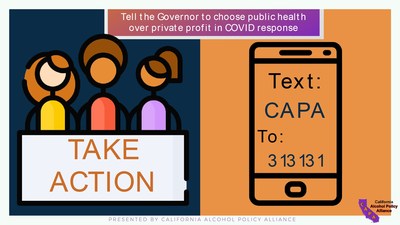
CAPA exhorta a la población del estado a enviar un mensaje de texto con la palabra CAPA al 313131 para hacer llegar al gobernador la petición de revaluar detalladamente la relación de California con la gran industria de las bebidas alcohólicas, reconocer que el consumo excesivo de alcohol ocupa el tercer puesto en la lista de causas evitables de muerte en el estado y considerar esencial la salud pública, no el alcohol. 

Actualmente, California registra más de 10,500 muertes relacionadas con el consumo de alcohol; 165,000 hospitalizaciones relacionadas con el consumo de alcohol y $35,000 millones en daños económicos derivados.

California Alcohol Policy Alliance (CAPA) agrupa a diversas organizaciones y comunidades californianas para proteger la salud y la seguridad, y evitar los daños relacionados con el alcohol mediante acciones en todo el estado.

Organizaciones que conforman CAPA

  • Alcohol Justice
  • Alcohol-Narcotics Education Foundation of California
  • ADAPP, Inc.
  • ADAPT San Ramon Valley
  • Bay Area Community Resources
  • Behavioral Health Services, Inc.
  • CA Council on Alcohol Problems
  • CASA for Safe & Healthy Neighborhoods
  • Center for Human Development
  • Center for Open Recovery
  • DogPAC of San Francisco
  • Dolores Huerta Foundation
  • Eden Youth & Family Center
  • Institute for Public Strategies
  • FASD Network of Southern CA
  • FreeMUNI – SF
  • Friday Night Live Partnership
  • Koreatown Youth & Community Center
  • Laytonville Healthy Start
  • L.A. County Friday Night Live
  • L.A. Drug & Alcohol Policy Alliance
  • L.A. County Office of Education
  • Lutheran Office of Public Policy – CA
  • MFI Recovery Center
  • Mountain Communities Family Resource Center
  • National Asian Pacific American Families Against Substance Abuse
  • National Council on Alcoholism & Drug Dependence – Orange County
  • Partnership for a Positive Pomona
  • Paso por Paso, Inc.
  • Project SAFER
  • Pueblo y Salud
  • Reach Out
  • San Marcos Prevention Coalition
  • San Rafael Alcohol & Drug Coalition
  • SAY San Diego
  • Saving Lives Drug & Alcohol Coalition
  • South Orange County Coalition
  • Tarzana Treatment Centers, Inc.
  • The Wall Las Memorias Project
  • UCEPP Social Model Recovery Systems
  • Women Against Gun Violence
  • Youth For Justice

Más información en: https://alcoholjustice.org/press-packets 

Contactos: 

Mayra Jimenez 323 683-4687

Jorge Castillo 213 840-3336

Michael Scippa 415 548-0492


California Alcohol Policy Alliance (CAPA) AlcoholPolicyAlliance.org

Foto – https://mma.prnewswire.com/media/1218513/CAPA___Take_Action.jpg
Logo – https://mma.prnewswire.com/media/469269/Califorina_Alcohol_Policy_Alliance_Logo.jpg


FUENTE California Alcohol Policy Alliance

FIBRA Prologis Anuncia sus Resultados Financieros del Segundo Trimestre de 2020

CIUDAD DE MÉXICO, 22 de julio de 2020 /PRNewswire-HISPANIC PR WIRE/ — FIBRA Prologis (BMV:FIBRAPL 14), un fideicomiso de inversión en bienes raíces líder en inversión y administración de inmuebles industriales clase-A en México, anunció hoy sus resultados del segundo trimestre de 2020.

LOGROS DESTACADOS DEL TRIMESTRE:

  • La recolección de renta fue de 97.9 por ciento.
  • La ocupación al final del periodo fue de 95.5 por ciento.
  • La renta neta efectiva en renovaciones creció un 13.2 por ciento….

CIUDAD DE MÉXICO, 22 de julio de 2020 /PRNewswire-HISPANIC PR WIRE/ — FIBRA Prologis (BMV:FIBRAPL 14), un fideicomiso de inversión en bienes raíces líder en inversión y administración de inmuebles industriales clase-A en México, anunció hoy sus resultados del segundo trimestre de 2020.

LOGROS DESTACADOS DEL TRIMESTRE:

  • La recolección de renta fue de 97.9 por ciento.
  • La ocupación al final del periodo fue de 95.5 por ciento.
  • La renta neta efectiva en renovaciones creció un 13.2 por ciento.
  • El promedio ponderado de retención de clientes fue de 82.6 por ciento.
  • El NOI en efectivo sobre mismas propiedades bajó 11.4 por ciento.
  • Las adquisiciones de activos completadas fue de Ps. 8,824 millones (US$358.5 millones).

Las utilidades netas por CBFI en el segundo trimestre fueron de Ps. (0.4416) (US$(0.0189)) comparados con Ps. 0.7487 (US$0.0395) por el mismo periodo en 2019.

Los fondos provenientes de operaciones («FFO», por sus siglas en inglés) por Certificado Bursátil Fiduciario Inmobiliario («CBFI») fueron de Ps. 0.9131 (US$0.0383) para el trimestre comparado con Ps. 0.8325 (US$0.0434) para el mismo periodo en 2019.

SE MANTIENEN LA SOLIDEZ DE LOSRESULTADOS OPERATIVOS

«Nuestro desempeño en el segundo trimestre superó nuestras expectativas, resaltando la resiliencia de nuestra estrategia de inversión», dijo Luis Gutiérrez, Director General de Prologis Property México. «Si bien  el COVID-19 continúa afectando la vida cotidiana, nuestro portafolio y clientes son factores clave para la cadena de suministro que sirven a la economía del hogar. Seguimos siendo cautelosamente optimistas en nuestro pronóstico dada la adopción del comercio electrónico y la operaciones de manufactura de «nearshoring» que avanzaron en la primera mitad del año y no muestran signos de desaceleración.»

Gutiérrez agregó: «A pesar de las condiciones macroeconómicas desfavorables, FIBRA Prologis pudo adquirir Prologis Park Grande, el principal parque logístico en la Ciudad de México, así como  dos inmuebles tipo Last Touch® ubicados dentro de las zonas urbanas. Las adquisiciones profundizan nuestra presencia en el consumo clave del país.»

Portafolio Operativo

1T20

1T19

Notas

Ocupación al final del periodo

95.5%

96.6%

Tres de nuestros seis mercados superaron el 95%

Contratos de Arrendamiento Iniciados

5.1 MSF

2.0 MSF

66% de la actividad de arrendamiento relacionada con la Ciudad de México y Guadalajara; 64% de los vencimientos de 2020 fueron en la primera mitad de 2020

Retención de Clientes

82.6%

85.1%

Cambio en la Renta Neta Efectiva

13.2%

16.0%

Cuatro de seis mercados registraron un cambio positivo de renta neta efectiva de al menos 10%

NOI en efectivo sobre Mismas Propiedades

-11.4%

3.9%

Mayores concesiones relacionadas con un plazo de arrendamiento más largo junto con un peso más débil y una menor ocupación promedio, parcialmente compensado por rentas más altas

NOI sobre Mismas Propiedades

-6.0%

0.9%

SÓLIDA POSICIÓN FINANCIERA

Al 30 de junio de 2020, el nivel de apalancamiento de FIBRA Prologis era de 29.0 por ciento y la liquidez era de Ps. 6, 557 millones (US$283.0 millones), que incluían Ps. 5.9 billones (US$255.0 millones) de capacidad disponible en la línea de crédito no garantizada y Ps. 658.0 millones (US$28.4 millones) de efectivo disponible no restringido.

GUÍA ACTUALIZADA

«FIBRA Prologis reportó un buen desempeño operativo y financiero mientras mantenía una liquidez significativa», dijo  Jorge Girault, vicepresidente senior de Finanzas de Prologis Property México. «Si bien no tenemos visibilidad sobre cuánto tiempo durará la pandemia sanitaria, nuestro resultados del segundo trimestre y la resiliencia del portafolio nos alientan. En este sentido estamos ajustando nuestra guía para reflejar nuestra perspectiva actual para la segunda mitad del 2020».

(US$ en millones, excepto por montos en CBFI) 22.75MXN por USD promedio para el año completo.

Previo

Revisado

FFO por CBFI*

US$0.1400 – 0.1600

US$0.1550 – 0.1650

Distribución por CBFI del año completo 2020

US$0.097

US$0.097

Ocupación al final del año

94.0 – 96.0%

95.0 – 96.0%

NOI en efectivo sobre mismas propiedades**

-4.0 – 1.0%

-5.0 – -3.0%

Capex anual como porcentaje de NOI

13.0 – 14.0%

13.0 – 14.0%

Comisión por administración de activos y honorarios profesionales

US$19.0

US$19.0 – 21.0

Adquisición de edificios

US$350 – 400.0

US$350 – 400.0

* Excluye el impacto de movimientos en moneda extranjera
** Basado en dólares estadounidenses

INFORMACIÓN SOBRE LA TRANSMISIÓN POR INTERNET (WEBCAST) Y CONFERENCIA TELEFÓNICA

FIBRA Prologis sostendrá una conferencia telefónica/webcast en vivo para analizar los resultados del trimestre, así como las condiciones que prevalecen en el mercado y las perspectivas a futuro. Aquí están los detalles de la llamada:

  • Jueves 23 de julio de 2020, a las 9 a.m. hora del centro/10 a.m. hora del este
  • Webcast en vivo ingresando a www.fibraprologis.com, en la sección de Relación con Inversionistas, haciendo click en Eventos
  • Vía conferencia telefónica marcando +1 833 714-0919 o +1 778 560-2663 e ingresando la contraseña 8796378.

Del 23 al 30 de julio estará disponible una repetición de la conferencia, la cual se podrá escuchar marcando +1 800 585-8367 desde los Estados Unidos y Canadá, o al +1 416 621-4642 desde cualquier otro país, e ingresando el código de conferencia 8796378. De igual forma, se publicará la repetición en la sección de Relaciones con Inversionistas en le sitio web de FIBRA Prologis.

PERFIL DE FIBRA PROLOGIS

FIBRA Prologis es un fideicomiso de inversión en bienes raíces de inversión y administración de inmuebles industriales clase A en México. Al 30 de junio de 2020, FIBRA Prologis consistía de 201 inmuebles destinados a logística y manufactura ubicados en seis mercados industriales en México, con un Área Rentable Bruta total de 39.0 millones de pies cuadrados (3.6 millones de metros cuadrados).

DECLARACIONES SOBRE HECHOS FUTUROS

Este comunicado contiene algunas declaraciones sobre hechos futuros. Dichas declaraciones están basadas en expectativas actuales, estimaciones y proyecciones de la industria y los mercados en los cuales FIBRA Prologis opera, así como en creencias y suposiciones derivadas del Administrador de FIBRA Prologis. Dichas declaraciones implican incertidumbres que pudieren llegar afectar significativamente los resultados financieros de FIBRA Prologis. Palabras como «espera», «anticipa», «intenta», «planea», «cree», «busca», «estima» o variaciones de las mismas y expresiones similares tienen la intención de identificar dichas declaraciones sobre hechos futuros, que por lo general no son de naturaleza histórica. Todas las declaraciones en relación con el rendimiento operacional, eventos o desarrollos que esperamos o anticipamos que ocurran en el futuro, incluyendo, declaraciones relacionadas con renta y crecimiento ocupacional, actividades de desarrollo y cambios en las ventas o en el volumen de propiedades a ser aportadas, enajenaciones, condiciones generales en las áreas geográficas en las que operamos, y nuestra deuda y posición financiera, serán consideradas declaraciones sobre hechos futuros. Estas declaraciones no garantizan un rendimiento futuro e implican ciertos riesgos, incertidumbres y supuestos que son difíciles de predecir. No obstante que creemos que las estimaciones contenidas en cualquier declaración sobre hechos futuros están basadas en suposiciones razonables, no podemos asegurar que nuestras expectativas se cumplirán y por lo tanto los resultados reales podrían diferir materialmente de lo expresado o previsto en dicha declaración. Algunos de los factores que pudieren llegar afectar dichas resultados incluyen, pero no se limitan, a: (i) la situación económica internacional regional y local, (ii) los cambios en los mercados financieros, tasas de interés y tipos de cambio de moneda extranjera, (iii) aumento en, o surgimiento de, competencia respecto de nuestras propiedades, (iv) los riesgos asociados con adquisiciones, enajenación y desarrollo de propiedades, (v) el mantenimiento del régimen y estructura fiscal de un fideicomiso de inversión en bienes raíces, (vi) la disponibilidad de financiamiento y capital, los niveles de endeudamiento que mantengamos y nuestras calificaciones, (vii) los riesgos relacionados con nuestras inversiones, (viii) incertidumbres ambientales, incluyendo los riesgos de desastres naturales, y (ix) los factores de riesgo adicionales discutidos en los comunicados, informes, reportes, prospectos y suplementos presentados ante la Comisión Nacional Bancaria y de Valores y la Bolsa Mexicana de Valores, S.A.B. de C.V., por FIBRA Prologis, bajo el rubro «Factores de Riesgo». Ni Prologis ni FIBRA Prologis asumen obligación alguna de actualizar las declaraciones sobre hechos futuros que aparecen en este comunicado.

Logo – https://mma.prnewswire.com/media/528012/FIBRA__Logo.jpg

FUENTE FIBRA Prologis

FIBRA Prologis Announces Second Quarter 2020 Earnings Results

MEXICO CITY, July 22, 2020 /PRNewswire-HISPANIC PR WIRE/ — FIBRA Prologis (BMV:FIBRAPL 14), a leading owner and operator of Class-A industrial real estate in Mexico, today reported results for the second quarter of 2020.

HIGHLIGHTS FROM THE QUARTER:

  • Rent collections were 97.9 percent.
  • Period-end occupancy was 95.5 percent.
  • Net effective rent on rollovers increased 13.2 percent.
  • Weighted average…

MEXICO CITY, July 22, 2020 /PRNewswire-HISPANIC PR WIRE/ — FIBRA Prologis (BMV:FIBRAPL 14), a leading owner and operator of Class-A industrial real estate in Mexico, today reported results for the second quarter of 2020.

HIGHLIGHTS FROM THE QUARTER:

  • Rent collections were 97.9 percent.
  • Period-end occupancy was 95.5 percent.
  • Net effective rent on rollovers increased 13.2 percent.
  • Weighted average customer retention was 82.6 percent.
  • Same store cash NOI decreased 11.4 percent.
  • Completed asset acquisitions totaled Ps.8.8 billion (US$358.5 million).

Net earnings per CBFI was Ps. (0.4416) (US$(0.0189)) for the quarter compared with Ps. 0.7487 (US$0.0395) for the same period in 2019.

Funds from operations (FFO) per CBFI as defined by FIBRA Prologis was Ps. 0.9131 (US$0.0383) for the quarter compared with Ps. 0.8325 (US$0.0434) for the same period in 2019.

STRONG OPERATING RESULTS CONTINUE

«Our performance in the quarter exceeded our expectations, underscoring the resiliency of our investment strategy,» said Luis Gutiérrez, CEO, Prologis Property Mexico. «While COVID-19 continues to affect daily life, our portfolio and customers are key contributors to the supply chain that serves the stay-at-home economy. We remain cautiously optimistic in our outlook given the adoption of e-commerce and nearshoring of manufacturing operations, both of which advanced in the first half of the year and show no signs of slowing down.»

Gutierrez added: «Despite uneven macroeconomic conditions, FIBRA Prologis was able to acquire Prologis Park Grande, the premier logistics park in Mexico City, as well as two, urban, Last Touch® facilities. The acquisitions deepen our presence in the country’s key consumption.»

Operating Portfolio

2Q20

2Q19

Notes

Period End Occupancy 

95.5%

96.6%

Three of six markets above 95%

Leases Commenced

5.1 MSF

2.0 MSF

66% of leasing activity related to Mexico City and Guadalajara; 64% of 2020 expirations addressed in 1H 2020

Customer Retention

82.6%

85.1%

Net Effective Rent Change

13.2%

16.0%

Four of six markets recorded positive net effective rent change of at least 10%

Same Store Cash NOI

-11.4%

3.9%

Higher concessions, the result of  longer lease terms  along with a weaker peso and lower average occupancy partly offset by higher rents

Same Store NOI

-6.0%

0.9%

SOLID FINANCIAL POSITION

At June 30, 2020, FIBRA Prologis’ leverage was 29.0 percent and liquidity was Ps. 6.6 billion (US$283.0 million), which included Ps. 5.9 billion (US$255.0 million) of available capacity on its unsecured credit facility and Ps. 658.0 million (US$28.4 million) of unrestricted cash.

GUIDANCE UPDATE

«FIBRA Prologis reported solid operational and financial performance while maintaining significant liquidity,» said Jorge Girault, senior vice president, Finance, Prologis Property Mexico. «While we have no visibility into how long the pandemic will last, we are encouraged by our performance. As a result, we are adjusting our guidance to reflect our current outlook for the second half of 2020.»

(US$ in million, except per CBFI amounts)

22.75MXN per USD (average for full year)

Previous

Revised

FFO per CBFI*

US$0.1400 – 0.1600

US$0.1550 – 0.1650

Full Year 2020 Distributions per CBFI

US$0.097

US$0.097

Year End Occupancy

94.0 – 96.0%

95.0 – 96.0%

Same Store NOI (Cash)**

-4.0 – 1.0%

-5.0 – -3.0%

Annual Capital Expenditures as % of NOI

13.0 – 14.0%

13.0 – 14.0%

Asset Management and Professional Fees

US$19.0

US$19.0 – 21.0

Building Acquisitions

US$350 – 400.0

US$350 – 400.0

*Excludes the impact of foreign exchange movements

** Based in U.S. dollars

WEBCAST & CONFERENCE CALL INFORMATION

FIBRA Prologis will host a live webcast/conference call to discuss quarterly results, current market conditions and future outlook. Here are the event details:

  • Thursday, July 23, 2020, at 9 a.m. CT/10 a.m. ET.
  • Live webcast at www.fibraprologis.com, in the Investor Relations section, by clicking News & Events.
  • Dial in: +1 833 714-0919 or +1 778 560-2663 and enter Passcode 8796378.

A telephonic replay will be available July 23–July 30 at +1 800 585-8367  from the U.S. and Canada or at +1 416 621-4642 from all other countries using conference code 8796378. The replay will be posted in the Investor Relations section of the FIBRA Prologis website.

ABOUT FIBRA PROLOGIS

FIBRA Prologis is a leading owner and operator of Class-A industrial real estate in Mexico. As of June 30, 2020, FIBRA Prologis was comprised of 201 logistics and manufacturing facilities in six industrial markets in Mexico totaling 39.0 million square feet (3.6 million square meters) of gross leasable area.

FORWARD-LOOKING STATEMENTS

The statements in this release that are not historical facts are forward-looking statements. These forward-looking statements are based on current expectations, estimates and projections about the industry and markets in which FIBRA Prologis operates, management’s beliefs and assumptions made by management.  Such statements involve uncertainties that could significantly impact FIBRA Prologis financial results. Words such as «expects,» «anticipates,» «intends,» «plans,» «believes,» «seeks,» «estimates,» variations of such words and similar expressions are intended to identify such forward-looking statements, which generally are not historical in nature.  All statements that address operating performance, events or developments that we expect or anticipate will occur in the future — including statements relating to rent and occupancy growth, acquisition activity, development activity, disposition activity, general conditions in the geographic areas where we operate, our debt and financial position, are forward-looking statements. These statements are not guarantees of future performance and involve certain risks, uncertainties and assumptions that are difficult to predict. Although we believe the expectations reflected in any forward-looking statements are based on reasonable assumptions, we can give no assurance that our expectations will be attained and therefore, actual outcomes and results may differ materially from what is expressed or forecasted in such forward-looking statements. Some of the factors that may affect outcomes and results include, but are not limited to: (i) national, international, regional and local economic climates, (ii) changes in financial markets, interest rates and foreign currency exchange rates, (iii) increased or unanticipated competition for our properties, (iv) risks associated with acquisitions, dispositions and development of properties, (v) maintenance of real estate investment trust («FIBRA») status and tax structuring, (vi) availability of financing and capital, the levels of debt that we maintain and our credit ratings, (vii) risks related to our investments (viii) environmental uncertainties, including risks of natural disasters, (ix) risks related to the coronavirus pandemic, and (x) those additional factors discussed in reports filed with the «Comisión Nacional Bancaria y de Valores» and  the Mexican Stock Exchange by FIBRA Prologis under the heading «Risk Factors.» FIBRA Prologis undertakes no duty to update any forward-looking statements appearing in this release.

Non-Solicitation – Any securities discussed herein or in the accompanying presentations, if any, have not been registered under the Securities Act of 1933 or the securities laws of any state and may not be offered or sold in the United States absent registration or an applicable exemption from the registration requirements under the Securities Act and any applicable state securities laws. Any such announcement does not constitute an offer to sell or the solicitation of an offer to buy the securities discussed herein or in the presentations, if and as applicable.

Logo – https://mma.prnewswire.com/media/528012/FIBRA__Logo.jpg


SOURCE FIBRA Prologis

California Alcohol Policy Alliance (CAPA) holds Governor Gavin Newsom accountable for COVID-19 response failure of making alcohol «essential»

SAN FRANCISCO, July 22, 2020 /PRNewswire-HISPANIC PR WIRE/ — The California Alcohol Policy Alliance (CAPA) held a virtual press event today to acknowledge California Governor Gavin Newsom’s failure to make public health and…

SAN FRANCISCO, July 22, 2020 /PRNewswire-HISPANIC PR WIRE/ — The California Alcohol Policy Alliance (CAPA) held a virtual press event today to acknowledge California Governor Gavin Newsom’s failure to make public health and safety essential by instead making alcohol essential in the state during the #COVID19 pandemic. The event launched a letter writing campaign to Newsom urging him and the California Department of Alcohol Beverage Control (ABC) to remove alcohol outlets from essential services, to protect public health and safety. Several youth groups across the state say many of their teenaged peers are getting creative to get alcohol, and it’s working.

«Kids today are dressing up at this time as senior citizens to buy alcohol. Teens across TikTok are participating in this challenge and it’s crucial now more than ever that ABC policies are still followed and more importantly our leaders address the issues that are driving teens at high rates to alcohol in the first place,» said Eric, a high school senior from the Contra Costa County Youth Health Coalition. «We need lasting reforms that hinder this pattern from continuing through the pandemic and after it has passed.»

Speakers at the event outlined a litany of issues that have emerged as the coronavirus rages across California. Alcohol consumption is increasing and ways to get alcohol are easing. The California Alcohol Policy Alliance (CAPA) is alarmed by the loosening of alcohol regulations which they call  «an immediate threat to the health and well-being of communities.» This indicates a serious failure in California by the Governor and the top state agencies reporting to him to acknowledge and address public health and safety concerns of making alcohol essential during the pandemic. The catastrophic annual alcohol-related harms that already plague the state have been dismissed along with the rise in those harms being experienced now that alcohol was deemed essential.

«The California Alcoholic Beverage Control Department needs to make the wellbeing of the people of California essential and not bail out big alcohol,» stated Gilbert Mora, Co-Chair, California Alcohol Policy Alliance (CAPA). «Where is the science behind the public consumption of alcohol being essential? No one can drink with their mask on.»

According to a study released by the nonprofit research institute RTI International, 35% of people surveyed reported excessive drinking and 27% reported binge drinking in April. About 30% of those surveyed revealed they are drinking several more days per month than they did before the pandemic. The increase is attributed to the stress, boredom and loneliness during the stay at home orders.

Some states, including California, are making it easier to get alcohol. Nationwide alcohol sales climbed 26% between March and June this year compared to the same time last year, according to the Nielsen Corp, driven mainly by online orders which skyrocketed to 243%.

At the beginning of the stay-at-home order in March, the ABC provided special permits allowing cocktails-to-go and alcohol delivery to boost sales for alcohol businesses. On July 1, due to the sudden increase of positive cases and hospitalizations, Governor Newsom announced another shutdown of indoor dining, causing alcohol outlets to heavily rely on takeout and delivery. 

«Over-concentration is already epidemic in major California cities,» said Carson Benowitz-Fredericks, research manager at Alcohol Justice. «The Los Angeles Drug and Alcohol Policy Alliance reports that 80% of Los Angeles census tracts are over-concentrated, and San Francisco has an even greater density of licensees—so much so that San Francisco legislators appeal to the state for even more licenses because new restaurants cannot make enough money from food sales alone to compete with their neighbors. By giving every alcohol licensee access to an individual’s home through delivery, nearly every single census track becomes massively oversaturated.»

The prevalence of virtual events such as COVID happy hours, wine and spirits tastings, online parties and social media posts that promote new names for cocktails such as «quarintinis» are highlighting drinking as a way to relieve boredom. This is a danger to public health.

People who are alcohol dependent have weakened immune systems, making it harder to fight off Covid-19. Even individuals who are not addicted but drinking more during the pandemic are at risk for alcohol misuse, which leads to drunk driving, as well as increases in violence, domestic abuse and financial problems. Excessive drinking also increases the risk for liver disease, breast cancer, depression, stroke and heart attack.

Moreover, there is a disproportionate number of alcohol businesses and alcohol advertising in low income minority communities, increases the potential for alcohol related problems in neighborhoods that are already under-resourced.

Veronica de Lara/Co-Chair of CAPA said, «Why are the impacts of alcohol harms and misuse not considered in the state-wide COVID-19 response? What is the science behind alcohol being essential during a global pandemic? Why are we deregulating alcohol? We want answers! Our communities and our families demand public health and safety over economic gain.»

Because of the high potential for risky behaviors and subsequent community disruption during the pandemic, CAPA and its community partners strongly urge Governor Newsom to remove alcohol from the list of essential businesses and reinstate ABC regulations that prevent alcohol takeout, delivery, and expanded public consumption in public spaces. Specifically, CAPA is requesting the Governor to:

  • Rescind all «temporary» alcohol rules and regulation rollbacks
  • Create statewide standard alcohol policy regulations within the Covid-19 response
  • Address the disproportionate increase in alcohol harms to low income communities of color
  • Increase alcohol taxes and allocate the additional funds to treatment and prevention
  • Retire outdated/unused alcohol licenses

CAPA is urging Californians to Text the word CAPA to 313131 to send a message to the Governor asking him to closely re-examine California’s relationship with Big Alcohol, acknowledge that excessive alcohol use is No. 3 on the list of preventable causes of death in the state and make public health essential, not alcohol.

California currently suffers over 10,500 alcohol-related deaths, 165,000 alcohol-related hospitalizations and $35 billion in related economic harm.

The California Alcohol Policy Alliance (CAPA) unites diverse organizations and communities in California to protect health and safety, and prevent alcohol-related harm through statewide action.

CAPA Member Organizations

  • Alcohol Justice
  • Alcohol-Narcotics Education Foundation of California
  • ADAPP, Inc.
  • ADAPT San Ramon Valley
  • Bay Area Community Resources
  • Behavioral Health Services, Inc.
  • CA Council on Alcohol Problems
  • CASA for Safe & Healthy Neighborhoods
  • Center for Human Development
  • Center for Open Recovery
  • DogPAC of San Francisco
  • Dolores Huerta Foundation
  • Eden Youth & Family Center
  • Institute for Public Strategies
  • FASD Network of Southern CA
  • FreeMUNI – SF
  • Friday Night Live Partnership
  • Koreatown Youth & Community Center
  • Laytonville Healthy Start
  • L.A. County Friday Night Live
  • L.A. Drug & Alcohol Policy Alliance
  • L.A. County Office of Education
  • Lutheran Office of Public Policy – CA
  • MFI Recovery Center
  • Mountain Communities Family Resource Center
  • National Asian Pacific American Families Against Substance Abuse
  • National Council on Alcoholism & Drug Dependence – Orange County
  • Partnership for a Positive Pomona
  • Paso por Paso, Inc.
  • Project SAFER
  • Pueblo y Salud
  • Reach Out
  • San Marcos Prevention Coalition
  • San Rafael Alcohol & Drug Coalition
  • SAY San Diego
  • Saving Lives Drug & Alcohol Coalition
  • South Orange County Coalition
  • Tarzana Treatment Centers, Inc.
  • The Wall Las Memorias Project
  • UCEPP Social Model Recovery Systems
  • Women Against Gun Violence
  • Youth For Justice

For more information: https://alcoholjustice.org/press-packets

Contact: 

Mayra Jimenez 323 683-4687

Jorge Castillo 213 840-3336                                                             

Michael Scippa 415 548-0492      


California Alcohol Policy Alliance (CAPA) AlcoholPolicyAlliance.org

Photo – https://mma.prnewswire.com/media/1218513/CAPA___Take_Action.jpg
Logo – https://mma.prnewswire.com/media/469269/Califorina_Alcohol_Policy_Alliance_Logo.jpg

SOURCE California Alcohol Policy Alliance

Toyota Motor North America anuncia cambios ejecutivos

PLANO, Texas, 22 de julio de 2020 /PRNewswire-HISPANIC PR WIRE/ — Toyota Motor North America (TMNA) anuncia cambios ejecutivos en sus operaciones de innovación social y Toyota de México.

Toyota logo.

A partir del 1 de septiembre de 2020, <span…

PLANO, Texas, 22 de julio de 2020 /PRNewswire-HISPANIC PR WIRE/ — Toyota Motor North America (TMNA) anuncia cambios ejecutivos en sus operaciones de innovación social y Toyota de México.

Toyota logo.

A partir del 1 de septiembre de 2020, Sean Suggs, presidente de Toyota Motor Manufacturing, Mississippi (TMMMS), será designado vicepresidente de grupo y director general de innovación social de TMNA. Suggs asumirá un papel doble, manteniendo sus responsabilidades en TMMMS hasta nuevo aviso.

En su nueva función, Suggs será responsable de los esfuerzos filantrópicos de TMNA, de la fundación Toyota USA Foundation y de la estrategia de diversidad e inclusión corporativa. Reportará a Sandra Phillips Rogers, vicepresidenta de grupo, asesora jurídica, directora general de asuntos legales y directora general de diversidad de TMNA.

Como presidente de TMMMS, Suggs seguirá reportando a Brian Krinock, vicepresidente sénior de plantas de vehículos, TMNA.

Suggs reemplazará a Albert (Al) Smith, Jr., vicepresidente de grupo y director general de innovación social de TMNA, que se jubila después de 30 años en la empresa. Smith fue fundamental en la formación y dirección del equipo de innovación social de la compañía. Bajo su liderazgo, Toyota ha sido reconocida por numerosas organizaciones por su compromiso con mejorar las comunidades en las que operamos y por sus iniciativas de diversidad e inclusión, lo que ha llevado a Toyota a ascender hasta el 10º lugar en la lista de las 50 Mejores Empresas para la Diversidad de 2020 (2020 Top 50 Companies for Diversity®) de DiversityInc.

«Un sólido compromiso con la comunidad y la inclusión se han vuelto cada vez más presentes en nuestra vida diaria», dijo Phillips Rogers. «Agradecemos a Al por todo lo que ha hecho por nuestra empresa, y Sean seguirá manteniendo el compromiso de ‘Respeto por Todos’ de Toyota, al tiempo que ayudará a crear futuras iniciativas que tendrán un impacto duradero y positivo en nuestro lugar de trabajo, en el mercado y en la sociedad».

Además, a partir del 3 de agosto de 2020, Luis Lozano, director sénior de asuntos externos y asesor jurídico y de cumplimiento de Toyota Motor Sales de México (TMEX), asumirá la presidencia de Toyota de México (TdM). Lozano reemplazará a Mike Bafan, actual presidente de TdM.

Lozano, que se incorporó a la empresa en 2005, será responsable de todos los asuntos públicos, incluidos los asuntos jurídicos y de cumplimiento, los asuntos gubernamentales y reglamentarios, las comunicaciones y la responsabilidad social corporativa, y el cumplimiento de las normas aduaneras y comerciales de Toyota en México. Reportará a Chris Reynolds, director general de administración, manufactura y recursos corporativos de TMNA.

Bafan continuará siendo presidente de la junta directiva de Toyota Manufacturing de Baja California (TMMBC) y Toyota Motor Manufacturing de Guanajuato (TMMGT), así como vicepresidente de grupo del Centro de Innovación de Proyectos de Manufactura (MPIC), TMNA, con sede en Plano, Texas.

Tom Sullivan seguirá siendo el presidente de TMEX, responsable de las ventas y trabajando con la red de concesionarios de Toyota en México.

Además, Jun Umemura, quien fungió como vicepresidente de grupo de asuntos de México, TMNA, se jubilará después de más de 50 años de servicio con Toyota.

Durante sus 50 años de carrera con Toyota, Umemura ha ayudado a la empresa a establecer sus operaciones de producción en Estados Unidos, en 1984, y participó en la planificación y puesta en marcha de las primeras instalaciones de manufactura de vehículos de propiedad exclusiva de la empresa en Kentucky y Ontario, Canadá. También fue responsable de la puesta en marcha de Toyota Motor Manufacturing Baja California (TMMBC), la primera planta de Toyota en México, establecida en 2002. En 2016, se convirtió en vicepresidente de grupo de TMNA, responsable de las operaciones en México, así como miembro de la junta directiva y asesor ejecutivo de TMEX, TMMBC y Toyota Motor Manufacturing Guanajuato (TMMGT).

«La carrera de Jun en Toyota abarca cinco décadas y ayudó a sentar las bases de nuestra huella de fabricación, representada hoy en día por 14 plantas en América del Norte», dijo Reynolds. «Al mismo tiempo, la carrera de Al abarcó tres décadas y sus contribuciones a la estrategia de impacto compartido de las organizaciones, la planificación corporativa, las ventas y las operaciones de servicio son incomparables. Agradecemos a Jun y Al por su dedicado servicio a Toyota y a nuestros clientes, y damos la bienvenida a Sean y Luis, ambos líderes probados y respetados dentro de la industria y apasionados por nuestra compañía».

Acerca de Toyota:
Toyota (NYSE:TM) ha formado parte del tejido cultural de los Estados Unidos y Norteamérica durante más de 60 años, y está comprometida con el avance de la movilidad sostenible de próxima generación a través de nuestras marcas Toyota y Lexus. Durante ese tiempo, Toyota ha creado una importantísima cadena de valor, a medida que nuestros equipos han contribuido al diseño, la ingeniería y el ensamblaje de clase mundial de más de 40 millones de automóviles y camionetas en Norteamérica, donde tenemos 14 plantas de fabricación -15 incluyendo nuestra empresa conjunta en Alabama (10 de ellas en los EE.UU.)- y empleamos directamente a más de 47,000 personas (más de 36,000 en los EE.UU.). Nuestros 1,800 concesionarios de América del Norte (cerca de 1,500 en los EE.UU.) vendieron unos 2.8 millones de automóviles y camionetas (cerca de 2.4 millones en los EE.UU.) en 2019.

A través de la campaña «Start Your Impossible» (Comienza tu imposible), Toyota destaca la forma en que se asocia con organizaciones comunitarias, cívicas, académicas y gubernamentales para abordar los desafíos de movilidad más apremiantes de nuestra sociedad. Creemos que cuando la gente es libre de desplazarse, todo es posible. Para obtener más información sobre Toyota, visite el sitio www.toyotanewsroom.com.

Contacto:  Victor Vanov 469.292.1318

Logo – https://mma.prnewswire.com/media/785813/TOYOTA_MEDIA_RELATIONS_LOGO.jpg  


FUENTE Toyota Motor North America

Mazda reanudará la plena operación de sus fábricas en todo el mundo en agosto, debido a las fuertes ventas y demanda de EE.UU.

IRVINE, California, 22 de julio de 2020 /PRNewswire-HISPANIC PR WIRE/ — A partir de agosto, Mazda Motor Corporation retornará a sus operaciones normales de fábrica, o a los niveles anteriores a la crisis del COVID-19, ante el aumento de las ventas y las previsiones sobre la demanda de productos en EE.UU. En junio, las operaciones de Mazda en Norteamérica lograron un aumento de las ventas de casi el 11% con respecto al año anterior. En particular, el volumen de ventas de los roadster CX-9 y MX-5 de tres filas creció alrededor…

IRVINE, California, 22 de julio de 2020 /PRNewswire-HISPANIC PR WIRE/ — A partir de agosto, Mazda Motor Corporation retornará a sus operaciones normales de fábrica, o a los niveles anteriores a la crisis del COVID-19, ante el aumento de las ventas y las previsiones sobre la demanda de productos en EE.UU. En junio, las operaciones de Mazda en Norteamérica lograron un aumento de las ventas de casi el 11% con respecto al año anterior. En particular, el volumen de ventas de los roadster CX-9 y MX-5 de tres filas creció alrededor de un 50 por ciento y un 25 por ciento, respectivamente.

Mazda North American Operations is headquartered in Irvine, Calif., and oversees the sales, marketing, parts and customer service support of Mazda vehicles in the United States and Mexico through nearly 700 dealers. Operations in Mexico are managed by Mazda Motor de Mexico in Mexico City. For more information on Mazda vehicles, including photography and B-roll, please visit the online Mazda media center at www.mazdausamedia.com.

Durante el resto del mes de julio, Mazda concluirá los ajustes de producción aplicados en las plantas de Japón, México y Tailandia como consecuencia de la pandemia. Mazda ha estado supervisando los niveles de inventario y modificando la producción desde finales de marzo. Actualmente, casi todos los concesionarios alrededor del mundo han reanudado sus operaciones de venta.

A nivel mundial, Mazda sigue siendo prudente y flexible con respecto al riesgo que supone el COVID-19 y seguirá de cerca las tendencias y la demanda en cada uno de los mercados a los que se envían los vehículos de Mazda.

Mazda North American Operations tiene su sede en Irvine, California, y supervisa las ventas, el marketing, las piezas y el servicio de atención al cliente de los vehículos Mazda en los Estados Unidos y México a través de unos 620 concesionarios. Las operaciones en México son administradas por Mazda Motor de México en la Ciudad de México. Para obtener más información sobre los vehículos de Mazda, incluyendo fotos y B-roll, visite el centro para la prensa de Mazda en el sitio InsideMazda.MazdaUSA.com/Newsroom.

Siga los canales de MNAO en las redes sociales a través de Twitter e Instagram en @MazdaUSA, y en Facebook en Facebook.com/MazdaUSA.

Logo – https://mma.prnewswire.com/media/53154/mazda_north_american_operations_logo.jpg

FUENTE Mazda North American Operations

Mazda To Resume Full Factory Operation Worldwide In August Amid Strong US Sales And Demand

IRVINE, Calif., July 22, 2020 /PRNewswire-HISPANIC PR WIRE/ — Starting in August, Mazda Motor Corporation will return to normal factory operations, or pre-COVID-19 levels, amid increased sales and future forecast for product demand in the U.S. In June, Mazda North American Operations achieved a sales increase of nearly 11 percent year-over-year. Most notably, the three-row CX-9 and MX-5 roadster volumes grew approximately 50 percent and 25 percent, respectively.

<div id="prni_dvprnejpg5418left"…

IRVINE, Calif., July 22, 2020 /PRNewswire-HISPANIC PR WIRE/ — Starting in August, Mazda Motor Corporation will return to normal factory operations, or pre-COVID-19 levels, amid increased sales and future forecast for product demand in the U.S. In June, Mazda North American Operations achieved a sales increase of nearly 11 percent year-over-year. Most notably, the three-row CX-9 and MX-5 roadster volumes grew approximately 50 percent and 25 percent, respectively.

Mazda North American Operations is headquartered in Irvine, Calif., and oversees the sales, marketing, parts and customer service support of Mazda vehicles in the United States and Mexico through nearly 700 dealers. Operations in Mexico are managed by Mazda Motor de Mexico in Mexico City. For more information on Mazda vehicles, including photography and B-roll, please visit the online Mazda media center at www.mazdausamedia.com.

Through the remainder of July, Mazda will end production adjustments implemented at plants in Japan, Mexico and Thailand caused by the pandemic. Mazda has been monitoring inventory levels and modifying production since the end of March. Currently, almost all dealerships worldwide have resumed sale operations.

Globally, Mazda remains cautious and flexible regarding the risk posed by COVID-19 and will closely monitor trends and demand in each market where Mazda vehicles are shipped.

Mazda North American Operations is headquartered in Irvine, California, and oversees the sales, marketing, parts and customer service support of Mazda vehicles in the United States and Mexico through approximately 620 dealers. Operations in Mexico are managed by Mazda Motor de Mexico in Mexico City. For more information on Mazda vehicles, including photography and B-roll, please visit the online Mazda media center at InsideMazda.MazdaUSA.com/Newsroom.

Follow MNAO’s social media channels through Twitter and Instagram at @MazdaUSA and Facebook at Facebook.com/MazdaUSA.

Logo – https://mma.prnewswire.com/media/53154/mazda_north_american_operations_logo.jpg  

SOURCE Mazda North American Operations