XCMG Exports Special Epidemic Prevention Equipment to the Middle East, Assisting Global Partners in Fighting COVID-19

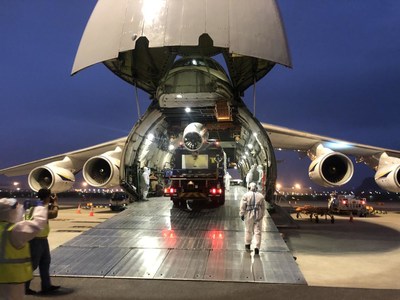
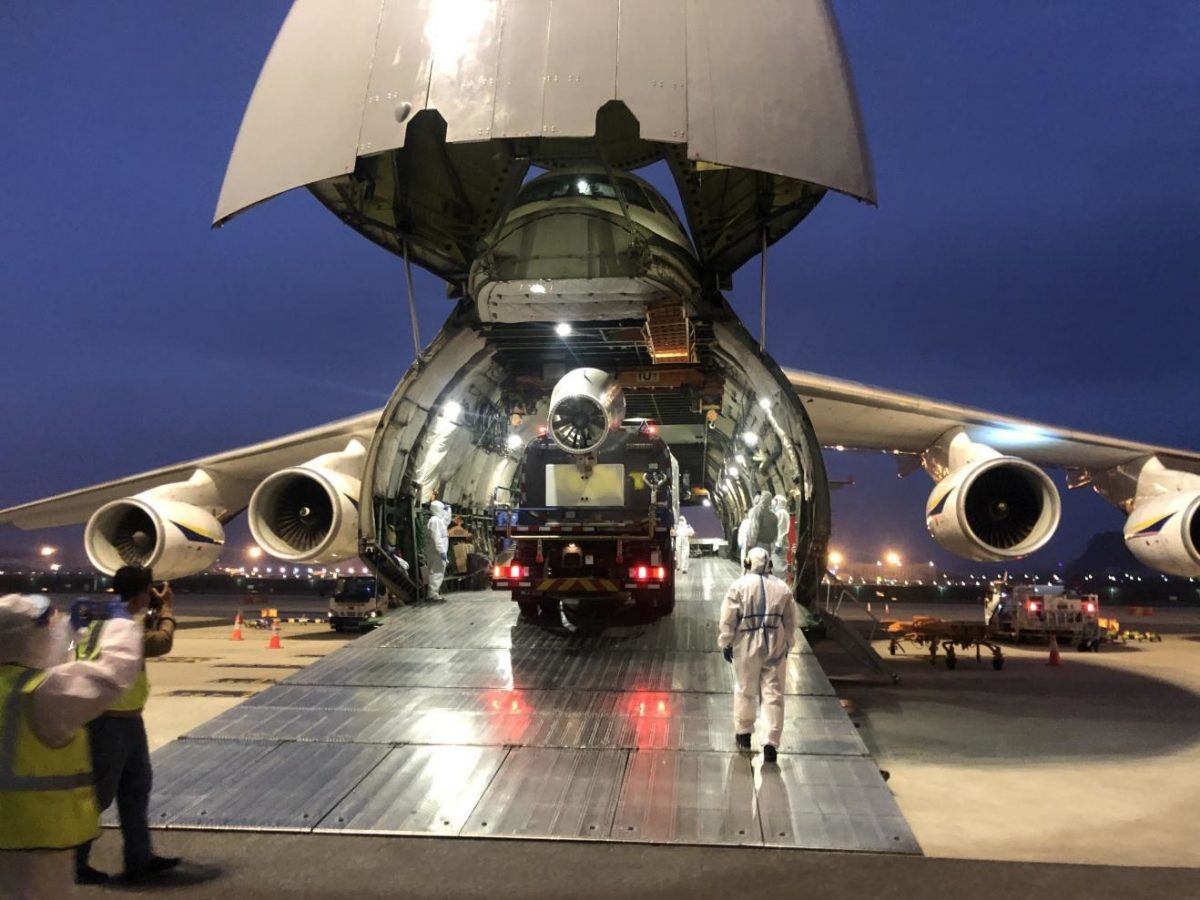
XUZHOU, China, April 10, 2020 /PRNewswire/ — XCMG (SHE:000425) has delivered an order of multi-functional dust suppression vehicles to the Middle East on March 30, marking a new milestone as the company’s first bulk export of the product. The deal was completed on XCMG’s 

XUZHOU, China, April 10, 2020 /PRNewswire/ — XCMG (SHE:000425) has delivered an order of multi-functional dust suppression vehicles to the Middle East on March 30, marking a new milestone as the company’s first bulk export of the product. The deal was completed on XCMG’s Machmall.com platform and is also the first time Chinese special epidemic prevention equipment was exported through an international e-commerce platform.

XCMG Exports Special Epidemic Prevention Equipment to the Middle East, Assisting Global Partners in Fighting COVID-19.

As the world continues to fight COVID-19, special epidemic prevention equipment is now in high demand. To promote the products, XCMG has created a special section on Machmall.com, which was launched in 2018 as a global one-stop marketing and sales platform for construction machinery and spare parts.

A company in Middle East was in urgent need to purchase dust suppression vehicles amid the COVID-19 outbreak and reached out to XCMG on Machmall.com, it eventually chose XCMG products for their excellent functionality, after-sales services, delivery time and price.

«The global economy is faced by unprecedented pressure and challenges, added to this; we are now fighting COVID-19. XCMG hopes to offer support to global partners, bearing the responsibility of ‘making the world a better place, and has designed these vehicles to improve disinfection efficiency, » said Wang Min, Chairman of XCMG.

Meanwhile, XCMG has shipped four million masks and 700,000 surgical gowns purchased by Vale in Brazil on April 4. Working around the clock, XCMG led teams to procure medical supplies and help partners solve raw material, production and logistics issues; XCMG completed the task in two weeks.

Wang Min commented that when the epidemic situation escalated in China, XCMG purchased and donated more than RMB 5 million in supplies, with emergency assistance from global partners. XCMG is committed to integrating global resources to help more countries fight against the pandemic.

At present, XCMG has provided assistance and medical supplies to over 40 countries. On April 4, XCMG also donated more than 100,00 masks and epidemic prevention supplies to 10 countries including the Philippines, UAE and Nigeria.

About XCMG

XCMG is a multinational heavy machinery manufacturing company with a history of 77 years. It currently ranks sixth in the world’s construction machinery industry. The company exports to more than 183 countries and regions around the world.

For more information, please visit: www.xcmg.com, or XCMG pages on FacebookTwitterYouTubeLinkedIn and Instagram.

Photo – https://mma.prnewswire.com/media/1153841/XCMG.jpg


Kia Soul EV and Telluride win 2020 World Car Awards

  • Kia Telluride SUV crowned World Car of the Year
  • Kia Soul EV electric crossover named World Urban Car

SEOUL, South Korea, April 9, 2020 /PRNewswire/ — Kia Motors Corporation has won big at the 2020 World Car Awards with the Telluride named ‘World Car of the Year’ and the Soul EV ‘World Urban Car’.

<img id="prnejpg3d3cleft" title="Kia Telluride named 2020 World Car of…

  • Kia Telluride SUV crowned World Car of the Year
  • Kia Soul EV electric crossover named World Urban Car

SEOUL, South Korea, April 9, 2020 /PRNewswire/ — Kia Motors Corporation has won big at the 2020 World Car Awards with the Telluride named ‘World Car of the Year’ and the Soul EV ‘World Urban Car’.

Kia Telluride named 2020 World Car of the Year

The Kia Telluride was rewarded by the judging panel for its distinctive design and impressive practicality. The World Car of the Year title represents another accolade for a vehicle that has garnered more than 70 awards since its introduction in 2019. The SUV has already been crowned North American Utility Vehicle of the Year and MotorTrend SUV of the Year, among others.

The fully-electric Soul EV was named the ideal car for the city by the jury, combining zero-emission performance and impressive electric range with a compact body, bold design, and high levels of practicality.

«Everyone at Kia is truly honored to receive not just one, but two awards from the World Car of the Year judging panel,» said Thomas Schemera, Executive Vice President and Head of Product Division at Kia Motors Corporation. «This is one of the hardest-fought competitions in the global automotive industry, proving that the Telluride and Soul EV are both truly outstanding vehicles. These accolades are testament to the talents and efforts of a worldwide team, who all strive to create desirable, high-quality and practical cars that drivers love.»

Available across North America and in many of Kia’s global markets, the Kia Telluride merges a strong exterior design presence with a spacious, practical and high-quality cabin which can seat up to eight passengers. Equipped with an array of advanced technologies, all-wheel drive, and driver-assistance systems, the Telluride is ideal for family adventures on and off the beaten track.

The compact Kia Soul EV features a powerful battery-electric powertrain with a choice of 64 or 39.2 kWh battery packs. Able to travel up to 452 kilometers on a single charge the Soul EV offers drivers greater all-electric range than many more expensive electric vehicles both in the urban environment and beyond city limits. A series of advanced range-increasing technologies, including regenerative braking, ensures drivers can maximize the distance on a single charge.

For more detailed information on 2020 World Car Awards, please visit Kia’s media website: www.kianewscenter.com

Photo – https://mma.prnewswire.com/media/1143327/Telluride.jpg

Servo Drive Market’s Annual Installation to Hit 26 Million Units by 2025, Says Global Market Insights, Inc.

SELBYVILLE, Delaware, April 8, 2020 /PRNewswire/ — Global Servo Drive Market is set to exceed an annual installation of 26 million units by 2025, as reported in the latest study by Global Market Insights, Inc. Rising need for adoption of energy efficient codes & standards along with increasing industrialization…

SELBYVILLE, Delaware, April 8, 2020 /PRNewswire/ — Global Servo Drive Market is set to exceed an annual installation of 26 million units by 2025, as reported in the latest study by Global Market Insights, Inc. Rising need for adoption of energy efficient codes & standards along with increasing industrialization will fuel the global industry demand.

GMI

Massively driven by the mounting adoption of energy efficient standards in tandem with ongoing developments in automation, the global servo drive industry trends are poised to display a marked ascent during 2019-2025. Apparently, the increasing penetration of automation across myriad industry spheres encompassing oil and gas, metal cutting, and other sectors would bolster the large-scale deployment of servo amplifiers leading to the expansion of the servo drive market size.

Request for a sample of this research report @ https://www.gminsights.com/request-sample/detail/4204

In addition to the transforming automation trends, the rapid industrialization across emerging economies globally, paired with the increasing investments in infrastructural developments is anticipated to render positive outlook on the business statistics during the forecast period. Also, the continuing technological advancements and implementation of monetary support programs by state governments is supplementing the market growth.

Low voltage-based servo drive market is set to achieve significant 6% CAGR between 2019 and 2025, on account of adoption of stringent energy efficiency mandates coupled with the ongoing technological innovations across the small & medium enterprises. In addition, growing adoption of low-voltage units due to their small footprint across multiple small-scale utilities and industry verticals will further augment the industry landscape.

Browse key industry insights spread across 480 pages with 798 market data tables & 29 figures & charts from the report, «Servo Drive Market Statistics by Application, Category, Drive, Voltage, Industry Analysis Report, Regional Analysis, Application Potential, Price Trend, Competitive Market Share & Forecast, 2019–2025» in detail along with the table of contents:

https://www.gminsights.com/industry-analysis/servo-drive-market

Elaborating on the geographical terms, the Asia Pacific servo drive market is expected to register over 5% CAGR through 2025. This regional growth is ascribed to profound factors including the expansion of electronics market across the region chiefly led by China, India, and Indonesia, and growing initiatives devised to boost the robotics and automation sector.

Germany servo drive market revenue is set to achieve lucrative CAGR through 2025. This can be accounted to the escalating demands for precise control of equipment motion combined with the altering trends towards the adoption of technologically sound equipment that possess the ability to increase the operational feasibility.

Major market players operating across the global industry comprise of Schneider Electric, Rockwell Automation, Siemens, Toshiba Corporation, Honeywell International, Emerson Electric, Bosch Rexroth, Yaskawa Electric Corporation, Estun Automation and Fuji Electric.

Make an inquiry for purchasing this report @ https://www.gminsights.com/inquiry-before-buying/4204

Browse Related Reports:

Low Voltage Drives Market Analysis By Technology (Standard, Regenerative), System (Open Loop, Closed Loop), Power Range (Micro, Low), Capacity (<2.2 kW, 2.2-7.4 kW, 7.5-22 kW, 23-75 kW, 76-110 kW, 111-500 kW, >500 kW), Drive (AC { By Efficiency [IE1, IE2, IE3, IE4,]}, DC, Servo), By Application (Pump, Fan, Conveyor, Compressor, Extruder), End-Use (Oil & Gas, Power Generation, Food Processing, Automotive, Mining & Metals, Pulp & Paper, Textile, Marine) Industry Analysis Report, Regional Outlook, Application Potential, Competitive Market Share & Forecast, 2019 – 2025

https://www.gminsights.com/industry-analysis/low-voltage-drives-market

About Global Market Insights

Global Market Insights, Inc., headquartered in Delaware, U.S., is a global market research and consulting service provider, offering syndicated and custom research reports along with growth consulting services. Our business intelligence and industry research reports offer clients with penetrative insights and actionable market data specially designed and presented to aid strategic decision making. These exhaustive reports are designed via a proprietary research methodology and are available for key industries such as chemicals, advanced materials, technology, renewable energy and biotechnology.

Contact Us:

Arun Hegde
Corporate Sales, USA
Global Market Insights, Inc.
Phone: +1-302-846-7766
Toll Free: 1-888-689-0688
Email: sales@gminsights.com  


IDTechEx Reports on Autonomous Trucks: Addressing the Industry’s Structural Challenges

BOSTON, April 8, 2020 /PRNewswire/ — The automotive industry is experiencing a difficult time due to the Coronavirus, with severe shocks both to the supply and demand. Nonetheless, the industry will need to retain its focus on key transformation trends such as autonomy.

<img id="prnejpg70b9left" title="IDTechEx Reports on Autonomous Trucks: Addressing the Industry’s Structural Challenges. Source: IDTechEx Research…

BOSTON, April 8, 2020 /PRNewswire/ — The automotive industry is experiencing a difficult time due to the Coronavirus, with severe shocks both to the supply and demand. Nonetheless, the industry will need to retain its focus on key transformation trends such as autonomy.

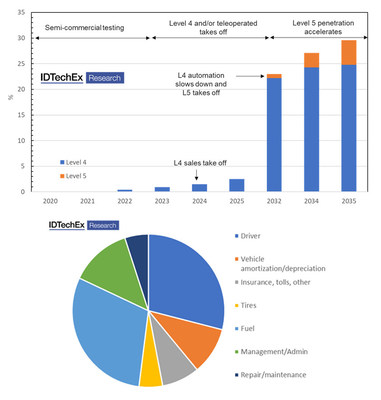
IDTechEx Reports on Autonomous Trucks: Addressing the Industry’s Structural Challenges. Source: IDTechEx Research (www.IDTechEx.com/EV)

Making a business case out of autonomous however, is not always straightforward. Some OEMs and Tier Ones are already suggesting that there is no business case for level 3 autonomy. This is because the technological complexity and costs jump as we transition from 2 to 3, whilst the value-add increases only incrementally. As such, there is now a serious discussion to focus instead on level 2.5, but design the system and development path such that it can be level-4 ready. See the IDTechEx report «Autonomous Cars and Robotaxis 2020-2040: Players, Technologies and Market Forecast«, for more detail on diffusion of different levels of autonomy in cars and robotaxis.

In parallel, companies are now finally realising that the autonomous mobility world does not begin and end with cars, and that there are numerous nearer term and simpler opportunities existing which often demonstrate a clearer business justification. Since the technology development platform can have significant common parts across all the sectors, it makes little sense to pursue siloed developments focusing only on cars.

One such significant opportunity is in autonomous trucking. In this article, analysts from IDTechEx discuss various aspects of autonomous trucking, outlining the latest trends and developments, discussing the remaining challenges and development opportunity, and offering a long-term market perspective and forecast. To learn more about this field, please see the IDTechEx report «Mobile Robots, Autonomous Vehicles, and Drones in Logistics, Warehousing, and Delivery 2020-2040«. This report offers a detailed analysis of technology, markets, and players active in using autonomous mobility across the entire logistic and delivery value chain. This includes autonomous robots in factories and fulfilment centres, autonomous industrial vehicles such as forklifts, autonomous trucks and vans, and last mile delivery pods, robots, and drones.

Structural pain points

The trucking industry is suffering from multiple pain points, one of which is the shortage of long-haul drivers. The American Trucking Association estimates that the US industry alone currently suffers a shortage of 60k drivers. This is forecast, based on current trends, to rise to 160k drivers by 2028. Clearly, this acts as a limiting factor constraining growth.

The addressable market is also significant. In the US, it is estimated that 1.9M people are employed as heavy and tractor-trailer truck drivers. The average salaries are around 41.3k$/yr. As such, the amount spent on driver wages each year in the US alone is $78Bn. In time, this colossal sum can be transferred from wages to technology and service costs offered by autonomous truck developers.

Unlike the case in private autonomous cars, there exists a clear commercial incentive. The pie chart below shows a typical split of the operating cost of a truck. Clearly, drivers represent a substantial proportion, i.e., 30%. Furthermore, there are early hints that autonomous driving can optimise fuel consumption, e.g., 7-10%, and also reduce tire damage.

Finally, there is the question of safety and asset utilization. Currently, driving hours are constrained by regulation in order to boost safety, which is a major challenge. According to statistics from G7, the largest commercial vehicle management platform in China, there is a major vehicle accident in every 25 logistic vehicles per year. This limits asset uptime. It is hoped that autonomous driving can increase safety and asset uptime.

Autonomous mobility has thus the potential to address many clear pain points. So the question is, what is the technology and commercial status, and what does the future market deployment look like? These questions will be answered in the rest of this article, to learn details please visit «Mobile Robots, Autonomous Vehicles, and Drones in Logistics, Warehousing, and Delivery 2020-2040«.

Starting from highways

Trucks are already equipped with higher levels of ADAS function. For example, Daimler is now offering cruise control on 100% of its trucks. When it comes to higher levels of autonomy, two different routes are being taken.

Multiple firms are developing technology to first autonomize highway driving. The argument here is that highways are simpler environments in relative terms compared to chaotic urban driving. The roads can often be long and straight, especially in large parts of the US. This relaxes the challenge in autonomous driving. On the other hand, the speeds are high, and the braking distances are long, e.g. 100m. As such, the perception technology will need to see much further ahead than might be the case with cars. This places additional requirements on the sensor suite technology (radar, lidar, camera, etc), as well as the software. This requirement will likely lead to different technology choices compared to cars. Furthermore, the vibration levels on ICE trucks, likely used in long-haul, are more severe, placing further challenges on long-term component reliability, especially if mechanical non-solid-state solutions are deployed.

In addition, there is a challenge of what to do when the truck is about to enter the more chaotic urban environment. Various solutions have been proposed, including humans taking over at change-over centres located near the city edges. The argument here is that fewer drivers will be needed given the shorter trip times in the final miles and that more drivers are likely to be available since it is not long-haul. As such, this arrangement will still reduce the payroll burden and help alleviate the driver shortage challenge. Teleoperation will likely also play a role at this stage.

The business model choice is also interesting. Some are developing the technology, hoping to sell it as an autonomous vehicle. Others are proposing to offer the fleets in a transport-as-service model, charging perhaps 40-50 cents per Km driven. The latter will likely result in a lower barrier to purchase, as well as faster time-to-market and generated income. It will also offer the chance to gather data, iterate, and improve the design especially the software. It will, however, require sufficient funding to absorb and maintain the cost and risk of autonomous trucks on the provider’ books, which can be a challenge for start-ups grabbling with high development costs. The former model will resemble the classic car-sell model. However, it will represent a larger barrier to purchase, as many truck fleet operators have geared their finances to service their operating costs and will not easily be able to muster up enough capex to pay for the currently much higher cost of autonomous trucks. The solution will likely reside in innovative financing offered by major manufacturers.

Starting closer to home

The other approach is to start in very constrained environments. For example, TuSimple has suggested that in China it is focused on low-speed autonomous solutions for port logistics. Einride is also focused on low-speed transport between a warehouse and terminal. The roadmap is to go from fenced to nearby environments (already done) before graduating the technology to rural, then highway, and then final urban.

The idea here is that low-speed operation in a controlled environment lowers the technological complexity, thus cutting down the deployment challenges and time. It will provide, nonetheless, a chance to deploy a fleet, which in turn allows the business model to be refined, the value proposition to be demonstrated in collaboration with a customer and in a real scenario, and the software stack iterated and upgraded to achieve better results.

These conditions have allowed the design of truly driverless trucks from the bottom-up. As such, the autonomy level is high. Currently, there are teleoperators remotely monitoring and controlling the driverless trucks. The key to making commercial sense is that the fleet size to teleoperator ratio be made as large as possible, e.g. >>10. This requires technological innovation, especially better autonomy and safety at the vehicle level, which would translate into lower required intervention numbers by the teleoperators.

The decision to start from low-speed constrained environments allows limited trip distances. This, in turn, will enable the deployment of fully electric trucks. They are easier to design and control as the system is electric. Given the lower part numbers and increasingly modular traction platforms, it aids designs of novel form factors. It will, however, require better route planning to best utilize the battery and to minimize charging downtimes. The trend towards electrification in light commercial vehicles, as well as heavy-duty trucks, is very significant. To learn more about this trend please see the IDTechEx Report «Electric Trucks 2020-2030«.

The short- and long-term outlooks

The chart below shows the current status and outlook. Today, the accumulated fleet size is still small. Essentially, the suppliers as well as the end users are jointly learning. There are multiple projects live across the world. Some companies have recently failed, e.g. Starsky as expected, but new ones, especially in Europe where there is a gap, are expected to form.

Overall, there is a market pull for autonomous driving. The realization is in this case largely technology limited. This cannot be said about every sector which autonomous mobility seeks to penetrate. In some cases, it is a technology looking for a problem.

IDTechEx assess that the market will remain in the learning phase until 2024. Within this time accumulated fleet sizes will certainly increase, but the character of the market will be one of early deployment and learning. Level 4 autonomy in certain highway conditions and teleoperated or telemonitored driverless low-speed trucks in constrained environments will take off likely beginning from 2024. True level 5 will take long. The research firm currently estimate that this will require longer than a decade realize. By that time, however, level 4 (or teleoperated driverless trucks) will also have made a significant impact, representing more than 20% of annual truck sales.

In the end, this is a colossal transition that simply cannot be ignored even in the current climate of cash flow challenges in the automotive industry. To learn more, please refer to the report «Electric Trucks 2020-2030» which provides an analysis of technologies, players, and markets. It includes detailed long-term (20-year) market forecasts assessing unit numbers by autonomy level and expected revenues. The cost models are segmented by components and software costs.

To find out more about electric vehicle research available from IDTechEx visit www.IDTechEx.com/research/EV or to connect with others on this topic, IDTechEx Events is hosting: Electric Vehicles – Everything is changing, November 18-19 2020, Santa Clara, USA www.IDTechEx.com/EVUSA.

IDTechEx guides your strategic business decisions through its Research, Consultancy and Event products, helping you profit from emerging technologies. For more information on IDTechEx Research and Consultancy, contact research@IDTechEx.com or visit www.IDTechEx.com.

Media Contact:

Jessica Abineri
Marketing Coordinator
press@IDTechEx.com
+44-(0)-1223-812300

IDTechEx logo

Logo: https://mma.prnewswire.com/media/478371/IDTechEx_Logo.jpg

Photo: https://mma.prnewswire.com/media/1143056/IDTechEx_Auto_Trucks.jpg
Greater Than Unveils Customized AI Based Solutions for Electric Vehicles and Hybrids

STOCKHOLM, April 8, 2020 /PRNewswire/ — The Swedish AI and insurtech company Greater Than today unveils its AI based platform and services for electric vehicles and hybrids and thereby broadens its offering for auto insurance, fleet, and OEMs.

With the customized solution that now includes all types of cars, auto insurers, fleets, and car manufacturers will reach immense flexibility with their policies and offerings. By being empowered with entirely new and detailed driving data from…

STOCKHOLM, April 8, 2020 /PRNewswire/ — The Swedish AI and insurtech company Greater Than today unveils its AI based platform and services for electric vehicles and hybrids and thereby broadens its offering for auto insurance, fleet, and OEMs.

With the customized solution that now includes all types of cars, auto insurers, fleets, and car manufacturers will reach immense flexibility with their policies and offerings. By being empowered with entirely new and detailed driving data from hybrid and electric vehicles in real-time, the opportunity is given to learn, and address tailored offerings for EV driving in a completely new way. Bundled in the customized solution, new tools and driving assessment functions tailored for Electric car and Hybrid manufacturers that give the driver increased control for enhancing the battery capacity.

«It is great timing and very exciting to be able to put this offer on the market right now. With an increased number of electric cars and hybrids on the streets, we are pleased to deliver a 100 percent risk analysis and full-service product for all our customers, regardless of the type of vehicle or fuel used. I am very proud to launch this world-unique product on the market right now.» – Says Liselott Johansson, CEO Greater Than

Greater Than’s AI algorithms have been practicing driving data from electric cars and hybrids around the world for an extended period. The result is that the company’s AI now delivers 99.98 % accuracy in its risk analysis of driving behavior even for drivers of EV and Hybrids – who do not have OBD readers connected in their cars. The accuracy of the risk assessment is at the same level as previously supported by onboarding diagnostics (OBD) readers in the vehicle.

Battery charging to last longer 

There is a direct relationship between driving behavior, energy consumption, and battery performance. Which naturally makes Enerfy Global a pioneering product for real-time battery capacity monitoring. When the service is connected, the driver gains instant insight into how the battery consumption gets affected by the current driving behavior. The feedback gives the driver increased control to adjust the driving behavior accordingly to how long they want the battery to last. Using instant feedback, it is now possible to maximize the capacity of the battery and get the most out of every charge. 

Enerfy Global, AI-based risk insight

The Enerfy Global AI technology, and algorithms has been practicing on real driving data since 2004. With its 99,98% accuracy to factual risk, Enerfy Global is today stated as one of the world’s most reliable AI technology to assess and price real-time driving patterns. To date, the AI has made more than 375,500 trillion qualified analyses and take over 400 million decisions daily. By the use of pattern discovery and

clustering algorithms, the data continually mines in real-time on the database of over its 650 million driving reference profiles. The algorithms in-depth details analysis is done down to a multiple of datasets

per second in real-time and taking into consideration the slightest change in driving behavior and instantly correlate it to both risk and carbon footprint. The artificial intelligence layer allows companies to use Greater Than’s AI to gain a new type of data insights, make more informed decisions, and create new business opportunities that exist in their market sectors. Enerfy Global consists of Enerfy Risk Portfolio Tracker and Enerfy Plug’n’Play products and is protected by seven patents in the US and the EU.

For media inquiries and/or more information, please contact:
Eva Voors, Head of PR and Communications 
+46-708-884880
eva.voors@greaterthan.eu
www.greaterthan.eu 
www.enerfy.se

This information was brought to you by Cision http://news.cision.com

https://news.cision.com/greater-than/r/greater-than-unveils-customized-ai-based-solutions-for-electric-vehicles-and-hybrids,c3084602

The following files are available for download:

Electric Vehicle Charger Market to Reach $25.5 Bn, Globally, by 2027 at 26.8% CAGR: Allied Market Research

Government regulations to curb down environmental pollution and increase in government initiatives for development of EV charging infrastructure drive the growth of the global electric vehicle charger market

PORTLAND, Oregon, April 8, 2020 /PRNewswire/ — Allied Market Research published a report, titled, «Electric Vehicle Charger Market by…

Government regulations to curb down environmental pollution and increase in government initiatives for development of EV charging infrastructure drive the growth of the global electric vehicle charger market

PORTLAND, Oregon, April 8, 2020 /PRNewswire/ — Allied Market Research published a report, titled, «Electric Vehicle Charger Market by Vehicle Type (Battery Electric Vehicle (BEV), Plug-in Hybrid Electric Vehicle (PHEV), and Hybrid Electric Vehicle (HEV)), Charging Type (On-board Chargers, and Off-board Chargers), and End User (Residential and Commercial): Global Opportunity Analysis and Industry Forecast, 2020-2027.» According to the report, the global electric vehicle charger industry was estimated at $3.8 billion in 2019, and is anticipated to hit $25.5 billion by 2027, registering a CAGR of 26.8% from 2020 to 2027.

Allied_Market_Research_Logo

Drivers, restraints, and opportunities-

Government regulations to limit environmental pollution, rise in market penetration of electric vehicles, and increase in government initiatives for development of electric vehicle charging infrastructure drive the growth of the global electric vehicle charger market. On the other hand, limited number of EV charging stations and inadequate standardization of EV charging impede the growth to some extent. However, upsurge in demand for luxury vehicles and rise in need for wireless charging of electric vehicles are expected to pave the way for multiple opportunities in the industry.

Request Sample Report at: https://www.alliedmarketresearch.com/request-sample/4084

The PHEV segment to dominate by 2027-

Based on vehicle type, the PHEV segment accounted for nearly half of the global electric vehicle charger market share in 2019, and is expected to lead the trail by the end of 2027. PHEVs emit less gases over conventional ICS vehicles as they have extra capability to run a certain distance without burning a single drop of fuel which, in turn, has boosted the segment growth. The BEV segment, on the other hand, would grow at the fastest CAGR of 29.0% throughout the forecast period. The fact that BEVs do not require gasoline at any point during operation, and they rely solely upon pure electric battery power drives the growth of the segment.

The on-board chargers segment to maintain the dominant share-

Based on charging type, the on-board chargers segment contributed to 95% of the global electric vehicle charger market revenue in 2019, and is anticipated to retain the lion’s share till 2027. Rise in demand for BEVs and PHEVs is expected to boost the demand for onboard chargers during the estimated period. At the same time, the off-board chargers segment would register the fastest CAGR of 29.1% throughout the study period. Off-board chargers convert AC to DC to provide fast charging to electric vehicles. And, surge in demand for luxury and supercars is projected to fuel the demand for DC fast chargers, thereby driving the growth of the segment.

Interested To Procure The Data of This Report? Enquire More Here at: https://www.alliedmarketresearch.com/purchase-enquiry/4084

Asia-Pacific, followed by Europe and North America, garnered the major share in 2019 –

Based on geography, Asia-Pacific, followed by Europe and North America, held the highest share in 2019, garnering nearly half of the global electric vehicle charger market. Growth in disposable income of the population is expected to increase the market presence of electric vehicle chargers in this province. Simultaneously, the LAMEA region would cite the fastest CAGR of 28.3% from 2020 to 2027. Deployment of strict government regulations to reduce the dependency on oil is expected to drive the market.

Key players in the industry-

  • POD Point
  • Robert Bosch GmbH
  • Siemens AG
  • Delphi Automotive
  • Chroma ATE
  • Silicon Laboratories
  • ABB Ltd.
  • Chargemaster PLC
  • Aerovironment Inc.
  • Schaffner Holdings AG

Schedule a Call with Our Analysts/Industry Experts: https://www.alliedmarketresearch.com/connect-to-analyst/4084

Avenue | The Market Research Library Access

Avenue, a user-based library of global market report database, provides comprehensive reports pertaining to the world’s largest emerging markets. It further offers e-access to all the available industry reports just in a jiffy. Avenue is a premium subscription-based model that serves as an informative solution on which the world-leading companies can rely on.

Avenue is a premium subscription-based model that serves as an informative solution on which the world-leading companies can rely on.

Sign up and start using your 14-day free trial: https://www.alliedmarketresearch.com/avenueTrial

Similar Reports:

Wireless Charging for Electric Vehicle Market

Electric Vehicle Range Extender Market

Electric Vehicle Charging System Market

Electric Vehicle Battery Market

Pre-book Offer 12% Discount:

Automotive Power Electronics Market

Smart Battery Charger Market

About us:

Allied Market Research (AMR) is a full-service market research and business-consulting wing of Allied Analytics LLP based in Portland, Oregon. Allied Market Research provides global enterprises as well as medium and small businesses with unmatched quality of «Market Research Reports» and «Business Intelligence Solutions.» AMR has a targeted view to provide business insights and consulting to assist its clients to make strategic business decisions and achieve sustainable growth in their respective market domain.

We are in professional corporate relations with various companies and this helps us in digging out market data that helps us generate accurate research data tables and confirms utmost accuracy in our market forecasting. Each and every data presented in the reports published by us is extracted through primary interviews with top officials from leading companies of domain concerned. Our secondary data procurement methodology includes deep online and offline research and discussion with knowledgeable professionals and analysts in the industry.

Contact us:
David Correa
5933 NE Win Sivers Drive
#205, Portland, OR 97220
United States
Toll Free (USA/Canada): 1-800-792-5285, 1-503-894-6022, 1-503-446-1141
UK: +44-845-528-1300
Hong Kong: +852-301-84916
India (Pune): +91-20-66346060
Fax: +1-855-550-5975
help@alliedmarketresearch.com

Web: https://www.alliedmarketresearch.com

Follow us on: https://www.linkedin.com/company/allied-market-research

Allied Market Research Blog: blog.alliedmarketresearch.com 

Logo: https://mma.prnewswire.com/media/636519/Allied_Market_Research_Logo.jpg

Visiongain Publishes Automotive Software Market 2020-2030 Report

LONDON, April 8, 2020 /PRNewswire/ — Market Forecasts by Vehicle Type (Passenger Cars, Light Commercial Vehicles and Heavy Commercial Vehicles), by Electric Vehicle (Battery Electric Vehicle (BEV), Hybrid Electric Vehicle (HEV), Plug-In Hybrid Electric Vehicle (PHEV) and Fuel Cell Electric Vehicle (FCEV)), Distribution Channel (OEMs and Aftermarket), Application (ADAS & Safety Systems, Body Control & Comfort Systems, Powertrain Systems, Infotainment Systems, Communication Systems,…

LONDON, April 8, 2020 /PRNewswire/ — Market Forecasts by Vehicle Type (Passenger Cars, Light Commercial Vehicles and Heavy Commercial Vehicles), by Electric Vehicle (Battery Electric Vehicle (BEV), Hybrid Electric Vehicle (HEV), Plug-In Hybrid Electric Vehicle (PHEV) and Fuel Cell Electric Vehicle (FCEV)), Distribution Channel (OEMs and Aftermarket), Application (ADAS & Safety Systems, Body Control & Comfort Systems, Powertrain Systems, Infotainment Systems, Communication Systems, Telematics Systems and Others) with Regional and National Market Analysis and Financial Analysis of Leading Companies

Visiongain Logo

The global automotive software market is expected to grow by exponential growth rate of 15.3% over the forecast period from 2020 to 2030. The market was valued at $19.3 billion in 2019 and has the potential to reach $92.4 billion by the end of forecast period 2030. Increasing investment by OEMs and other bodies in R&D activities as a result of altering public standards for car security and safety, increasing number of connected cars, rapid technological and innovation changes, and adoption electric vehicles are expected to drive the automotive software industry.

Asia Pacific region is expected to be the largest market for automotive software due to presence of major developing countries including China, India, and South Korea, leadership in vehicle production and consumption, and adoption of technological advancement by OEMs. The growth of middle-class population and standard of living in the region, particularly in China and India, is driving the sales of vehicles which further supported to the overall market demand.

Leading companies featured in the Automotive Software Market Report 2020-2030 report include Airbiquity, Blackberry, Elektrobit, Google, GREEN HILLS SOFTWARE, Microsoft Corporation, NVIDIA, RENESAS ELECTRONICS, Robert Bosch, WIND RIVER SYSTEM among others. Mergers & acquisitions and joint ventures constitute some of the industry players’ common strategies for reducing product price overall and maintaining extremely competitive conditions. In order to guarantee continued raw material supplies and ease of installation services, many actors in the sector create alliances with raw material providers and third-party installers.

Download samples here:

https://www.visiongain.com/report/automotive-software-market-report-2020-2030/#download_sampe_div

The comprehensive report provides market estimates and forecasts for leading domestic markets across the world for the period from 2020 to 2030. In addition, the report includes dedicated leading companies covering 10 leading software providers.

The report on the Automotive Software Market Report 2020-2030 will appreciate anyone who wants to better understand the market in various end use industries. It will be useful for companies that want to better understand the part of the market in which they are already involved or those that want to enter or expand into another regional or technical part of the Automotive Software industry.

Visiongain’s timely report reveals how best to compete in this profitable market space and maximize your company’s potential.

To find out more about this report please contact Sara Peerun at sara.peerun@visiongain.com or refer to our website: https://www.visiongain.com/report/automotive-software-market-report-2020-2030/

This report addresses the pertinent issues:
– Where are the most lucrative market prospects?
– Who are the leadings companies and what does the competitive landscape look like?
– What are the regional, technical and regulatory barriers to market entry?
– What are the technological issues and roadmap driving the market?
– Why is the market prospering and how can you fully exploit this?
– When will the market fully mature and why?

Research and Analysis Highlights

335 Tables, Charts and Graphs Illustrating the Global Automotive Software Market Prospects

Market Segmentation 2020-2030:

The global automotive software market is segmented on the basis of vehicle type, electric vehicles, distribution channel, application, and geography.

Automotive Software Submarket Forecasts by Vehicle Type Covering the Period 2020-2030 ($B)
– Passenger Cars Market Forecast 2020-2030 ($B)
– Light Commercial Vehicles Market Forecast 2020-2030 ($B)
– Heavy Commercial Vehicles Market Forecast 2020-2030 ($B)

Automotive Software Submarket Forecasts by Electric Vehicles from 2020-2030 ($B)
– Battery Electric Vehicle (BEV) Market Forecast 2020-2030 ($B)
– Hybrid Electric Vehicle (HEV) Market Forecast 2020-2030 ($B)
– Plug-In Hybrid Electric Vehicle (PHEV) Market Forecast 2020-2030 ($B)
– Fuel Cell Electric Vehicle (FCEV) Market Forecast 2020-2030 ($B)

Automotive Software Submarket Forecasts by Distribution Channel from 2020-2030 ($B)
– OEMs Market Forecast 2020-2030 ($B)
– Aftermarket Market Forecast 2020-2030 ($B)

Automotive Software Submarket Forecasts by Application from 2020-2030 ($B)
– ADAS & Safety Systems Market Forecast 2020-2030 ($B)
– Body Control & Comfort Systems Market Forecast 2020-2030 ($B)
– Powertrain Systems Market Forecast 2020-2030 ($B)
– Infotainment Systems Market Forecast 2020-2030 ($B)
– Communication Systems Market Forecast 2020-2030 ($B)
– Telematics Systems Market Forecast 2020-2030 ($B)
– Other Application Market Forecast 2020-2030 ($B)

Regional Automotive Software Market Forecasts 2020-2030

North America Automotive Software Forecast 2020-2030 ($B)
– US Market Forecast 2020-2030 ($B)
– Canada Market Forecast 2020-2030 ($B)
– Mexico Market Forecast 2020-2030 ($B)

South America Automotive Software Forecast 2020-2030 ($B)
– Brazil Market Forecast 2020-2030 ($B)
– Argentina Market Forecast 2020-2030 ($B)
– Colombia Market Forecast 2020-2030 ($B)
– Rest of South America Market Forecast 2020-2030 ($B)

Europe Automotive Software Forecast 2020-2030 ($B)
– Germany Market Forecast 2020-2030 ($B)
– France Market Forecast 2020-2030 ($B)
– UK Market Forecast 2020-2030 ($B)
– Czech Republic Market Forecast 2020-2030 ($B)
– Spain Market Forecast 2020-2030 ($B)
– Turkey Market Forecast 2020-2030 ($B)
– Russia Market Forecast 2020-2030 ($B)
– Slovakia Market Forecast 2020-2030 ($B)
– Italy Market Forecast 2020-2030 ($B)
– Poland Market Forecast 2020-2030 ($B)
– Rest of Europe Market Forecast 2020-2030 ($B)

Asia Pacific Automotive Software Forecast 2020-2030 ($B)
– China Market Forecast 2020-2030 ($B)
– Japan Market Forecast 2020-2030 ($B)
– India Market Forecast 2020-2030 ($B)
– South Korea Market Forecast 2020-2030 ($B)
– Thailand Market Forecast 2020-2030 ($B)
– Malaysia Market Forecast 2020-2030 ($B)
– Indonesia Market Forecast 2020-2030 ($B)
– Taiwan Market Forecast 2020-2030 ($B)
– Rest of Asia Pacific Market Forecast 2020-2030 ($B)

Rest of the World Automotive Software Forecast 2020-2030 ($B)
– Middle East Market Forecast 2020-2030 ($B)
– Africa Market Forecast 2020-2030 ($B)

Profiles of 10 Leading Companies, Involved in Automotive Software Market
– Airbiquity
– Blackberry
– Elektrobit
– Google
– GREEN HILLS SOFTWARE
– Microsoft Corporation
– NVIDIA
– RENESAS ELECTRONICS
Robert Bosch
– Wind River System

SWOT And Porter’s Five Forces Analysis

Did you know that we also offer a report add-on service? Email sara.peerun@visiongain.com to discuss any customized research needs you may have.

Companies covered in the report include:

Adobe Systems Software Ireland Ltd.
Aimotive
Airbiquity
Apple
Atego
Autonet Mobile
Blackberry
Elektrobit
Google
Green Hills Software
Kpit Technologies
Luxoft
Microsoft Corporation
MontaVista Software, LLC
NVIDIA
Renesas Electronics
Rightware
Robert Bosch
Saferide Technologies Ltd
Sigma Software Group
Vector Informatik
Wind River System

To discuss this report please e-mail Sara Peerun on sara.peerun@visiongain.com

Logo: http://mma.prnewswire.com/media/523989/Visiongain_Logo.jpg

Negative Impact of Covid-19 on Opus

STOCKHOLM, April 8, 2020 /PRNewswire/ — The Covid-19 outbreak is affecting Opus operations, and there is a considerable risk of a material impact on the Group’s financials. Opus is taking steps to minimize the impact on the Group.

In recent days, a number of government authorities around the world have introduced measures resulting in a material reduction of inspection volumes, including the temporary suspension of vehicle inspection programs. Opus has introduced cost reduction measures to…

STOCKHOLM, April 8, 2020 /PRNewswire/ — The Covid-19 outbreak is affecting Opus operations, and there is a considerable risk of a material impact on the Group’s financials. Opus is taking steps to minimize the impact on the Group.

In recent days, a number of government authorities around the world have introduced measures resulting in a material reduction of inspection volumes, including the temporary suspension of vehicle inspection programs. Opus has introduced cost reduction measures to partially mitigate such volume reduction. Overall, management believes there is a considerable risk that this will have a material negative effect on Opus financials, while due to uncertainties not possible to adequately assess.

This is information that Opus Group AB (publ) is obliged to make public pursuant to the EU Market Abuse Regulation. The information was submitted for publication, through the agency of the contact persons set out herein, at 07:30 CEST on April 8, 2020. 

For additional information, please contact:
Lothar Geilen, CEO
Tel: +46-31-748-34-00
E-mail: lothar.geilen@opus.se

Linus Brandt
CFO & Executive Vice President
Phone: +46-722-44-09-05 
E-mail: linus.brandt@opus.se  

This information was brought to you by Cision http://news.cision.com

https://news.cision.com/opus-group/r/negative-impact-of-covid-19-on-opus,c3083338

The following files are available for download:


Visiongain Publishes Automotive Simulation Market 2020-2030 Report

Market and Volume Forecasts by End User (OEMs, Automotive Component Manufacturers and Regulatory Bodies), by Deployment (On-Premises and Cloud), Component (Software and Services), Application (Prototyping and Testing) with Regional and National Market Analysis and Financial Analysis of Leading Companies

LONDON, April 7, 2020 /PRNewswire/ —

The global automotive simulation market is…

Market and Volume Forecasts by End User (OEMs, Automotive Component Manufacturers and Regulatory Bodies), by Deployment (On-Premises and Cloud), Component (Software and Services), Application (Prototyping and Testing) with Regional and National Market Analysis and Financial Analysis of Leading Companies

LONDON, April 7, 2020 /PRNewswire/ —

The global automotive simulation market is expected to grow by exponential growth rate of 9.6% over the forecast period from 2020 to 2030. The market was valued at $1.6 billion in 2019 and has the potential to reach $4.4 billion by the end of forecast period 2030. Increasing investment by OEMs and other bodies in R&D as a result of altering public standards for car security, rapid technological and innovation changes, and adoption of AI technologies (machine learning and deep learning technologies) are expected to drive the automotive simulation industry.

Visiongain Logo

Some of the main variables driving market growth are increasing demand for environmentally friendly simulation program generators that tend to provide macro-level data; designing simulators to regulate traffic, weather, wildlife, pedestrians, and other cars; and improving the evaluation and comprehension of assembly plant decision-making processes.

Asia Pacific region is expected to be the largest market for automotive simulation due to rising industrialization & infrastructural development, healthy growth of automotive sector, and presence of major OEMs. The growth of middle-class population and standard of living in the region, particularly in China and India, is driving the sales of vehicles which further supported to the overall market demand.

By application, testing segment is expected to register highest growth in forecast period. Due to the increasing use of the simulation software for testing models and validating the findings with the required outcomes, the testing implementation is expected to drive the market. The simulation software reduces OEMs efforts during on-road and laboratory testing, helping them to improve their products and techniques over time.

Download samples here:

https://www.visiongain.com/report/automotive-simulation-market-report-2020-2030/#download_sampe_div

Leading companies featured in the Automotive Simulation Market Report 2020-2030 report include Altair Engineering, Ansys, Autodesk, Dassault Systèmes, ESI, IPG Automotive, Mathworks, PTC, Siemens, SIMUL8 CORPORATION among others. Mergers & acquisitions and joint ventures constitute some of the industry players’ common strategies for reducing product price overall and maintaining extremely competitive conditions. In order to guarantee continued raw material supplies and ease of installation services, many actors in the sector create alliances with raw material providers and third-party installers.

The comprehensive report provides market estimates and forecasts for leading domestic markets across the world for the period from 2020 to 2030. In addition, the report includes dedicated leading companies covering 10 leading Simulation producers.

The report on the Automotive Simulation Market Report 2020-2030 will appreciate anyone who wants to better understand the market in various end use industries. It will be useful for companies that want to better understand the part of the market in which they are already involved or those that want to enter or expand into another regional or technical part of the Automotive Simulation industry.

Visiongain’s timely report reveals how best to compete in this profitable market space and maximize your company’s potential.

To find out more about this report please contact Sara Peerun at sara.peerun@visiongain.com or refer to our website: https://www.visiongain.com/report/automotive-simulation-market-report-2020-2030/

This report addresses the pertinent issues:
– Where are the most lucrative market prospects?
– Who are the leadings companies and what does the competitive landscape look like?
– What are the regional, technical and regulatory barriers to market entry?
– What are the technological issues and roadmap driving the market?
– Why is the market prospering and how can you fully exploit this?
– When will the market fully mature and why?

Research and Analysis Highlights

335 Tables, Charts and Graphs Illustrating the Global Automotive Simulation Market Prospects

Market Segmentation 2020-2030:

The global automotive Simulation market is segmented on the basis of End User, Deployments, Component, Application, and geography.

Automotive Simulation Submarket Forecasts by End User Covering the Period 2020-2030 ($M & Volume)
– OEMs Market Forecast 2020-2030 ($M & Volume)
– Automotive Component Manufacturers Market Forecast 2020-2030 ($M & Volume)
– Regulatory Bodies Market Forecast 2020-2030 ($M & Volume)

Automotive Simulation Submarket Forecasts by Deployments from 2020-2030 ($M & Volume)
– On-Premises Market Forecast 2020-2030 ($M & Volume)
– Cloud Market Forecast 2020-2030 ($M & Volume)

Automotive Simulation Submarket Forecasts by Component from 2020-2030 ($M & Volume)
– Software Market Forecast 2020-2030 ($M & Volume)
– Services Market Forecast 2020-2030 ($M & Volume)

Automotive Simulation Submarket Forecasts by Application from 2020-2030 ($M & Volume)
– Prototyping Market Forecast 2020-2030 ($M & Volume)
– Testing Market Forecast 2020-2030 ($M & Volume)

Regional Automotive Simulation Market Forecasts 2020-2030

North America Automotive Simulation Forecast 2020-2030 ($M & Volume)
– US Market Forecast 2020-2030 ($M & Volume)
– Canada Market Forecast 2020-2030 ($M & Volume)
– Mexico Market Forecast 2020-2030 ($M & Volume)

South America Automotive Simulation Forecast 2020-2030 ($M & Volume)
– Brazil Market Forecast 2020-2030 ($M & Volume)
– Argentina Market Forecast 2020-2030 ($M & Volume)
– Colombia Market Forecast 2020-2030 ($M & Volume)
– Rest of South America Market Forecast 2020-2030 ($M & Volume)

Europe Automotive Simulation Forecast 2020-2030 ($M & Volume)
– Germany Market Forecast 2020-2030 ($M & Volume)
– France Market Forecast 2020-2030 ($M & Volume)
– UK Market Forecast 2020-2030 ($M & Volume)
– Czech Republic Market Forecast 2020-2030 ($M & Volume)
– Spain Market Forecast 2020-2030 ($M & Volume)
– Turkey Market Forecast 2020-2030 ($M & Volume)
– Russia Market Forecast 2020-2030 ($M & Volume)
– Slovakia Market Forecast 2020-2030 ($M & Volume)
– Italy Market Forecast 2020-2030 ($M & Volume)
– Poland Market Forecast 2020-2030 ($M & Volume)
– Rest of Europe Market Forecast 2020-2030 ($M & Volume)

Asia Pacific Automotive Simulation Forecast 2020-2030 ($M & Volume)
– China Market Forecast 2020-2030 ($M & Volume)
– Japan Market Forecast 2020-2030 ($M & Volume)
– India Market Forecast 2020-2030 ($M & Volume)
– South Korea Market Forecast 2020-2030 ($M & Volume)
– Thailand Market Forecast 2020-2030 ($M & Volume)
– Malaysia Market Forecast 2020-2030 ($M & Volume)
– Indonesia Market Forecast 2020-2030 ($M & Volume)
– Taiwan Market Forecast 2020-2030 ($M & Volume)
– Rest of Asia Pacific Market Forecast 2020-2030 ($M & Volume)

Rest of the World Automotive Simulation Forecast 2020-2030 ($M & Volume)
– Middle East Market Forecast 2020-2030 ($M & Volume)
– Africa Market Forecast 2020-2030 ($M & Volume)

Profiles of 10 Leading Companies, Involved in Automotive Simulation Market
– Altair Engineering
– Ansys
– Autodesk
– Dassault Systèmes
– ESI
– IPG Automotive
– Mathworks
– PTC
– Siemens
– Simul8 Corporation

SWOT And Porter’s Five Forces Analysis

Did you know that we also offer a report add-on service? Email sara.peerun@visiongain.com to discuss any customized research needs you may have.

Companies covered in the report include:

Altair Engineering
Ansys
Anylogic
Aras
Autodesk
AVL
Comsol
Dassault Systèmes
Design Simulation Technologies
Dspace GmbH
ESI
IPG Automotive
Mathworks
Opal-Rt
PTC
Siemens
Simscale
Simul8 Corporation
Synopsys
TESIS GmbH

To discuss this report please e-mail Sara Peerun on sara.peerun@visiongain.com

Logo: http://mma.prnewswire.com/media/523989/Visiongain_Logo.jpg

Head Up Display (HUD) Market Analysis – New Opportunities Explored, Expansion at 25.9% CAGR Anticipated by 2025 | Million Insights

FELTON, California, April 7, 2020 /PRNewswire/ — Global Head Up Display (HUD) Market is expected to reach USD 13.5 billion by 2025. A Head Up Display (HUD) is a digital miniaturized or transparent display technology that does not need operators to change their focus…

FELTON, California, April 7, 2020 /PRNewswire/ — Global Head Up Display (HUD) Market is expected to reach USD 13.5 billion by 2025. A Head Up Display (HUD) is a digital miniaturized or transparent display technology that does not need operators to change their focus from their normal viewpoints. It shows data in a person’s line of sight. Though they were originally developed for military aviation, HUDs are now used in automobiles, commercial aircraft, and others. The Head Up Display Market is estimated to grow at a significant CAGR of 25.9% over the forecast period as the scope and its applications are rising enormously across the globe.

Growing awareness regarding vehicle and passenger safety, rising demand for technologically enhanced HUDs and connected vehicles, and suitability offered by grouping of satellite navigation technology and HUD system are documented as major factors of Insurance Analytics Market that are estimated to enhance the growth in the years to come. However, the technology is still at its initial stages and requires high investment on R&D activity and it is not popular among ordinary customers are the factors that may restrain overall market growth in the coming years.

Get Sample PDF and read more details about the «Head Up Display Market« Report 2025.

Head Up Display (HUD) Market is segmented based on type, component, application, and region.AR-Based HUD and Conventional HUD are the types that could explored in Head Up Display (HUD) in the forecast period. Software, Video Generators, Display Units, Projectors/Projection Units, and other components could be explored in Head Up Display (HUD) in the forecast period. The market may be categorized based on applications like automotive, aviation, and others that could be explored in the forecast period.

Globally, North America accounted for the substantial market share of Head Up Display (HUD) in terms of revenue and is estimated to lead the overall market in the coming years. The reason behind the overall market growth could be growing awareness regarding safety systems in aircraft and automobile manufacturing business, high disposable income, and huge customer base. The United States is a major consumer of Head Up Display (HUD) in the region.

Instead, Europe and the Asia Pacific are also estimated to have a positive influence on the future growth. Europe is the second largest region with significant market share. However, Asia Pacific is estimated to grow at fastest pace with the highest CAGR in the foremost period. The developing countries like India and China are the major consumers of Head Up Display (HUD) in this region.

The key players of Head Up Display Market are Panasonic, Nippon Seiki, Garmin, Continental, Thales, DENSO, MicroVision, BAE Systems, Pioneer Corporation, and Visteon. These players are concentrating on inorganic growth to sustain themselves amongst fierce competition. As companies all over the world have to believe that alliance with a market would permit them proportional market existence and authority to declare the leadership position.

Browse 101 page research report with TOC on «Global Head Up Display (HUD) Market» at: https://www.millioninsights.com/industry-reports/head-up-display-hud-market

Market Segment:

  • Head Up Display Application Outlook (Revenue, USD Million; 2014 – 2025)
    • Automotive
      • Premium/Luxury Cars
      • Sports Cars
      • Basic & Mid-segment Cars
    • Aviation
    • Wearables
    • Other
  • Head Up Display Regional Outlook (Revenue, USD Million; 2014 – 2025)
    • North America
      • U.S.
      • Canada
      • Mexico
    • Europe
      • Germany
      • UK
    • Asia Pacific
      • China
      • Japan
      • India
    • South America
      • Brazil
    • The Middle East & Africa

Browse reports of similar category available with Million Insights:

About Million Insights:

Million Insights, is a distributor of market research reports, published by premium publishers only. We have a comprehensive market place, that will enable you to compare data points, before you make a purchase. Enabling informed buying, is our motto and we strive hard to ensure that our clients get to browse through multiple samples, prior to an investment. Service flexibility & the fastest response time are two pillars, on which our business model is founded. Our market research report store, includes in-depth reports, from across various industry verticals, such as healthcare, technology, chemicals, food & beverages, consumer goods, material science & automotive.

Contact:
Ryan Manuel
Research Support Specialist, USA
Million Insights
Phone: +1-408-610-2300
Toll Free: 1-866-831-4085
Email: sales@millioninsights.com 
Web: https://www.millioninsights.com/ 
Blog: https://millioninsights.blogspot.com/